LETTER FROM ISTANBUL: These and Other Winters
James Tressler / Sunday, Jan. 16, 2022 @ 7 a.m. / Letter From Istanbul
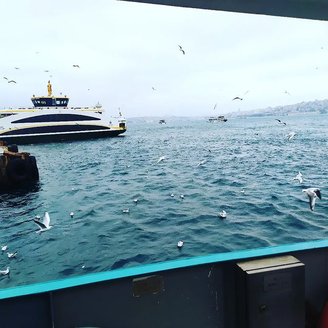
Photo: Tressler.
The
other morning on the ferry, I stubbornly stood outside on the deck,
shivering, pacing as the boat lurched across the choppy waves,
inching slowly to the European pier. The seagulls crested in the
dull, chilly waters, before scattering in a great burst as more boats
passed. Most of the passengers stayed inside the warm recesses of the
cabin. The surprising spring of last week was long gone. It was going
to be a cold week.
Every year around this time I get to thinking about my first winter in Prague, my first year of teaching. The cold winds hitting you when you step outside, the darkness of the early hour, the sight of other forlorn, sleepy and miserable-looking people huddled on the bus or metro. Time and circumstance has accustomed me to such weary conditions – and I’ve always been a morning person, weather or no.
But that winter of 2004-05 was quite different, I was quite different. Having spent the previous decade in California, where the proximity of the coast at least offers the illusion of fair winters, notwithstanding the sight of very real snow in the mountains up on the horizon, and where one needs only to keep dry and out of the offshore winds, I was ill-prepared for the realities of a long winter in a landlocked country in the heart of Europe. There, the ground becomes hard-bitten, and everything is frozen, angry ice cycles hanging jaggedly and occasionally falling and smashing in a car window or some unfortunate person’s head.
I didn’t have the right kind of shoes, or boots, for one thing. January in Prague most winters means a foot of snow on the ground, even in the city center, and the footing is treacherous. Out in the villages it’s much colder and the snow is deeper. Having already exhausted what money I’d brought from America on touristy things and late night pub crawls, as well as on finding a place to live, I had very little for such necessities as a proper coat, sweaters, woolen underwear, etc. I layered what clothes I had in curious and resourceful ways, and shivered my way down the hill to catch the tram to the metro.
“That’s not a very substantial looking jacket,” one of my first flatmates, a cheerful American girl, couldn’t help but remark as we stood together at the stop, while the winds ripped easily through the corduroy blazer I was wearing, bolstered with a zipped up wool training jacket on the inside. Hatless, my ears were beginning to freeze. I nodded, pretending an indifference to the cold. Truth be told, the American girl was not a very substantial flatmate – she bailed the week after I moved in, having failed to tell me when I moved in that she had already booked a flight back to the States, leaving me to scramble to find another flatmate in a strange new country.
In those early days, I had yet to secure work. I was sending CVs around to the various schools, and had gone to a few interviews. Other teachers I knew seemed to land jobs so easily, were smugly employed and too busy to help. As for myself, I was beginning to sweat as I mentally counted down each withdrawal from my ever-dwindling savings back in America. What was I going to do when that money ran out? One thing I learned that first winter is that it’s never a good time to worry about money, but it’s especially not a good time in the middle of a cold, hard winter.
Presumably, if the worst comes along in summer, one could always sleep on a bench in the park (which I actually did once, some time later, when I moved out of one apartment and had to wait a day before moving into the other. Having always considered the romance of sleeping and waking along the shores of the Vltava, I thought, why not? So I crashed on a bench, shaded by trees, with a view of the castle lit up in the night sky; alas, in the middle of the night I was rudely awakened by a sudden summer downpour, and ended up sleeping under a bush at a nearby church in Old Town). But the wintertime does not allow for such options, no matter how romantic or desperate.
All this time, I was bolstered and comforted by the romance of my situation, that there I was in Prague, this glowing romantic old city, and that I was on an adventure, the kind I had always wanted. Plus, straightened circumstances were not new to me. My first winter in Eureka back in the early ‘90s had been similarly desperate, as I struggled to look for work in the middle of one of the North Coast’s famously wet winters, slogging through the rainy Eureka streets and of course nobody was ever hiring. People always say that winter is a bad time to look for work. “Maybe in the spring!” they say, with false cheer. Well, some of us can’t afford to wait that long.
My predicament in Prague, while troubling, was not unfamiliar, just dressed up with the Old World setting. I may have been cold and hungry, but the view was nice. Look at all that culture, all that history! Yes, the scenery was free. I’d walk across the Old Town square, past the tourists, and smugly remind myself that I was not one of them. They all gathered each hour to watch the puppets come out of the astronomical clock, while I’d stroll down to the Vltava and over to the Smetana statue near the bridge or over to Wenceslas Square.
And the beer was cheap. Several pints of Pilsner-Urquell or Gambrinus in a warm pub helped keep the snow and winds outside at bay, with all of the people inside talking in loud voices … places like the Marquis de Sade, or Chateau, or the places near Mustek.
Relief came with a text message one afternoon from Martın, an Irish friend whom I’d known in the teacher training course. He was on his way back to Prague, and did I know anyone who was looking for a roommate?
With Martin back in town, I had someone to help with the rent, and a solid buddy to help brave the long winter. Martin was just 21, but seemed older, with his shaved head and ironic mirth in his merry blue Donegal eyes. He was back in Prague mainly for kicks, having managed to get his old boss to say he’d had to lay Martin off due to economic woes, which made him eligible for the dole. So he was living in the Golden City on the Irish taxpayers, bless him.
With this assurance that each Friday his bank account would be topped up, Martin had no money worries. To his credit, he was generous, both with his money and sympathy.
“It’s not easy,” he’d say, shaking his head, commiserating as I shared my frustrations. Like a true Irishman, he’d order us another pint. “Remember,” he’d say. “Everybody dies, not everybody lives!” Or: “We live on a rock that floats in the sky!” and other Celtic philosophies that seemed apropos. In such moments, I’d casually joke about Martin’s Irish luck, to which he’d wryly reply: “The luck of the Irish doesn’t extend beyond the glorious Irish isle!”
Still, Martin’s presence did seem to have its effect. Things always just seemed to happen when he was around. At the flat, there was an another American, whose presence I had scarcely noticed. He was an introvert who was almost always stoned and stayed in his room most of the time, which is why I hadn’t got to know him, or to even know he was there most of the time. He too was heading back to the States, as a matter of fact.
One evening, he materialized from his room, made a rare appearance on the sofa, looking a bit bleary eyed as always, speaking in his murmured monotone. Martin and I were sitting in the living room, having consumed a modest supper of mashed potatoes and the Czech rolls called rohliky. He overheard us talking and said, “You can have my job if you want it,” in his quiet way.
“Seriously?” I asked, my heart skipping a beat.
“Yeah,” he said. “Just come down to the school. I’ll introduce you to the director.”
He wrote down the address and directions to the school, and retired to his bedroom for the night. The next day or thereabouts, I found the school. It was a typical language school, not far from Namesti Republiky, a well-known square in the center. I got the job on the spot, and was even more elated when later that day, the director texted me with the details. Full time, and we were to be paid weekly – every Friday.
Martin shared my excitement. “Full time, plus pay every Friday,” he remarked. “Beats a kick in the balls, doesn’t it?”
Indeed, it did. We went out for drinks to celebrate, and that evening I met Marja, girl from Finland. She and her friends, a large group of fellow Finns, invited Martin and I to join them. Marja was 23, with pale yellow hair and bright, warm intelligent eyes. We passed a very pleasant evening together. Martin was happy for me, I was happy for myself, as Marja and I left and went for a walk. A fresh snow was falling and the lights of the city seemed full of a passionate beauty. Being Finnish, Marja was well stocked and equipped for the winter nights, and took it as a matter of fact thing. It was very comfortable to walk beside her, and to realize that, at the moment, the cold didn’t feel bad at all, and that I was going to make it through the winter all right.
Many years later, here in Istanbul … the winters here are different each year. Some years we get snow in the city, other years just cold rains; some arrive early and stay long, while others arrive late and leave early. This year has been fairly mild, though it’s chilly when those winds come ripping off the waves of the Bosphorus, especially on the ferryboats in the early morning. Many things have changed – I have changed. Here, I have a wife and son, and we have a small, comfortable flat. I have a university position. These days we worry about inflation for sure – it’s at nearly 40 percent now – but touch wood, we do not worry about the cold, and we do not worry about not having a place to get out of it. I think of our simple domestic life, the routine, and of my work at the school.
Perhaps I do sometimes miss the adventure, that time in all our lives when we were younger, poorer and more open to such possibilities, come what may. Whatever the reason, these winter days always, at some point, take me back to that first winter in Prague, and to many others.
###
James Tressler, a former Lost Coast resident, is a writer and teacher living in Istanbul. His new book of stories and portraits, “Building For The Apocalypse,” is available now at Amazon.
BOOKED
Today: 12 felonies, 16 misdemeanors, 0 infractions
JUDGED
Humboldt County Superior Court Calendar: Friday, Sept. 4
CHP REPORTS
Us101 N / South Fork Ofr (HM office): Traffic Hazard
1144 Curly Jack Rd (YK office): Trfc Collision-1141 Enrt
Central Ave / Hiller Rd (HM office): Trfc Collision-Unkn Inj
ELSEWHERE
RHBB: CDPH Issues Immunization Recommendations for 2026-27 Respiratory Virus Season
RHBB: Redway Transfer Station to Close an Extra Day for Construction
RHBB: Dows Prairie Road to Close for Two Months for Culvert Repair
Celebration of the Life of Late Restaurant Owner Esteban Gonzalez to be Held in Arcata on Sunday
Stephanie McGeary / Saturday, Jan. 15, 2022 @ 2:40 p.m. / Community , Event

Images provided by Gonazalez’s family
###
The family of late restaurateur Esteban Gonzalez – who died from pneumonia in January of 2021 – will be holding a celebration of Gonzalez’s life outside of Esteban’s Mexican Restaurant in Arcata on Sunday afternoon.
For the one year anniversary of Gonzalez’s passing, his nephew Luis Bazon told the Outpost, the family wanted to again share his memory with the community. The party will include two things that Gonzalez loved: mariachi music and food, with free tacos – both carne asada and vegetarian – being served.
Gonzalez was a beloved member of the community, known not only for his delicious food, but also for his generosity and willingness to help those in need. After his passing, the family received an outpouring of support and condolences, something that his family says has continued throughout the last year.

“We miss him a lot — especially with Christmas and the New Year,” Bazon told the Outpost. “It’s hard for the family. But a lot of people have been very supportive.”
The celebration will take place on Sunday, Jan. 16 from 1-5 p.m. on the block in front of the restaurant at 1021 I Street, Arcata. Of course, attendees should wear masks.
###
PREVIOUSLY:
THE ECONEWS REPORT: Year-End Wrap Up (We Ain’t Gonna Miss You, 2021)
LoCO Staff / Saturday, Jan. 15, 2022 @ 10 a.m. / Environment

Join Gang Green for a review of the highlights and lowlights of 2021.
Friends of the Eel River organized a motley crew of enviros, organized labor, religious leaders and others in a coalition to fight against the threat of a coal export facility and train line.
Humboldt Baykeeper continued to keep the community safe by tracking mercury in commonly consumed fish.
EPIC
maintained the decade-long fight over the Richardson Grove Project,
an attempt by Caltrans to realign portions of Highway 101 through
Richardson Grove State Park, which would require cutting into the
root system of nearby ancient redwoods trees.
AUDIO:
THE CANNABIS CONVERSATION: A Falling Tide Sinks All Ships
Jesse Duncan / Saturday, Jan. 15, 2022 @ 7:30 a.m. / Cannabis

Photo by Stormseeker on Unsplash.
John F. Kennedy, in reference to a slogan from the New England Council, famously noted that a rising tide lifts all boats. The concept holds that free markets, specialization and subsequent economic prosperity benefit all. While in current times we know this is not exactly true, as economic booms increasingly favor the wealthy, a strong economy makes life better on average. Greater access to credit, increasing 401(k) balances, strong property values, more job opportunities and wage growth are all associated with an expanding economy.
Conversely, a falling tide sinks all ships.
In modern times, our economic lives are increasingly interconnected. As goods and services flow across the world or localities, our lives connect with those of others. With the rise of “free markets” and globalized trade, these connections are ever more present. A problem or disruption in one area can have a ripple effect across the world. Like it or not, this is the paradigm we live in.
Our nation, county and own communities are no longer siloed as in the past. We depend on and benefit from the success of other individuals and industries. It is for this reason, that problems in the California cannabis space have people concerned across the state. Here at home, more and more people are talking about crashing cannabis prices and the ripple effects that will have on the local economy.
The true economic impact of the cannabis industry in Humboldt is poorly understood in some circles. While it is impossible to pinpoint the exact magnitude of the contribution, we know it’s significant. In fact, during the recent Master of Marijuana Certification I received through Cannabis Training University, it was estimated that cannabis-related activity accounts for fully two-thirds of the economy in some regions of Northern California, including Humboldt. I believe $2 billion a year is a conservative figure.
What those outside the industry fail to realize is that with price compression for pounds, the vast majority of cannabis farm revenues are spent in the local economy, not on lavish lifestyles or remittances abroad. Even if operators are from out of the area, they still pay inflated property tax and land payments. Many rent or buy a townhouse and they purchase food, diesel, propane, ATVs, hardware, lumber and agricultural supplies locally, just as resident farmers do. Farms employ contractors, plumbers, road crews, engineers, consultants, logging outfits, financial service providers and local labor with knowledge of farming in our region.
While opponents of cannabis argue that the industry should be allowed to fail, that would make for a very nasty economic scenario, especially here in Humboldt where the industry makes up such a large portion of GDP. Boutiques, car dealerships, restaurants, golf clubs, night-life establishments, travel agents, real estate professionals, lenders, insurance brokers and others would come to realize how dependent they have been on cannabis industry revenues.
As Warren Buffet famously noted, you only know who’s been swimming naked when the tide goes out. In other words, during good times it’s easier to make money and easy to lose sight of the fact that economic prosperity can be fleeting. Unfortunately for Humboldt County, many of us will learn this if the local cannabis industry fades away. All boats will sink with the falling tide and life here would be very different. The fundraising efforts for the Sequoia Park Improvement Project, the Senior Center in Fortuna and other high-profile funding efforts around the county will grind to a halt. Non-profits more broadly will feel the pinch, executive directors will be out of work, and sadly, those depending on charitable efforts will suffer.
While a Polytechnical Humboldt State and retirees moving north will undoubtedly contribute to the economy moving forward, that will simply not replicate a couple of billion dollars of lost economic output and all of us will pay the price.
Many locals feel well off or financially independent today in the face of record asset values. Remember that investor sentiment is always the very best just before a major downturn. A meaningful stock market rout coupled with recession-led real estate declines are in the cards at some point. Add to that an enormous slowdown in consumption locally as farms go under, times won’t feel so sweet for any of us.
Along these lines, I had two rather unsettling conversations this past week. The first was with a retailer who claimed to be down significantly in November and December. Sales were depressed last year with Covid and this year’s numbers were far worse. This conversation reinforced what I’ve been seeing over the past few weeks. Restaurants are seemingly less crowded, the mall is largely a ghost town and families like ours are starting to tighten their belts in the face of economic uncertainty, opting to hold off on home renovations and other major purchases.
The second conversation was with a local real estate agent who specializes in ranch properties. Unlike recent years where mountain properties were being bid up, multiple listings are now coming online regularly and I’ve seen some truly jaw-dropping reductions in list prices.
Regardless of personal views or political affiliation, it’s time to rally behind the cannabis community. While we have all heard demonizing stories over the years, the majority of legal farmers are good, hardworking people. They love their families and their communities and are the lifeblood of the local economy.
We need to repeal state cultivation taxes outright and suspend local Measure S cultivation taxes for a couple of years. This will buy our farmers and the broader community a bit of time until market access and pricing improve. With these actions, more farms will enter the regulated marketplace and operators can compete more effectively with the illicit market. The idea of tax reform is gaining traction across the state. In fact, a petition on change.org titled Save the Emerald Triangle Legacy Cannabis Farmers already has over 6,200 signatures, clearly indicating that others agree with the economic argument proposed here.
In the face of a collapsing local industry and distressed property sales, organized crime will step in and mop up the remains.…not the best future for ourselves, our children, or our communities. We’ve already seen this play out in other areas. Oregon had a major washout several years ago where it was estimated that 80% of original cannabis permit holders went under. Those farms were purchased, in many cases, by less desirable operators we are now reading about in the press. Heavily armed criminal organizations that care little for the environment, workers, or consumers. I know workers who spent all season in Southern Oregon in 2021 and instead of being paid, had a gun stuffed in their face and were told to kick rocks after months of labor and sacrifice.
This is a very real potential outcome for Humboldt if we see a major wave of farm failure. While many assume that mountain properties will lay fallow, I think that assumption is incredibly naive. Other operators will step in and I sincerely doubt they will have any of our best interests in mind.
###
Jesse Duncan is a lifelong Humboldt County resident, a father of six, a retired financial advisor, and a full-time commercial cannabis grower. He is also the creator of NorCal Financial and Cannabis Consulting, a no-cost platform that helps small farmers improve their cultivation, business, and financial skills. Please check out his blog at, his Instagram at jesse_duncann, and connect with him on Linkedin.
OBITUARY: Jesse James Green, 1983-2022
LoCO Staff / Saturday, Jan. 15, 2022 @ 6:56 a.m. / Obits

Jesse James Green (my Captain America), 40, Went to heaven on New Year’s 2022.
Born in San Diego on March 3, 1981 and moved to Humboldt county at age three. Jesse lived his younger years in Honeydew and spent the majority of his school years in Fortuna, where friends and acquaintances will tell you that he was always the life of the party, a little crazy and always wearing that stunning smile.
Life wasn’t easy for Jesse by any means, and that smile was hiding a very dark and turbulent home life that Jesse would battle to survive his whole existence.
Living in Eureka at age 21, Jesse will tell you “I fell in love with Molly the moment I opened the door and saw her standing there with her girls … It’s the only time a woman ever gave me butterflies in my tum-tum.” And while Jesse and Molly became fast friends and that friendship became family, it would be another decade of hard life-lessons learned, before Jesse would ever get to call Molly his.
He was 32 years old when he finally told her that she would be his forever. And within a few years they were married and if you ever spent time in a room with Molly and Jesse ..you understand the depth of the love they share.
Jesse spent many years working in the hills of Humboldt County providing for his family and countless hours helping Molly work around their home and at events. Perhaps you stopped by their dessert truck and picked up a treat and one of Jesse’s dazzling smiles. They really were his gift to us all.
Jesse is survived by the one and only love of his life, his wife Molly, her children Sariyah, Raine and Naiya, his mother Susan and sister Madeline. And his beloved boy, his bloodhound “Boomer.”
Jesse also leaves behind an extensive list of family that he gained in marriage, whom he cherished with all of his heart. He would especially want to mention Rich, Jodi and Dennis and lifelong friend Fallon Brown..for loving him the way he needed.
Our family thanks you all for your love and support.
To Jesse…Rest easy my love… You were too beautiful for this Earth.
There will be a memorial celebration of life for Jesse on Friday, January 21, 2022 at 6 p.m. at the Eureka First Church of the Nazarene, 2039 E St. Eureka.
###
The obituary above was submitted on behalf of Jesse Green’s loved ones. The Lost Coast Outpost runs obituaries of Humboldt County residents at no charge. See guidelines here.
OBITUARY: Angela Mary Faustino (Angie) Wratchford, 1965-2022
LoCO Staff / Saturday, Jan. 15, 2022 @ 6:56 a.m. / Obits

Angela Mary Faustino (Angie) Wratchford
Born October 10, 1965 in Eureka.
Passed peacefully in her sleep on January 6, 2022 in Eureka.
Angie
was a licensed Cosmetologist, a GIA Graduate and a bookkeeper.
Preceded in death by her father, Manuel Chester (Chet) Faustino.
Survived by: Rosemary Hunter (Mother), Westen Perry Wratchford (son), Reya Rosalina Wratchford (daughter), Tino Faustino (brother), Schelina Estevo (sister), John Perkins (brother), Craig Perkins (brother) and her beloved grandson Jasper Allen Flanagan-Hall.
Anyone who knew Angie knew of her love of rocks! Whether it be for landscaping, jewelry making or just for the joy and excitement of finding a beautiful specimen of her favorite, Brecciated Jasper.
Memories of Angie joyfully digging for agates on the beach accompanied by her brother Tino or any friend or family member she could infect with her enthusiasm will forever be with us.
A Celebration of life will be held on Monday January 17th, 2022 at the Pine Hill Baptist Church 4675 Union St., Eureka. Viewing will be held from 12 p.m. to 1 p.m., followed by a short service. A boxed lunch will be provided. Services will adhere to Covid precautions, distancing and masks required.
Arrangements were handled by Ayres Family Cremation in Eureka. A private interment will be held at St. Mary’s Catholic Church Greenview Cemetery, Arcata. Angie will be among the sixth generation to be buried in the Faustino family plot.
For further information call Rose Hunter at (707) 442-0075.
###
The obituary above was submitted on behalf of Angie Wratchford’s loved ones. The Lost Coast Outpost runs obituaries of Humboldt County residents at no charge. See guidelines here.
(UPDATE) Saturday Morning Tsunami Advisory in Effect for Parts of U.S. West Coast Following South Pacific Eruption
Andrew Goff / Saturday, Jan. 15, 2022 @ 6:22 a.m. / How ‘Bout That Weather
The Hunga Tonga-Hunga Ha’apai volcano eruption
UPDATE, 10:10 a.m.,:
The Humboldt County Sheriff’s Office of Emergency Services (OES) reports that the tsunami advisory is still in effect and asks that residents continue to stay away from beaches and low-lying coastal areas.
Humboldt Alert sent out the following creepy sounding voicemail at about 10 a.m.:
Humboldt Alert Tsunami Advisory
###
UPDATE, 8 a.m.:
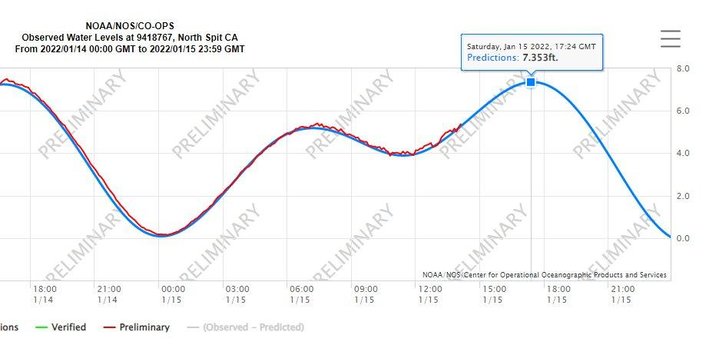
Eureka’s National weather service reports that a tsunami surge is actively occurring along the coast of northern California, and will continue through this afternoon.
Strong currents are expected to affect harbors and bays. The NWS is advising people to stay off docks, boats, and the shore.
Coastal flooding will be also possible at high tide between 9 and 9:30 a.m.
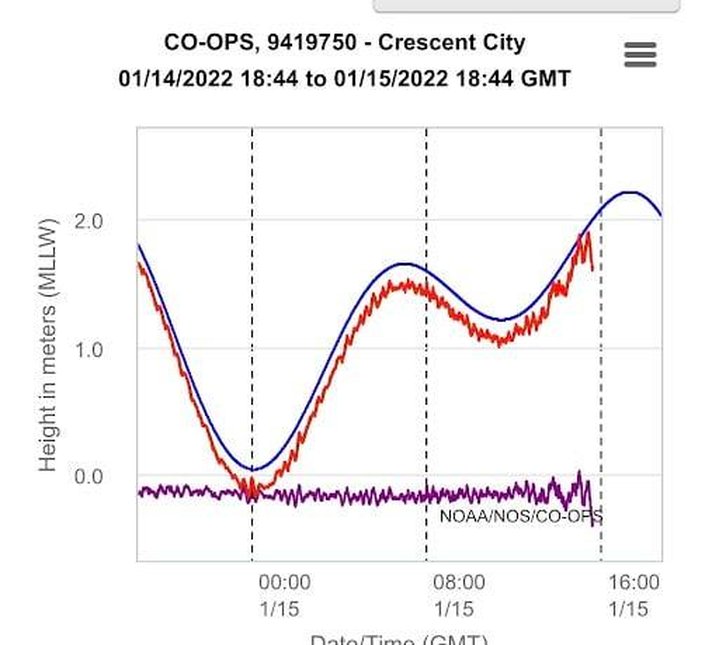
A tsunami surge is occurring along the coast of northern California. | NWS
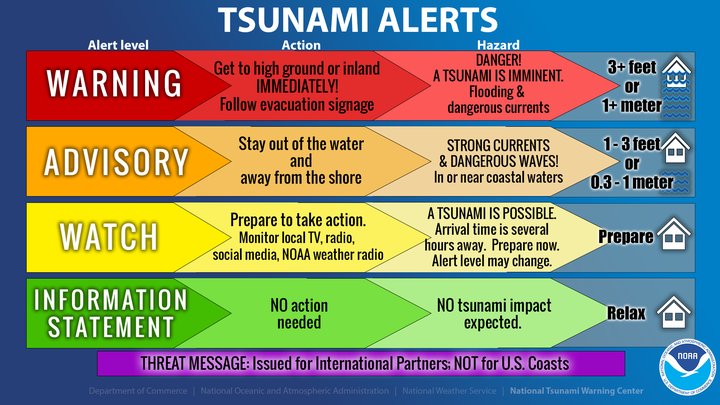
“Tsunami advisories mean that a tsunami capable of producing strong currents or waves dangerous to persons in or very near the water is expected or is already occurring,” the NWS stated. “Areas in the advisory should not expect widespread inundation. Tsunamis are a series of waves dangerous many hours after initial arrival time. The first wave may not be the largest.
###
A tsunami advisory has been issued for parts of the U.S. and Canadian Pacific coasts, including Humboldt, after an undersea volcano erupted near the island nation of Tonga on Saturday.
This is the moment a giant underwater volcano erupted causing a tsunami to hit the South Pacific country of Tongahttps://t.co/HtNhwqYQlX pic.twitter.com/2s6Zvqda8E
— BBC News (World) (@BBCWorld) January 15, 2022
The tsunami generated by the eruption is likely to be minor — probably no more than a couple feet in size. Still, it’s probably a good idea to stay off the beach and out of boats. The waves are expected to arrive around 7:30 a.m. and could last for hours.
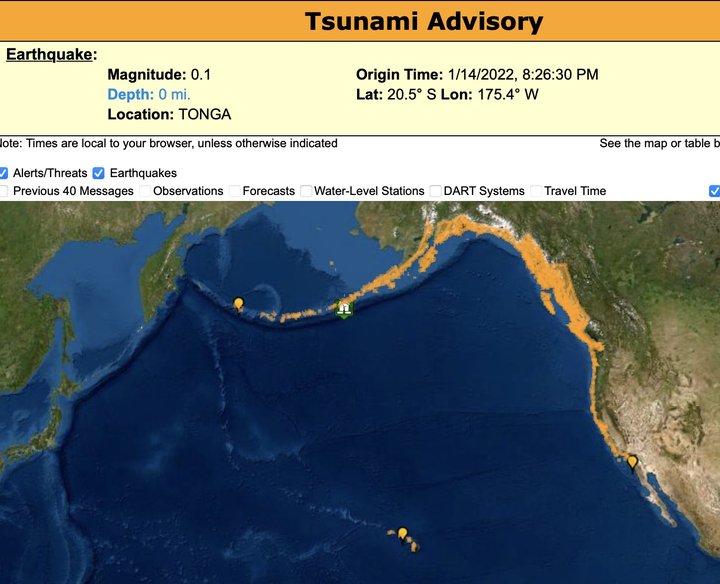
The Redwood Coast Tsunami Work Group posted the following:
TSUNAMI ADVISORY IN PLACE FOR ALL AREAS OF THE PACIFIC
A tsunami advisory is in place for Hawaii and the West Coast of the Pacific following an explosive eruption of Hunga Tonga volcano in the Tonga Islands area of the Pacific. A tsunami advisory means the likely peak water heights will be less than two feet and is very unlikely to cause inundation. It is a good idea to AVOID BEACH AREAS AND PUT FISHING TRIPS ON HOLD. At this time there is no need for evacuation of areas above high tide levels.
Tsunami flooding has been observed in the Tonga Islands and a modest tsunami observed on Wake Island and in Hawaii.
At this point a modest tsunami is expected to begin arriving along the US West Coast this morning. The National Tsunami Warning Center forecasts the following arrival times for the first tsunami surges on California coasts:
* California
Fort Bragg 0735 PST Jan 15
Monterey 0735 PST Jan 15
Port San Luis 0740 PST Jan 15
Santa Barbara 0745 PST Jan 15
La Jolla 0750 PST Jan 15
Los Angeles Harb 0750 PST Jan 15
Newport Beach 0755 PST Jan 15
Oceanside 0755 PST Jan 15
Crescent City 0800 PST Jan 15
San Francisco 0810 PST Jan 15Note these are only the initial times - a tsunami is likely to continue arriving for many hours.
The eruption produced a massive ash cloud 12 miles into the sky and triggered an ash warning to airlines.
We will update as more information becomes available.
Because we know some of you are going to go seeking a show anyway, we will just say stay safe, ocean watchers.