

OBITUARY: Larry Allen Phillips, 1939-2021
LoCO Staff / Tuesday, Jan. 18, 2022 @ 6:56 a.m. / Obits

On December 13, Larry Allen Phillips, 82, took his final breath in his home, surrounded by family. He is finally at rest and will be forever loved, missed and remembered.
Originally from Missouri, Larry served in the Marine Corps before settling in Hydesville in 1968 with his wife, Patricia. He hauled logs and then chips for Louisiana-Pacific, and later hauled lumber for Osburn Trucking, Nolan’s and Chambers. He had many interests and hobbies over the years, including mining for gold, trap shooting and woodworking. Larry loved driving across the country, admiring the many beautiful landscapes along the way. He was a huge rockhound and enjoyed spending time with his friends at the Rock & Arrowhead Club in Oregon.
Larry leaves behind his wife of 53 years, Patricia, and kids Christy Phillips Johnson, Joe (Renee) Phillips and Leah Phillips Berti, grandkids Heaven Phillips, William Roberson, Reba Roberson, Travis (Haley) Johnson, Tristan Johnson, Shanna Johnson, Anthony Phillips, Cailin Berti and Tyler Berti, his sister Eleanor Phillips, nephew Scott Hendricks, and many great-grandchildren. He was predeceased by his parents Alvin and Virginia Phillips, his sister Sandra Hendricks, daughters Linn and Nora Phillips, son Larry Phillips and grandson Izzy.
###
The obituary above was submitted on behalf of Larry Phillips’s loved ones. The Lost Coast Outpost runs obituaries of Humboldt County residents at no charge. See guidelines here.
BOOKED
Today: 12 felonies, 16 misdemeanors, 0 infractions
JUDGED
Humboldt County Superior Court Calendar: Friday, Sept. 4
CHP REPORTS
Us101 N / South Fork Ofr (HM office): Traffic Hazard
1144 Curly Jack Rd (YK office): Trfc Collision-1141 Enrt
Central Ave / Hiller Rd (HM office): Trfc Collision-Unkn Inj
ELSEWHERE
RHBB: CDPH Issues Immunization Recommendations for 2026-27 Respiratory Virus Season
RHBB: Redway Transfer Station to Close an Extra Day for Construction
RHBB: Dows Prairie Road to Close for Two Months for Culvert Repair
Orion Cosce Drops Out of Upcoming UFC Bout After Contracting COVID-19, Brother Louis Accepts Next Fight
John Ross Ferrara / Monday, Jan. 17, 2022 @ 4:20 p.m. / COVID-19 and Humboldt , LoCO Sports!

Orion Cosce (left), Louis Cosce (right). | Photos provided by the Cosce family
Humboldt’s Orion Cosce has backed out of his upcoming fight at UFC 271 after the unvaccinated fighter reportedly contracted COVID-19 last month.
The UFC does not require its athletes to be vaccinated. However, Cosce told the Outpost that the illness left him unable to train for about three weeks while he quarantined and recovered. With less than a month to return to fighting shape before his bout with Mike “Blood Diamond” Mathetha, Cosce decided to call off the fight.
“It sucks,” Cosce said. “I enjoy fighting, so this really sucked since I was going to have an opportunity to be on a big card. Hopefully, when I’m ready, I’ll be able to [get] on another pay-per-view. I love fighting in front of crowds.”
At the peak of his illness, Cosce said he suffered from mucus buildup in his lungs, cold sweats and aches. While the disease cost him a spot on a major UFC card, Cosce said that he currently has no plans to get vaccinated for COVID-19.
“I’m not vaccinated, and honestly, I have no interest in getting it,” the 27-year-old Weitchpec native said. “It always leads to more boosters now, as well as the one fact: Money doesn’t help make a vaccine better, time and research do. If people want to be vaccinated, good for them.”
Cosce said that he is still not 100 percent healthy, but once he recovers, he hopes to return to his full training regimen and possibly get another fight in the spring.
In the meantime, he plans to help his brother Louis train for his upcoming fight against Preston Parsons at UFC Fight Night 208 on April 23.
###
PREVIOUSLY:
- Local MMA Star Refocused Heading Into Weekend Pro Fight
- Cosce Dominates on Good Night for Local MMA Fighters
- Cosce Headlines Big Night of Fights at Bear River Casino
- Cosce Shows Why He’s ‘Next Level’ MMA Talent
- VIDEO — Eight Seconds and Done
- Cosce Brothers to Headline Rumble in the the Redwoods
- Another Quick Finish for Busy Orion Cosce
- Still Undefeated, Cosce Brothers Take Cow Palace by Storm
- Cosce Prepares for First Pro Fight in Humboldt
- Big Local Presence on Packed Bear River Card
- Bear River Fight Night ‘Most Exciting Yet’
- Team Cosce Excited for the Future After Another Big Win
- North Coast MMA Enjoying Impressive Winning Streak
- MMA Bros From Weitchpec Invited to Compete in ‘Dana White’s Contender Series’ for Shot at UFC Contracts
- (VIDEO) UFC President Dana White Hypes Humboldt’s Louis Cosce on Social Media in Anticipation of Tonight’s ‘Contender Series’ Matchups
- (VIDEO) Cosce Brothers Awarded UFC Contracts By Dana White After TKOing Opponents, Remain Undefeated
- Local UFC Fighter Louis Cosce Looks to Defend Perfect Record Tomorrow at UFC 255; Brother Orion Scratched From Contest Due to Injury
- (VIDEO) Local MMA Fighter Louis Cosce Handed First Loss By TKO at UFC 255, Wins $50,000 ‘Fight of the Night’ Bonus
- Homegrown Humboldt Fighter Orion Cosce to Compete in His First Official UFC Bout This Week
- (VIDEO) Orion Cosce Loses First Official UFC Bout By Second-Round Knockout
- Humboldt’s Orion Cosce Announces UFC 271 Bout Against Mike ‘Blood Diamond’ Mathetha, Sets Sights on First UFC Victory
GUEST OPINION: Gateway Plan Does Housing the Right Way
LoCO Staff / Monday, Jan. 17, 2022 @ 10:40 a.m. / Guest Opinion
Humboldt is growing. How it grows is our choice. Arcata’s Gateway Area Plan will help to meet our area’s future housing needs while protecting the open space and agricultural lands that make Humboldt special. Unfortunately, opponents of the project have seized on specious environmental arguments to confuse the matter. To set the record straight, we — executive directors of local environmental organizations — want to be clear: infill development projects, like the Gateway Project, are good for Humboldt County and good for the environment.
Whether it is climate refugees unwilling to spend another summer scorching in Sacramento or displaced by fire, Bay Area residents freed to move by telework, or students and professors ready to make Humboldt State Polytechnic their new home, new folks have already started moving to Humboldt. And if housing prices are any indication of demand, lots of people already want to live here. Humboldt’s housing market is “white hot,” among the hottest in the country. The cost of this hot market is already felt by folks who have seen their rent increase or their dreams of a starter house vanish.
More urban housing won’t jeopardize Humboldt’s rural charm but opposing infill development will. Here’s how: Absent infill development, housing demand will be met either by pricing people out of the area — displacing community members who have long called Humboldt home or furthering our homelessness crisis — or by building new housing in previously undeveloped areas.
Our urban areas are largely built out, with areas like the Gateway a seeming exception. If housing pressure is not released in our urban core, it will be released through creeping development — further into Dow’s Prairie, in the woods by Kneeland, or on the bluffs of Loleta, where the county’s weak regulations will allow for environmentally harmful development for those who can afford it. What’s special about Humboldt is that our towns have borders and are surrounded by green space and not just more asphalt. Fighting infill development is an invitation for sprawl that will bulldoze the agriculture and forest lands that make Humboldt special. Opposing housing in our cities will push it into the unincorporated areas of the County, where auto-dependent sprawl is encouraged by lax regulations.
The Gateway Area Plan is a long-term planning document to reexamine the kind of development the city wants to encourage in a 138-acre area in the western side of the city that once primarily housed industrial uses. The Gateway Area Plan is just that — a plan — and cannot, by itself, develop or force landowners to build housing. Rather, it would allow private mixed-use development, including apartments, condos, or townhouses, by removing barriers to development through rezoning to allow new uses. All told, the Plan allows, but does not guarantee, up to 3,500 new homes, constructed over 20 years or longer.
There are many attributes to this area that make it ideal for redevelopment. Because this area was already largely developed for industrial uses, we don’t need to convert farms, fields or forests to build more housing — we can encourage landowners to redevelop blighted properties instead. The plan would also offer protections for wetlands and other green places within the Gateway Area, maintaining core restoring pockets of nature near new housing. The Plan would also encourage walking and biking for residents by planning for walkable and bikeable communities, enabling fewer car trips for its residents and a more lively, community-feel to the neighborhood. Many of Arcata’s job, transit, and recreational opportunities are an easy walking distance from the Gateway Area (half mile or less), including the Plaza and Humboldt State University.
Let’s contrast the Gateway Project with another large project in the works: the North McKay Ranch. While the Gateway would develop an area that is already largely impacted, including a former millsite and other legacy industrial sites, the North McKay Ranch would build large, expensive houses on cul-de-sacs jutting into the McKay forest in Cutten. These homes built on previously undeveloped land will impact forest, riparian, and aquatic habitat. In contrast, infill housing built in the urban core has a negligible impact on wildlife, and if done the right way can actually reverse some of the negative impacts of previous urban development.
Instead of a development within the urban core of the city, the North McKay Ranch would add housing at the periphery. Building at the periphery means longer commutes and more traffic impacting our roads. Instead of a planned development, with the city and its residents playing a role in project development, North McKay is primarily subject to the whims and tastes of its developer. And so on.
Could the Gateway Plan be improved? Sure. For example, we think the planned sidewalks should be wider, and some optional amenities like electric vehicle charging stations should be made into requirements. But let’s not get twisted: These are improvements to something that is, at its core, already good. To try to kill the project through falling back to these points is shortsighted. To those willing to engage with civic government to advocate for making the project better, you have our unalloyed respect. But to those who will stop at nothing to kill this project, please consider the impacts your actions will have on housing prices and the environment. And to those who support it like we do, please show your support by signing RCCER’s petition encouraging local governments to pursue more projects like the Gateway Plan.
Tom
Wheeler
Executive
Director, EPIC
Caroline
Griffith
Executive
Director, Northcoast Environmental Center
Colin
Fiske
Executive
Director, Coalition for Responsible Transportation Priorities
Matt
Simmons
Member,
Redwood Coalition for Climate and Environmental Responsibility
Jennifer
Kalt
Executive
Director, Humboldt Baykeeper
MONDAYS WITH MICHAELE: (Kinda) Goodbye, Nazy!
LoCO Staff / Monday, Jan. 17, 2022 @ 7:30 a.m. / Mondays With Michaele
Your President of Positivity is conflicted! Sure, she’s excited that her good chum Nazy Javid of North Coast News is furthering her career by accepting a position that will take her out of Humboldt and over to Redding, but it’s sad to lose a local friendly face (and sister in Zumba). The good news — Nazy’s specialty — is that if you’ve grown to need Javid in your life over these past five years, her presence will still be available to you on your television when she begins hosting a two-hour morning news show that will be produced in Redding but will air in Humboldt on KAEF ABC 23 starting on Jan. 31. So there!
Michaele and all of Humboldt wish you well, Nazy! See you literally soon. Ciao Bella!
# # #
Below: Nazy friends and fans say see ya. Photos: Matt Filar


(AUDIO) HUMBOLDT HOLDING UP: How Can Humboldt Better Prepare for Future Earthquakes, Tsunamis and Storms? Alison Sterling Nichols of COAD Discusses Countywide Disaster Response and Preparation
Stephanie McGeary / Sunday, Jan. 16, 2022 @ 8:13 a.m. / Humboldt Holding Up
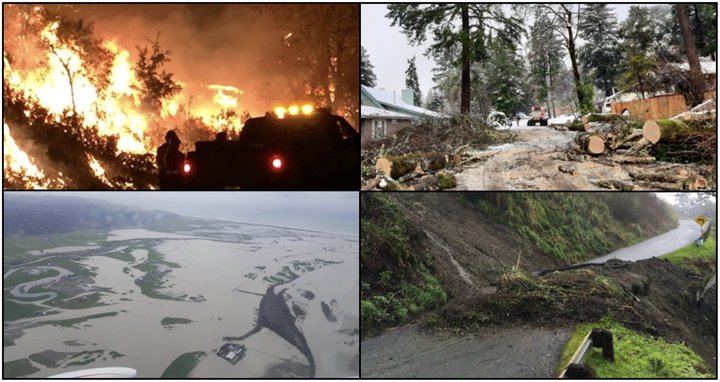
Fires, snow storms and rock slides are just a few of the disasters that impact Humboldt County | File photos
Alison Sterling Nichols explains Humboldt COAD
With Humboldt experiencing a shocking 6.2 earthquake, a damaging winter storm and a tsunami warning, just in the past few weeks (and all of that on top of the ongoing pandemic), now seems like a better time than ever to think about the county’s emergency preparedness. And Humboldt Community Organizations Active in Disaster (COAD) is doing exactly that – working to improve countywide efforts to prepare for natural (and other types) of disasters.
“Our goal is to bring the whole community together to prepare for when – and it’s not if, it’s when – something happens,” Alison Sterling Nichols, director of Humboldt COAD told the Outpost. “If we’re prepared, we can respond in as organized a way as possible.”
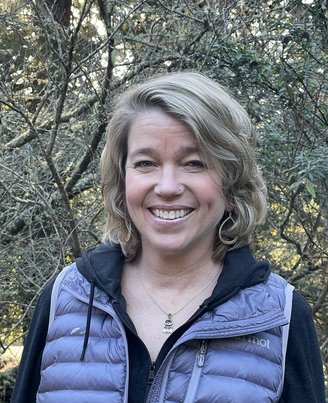
Sterling Nichols | Submitted
Sterling Nicols joined the Outpost for an interview on this week’s episode of Humboldt Holding Up – our podcast spawned from pandemic-era boredom – to discuss the types of disasters Humboldt County is most prone to and how COAD is working to build out our local preparation and response, addressing the areas where our isolated county is most vulnerable.
One of Humboldt COAD’s primary goals, Nichols explained, is to serve as a hub for different agencies to access information and resources. The group is a partnership of local tribes, nonprofits, faith-based organizations, businesses and government agencies. Sterling Nichols, along with nine other members of a launch committee – including representatives from the Humboldt County Sheriff Office of Emergency Services (OES), Blue Lake Rancheria, College of the Redwoods, the Redwood Regional Economic Development Commission (RREDC) and more – began working on forming COAD in February of 2021 and officially launched the group in September.
Of course, the county does already have an emergency coordination center – the OES, which coordinates emergency planning, response, and recovery in collaboration with local, state, and federal partners. But there are many aspects of coordination that the OES doesn’t have the time or resources to handle on its own. Humboldt COAD will work in tandem with OES, Ryan Derby – OES director – explained during COAD’s virtual launch, to help fill in those gaps.
“Having a functional and well-formed COAD will help achieve greater success in our response needs, identifying the unique needs of our community and helping address some of the gaps that we in OES aren’t able to meet or have challenges doing the outreach for during a disaster,” Derby said during the virtual launch in September.
Because the OES has certain protocols it needs to follow when an emergency situation occurs, it can be overwhelming for the office to handle the number of people and organizations reaching out to try and help. This is where Humboldt COAD will step in, helping to connect individuals, businesses and organizations to the proper channels for them to provide whatever assistance they are able. COAD has organized response areas into 12 different “working groups,” which will focus on topics including transportation, donations, childcare, animal welfare, food and tribes. Members of COAD can join a working group to work with other members to identify the needs of each of those response areas.
Sterling Nichols also discussed some of the unique challenges of disaster preparation in Humboldt County, including planning for sea level rise in our coastal communities and planning for a more severe fire season in our inland areas. The increase in summer temperatures and wildfires in surrounding areas also makes Humboldt County an ideal “climate refuge,” with many people fleeing here during disasters and some relocating here permanently. COAD is also looking at how these changes impact our infrastructure, medical system and supplies.
Humboldt’s geographic isolation also impacts our ability to receive supplies (what do we do when or highways are closed?) something the transportation group will work to address, Sterling Nichols explained.
The Humboldt COAD will also being working with regional partners, particularly or neighboring Del Norte and Trinity counties, to coordinate emergency response, because disasters affect all of us. “Fires don’t stop at county lines,” Sterling Nichols said.
If you want to get involved with Humboldt COAD, there are several ways you can help. Organizations can become a COAD member (joining is completely free) and a representative will be able to attend the COAD meetings and join one of the working groups. If you are an individual or business that can provide resources during an emergency – such as generators or cold storage facilities – but do not necessarily want to attend meetings, you can sign up as a resources organization. You can find more information on the “how to get involved” section of Humboldt COAD’s website. Humboldt COAD will be holding its first member meeting in February, so now is a good time to get involved.
To hear more details about how Humboldt COAD is helping our community work together to better prepare for, respond to and recover from disasters, click on the audio player above to listen to Sterling Nichols chat with the Outpost’s Stephanie McGeary and Andrew Goff.
You can also scroll through past interviews below.
PREVIOUS HUMBOLDT HOLDING UP GUESTS:
- #78 Miranda’s Rescue Founder Shannon Miranda
- #77 Eureka Police Department Chief Steve Watson
- #76 Artistic Directors of ‘The Bartow Project’ Michelle Hernandez and Zuzka Sabata
- #75 Foggy Bottoms Boys Thomas and Cody Nicholson Stratton
- #74 North Coast News’ Nazy Javid
- #73 Pumpkin Carver Mike Craghead
- #72 Eureka Police Department Sergeant Leonard LaFrance
- #71 Eureka Artist Duane Flatmo
- #70 Arcata City Councilmember Sarah Schaefer
- #69 Humboldt Hot Air Director Neroli Devaney
- #68 St. Joe’s James Ladika and Austin Allison
- #67 Eureka Artist Richard Evans
- #66 NCRT’s Calder Johnson
- #65 TV Newsman Dave Silverbrand
- #63 Housing Policy Specialist Brian Heaton
- #62 Muralists Blake Reagan and Lucas Thornton
- #61 Arcata City Councilmember Emily Goldstein
- #60 Kayak Guide Eric Stockwell
- #59 Eureka City Councilmember Natalie Arroyo
- #58 Wiyot Cultural Center Manager Marnie Atkins
- #57 Humboldt County Growers’ Alliance’s Natalynne DeLapp
- #56 RREDC Executive Director Gregg Foster
- #55 Dell’Arte’s Michael Fields
- #54 Llama Wrangler Keagan Trischum
- #53 Crabs President David Sharp
- #52 Ferndale Organic Dairy Farmers Kristina Radelfinger and Dorice Miranda
- #51 Former Arcata Mayor Alex Stillman
- #50 Cooperation Humboldt’s David Cobb
- #49 Ink People Center for the Arts’ Libby Maynard
- #48 Humboldt Bay Social Co-Owner Amy Cirincione O’Connor
- #47 Musician Lyndsey Battle
- #46 Mad River Brewing CEO Linda Cooley
- #45 LoCO Editor Hank Sims
- #44 Humboldt Republic’s Jason Brandi
- #43 Table Bluff Farmer Hannah Eisloeffel
- #42 Logger Bar Owner Kate Martin
- #41 Teacher/Rapper Zach “Zigzilla” Lehner
- #40 Madaket Captain “Zippo” Libby Tonning
- #39 Event Planner Alegria Sita
- #38 Food For People’s Anne Holcomb
- #37 AHHA President Nezzie Wade
- #36 Performance Artist Noël August/Tucker Noir
- #35 Eureka Mayor Susan Seaman
- #34 Eagle House Owner Jennifer Metz
- #33 Absynth Quartet Drummer Mike “Tofu” Schwartz
- #32 HACHR Executive Director Lasara Firefox Allen
- #31 Alchemy Distillery Owner Amy Bohner
- #30 Eureka City Councilmember Kati Moulton
- #29 Eureka City Councilmember Scott Bauer
- #28 Ungraceful Ager Barry Evans
- #27 Arcata City Councilmember Sofia Pereira
- #26 HumBrews Music Booker Laurel Weston
- #25 Eureka City Councilmember Kim Bergel
- #24 Film Commission’s Cassandra Hesseltine and Nate Adams
- #23 Marble Maker Topher Reynolds
- #22 Arcata Playhouse Director Jacqueline Dandeneau
- #21 Humboldt Political Junkie Eric Kirk
- #20 Rio Dell Mayor Debra Garnes
- #19 Second District Supervisor Estelle Fennell
- #18 Arcata Food Aficionado Jada Calypso Brotman
- #17 Body Piercer Jackie Silva
- #16 Dick Taylor Chocolate’s Adam Dick
- #15 FUHS Teachers Mark Thom and Inma Thompson
- #14 Eureka City Manager Miles Slattery
- #13 Savage Henry Co-Founder Chris Durant
- #12 Eureka Street Art Festival Organizer Jenna Catsos
- #11 SCRAP Humboldt Founder Tibora Bea
- #10 Gym Owner Tyler Parr
- #9 Six Rivers Brewery Co-Owner Meredith Maier
- #8 Multicultural Skincare Therapist Levia Love
- #7 Annie’s Cambodian Server and Social Worker Joshua Coppock
- #6 Eureka City Councilmember Austin Allison
- #5 HSU Professor Deidre Pike
- #4 Pastor Bethany Cseh
- #3 Singer/Songwriter Chris Parreira
- #2 Eureka City Councilmember Leslie Castellano
- #1 Arcata City Councilmember Paul Pitino
(VIDEO) HUMBOLDT OUTDOORS: The Ruins of Humboldt County’s First Lighthouse
John Ross Ferrara / Sunday, Jan. 16, 2022 @ 8 a.m. / Humboldt Outdoors
Local videographer Ray Olson is back with another edition of his inspirational travel series “Humboldt Outdoors.”
In today’s episode, Olson explores the ruins of Humboldt County’s first lighthouse, located in the Samoa Dunes Recreational Area.
Olson also chats about the lighthouse’s history with Bureau of Land Management Park Ranger and author of the book “Lighthouses of Humboldt County,” Julie Clark.
Watch Olson’s full video to learn more about this piece of Humboldt County history.
###
PREVIOUSLY:
GROWING OLD UNGRACEFULLY: Celebrating the Webb Space Telescope
Barry Evans / Sunday, Jan. 16, 2022 @ 7 a.m. / Growing Old Ungracefully
For the past several years, I’ve been sharing my enthusiasm about Hubble’s successor, the James Webb Space Telescope, every chance I got. My excitement reached fever pitch when Webb was launched early on Christmas Day, and has barely subsided during its subsequent deployment. I’ve been fielding a bunch of questions, too. Here goes:
What’s Webb going to do that other telescopes can’t do?
Webb is a quantum leap in telescope technology. It’s huge for a space-based telescope, 21 feet across, meaning it can see really dim objects. And it’s infrared capable (infrared being the invisible spectrum of light beyond visible red), so it can see farther back in time than any other telescope. In addition, these capabilities will give us much more information about possible life signs on planets beyond our solar system than present instruments can.
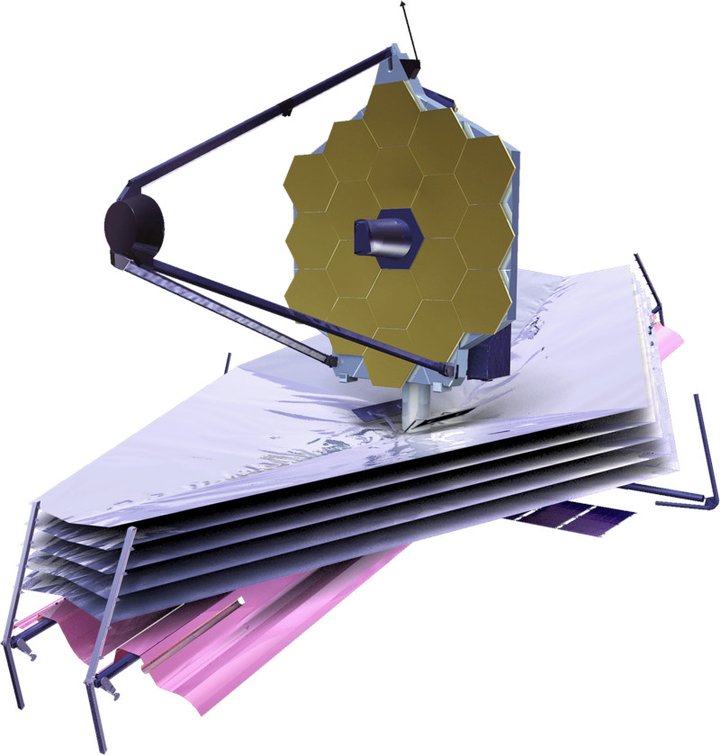
It looks pretty in this image, but it’s actually pitch-black on the side facing away from the sun—one reason why Webb doesn’t have “selfie” cameras. (NASA)
How much farther back in time are we talking about?
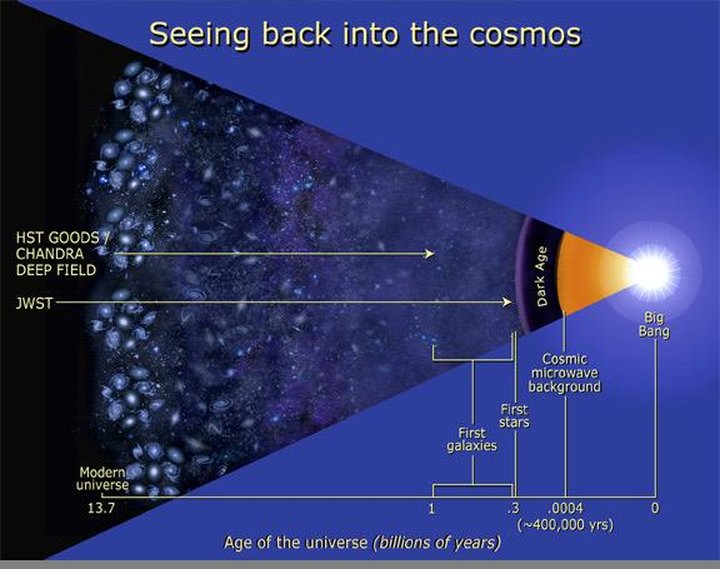
Ancient light has been red-shifted by the expansion of the universe, so the deeper into the infrared spectrum we look, the farther back we can “see.” Whereas Hubble, with very limited infrared ability (because of the limitations of its low Earth orbit) can detect light from when the universe was about a billion years old, Webb should see to about 100,000 years after the Big Bang era. (100,000 years sounds a lot, but that would be like an 80-year-old human seeing herself five hours after her birth.) Meaning that it should give us information about the formation of the first stars and galaxies, and add to our understanding about how this particular universe in which we live actually came about.
(NASA)
Why not put it a low-Earth orbit, like the Hubble telescope?
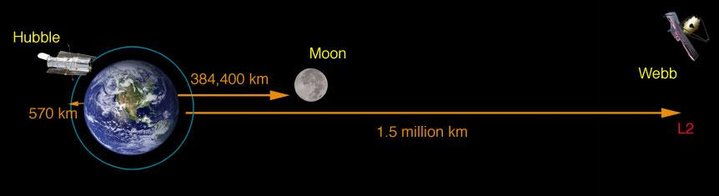
Webb isn’t just larger than Hubble (with a mirror six times its area), but Webb’s infrared capability means it’ll see back farther in time and with much greater sensitivity than Hubble or any existing telescopes. Since infrared radiation from the sun, Earth and moon would swamp Webb’s sensitive detectors, its mirror has to be shielded from all three bodies, which can’t be done in low Earth orbit.
So where’s it going to be?
Webb will orbit the sun in lockstep with the Earth, but a million miles farther from the sun than Earth, where its sunshade will shield its mirror simultaneously from the sun, Earth and moon.
(NASA)
How can it orbit the sun at the same rate as the Earth if it’s farther out—I thought the farther out you were, the longer the orbital period?
That’s the beauty of where it’s going to be, near L2, the second “Lagrange point.” L2 is a sweet spot a million miles beyond Earth where the combined gravitational pull of the sun plus Earth exactly balances the centripetal force there.
So it’s just going to sit at the L2 point?
No. If it did that, sunlight would be blocked by the Earth, putting Webb’s five solar panels in the shade. Instead, it’ll be in a six-month “halo orbit” around L2, where it will receive constant sunlight and still be able to shield its dark side (the mirror side) from sun, Earth and moon radiation.
Why not just put it on Earth then?
Water vapor in our atmosphere absorbs most infrared energy before it reaches us, so an infrared telescope has to be above Earth’s atmosphere, i.e. in space. Another advantage of infrared is that it cuts through the space dust that blocks visible light. Compare these two images from Hubble of the Carina Nebula: the top one is taken in ultraviolet and visible light, the bottom one in infrared.
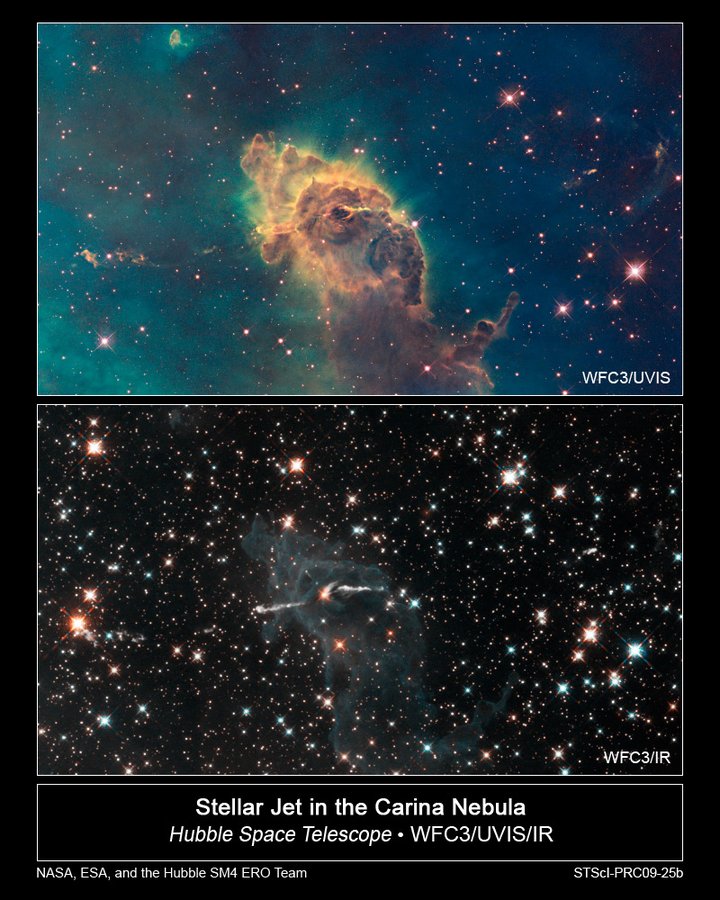
(NASA)
Besides looking at the early universe, what else will Webb be doing?
It’s an ideal instrument for analyzing potentially life-bearing planets around other stars in our galaxy. It’ll also be investigating so-called “dark matter,” the invisible stuff thought to make up over a quarter of our universe (i.e. far more abundant than visible matter). And it will give us unprecedented clear views of planets and moons in our own solar system.
What’s the status of the Webb telescope now?
Because the mirror is so large—about 21 feet across—it had to be folded origami-style to fit into the rocket that launched it, a specially adapted European Space Agency Ariane 5. Also the sunshade, five tennis-court size thin layers of silicon-coated plastic, was rolled up. So in the two weeks after launch, the telescope unwrapped itself like a flower, culminating with the two “wings” (each comprising three mirror segments) unfolding on January 7 and 8. At this point most, but not all, of Webb’s 344 “critical failure points” are now retired. Possibly the most critical operation now is the third MCC (mid-course correction), the “burn” that will put it into its halo orbit around L2. That’s scheduled for 29 days after launch, a week from today.
This GIF shows the two “wings” of the 18-segment telescope mirror unfolding from their launch configuration. Each movement took about five minutes in real time. NASA via GIPHY
And then we’ll see images from Webb?
Nope, that won’t happen until June. It’ll take that long for it to cool down to operating temperature (minus 380 degrees Fahrenheit) and to adjust its 18 hexagonal mirrors so they operate as one. To give some sense of why it’s going to take so long, each mirror has six “actuators” on its back to slightly change its geometry, which will be finely adjusted to about one-thousandth the thickness of a piece of paper.
If there’s a problem, can it be fixed, like they fixed Hubble?
No, it will be a million miles away and wasn’t designed to be repaired. Hubble, orbiting 340 miles overhead, was.
Who’s James Webb?
James E. Webb, 1906-1992, was NASA’s second administrator from 1961 to 1968, overseeing the bulk of the Apollo program. He also established scientific research as a core NASA activity.
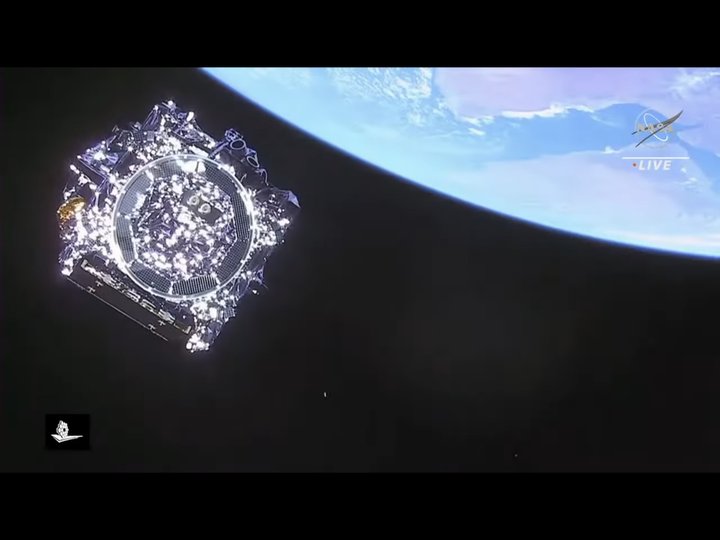
Our last view of Webb on Christmas morning following the spring-assisted separation from the upper stage of its specially-adapted Ariane 5 rocket. Sixteen days later, it had unfolded itself into the final configuration. (NASA)
I’ll do an update on the Webb telescope once it’s finally configured and able to actually do science.


