Labor unions and their Democratic allies in the Legislature want to bring back extra paid sick leave for COVID-19. Gov. Gavin Newsom is also proposing to revive supplemental leave in his budget.
But as with so much else in the pandemic, it’s not a simple proposition.
There’s opposition from powerful business groups. And key details of the leave still must be worked out, including whether companies would get any help to offset their costs.
Under the state law in effect from last March until Newsom and the Legislature let it expire Sept. 30, any employer with more than 25 workers was required to offer as much as 80 hours of leave for quarantines or vaccine side effects. Employees received as much as $511 a day, or a maximum of $5,110 total, with hours accrued retroactive to Jan. 1, 2021.
The supplemental leave – on top of the minimum three days of paid sick leave a year that all employees get – was funded last year by a federal tax credit equal to a worker’s paid time off, including any health care costs. That credit also expired Sept. 30. The state law didn’t contain a provision to reimburse businesses – and it’s not in Newsom’s proposed budget, or in his emergency $1.4 billion request for COVID response.
Ashley Hoffman, a policy advocate at the California Chamber of Commerce, said her group continues to have concerns about the costs to business – and raised the argument that paid sick leave encourages workers not to get vaccinated.
“Businesses are already doing a lot to help fight the pandemic. There’s been a lot of mandates through Cal/OSHA,” she told CalMatters. “There’s this general issue of: How much does the business community have to continue to subsidize those workers who are choosing to continue to be unvaccinated? That seems to cut against the state’s message to get vaccinated.”
The governor’s office said it would not comment on that argument, or whether any aid for businesses is under consideration.
“We’re working with the Legislature to craft a policy that meets the needs of 2022 – which are different than 2021’s, given new and revised information about science and vaccines,” said H.D. Palmer, spokesperson for Newsom’s finance department.
“How much does the business community have to continue to subsidize those workers who are choosing to continue to be unvaccinated?” — Ashley Hoffman, policy advocate at the California Chamber of Commerce
In voicing his support for renewing the leave, Assembly Speaker Anthony Rendon suggested he would be open to aiding some employers. “In the absence of new federal funding to assist small businesses with COVID sick leave requirements, I support augmenting the Governor’s budget to add state funding for this purpose, and we have already had a productive discussion on this,” Rendon said in a statement.
In 2022, the omicron surge – with California now reporting nearly 60,000 coronavirus cases a day – is causing staffing shortages in health care and other essential workplaces.
“We believe it’s important to value those workers and provide them sick leave protections,” Newsom said at his budget rollout Monday.
Democratic leaders of the Legislature agree. “We look forward to working out the details and reaching early agreement on this budget action,” Senate President Pro Tem Toni Atkins told CalMatters.
Assemblymember Wendy Carrillo, a Democrat from Los Angeles, said given the budget surplus, it was the right time to protect workers and help struggling small businesses.
“Workers should not have to make a choice between losing their job or taking care of their health or the health of a loved one. And small businesses, who are the heart of many communities, need support as we move forward with pandemic and economic recovery efforts,” she said in a statement Tuesday. “These efforts are not mutually exclusive, they are complementary. We can do both.”
The governor’s support came after months of lobbying by unions and public health groups, as well as the Work and Family Coalition,who are urging the Legislature to act swiftly, well before final approval of the budget in June.
“Workers currently have no safety net if they are exposed or sick with COVID-19 just as the virus is breaking new records.” — Andrea Zinder, president, United Food and Commercial Workers Western States Council
The United Food and Commercial Workers Western States Council, which represents 180,000 employees in California, is demanding an immediate reinstatement of the two weeks of COVID leave as a “public health imperative.”
“Workers currently have no safety net if they are exposed or sick with COVID-19 just as the virus is breaking new records,” its president, Andrea Zinder, said in a statement.
SEIU California, which has 700,000 members in 17 local unions, is also amping up the pressure on legislators.
“As omicron continues to spread, it is critical that the Administration has signaled its commitment to providing workers supplemental paid sick leave that we need to keep ourselves, our colleagues, our families, our clients and patients, and our communities safe,” union President Bob Schoonover said in a statement.
###
CALmatters.org is a nonprofit, nonpartisan media venture explaining California policies and politics.
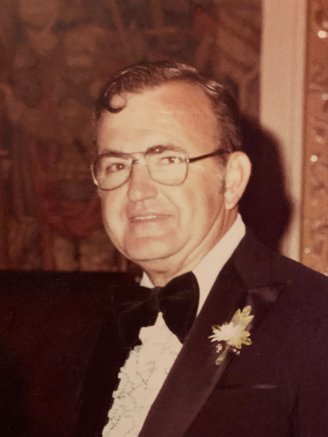
Harold
(Lucky) Benjamin Reed Jr., 87, passed away peacefully in his sleep,
on January 6, 2022. He was born in Boles, Arkansas on Jan.
26, 1934
to Winnie and Harold Benjamin Reed Sr.
Harold
is survived by his wife of 61 years, Diane J. Reed; children
Jacqueline (José), Carolyn Sue (D), Linda (Gary) and Harold Benjamin
III (Suzie); and
sisters;
Alice & Claudia.
He
is also survived by 19 grandkids — Erika, Dustin, Jason, Twins;
Jennifer & Jessica, Nicole, Shasta, Kaitlyn, Garrett, Joey,
Christopher, Esteban, Lacee, Krysteena, Brian, Adrianna, Michayla,
Savannah and
Zach.
Harold
is preceded in death by his parents, Harold & Winnie Reed, and
his daughter Carolyn Sue.
After
Sue’s death, Lucky and Diane took on raising all seven
of her children.
Harold
graduated in 1952 from Visalia High School. He went into the Air
Force immediately after and enjoyed his four
years
spent there.
He
went on to become a resident deputy in Hoopa with the Humboldt County
Sheriff’s Office. Lucky continued his education and received his AA
degree, BA degree and finished with his masters
in public administration.
Harold
met the love of his life while conducting a traffic stop for a broken
taillight in 1960. He didn’t ticket her but instead spent his
mornings at the Oaks Cafe where Diane worked. She would have his
coffee and donuts waiting. They married four months later on December
17, 1960 and went on to have four beautiful children and 61 years of
marriage.
In
1967, Harold became Sergeant with the Humboldt County Sheriff’s
Office and served 32 1/2 years and the family moved to McKinleyville.
Soon after, he joined the Masonic Lodge #106, and became a Master
Mason, a member of the Scottish Rite and Shriners. He was also a
member of the Order of Eastern Star, and the Order of Amaranth.
Lucky also joined the U.S. Coast Guard Reserves where he later
retired as Lt. Commander of the reserve group.
Harold
and Diane joined the Humboldt Gem & Mineral Society for 40 years
becoming lifelong rockhounds. They enjoyed many trips together.
Harold also enjoyed hunting and going shooting at the gun range. He
enjoyed playing the game Farkle with many people, especially Mike,
who taught him how to play.
He
was the best storyteller and an avid reader. He used to say “Never
let the truth keep you from telling a good story”.
We
love you, Papa!
We will see you again someday.
Our
family would like to express our heartfelt thanks, for the wonderful
help and care given by MRCH Home Health Services and Hospice of
Humboldt.
There
will be a viewing on January 16, from 10 a.m.
to
1 p.m.
at Sanders Funeral Home
in Eureka at 1835 E St.
A
celebration of life will be held on January 18, at 1 p.m.
at
the Six Rivers Masonic Lodge #106 in Arcata at 251 Bayside Rd.
###
The obituary above was submitted on behalf of Harold Reed’s loved ones. The Lost Coast Outpost runs obituaries of Humboldt County residents at no charge. See guidelines here.
Press release from the Humboldt County Sheriff’s Office:
Humboldt County Sheriff’s Deputies have arrested a Myers Flat man as a result of an ongoing investigation into the theft of gasoline and tools from a Humboldt County Roads facility in Southern Humboldt.
Maxwell Thomas Elliot, age 26, was identified as the primary suspect in a series of burglaries at the facility. Elliot was caught on surveillance footage on numerous occasions forcing entry into the property. He is believed to have stolen over 900 gallons of gasoline and miscellaneous tools from the facility over the course of a month.
On Jan. 11, 2022, at about 10:37 a.m., sheriff’s deputies conducted a traffic stop on a vehicle occupied by Elliot and he was taken into custody without incident. During a search of the vehicle, deputies located multiple empty gas cans and stolen property from the facility.
Elliot was booked into the Humboldt County Correctional Facility on charges of burglary (PC 459/461(a)), grand theft (PC 487), possession of stolen property (PC 496(a)), violation of probation (PC 1203.2(a)) and driving without a license (VC 12500).
Anyone with information about this case or related criminal activity is encouraged to call the Humboldt County Sheriff’s Office at (707) 445-7251 or the Sheriff’s Office Crime Tip line at (707) 268-2539.
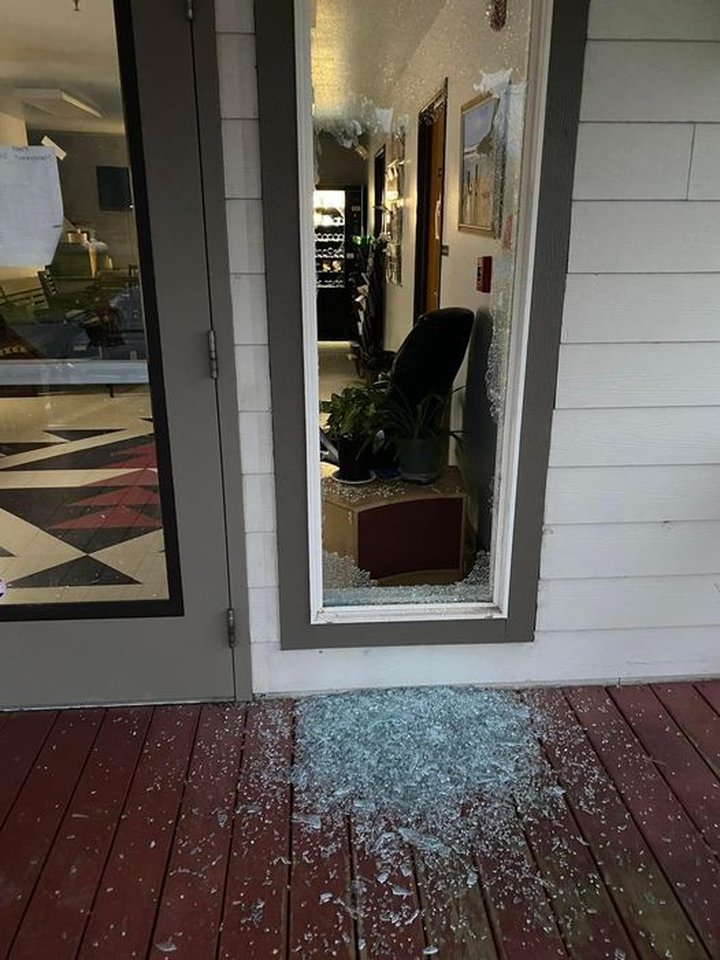
The scene of the burglary. | Photo provided by HVTPD.
A 38-year-old Hoopa man was arrested for felony vandalism and burglary after the suspect allegedly broke into a Hoopa Valley Tribe children’s learning center to steal snacks from a vending machine.
Hoopa Valley Tribal Police Department Lt. Robert Buckman told the Outpost that officers responded to a burglary alarm at the Head Start Program at Highway 96 and Loop Rd shortly after 4 a.m. yesterday.
Officers were unable to find the suspect on scene, but discovered that one of the building’s windows had been smashed. A vending machine inside the learning center also appeared to be vandalized and ransacked of most of its snacks. No other items were reported stolen from the facility.
Upon reviewing security footage, Buckman said that officers identified the burglary suspect as Carlyle Colegrove. That afternoon officers located the suspect and made the arrest.
“We saw the suspect walking with items stolen out of the vending machine,” Buckman said. “He was wearing the same clothing as the video.”
Humboldt County Sheriff’s Office spokesperson Samantha Karges told the Outpost that Colegrove was not booked into the Humboldt County jail. Instead, Hoopa PD officers opted not to transport the man from Hoopa to the Humboldt County Jail in Eureka on the grounds that he would have been immediately released after the booking process.
“Some felonies meet the criteria for an inmate to be released on their own recognizance (OR),” Karges said. “When that is the case, the inmate will be booked and then OR’ed — released with a court date. If a law enforcement officer is bringing an inmate from far away, such as Hoopa, the officer will often call the jail to let them know. Jail staff will advise the officer whether or not the inmate will be held, or just booked and released. This saves the officer from being taken away from their beat area for several hours when the inmate is just going to be released anyway after they are processed.”
Colegrove was cited for the crimes and released from custody in Hoopa.
UPDATE, 3:45 p.m.: Moments ago, the Outpost received a statement from Councilmember Watson responding to today’s release from the City of Arcata. You can read it in full below:
Councilmember Watson
I believe in anti-discrimination and anti-harassment; harassment and discrimination have no place in the workplace. I am sorry the allegation against me was raised, but I have not done anything to warrant such an allegation. I have to believe that I’ll be given due process during this investigation, although nobody has told me what I am accused of having done wrong, who the potential victims are, or the identities of any witness. I fear that these allegations are motivated by my continued efforts to hold City staff accountable with timely answers to my questions on behalf of my constituents. If true, that’s disappointing. It is my sincere hope that this investigation will be concluded shortly so that we can all get back to the business of running the City.
# # #
Original Post: In a release issued Tuesday, the City of Arcata announced that it has hired an outside investigator to look into undisclosed allegations that embattled councilmember and former mayor Brett Watson violated the city’s Anti-Discrimination and Harassment Policy. The release goes on to say that while the investigation is being conducted special procedures have been established to limit Watson’s access to city staff.
“Usually, the accused person will be either placed on administrative leave or, if possible, re-assigned to work duties that remove them from interacting with potential victims and witnesses,” the city’s release states. “Because Councilmember Watson cannot be placed on administrative leave, the City Council adopted special protocols through which he may interact with City staff to continue performing all of his duties as an elected official while having restricted contact with potential victims and witnesses.”
Upon receiving the release, the Outpost reached out to Watson who said he couldn’t comment on the situation at this time. Read the full announcement from the City of Arcata below:
The Arcata City Council has received a report of potential violations of
the City’s Anti-Discrimination and Harassment Policy by Councilmember Brett Watson and has hired an
outside investigator to investigate the alleged violations.
The City is committed to providing an environment for its employees that is free from discrimination or
harassment, and through its Anti-Discrimination and Harassment Policy, has adopted zero tolerance of
such conduct. This Policy rests on the fundamental precept that each employee, City Council member,
Commission member, Committee member, vendor and contractor must treat others with respect, dignity,
and professionalism.
In a typical matter of this type, the City protects potential victims and witnesses from potential
retaliatory conduct by the person accused of discrimination or harassment by eliminating all interactions
between the accused person with the potential victims and witnesses to the greatest extent possible.
Usually, the accused person will be either placed on administrative leave or, if possible, re-assigned to
work duties that remove them from interacting with potential victims and witnesses. Because
Councilmember Watson cannot be placed on administrative leave, the City Council adopted special
protocols through which he may interact with City staff to continue performing all of his duties as an
elected official while having restricted contact with potential victims and witnesses.
At this time, no finding has been made as to whether a violation of the City’s policy has occurred, and
we are committed to due process throughout this investigation. Although this involves an elected
official, it is a confidential personnel matter and the privacy of the potential victims and witnesses must
be protected. The City is unable to disclose the nature of the potential violations, the names of the
potential victims and witnesses, or the special protocol applicable to Councilmember Watson.
Investigations, by design, are conducted independently and develop based on each witness’s
information; therefore, they do not have a specified timeline. The City will seek to balance the public’s
interest in knowing the conduct of its elected officials against the privacy rights of the affected
employees. Once the investigation is completed, the City will determine what, if any, additional
information can be disclosed to the public.
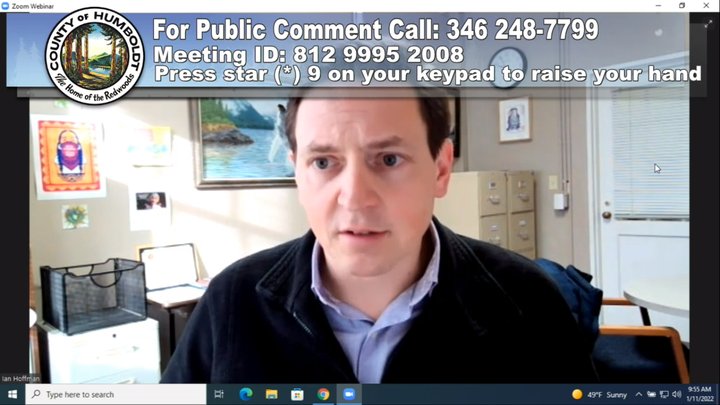
At the end of his presentation to the Board of Supervisors this morning, Dr. Ian Hoffman — who has served as Humboldt County’s health officer since December 2020 — said that he will be resigning from that position to return to clinical work.
Hoffman said that he had notified the board of his decision in a letter to board members last night.
“It’s a very difficult decision that I’ve had to come to over course of the last month or so,” Hoffman said. “This job has offered tremendous satisfaction, working with each and every one of you and all the folks here at public health and DHHS. It’s an unbelievable group of people.”
Hoffman did not mention when his resignation will become effective, nor exactly what other job he has accepted, but said that he hoped to continue to offer his services to the department.
“I took another position that will allow me to be with my family more, and I’m hopeful that I can continue to do work in public health as well as going back to a clinical role,” he said.
Gov. Gavin Newsom holds a nearly three-hour press conference to unveil his budget proposal for 2022-23 in Sacramento on Jan. 10, 2022. Photo by Miguel Gutierrez Jr., CalMatters.
###
It’s been a tumultuous few years in California, with record wildfire seasons, a worsening drought and a wave of smash-and-grab retail theft amid a coronavirus pandemic that just won’t seem to end.
But when it comes to the state’s finances, things are looking up. Way up. Tens of billions of dollars up.
As he enters a reelection campaign, Newsom is taking advantage of California’s unprecedented fiscal health to shift into crisis management mode. At a nearly three-hour press conference, he emphasized an agenda tackling what he characterized as the “greatest existential threats” facing the state — COVID-19, climate change and homelessness among them — while also sprinkling in some priorities, including an expansion of health care for undocumented immigrants, long sought by liberal supporters.
“This proposal will be considered in light of the challenges today, and we will back in light of the challenges that present themselves tomorrow,” Newsom said.
The governor’s framework is just the opening bid in negotiations with the Legislature, which must pass a budget by June 15 in order to get paid — though the details are not worked out until well into the summer some years. A final deal could look significantly different from Newsom’s proposal once lawmakers have their say, but the early response Monday from the Democratic majority was largely positive. Senate leader Toni Atkins said the governor’s plan aligned with her goal of helping the neediest Califorians.
Revenue projections, which administration officials said were calculated in December before the omicron variant sent COVID-19 cases surging again, could also change dramatically by May, when Newsom must submit a revised budget proposal.
Some pieces of his plan, including money to combat retail theft, were unveiled early as Newsom tried to stay on top of mounting political pressure. Following a series of brazen group robberies at malls and stores in numerous California cities last fall, Newsom announced in December that he would propose more than $300 million in funding to put police outside businesses and to investigate and prosecute organized crime rings.
Here are other key areas from the governor’s budget proposal:
Newsom wants the Legislature to act quickly to approve about half of the money as emergency assistance in the current fiscal year, to help overloaded hospitals hire additional staff and to expand testing and vaccination capacity. He also said he is in discussion with legislative leaders to bring back a supplemental paid sick leave program for workers who test positive for COVID-19, after allowing a previous version to expire last fall.
Potentially fulfilling a nearly decade-long push by activists, Newsom said he is ready to expand access to Medi-Cal, the state’s health insurance program for the poor, to all California residents regardless of immigration status. The state has already opened Medi-Cal to undocumented residents until they turn 26 and once they turn 50, but making the program universally available would be a first nationwide. The expansion would take effect in 2024 and cover about 700,000 more people, at a cost of about $2.2 billion per year.
“I have not had the opportunity to read that plan and no one has presented it to me,” he said.
Will taxpayers get some money back?
State tax collection has been so robust that California may, for the first time in decades, exceed a constitutionally-mandated spending cap, above which any remaining money is split between schools and taxpayer rebates.
Newsom said his administration currently estimates the budget will be about $2.6 billion higher than that limit in the coming fiscal year, though the number is expected to change when revised revenue projections are released in May. As a result, the governor held off on any proposals similar to the stimulus checks that the state sent to low- and middle-income households last year, though he said: “There likely will be substantial contributions back to the taxpayers.”
More immediate relief may come this summer at the pump. With gas prices climbing, Newsom proposed to forgo the annual increase to a fuel excise tax that would take effect in July, potentially lowering costs for drivers. That money — an estimated $523 million to fund state and local road repairs and other transportation projects — could be replaced from another source.
Natural disasters fuel more spending on climate change
The governor’s spending plan includes an additional $1.2 billion over two years for programs to increase forest thinning, build fuel breaks, and help homeowners and fire-prone communities retrofit structures and improve defensible space. CalFire — whose budget has grown by more than $1.5 billion over the past three years — would receive another $248 million for new planes, crews and equipment.
The state has already committed to spending $5.2 billion over three years to deal with the ongoing drought. But after some major reservoirs dropped to their lowest levels ever last fall, Newsom is seeking to add $750 million more for water conservation programs, financial assistance for water agencies and grants for farmers to modify their operations.
Looking for climate solutions in a state where the transportation sector is now the largest source of greenhouse gas emissions, the governor has gone all-in on zero-emission vehicles. Newsom signed an executive order in 2020 to phase out the sale of new gas-powered cars and passenger trucks by 2035. His budget proposal on Monday included nearly $6.1 billion to accelerate the transition to cleaner vehicles, with a focus on school buses and commercial trucks.
“We believe this is the future,” he said. “If we don’t invest in the future, we’re not going to do very well there.”
Clearing ‘unacceptable’ homeless encampments
Though Newsom has made homelessness a central focus of his first three years in office, the entrenched and growing crisis — more visible than ever after the pandemic pushed many Californians into housing instability — is a frequent source of criticism for his opponents. Those who tried unsuccessfully last year to recall the governor pointed to it as one of his greatest failures, while Republican lawmakers have urged him to call a special session to directly confront the issue.
Newsom’s budget proposal on Monday included another $2 billion to build on what has been one of his most notable recent policy successes: distributing grants to local governments to quickly convert vacant hotels, motels and other buildings into thousands of units of supportive housing for homeless people. His plan would spend $1.5 billion over the next two years to provide tiny homes and other interim housing as a bridge while more of the permanent units are completed, plus $500 million to help local officials clear encampments.
“What’s happening on the streets and sidewalks in our state is unacceptable,” said Newsom, who hinted that he would also pursue legislation this year to strengthen a law that allows officials to force people into treatment if they cannot care for themselves. While these conservatorships are a controversial approach among advocates, Newsom said they can be necessary in cases of severe mental health or substance abuse problems.
“We’re not satisfied with the status quo, in terms of the tools in our tool kit to help people that are struggling and are putting themselves in harm’s way,” he said. “I don’t want to see any more people die on the streets and call that compassion.”
Averting a funding crisis for local schools
Newsom’s proposed spending includes a record $119 billion for K-12 schools — nearly the size of the entire state budget a decade ago — but some local districts are still sounding the alarm about a looming fiscal cliff stemming from plummeting enrollment and attendance.
The governor aims to avert this potential calamity by giving districts more flexibility in how they report their average daily attendance, which the state uses to determine their funding. Under Newsom’s proposal, schools could use whatever is highest among the previous year’s attendance, the current year’s or an average of the three most recent years.
“It’s a better option than the sudden drop,” said Harold Sullins, an associate superintendent at San Bernardino City Unified. “The only challenge I see with averaging it is you’re still going to see a very significant decline in funding.”
The budget would also provide $54 million to help districts recruit teachers, including by waiving examination and credentialing fees. Amid the spread of the omicron variant, staffing shortages across the state threaten school closures in some districts.
More in-state students and equity at colleges
With a new goal of ensuring 70% of working-age adults receive some type of college credential by 2030 — up from 52% in 2019, according to one measure — Newsom’s budget proposal envisions a five-year plan to dramatically expand in-state enrollment at the University of California and California State University.
The state would provide money this year to add room for 9,400 more California students at CSU and 7,100 at UC, where some would take slots normally reserved for out-of-state applicants.
Then over the next four years, each system would get a 5% annual funding increase if they meet key targets, including expanding in-state enrollment by another 1%, increasing graduation rates and closing student equity gaps across racial and economic groups. By the 2026-27 academic year, that would mean another 7,000 California students at UC and 14,000 at CSU.
Assemblymember Phil Ting, a San Francisco Democrat who leads the Assembly budget committee, said he welcomes tying increased funding to even greater California enrollment, which has been a major priority for Democrats in the Legislature.
###
CalMatters reporters Julie Cart, Joe Hong, Ana B. Ibarra, Sameea Kamal, and Mikhail Zinshetyn contributed to this story. CALmatters.org is a nonprofit, nonpartisan media venture explaining California policies and politics.