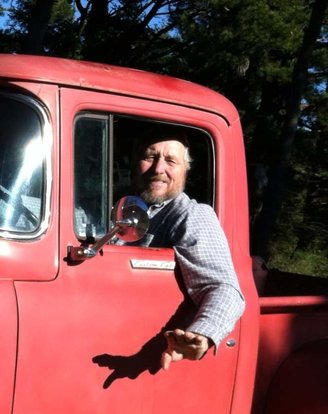
A scholar of history with a long career in higher education administration, Jeff Crane has been named the new dean of Humboldt State University’s College of Arts, Humanities & Social Sciences (CAHSS). Crane will start on January 6, 2022.
Crane is excited about joining HSU at a pivotal time. Previously the dean of the College of Arts and Sciences at St. Martin’s University in Washington state, Crane was attracted to HSU’s polytechnic vision and the University’s ambitious plans to establish itself as a premier center for climate resilience and social justice.
“The arts, humanities, and social sciences play a critical role in addressing issues related to climate justice and diversity, equity, and inclusion,” says Crane. “The college [CAHSS] fosters interdisciplinary learning, helping students learn to be adaptive and innovative in a changing world.”
In his nearly six-year tenure as Saint Martin’s Dean of Arts and Sciences, Crane helped increase the number of majors in the college by 50%. His experience in curriculum development, community engagement, and fundraising are well-aligned with HSU’s plans for growth and expansion––the University will add 12 new academic programs by Fall 2023 with the polytechnic designation.
“Dr. Crane’s years of experience as a dean, coupled with his personal and professional focus on climate justice and the environment, align him well to serve HSU,” explains Jenn Capps, provost and vice president of Academic Affairs.
Since earning his doctorate of History in 2004, Crane has developed scholarly expertise in the American environmental movement and sustainable agriculture as a form of social justice. In 2017, he helped establish Our Common Home Farms in Lacey, Washington, which donated 9,253 pounds of organic produce to the community last year. He also helped design a one-acre food farm in the City of Lacy, and is increasingly focused on scholarship and engagement on permaculture and community farming as a climate justice strategy.
“A true permaculture system is multi-faceted,” explains Crane. “It stores carbon, filters water, preserves habitat for wildlife and insects, and grows food for the community.” On his arrival to Humboldt, Crane will be actively looking for community partners to expand opportunities for engagement and education around climate justice, equity, and agriculture on the North Coast.
As a college dean, Crane also has a successful track record in securing major funding for programming related to experiential learning and internships, two key elements of the polytechnic ethos of hands-on learning. In 2020, Crane helped secure a $2.25 million grant to help match historically underrepresented students with paid internships, which can be critical to job placement after graduation.
“We want students to know that they can pursue valuable career opportunities without being excluded,” says Crane.
“We are thrilled to welcome Dr. Crane to HSU. He has a proven record of fundraising and experience successfully implementing strategies that positively impact retention and graduation rates, particularly for traditionally underrepresented students,” says Capps. She also expressed her gratitude to CAHSS Interim Dean Rosamel Benavides-Garb for his leadership over the past two years. “Dr. Benavides-Garb took on this leadership role during an especially challenging time at HSU, and I am so grateful for his valuable contributions.”
Once he arrives in Humboldt, Crane says he is excited about joining the University’s effort to build a model of 21st-century education that engages deeply with the community and tough issues facing society, while supporting students’ academic and personal success.
“I’ve been impressed by how warmly welcoming the community has been,” says Crane, who is looking forward to exploring the region’s beaches, forests, and communities by foot.
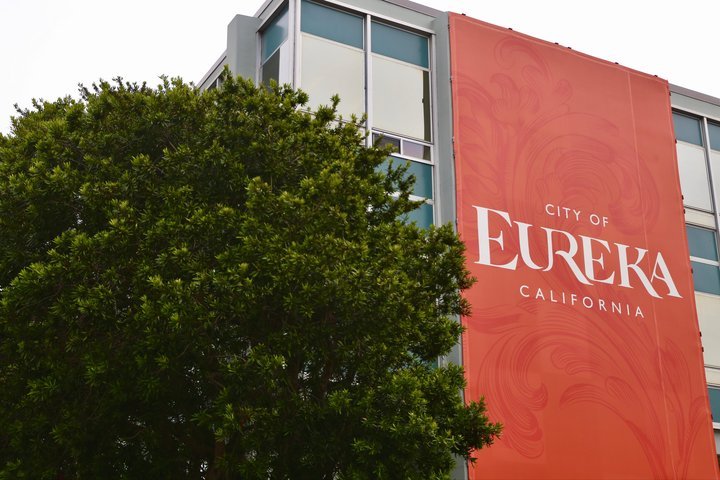
We keep publishing this photo of Eureka City Hall because City Council meetings were once held here, rather in the ether, and may someday be held here again. Photo: Andrew Goff.
###
It’s Eureka City
Council night! Let’s take a look at what’s on the agenda.
###
The City of Eureka
has been looking to goose development on the town’s waterfront
for a long, long time, and with limited success. But as we
told you a couple of months ago, the city has a new plan to get
there. Local officials are looking to draft something called “the
Waterfront Specific Plan,” a big part of which would streamline
permitting under the California Environmental Quality Act.
But first the city
has to hire some consultants to do the public outreach, research the
relevant laws and regulations and to draft the plan itself. A request
for proposals was published earlier in the year, and two big
out-of-town firms responded: Dudek
and MIG. City staff reviewed
and scored the proposals, and have picked Dudek as the clear
favorite.
MIG’s proposal included a major assumption that the
Coastal Commission will certify the City’s draft Land Use Plan
(LUP) by early 2022; that assumption is unrealistic. When asked at
the interview how removing the assumption would affect their
proposal, it was clear MIG’s approach was dependent on that
assumption. Furthermore, they did not present a clear approach for
adhering to their proposed budget and schedule.
Overall, Dudek’s proposal and interview outshined MIG’s
as Dudek’s project manager was engaged and enthusiastic, and had a
solid plan for approaching the limited budget and invoicing strategy
to comply with HCD grant funding expenditure deadlines. Dudek also
had a unique outreach strategy with subconsultant Crowdbrite, and
appeared to have more experience with the regulatory framework of the
Coastal Zone and with projects of similar size and scope.
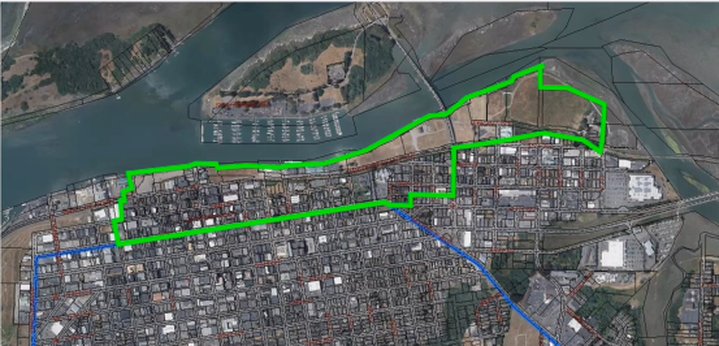
The Waterfront Specific Plan will cover this area of town. Map from the city’s Request for Proposals.
Gotta say, too, that
the Dudek’s pitch for their proposed project manager, who now works
out of the company’s Portland offices, was pretty strong. From the
company’s proposal:
Dudek’s Project Manager, Rose Newberry, has spent
countless hours on the waterfront as a former member of the Humboldt
State’s Women’s Crew Team, and knows firsthand the recreational,
retail, and industrial opportunities this area has to offer. She is
likely the only prospective project manager who has attended Arts
Alive, almost been run over by an oyster barge, and has a very
specific Los Bagels order.
Dudek’s pitch
includes examples of similar planning work that it has undertaken for
local agencies around the state, including in the San Diego area, in
San Mateo, on Catalina Island and elsewhere. You can browse their
proposal at this link, and also take a look at the Berkeley-based
MIG’s proposal at this link, if you like.
So the council will
likely pick a contractor at this meeting, and it’ll likely be
Dudek. But are you still confused about what the city’s Waterfront
Specific Plan is meant to accomplish? Do
check out Stephanie McGeary’s write-up back in September. It’ll
fill you in.
Back in 2014, the
city passed an ordinance governing the collection and repatriation
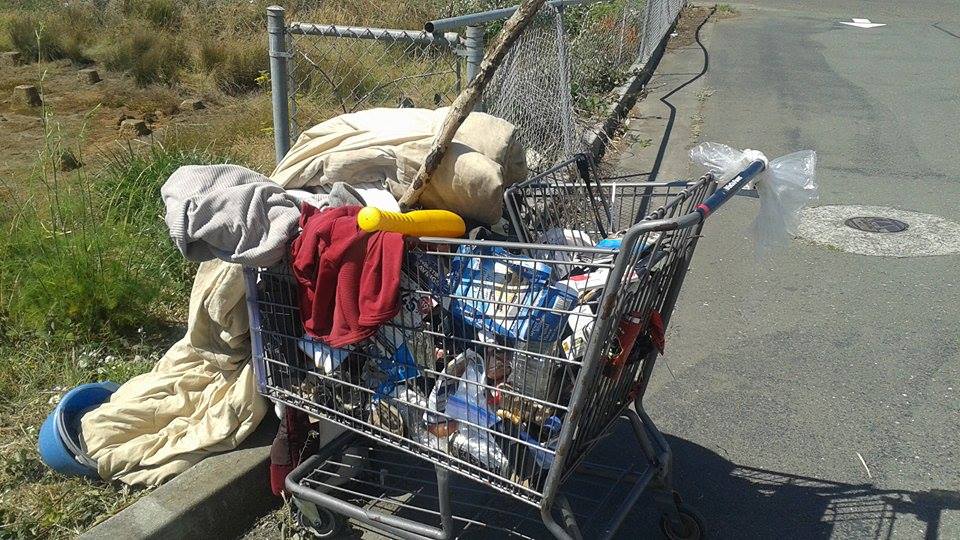
of shopping carts stolen from local grocery stores. It defined
loose carts as a public nuisance and threat to public safety,
required large retailers to develop a city-approved “Abandoned Cart
Prevention Plan,” and set up a system whereby city government would
collect, catalog and store retrieved carts at the city’s
Corporation Yard for up to 30 days, during which the store could come
collect them.
Well, that last part
isn’t working, apparently. Staff
are asking the City Council to repeal the shopping cart ordinance and
replace it with something that is less of a burden on staff
operations.
In
particular, and particularly since the pandemic, staff write, the
stores aren’t bothering to come collect the carts that various city
agencies continue to gather up on a regular basis, and they’re
starting to pile up. From the staff report:
Before COVID, the retrieval of carts by businesses was
sporadic at best. For many, it is logistically infeasible to collect
carts since they have neither the personnel or equipment to collect
and transport them. For others, it is not economically feasible. Even
for the retailers that did collect carts, the retrieval was spotty
and many of their carts ended up being disposed of.
During COVID, the rate of retrieval by retailers dropped
precipitously. Whether this was due to staffing constraints, or the
need to clean every cart prior to putting it back into service, the
number of carts accumulating at the Corp Yard increased.
Many of the carts retrieved by the City are contaminated
with blood, feces, and other hazardous materials. Since COVID,
retailers have likely decided that retrieving and decontaminating
carts simply isn’t worth the time.
So, what’s the
solution? Well, the new ordinance the staff is asking for would allow
city workers to take carts directly to the dump, and to get tough
with retailers: The city would issue citations and fine retailers
whose carts they come across, enough to cover the cost of cart
disposal and also a “punitive” amount that would hypothetically
make stores get more serious about keeping track of their carts.
Read the staff report and the text of the proposed new ordinance at these links.
###
City budgets,
generally, rode out the pandemic very well, and Eureka is no
exception. Revenues did not plunge, cash was not depleted …
everything’s going along just fine.
Now, the city –
like a lot of other cities around the state, and private companies
too – would like to give its employees a bonus for weathering
the pandemic. In Eureka, every city worker was deemed to be an
essential worker, and so they kept working throughout.
An item on tonight’s
consent calendar – meaning it’s likely to pass without much
discussion – budgets a little more than half a million dollars of
general fund money to provide its employees with what it calls an
“essential worker recognition stipend” for services rendered
since the beginning of the pandemic:
When the pandemic started in March 2020, all City of
Eureka staff were deemed essential in order to continue to provide
vital public services and programs the City administers. In order to
recognize our employees and their sacrifices during the pandemic,
staff is recommending a one-time General Fund appropriation not to
exceed $550,000. For full time current employees who worked during
this timeframe, the amount per employee would not exceed $2,500.
Current employees that worked between 1000 hours and full time during
this timeframe, would receive a prorated portion of $2,500 based on
the time worked. This would not include overtime or time where leave
banks were used.
The council looks to
finish up a few matters that have been on the last few agendas. Two
of them are election-related: implementing
redistricting and
ranked-choiced voting.
The final city ward maps have been pretty uncontroversial and
ready-to-go for a while now, but state law requires four public
hearings before adoption. This is the fourth. At
the same time, all the wrinkles seem to have been ironed out of the
city’s implementation of Measure C, the ranked-choice voting
referendum approved overwhelmingly at the polls earlier this year.
They’ve altered the proposed system so that any ties, after all the
rounds are counted, go to the candidate who receives the highest
number of first-choice votes – a one-in-a-million scenario, but one
that’s nice to prepare for, I suppose.
The city’s
proposed ban of coal storage
on city-owned property is probably likewise ready to go. The proposed
ban, which was prompted by weird Midwestern interests making some
kind of play to take over the old North Coast Railroad tracks to the
Bay Area, originally allowed
for an exception for “small” amounts of coal. The council thought
it would be good to define, in statute, exactly what was meant by
“small,” and the revised version now does so: 25 pounds or less.
They’re going to
build a new restroom and snack shack at Highland Park, and
Valley Pacific – the company that bought out Renner Petroleum a few
years ago – wants to give the City $60,000, or $10,000 a year over
the next six years, to help fund the new facility. In return, the
company would get naming rights to the snack shack, and they’d like
to name it “Valley Pacific Snack Shack.” The council could agree
to the deal tonight.
How will the city
spend the
$6.3 million it has received from the American Rescue Plan
Act? Well, here’s the staff’s proposed budget, which they’ll
talk about tonight. It includes a lot of money for infrastructure
upkeep – sewage system upgrades, road maintenance, fire station
improvements, better broadband – but there are a couple of new
items on there, too: A community compost facility and a new
police substation in the old Coast Guard building at the foot of
Commercial Street. (Full list here.)
As it does every
year at about this time, the City Council will pick a new mayor
pro-tem from among its ranks. It’s mostly a ceremonial honor –
the only thing the MPT does, really, is run the meetings when the
actual mayor is absent.
Lastly but not last (actually first on the
agenda, chronologically speaking) the City Council will recognize and
thank outgoing Police
Chief Steve Watson for
his 16-odd years of service to to the city. Read the full proclamation here.
###
Full
City Council agenda – including lots more stuff that we never even
got around to! – can be found at this link. City Council meetings
are still happening over Zoom. Here’s the link
if you want to join. It starts at 6 p.m.
James
Holland, 77, of Loleta,
passed away November 28, 2021 after a lengthy
battle with health issues.
James
was born in Arkansas in 1944 and graduated from Willits High
School in 1963. He then spent
a short time in the armed forces.
James started working at Humboldt
Creamery in Loleta in 1964 and retired many years later. James was
the hardest-working man we will ever know. You could always count on
a good laugh and he
always kept you guessing. James enjoyed fishing, hunting and could
build anything he put his mind to. Many have enjoyed and will
remember his spicy jerky and homemade apple cider.
James
is preceded in death by his parents J.O. and
Jewel Holland, brothers Bill and Jimmy and sister Glenda. He is
survived by his loving wife of 47 years, Kathy Holland, three children
James, Pamela and Jody, and six grandchildren — Allen,
Katie, Justin, Austin, Josiah and Xxander — along with many nieces
and nephews.
Spreading
of ashes will take place with immediate family
only.
###
The obituary above was submitted on behalf of James Holland’s loved ones. The Lost Coast Outpost runs obituaries of Humboldt County residents at no charge. See guidelines here.
Robert Wayne Bronnenberg, 69, of Fortuna, went home to be with his Heavenly Father on August 7, 2021.
He was born at Glendale Hospital in Glendale, Calif. to James and Margaret Bronnenberg on October 19, 1951. He grew up in Sun Valley and Sylmar, Calif. He graduated Sylmar High School in 1969 and shortly after he served in the Army 509th infantry paratroopers. He was a true patriot.
He had worked with his Dad and brother doing brick, stone, and concrete work, later becoming a General Contractor for many years until his retirement.
He had a passion for fishing, riding motorcycles, classic cars, dune buggies, walks along the ocean, and also made sure everyone had a great time no matter what we were doing.
He loved life and lived it to the fullest with the greatest of smiles.
He always put his family first and was the best husband, father, grandfather, and friend. He was a proud Christian, and believed that we will all be rejoicing in Heaven.
He was always ready and willing to help anyone in need and considered everyone his friend.
This world will never be the same without him.
He was preceded in death by his parents, James and Margaret, brothers Allen and Carl, and sisters, Barbara and Cindy.
He leaves behind his wife Sandy of 43 years, his sons James (Kelly) of Meridian Idaho, Michael (Janell) of Fortuna, daughter, Jennifer (Bobby) of Bieber, Calif., 10 grandchildren, two great-grandchildren, and numerous nieces and nephews, his sister Juanita of Fortuna, his sister-in-law Linda of Canyonville, Ore., and his dogs Buzz (who was always at his side) and Mytzy his lap dog.
###
The obituary above was submitted on behalf of Bob Bronnenberg’s loved ones. The Lost Coast Outpost runs obituaries of Humboldt County residents at no charge. See guidelines here.
Christopher Ryan Sanderson passed away in Eureka on November 29, 2021, after a small stay in the hospital due to renal organ failure.
Chris was born on December 17, 1983. He grew up in Rio Dell with his family and many friends that eventually became family. He played baseball his whole life and played it very well. He loved camping, hunting and fishing with his brothers and family. He graduated from Fortuna High School in 2002.
Chris lost his way early in life but never once lost his kind soul.
He is preceded in death by his granny, Alsie Isabel Sanderson, and father, Ronald Dwyane Sanderson. He leaves behind his five-year old daughter, Clover, his papa, Darrow Sanderson of Rio Dell, his mother Penny Hall of Fortuna, his sister Gina/Bret Lamb of Washington, his brother Ronald/Meggan Sanderson of Carlotta, Ben/Tiana Sanderson of Rio Dell, Elijah Sanderson of Fortuna, Brandon/Sasha Sanderson of Carlotta, and many of nephews, nieces, aunts, uncles and cousins, and so many loving and caring friends that helped him with something to eat, a ride or a couple of bucks though his journey.
A memorial service will be held on his birthday on December 17 at the Rio Dell Fireman’s Hall at 2 p.m. All are welcome. Please come and share your favorite stories of Chris.
###
The obituary above was submitted on behalf of Chris Sanderson’s loved ones. The Lost Coast Outpost runs obituaries of Humboldt County residents at no charge. See guidelines here.
Eureka’s average winter temperatures. | Graphic provided by Climate Central.
While much of the earth is heating up, data shows that Eureka winters are getting progressively colder.
Of the 250 U.S. cities studied by Climate Central — an independent organization of climate change researchers — only five have experienced colder winters on average since 1970: Eureka; Biloxi, Mississippi; Denver; Idaho Falls, Idaho and Marquette, Wisconsin.
While uncommon, Deputy Director of Climate Resilience for the California Department of Water Resources John Andrew told the Outpost that Eureka’s climate trend isn’t unexpected.
“We never expected climate change to be the same everywhere, and our experience is confirming that perspective,” Andrew said. “While winters are generally getting warmer, it is not unusual that specific locations are exceptions to that rule. And even places that are warming on average can still experience cold events in winter, sometimes severe ones.”
During the last 51 years, Eureka’s average winter temperature has dropped by 1.3 degrees Fahrenheit. While experts were unable to give a more definitive answer without proper research, local NOAA meteorologist Matthew Kidwell told the Outpost that this trend is likely related to Eureka’s proximity to the Pacific Ocean.
“Temperatures in Eureka are driven by different factors than inland areas due to the proximity of the ocean,” Kidwell said. “One example of that is the past few weeks. The coastal clouds have kept the temperatures at the coast below normal while the inland areas have been above normal. Beyond that, it is difficult to say without doing more research.”
Castellano has served as executive and artistic director of Synapsis Collective and is a Eureka City Councilmember | Photo: Leon Villagomez
Ink People Center for the Arts press release:
Ink People Center for the Arts is excited to announce Leslie Castellano as its new Executive Director. Castellano will succeed Libby Maynard, who is retiring this December after 42 years leading the organization.
Leslie Castellano’s name will be familiar to members of the arts community through her work as an educator, artist, business owner, organizer, volunteer, and Eureka city councilmember. Trained as a dancer, she serves as executive and artistic director of the performance group Synapsis Collective. As an arts administrator, she worked with collaborators to organize the inaugural outdoor land art exhibition Outer Roominations during the pandemic. She works as an instructor at Trajectory, a career development program in Eureka for visual, performing, and literary artists and fine artisans with disabilities. As a current member of the Eureka City Council, representing Ward 1, she advocates for the arts and culture as instruments of community wellbeing and civic engagement.
Castellano’s involvement with and support of Ink People projects is longstanding. Prior to accepting a position as Executive Director she served on the Ink People Board of Directors for fifteen years, holding positions as secretary, vice president and, most recently, past president. As director of Synapsis Collective and a longtime employee of Trajectory, she has worked directly with two DreamMaker projects and is familiar with the scope and complexity of the DreamMaker program, with its over 100 separate independently directed, community-initiated ventures.
In her role as executive director of Synapsis, Castellano taught dance and acrobatics to children, youth, and adults, in addition to writing grants that made it possible to fund free community-based art programs, an accessible dance program, a street festival, and a community mapping project. She was responsible for maintaining these projects’ budgets, supervising employees and volunteers, and designing strategies for successful program delivery.
Castellano spent three months performing as a dancer with Carpetbag Brigade Physical Theater in Monterrey, Mexico at the United Nations World Cultural Forum. She also danced in Karl Frost’s “Great Bear Wilderness Project,” which had performers spending several months filming in the Canadian wilderness in order to bring awareness to places that would be impacted by oil spills and pipelines. Through feralferal, her ongoing collaboration with Kevin Dockery, she creates original dance pieces that explore concepts including otherness, society, and the wild.
She ran successfully for Eureka City Council in 2018 with a slogan of “Together We Thrive,” listing a robust and ecologically sound economy, housing, youth programs, and neighborhood safety as key priorities. “Caring for people and building community has been at the core of all my work,” she said at the time. “I am familiar with the energy, commitment, and organization it takes to develop projects that include feedback and input from a wide range of perspectives. In addition, I have years of experience creating diverse partnerships between organizations and citizens.”
“After a competitive recruitment process, we are very excited about the selection of Leslie Castellano and are assured by her creative vision to develop the organization’s legacy,” board member Robert Sataua said. “Leslie has already contributed so much to The Ink People as a culture worker, community organizer and artist. We are impressed with her ability to merge her talents across a myriad of projects, and grateful she has decided to focus her energy with us. In this era of immense change, we are confident she can build on our strengths to reimagine how we champion culture and art.”
Maynard, who co-founded the Ink People in Eureka in 1979, expressed confidence that Castellano is the right person to take the organization into the future. “Following a well thought out and fair process, the Ink People Board of Directors has chosen Leslie Castellano to succeed me as Executive Director, and I couldn’t be happier,” she said. “Leslie has a great vision for the future, is thoughtful and kind, and has new ideas to lead the Ink People into the next 40+ years.”
“Now that I am Executive Director,” Castellano said, “my hope and my excitement is to bring my passion for people and for cultures to the Ink People, building on its strong foundations to take the organization forward into the future.”
As Executive Director, Castellano will work closely with staff and board members to ensure that the organization can continue adapting to serve people of this region by weaving the arts into the fabric of our community. A California native, she grew up in the Florida panhandle and has lived in Humboldt County since 1998. She studied anthropology and sociology at New College in Florida and studied dance and postmodern performance through intensive work with Sara Shelton Mann, Karl Frost, Keith Hennessy, Diego Piñon, and others. She lives with her husband Derek Shaw, two cats, and a dog above the stage of the new Synapsis performance space in Eureka.
About Ink People Center for the Arts
The Ink People Center for the Arts seeks to encourage people to exercise their humanity, build civic discourse, and engage their creative potential. Since our founding in Eureka in 1979, our vision has been weaving the arts into the fabric of our community. Through our DreamMaker Program, we provide administrative and logistic support to more than 100 independently directed, community-initiated arts and culture projects. Our other core projects include facilitating public art, promoting community artists and culture bearers, creating arts programming for youth and the differently abled, and partnering with municipal, state and tribal authorities to promote the arts.