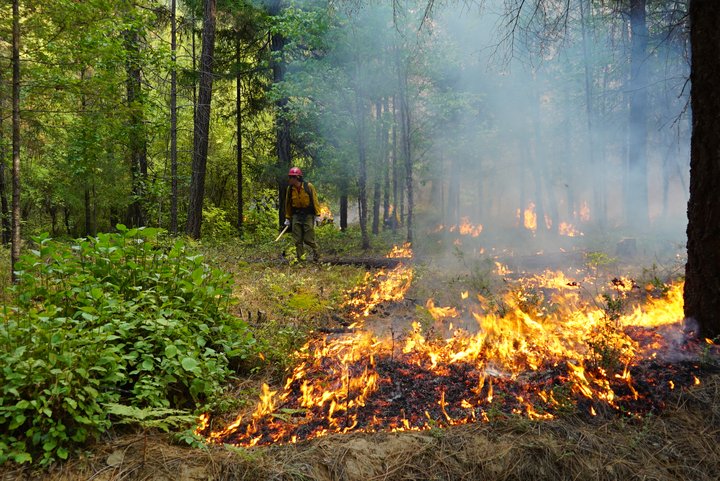

Newsom Declares Drought Emergency Across California
Rachel Becker / Wednesday, Oct. 20, 2021 @ 7:05 a.m. / Sacramento
Gov. Gavin Newsom today declared a drought emergency for the entire state of California, as conservation efforts continue to fall far short of state targets.
Newsom also authorized California’s water regulators to ban wasteful water use, such as spraying down public sidewalks, and directed his Office of Emergency Services to fund drinking water as needed. But he stopped short of issuing any statewide conservation mandates.
“As the western U.S. faces a potential third year of drought, it’s critical that Californians across the state redouble our efforts to save water in every way possible,” Newsom said in a statement.
Today’s announcement extends drought emergencies, already declared in 50 counties, to the eight remaining counties where conditions had thus far not been deemed severe enough: Los Angeles, Orange, Riverside, San Bernardino, San Diego, Imperial, San Francisco and Ventura.
The emergency declarations are aimed at easing responses to the deepening drought — such as emergency bottled water purchases or construction to bolster water supplies — by reducing environmental and other regulations. Under the proclamation, local water suppliers must begin preparing for the possibility of a dry year ahead.
“We think we’ll be able to manage through this year,” said David Pettijohn, director of water resources at the Los Angeles Department of Water and Power. “Next year is the issue. And we don’t know what the water year is going to look like. Nobody can predict the weather.”
But California’s water watchers say that without a conservation mandate, California is losing time, and water. “We know mandates are more effective than voluntary calls,” said Heather Cooley, director of research at the Pacific Institute, a global water think tank. “It takes time to ramp up, and because of the delay in asking Californians to save water this spring, we are further behind than we should be.”
Conservation improving, but still short of goals
New data released today by the State Water Resources Control Board reveals that Californians cut their water use at home by 5% in August compared to August 2020, an improvement over the reductions of less than 2% in July but still far short of the voluntary 15% cuts Newsom urged in July.
The hard-hit North Coast, where the state’s first drought emergencies were declared in April, continued to show the biggest drops in household water use — with an 18.3% decrease compared to August of last year. Conservation numbers tapered off moving south, with the San Francisco Bay Area conserving nearly 10% more water than last August.
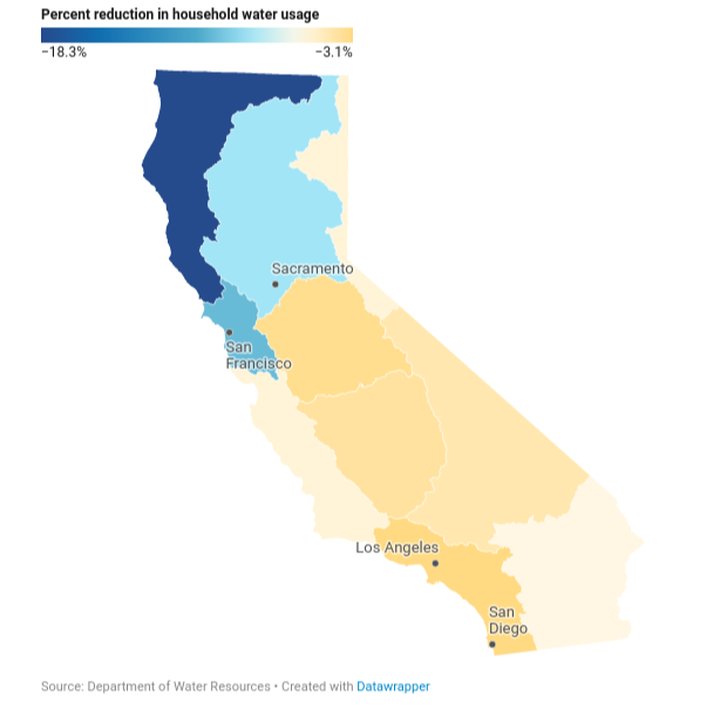
Residents of the North Coast reduced their household water usage by roughly 18%, while residents of the highly populated South Coast cut their water usage by about 3% during the same period.
The South Coast region — which includes Los Angeles, Orange, San Diego and Ventura counties — showed an improvement over July, when water use was roughly even with last year. In August, residents used about 3.1% less water than they did in August 2020.
“Those numbers are a little bit misleading, frankly,” said Pettijohn, pointing to existing conservation measures including mandatory outdoor watering restrictions. “Looking at one month, in one year, compared to the same exact month in the current year, it’s really not a true measure of what the efforts in the city have been.”
The current reductions in water use are on top of conservation that has continued since the last drought. In 2020, Californians were already using about 16% less water in their homes and businesses statewide compared to 2013, according to water board data analyst Marielle Pinheiro.
This August was both the hottest and driest on record, according to the governor’s office. And the increased conservation, even during an exceptionally dry month, “is especially significant,” Pinheiro said at the water board meeting today.
“Once you’ve learned to save water, why turn the water on when you’re brushing your teeth?” said former water board chairperson Felicia Marcus, who led the response during the last drought under former Gov. Jerry Brown. “The glass half full view of that is that messaging is starting to take hold.”
Still, Newsha Ajami, director of Urban Water Policy at Stanford University, was surprised that Newsom didn’t declare a statewide water conservation mandate today.
“We really need to reduce per capita water use significantly in some areas of the state,” she said. “If this drought lingers longer and we end up having a few more dry years we are going to have a lot more communities experiencing water scarcity and water access issues.”
An unknown water year ahead
Newsom’s announcement today comes at a pivotal moment for California’s water.
The state just closed out its second-driest water year on record, with nearly 88% of California now in the clutches of extreme drought, or worse. By the end of September, statewide reservoir storage had hit 60% of average, with Lake Oroville setting a new record low.
“It’s amazing that in the second dry year, we’re in as scary a position if not scarier than what we faced in that last drought. It’s almost beyond comprehension,” Marcus said. “It’s a stunning challenge.”
State officials have warned water providers south of the Delta relying on state water allocations that they might be cut off completely next year.
“We’re starting with record low (reservoir) storage,” Karla Nemeth, director of the state Department of Water Resources, said last month. “We would have to have north of 140% of (average) precipitation to generate average runoff into the reservoirs that would begin filling that hole.”
“It’s amazing that in the second dry year, we’re in as scary a position if not scarier than what we faced in that last drought. It’s almost beyond comprehension.”
— Felicia Marcus, former chairperson, State Water Resources Control Board
Now, California is on the cusp of its rainy season, from November to April, when it receives almost all of its yearly precipitation.
A series of storms are expected to reach Northern California this week, with another that could unleash some rain over Southern California as soon as this weekend, according to Chad Hecht, a meteorology staff researcher with the Center for Western Weather and Water Extremes at the Scripps Institution of Oceanography.
Precipitation forecasts range from eight inches in the Sierras over the next seven days, to less than half an inch in Southern California, said Julie Kalansky, the center’s deputy director.
While the rain is unlikely to substantially refill empty reservoirs, it could help prepare thirsty soils for more rains to come.
For these storms, “the runoff from them may not be very high, but they’ll help moisten the soils. So if we get more, hopefully you get more runoff that you know can go into reservoirs or streams and ecosystems,” Kalansky said.
But the water year ahead remains murky: Cooler than average temperatures in the tropical Pacific herald the arrival of La Niña conditions, which the National Weather Service’s Climate Prediction Center reports have an 87% chance of continuing between December and February.
La Niña can stir up storm tracks, changing how much precipitation falls on California. But the results vary — especially for Northern California — making it difficult to predict what this means for rain and snowfall in the northern two-thirds of the state, Kalansky said.
For Southern California, on the other hand, La Niña tends to foretell a drier year. “It doesn’t mean that we’re necessarily going to have a really dry year, but we typically don’t get really wet years when it’s a La Niña,” she said.
Overall, Kalansky said, “it’s still yet to be decided on whether or not this year is going to be wet or dry and what this means for drought. We just don’t have those answers yet.”
###
CALmatters.org is a nonprofit, nonpartisan media venture explaining California policies and politics.
BOOKED
Today: 3 felonies, 8 misdemeanors, 0 infractions
JUDGED
Humboldt County Superior Court Calendar: Today
CHP REPORTS
No current incidents
ELSEWHERE
RHBB: Barn Destroyed as Fire Spreads to Second Structure Near Ferndale
100% Humboldt, with Scott Hammond: #129. You Don’t Have to Be Wealthy to Give Back | Sara Dronkers
RHBB: Trinity County Marks 25th Anniversary of September 11 with First Responder Commemoration Ceremony
RHBB: CDPH Issues Immunization Recommendations for 2026-27 Respiratory Virus Season
OBITUARY: James Francis Gerace, 1939-2021
LoCO Staff / Wednesday, Oct. 20, 2021 @ 6:56 a.m. / Obits
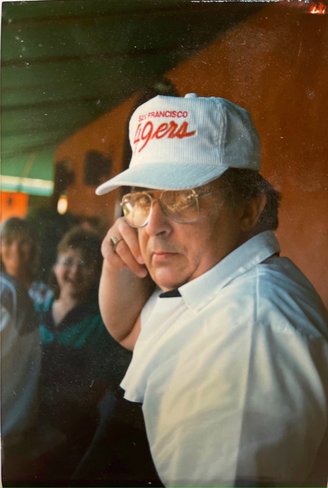
With extreme sadness, our family and friends have lost James Francis Gerace, “Jim.” He passed away on September 6, 2021 at the age of 82. Jim was survived by his wife, or “angel” as he called her, of 60 years, Donna Gerace, and five children — Jimmy Gerace, Vickie Grammer, Ginger Rotbergs, Joseph (Dominic) Gerace and Jennifer Lewerenz. Jim had ten grandchildren, six great-grandchildren with one on the way, and his faithful canine companion, Queenie.
Jim graduated Patterson Park High School in Baltimore, Maryland in 1957, then joined the Army, where it took him to Korea for a brief stint. He became very prolific in Morse Code, holding a very high security clearance.
After Korea, Jim was stationed at Two Rock Ranch in Petaluma. That proved to be the move that changed his life and the start of his legacy. While on a week-end leave, he and a friend went to a local bowling alley in Petaluma, where Jim said to his friend, “See that girl over there? “That is the type of girl I’m going to marry”. Two weeks later, Jim and his friend were at a local drive-up, where he saw “that girl” again. This time, Jim got her phone number. They were married three weeks later.
Jim and Donna moved their family to Eureka in the early ‘80s, where Jim transferred locations with PG&E as a meter-reader. Jim tirelessly worked his way through the ranks for 35 years and was a budget coordinator when he retired. Jim had a strong work ethic, which is why retirement did not last long. He found a small local security company, Initial Security in Eureka, where he could observe and report from his vehicle. With Jim’s analytical mind, and professional office demeanor, he found himself running the local branch after only five months into his employment. Jim did this for 12 more years, then retired again.
Although Jim was a very dedicated and hard worker, he was more dedicated to his family. Jim had a very huge personality and was very heart-warming and welcoming to anyone that walked into his home. Jim was a foster parent to many, and a second Dad to many others. He also had a propensity to pick-up stray cats along the way and bring them home. He also loved the America he grew up in, NASCAR, Racquetball, eagles, and sweets! Jim’s other passions included chess, where his analytical skills shined. He also taught chess to local youth. Jim loved agate hunting, wherein one particular day it led to him getting pulled out into the ocean by a rogue wave. At the last minute he grabbed onto a rock and held on.
Jim — a husband, a dad, a grandpa, a friend — was our rock, that solid personality that you could turn to for real talk and great advice, which truly came from the heart. We will forever hold on to that. We will always remember his favorite saying, “Loyalty above all else, except Honor.”
Services will be held on November 21, 2021, 3 p.m., at First Methodist Church banquet hall in Eureka, where Jim will be honored and remembered in the company of family and friends. Feel free to bring your favorite dessert dish or Jim’s (rhubarb pie).
###
The obituary above was submitted on behalf of Jim Gerace’s loved ones. The Lost Coast Outpost runs obituaries of Humboldt County residents at no charge. See guidelines here.
OBITUARY: Sylvia Marie Tidwell, 1933-2021
LoCO Staff / Wednesday, Oct. 20, 2021 @ 6:56 a.m. / Obits
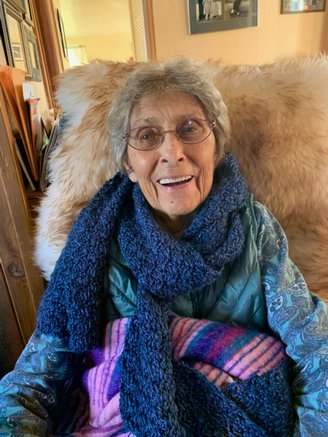
Sylvia Marie Tidwell (Johnson)
passed away peacefully in her Fieldbrook home of 64 years on October
12, 2021 in the care of her loving family. Sylvia was born on January
5, 1933.
Sylvia spent most of her youth in Klamath and Korbel, where she met her husband Orien Tidwell. She said she was drawn to Orien’s good looks and liked that he had a big nose like she did. They were married 36 years until Orien’s death in 1990. Sylvia said she became a wonderful cook out of the necessity to feed five hungry kids. She loved to go wild blackberry and huckleberry picking taking all five kids down to Timmon’s field with our dogs, a few goats and occasionally a cat or two. Sylvia enjoyed playing cards especially pinochle where she could be a bit of a card shark. She was hardworking, an avid gardener, loved all animals, and simply one of the kindest people you would ever want to meet. Sylvia’s good disposition was nurtured by her ability to find joy in the small pleasures of this life.
Sylvia leaves behind her five children, daughter Belinda Trageser and husband Bill, daughter Teresa Cox and husband David, son Denis Tidwell, son David Tidwell and wife JoLynn, daughter Kathy Nored and husband Bryan. Sylvia was preceded in death by her beloved grandson Travis Scott Tidwell in 2019. Her grandchildren are Lydia Samuelson and husband Aaron, Luke Trageser and wife Natasha, Kathryn Cerny and husband Will, Lars Cox and girlfriend Jessica, Kyler Tidwell and girlfriend Ashley, Kayla Tidwell, Daniel Nored and wife Kyla. Sylvia’s great grandchildren are Myles and Bryce Samuelson, Chance Tidwell-Rowland, Nikolai and Vaughn Trageser and Tenzlee Nored.
The Tidwell family would like to thank Mariann Hassler, Sylvia’s special friend, for the loving care she gave to all of us during our mothers struggle with dementia.
Family and friends are invited to attend the graveside service at 11 a.m. at Greenwood Cemetery on October 23, 2021. Sylvia will be laid to rest in a casket built by family and friends. An outdoor memorial service will be held at Sylvia’s home following the graveside service. In lieu of flowers, the family requests that donations be made to the Alzheimer’s Association Hospice of Humboldt, Fieldbrook Volunteer Fire Department, and Miranda’s Rescue. In honor of our mother, please show some kindness today.
###
The obituary above was submitted on behalf of Sylvia Tidwell’s loved ones. The Lost Coast Outpost runs obituaries of Humboldt County residents at no charge. See guidelines here.
OBITURY: Ellen Pearl Magnotte, 1945-2021
LoCO Staff / Wednesday, Oct. 20, 2021 @ 6:56 a.m. / Obits
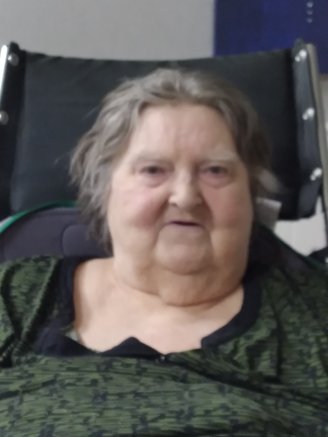
Ellen Pearl Magnotte was born November 27, 1945 in Arcata and passed away September 25, 2021 in Petaluma at the age of 75. She was a resident of Arcata until she moved to Imperial Valley, then moved back home to Arcata in 2013, until 2020 when she moved to Mckinleyville until her death.
She worked as a maid and a seamstress for many years . She decided to become a beautician for many years until she retired. She enjoyed being in 4-H as a young girl. She loved to craft and loved to sew blankets for her family. She loved her family.
She married the love of her life, Patrick Magnotte, on January 20, 1982. She will be missed by family and friends.
She is survived by her youngest brother, David Hill, and his wife Sherry Hill, his daughter Ellen’s nieces Michaela Hill and nephew Harvey Olson, and many other family members and friends. She is preceded in death by her husband, Patrick Magnotte, her mother Myrtle Hill and her father Amil Hill. Her middle brother Lee Hill, as well as her aunts Eunice O’Neil and June Fredrickson.
We will have a celebration of life at a later date. If you would like to send a card or flower feel free to — 9 15th Street, Apt. B, Eureka, California, 95501.
###
The obituary above was submitted on behalf of Ellen Magnotte’s loved ones. The Lost Coast Outpost runs obituaries of Humboldt County residents at no charge. See guidelines here.
PENINSULA RISING: County Creating a Financing District to Supercharge Development in and Around Samoa
Ryan Burns / Tuesday, Oct. 19, 2021 @ 4:19 p.m. / Local Government
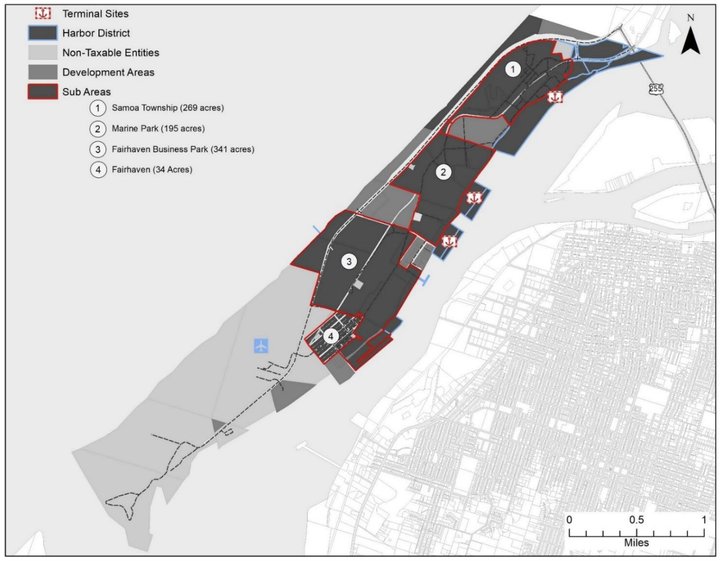
Map of draft boundaries for the Enhanced Infrastructure Financing District (EIFD) on the Samoa Peninsula. | Image via County of Humboldt.
###
A lot is happening out on the Samoa Peninsula. You’ve got the Samoa Town Master Plan, a major residential, commercial and light industrial project being built by Danco. You’ve also got Nordic Aquaculture’s land-based Atlantic salmon farm, which is in the late planning stages. Plus there’s the transpacific fiber optic cable that will connect Humboldt to Asia, major offshore wind development potential and more.
Impressive. But in a presentation nestled into the Board of Supervisors meeting on Tuesday, staffers in the county’s Economic Development Division said the peninsula’s true potential has been stifled over the years by economic barriers and inadequate infrastructure.
“The county has been trying to come up with a solution to this for quite some time,” said Tanner Etherton, an administrative analyst in Economic Development. After holding community workshops, stakeholder meetings and conducting outreach and research, the county believes it has found that solution. It’s called an Enhanced Infrastructure Financing District (EIFD).
The name may not be sexy, but Etherton explained that this economic tool — a form of tax increment financing — can capture the value of future development, using bond revenues backed by projected property tax increases to fund investments in community infrastructure, effectively jump-starting economic development on the 2,443-acre land mass south of the Samoa Bridge.
At Tuesday’s meeting, staff presented a draft Infrastructure Financing Plan (IFP) and offered an overview of how the program would work, but no formal action was taken. In the coming months, at least three public hearings will be held to hear and incorporate community feedback before the Board of Supervisors gets asked to formally establish the EIFD.
The district will be governed by a Public Finance Authority (PFA). (Yes, government loves those acronyms.) This particular PFA, which the board agreed to form in June, is comprised of three supervisors (Rex Bohn, Virginia Bass and Mike Wilson) along with two members of the public, Tim Callison and Christopher Drop.
The county calculates that there’s currently about $49.5 million in assessed value on peninsula properties. With help from the EIFD, Economic Development staff says that could balloon to about $724.7 million in new development value over the next decade.
“We found that implementation of the EIFD has long-lasting, community-wide significance, which promotes economic prosperity, achievement of energy goals, promotion of environmental sustainability, increasing jobs and enhancement of quality and place of life in Humboldt County,” Etherton said.
In a PowerPoint presentation, he offered a list of anticipated regional benefits:
- $52.8 million in net fiscal impact to County over 50 years (on a present-value basis)
- 198 housing units within the District
- 7,088 direct, indirect, and induced temporary, construction job years over the construction period
- 805 direct, permanent jobs in the County
- 987 additional indirect and induced permanent jobs in the County (total of 1792 direct, indirect, and induced jobs)
- $989.1 million in economic output from construction in the County
- $261.1 in annual ongoing economic output in the County.
“And the big question is, ‘What are the funds going to be used for?’” Etherton said. He cited wisdom imparted by his boss, Economic Development Director Scott Adair, saying, “When we think of economics and infrastructure we often think of factories and cities, and even smokestacks, but it’s important to note EIFD can fund a variety of projects, most of which are geared towards sustainable development.”
The California Center for Rural Development up at HSU conducted interviews with stakeholders to find out what people want to see out on the peninsula, and the resulting wish list included water system infrastructure upgrades, green energy opportunities and development incentives such as advanced permitting and the placement of easements.
Etherton presented a spreadsheet showing an extensive list of proposed facilities, ranging from solid waste disposal and mass timber manufacturers to affordable housing, libraries, child care facilities and more.
The mechanics of EIFD funding are a bit complex. Etherton explained that for every dollar of incremental property tax available, the financing district will receive approximately 12.75 cents. There’s also money available via incremental property taxes in lieu of motor vehicle license fees. The financing district would get 10.5 cents of every dollar there.
“This gives the fund a total annual revenue of $1.8 million by year 10 [and] a cumulative revenue of $30.1 million by year 20. Based on this information, by just year five the EIFD could have a bonding capacity of 9.4 million, which it could issue and start paying for infrastructure at an earlier date.”
The financing district will also be leveraged to seek grant funding from the state and feds. The issuance of bonds will require 55 percent voter approval. But the takeaway on Tuesday was that this new stream of revenue has potential to transform the Samoa Peninsula in the coming years with vast improvements to infrastructure and economic development.
The next public hearing of the Public Financing Authority is scheduled for December 14 at 10:30 a.m. with two more planned for February and March.
GLORY GONE: Kinetic Museum in Eureka to Close; Museum Director Shares His Thoughts
Andrew Goff / Tuesday, Oct. 19, 2021 @ 3:47 p.m. / Art , Kinetic
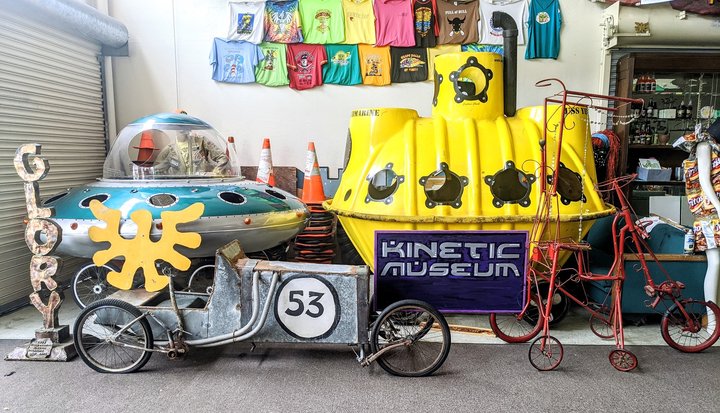
Some of the items in the soon-to-close Kinetic Museum | Facebook
As part of coming to terms with the loss of two years of kinetic racing to the COVID-19 pandemic and subsequent mounting expenses, the Kinetic Universe — the organization responsible for staging Humboldt County’s annual Kinetic Grand Championship — has announced that it will be closing the Kinetic Museum, the repository of glorious race memorabilia and nostalgia on Eureka’s A Street.
In announcing the decision, Kinetic Universe President Steve McHaney wrote about the challenges the organization has experienced recently in trying to keep kinetic racing alive in Humboldt during these uncertain times.
“It takes the monumental effort of many people to bring this beloved signature event to fruition,” McHaney said. “It also takes money, which has proven to be increasingly difficult to raise to cover our numerous expenses, one of those being rent and utilities for the museum.”
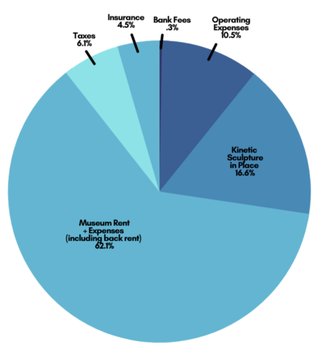
2020-2021 Kinetic Universe expenses, as shared by KU
Those museum-related expenses accounted for nearly two-thirds of the KU’s budget over the last race-less year. McHaney noted that the owner of the building the museum currently resides in has been understanding and even allowed a year and a half of back rent to accumulate, but said that continuing to finance the space is unsustainable as the organization shifts its focus to planning for an in-person race in 2022.
“The next chapter in the history of the museum will be to create a financially self-sustaining operation,” McHaney wrote. “A future museum will not only honor the history of the race, but will be built on the values expressed by the kinetic community: youth engagement, hands-on activities, outreach to schools, STEAM education, special events, and more.”
In the meantime, the museum’s contents are slated to be put into storage or be returned to their creators.
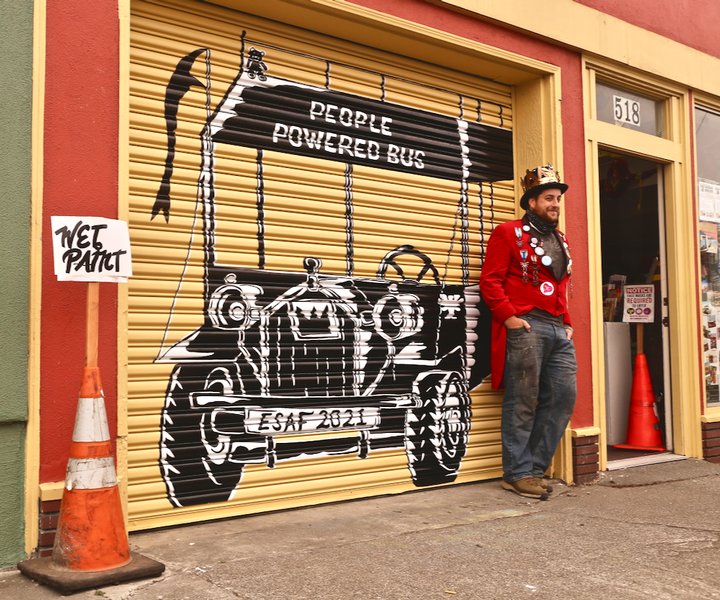
Robert “Robot” Adams, Kinetic Museum director, historian and archivist, seen here with his entry in this year’s Eureka Street Art Festival
The loss of the museum will surely be most felt by its curator and archivist Robert “Robot” Adams who told the Outpost he’s upset to see countless hours of his labor and passion discarded without having a say in the matter.
“Five years of my life is closing before the end of the year and I wasn’t a part of the decision,” Adams told LoCO. “The people who volunteered to help when I was tired and begging for it after the 2020 Kinetic Shelter-in-Place think this is the right decision because it isn’t their hard work closing. Most don’t live here, they aren’t in the community and they don’t see the work I do.”
Looking at an imminent end of this era of his kinetic experience, Adams surprised the Outpost by sending us his a lengthy, heartfelt essay on his thoughts on the museum’s closure and why kinetics have been important to him. Read that below:
I’ve been a kinetic volunteer for the last 20 years and have curated the museum for the last five.
I was a S.T.E.A.M. kid before the ideas had a unifying name. I was always building freakbikes and large art in my backyard with whatever I could find in free piles around McKinleyville. I was brought to my first race by the older brother of a neighbor who knew I would enjoy it. What he couldn’t have predicted was how he was introducing me to a family I never knew I had.
My first race in 2002 was a homecoming. That race had 44 entries. Of course Flatmo had his giant art — in the shape of Tide Fools that year — but the winner was a little guy, Curt Welsh, on a playing card/donkey trike, There were machines that looked like they were built with a NASA sized budget, and there was Granpa, the oldest racer on the course, whose machine was rust held together with duct tape and prayer. Outside of the machines there were ACE Judges, Queens, and Ted Suggs - people with elaborate costumes, and personality bigger than all the machines, who soaked up all the attention.
Racing looked like it was for everyone. It was a place where imagination and hard work were valued more than the size of your wallet or actual skills. I was 10 years old and poor and imagination and hard work were all I had.
The Ferndale Kinetic Museum was the first museum I had ever gone to and nothing like the ones you’d see on public access TV. It was free! And you were allowed to touch everything (at your own risk) and you were encouraged to ask questions, and even question the “adults” in charge — just because they were older, didn’t mean they were right. I wanted to come back every weekend. I rode from McKinleyville to Ferndale as often as I could, part by bus and part by bike.
Every month, while curating the Eureka Kinetic Museum I meet at least one kid that reminds me of how I got started in all of this. Now no 10 year olds are traveling 33+ miles to ask me questions — the internet and books are easily available — but I can spot the STEAM kids when they walk though the door.
There are a few specific types of youth visitors who get me excited to give a tour:
- Backyard artists & engineers who just discovered how large their family is;
- Kids who can’t breathe because they ask so many questions;
- And teenagers who think they know everything — because I get to ask them questions.
I was all of those kids a some point, and sometimes I still am.
The Kinetic Museum is free magic, there is no other way to describe what a space like KME does to your brain, imagination and heart - its a gallery, a workshop, a library, an amusement park, a theater stage, and a memorial, but most importantly it’s fun with no barriers to participation.Closing the doors is going to have a huge impact on our community and the future of the Kinetic Grand Championship. KME is a physical location that acts as a year round marketing tool for the KGC, we are in the community everyday having fun while inviting and inspiring others to participate in a future race.
Future Kinetic Grand Champions and Rutabaga Queens could be someone who get inspired by the Kinetic Museum next Friday — it was true 20 year ago when 10 year old Robot walked through the doors in Ferndale.
There is this idea that you should try to be the type of adult that you needed when you were younger, and that’s what I try to do through KME. I needed some to show me how to used tools, stick metal together and explain why some things float, but also I needed safe people to tell I wanted to be a Queen, or dress up as a yeti or a dragon without laughter.
The Kinetic Museum is a place that tells you that, despite all the reasons not to, you’re allowed to follow your silliest dreams, and you deserve to have fun.
Children don’t grow up to be Robot Queens or, let’s say, build giant flaming octopi without spaces like the Kinetic Museum.
Klamath Prescribed Fire Training Attracts People From Around the Globe to Learn And Burn From the Epicenter of Cultural Burning
Jacquelyn Opalach / Tuesday, Oct. 19, 2021 @ 2:26 p.m. / Environment , Fire
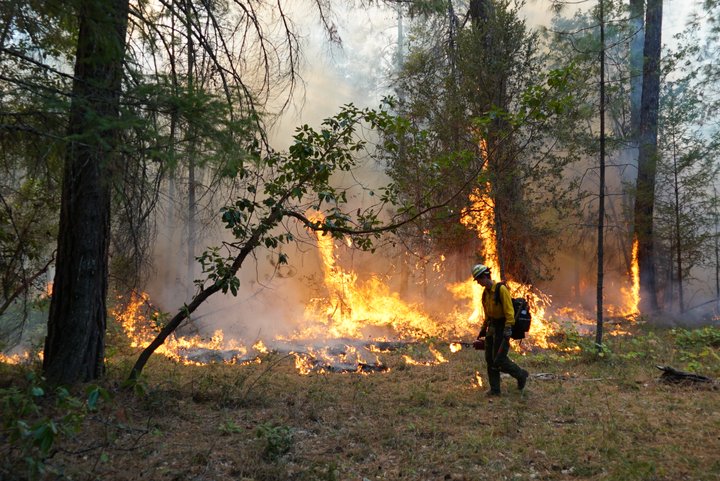
A 2021 Klamath TREX participant. | Photos: Eric Darragh
###
The season is turning. It’s time for prescribed fire, the good fire that helps prevent wildfires.
Around here, a lot of prescribed burning — intentionally introducing controlled fire to the landscape in order to reduce fuel come next wildfire season — happens through the annual Klamath River Prescribed Fire Training Exchange (Klamath TREX), a “learn and burn” training event. With 150 participants and several areas ready to burn, this year’s Klamath TREX, already underway, is the largest prescribed fire training in the United States, its organizers say.
In fact, “the middle Klamath has really emerged as sort of this epicenter of a national movement around prescribed fire and cultural burning,” Craig Tucker, a natural resources policy consultant with the Karuk Tribe, said at a Klamath TREX media briefing.
Why? “Because that’s where the Karuk Tribe is,” Tucker said.
Fires intentionally lit by Indigenous peoples burned through landscapes for thousands of years before the development of state and federal laws and regulations largely stamped those practices out. Beyond protecting watersheds and their people from wildfires, tribes used fire because it helps ecosystems thrive.
“We’ve got a very significant and long-lasting relationship with fire here in our Aboriginal territory,” said Bill Tripp, Karuk Tribe natural resources director. “Our creation stories talk a lot about how our relationships formed with plants and animals and ecological processes, such as fire.”
Seasonal prescribed burning helped protect wooden houses and structures in Karuk country, Tripp said, but it’s always been about more than just that.
”Frequent low- to mid-severity fires help to maintain habitat dynamics out there to support biodiversity and helps to create food for the plants and animals that are also our food. And so, in us helping to feed them, they, in turn, feed us.”
Prescribed burning stabilizes staple Karuk foods salmon and acorns, Tripp said. Burning removes small vegetation that uses surface water, which increases flow, and the smoke in the air reduces water temperatures — both of which are beneficial to salmon, Tripp explained. Burning at the right time can prevent bugs from infesting next year’s acorn crop, which supports animals relying on that food source, too. And burning supports other cultural practices, like basket weaving, by making the materials pliable.
“It’s kind of a circular economy out there, and a socio-ecological system, and the humans are part of [it],” Tripp said.
Today, cultural and prescribed burning are being steadily revived, but despite the known benefits of prescribed burning — potentially reducing damage and spread come inevitable wildfires — it continues to face barriers in the form of permitting and regulation setbacks.
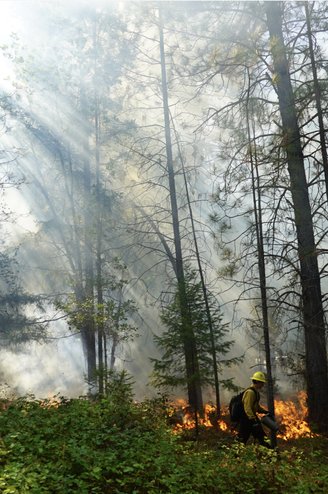
TREX events manage to comply with current legal structures.
Originally developed by the Nature Conservancy, an environmental nonprofit, TREX has grown into about 15 annual trainings around the United States. The trainings are typically joint-hosted by several local, state and federal organizations; Klamath TREX alone is supported by more than a dozen partners, like the Mid Klamath Watershed Council, Salmon River Restoration Council and Cultural Fire Management Council.
The training shares intergenerational knowledge about how to bring fire to the landscape in a good way, during times of the year when it’s safe, said Erica Terence, public information officer for Klamath TREX.
Prescribed burning must fall within a delicate window: after the first rains of the season, which dampen the landscape enough to make it safe to burn, and before the later, heavier rains, which make the duff and vegetation too wet to catch.
Klamath TREX is usually two weeks long, but this year it will run all of October and into November, for seven weeks, and participants will come and go in two-week shifts. Trainees must take a 40-hour fire course before TREX, and by the end of the training, they wield the flame.
“We do have a labor shortage here in the middle Klamath to pull off these burns,” Tucker said. “And so in exchange for folks here in the middle Klamath sharing this information, we’re getting a temporary large workforce to help us put these burns on.”
The seven-week training length is exciting, Terence said, because it means they’ll be able to capitalize on the burn window in different areas as they come along. Organizers plan to burn areas on Karuk, private and public lands in and near Happy Camp, Somes Bar and Orleans. They’re working on burning piles (material that is the result of forest management), and broadcast burning, which is burning landscapes that do not have a forest canopy.
The training attracts participants from all over the world. Some people return multiple years because they like Klamath TREX so much, and many have told Terence that its focus on cultural resources sets it apart from other TREX events.
“The partners that host TREX are able to share out knowledge about how to reintroduce fire in your home territory. And so many people, especially tribes, are taking that knowledge back and working on doing that where they come from,” Terence said.
A big part of Klamath TREX is simply getting comfortable with fire. “There’s a lot of fear of fire out there,” Terence said. “We’ve been putting fires out for so long that part of it is just getting a chance to do it (prescribe burn) hands-on. Hold the torch.”
Fear of fire continues to hinder organizations and groups who are interested in burning more. The Karuk Tribe hopes to one day manage their million-acre aboriginal land with fire the way their ancestors did, Tripp said. A decade of catastrophic wildfires have shown that the stakes are high.
The Good Fire Report, a paper outlining cultural burning barriers published by the Karuk Tribe, says that air quality permits, burn permits and environmental review interfere with tribal sovereignty over controlled burning, and calls for agencies to establish stronger relationships with tribes in order to move prescribed and cultural burning forward.
California is working on it. This year saw a few major bills pass that will loosen restrictions on prescribed and cultural burning. The legislation requires the California Department of Forestry and Fire to appoint a cultural burning liaison, aids with burn bosses’ training and certification and makes it easier for agencies to buy insurance for burn projects. Additionally, California’s 2021-22 budget package allots $20 million to tribes working on prescribed and cultural burning.
But more is needed, Tripp said. “In order to really scale up, which is what we need to do to enact meaningful change, we have to address (additional) policy barriers,” he said.
Furthermore, “if the public doesn’t support it doesn’t happen,” Tripp said, but that’s not the case around here. Folks are thankful for the burns, which makes the middle Klamath the perfect place for a pilot prescribed fire training center that could be led by the Karuk Tribe and its partners.
“This is a good thing,” Tripp said. “It’s going to be the solution to the major problems that we’re seeing today.”