First, the good news: The flu was practically nonexistent last year.
The bad news: Little flu last season means increased risk this fall and winter.
The so-called “twindemic” that public health officials in California and elsewhere warned about last year — the combined threat of influenza and COVID-19 — was largely eased by the wide use of face masks, physical distancing and reduced travel, experts say. But their concerns are back this year.
Flu activity during the 2020-21 season was the lowest recorded since data began being collected in 1997, according to the Centers for Disease Control and Prevention.
“Because of so little disease last year, population immunity is likely lower, putting us all at increased risk of disease this year, especially among the most vulnerable including our children,” CDC director Rochelle Walensky said at a press briefing earlier this month.
The agency was notified of one pediatric death last flu season, compared to 199 flu deaths reported among children the year before. The CDC did not have estimates for last season’s flu deaths among adults.
A potentially bad flu season is especially concerning as hospitals are facing severe understaffing. Last week, a third of all California hospitals reported critical shortages in staffing due in part to burnout, CalMatters reported.
For example, during the 2017-18 flu season, considered severe by the CDC, about 710,000 people were hospitalized nationwide — including about 100,000 people in California, health officials have estimated.
“Because of so little disease last year, population immunity is likely lower, putting us all at increased risk of disease this year.” — Rochelle Walensky,CDC Director
Flu shots continue to be the best protection against severe illness. Doctors and public health experts are urging people to get vaccinated — ideally by the end of October — noting that flu shots will ultimately reduce the number of people who will need ambulance transport and the emergency room.
“We saw virtually no flu last year and are uncertain about what this year will hold,” said Dr. Penny Borenstein, San Luis Obispo County’s health officer.
“We do know that the most recent flu season was relatively mild in the Southern hemisphere and that the vaccine was a good match for the strains circulating there,” she said. “We are hoping for a similar outcome during our soon-to-arrive Northern hemisphere flu season.”
According to CDC estimates, 47% of adults in California received a flu shot last year, similar to the 2019-20 flu season — that’s among the lowest in the country and slightly lower than the national average of 50%. By comparison, Massachusetts and Rhode Island had the highest flu shot uptake last year at 62% and 64%, respectively.
California fared better with flu shots for kids — about 58% of children were immunized last season. In Massachusetts, immunization among kids was close to 84%.
Last year, many people skipped holiday gatherings, college students weren’t traveling home, and masking and physical distancing was required in most places — all factors that probably helped mitigate flu activity.
“Unfortunately, this year we have relaxed most of these measures,” said Shira Shafir, an epidemiology professor at the University of California, Los Angeles. That’s bad news for both COVID and non-COVID respiratory infections, she said.
And the pandemic isn’t quite over. While close to 80% of Californians age 12 and over have been immunized against COVID, that still leaves pockets of people who can flood hospitals this winter.
“It can still get bad,” said Dr. George Rutherford, a professor of epidemiology at University of California, San Francisco. “I do think all of this will be revealed in November — if we start to see a surge in early November, it will get worse during the holidays.”
Health experts are also keeping an eye on the delayed uptick of respiratory syncytial virus, or RSV, another seasonal virus. This virus usually peaks in the winter, but in some places, cases spiked this summer, much later than usual, Rutherford said.
“If we start to see a surge in early November, it will get worse during the holidays.” — Dr. George Rutherford, professor of epidemiology at UCSF
Like the flu, respiratory syncytial virus diminished last winter likely because of distancing and masking. Surveillance reports from the CDC show that, in California, the percentage of tests that come back positive for RSV has been on the rise since June.
“That’s also a concern, maybe even more than influenza,” Rutherford said.
Researchers who looked at the most recent RSV spike in New York recently wrote in the Journal of American of Pediatrics that hospitals should be planning for an increase in pediatric emergency visits. There is no vaccine for this virus.
The burden respiratory illnesses will have on this fall and winter depend largely on how much masking continues, Rutherford said. Besides getting the flu shot and the COVID-19 vaccine, he recommends that people plan to celebrate Thanksgiving outdoors.
“Also, you don’t need to have 60 people over for Thanksgiving. Keep it small, make life simpler,” he said.
###
CALmatters.org is a nonprofit, nonpartisan media venture explaining California policies and politics.
After more than 18 months of deliberation, California’s political ethics regulators are finally set to vote today on new rules when elected officials raise money for charities that they or their family control.More public disclosure of their ties to the group getting the payments? Yes.
Limits on money from interest groups that lobby the officials? Not at all.
The proposed rules fall far short of what government watchdogs say is necessary to rein in the growing trend of charitable donations serving as a conduit for interest groups that seek to influence politicians. Stronger rules would need legislative approval, and lawmakers made clear they’re not interested.
Specifically, one new rule requires officials to report their ties to a nonprofit organization when they ask donors to give money to a group that employs, or is controlled by, the official, their staff or their family members.
“These are relationships with a potential for influence or self-dealing that the public would want to have disclosed,” says a staff report to the commission.
“Increased disclosure is great but it’s only a first step to solving a larger problem.” — Jonathan Mehta Stein, executive director of California Common Cause
The proposed rules also would:
Require officials to disclose when they are involved in making a decision that impacts the donor from whom they’ve solicited a charitable donation. This rule does not apply to decisions on general state legislation.
Require officials to estimate the amount of money they raised for a nonprofit if they can’t get an exact amount within 30 days
While the rules would give the public more information about some transactions that could influence politicians, they do not constitute the kind of sweeping reform that government watchdogs say is necessary.
“Increased disclosure is great but it’s only a first step to solving a larger problem,” said Jonathan Mehta Stein, executive director of California Common Cause.
“It seems like a no-brainer that really egregious instances of behested payments, like the ones being targeted by these regulations, ought to be prohibited.”
But that would have to be done by the Legislature, not the FPPC. The commission can change rules about how to apply California’s political ethics law, but it doesn’t have the power to change the law itself. And legislators who have that power are unlikely to change a law that serves their interests. They made that clear to the commission.
“The current statutes and regulations regarding behested payments work well and are not in need of major adjustments,” Lance Olson, an attorney representing the state Senate and Assembly, wrote in a letter to the FPPC when it began reviewing potential changes last year.
He concluded the letter by reminding the commission that its power is limited to adopting rules “interpreting the requirements of law.” Overhauling the law that allows politicians to solicit unlimited donations to charity, he wrote, “remains the role of the Legislature and Governor.”
Yet even within the rules it has the power to craft, the commission chose to limit the scope of disclosure for decisions that officials make that impact donors: It would not be required for general legislation that doesn’t impact a specific group. Disclosure would be required for bills that more narrowly affect a person or industry. However, even then, due to limits in state law, the requirement would not apply to bills concerning public employee unions.
“The current statutes and regulations regarding behested payments work well and are not in need of major adjustments.” — Lance Olson, an attorney representing the state Senate and Assembly
Richard Miadich, chairperson of the Fair Political Practices Commission, has said general legislation should be left out of the rule because of its broad reach. He wants the rule to help shine light on more specific decisions, such as a city council’s approval of a permit for a developer who donates to a charity at a council member’s request.
But a Los Angeles activist who monitors development deals in that city said the new disclosure rules “would make no difference whatsoever.” Kim Cooper said the ties between former city council member Jose Huizar, a nonprofit focused on refurbishing a historic park in his district and a developer who wanted to restore the park were well known before Huizar was indicted last year on charges of taking bribes from developers.
“It wasn’t a secret,” Cooper said.
The use of nonprofits in some political operations is “a big problem,” she added. “And it’s not going to be solved by making little nibbling changes to how it is disclosed.”
The FPPC drafted the proposed new rules before completing its investigation of Assemblyman Evan Low, launched after CalMatters reported that the Democrat from Silicon Valley had stopped reporting donations to the nonprofit affiliated with the Legislature’s technology caucus, which he leads.
The investigation remains ongoing more than a year and a half after it was launched, said FPPC spokesman Jay Wierenga. And, he noted, the commission doesn’t get any details on the investigation until it’s over.
“Investigations can take a variety of times to complete in order to be both timely and thorough. Both are equally important. There are a myriad of factors that go into any situation, such as availability of documents, witnesses, cooperation, conflicting testimony, and more,” Wierenga wrote in an email.
“There isn’t a game clock on it, the time needed is what’s necessary to get to completion.”
###
CALmatters.org is a nonprofit, nonpartisan media venture explaining California policies and politics.
Danielle “Danni” Wight left this world unexpectedly at her home
in Arcata on October 7, 2021, at the young age of 34. She was
born in San Francisco on September 19,1987, prematurely at 4
lbs., 9 oz. to Sandra Dennon and David Wight.
Danni, as known by friends and family, spent her life growing up
between the bright lights of Las Vegas and the beautiful ocean and
redwoods of Humboldt County. Las Vegas has proven to have bestowed
Danni with lifelong friends. Friends who say, “Danni had the
biggest heart of anyone they knew. She always helped people in
need…even to the detriment of her own happiness. She never stopped
caring about other people.”
In Humboldt County and surrounding
areas, Danni had the love and support of her family and friends who
encouraged her in her education and career opportunities. Danni had a
gift for writing which was passed on from her mom. Danni expressed
this gift through her poetry. She loved her friends and family. She
also had a love for music, the outdoors, her piercings, and tattoos.
But her biggest love of all is her two daughters. From the moment she
found out she was pregnant with her first daughter to her last
breath, her two girls were her entire world.
Danni graduated from Silverado High School in 2005. She had many
dreams along her path that she pursued. She attended the Paul
Mitchell Beauty School of Cosmetology and then went on to study
Dental Assisting at College of the Redwoods. Later in her life, she
moved on to be a Foreclosure Specialist and then a Loan Processor.
She was very proud of these accomplishments as was her friends and
family.
Danni was preceded in death by her grandmother Phoebe Rae Rose, her
mother Sandra Dennon and her brother Shad Burns.
Danni is survived by her two beautiful daughters Onyx and Omen, her
father David Wight, her brother Jasen Dennon, her nieces and nephews
Cody, Jacee, and Makai. And a large loving extended family. Danni’s
unforgettable laugh and her bright smile will be painfully missed by
all who knew and loved her.
A celebration of life will be announced at a later date.
###
The obituary above was submitted on behalf of Danielle Wight’s loved ones. The Lost Coast Outpost runs obituaries of Humboldt County residents at no charge. See guidelines here.
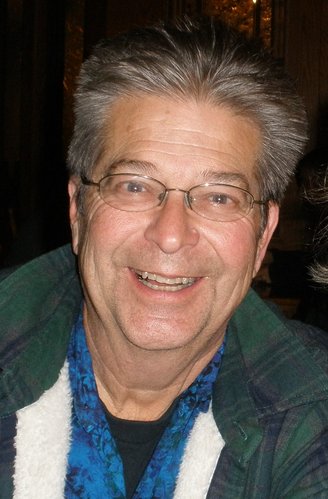
Terry
Kaup left this life October 13th at home, surrounded by the people
and animals he loved most. He passed away from pancreatic cancer
surgery complications. Born in Madera, California in 1951, Terry grew
up loving the outdoors, playing tennis, Giants baseball, and riding
his bike all around town.
Terry
attended college at USC where he studied social work and loved
college life as a Trojan. He met his lifelong friends Pete and Donna
Jakubowski in college. Pete and Terry would argue politics for hours
but loved each other despite their differences. He went on to
graduate school at George Williams College to study recreation
administration which led to a career in Boys & Girls Clubs. He
was so proud of his work at the Santa Ana, Humboldt County, and Santa
Cruz Boys & Girls Clubs. As the Director of the Humboldt County
Boys & Girls Club, he started the local tee ball league and
proudly celebrated the success of many local youth. There, he met his
good friends Keith Hawks and Bonnie Bennett. Keith followed Terry to
the Santa Cruz Boys Club where they transitioned the club from a Boys
Club to a Boys & Girls Club.
He
met his wife, Cindi, through HSU’s YES Program “Together in Sign”
where they volunteered to support young deaf children in the
community. They both went into teaching, sharing a love of children.
Terry worked at Arcata Elementary, Green Point School, Glen Paul
School, and was a substitute teacher for Eureka City Schools. Once
retired, he continued to volunteer in the Special Day Class at Eureka
High School.
The
highlight of Terry’s life was being an at-home dad to his
daughters, Siera and Maya, and their exchange student, Shavez, who
was like a son to him the past 20 years. He was so proud of all their
musical, athletic and academic pursuits, always cheering them on and
celebrating their accomplishments. He never missed any of Siera’s
tennis or soccer matches, Maya’s gymnastics or track meets, or
their shared Limited Edition choir concerts at Eureka High School.
Many
people will remember Terry by his great sense of humor and his
fun-loving nature. He really enjoyed making people laugh. He was also
very competitive and challenged others to games of all kinds. He was
pretty famous during his Boys Club days for his homemade water guns
called “water weenies” that could hold five gallons of water and
drench a crowd of kids.
Terry
is well-known for his love of flower gardening and sharing his
flowers with neighbors and friends. He would regularly be found
planting new shrubs to attract hummingbirds, redesigning his pond, or
playing with his beloved dogs and cats outside in the garden. He
enjoyed sharing stories of hiking adventures such as his hike to the
top of Mt McKinley or taking his daughters to the top of Half Dome in
Yosemite. He also had magical moments and stories about buffalo, elk,
eagles, whales, manatees and otters.
Terry
was on the board of the local Unitarian Universalist Fellowship. He
helped to create and organize the Halloween Festival each year,
setting up the lights, tents and music for the magical outdoor
experience. He was blessed to be a part of a men’s group for the
past twenty years who even managed to meet weekly via Zoom for the
past year and half.
Heartfelt
thanks to Jan Rowan, Joann Grace, Sue Mossman, Chip Sharpe, Jamal
Tharp, Michelle Hastings, the HCOE family, Sonya Glasserkey, Dave
Woody, and Rick Greaney for their help in making it through the past
few months. The abundance of love and support from the community has
meant so very much to the family.
Terry
is survived by his wife of 34 years, Cindi Kaup, and their children,
Siera and Maya Kaup. His family will spread his ashes at Yosemite,
where he spent his youth trekking up mountains and where he and Cindi
were married.
###
The obituary above was submitted on behalf of Terry Kaup’s loved ones. The Lost Coast Outpost runs obituaries of Humboldt County residents at no charge. See guidelines here.
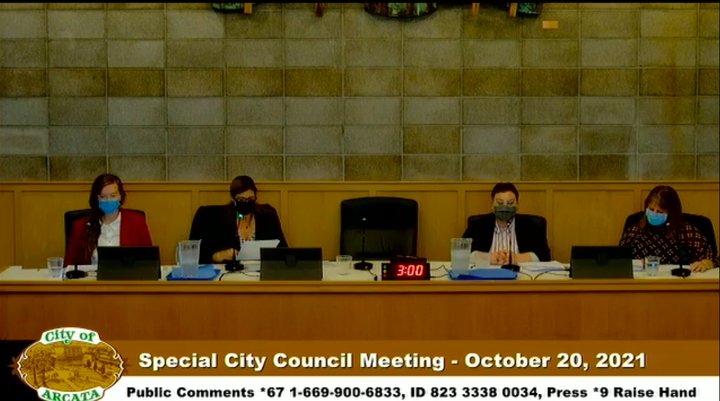
Arcata City Council, minus Councilmember Brett Watson | Screenshot from online meeting video
###
During an unusual meeting on Wednesday evening — held in the usual virtual fashion — the Arcata City Council cast a unanimous vote of no confidence in Mayor Brett Watson and elected another councilmember to serve out the remainder of Watson’s term as mayor.
Exactly what led to the council making this decision is pretty unclear. But according to a statement read by Councilmember Emily Goldstein, the decision was based on recent behaviors of Watson that “negatively affected the city and some of its staff members.”
“I move to have a vote of no confidence for Councilmember Brett Watson,” Goldstein said during the meeting. “For the public listening in, this means that I move to hold a vote to determine if the council believes Councilmember Watson is fit to serve on our Arcata City Council. We have no legal ability to remove him from the city council. However, I believe we owe it to the people of Arcata to make it clear — we do not align ourselves with the actions of Councilmember Watson. This last week, information came to light regarding alleged behaviors of Councilmember Watson that negatively affected the city and some of its staff members.”
Goldstein remained vague about what the alleged behaviors were that led to her motion of no confidence, saying only that it “could not be shared publicly at this time.”
After Goldstein read the statement she moved that the council vote no confidence, which was unanimously supported by Councilmembers Stacy Atkins-Salazar, Sarah Schaefer and Meredith Matthews.
Watson himself was conspicuously absent from the meeting.
“I’ve really been struggling with the loss this last week,” Watson wrote in the Aug. 3 statement. “I appreciate the community’s patience while I sort through the impact his death has had on me and the events of Sunday night.”
The agenda for Wednesday’s special meeting — which was released on Tuesday — stated only that the mayor position was being vacated mid-term and that the council would be electing a new mayor and vice-mayor. Additional information was difficult to obtain and no one would say if Watson planned to leave the council. City staff would only tell the Outpost that the meeting was in response to Watson’s “need for some personal time.”
What happens next is still unclear. Watson has made no comment on if he plans to resign and, as Goldstein pointed out in her statement, the council cannot legally remove him. That would need to be done through a recall election. We can only assume that the details will become clearer in the coming weeks.
In the meantime, Watson does technically still sit on the Arcata City Council, but he is no longer the mayor. Using the usual rotation method, the council elected Atkins-Salazar as the new mayor and Goldstein as the new vice mayor. Both terms will end on Dec. 22, 2022.
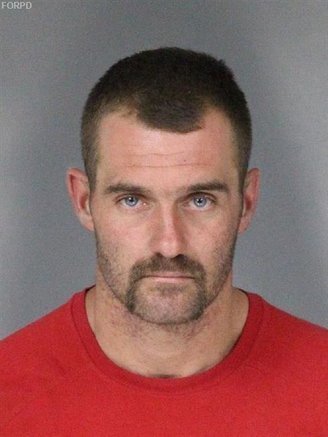
Hydesville resident Jeffrey Cody Miller, who will be remembered for killing and butchering a pet pig in Arcata, was sentenced this morning to three years in prison for committing more crimes while out of jail on supervised release.
Judge Kaleb Cockrum sentenced Miller to the middle term of three years after he pleaded guilty to possession of a controlled substance while armed with a firearm. Miller, 35, was arrested during a traffic stop on March 31. He was carrying drugs and had a loaded Smith and Wesson in his vehicle.
Miller was given credit for 204 days actually served and 204 days of “good time” credit. Cockrum also sentenced him to 180 days for violating the terms of his supervised release on the animal cruelty conviction, but that sentence will run concurrently with the three years.
When Miller decided he had watched the pig long enough, he shot her in the head. He was in the process of cutting her up and packaging her when the APD officer returned to say the owners had been found.
Press release from the Humboldt County Sheriff’s Office:
On Oct. 19, 2021, at about 7:50 p.m., Humboldt County Sheriff’s deputies were dispatched to a residence on the 300 block of Higgins Street, in the county’s jurisdiction of Eureka, for the report of a domestic disturbance between a man and a woman.
Gerald Fay Barnhart | HCSO.
Deputies arrived on scene and contacted a female at the residence. While speaking with the female near the open front door of the residence, a male suspect, identified as 54-year-old Gerald Fay Barnhart, rushed toward deputies from inside the residence, attempting to close the door. While attempting to close the door on the deputies, Barnhart grabbed hold of one deputy and forcefully pushed the deputy, causing visible injury.
A second deputy deployed a department-issued taser, striking Barnhart and successfully gaining compliance without further incident. Barnhart did not sustain injuries from the taser deployment.
Barnhart was arrested and booked into the Humboldt County Correctional Facility on charges of obstructing a peace officer by means of violence (PC 69) and obstructing/resisting a peace officer (PC 148(a)(1)).
Anyone with information about this case or related criminal activity is encouraged to call the Humboldt County Sheriff’s Office at (707) 445-7251 or the Sheriff’s Office Crime Tip line at (707) 268-2539.