

Small Tsunami Waves Measured Along the Humboldt Coast After 8.2 Earthquake Hit Alaska’s Aleutian Islands Last Night
John Ross Ferrara / Thursday, July 29, 2021 @ 11:35 a.m. / Earthquake

A chart showing tsunami perturbation along the North Spit this morning. | NWS
Small tsunami waves were recorded in Humboldt County this morning following a powerful 8.2 earthquake that struck Alaska’s Aleutian Islands at 11:15 p.m. yesterday.

Last night’s 8.2 Earthquake and aftershocks. | USGS
Eureka’s National Weather Service Office shared tide gauge data showing slightly elevated waves — likely caused by the earthquake — striking the North Spit this morning.
“The perturbation over the last couple of hours is likely associated with the small tsunami waves from Alaska,” the NWS shared on social media. “Similar signatures can be seen at tide gauges all along the coast. This is a great reminder that tsunami waves continue to affect the area long after a specific ‘arrival time.’”
The 8.2 earthquake was the strongest on record since 1964, CNN reports, and prompted tsunami warnings for Alaska and Hawaii. However, all tsunami warnings were eventually lifted throughout the Pacific.

NWS.
While the earthquake didn’t generate any hazardous tsunamis, Warning Coordination Meteorologist with Eureka’s National Weather Service office Ryan Aylward told the Outpost that the North Coast may continue to see irregular tide fluctuations caused by small tsunami waves during the next 24 hours.
“The large 8.2 earthquake in Alaska last night was impressive!” the NWS said. “Thankfully it did not generate a large tsunami for the West Coast.”
Thu Jul 29 09:31:40 UTC 2021 event picture pic.twitter.com/4oKtX2ymqt
— NWS Tsunami Alerts (@NWS_NTWC) July 29, 2021
BOOKED
Yesterday: 3 felonies, 8 misdemeanors, 0 infractions
JUDGED
Humboldt County Superior Court Calendar: Today
CHP REPORTS
No current incidents
ELSEWHERE
RHBB: Planning for Sea Level Rise Splits Humboldt Commission
RHBB: Burning Starting Today on Vegetation Management Project West of Redding
All Hail Arcata’s New Councilmember! Meredith Matthews Unanimously Selected by Council During Wednesday Night Candidate Forum
Stephanie McGeary / Thursday, July 29, 2021 @ 11:25 a.m. / Local Government

Matthews | Photos from the City of Arcata
Following an hours-long candidate forum on Wednesday night, the Arcata City Council unanimously selected Meredith Matthews — a board member of the Arcata Chamber of Commerce and administrative specialist for the Redwood Coast Energy Authority — as its fifth councilmember.
“I am honored to be a voice for Arcata,” Matthews posted on Facebook, following last night’s forum. “This is a goal realized. If you know me, you know the love I have for Arcata is so deep. Thank you, thank you.”
Matthews was selected to fill out the remainder of previous Councilmember Sofia Pereira’s term, which ends in Dec. 2022. Pereira resigned in June to take a job as Humboldt County’s director of public health.
Six candidates were considered for the seat and fielded questions from both the council and members of the public during Wednesday’s forum. (A seventh qualifying applicant, Elizabeth Conner, withdrew her application for personal reasons.)
After the candidates answered questions and provided closing statements, the council took public comment and then voted on their top three preferred candidates, using a ranked-choice voting system. The council’s top three choices were Matthews, Paul Pitino and Kimberly White.
The council then voted again on only the top three candidates, choosing their two preferred options. Though the numbers were very close, Matthews was rated the top choice.
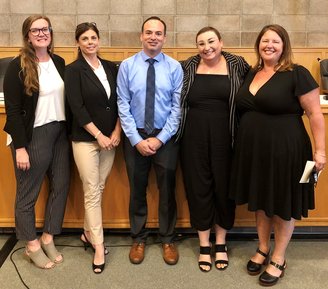
The complete Arcata City Council: (from left) Sarah Schaefer, Stacy Atkins-Salazar, Brett Watson, Emily Goldstein, Meredith Matthews
After some discussion, Councilmember Stacy Atkins-Salazar made a motion
to nominate Matthews for the council position. At first, no council
member would second the motion, and it seemed like it was going to die.
However, after the council further discussed its options — which would include holding another meeting to choose a new councilmember, or putting the choice to the public by calling a special election — Councilmember Sarah Schaefer decided to second the motion and the council voted unanimously to appoint Matthews.
“I believe that every decision we make as a city council has to hit the triple bottom line — it’s people, planet and prosperity,” Matthews said in her closing remarks during the forum. “My philosophy is servant leadership, which means having empathy, and listening and being attentive and healing. I truly believe that everyone has a voice to bring to the table and we have a responsibility to make sure everyone is represented.”
Matthews will be sworn into the Arcata City Council at the beginning of the council meeting on August 18.
You can watch a full video of the candidate forum here.
(VIDEO) Sheriff’s Office Seeks Help Identifying Man Caught on Camera Abandoning Dog
Ryan Burns / Thursday, July 29, 2021 @ 10:45 a.m. / Animals , Crime

Screenshot from security video.
###
A man was captured on camera Wednesday afternoon pulling into the parking lot of the Humboldt County Animal Shelter and, with the help of a child, abandoning a dog who can be seen sprinting after the truck as it drives away. Now the Sheriff’s Office is asking for the public’s help in identifying the man.
In a Facebook post, animal shelter staff say the man pulled into the McKinleyville shelter’s parking lot around 1:35 p.m. (The timestamp on the video is an hour off.)
“When he came to the front desk he was told that someone would help him shortly,” the post says. “He left the front office, returned to the passenger side of his vehicle where there was another subject that appears to be a juvenile. This second subject gets out of the vehicle [and] seemingly stands by for further instruction.”
In the video, the kid is mostly obscured by the full-size pickup, but he and the man appear to let the dog out of the cab and, after a brief conversation, they hop back into the vehicle before the man reverses and drives away.
“The dog initially runs off into a field but once the dog realizes that he is being left behind he pursues the vehicle that brought him to the shelter,” the Facebook post reads. Staff managed to catch the dog, which is now safe at the shelter. But staff would still like to identify the man who so callously dumped the animal.
“Yes, the dog is safe at the shelter,” the Facebook post says. “No, the license plate is not readable on the video. It is a crime to abandon an animal and morally reprehensible as well. And to involve your child in that?? No printable words for that behavior.”
The video can bee seen below. The Sheriff’s Office is asking anyone who might know the dog or the people who abandoned it to call 707-840-9132.
###
UPDATE: Here’s a photo of the dog, which is described as a male, black and white Border Collie and Pit Bull Terrier.

###
Lawmakers Aim to Boost Student Voting Power on UC, Community College Boards
Matthew Reagan / Thursday, July 29, 2021 @ 7:25 a.m. / Sacramento
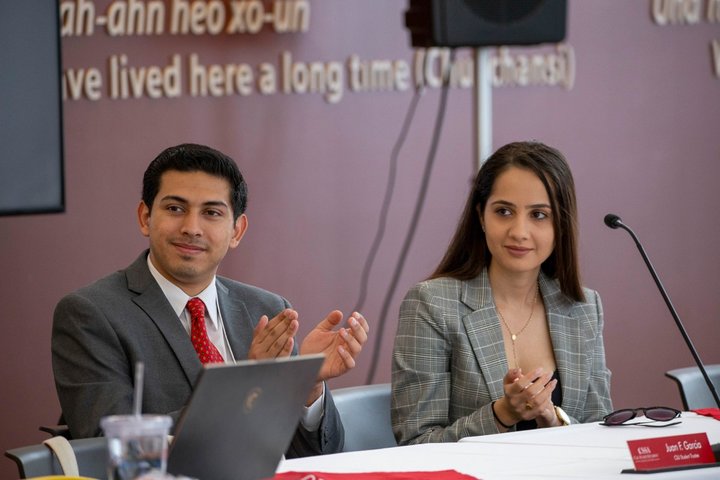
CSU Student Trustees Juan F. Garcia and Maryana Khames visit Fresno State University for a Cal State Student Association meeting in November 2019. The three higher education governing boards in California are moving to expand voting power for student representatives. Photo courtesy California State Student Association.
California students could gain more representation on two of the state’s three higher education governing boards this year.
In 2019, the state Legislature expanded the number of students with voting power on the California State University Board of Trustees from one to two. This year, legislators have done the same for California Community Colleges Board of Governors and are considering a constitutional amendment that would make the same change for the University of California’s Board of Regents.
While the changes may seem nominal, student representatives say the bills are a win — taken together, they effectively double the number of student voices in some of the nation’s largest higher education systems and send a strong message about the competence of student representatives.
“It’s important to note that students are the ones who know most about the challenges that they are facing and their voices will be essential in tackling these challenges and potential solutions,” said Democratic state Sen. Steve Glazer of Orinda, the author of SCA-5, which would expand voting power for UC student regents in their first year.
Student representatives on the CSU, UC and community college boards are appointed by the governor from a pool of candidates vetted and nominated by each system’s student government association. Before 2019, student appointees on all three boards had to wait a year before gaining the ability to cast votes.
“It’s important to note that students are the ones who know most about the challenges that they are facing and their voices will be essential in tackling these challenges and potential solutions.”
— State Sen. Steve Glazer of Orinda
The Student Senate for California Community Colleges approached Assemblymember Jose Medina to craft a bill after his successful expansion of student voting power at the CSU, according to Andrew Nickens, outgoing student senate staffer.
Nickens said AB-337, which waives the voting restrictions for student members of the California Community College Board of Governors, validates that the state’s community college students can and should be meaningfully involved in the system’s decision-making process from the beginning of their appointment. Gov. Gavin Newsom signed the bill into law in June.
Alexis Atsilvsgi Zaragoza, a UC Berkeley undergraduate, served as the regent-designate on the UC Board of Regents for the past academic year. As a regent-designate, Zaragoza did not have voting power despite often being “one of the people who knew the most about the item in the room,” she said.
The current setup of the UC Board of Regents means students are unable to vote in half of the board’s committees where issues such as student housing, tuition hikes and basic needs are being considered. The UC bill, currently under consideration in the Assembly Appropriations Committee, would allow for a voting student representative to be present in all committee meetings.
The expansion of student voting power at the CSU in 2019 made a “major difference” in the board’s ability to understand the impact of policy decisions on the student experience, said Loren Blanchard, who served as the university’s vice chancellor for student affairs from 2015–2021.
“Everybody around that dais, especially those that were nonstudents — they sat up, they really listened attentively and were oftentimes seeking additional information from the students to gain a higher level of clarity before they actually took the vote,” he said.
“They sat up, they really listened attentively and were oftentimes seeking additional information from the students to gain a higher level of clarity before they actually took the vote.”
— Loren Blanchard, former CSU student affairs administrator
Effectively communicating the realities of being a college student today to trustees who may not always understand them is one the main roles of a student trustee, said Krystal Raynes, the 2020-2022 student trustee on the CSU board and an undergraduate at CSU Bakersfield.
“Either their grandkids are in college and that’s how they know about what’s happening in college kind of vaguely, or they don’t really have any family members in college and they haven’t been in college for a long time,” Raynes said. “So it’s up to us as student trustee board members to bring that perspective in, and always remind them it’s different nowadays.”
Raynes said a safe return to campus, basic needs and housing are a few topics where student perspective is essential to ensure effective governance from statewide boards. As a student during the pandemic, she said it was critical to share her own experience facing housing insecurity with trustees and administrators like Blanchard.
“You can see it on his face, that my story, my testimony, made a difference with him,” she said of Blanchard.
Blanchard said he remembered Raynes’ story vividly and that input from students like her is vital when crafting the system’s annual budget. The 2021-22 state budget allocates $15 million to the CSU to expand its basic needs program.
Student advocates in the California Community Colleges hope the changes at the statewide level will set the stage to expand student power in the system’s 73 local community college districts, too.
Before serving as a UC student regent, Zaragoza was a member of the California Community Colleges Board of Governors. There she was involved in ongoing efforts to expand student voting powers at the local level, where many decisions about day-to-day operations of the colleges are made. Currently, each district varies in student input, though all are required to include one or more non-voting student members.
AB-1216, authored by Asm. Rudy Salas, a Bakersfield Democrat, would create a working group to study whether to set a statewide standard for student powers at the community college district level. It’s also pending in the Appropriations Committee.
“It’s very interesting where instead of the local community colleges being so student centered and then the big hierarchical statewide board being more, I guess, separated from the students, it’s like the other way around,” Zaragoza said.
###
Reagan is an intern with the CalMatters College Journalism Network, a collaboration between CalMatters and student journalists from across California. This story and other higher education coverage are supported by the College Futures Foundation.
CALmatters.org is a nonprofit, nonpartisan media venture explaining California policies and politics.
Recall Money Wars: What Do Newsom’s Million-Dollar Donors Want?
Ben Christopher / Thursday, July 29, 2021 @ 7:12 a.m. / Sacramento
Gov. Gavin Newsom may be fighting for his political life amid a fourth wave of COVID, a drought without modern precedent, another horrific fire season, a spiking murder rate and an increasingly credible-seeming recall.
But at least he has a lot of really rich political allies.
At last count, the main committee tasked with defending the governor against the Sept. 14 recall has raised some $39 million. Another allied committee and Newsom’s own 2022 campaign account, which state law allows him to draw upon this year, add another $4 million to that war chest.
That’s more than double all the cash raised by the committees campaigning for his ouster and the 46 candidates hoping to replace him, combined.
It also represents the generosity — or perhaps the strategic expenditure — of a broad coalition of some unlikely allies.
They include California’s largest teachers union and its most vocal charter school advocates; nurses and the hospitals they sometimes clash with; Realtors, developers, building trades unions and corporate landlords who have differing views on the housing crisis; defense contractors at Lockheed Martin; abortion rights advocates; new car dealers; and the financier-turned-liberal-megadonor George Soros. All have found common cause in keeping Newsom in his job.
A new CalMatters analysis of the donors to the main anti-recall committee found that organized labor threw Newsom the largest financial lifeline — roughly 45% of the total, including $1.8 million from the teachers union and $1.75 million from the prison guards this week.
Companies and individuals hailing from the state’s business community coughed up another 36% of the $39 million. The remainder came from an assortment of ideological interest groups, tribal governments, the California Democratic Party and small-dollar contributors. (CalMatters’ recall money tracker now shows where donations from a wide range of industries are going.)
If political contributions are a vote of confidence, the votes of the well-heeled, powerful and influential are overwhelmingly in the incumbent governor’s camp.
Newsom’s current haul isn’t quite the $58 million that he raised during the 2018 race. And it’s dwarfed by recent corporate-backed ballot measure fights that have hit the 9-digit mark.
But if donations were votes, Newsom would defeat the recall in a landslide. The political reality could be far different: A new UC Berkeley Institute of Governmental Studies poll found pro- and anti-recall sentiment in a virtual dead heat among likely voters. That could provide Newsom’s allies with fresh incentive to pony up — and his campaign more reason to solicit money for the campaign ahead, especially to increase awareness and enthusiasm among Democrats.
The governor’s campaign seems to be taking the threat seriously. In a TV spot that hit the state’s airwaves Wednesday night, U.S. Sen. Elizabeth Warren of Massachusetts, a progressive icon, implored the electorate to vote no “to protect California and our democracy.”
“This is a relatively painless way to strengthen your relationship with an incumbent governor.”
— Dan Schnur, former chairperson of California’s Fair Political Practices Commission
Neither a boatload of money nor a crowded roster of well-financed supporters, however, is a sure recipe of electoral success. Last year, a campaign to repeal state restrictions on affirmative action outraised the opposition nearly 17-to-1, while racking up endorsements from every corner of California power and influence. It failed by 14 percentage points.
But there’s another, even more important reason for many to give, said Dan Schnur, former chairperson of California’s Fair Political Practices Commission and a past strategist for Republican politicians: “This is a relatively painless way to strengthen your relationship with an incumbent governor.”
California campaign finance regulations cap the amount of money that gubernatorial candidates can raise at $32,400 per person — a limit that covers the challengers seeking to replace Newsom. But no such limits apply to committees raising money for a general cause — like the one defending Newsom against the recall. That difference is allowing individuals and groups to write million-dollar checks to help the governor.
Organized labor to the rescue
Just as the news of the surprisingly grim Berkeley poll was percolating through the California political universe, two more public employee unions — both political forces in their own right and conspicuously absent from the governor’s campaign finance filings — announced this week that they were opening up their coffers.
First, the California Correctional Peace Officers Association threw in $1.75 million. Then came the California Teachers Association with $1.8 million.
Though the teachers were the largest funder of Newsom’s 2018 campaign, that relationship got complicated last spring as Newsom and the union sparred first over when teachers would get vaccines, then how quickly schools should reopen.
But now, Newsom “is facing opponents who are funded by a network that wants to dismantle public education. The choice is stark and clear,” union president E. Toby Boyd said in a statement Wednesday.
Many of the top Republicans vying to take Newsom’s place in the governor’s office support bolstering charter schools, allowing families to spend publicly-funded vouchers on private education and making it easier to fire teachers deemed to be underperforming.
Newsom “is facing opponents who are funded by a network that wants to dismantle public education. The choice is stark and clear.”
— E. Toby Boyd, president of the California Teachers Association, which gave $1.8 million
The teachers and correctional officers join a financial field fighting the Newsom recall that is crowded with other organized labor groups, including other public employees, construction workers, nurses and other health care workers and food pickers and processors.
Service Employees International Union California, one of the state’s most influential organized labor groups, has kicked in $5.5 million through its various locals. The largest single contribution came from Local 2015, which represents nursing home employees and other long-term care workers.
Local president April Verrett declined an interview request, but emphasized in a statement that the union’s support is more than just financial: “We plan to mobilize our predominantly Black, brown, and immigrant caregivers, who have been on the front lines of this pandemic, to make their voices heard as we go door to door, over the phone and online encouraging a vote against the recall.”
For many labor groups, supporting Newsom in his time of need is an investment in the future. One of the governor’s longstanding health policy goals is to implement what he has called a “master plan on aging” to beef up the state’s patchwork system of elder care. The idea is still in blueprint form, but the promised overhaul would require a massive increase in state funding for health care and long-term care programs.
For other unions, supporting Newsom now looks a bit more like a thank you card. Prison guards, for example, aren’t reliable Democratic allies. But earlier this year, they scored a major pay hike from the governor and lawmakers over the objections of the state’s Legislative Analyst’s Office.
And the alternatives to Newsom on the recall ballot? For most labor groups, there are few appealing options: When he was mayor of San Diego, Kevin Faulconer made overhauling the pension system for former city employees a top priority. John Cox has repeatedly railed against the political influence of prison guards. And conservative radio show host Larry Elder opposes the minimum wage.
Familiar financiers
But unions make up less than a majority of the contributors to the Newsom cause. The rest of the list is full of regular large donors to California political campaigns, including special interests and more than a few billionaires.
Netflix CEO Reed Hastings — a notable charter school advocate who supported Antonio Villaraigosa over Newsom in the first half of the 2018 campaign — gave the governor’s committee its largest single contribution of $3 million.
Other titans of Silicon Valley have lined up to back Newsom. In a public letter published in March, Laurene Powell Jobs, founder of the Emerson Collective and widow of Apple’s Steve Jobs; prominent Bay Area angel investor Ron Conway; and former Google CEO Eric Schmidt were among executives and venture capitalists to close ranks behind the governor. Since then donors from the tech sector have given nearly $1.4 million.
Another $1 million came from George Marcus, a Bay Area real estate mogul with a history of backing moderate Democrats and opposing rent control measures. More than $500,000 was donated by hedge fund heir Liz Simons, who in recent years has contributed millions to criminal reform justice efforts and progressive prosecutors, including Attorney General Rob Bonta.
And whatever Newsom’s conservative critics might say about his anti-business policies, there are plenty of proud capitalists on his roster of defenders. That includes typical big spenders such as the California Realtors, dentists and the building industry.
Unlike other sectors, which have largely consolidated in one camp or the other, developers are divided. While individual real estate titans including GOP mega donor Geoffrey Palmer support the recall, the California Building Industry Association, which lobbies in the state Capitol, is backing the governor.
Association President Dan Dunmoyer, who served as cabinet secretary to Arnold Schwarzenegger after he became governor in the 2003 recall, said that on policy, the governor has said many of the right things. Even if he hasn’t been able to deliver on those lofty goals, Dunmoyer said he wants to give the governor another year to “prove himself” before the next regularly scheduled election in 2022.
He said his group’s support for Newsom is also partly about timing. When so much is uncertain in California, a little stability might do developers good, he said.
Removing a governor, he said, is “just not really logical, especially in the middle of a pandemic, fire, housing, homeless crisis.”
###
CalMatters data reporter Jeremia Kimelman contributed to this story. CALmatters.org is a nonprofit, nonpartisan media venture explaining California policies and politics.
OBITUARY: Paul Gregory McNally, 1953-2021
LoCO Staff / Thursday, July 29, 2021 @ 6:56 a.m. / Obits
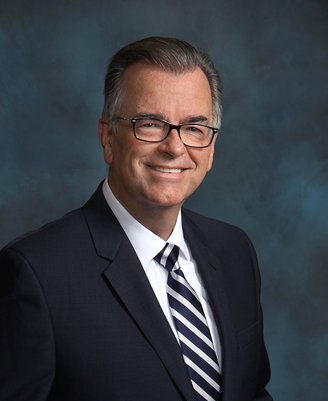
Paul Gregory McNally, the recently retired general manager of the Ingomar Club, died early Thursday morning, July 15, after a brief battle with cancer at St Joseph’s Hospital in Eureka.
Paul was born on July 6, 1953, in Eureka to Raymond Gregory McNally and Marilyn Jean (Carlson) McNally, who both spent their careers with Bank of America. Paul attended Worthington School, Zane Junior High and graduated in the Eureka Senior High class of 1971. He received his Bachelor’s degrees from Humboldt State in business, journalism, and political science.
Paul began his long and distinguished career in hospitality in 1974 at the Eureka Inn. While there, Paul worked alongside John Porter in transforming the Inn into Eureka’s “go-to” destination, especially at Christmas time. Paul took great joy transforming the Inn into a magical Christmas destination for many Humboldt County families. The centerpiece of the Inn’s Christmas celebration was the hand-picked and cut 24-foot-tall Christmas tree, always adorned with many memorable scenes. Most notable of those scenes was in 1984, when the tree was decorated with 15 pairs of live white doves, followed the next year by an engineering marvel of four working train sets. Planning and implementing these elaborate Christmas events always provided great happiness for Paul.
His hospitality career transitioned in 1986 to the Hyatt Corporation, where he spent nearly two decades working at resort properties around the world. The list of those properties is long and prestigious, and includes those in San Francisco, Vail, Maui, Goa and Seoul, among others. Paul personally supervised many high-profile Hyatt stays, including Presidents Bill Clinton and George HW Bush, Queen Elizabeth II, King Fahd, Prime Minister Benjamin Netanyahu, and Prime Minister Lee Kuan Yew.
The Ingomar Club was very fortunate to secure Paul’s services as a consultant in 2004 after a family illness brought Paul back to Eureka. In 2008 he began his tenure as General Manager, during which he helped grow the Club’s membership significantly, while embracing and incorporating the Club’s heritage and significance to the local community in all that he did. Paul retired from the Ingomar Club in 2019. He was eager to begin the next phase of his life. He had great plans for amazing travel, joyful visits with family and friends, and just simply relaxing at home with his beverage of choice.
Paul’s charm, wit, and generous nature were abundantly clear to everyone. He had many friends both locally and around the world, whom he cherished, who feel blessed to have known him. Paul will be greatly missed.
Paul was predeceased by his parents Raymond and Marilyn and is survived by his Aunt Lois Hadley, cousins Joan Caldwell and Sue Tofflemire, and their children Andrew and Brian Tofflemire, and Sarah and Erin Caldwell. He is also survived by his long-time friend Tamara Dinsmore who shared many Giants game with him, rain or shine, win or lose.
The family would like to thank all the close friends and associates who were so important to Paul, especially Ramon Ranoco, Janet Hansen, Dolores Vellutini, and Susanne Campton for their care and attention to Paul during this past year while he was dealing with health issues.
Paul was dedicated to KEET-TV, serving on their Board of Directors, and as Board President, and most recently as an active member of the Leadership Circle. Helping the KEET team with his hard work and creative ideas to help them meet their annual goals. As a strong supporter of public television and radio, as well as various non-profit organizations in the arts, theaters, museums, and historical societies, in lieu of flowers, please consider a donation to KEET, or a charity of your choice.
A celebration of Paul’s life is will be held Saturday, August 21st at 11 a.m. at Sacred Heart Catholic Church. Please contact paulmcnallylifecelebration@gmail.com so that we may keep you up to date with details.
###
The obituary above was submitted on behalf of Paul McNally’s loved ones. The Lost Coast Outpost runs obituaries of Humboldt County residents at no charge. See guidelines here.
OBITUARY: Virginia Gale Yeager, 1963-2021
LoCO Staff / Thursday, July 29, 2021 @ 6:56 a.m. / Obits
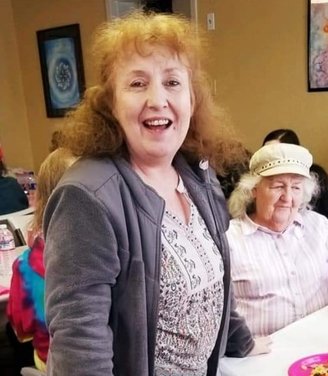
Virginia
Gale Yeager, 58, was born in a doctor’s office in Willow Creek in
1963 to her parents Richard and Donnie Eastburn. She went to be with
her lord
and savior
due to complications of liver cancer on July 26, 2021 in
McKinleyville. She was was a beloved wife,
mother,
grandmother,
daughter
and sister.
Virginia, mostly known as Giner, lived in Willow Creek and also in Michigan for a short time while she was a child. She grew up mostly in McKinleyville where she attended Dows Prairie Elementary School and proceded to graduate from McKinleyville High School in 1982. She then went to College of the Redwoods for back-office nurse training.
Virginia married the love her life, Clifford Allen Yeager, on February 22, 1986 in Mckinleyville at Abundant Life Center Church. She was married for 35 wonderful years. They then had three very loved children — Joshua Allen Yeager, Jessica Ann Yeager and Michael James Yeager. She had the blessing of becoming a grandma when Jacob Luis Trejo was born on December 9, 2019.
Virginia was a transcriptionist. She was also a bookkeeper for Rohnerville Assembly of God for many years. Most recently she worked at Hideaway Mini Storage in McKinleyville for 10 and a half years. She was loved by the employees and tenants alike.
Virginia enjoyed doing many things such as women’s volleyball and softball. She was a lover of reading anything that sparked her interest. She especially loved reading the word of God. There was nothing she enjoyed more than spending time with her family and being in the house of the Lord.
Virginia had a strong faith in God. She was devoted to her family and church family. She was a member at North Fork Community Gospel Church. Her love for the Lord never wavered and only grew stronger the older she got. She was a saint and one of the most kindhearted and sweetest people known. Her laugh was contagious and her smile could light up the room.
She preceded her sister Linda Blair in death and is survived by her parents Richard and Donnie Eastburn, brother Glenn Ray Eastburn and family, husband Allen Yeager, her children: Joshua Yeager, Jessica Yeager and Michael Yeager, her grandson Jacob Trejo, and numerous more relatives.
The memorial service will be held July 31, 2021 at Greenwood Cemetery in Arcata at 2 p.m.
###
The obituary above was submitted on behalf of Virginia Yeager’s loved ones. The Lost Coast Outpost runs obituaries of Humboldt County residents at no charge. See guidelines here.


