The first deadline Gov. Gavin Newsom set in his $2 billion plan to reopen California’s schools will come and go Monday without the necessary support from the Legislature, signaling the proposal has all but stalled.
The governor’s proposal aimed to incentivize school districts to reopen their campuses by paying out grants of $450 to $700 per student to schools that developed safety plans for in-person instruction by Monday and opened doors to the state’s youngest students by Feb. 16.
But that proposal capsized under a wave of criticism and now the governor, lawmakers, school district leaders and teachers unions have limited time to figure out a solution before bringing kids back on campuses for this academic year becomes moot.
Criticism for Newsom’s proposal stemmed from the state’s largest school districts, teachers unions and legislators who called it unworkable and unlikely to nudge open classroom doors for the millions of California students still learning remotely.
Among the issues raised had been the plan’s tight deadlines to receive full funding, the stringent testing requirements attached to the grants — which could have cost districts more than the grants were worth — and, for some legislators, the lack of emphasis and coordination Newsom’s proposal placed on prioritizing vaccines for teachers and school staff.
Newsom’s staff said in legislative hearings this month that the plan’s deadlines were based on a sense of urgency and the high stakes behind a school year that could end entirely remotely for the majority of California’s 6.1 million students.
Jessica Holmes, a Department of Finance analyst, told lawmakers at a Jan. 21 hearing that it would be “very unlikely” that school campuses would reopen this school year if schools haven’t yet done so by April.
“If we’re in distance learning at the end of this school year, what does it mean for next school year, and that is a very big fear and concern that we have,” Holmes said.
The governor and the Legislature are negotiating the plan behind closed doors, but a key issue affecting whether more school campuses will reopen this semester seems to depend on whether teachers will receive priority access for vaccination.
The California Teachers Association, which wields significant influence at the Capitol, wrote in a letter to the governor Wednesday calling for teachers to be vaccinated before reopening campuses. Teachers unions have also opposed allowing schools to reopen if their counties remain in the state’s purple tier — which the state currently allows for elementary schools.
When Newsom first introduced his proposal Dec. 30, the state included a rationale for it, noting low risks of transmitting the coronavirus through in-person instruction, especially for elementary grades, if paired with rigorous safety protocols. Researchers with the Centers for Disease Control found little evidence of transmission through in-class instruction in an article published this week, though cautioned that other school-related events such as indoor sports practices could result in higher transmission of the virus.
While some school districts, such as Long Beach, have begun to vaccinate some educators, the picture is muddied from county to county, with some prioritizing Californians 65 and older for the limited doses received so far.
Last fall, local school superintendents, school boards and labor unions in some districts put forth requirements for reopening campuses that exceeded those of the state’s, prompting a group of Democratic lawmakers to introduce legislation that would mandate when schools should safely reopen.
In a candid private conversation with superintendents Thursday reported by Politico, Newsom expected his plan would change as his office negotiates with the Legislature, and said requiring all educators be vaccinated before reopening schools would likely mean campuses staying closed.
“If everybody has to be vaccinated, we might as well just tell people the truth: there will be no in-person instruction in the state of California,” Newsom told the superintendents.
Democratic Assemblyman Patrick O’Donnell, chair of the Assembly Education Committee, said state and local officials should better coordinate access to the vaccine for California’s educators. Schools should offer in-person instruction if teachers receive the vaccine, O’Donnell said.
“The governor’s keeping his own staff at home, but then he tells teachers they need to go back into the classroom without vaccination? That’s not right,” O’Donnell said. “Let me be blunt: the path to getting our schools reopened is to vaccinate our teachers, and I’m confident the governor will help us achieve our goal.”
The governor remains unders immense pressure to act on schools. Parents frustrated with how the state and local districts have handled reopenings throughout the pandemic have begun grassroots organizing, and the issue could fuel a long-shot recall effort.
Newsom’s reopening plan also included new guidance that has had a ripple effect on schools that have already reopened. Some districts in San Diego and Placer counties have scaled back plans to expand their in-person instruction offerings to students and families, citing updated guidance that puts firmer restrictions on spacing students’ desks.
This week, the Roseville Joint Union High School District in the Sacramento suburbs decided to revert to a hybrid model for some of its high schools instead of remaining in a 5-day week in person as it had planned when campuses first opened Jan. 5.
“It’s infuriating. Parents are fed up,” said Jonathan Zachreson, a Roseville parent of three attending schools in the elementary and high school districts. “It looks like these politicians are incentivizing reopening schools, but in reality the plans they come up with do the exact opposite.”
###
CALmatters.org is a nonprofit, nonpartisan media venture explaining California policies and politics.
After nearly three weeks off the air due to corporate greed contract disputes, both KVIQ (the local CBS affiliate) and KIEM (NBC) are back in the channel lineup for local Suddenlnk subscribers.
On Thursday afternoon, a man named Brad Ayers, who is the senior director of government affairs for Suddenlink’s parent company, Altice USA, sent an email to local stakeholders announcing the ceasefire.
“I am pleased to report that Altice USA reached an agreement this afternoon with Cox Media Group which will return KVIQ (CBS) and KIEM (NBC) to Suddenlink programming in your area,” Ayers’s email stated.
The two corporations blamed each other in the dispute. Earlier this month, Cox alleged that Suddenlink “unfortunately opted to place their customers in the middle of their negotiations.” Suddenlink, in turn, issued its own statement, blaming Cox Media Group for jacking up customers’ fees and “pulling its networks” from TV lineups in six markets, including Humboldt County.
Sean Takata McLaughlin provided the following statement late Thursday:
We understand that an agreement has been reached between Cox Media Group and Altice that will again allow for retransmission of Cox Media Group (CMG) owned stations KIEM (NBC) and KVIQ (CBS) over the cable systems in Humboldt County (Eureka DMA) as well as five other markets and eight other TV stations across the nation. Altice owns the cable system operating as Suddenlink that provides TV, internet and telephone service in the Cities of Eureka, Arcata, Fortuna, Ferndale, Blue Lake and Trinidad as well as areas of Humboldt County from Scotia to Big Lagoon.
“Humboldt County sent a strong letter to our Congressional delegation calling for policy changes that would return jurisdiction to local governments. The letter also called for the Federal Communications Commission (FCC) to reconvene a Localism Task Force to consider the harms of media consolidation and lack of local accountability in the information ecosystem. At the State Legislature, Access Humboldt is calling for an audit of cable TV and local broadcasters performance during the pandemic - for the purpose of finding solutions to close the digital divide. Our goal is univeral access to open secure networks that meet local needs and interests - esp: public health and safety; education; economic and community development; culture and arts; and civic engagement.
“On behalf of our local governments, Access Humboldt will continue to seek ways to avoid such a problem in the future. And we will also ask both Suddenlink (Altice) and Cox Media Group’s stations KIEM (NBC) and KVIQ (CBS) to be accountable to our local community as much as possible.”
On a related note, today Access Humboldt joined with national groups in asking that President Biden quickly name a fifth FCC Commissioner to fill the agency for the work ahead. The Federal Communications Commission (FCC) has jurisdiction over broadcast TV and cable TV, and much harm has occured through that agency during the past four years. The FCC bears responsibility for the policy failures we see across our media and broadband internet landscape.
Finally - we ask our State Legislature to reform the failed regulatory regime under the Digital Infrastructure and Video Competition Act, which eviscerated local jurisdictions’ authority to negotiate with absentee owners of critical communications infrastructure.
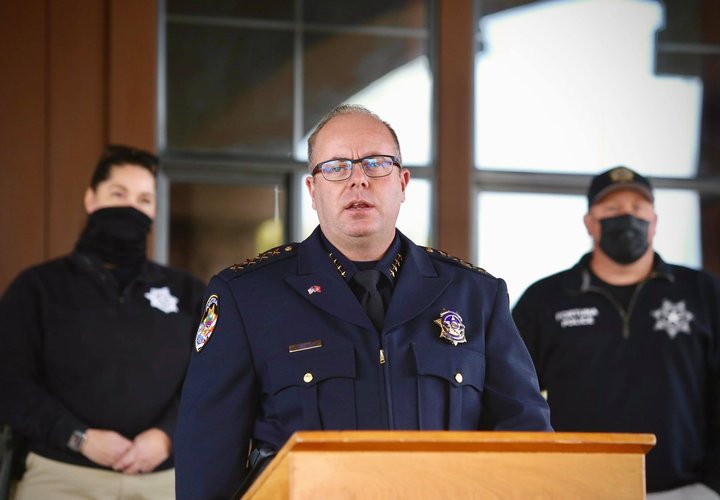
Fortuna Police Chief Casey Day at today’s press conference. Photo: Andrew Goff.
###
From the Fortuna Police Department:
On
Friday, January 29th 2021, at approximately 7:00 A.M., the Fortuna
Police Department took 29 year old, Matthew Oliver Gibson of
McKinleyville, into custody and booked him at the Humboldt County
Correctional Facility.
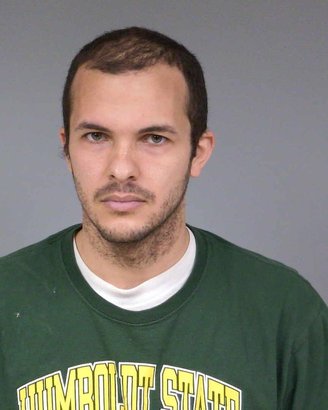
Gibson.
Between
2017 and 2018, Gibson was employed as a teaching assistant for Toddy
Thomas Middle School in Fortuna. During that time, Gibson repeatedly
and sexually victimized a middle school student while working in his
capacity as a teaching assistant. Gibson was primarily helping with
an after school program at the time of the occurrence. Information
concerning these events and allegations finally surfaced in January
of 2021 and the Fortuna Police Department was notified.
Detectives
and School Resource Officer’s worked diligently to establish and
corroborate facts associated with the allegations which subsequently
culminated with Matthew Gibson’s arrest this morning. The
collaborative effort and cooperation between school officials and the
police department throughout this investigation has been excellent
and this remains an open and ongoing investigation.
The
Fortuna Police Department would like to thank the District Attorney’s
Office and allied agencies for their assistance with this
investigation.
It
should be emphasized that Matthew Gibson’s employment with Toddy
Thomas Middle School ended in December of 2018 and he was not
currently employed at the time of his arrest. The school district’s
number one concern has always been the safety and wellbeing of
students and will continue to be their number one concern going
forward.
The
Fortuna Police Department is seeking information from anyone who
might have knowledge about the allegations against Matthew Gibson to
come forward. Additionally, the Fortuna Police are working tirelessly
to identify any additional victims and ask that anyone with any
information contact Fortuna Police.
Matthew
Gibson was booked into jail for suspected violations of California
Penal Code sections: 261.5(d) – Unlawful Sexual Intercourse with a
Minor, 261(a)(1) - Rape, 288(a) – Lewd and Lascivious Acts,
288(b)(1) – Lewd and Lascivious Act by Force, 288.5(a) –
Continuous Sexual Abuse of a Child, 289(a)(1)(A) – Forcible Acts of
Sexual Penetration, and 288(c)(1) – Sexual Abuse of a Child Under
16 Years of Age. A number of additional felony violations will be
filed with the Humboldt County District Attorney’s Office.
The
Fortuna Police Department remains committed to public safety and
transparency.
Any
questions regarding this incident can be directed to the Chief of
Police, Casey J. Day at (707)-725-7550.
###
Video from the press conference at the Fortuna Police Department’s Facebook page below:
Citing the ongoing impacts from COVID-19, the organizers of the beloved Kinetic Grand Championship have announced that there will be no in-person race this coming Memorial Day, making this the second straight year that the global pandemic has harshed Humboldt’s art nerd glory.
Read the message from the Kinetic Universe, the organization responsible for running the race, below:
Kinetic Universe places the highest value on the health and wellbeing of our kinetic family, which includes not only builders, racers, peons and pit crews, but also the many dedicated volunteers, generous sponsors and supporters, and our many thousands of fans. The threat of harm from COVID-19 is all too clear and continues to impact all facets of our lives. Even though vaccines are beginning to be distributed, all indications are that widespread vaccination and herd immunity will not be achieved until perhaps the end of the year. While we hope for earlier relief from the pandemic, it takes months of effort to plan for the race and we believe it is important to act early and prudently. After consulting with Humboldt County Department of Health & Human Services, we have determined that it is in the best interest of public health to cancel the in person Memorial Day (May 29, 30, and 31st, 2021) Kinetic Grand Championship race.
There is no glory in cancelling this beloved event for the second year in a row and we take this unprecedented precaution out of a sense of care for the kinetic community. Though we are not planning an in person race this year, we will be keeping the spirit of kinetics alive with virtual events. We look forward to collaborating with those of you able to contribute your ideas, talents, time, and love of the race so that we may celebrate kinetic glory safely in 2021 and continue building our great tradition.
Kinetic Universe Board of Directors Steve McHaney, President Robert van de Walle, Treasurer Jenette Kime, Secretary Jennifer Thelander
Candis Danielson and her family. | Photo via GoFundMe, used with the family’s permission.
###
A 35-year-old mother of five is recovering from serious injuries and a surgery in which one of her feet was amputated after she was viciously attacked by two pit bulls while trying to help a neighbor Thursday afternoon in Myers Flat.
Candis Danielson had gone over to her neighbor’s house to help him with his generator during a power outage when the neighbor’s dogs got out of his trailer and attacked her, according to Aaron Merriman, an emergency medical services worker who responded to the scene.
The dogs had dragged Danielson under the trailer and inflicted extensive damage to her legs and feet, Merriman said.
“She was in extreme shock but would respond to her name,” Merriman said.
According to to a press release from the Humboldt County Sheriff’s Office, responding deputies performed life-saving efforts on Danielson, who was transported to St. Joseph Hospital and is expected to survive.
Another victim also suffered bite injuries and was treated at a nearby fire station, the sheriff’s office said.
Danielson’s sister, Shiann Davis, set up a GoFundMe campaign to raise money for Danielson’s medical bills and any potential legal fees. In the initial post, which went up on Thursday evening, Davis wrote that her sister was undergoing surgery to have one leg amputated and may lose the other leg as well. However, in a Friday morning update, Davis wrote that surgeons had only amputated one foot, “and they are bringing in specialists to see what they may be able to save of the rest of her leg.”
Davis released the following statement to the Outpost Friday morning:
It’s taking a minute just to get over the initial shock of everything. We’re just trying to remind ourselves Candis is in good hands and being taken care of by proper specialists, her pain is being managed, and most importantly she’s alive.
It’s a strange world now. We can’t be there in the hospital with her and even her kids may not be able to see her for probably a month while she’s going through this because of COVID, but the precaution makes sense for her safety and the safety of others.
If you know her, you also know how strong she is and how much of a fighter she is. If you don’t know her, take my word that you’d be lucky to cross paths one day. We’re grateful to everyone that has offered support to our family during this time. Thank you so much for your generosity, for sharing, and for reaching out.
Davis’s boyfriend, Myles Cochrane (who formerly worked as program director at KSLG FM, owned by the Outpost’s parent company, Lost Coast Communication, Inc.), defended pit bulls generally but said these particular dogs were dangerous:
Dogs are one of the greatest gifts to humanity. Regardless of breed or size, if they’re raised right they will in all likelihood succeed. It’s unfathomable some humans have the luxury of being called a “gentle giant” yet many qualifying pit bulls don’t get the same privilege. That said, these particular dogs should never have had this opportunity at attempted murder.
Humboldt County Sheriff’s Office Public Information Specialist Samantha Karges told the Outpost that the dogs will be required to undergo a vicious dog hearing.
“If at that hearing the dogs are determined to be potentially dangerous or vicious dogs, and that the release of the dogs would create a significant threat to the public health, safety, and welfare, then the dogs could be put down. The process is outlined in County Code § 547.”
The dogs’ owner has not been charged with any crimes — no charges have been requested, Karges said, adding that the incident is still under investigation.
###
Here’s the press release from the Humboldt County Sheriff’s Office:
On Jan. 28, 2021, at about 12:45 p.m., Humboldt County Sheriff’s deputies were dispatched to a residence on the 200 block of Myers Avenue in Myers Flat for the report of a dog attack.
According to the reporting party, the 35-year-old female victim had arrived at the residence to perform housekeeping services. Upon arrival, the victim was reportedly attacked by two pit bulls, which were pets that lived at the residence.
When deputies arrived on scene, the dogs had already been detained in a vehicle by their owner. Deputies located the victim with serious and extensive injuries related to the attack. Deputies performed life-saving efforts on the victim. The victim was transported to a local hospital for treatment and is expected to survive.
While investigating, deputies learned of a second victim who was being treated for bite-related injuries at a fire station nearby. Upon contacting the male victim, deputies learned that the man had stopped at the property to assist the female victim and dog owner. However, while attempting to assist, the man sustained moderate injuries from the dogs. The man left the property prior to deputy arrival to seek medical treatment.
Animal Control Officers took custody of the dogs and they were transported to the Humboldt County Animal Shelter where they are being held pursuant to Humboldt County Code § 542-13 and § 547-14.
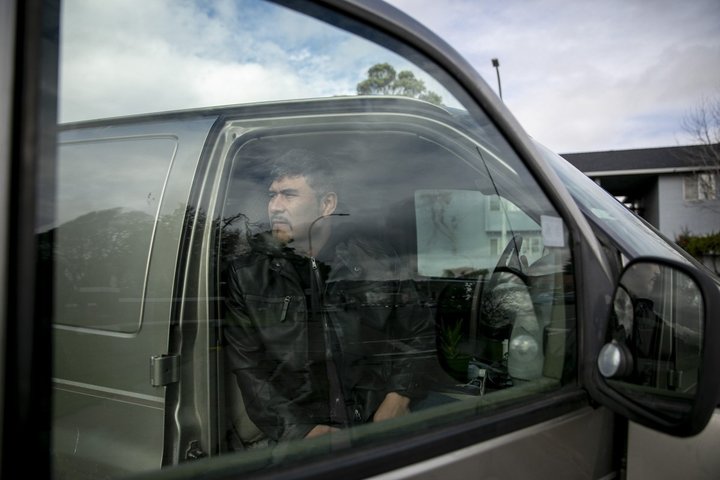
Guillermo Hernandez, who uses his van for his businesses, lost work when his license was suspended in 2013 for failure to pay a ticket. He sued the DMV along with several other Bay Area residents and won. Photo by Anne Wernikoff, CalMatters
###
More than 400,000 Californians had their driver’s licenses reinstated last month after an appeals court ruled that the state was illegally penalizing people who failed to appear in court on costly traffic tickets.
More than three million traffic infraction citations are issued in California every year, averaging between $600 and $700 each.
California has among the highest traffic ticket penalties in the country due to a litany of state and county add-on fees. A ticket for running a red light — which has a base fine of $100 — actually costs nearly $500 because of state and local fees, and more than $800 if the driver misses a deadline to pay or appear in court.
The ruling “limits this blunt instrument of punishing people for not taking care of traffic tickets when in reality, for many Californians, traffic tickets are simply too expensive to take care of,” said Rebecca Miller, senior attorney at the Western Center on Law and Poverty, one of the organizations that sued the Department of Motor Vehicles.
“Like any state in the country, we have over-policing of lower-income and black and brown communities in California.”
Several Bay Area residents sued the DMV in 2016 when their licenses were suspended after they failed to pay a traffic ticket or appear in court. Last June, a three-judge panel in the First Appellate District ruled in their favor, deciding that the state inappropriately suspended the licenses of drivers without formal notices from traffic courts that their failure to appear was willful.
As a result, the DMV lifted suspensions on 555,000 driver’s licenses. Because some had additional suspensions for other reasons, about 426,000 motorists were eligible to have their licenses reinstated, according to the DMV.
“Like any state in the country, we have over-policing of lower-income and black and brown communities in California.” — Rebecca Miller, senior attorney at the Western Center on Law and Poverty
Legal aid groups — the Western Center on Law and Poverty, Bay Area Legal Aid, the Lawyers’ Committee for Civil Rights of the San Francisco Bay Area and the East Bay Community Law Center — represented the plaintiffs.
The lead plaintiff, Guillermo Hernandez, of Richmond, had been ticketed in 2013 for not updating his driver’s license information and driving without a valid registration, court records show.
Hernandez said he tried to go to court to take care of the ticket but was told twice that clerks couldn’t find it in the system. It was only later when he tried to renew his license that he discovered there was a hold on it for more than $900 in fines and fees.
“At that time I just didn’t have the money. I didn’t have work. That’s a lot of money… How am I going to pay it?’” he said, speaking in Spanish.
Hernandez had to cut back on his work buying and selling secondhand goods around the area. “I was afraid they would grab me and make me pay more money for tickets,” he said.
Hernandez said he’s glad he saw the lawsuit through the appeals court even after his attorney helped him get onto a repayment plan and get his license back before the case concluded.
“I feel really proud that I did something for society,” he said.
Richmond resident Guillermo Hernandez, the lead plaintiff in a 2016 case against the DMV, is photographed at Nicholl Park on Jan. 28, 2021. Hernandez had his license suspended after he was unable to pay a ticket and fees in 2013. Photo by Anne Wernikoff,
The appellate opinion is somewhat narrow and technical: By law the DMV is supposed to suspend a license if it receives a notice from a traffic court that a driver “willfully” violated a written promise to appear in court, according to the opinion. The DMV argued that when it receives notices a driver failed to appear in court that indicates that the actions were willful. The trial court agreed, but the Appeals Court found that the DMV needed a more formal notice that a driver broke the law.
The DMV said in a statement to CalMatters that from now on it “will only impose a (failure to appear) suspension based upon misdemeanor (failure to appear) notifications submitted by the courts.”
But attorneys involved in the case said it’s too soon to tell how the case will affect license suspensions going forward.
Fees tacked onto traffic fines
Economic justice advocates and some government officials are examining court fines and fees as part of a national reckoning over racial disparities in the justice system. A growing body of data suggests black and brown drivers are more likely to be pulled over than white motorists, and they often face staggering bills for traffic tickets.
That’s because state and local governments have tacked on numerous fees that have nothing to do with traffic violations, said Martin Hoshino, the state Judicial Council’s administrative director, who served on a national task force regarding fines, fees and bail practices.
“It became unnerving to think that courts had been turned into revenue centers, and judicial officers were in this really awkward position of perhaps knowing they were imposing a fine or fee for which their court operation was benefiting. I think that’s wrong,” Hoshino said.
Records and interviews show fees in criminal court, including for traffic violations, have funded an array of services and projects in California, including court construction, DNA collection, emergency medical air transport and sunken vessel recovery off the coast.
“When you put all of the decisions together and look at it holistically 30 years later, you find out you’ve created a regressive, harmful, at times self-defeating revenue system because you’re pushing people into debt traps,” Hoshino said.
In addition, “you’re not able to collect the debt,” he said. Uncollected debt on court fines and fees doubled over the past decade to roughly $10 billion in California.
“I pleaded to have that license so I could pay my bills and look for work. I was working with two temp agencies who wanted nothing to do with me when I explained the situation.” — Stacey Kmetz, delivery driver
Stacey Kmetz knows about the burden of traffic ticket debt. The San Jose resident, who was out of work and sleeping on a friend’s couch, got a nearly $900 ticket in Marin County for driving without proof of insurance.
“I was really stuck. I asked everybody I knew for help,” Kmetz said.
When she didn’t appear in traffic court by the date on her citation, her license was suspended. Kmetz ultimately went to court and got a $78-a-month payment plan, records show. But the court did not notify the DMV to lift the suspension.
“I pleaded to have that license so I could pay my bills and look for work,” she said. “I was working with two temp agencies who wanted nothing to do with me when I explained the situation.”
Legal Aid attorneys stepped in and got the court to recall the failure-to-appear notification. Kmetz was able to get her license back in October after six months without it.
“It was terrible. The anxiety of the whole dilemma…it was awful,” she said, adding that she’s since used her license to work as a driver for some delivery apps.
Pilot program to avoid court appearances
Lawmakers and court officials have taken some recent steps: They have eliminated license suspensions for failing to pay traffic tickets and developed payment plans.
The court system also developed a pilot project that makes it easier for low-income motorists to request a traffic ticket fee reduction. A website called MyCitations allows motorists to request a reduction online. The courts can consider a driver’s income and other information on their ability to pay before deciding whether to lower a penalty.
The virtual ticket system was created so that motorists wouldn’t have to appear in person at a courthouse if they wanted to get their ticket debt reduced.
Many Californians can’t afford a day off work to plead their case to a judge. But when they don’t pay and don’t show up at court, the fines increase, their licenses can be suspended and if they are caught driving on a suspended license, they face criminal charges.
“It’s the criminalization of poverty,” said Asher Waite-Jones, staff attorney and clinical supervisor at the East Bay Community Law Center.
The pilot project includes seven counties. Tulare, Shasta and Ventura counties launched the first year, San Francisco and Santa Clara counties are in year two and Fresno and Monterey counties are launching now.
From April 2019 through Nov. 2020, nearly 7,000 drivers requested a fine and fee reduction through the pilot program. More than 85 percent of those drivers reported incomes below the poverty line and their debt was an average of 447 days outstanding, according to a recent report on the project the Judicial Council prepared for the legislature. Three quarters of the requests were approved; the penalty was reduced an average of $347 per ticket, according to the report.
Many Californians can’t afford a day off work to plead their case to a judge. But when they don’t pay and don’t show up at court, the fines increase, their licenses can be suspended and if they are caught driving on a suspended license, they face criminal charges.
The governor’s current budget proposal includes money to bring the pilot system statewide. Ongoing funding would increase to $58.4 million by 2024-25.
“It’s been really important during the pandemic because it gives people a way to request a discount without going into traffic court,” said Anne Stuhldreher, director of the financial justice project in the San Francisco treasurer’s office. “We should be able to hold people accountable without putting them in financial distress.”
Stuhldreher and legal service attorneys suggest a better fix is doing away with many of the fees. Last year, lawmakers eliminated a number of fees levied in criminal court. Advocates are pushing them to do the same with traffic tickets.
When courts do reduce a driver’s ticket penalty, the amount varies, depending on the court and judge; the reduction can be 50 percent in some courts and 80 percent in others.
“Fifty percent is not necessarily meaningful to many of my clients who are homeless or completely destitute,” said Waite-Jones, the East Bay Community Law Center attorney.
The court system administrator, Hoshino, recommends more substantial changes from lawmakers.
But he also worries about how California will make up the revenue for vital services if the fees are slashed. The state collected $1.4 billion in court fines and fees — all cases, not just traffic-related — in 2018-19.
“If you’re going to remove $1.4 billion for state and local programs, you’re either going to end up abolishing those programs or you’re going to have to find alternatives,” Hoshino said.
###
CALmatters.org is a nonprofit, nonpartisan media venture explaining California policies and politics.
Eureka City Hall, with its then-new Eddy Alexander-authored branding unfurled. File photo: Andrew Goff.
###
At
its Tuesday night meeting, the Eureka City Council will return to the
oft-delayed and rerun camping ordinance that City government has
taken up and rejiggered several times over the past few months. (See
here
and here
and here
for previous episodes).
What’s
the nut of the ordinance? Basically, the point of it is to restrict
camping in high-profile areas of the city while at the same time
threading the legal needle laid down by the Ninth Circuit in the
Martin v. City of Boise decision, which held that it was
impermissible for local jurisdictions to criminalize the act of
sleeping.
What
would the ordinance do, if passed? A couple of things. First of all,
it would ban all camping in certain well-defined areas of the city:
Downtown/OldTown, Henderson Center, the waterfront and the city’s “Northern Gateway.” (See maps and text definitions of these areas at the
links.) It would also ban all camping within 75 feet of a public
trail, or at the city golf course, or at city
parks, including Sequoia Park.
It
would also ban camping on any public property during the daytime,
unless it’s raining, snowing or below 40 degrees. Unless the
weather is bad, people will have to pack up their tents in the
morning.
Why
is this legal, in light of Boise? In the most recent city staff report, City Attorney Bob Black argues that this is perfectly
within the Ninth Circuit’s guidelines. For one, staff say, the city
isn’t proposing to criminalize camping everywhere in the
city – there are still publicly owned parcels of land where camping
(at night) will be legal.
Where
are those spots? The city takes care not to define them, but it says
they are definitely out there. The
staff
report says
that:
City staff have supplied the information that over 900
acres of City, State, and Federal public property, not counting
streets, sidewalks and buildings, remain outside the prohibited
places of the ordinance.
One
such property, it appears, would be none
other than the property formerly known as “the Devil’s
Playground” near the Waterfront Trail, which was the site of a
large homeless
encampment
for years until the city conducted
mass evictions there in May 2016. Whatever happens there going
forward, it clearly won’t be Devil’s Playground II – the new
rules against camping and leaving up tents during the daytime will be
the same as in the rest of the city.
(UPDATE, 9:15 a.m.: Actually, not that much of the area of the old Devil’s Playground encampment will be campable, City Manager Miles Slattery tells the Outpost this morning — some of it is in the waterfront restricted area, and more of it is marsh.)
The
draft ordinance makes clear that the city’s goal in these programs
is not punitive. If passed as it is currently drafted, this will be
written right into city code.
The law enforcement response to a violation of this
Section should prioritize the City of Eureka’s restorative justice
and diversion programs in preference to citations for infractions
when offenders are willing and able to participate in those programs.
###
Elsewhere
on Tuesday night’s agenda, perhaps not coincidentally: The council
will receive a report from City Manager Miles Slattery on the city’s
Community Safety Engagement Team, a multidisciplinary and
multidepartmental task force that works with the city’s homeless
population, attempting to steer chronically homeless people into
services and shelter. (Our Freddy Brewster wrote a great profile on
the CSET team’s work a couple of years ago. You
can find it here.)
Also,
the council will hear an update from Eddy Alexander, the
Virginia-based marketing firm hired to promote the city in the summer
of 2019.
###
The
Eureka City Council meets virtually on Tuesday night at 6 p.m. Full meeting agenda here. Instructions on how to view and participate below:
You can view the City Council meetings live on the City of Eureka’s website at
www.ci.eureka.ca.gov or on Cable Channel 10. To view from the website, select the Watch City
Council Meetings orange button from the home page.
Members of the
Public who wish to speak and be heard during the Council meeting may submit
their phone number and the name of the item that they would like to comment on by e-mail to
cityclerk@ci.eureka.ca.gov or leave a message at 707.441.4175. The City Clerk will call the
public member during the discussion of the item or the public member may request the Zoom
meeting link to log into the meeting for comment.