Cheryl Louise Hartman-Bender, lawyer, environmental activist, pilot, farmer, and resident of
Humboldt County since 1990, passed away on October 26, 2020 at her home in Carlotta at the
age of 75.
She was born in Portland, Oregon on May 4, 1945 and was the middle child of an
older brother and sister and a younger brother.
The best way to describe Cheryl was that whatever she did, she did it at 110%. She took no half
measures. She never hesitated. She did everything how she wanted and when she wanted to do it.
When she wanted to fly a plane, she didn’t buy one, she built one. When she wanted to raise
sheep, it wasn’t one, it was a herd of them. When she wanted a car, it had to be a Porsche, and it
had to be red.
She moved from Portland to Long Beach California as a where she attended Pacific Coast
University in Long Beach, California where she obtained her law degree. She later practiced
family law, and flew small planes, and drove fast cars. She then moved to Caliente, Nevada, and
then to Humboldt County in 1990. While in Humboldt country she practiced law, was involved
in the community in activities such as 4H, the local pilots club, and then later obtained her
bachelor’s in environmental science from Humboldt State University.
She spent her retirement raising wolf/dog hybrids, gardening, Being a member of the
Experimental Aircraft Association and hiking around the various trails of Humboldt County.
Cheryl is survived by her sons Jeffery Dale Bender, and Christopher Scott Hartman.
J.K Rowling wrote that “To the well-organized mind, death is but the next great adventure.” For
a woman who got married and divorced, obtained a law degree, a pilots license, a red Porsche, traveled
internationally, lived in three states, got another degree, and raised cats, chickens, pigs, cows,
sheep, wolf-dogs, and two sons, I can’t help but wonder if she just wanted to try something new.
A celebration of life will occur on January 3rd , 2021. Details to follow.
###
The obituary above was submitted on behalf of Cheryl’s loved ones. The Lost Coast Outpost runs obituaries of Humboldt County residents at no charge. See guidelines here.
A Corvette parked outside the county coroner’s office in 2017 matched the description of one sold to a sheriff’s deputy from the estate of a man who’d recently died. | File photo.
###
The California Attorney General’s office will not pursue criminal charges against any current or former members of the Humboldt County Coroner-Public Administrator Bureau following an “exhaustive review” of that department’s handling of the estates of deceased people.
As Outpost readers may recall, Sheriff Billy Honsal announced in June of 2017, mere weeks after he was appointed to the position, that he was launching an internal investigation into his own department — specifically, the Coroner-Public Administrator Bureau, which had been a separate county office until February 2015.
The investigation was launched in response to an anonymous letter along with questions from the Outpost regarding the behavior of deputies who’d been charged with administering the estates of the recently deceased.
A subsequent Outpost investigation revealed that, for years, sheriff’s deputies and their family members had been allowed to buy high-value items from estates being handled by the Public Administrator, often at suspiciously low prices and with threadbare documentation. Each of these purchases, which included electronics, automobiles, furniture, a firearm and more, violated California Government Code Section 27443 and was punishable by a $1,000 fine, imprisonment of up to a year or both. The practice dated at least as far back as 2013.
District Attorney Maggie Fleming launched her own investigation into the matter, though she quickly referred the case to both the FBI, which declined to investigate, and the California Attorney General’s Office, which agreed to look into it.
Since that time, nearly three-and-a-half years ago, the Outpost has been unable to get any information about the status of the investigation. Each inquiry was met with this boilerplate response:
To protect its integrity we can’t comment on — even to confirm or deny — a potential or ongoing investigation.
As we previously reported. Government Code Section 6254(f) provides an exemption to the state’s Public Records Act, allowing law enforcement agencies to withhold records pertaining to investigations, among other documents.
Today’s announcement doesn’t shed a whole lot of light into what the state’s investigation found. In a letter to Fleming dated Nov. 18 (and stamped received on Nov. 23), Senior Assistant Attorney General James Root says:
Dear Ms. Fleming:
Our office has completed an exhaustive review of the public administrator’s handling of estate property in Humboldt County, a matter of concern which was referred to us by your office. Based on our review, we have closed our file and will not pursue criminal charges in the matter. We recognize the high level of trust placed in the public administrator and note that the Sheriff-Coroner, which now oversees that function, has taken significant steps to increase controls and accountability in fulfilling its duties.
In 2018, a year after the story broke, Honsal briefed the Outpost on a range of anti-corruption measures he’d implemented. To start, he’d ordered his employees to return all the items they’d purchased from estates managed by the Public Administrator since February 2015. He also implemented a new policies and procedures manual for the Coroner-Public Administrator Bureau, increased training and adopted more detailed record-keeping.
The Outpost has reached out to the Humboldt County Sheriff’s Office for comment on the AG’s decision not to pursue charges. [UPDATE: The HCSO issued a press release, which we’ve posted below.]
Below is a press release issued Monday afternoon by the Humboldt County District Attorney’s Office:
On November 23, 2020, the Humboldt County District Attorney’s Office received a letter (attached) from the State Attorney General (AG), indicating the AG will not pursue charges following their investigation into the prior conduct of the former Humboldt County Coroner-Public Administrator’s Office.
The need for an investigation arose in June 2017, when Humboldt County officials received an unsigned letter questioning the way the Coroner-Public Administrator had disposed of property belonging to deceased persons.
In July 2017, the Humboldt County District Attorney’s Office requested assistance from the FBI, with the idea that the FBI’s experience with public corruption cases and available resources might lead to an effective and timely investigation.
Also in July 2017, the Humboldt County District Attorney requested the State AG take the case due to possible perception of a conflict of interest. The FBI declined to be involved, but the State AG agreed in August 2017 to assume the investigation and any subsequent prosecution.
And here’s the press release from the Humboldt County Sheriff’s Office:
The Humboldt County Sheriff’s Office has been notified that the California Department of Justice has concluded its review of the past Public Administrator’s handling of estate property in Humboldt County and will not pursue criminal charges in the matter.
We would like to thank the Department of Justice for their thorough review of this case and recognition of the steps the Sheriff’s Office has taken to increase controls and accountability.
We recognize the errors that were made in the past handling of Public Administrator cases and have taken the following actions to ensure that the Public Administrator division of our organization adheres to the California Probate Code and the Government Code.
We have updated our Public Administrator policy and procedures manual, with employees closely adhering to this policy.
As part of our new policy, the Coroner-Sergeant does a weekly review of all open Public Administrator cases to ensure accuracy.
This policy also requires receipts have complete details including information identifying all parties and the estate associated, a Public Administrator case number and a complete description of the property.
All deputy coroners and Public Administrator staff are members of the California State Association of Public Administrators, Public Guardians, and Public Conservators, and are staying up to date on the education/training requirements set forth by the law.
The Humboldt County Sheriff’s Office is committed to carrying out our responsibilities to the community ethically and with accountability. We are constantly striving for progress and continue to review our policies and procedures as we work toward our mission to protect an serve our community and earn the public’s trust through compassion and accountability.
FREQUENTLY ASKED QUESTIONS ABOUT THE PUBLIC ADMINISTRATOR DIVISION
What is The Public Administrator?
The Public Administrator serves in a fiduciary capacity to provide professional estate management services to county residents who die without someone willing or able to handle their affairs. The powers of the Public Administrator are mandated by the Probate Code of the State of California.
When is an estate handled by the Public Administrator?
The Public Administrator may be appointed under the following circumstances:
When no executor or administrator has been appointed and the property is at risk of waste, loss or misappropriation.
When appointed by the Court.
When an heir nominates the Public Administrator or the Will names the Public Administrator as Executor.
When there are no known heirs of the estate.
For an heir who resides outside of the State of California and requests the Public Administrator.
When the named Executor fails to act on a Formal Probate and no other person has a preferred right.
In situations where the person with priority to act is not a resident of the United States.
Category of Estates handled by the Public Administrator
1. Indigent Estates
These are estates without sufficient funds for disposition of the decedent remains and no heirs to take care of disposition arrangements. In situations where the assets of an estate are not sufficient to pay for disposition, the law requires disposition by the relatives of the decedent. If there are no relatives or other persons to act, the County assumes that responsibility.
2. Summary Estates
Estates not exceeding $50,000.00 in value. The Public Administrator may act without court authorization to marshal and distribute the assets of these estates pursuant to the Probate Code.
Estates valued at $50,000.01 to $150,000.00. The Public Administrator may act after an ex parte application seeking authority to summarily dispose of a small estate is approved by the court.
3. Probated Estates
These are estates over $150,000.00 in value. An estate of this size is handled by the Public Administrator under the jurisdiction of the Superior Court. The proceeding commences from the first filing of a petition and appointment of the Public Administrator. Other procedures subject to court approval include proving a will, sale of property, paying taxes and distribution of assets. An accounting is completed and submitted to the court to show what was done before the Public Administrator is discharged.
What is the overall objective of the administration of an estate?
The overall objective of the administration of an estate is to:
Collect a decedent’s assets (including partially owned assets)
Determine and pay the debts, expenses, and taxes
Distribute the balance of the assets to the persons (sometimes trusts) entitled to them.
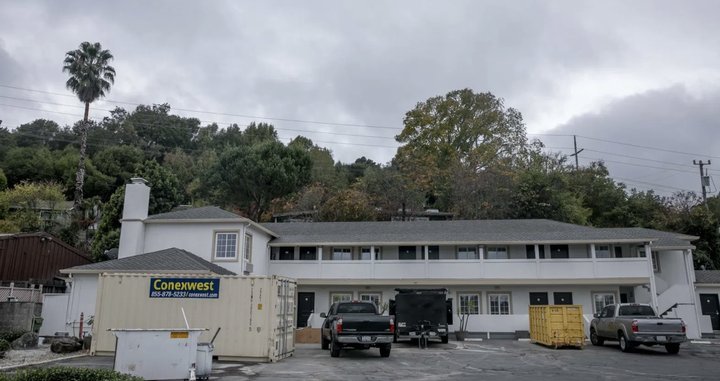
America’s Best Value Inn Corte Madera — an 18-unit motel — is among the properties Project Homekey is targeting for homeless housing. The $800 million program expires at the end of the year. Photo by Anne Wernikoff for CalMatters
If $800 million wasn’t a sufficiently appetizing carrot to get his audience to buy more motels, Gov. Gavin Newsom could dangle a more spiritual enticement: less time burning in the afterlife.
At the California State Association of Counties’ annual conference in mid-November, more than 200 county supervisors and other officials awaited answers via Zoom for how the governor was planning to ward off all manners of local government armageddon — pestilence, wildfires, pension payments.
When asked about Project Homekey, his program for counties to gobble up as many properties as possible for homeless housing in six months, Newsom veered into the theological.
“You can take years off purgatory, anything you’ve damn done wrong in your damn lives,” said the governor, crediting those officials that have jumped at the program. “Thank you for having the decency, the courage to do the right thing.”
The brimstone-tinted shade was in part directed at Marin County, the affluent Bay Area suburbs Newsom used to call home. The day before his Zoom remarks, the Marin County Board of Supervisors nixed a plan to buy the 70-unit Inn Marin in Novato and convert it to permanent supportive housing. After an outcry from neighbors and a dispute with the hotel’s owner over sales price (a $3.5 million gap between asking price and the appraisal), county supervisors in a closed door meeting decided to return the $11.9 million Newsom’s housing department awarded them for the purchase.
“Father Coz taught me in different verses in the bible, in terms of helping thy neighbor,” said Newsom, referencing his Jesuit economics professor at Santa Clara University. “And so when people push back and people say it’s not my responsibility and push it off to someone else, I’m going to keep pushing back against that.”
It’s not the first time Newsom has harangued local governments to shed a “not in my backyard” mentality and help house the more than 150,000 Californians without a stable place to call home. But in Newsom’s tone, or perhaps in the 11 times he said the word “damn” in his Zoom remarks, one can sense a more desperate exasperation. While the pandemic has laid waste to other parts of Newsom’s ambitious agenda, it has presented his administration with a time-limited silver lining: a perfect storm for getting people housed.
Newsom has some key factors working in his favor: Depressed land prices mean properties can be had at a relative bargain; most of the cost is on the outgoing Trump administration’s tab; and the coronavirus presents a public health justification to act quickly and skip the approval process that often derails housing projects.
Preliminary estimates also put the program’s acquisition price at $146,000 per unit. While that figure doesn’t include future construction costs, it’s a relative bargain compared to building homeless housing from scratch.
As part of “Homekey,”, California is set to acquire more than 90 properties it hopes to convert to homeless housing. If successful, the program could add 6,100 housing units, all of which will be ready for occupancy within three months.
Homelessness advocates say the pace and scope of the program are truly unprecedented.
“Seeing things get set up right away, while it’s been taxing and hard on all of us trying to keep up with everything, it feels kind of like a new day,” said Tescia Uribe, chief program officer at PATH, a Southern California-based homelessness services provider with eyes on two Homekey properties. “Let’s cut the red tape, let’s stop talking about why we can’t do things.”
Despite the optimism, Homekey faces significant questions: What will happen to the thousands of homeless Californians living temporarily in motels as part of Project Roomkey, Homekey’s predecessor? Will cities that object to new permanent homeless housing in their borders be able to derail motel sales? And will California voters see less of their neighbors sleeping on the streets as a result of Project Homekey?
Here’s what we know so far.
What happens to all those homeless people staying in motel rooms now?
That’s unclear.
Ruth Moore is 64, a breast cancer survivor, and unsure whether she’ll have to sleep in a shelter again come January.
She’s also one of nearly 14,000 formerly unsheltered Californians still living in a hotel funded by Project Roomkey, the emergency housing program Newsom created in April, according to state estimates. Since September, Moore has lived in the Hampton Inn in Roseville, a suburb of Sacramento. She and the 70 or so other formerly homeless occupants of the hotel have been told by Placer County caseworkers that they’ll need to find alternative housing by January, when the lease is set to expire.
Moore is skeptical. Earlier warnings that the hotel lease would expire turned out to be false alarms, as the county always seemed to find more funds at the last minute.
But if she is forced to leave, she’s unsure where she’ll go. She says she’s on a waiting list for a Section 8 voucher, and has applied to several subsidized senior housing complexes with no success yet. She’s resisted county staff efforts to steer her towards shared housing, where she had a bad experience before.
“What are they going to do, just throw us all out?” asked Moore. “I see people that are using their walkers, wheelchairs, they can barely get around. All of us are older, it’s not like we got 18-year olds in here.”
With an assist from the feds — the Federal Emergency Management Agency picks up 75% of the cost — California counties scrambled to lease as many hotel rooms as they could to get homeless seniors and those with serious pre-existing health conditions out of congregate shelters and encampments, where the virus could spread quickly. Neither FEMA nor the state could provide a comprehensive figure for how much the program has cost so far.
Ruth Moore, 64, shows some of the belongings she keeps in the trunk of her car. Moore occasionally slept in her car before finding a temporary hotel as part of Project Roomkey. Credit: Matt Levin / CalMatters
By some metrics, Project Roomkey was a runaway success. The state met Newsom’s ambitious goal of securing 15,000 rooms in just three months, providing tens of thousands of Californians their own bed and bathroom, some for the first time in years. And by relocating residents of overcrowded shelters to hotels, the state largely avoided the nightmare scenario public health experts feared: a major, deadly outbreak at a shelter or encampment (although homeless deaths unrelated to the virus are increasing).
“(Roomkey) really grabbed those who were at the highest risk of doing poorly and got them to safety,” said Dr. Margot Kushel, director for the UCSF Center for Vulnerable Populations. “At least in this first part of the pandemic, we didn’t see in the homeless population what we saw in, for instance, prisons and jails, where were these massive, massive outbreaks.”
But Roomkey is winding down, as hotel leases expire and counties run out of their own funds to make up for what FEMA doesn’t cover. Roughly 269 hotels are still in use, down from a peak of 329 in August. FEMA estimates that it’s already reimbursed about $30.6 million for hotels in five counties and one city, but that the final price is likely to be significantly higher once more jurisdictions submit their expenses.
As the virus surges across the state, the timing is alarming, especially with the prospect of a vaccine and more resources from the Biden administration mere months away.
More than 23,000 homeless Californians have at one point or another stayed in a Roomkey hotel room. But no state agency keeps a detailed accounting of where those homeless Californians have ended up, be it in permanent housing, in another shelter, or back on the streets. A data analysis from the Palm Springs Desert Sun, culled from more than 40 separate counties, found that only 5% of those who slept in a hotel room were transitioned to a permanent housing solution. Sixteen percent returned to homelessness.
The Newsom administration is desperately trying to ensure those currently in a hotel don’t end up homeless again. Earlier this month the state freed up $62 million for counties to extend hotel leases and provide more rental subsidies for those transitioning out of Roomkey.
So how is the motel shopping spree for Project Homekey going?
Good. Ish.
Newsom first floated Project Homekey, Project Roomkey’s successor, as part of May negotiations with state lawmakers over the pandemic-ravaged state budget.
Homekey would provide $600 million in funding (ultimately increased to $800 million) for counties, cities and local housing agencies to buy property that could be used for homeless housing.
But the money and flexibility came with a catch: It had to be spent by the end of 2020, or it would be returned to the feds. Since Homekey was approved as part of the state budget in July, that meant property transactions that often take years would have to complete in mere months.
In order to expedite the process — and avoid the politically horrifying prospect of returning free money to the Trump administration — Newsom and state lawmakers allowed Homekey projects to skip the zoning, permitting and environmental review steps local governments typically require.
Counties, cities, local housing agencies and affordable housing developers would have to guarantee projects could provide at least temporary housing within 90 days, and would have to match any state funding above $100,000 per unit.
Only a handful of the approved Homekey purchases are Project Roomkey motels with current homeless occupants. Many aren’t hotels at all.
The result: grants to buy 97 properties all over the state for more than 6,100 housing units, at last count. The appetite was so overwhelming that the state coughed up another $200 million to clear the project list, with philanthropic partners Blue Shield and Kaiser Permante pitching in additional funding.
“What Homekey did was really decrease the amount of time it would take,” said Jennifer Hark-Dietz, PATH executive director. “It really did help with being able to get these units online a lot faster than any other method we’ve seen before.”
Hark-Dietz says her organization was already close to buying the vacant 40-unit apartment complex in Los Angeles called “The Orchid” at the beginning of the pandemic. What PATH anticipated would be at least a 10-month process — time spent mostly devoted to layering different funding sources together — was hastened to 90 days once the project got Homekey approval and state funds.
Only a handful of the approved Homekey purchases are Project Roomkey motels with current homeless occupants. Many aren’t hotels at all: Alameda County is eyeing a college dormitory, while other sites are commercial properties that can be quickly repurposed for residential uses.
While stressing that the numbers aren’t final yet, a Newsom administration spokesperson estimated that the total cost of acquiring a Homekey housing unit was on average $146,000 per door. For the 25 projects that have closed escrow, the average cost was about $163,000 per unit.
The state did not require Homekey applicants to project future construction costs, but those can be pricey. Typically, the more expensive a property is to buy, the less construction work is needed to convert properties to permanent housing.
The Orchid is a good example. At $400,000 per unit, it’s one of the more expensive properties Homekey has targeted. But with private bathrooms and kitchens it can be used for permanent housing almost immediately, and is still significantly cheaper than building homeless housing from scratch. A Los Angeles City Auditor reporter found that homeless housing cost $500,000 per unit when constructed from the ground up.
What about the “ish” part?
While the Newsom administration has trumpeted Project Homekey awards in a series of press conferences, only 25 properties have actually closed escrow as of mid-November, according to the state, and seven projects that the state announced publicly have fallen through.
The state says money awarded to the failed projects has been redistributed to other Homekey applications, and that the units lost in those abandoned projects have been more than made up by the new units brought off the waiting list.
“We do not anticipate needing to return any money to the federal government,” a spokesperson for the state housing department wrote via email, referencing the Dec. 31 deadline for property sales to close before the federal dollars expire. The spokesperson also said the state anticipated about 10% of the deals they authorized would ultimately be scratched.
In six of the derailed projects, local governments have cited a gap between the price property owners were asking for and the property’s appraisal value. The state will only pay up to the appraisal price — locals are on the hook for anything above that.
Marin County Supervisor Damon Connelly says the $3.5 million gap between appraisal and sales price was what doomed the Inn Marin, not the opposition that had erupted in Novato, the city in which the motel was located.
“We felt an obligation to make sure that the deal made sense for taxpayers,” Connelly said. “We felt that what was being asked was significantly over what was appraised.”
A $12.5 million Sacramento motel conversion confronting legal challenges from a neighboring luxury housing developer has also been called off.
The defeat of these Homekey projects highlights the obstacles homeless housing has consistently faced in California. Even after taking away many of the legal avenues available to stop projects, local governments and neighbors are still finding ways to resist. While Project Homekey’s tight timeline has enabled the state to move swiftly, it has also provided ammunition for local elected officials to say their communities have had no chance to shape what those projects look like.
Will you see fewer tents after all of this?
Probably not.
If the roughly 70 remaining Homekey projects that have yet to be finalized go through, Newsom will have added more than 6,100 units of homeless housing in less than six months. Homelessness advocates say they can’t remember a time when the state has added so much homeless housing stock so quickly.
But despite the unprecedented scale and pace, the governor may not see meaningful progress on the metric most important to voters: a visible reduction in people sleeping outdoors.
With more than 150,000 Californians living in emergency shelters or on the streets, 6,100 units will make a dent, but it won’t solve the problem.
“Will we see a noticeable difference on the street? No,” said Kushel. “The homelessness problem is so enormous.”
Kushel and other researchers also fear the gains made by Homekey could be easily swamped by a flood of Californians becoming homelessness after the state’s temporary eviction moratorium is set to expire in late January.
That presents a major political problem for Newsom, who staked much of his pre-pandemic governorship on solving the state’s homelessness woes. A recent UC Berkeley poll found that while the governor received high marks for his handling of the coronavirus, more than 50% of voters said his handling of housing and homelessness issues was “poor” or “very poor.”
“The counterfactual is very hard for people to see,” said Kushel. “If we hadn’t done Roomkey, if we hadn’t done Homekey, things would have looked even worse. When things look like they’re the same, what people are not seeing is that the same is a lot better than worse.”
###
CALmatters.org is a nonprofit, nonpartisan media venture explaining California policies and politics.
Inside California’s prisons, coronavirus cases have exploded, reaching 3,861 active cases last week — the highest so far. Yet the state has slowed its early releases of inmates, raising questions about overcrowding as the infections spread through the prisons.
Over the summer, jails and prisons released thousands of inmates through early release programs. The state’s prison population dropped by nearly 20 percent, reaching its lowest in three decades.
But early releases have now slowed to a trickle. Between July 10 and August 9, more than 4,000 prison inmates were released, according to court documents. About three months later, it was fewer than 450.
As result, California’s prison populations are remaining constant at the same time that the virus is surging. Systemwide, the prisons remain overcrowded. Nine prisons that have been hit the hardest by COVID-19 are at least 120% over capacity.
“What should happen is populations in the jails should be reduced, and populations in the prisons should be reduced,” said Aaron Littman, deputy director of COVID-19 Behind Bars Data Project at UCLA School of Law.
In the meantime, county jails are facing their own problem: About 7,000 prison inmates are sitting in county jails awaiting transfers to state prisons. For months, state corrections officials halted the transfers, creating the backlog.
Recently about 3,000 inmates were transferred out of jails to prisons, but then, on Thursday, the California Department of Corrections and Rehabilitation again suspended transfers after coronavirus cases rose.
“It’s kind of a pressure release valve,” said Lieutenant John Bednar, a spokesman for the Mendocino County Sheriff’s Department. “We had a constant build-up.”
Struggling with the backlog at county jails
It was 3 a.m. when inmates climbed into vans and made the hours-long trip from Mendocino County jail in Ukiah to North Kern County Prison’s inmate reception center.
What was once a frequent, shorter trip to San Quentin was different now. After a coronavirus outbreak over the summer infected thousands of inmates and led to several deaths, San Quentin is no longer an intake center. The pandemic changed things: There were more inmates, more guards, COVID-19 tests and a multi-day trip with the overtime pay and per diem to match.
“We had a very small window,” said Bednar of the county’s sheriff’s department. Before moving, inmates had to be tested for COVID-19 within seven days making the trip. “We actually drove (the tests) down to a lab in San Francisco, so that we could get them back in time.”
Since August, the state has accepted 3,000 transfers at their three reception centers: North Kern State Prison, Wasco State Prison and Central California Women’s Facility.
Pre-COVID-19, the transfer machine cycled about 2,500 inmates from jail into prisons each month. But the pandemic quickly ground things to a halt, and then a slow, unsteady churn. The state picked up the tab, paying counties $93.54 per day for each inmate.
“We continue to work closely with our local law enforcement partners on all intake timing and procedures in a way that protects public health and public safety,” a spokesperson for the corrections department said in a statement. “While we recognize the suspension of intake has been challenging for county jails, it has been a necessary step.”
County jail populations in California declined in April, around the time $0 bail for misdemeanors and certain low-level felonies went into place. But by late June, the state Judicial Council reversed course, and while some counties, like Mendocino, continued zero bail, others did not.
“When they instituted zero bail, we immediately saw a big drop in numbers,” said Bednar. “But as time progressed, even with the zero bail instituted, our numbers just kept increasing.”
Inyo County did not keep $0 bail. Since rescinding it, the county’s jail population has nearly doubled. It’s larger than it was before the pandemic started.
Inyo County’s jail is struggling with a backlog as the state holds up transfers. Its jail often serves as a pit stop for inmates who are headed to state prison because they violated rules at the region’s inmate fire camp. Every now and again, the jail would hold a person or two, and the state would pick them up within weeks. But this year was different. There weren’t one or two “courtesy holds,” as Lieutenant Jared Sparks calls them. There were five.
“It’s a huge problem for us,” Sparks said. “We’re a small facility. We only have so many beds. We do not generally place state prison inmates in a two-man cell. They’re not in the general population.”
Inyo County can house 96 inmates, according to pre-pandemic population estimates. Right now, it holds 50. But Sparks said the estimated capacity numbers are unreliable during the pandemic, and having the state prisoners is making things more crowded.
“We do a pretty substantial testing and quarantine process here at the jail,” Sparks said. “So much so that we’re almost full all the time. Basically, to have these state prisoners in here, it’s taking out a substantial amount of my housing options because of their security levels.”
And it’s not just small counties that are struggling.Monterey County can manage about 850 to 900 inmates in its jail. More than that, and “it just gets harder,” said Jim Bass, the county’s chief deputy of corrections. “There’s less space to social distance. That’s when tempers tend to flare — just things that sometimes happen when people are around each other 24/7.”
By early November, the jail was full, and about 160 inmates were waiting to be transferred to state prison. The state then transferred 89 of them.
“There had been no transfers in roughly seven months,” Bass said.
The number of inmates awaiting transfer is a concern because nearly 30 percent of Monterey County jail inmates tested positive for COVD-19 in July. It’s unclear if any of the infected inmates were state prisoners.
San Joaquin County has a similar problem.
On Oct. 31, the county jail reported a little over 1,500 inmates, its highest inmate population since before the pandemic; 325 of them were state prisoners awaiting transfers.
“CDCR’s policy since March, 2020 of not accepting any transfers from county jails has had a negative impact on our overall census at the San Joaquin County jail,” said Jennifer Kline, spokesperson for the jail.
Last week, San Joaquin County was transferring inmates to prisons with hopes of moving more this week. But on Thanksgiving Day, CDCR stopped transfers.
Costs are also an issue.
“Hell, we had one guy who was costing us, between his treatments for dialysis, costing us ten times what they were paying us a week,” said Mendocino County Sheriff Matthew Kendall. “That’s where the shortfall is coming in.”
“They need to release more people”
Advocates say there is a solution for counties with overcrowded jails: release more inmates.
“Sheriffs have many options at their disposal,” said Lizzie Buchen, director of the ACLU of California’s Criminal Justice Program. “There are ways they can create space in their jails, and they should all be doing that in a much more significant way than they have been. Every sheriff in California can create a safe facility. They just need to release more people.”
While counties could release more inmates, they have no authority over state prisoners. That’s the state’s job.
Between July 1 and Nov. 11, 6,598 state prisoners were released from prisons and camps, according to court documents from the state. Since then, CDCR has mostly released people with 180 days or less on their sentence, suspending its one-year release program. The state also hasn’t awarded credits towards early release — which over the summer led to about 2,100 people released early, according to CDCR’s estimates.
When questioned about why early releases aren’t happening as much as they did over the summer, CDCR attorneys argued that the “discretionary early-release program was implemented as an added safety measure at a time when more comprehensive COVID-19 related policies were still being developed.”
And since then, they’ve “adopted additional significant safety measures to reduce the spread of COVID-19.”
Advocates say prison inmates at high risk from COVID-19, especially the elderly or those with health problems, should be priorities for early release.
“We think, essentially, the medically vulnerable should be the ones who could be released from prison to the community safely,” said Donald Specter, attorney for the Prison Law Center, which is trying to get CDCR to release more inmates. “And that should be done on a much larger scale than it’s being done now.”
Los Angeles County has done just that.
Since early April, Los Angeles County jails have released nearly 13,000 people, significantly lowering their jail population. A Los Angeles Sheriff’s spokesperson said “we can hold an inmate as long as necessary.”
And that may take awhile.
On Thanksgiving eve, 2,947 inmates were in Los Angeles County jails awaiting transfers. On Thanksgiving day, the state stopped all prison transfers — again.
###
CALmatters.org is a nonprofit, nonpartisan media venture explaining California policies and politics.
On 11-23-2020 at approximately 3:30 PM a bystander located the bodies of two deceased persons along Hulls Valley Road in a remote area Northeast of Covelo’s valley floor.
Sheriff’s Detectives responded to the location and confirmed the existence of the two deceased bodies.
Due to pending darkness, the Sheriff’s Detectives processed the scene the following day with the assistance of the California Department of Justice Eureka crime lab and investigators with the Mendocino County District Attorney’s Office.
On 11-27-2020 a forensic autopsy was performed on the bodies at which time they were identified as being Kyle James McCartney and Traci Lynn Bland.
An official cause of death for both individuals is pending at this time but Sheriff’s Detectives are investigating their deaths as being homicide related.
Sheriff’s Detectives are continuing investigations at this time and are working closely with the Mendocino County District Attorney’s Office in identifying suspect(s) and potential charging/prosecution related to McCartney and Bland’s deaths.
No additional information is available for release at this time due to the Sheriff’s Detectives ongoing investigations.
Once additional information becomes available, it will be disseminated via Mendocino County Sheriff’s Office press release.
The Sheriff’s Office would like to thank the following public safety agencies for their assistance in this ongoing investigation:
Mendocino County District Attorney’s Office, Round Valley Tribal Police Department, California Department of Justice Eureka crime lab and the California Department of Justice Santa Rosa crime lab.
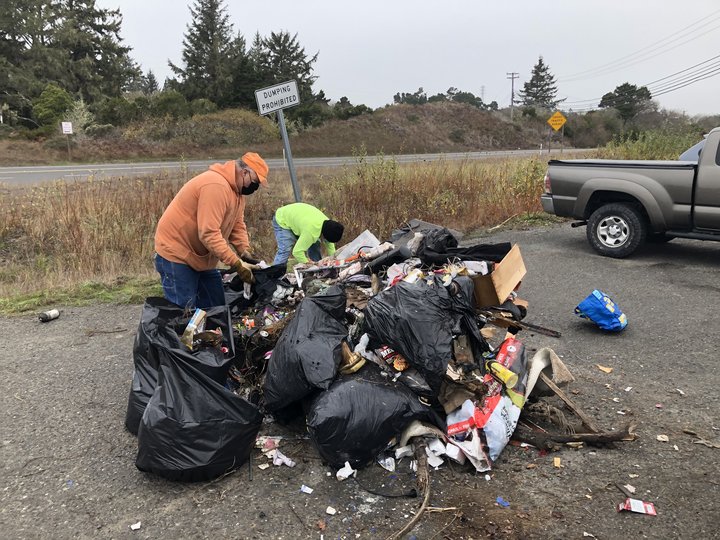
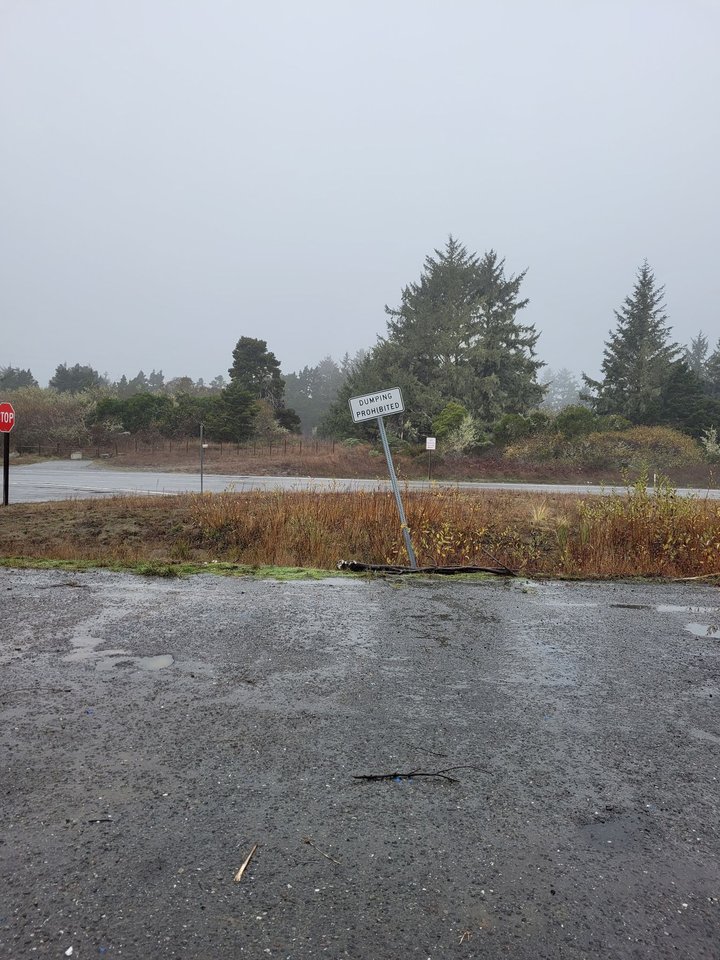
On Sunday, the Outpost was sent the above video, which shows some human garbage brazenly dumping a truckload of literal garbage at the intersection of Vance Avenue and State Route 255, just south of Manila on the Samoa Peninsula.
The videographer, who asked to be identified only as David from Manila, said in a message, “Clearly they’re using the sign as an anchor and put something at the very front of the bed attached to a strap or rope, so everything comes out when they drive away.”
The sign in question reads “Dumping Prohibited.”
Robert Provolt (left) and Roberto Theian picking up garbage on Monday.
###
On Monday morning, Humboldt Bay Harbor District employees Robert Provolt and Roberto Theian were onsite, cleaning up the garbage with help from a Manila residents Bobby Wright and Jennifer Savage, who is California policy manager for the environmental nonprofit Surfrider Foundation.
Provolt said that among the garbage they’d found mail and court documents with names and addresses.
Photo submitted by Manila resident.
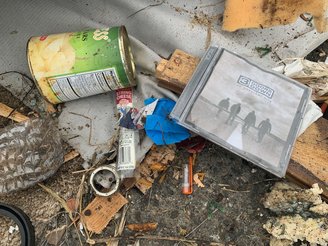
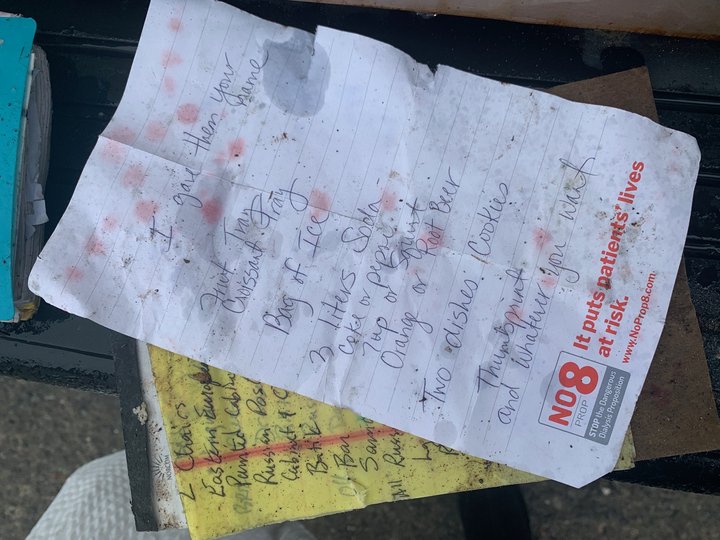
“Yeah, we’ve got three different names so far,” he said. Provolt plans to turn that information over to his boss. The pile of refuse included large garbage bags filled with household waste (clothing, food wrappers, a handwritten shopping list, a 3 Doors Down CD, etc.) along with broken furniture, scrap metal, empty motor oil cans and more. “This almost looks like a landlord cleared somebody out,” Provolt said. “A slumlord.”
Theian said people dump garbage on the peninsula “all the time,” especially along Vance Avenue. The Harbor District takes turns cleaning up the messes with other agencies, such as the PacOut Green Team, a nonprofit community group dedicated to picking up litter.
Pam Halstead, a member of the Peninsula Community Collaborative, agreed that the problem is chronic. “My husband and I have been picking up trash daily along Vance for the past two years plus,” she said.
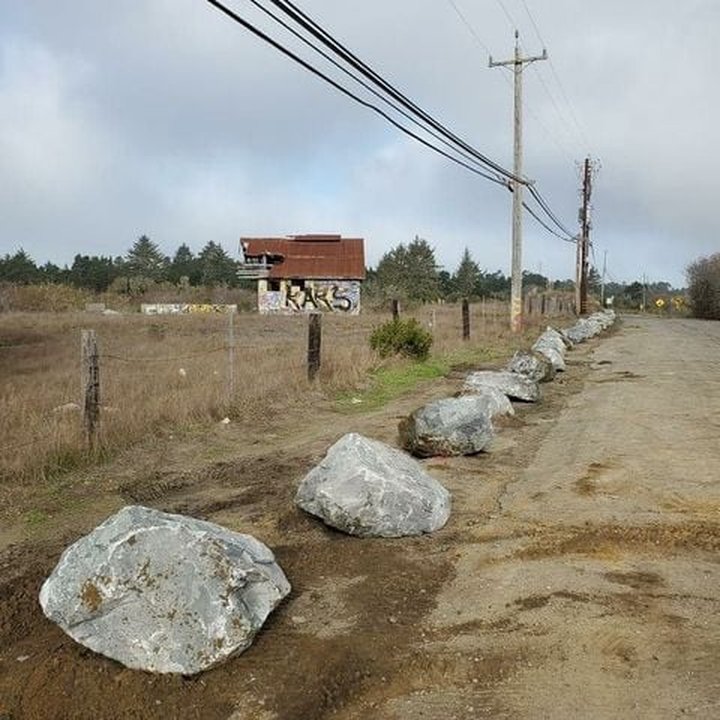
Just last week her organization placed large boulders along Vance in hopes of cutting down on the illegal dumping.
Photo courtesy Peninsula Community Collaborative.
###
The PacOut Green Team took to Facebook yesterday in hopes of identifying the culprits of this latest dump. They posted photos of the garbage, along with some long-distance shots of the maroon pickup truck.
###
A number of angry commenters theorized that the garbage was connected to a nearby homeless camp, but the page’s administrator said, “[W]e suspect it was not from a homeless person. Most of the trash we deal with are from ‘housed’ people.”
The Outpost reached out to the Humboldt County Sheriff’s Office to ask whether anyone has reported more info about this incident. We’ll update if we hear anything of substance.
Photos courtesy Manila resident.
###
UPDATE, 1:25 p.m.: Halstead sent along the following post-cleanup photo, and she said the sign has since been straightened.
Press release from the Humboldt County Sheriff’s Office:
On Nov. 28, 2020, at about 4:15 p.m., Humboldt County Sheriff’s deputies on patrol in the Loleta area conducted a traffic stop on a vehicle in the area of Montgomery Street and Eel River Drive.
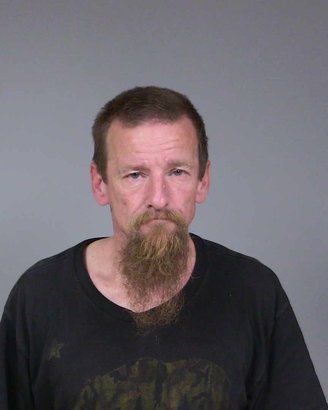
Deputies contacted the female driver, who was found to be on active probation with a search clause. While speaking with the driver, deputies observed cannabis in plain view inside the vehicle. Deputies conducted a weapons search of the driver and male passenger, 52-year-old Dennis Michael Burriesci, prior to searching the vehicle. During the search of Burriesci, deputies located a loaded firearm and learned that Burriesci is a felon restricted from possessing a firearm.
Burriesci was placed under arrest and further searched for illicit materials. During that search, deputies located two small bags of heroin, a small bag of methamphetamine, two bags of prescription pills, syringes and a large amount of cash.
During their investigation, deputies also located drug paraphernalia and psychedelic mushrooms.
Burriesci was booked into the Humboldt County Correctional Facility on charges of convicted felon in possession of a firearm (PC 29800(a)), person prohibited in possession of ammunition (PC 30305(a)), possession of a controlled substance while armed (HS 11370.1(a)), possession of a narcotic controlled substance (HS 11350) and possession of a controlled substance (HS 11377(a)).
The driver was released at the scene.
Anyone with information about this case or related criminal activity is encouraged to call the Humboldt County Sheriff’s Office at (707) 445-7251 or the Sheriff’s Office Crime Tip line at (707) 268-2539.




 Ruth Moore, 64, shows some of the belongings she keeps in the trunk of her car. Moore occasionally slept in her car before finding a temporary hotel as part of Project Roomkey. Credit: Matt Levin / CalMatters