Cannabis
use is on the rise globally. Whether seeking relief from pain,
menopause, stress, or a host of other ailments, individuals across
the world are increasingly seeking cannabis as a form of medicine or
as a recreational outlet. As tired stereotypes around cannabis
consumption fade away and as more governments look to the industry as
a source of economic output and personal wellness, forecasts for
industry growth are significant.
The
global cannabis market was valued at nearly $30 billion in 2021 and
is expected to grow to approximately $200 billion by 2028, an
impressive compound growth rate of 32%. In terms of market
segmentation, consumption growth is the fastest among Generation Z,
with
use among baby boomers and women also growing rapidly.
Because
the industry is evolving quickly, a plethora of new products are now
available to consumers. This piece will touch on different methods of
consuming cannabis so that you can make a more informed choice about
what works best for you.
Smoking
or inhaling cannabis is what traditionally comes to mind when
thinking about weed. Inhaled cannabis is enjoyed by many as their
preferred method of consumption. Cannabis can taste amazing and many
folks simply enjoy firing up a bowl or a joint. The process can
become somewhat ritualistic and I always derived satisfaction from
handling the flower, smelling it, putting it in my pipe or bong, and
watching it burn. Many also prefer the effects of inhaled cannabis as
it hits you quickly, often on the exhale for strong flower and
extracts. Effects tend to last from 1-2 hours for experienced users,
and longer for newcomers.
Smoking
isn’t the healthiest of activities though. Cannabis burns hot and
can be irritating to the throat. Some research also shows that
compounds found in cannabis can become carcinogenic when heated.
While
no direct causal link has been found between cannabis smoke
and cancer diagnosis, the plant does contain certain chemicals
deemed harmful such as benzopyrene and benzanthracene. Interestingly,
some scientists believe that the active compounds in cannabis,
cannabinoids and terpenes, actually prevent these chemicals from
causing cancer in pot smokers…fascinating stuff that we’d know
more about with a national R&D effort.
Smoking
cannabis also produces a very strong odor that some find offensive.
Of the delivery methods for consumption, smoking is the most
inefficient way to get cannabinoids into your system. 50% of the
active compounds are lost directly to flame, and another 20% are lost
upon exhale. Physicians rarely recommend smoking cannabis, favoring
vaporization for those who need a very fast onset of effects, such as
those consuming for migraine or nausea relief.
Vaporizing
is another form of inhaled cannabis that more and more consumers are
adopting. When vaporizing at a lower heat, plant resins and oils melt
without burning plant material and without allowing tars and burning
embers to enter your mouth. Because vape devices burn at lower
temperatures, fewer potential carcinogens are associated with this
method. This method is also essentially odorless and can be a very
discrete way of consuming. Vaping is also a far more efficient way to
consume cannabis that preserves over twice as many cannabinoids as
smoking.
Caution
must be taken though. Vaporizing, especially cannabis oils and dabs,
can be a very powerful delivery method not suitable for novice users.
Additionally, research is now showing that not all vape devices are
created equal. Some include metal alloys, contaminants, and plastics
inappropriate for heating. Using high-quality devices with
medical-grade inputs is important.
Finally,
as was in the news a few years ago, illicit market vape cartridges
can very dangerous. Because extracts are a highly concentrated form
of cannabis, any pesticide residue or other harmful chemicals on the
cannabis will be concentrated in the extract and found there at
higher levels. Additionally, some cartridges use vitamin e acetate to
thin the cannabis oil and this has proven to be quite dangerous.
Vape
carts make up approximately 23% of the legal market here in the
Golden State.
Edibles
refer to cannabis products that we eat. Because smoking is
associated with certain social stigma and health concerns, many find
edibles to be an appropriate alternative. Unlike inhaled cannabis
which goes directly to the central nervous system, edibles must be
digested by the stomach and metabolized in the liver before effects
are felt. As such, depending on your metabolism and what’s in your
stomach at the time of consumption, the onset of effects can take
between 30 minutes and 2 hours.
A
plethora of edible products are coming to market. Those made with
distillate, an odorless, tasteless substance, don’t taste like
cannabis and are the go-to method for some. I prefer full-spectrum
water hash gummies, which taste like ganja and provide me a
full-body, lasting experience characterized by creativity, curiosity,
and a general sense of well-being. The effect of edibles lasts quite
a while, up to 6-8 hours for some, longer for the less experienced,
or if a very high dose is taken. Those with chronic pain and sleep
issues find a nighttime edible to be very beneficial.
Edibles
are stronger than inhaled forms of cannabis and need to be approached
cautiously. I overshot one time on a brownie about 10 years ago.
Damn thing tasted like ganja sludge and I frankly should have known
better. I got sick, was an odd sort of green/yellow for several
hours, and the effect lasted all day. I was slumped over in the drift
boat and was half-ass dragging a fly down the Trinity as I couldn’t
stand or cast for several hours.
When
edibles are broken down by the body the THC (the active ingredient
that gets you high) converts to a stronger form which explains the
increased potency. I have also heard several stories of children and
pets accidentally consuming edibles, so for those with families,
extreme precaution must be taken to keep products safe, secure, and
away from unwanted hands (or paws). Initial dosing recommendations
for novice users are 2.5mg THC. Most edibles are sold in 5mg to 10mg
increments, which I believe is overly strong for newbies.
Within
the edibles category is an increasingly popular choice –
drinkables. Cannabis spiked, non-alcoholic beer, wine, seltzers, and
sodas are becoming more widespread in social settings. Unlike
traditional edibles with a very slow onset, drinkables hit the user
in about fifteen minutes.
Edibles
account for approximately 15% of California dispensary sales.
Tinctures
are cannabis-infused liquids made from alcohol or oils most
generally. Tinctures are designed to be used under the tongue and are
administered with a dropper. With this sublingual delivery, active
compounds enter the bloodstream and the onset of effect is much
quicker. Duration tends to be around several hours. Were you to
swallow the tincture instead, it would essentially become an edible
with slower onset.
I
enjoy the effect of tinctures but have found homemade versions
displeasing as I don’t like the taste of alcohol or oil. For many
though, this discrete form of consumption is a go-to method.
Topicals
are another interesting method of consuming cannabis. Creams and
salves are becoming increasingly available and with this method,
cannabis will not show up on drug screening tests if that’s a
concern for you. Topicals are being used for skin beautification,
localized pain management, and therapeutic massage namely. This
method of consumption will not get you high and has a relatively
rapid onset of effects around 30 minutes. Duration tends to be around
2-4 hours. Like all things, specifics matter. Understanding how much
active ingredient is in each product is important and will indicate
how much relative value a product has.
Transdermal
Patches, akin to a nicotine patch, are growing in interest and
availability. With a patch, medicine is released slowly, providing
ongoing relief for those who need it. It’s important to note that,
unlike salves or balms, a transdermal patch will show up on drug
screens.
Because
delivery of active compounds can be somewhat limited through a patch,
they should be placed on venous tissue where there is less fat and
softer skin. Research is underway in this area to improve delivery,
so we can expect to see further developments in months and years to
come.
Raw
Cannabis is being labeled as a superfood by some in the industry.
Cannabis acids like CBDa and THCa are available in raw plant material
that has not been heated, so folks usually juice cannabis or eat it
as an ingredient in salads. Full of antioxidants, omegas, and amino
acids, raw acids have been shown to improve immune function and serve
as anti-inflammatories. A very recent report from Oregon State
University and the Oregon Health and Science University even claims
that cannabis acids prevent the virus that causes Covid-19 from
entering human cells.
Raw
consumption is non-psychoactive so it will not get you high. Cannabis
trichomes can be a bit hard to digest, so some practitioners
recommend eating only immature cannabis leaves, while others believe
that eating both leaves and flowers is the way to go. Raw cannabis
can also taste bitter, so complimenting it with another fruit or
vegetable can make your experience more enjoyable.
Consuming
cannabis is no longer confined to friends passing around a doobie or
a pipe. Both psychoactive and non-psychoactive options designed to
treat a host of ailments are now available in the marketplace. With a
plethora of new products and consumption methods available, even
those with long-standing opposition to cannabis are entering the
market as they search for alternative forms of medicine, relaxation,
spiritual connection, or enhanced sensory experiences. Local
dispensaries are becoming more well-versed with relation to their
increasingly diverse product offerings and can be a resource for you
on your path to personal wellness.
###
Jesse Duncan is a lifelong Humboldt County resident, a father of six, a retired financial advisor, and a full-time commercial cannabis grower. He is also the creator of NorCal Financial and Cannabis Consulting, a no-cost platform that helps small farmers improve their cultivation, business, and financial skills. Please check out his blog at, his Instagram at jesse_duncann, and connect with him on Linkedin.
After thoughtful consideration and discussion, the Superintendents from the HDNL reached a
consensus regarding new spectator guidelines for the remainder of the 2022 Winter Sports
Season.
The group’s discussions were focused on the following priorities:
1. Preserve in-school instruction for all students
2. Preserve the opportunities for student-athletes to participate in competition
3. Provide a framework for Family Members to attend scheduled HDNL games/wrestling
contests
4. Avoid the California Department of Public Health (CDPH) defined Mega Events of 500
people or more, requiring Vaccine Verification or Negative Testing for all attendees age 2
and older
Starting Monday, January 24, each student-athlete will be able to have up to 4 Family Members
attend a HDNL Winter Sports Event. Family Members will enter the events as a group and also
follow the CDPH required masking guidelines once they enter the gym.
To maximize attendance opportunities for Family Members, the gyms will be “cleared out”
between each game and then the next group of Family Members will enter the facilities. For
smooth transitions between games, your prompt departure and patience while waiting to enter is
greatly appreciated.
Each school will be responsible for developing their “guest list” of Family Members for both
home and away games.
In support of these priorities, the Superintendents and the Humboldt - Del Norte League remind
the Community to fulfill the CDPH requirement for being masked in all High School buildings
and all indoor High School athletic events.
Thank you in advance for your understanding, cooperation and assistance.
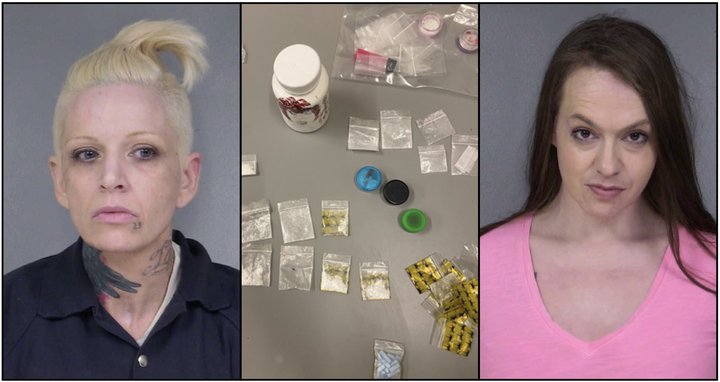
Since early January 2022 the Humboldt County Drug Task Force (HCDTF) had been investigating Amy
Spindler (45 years old from Eureka) for fentanyl sales. As a result of their investigation agents received a
search warrant for Spindler.
On January 20th, 2022 HCDTF agents contacted Spindler outside of her vehicle at a gas station in the 2800
block of Broadway St. in Eureka. Spindler and her passenger, Rebecca Chapa (37 years old from Eureka)
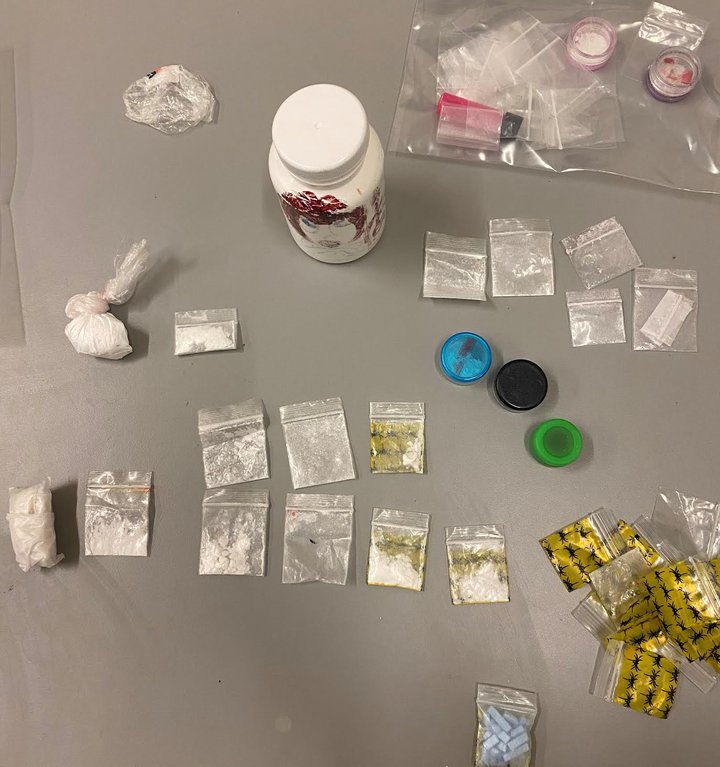
were detained without incident. Agents served the search warrant and located multiple packages and
containers of fentanyl and Xanax as well as cutting agents in the vehicle.
Agents advised both suspects they were under arrest and advised them that if they had drugs hidden
inside of their clothing it would be a felony to transport it into the jail. Chapa admitted to having
additional fentanyl inside of her shirt and she was allowed to retrieve the fentanyl out of her shirt and
give it to the agents. Spindler denied having any drugs hidden on her person.
Both suspects were transported to the jail and booked for the following charges:
H&S 11351 Possession of fentanyl for sale
H&S 11378 Possession of controlled substances for sale
During the jail booking Spindler was found to have fentanyl hidden inside of her shirt. Spindler added a
felony charge for the following:
PC 4573 Bringing drugs into a jail or prison
Anyone with information related to this investigation or other narcotics related crimes are encouraged to
call the Humboldt County Drug Task Force at 707-267-9976.
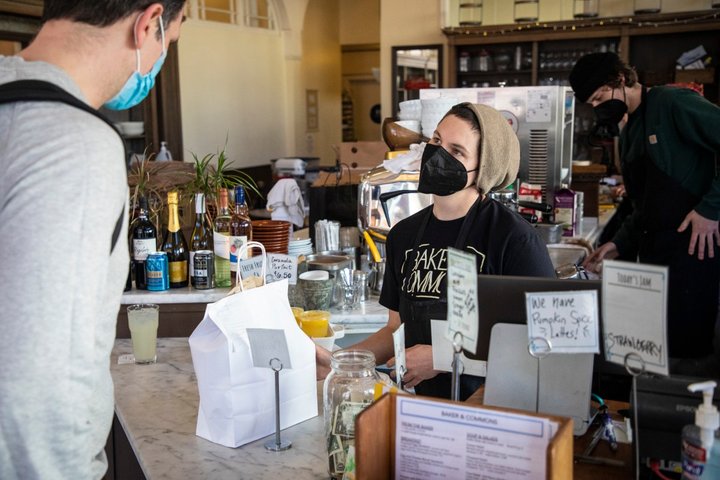
Jaz B. serves a patron at Baker & Commons in Berkeley on Jan. 19, 2022. Photo by Martin do Nascimento, CalMatters
###
A new cough. The beginnings of a fever. A note from your boss about a COVID case at work.
As omicron ripples across California, workers are learning they’ve been exposed and coming down with symptoms. What happens next? There are rules employers and workers are supposed to follow to keep workplaces safe and limit the spread of the virus.
Most California workers who are working in person are covered by emergency temporary rules from the Division of Occupational Safety and Health, better known as Cal/OSHA. A subsection of workers, including some in health facilities, correctional facilities, homeless shelters, and drug treatment centers, are protected by different workplace rules.
Here are the answers to some questions Californians might have about their rights in the workplace during the pandemic.
Can I get time off to get tested?
Sort of.
If you get exposed to COVID at work, your employer is generally required by Cal/OHSHA’s covid workplace rules to provide you with testing, at no cost, during paid time, unless you’ve recently recovered from COVID.
If your exposure is from outside of work, your employer is still required to provide testing at no cost to you, during paid time, if doing so would allow you to remain at work or return to work earlier under public health guidelines for isolatiolation and quarantine, said Erika Monterroza, a spokesperson for the state Department of Industrial Relations.
Unvaccinated, symptomatic workers must be provided with tests by their employer, at no cost to themselves, during paid time, regardless of whether there is a known exposure.
Can my boss make me come to work if there’s a COVID outbreak at my workplace?
It depends.
If an outbreak happens at work, employers are generally required to immediately make testing available to workers who may have been exposed, at no cost to the workers. If you test positive, your employer is required to send you home with pay, and you should only return to work once you meet public health guidance for ending isolation.
If you were exposed but don’t immediately test positive, whether or not you get sent home from work depends on which category you fall into in the state public health department’s isolation and quarantine guidance.
If there’s an outbreak but you weren’t exposed — say, for example, you work in a different building than the people who have COVID — Cal/OSHA’s COVID workplace rules don’t prevent your boss from insisting you work in person, said Monterroza.
Do I need a mask at work? Do patrons? Who enforces the masking rules?
Yes, workers must wear masks while working indoors, under a statewide mask mandate that went into effect in mid December.
There are some exceptions, like for workers who are in a room by themselves, workers with a medical condition that prevents them from wearing a mask, and for when workers are actively eating or drinking.
Employers are responsible for ensuring their employees follow workplace mask rules. If an employer is not enforcing mask rules, workers can file a complaint to Cal/OSHA online or call the agency’s center that handles workers’ questions about COVID-19 at 833-579-0927.
There are other ways for workers to address workplace safety issues, including mask usage. Workers are entitled to band together to raise a labor issue with their employer, said Stephen Knight, executive director of Worksafe, a statewide occupational safety organization.
“Anything you do to raise a labor issue with your employer together with other colleagues at work is protected activity under federal law,” Knight said, adding that it is safer for workers to raise issues collectively than to do so alone.
The statewide mask mandate extends to all indoor public settings, so customers coming into stores or gyms, for example, have to wear masks. Local law enforcement agencies are responsible for enforcing mask rules for customers, Monterroza said.
If I get COVID, do I get additional sick leave?
Probably not.
Individual employers may opt to offer supplemental sick leave for COVID. Some localities require that companies provide supplemental COVID sick leave, said Hannah Sweiss, an attorney who counsels employers on how to comply with workplace COVID rules. The city of Los Angeles, for example, requires large employers to offer extra sick leave.
But there’s currently no statewide requirement that employers offer extra sick leave for COVID.
There was a statewide requirement that companies with more than 25 employees offer as much as 80 hours of supplemental sick leave related to COVID-19, but it expired in September of 2021. Legislators and the Newsom administration are currently negotiating over bringing back extra paid sick leave for COVID, with the goal of an agreement in the next several weeks.
Again, if you get COVID from a work-related exposure, your employer is required to send you home, with pay. If your employer provides sick leave beyond the three days required by law, it can require you to use those additional sick days while you quarantine or recover.
However, you can’t be asked to use your three sick days to cover time out after a workplace exposure to COVID. Unless you are already receiving disability or workers’ compensation for the time you’re out after a workplace exposure, your employer is typically on the hook for paying you until you meet public health guidelines to return to work.
“We are muscling our way through a pandemic without sick leave. It needs to be changed, and I don’t know what the people can do but call the governor.” — Stephen Knight, executive director, Worksafe
If you have to quarantine due to a COVID exposure or case that you’re sure isn’t work related, you can use any existing sick days you have. Beyond that, your employer isn’t required to pay you for that time. However, you may be eligible for other benefits, such as disability insurance.
With omicron spreading rapidly, it isn’t always clear if a worker was exposed to COVID from work or outside of work, said Mitch Steiger, senior legislative advocate with the California Labor Federation. Workers could think they got it off the job when they actually got it on the job, said Steiger, so workers may want to consider the possibility that their exposure was occupational.
Worker advocates are quick to point out that public health guidance telling COVID-positive workers to stay home for five days, while the state only requires employers to give three paid sick days, puts some workers in an impossible situation.
“We are muscling our way through a pandemic without sick leave,” said Knight. “It needs to be changed, and I don’t know what the people can do but call the governor.”
Can I get workers’ compensation if I get COVID at work?
Workers’ compensation covers things like medical care, temporary disability payments if you lose wages because of COVID, and permanent disability payments if you don’t recover completely.
It’s pretty straightforward for a worker to start the process of getting workers’ compensation, said Steiger. Once a worker reports having suffered an occupational illness, the employer is required to give the employee a form to fill out to start the process. The Department of Industrial Relations has a guide for workers about how the process works.
Steiger cautions that the process can move slowly, so employees should get it started as early as possible, and also consider whether they should be paid for time out from work under Cal/OSHA’s COVID workplace rules.
A California law passed in 2020 made it easier for first responders and health care workers, as well as workers at a worksite that has COVID outbreak, to access workers’ compensation, by building in a presumption that if these workers get sick it’s due to exposure at work. The burden is on employers to prove the illness did not occur at work.
Can my employer change my job while I’m sick with COVID or quarantining?
If you’re quarantining or sick with COVID because you were exposed at work, and you’re not currently receiving disability or workers’ compensation payments, your employer is required to maintain your pay, benefits, seniority, jobs status, and all other employee rights.
Employers aren’t supposed to disincentivize employees from reporting COVID exposures, said labor lawyer Ilana Morady.
If your boss fires you, or retaliates against you for following public health guidance after an exposure or positive test, your boss could be violating rules that require employers to ask employees to report COVID-19 symptoms and possible close contacts to their employer without fear of reprisal, said Morady.
###
CALmatters.org is a nonprofit, nonpartisan media venture explaining California policies and politics.
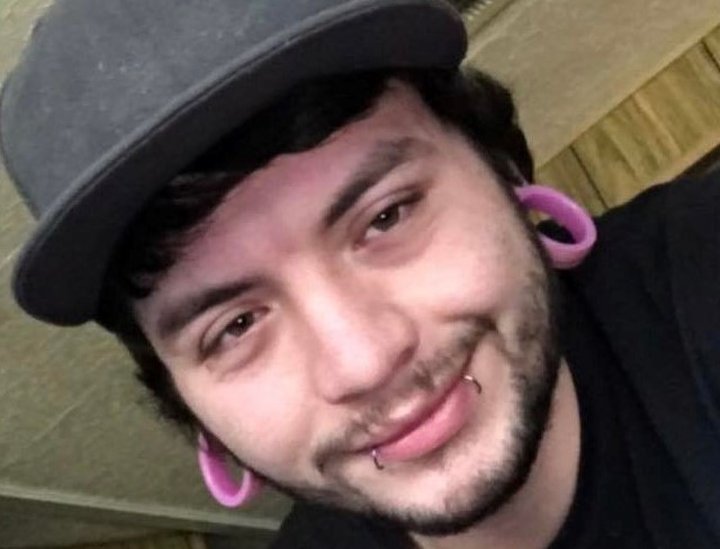
Kevin Carlos Rodriguez entered
this world on November 7, 1991 to his parents Carlos and Kelly
Rodriguez in Libby, Montana. He departed this life on Sunday night,
December 26, 2021 in Willow Creek at the age of 30. Kevin’s life
ended suddenly; while working as a tow truck driver assisting a
customer, when a random snow-covered tree fell. In an instant the
world was forever changed for all who loved and knew Kevin.
Kevin
and his siblings grew up in Butte, Montana. Kevin and his twin
brother Kris were inseparable. Always together whether laughing or
arguing; always side by side. Regardless of the fighting and name
calling, there was no stronger bond than what they had. With older
brother Jeremy and sister Jonna, a lot of the kids in Montana enjoyed
“Folfing”. Californians call it Disc Golf, but in Montana it’s
“Folfing.” They all liked to play in the snow, shoot guns, and
were your typical kids. Kevin had many friends in Butte: Tosha Ward,
Brandon Belli, Cody Clarke, Travis Ceartin, and many others. Kevin
graduated from Butte High School in 2011.
Kevin
moved to Willow Creek in 2016 to be near his mother Kelly, brothers
Jeremy and Kris, and several other family members. He wanted to make
a better life for himself. When he met the love of his life, Cassidy
Burchard, his new journey began. Together they created their own
family, having Haisley Raelynn join them one year ago. Being a father
changed Kevin’s life instantly.
Kevin
was a kind person, with a caring soul who became an amazing man and
father. He briefly worked at the Pizza Factory, The Smoke Shop and
Chevron before finding his niche at Buddy’s. Kevin was charismatic,
funny, and enjoyed the banter and camaraderie with the Buddy’s tow
family. Wearing his favorite color pink gauged lobes, with his
mischievous smirk, Kevin would routinely negotiate with the other
drivers, who’d take the next tow to the coast, so he could eat
lunch at his favorite Mexican restaurant, or order his favorite
cheeseburger. Kevin was a hard-working man, and really enjoyed being
a tow truck driver. He cared about everyone, and “he
was always helping somebody”
whether on the job or off the clock. He liked to play video games,
but most of all he valued spending time with his two greatest loves,
Cassidy and Haisley. He was the happiest man, and father, with his
big beautiful smile; there was no mistaking his love.
Kevin
is survived by his dearest love, Cassidy Burchard, and their one-year
old daughter Haisley Raelynn Rodriguez; his mother Kelly Rodriguez
and her partner Bill Barber; his father Carlos Rodriguez; his older
brother Jeremy Rodriguez and wife Destinie; his twin brother
Kristopher Rodriguez, his younger sister Jonna Stuart and husband
Rob, and several nieces and nephews. Also his uncles, Tony Allen and
Phillip Allen; his aunt Tracy Allen and her son Scott Street; and
many cousins.
Kevin
was preceded in death by his maternal grandmother April Parvi, and
his uncle Paul Allen.
At
noon
on Sunday, February 6, 2022, Buddy’s Auto Center is coordinating a
Tow Truck procession to honor our hero, Kevin Carlos Rodriguez. The
procession will conclude at the Trinity Valley Elementary School.
At
2 p.m. on
Sunday, February 6, 2022, family and friends are invited to attend a
Celebration of Life in the Trinity Valley Elementary School
gymnasium, 730 Hwy. 96, in Willow Creek. A reception
will follow at The Detail Shop, 135 Mayfair Street, Willow Creek. And
yes, the menu includes cheeseburgers.
Kevin
will be truly missed and never forgotten. His memories will live on
through his daughter Haisley, hearing all the stories. We love you
Kevin.
Contributions
can be made to the Haisley Raelynn Rodriguez youth account, at Coast
Central Credit Union.
###
The obituary above was submitted on behalf of Kevin Rodriguez’s loved ones. The Lost Coast Outpost runs obituaries of Humboldt County residents at no charge. See guidelines here.
Randy L. Church
July 30, 1960, to November 23, 2021.
On November 23, 2021, Heaven gained an amazing man. Randy Lee Church (61) was born in Fortuna to Roy and Wilma Church. Randy was the youngest of four boys. Randy grew up surrounded by his brothers and close friends that he considered family. He spent as much time as possible outdoors fishing, hunting, racing motorcycles and working in the woods. Randy fell in love with racing his motorcycle and was very good at it. He won tons of trophies that he was very proud about and could tell you a story about almost every trophy he had. His main reason for winning was to make his dad proud.
One of Randy’s main passions was fishing. He would fish anywhere at any time. If the fish were running you were more than likely going to see his truck parked somewhere along Highway 36. He could tell you the best fishing stories about his escapades with his closest friends. Randy was a fix-it man. I don’t recall there ever being a thing that he couldn’t fix. People would come from afar to get his opinions or to have him fix things.
Randy met his lifelong love Diana Bennett in 1992. For 28 years they stood by each other through thick and thin. One of their greatest accomplishments was building their family. In 2008, they were able to finalize their adoption of Bobbie Jo Church (JoJo). Randy was completely wrapped around her little finger. He loved and adored his daughter. Years later the family grew to include their bonus daughter Kasey Hackett and their love only grew stronger. Randy’s love of his family and friends knew no bounds. He had a heart of gold and would help anyone in need whether he knew them or not. His friends were his family. If you were lucky enough to know him, you knew that he had your back. He had the best sense of humor and an infectious laugh. He was a rare gem that is deeply missed by so many.
Randy is preceded in death by his parents, Roy and Wilma Church, his nephew Joey Church, Diana’s grandmother Ellen Judd and her father Kevin Wildman.
He is survived by his life partner Diana Bennett and their children JoJo and Kasey, his family Kenny and Janet Church, Greg and Makenzie, Richard and Joyce Church, Angel, Brandi and Alex Church, Laurie Church and son Cade, Matalie Steen and family, Bobbie and Kevin Spurlock and family, Rod and Annette Church, Stephanie and Steve Tosten and family, Brookeand JV Glaser and family, and Rodney Ray and Jennifer SorciChurch and family. He is also survived by Bob Judd and Sheila Judd, Debra Bennett, Brent Bennet and Laura Svoboda and family, Shaun Wildman and family, Lauri and Cruz Gomez, Jessica and Jafid Moran and son Connor, Daniel Gomez, Nick and Sarah Rennie and daughter Madelyn. Randy had so many friends and family that he held near and dear such as Mike Raven, Scooter Harris, Leonard Rodriguez, Shane Toole, DaveGomez, David Card, Gene and Sarah Bender, Laurel Jewel, and so many more.
Due to the uprise in COVID cases we are postponing his celebration of life until it is safe for all. We will inform you with a date as soon as we know. Thank you all for your love and support.
###
The obituary above was submitted on behalf of Randy Church’s loved ones. The Lost Coast Outpost runs obituaries of Humboldt County residents at no charge. See guidelines here.
Guess what! It is once again time to preview how the rest of the world will soon view Humboldt on their personal screens. Click play above… and remember to breathe.
Yes, earlier today Apple TV+ released the trailer for The Sky is Everywhere, the A24-produced, Josephine Decker-directed adaptation of the 2010 young adult novel of the same name that LoCO readers will recall was shot entirely here in Humboldt back in the fall of 2020. Remember? The film crew painted the rail of the Old Town gazebo a glorious blue before it was unfortunately repainted black? Yeah. That was for this.
As shown in the trailer, the film centers on the story of Lennie (played by Grace Kaufman), who is simultaneously having difficulty coming to terms with the death of her sister while also navigating budding complicating relationships with her sister’s former boyfriend and the new boy in school. Other notable Sky performers include Jason Segel (Forgetting Sarah Marshall, The Muppets, TV’s “How I Met Your Mother”) and Cherry Jones (“The Handmaid’s Tale,” HBO’s “Succession”).
Oh, and let’s not forget another of the film’s stars: Humboldt County! Back in 2020, LoCO respectfully crept onto The Sky is Everywhere‘s film sets as they were shooting in Sequoia Park and Old Town. On top of those locales, in this trailer we spot Arcata High School, Arcata Presbyterian Church and the Eureka Waterfront. (What did we miss?)
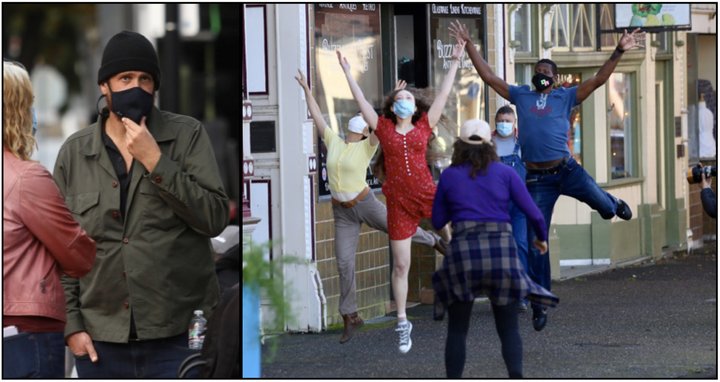
Sky stars Jason Segel, Havana Rose Liu and local actors on set in Nov. 2020 | Photos: Andrew Goff
In addition to the joy of seeing Humboldt filmed so beautifully and professionally, there are some in our midst, namely Humboldt-Del Norte Film Commissioner Cassandra Hesseltine, who would like us to remember what a nice little boost to the local economy these large-scale productions afford us. By Hesseltine’s calculations, The Sky is Everywhere crew injected upwards of $2 million into local businesses — between lodging, meals, supplies and Jason Segel’s trips to Jitter Bean, among other expenses — during their multi-month stay here at the height of the pandemic. (As someone who visited the set, we can attest that strict COVID safety protocols were followed.) Over 500 local people played some role in the production and Hesseltine is happy with what she’s seen of the film so far.
“We are thrilled with the look of the trailer and looking forward to seeing our beautiful locations when the entire film premieres!” Hesseltine told LoCO. “Honored that they filmed the entire project in the redwood region while keeping the community safe during the pandemic.”
The Sky is Everywhere will be released in select theaters and (more useful to local eyeballs) Apple TV+ on Feb. 11.