

Arcata House Partnership Approved to Operate Safe Parking Program for Homeless, But Executive Director Says Short Staffing May Delay Program’s Launch
Stephanie McGeary / Thursday, Jan. 20, 2022 @ 1:41 p.m. / Homelessness , Local Government
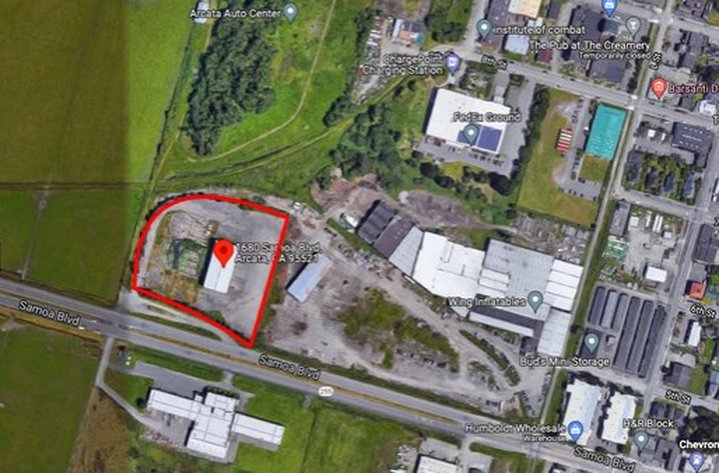
The site at 1680 Samoa Boulevard that will hold Arcata’s Safe Parking Program. But how soon? | File image
PREVIOUSLY:
- Safe Parking Program: Arcata City Council Will Consider Leasing Property on Samoa Boulevard to Provide a Legal Place for Homeless People to Sleep in Their Vehicles
- Arcata City Council Approves Safe Parking Program to Shelter Homeless, Moves Forward with Valley West Hotel Housing Projects
- Arcata House Partnership Proposes Plan to Operate Arcata’s ‘Safe Parking Program’ for Homeless; Council Will Review Proposal Tonight
###
During its Wednesday night meeting, the Arcata City Council unanimously voted to award a contract to local nonprofit Arcata House Partnership (AHP) to operate a Safe Parking Program on an industrial site on Samoa Boulevard, providing a safe and legal space for homeless people to park and stay in their vehicles.
The site at 1680 Samoa Boulevard can accommodate up to 30 vehicles – including cars, trucks, vans and RVs – and will be equipped with portable restrooms, drinking water, and electrical charging stations. Residents will also be provided with free meals, mobile showers provided by Affordable Homeless Housing Alternatives (AHHA), access to medical services and access to case management to help them secure employment, benefits and more permanent housing. Funding to operate this pilot project for one year will come from $685,000 in ARPA funds, which the council set aside earlier this year for development of a Safe Parking Program.
With the funding in place, the location secured and AHP’s operations proposal approved by the council, just about everything is on track to get the Safe Parking Program up and running. But Darleen Spoor, executive director of AHP, told the Outpost that the nonprofit is facing one big roadblock: AHP does not currently have enough employees to operate the program.
“The biggest thing that’s gonna hold us up is getting staff,” Spoor told the Outpost in a phone interview on Thursday morning. “We are severely short-staffed…Our staff are working overtime. I can’t keep asking them to go at this rate.”
To ensure the safety and security of the residents, the Safe Parking site needs to have 24-hour on-site management, something that was included in AHP’s proposal. On top of that, the organization needs staff to conduct outreach – accessing and communicating with Arcata’s unhoused population, to identify folks who are eligible for the program and to invite them to move to the Samoa site. At the bare minimum, Spoor said, AHP will need to hire five new staff members to be able to operate this program on top of the nonprofit’s other services.

AHP currently has six job openings posted online and Spoor says that she has just not been getting applicants. Spoor says AHP has even raised the starting salary several times, with their starting wage now set at $20.72 per hour – more than $5 above California minimum wage. The positions also include full health benefits, paid holidays and vacation time. Still, there has been little interest so far.
Why exactly it has been so hard to find employees, Spoor is not sure. But the issue is certainly not unique to the nonprofit sector. As industries re-awaken amid the COVID pandemic, the county and the state are seeing a huge labor shortage, which has been attributed to multiple factors including people’s COVID fears, childcare needs and the ability for many people to work remotely. Spoor says that other agencies she works with are getting hit hard too. “All of us – medical providers, other service providers – we’re all grossly understaffed,” Spoor said.
Facing short staffing is a frustrating issue for Spoor to deal with, especially at a time when so much progress is being made to address homelessness in Arcata. In addition to moving forward with the Safe Parking Program, the Arcata City Council recently took steps to advance AHP and Danco’s efforts to convert two Valley West hotels into permanent supportive housing for homeless individuals. AHP recently applied for a state Homekey grant to fund its portion of the project and Spoor said she hopes that she will have enough staff in place before that project also gets underway.
If all goes well and AHP can find more staff, Spoor says she hopes to launch the Safe Parking Program sometime in February. The plan will be to start with 10 vehicles on the site and build up from there, she said. Before anyone can move in their vehicle, a few improvements also need to be made to the Samoa property, including installing a security camera and putting in the portable restrooms and trash receptacles. But Spoor says that all of that could be done pretty much immediately.
The staffing situation is really AHP’s only roadblock at this point and Spoor just hopes that the nonprofit can find more folks so it can launch this important project. Spoor realizes that the Safe Parking Program is not a long-term solution, but it will offer immediate assistance to folks in need.
“Is it ideal? No,” Spoor told the Outpost. “Do I wish they could have more permanent housing? Yes. At least they’ll have a place to get stable. At least they’ll have a place to pee. A lot of us take that for granted.”
BOOKED
Today: 12 felonies, 16 misdemeanors, 0 infractions
JUDGED
Humboldt County Superior Court Calendar: Friday, Sept. 4
CHP REPORTS
No current incidents
ELSEWHERE
RHBB: CDPH Issues Immunization Recommendations for 2026-27 Respiratory Virus Season
RHBB: Redway Transfer Station to Close an Extra Day for Construction
RHBB: Dows Prairie Road to Close for Two Months for Culvert Repair
TODAY in COURT: Two Local Murder Cases Moving Forward
Rhonda Parker / Thursday, Jan. 20, 2022 @ 1:18 p.m. / Courts
The preliminary hearing has been delayed for a Garberville resident accused of murdering a 25-year-old Whitethorn man by shooting him in the head.

Combs.
This morning, at the request of Deputy Public Defender Ben McLaughlin, Judge Kaleb Cockrum granted a continuance for Jake Henry Combs, 29. The hearing had been scheduled for this morning, but McLaughlin said there is “a considerable amount of discovery (evidence) outstanding,” including the autopsy report.
Combs allegedly shot Trevor John Earley to death in the early morning hours of Jan. 6 after walking up behind Earley and putting a 9mm handgun to his temple.
Deputy District Attorney Shelly Small did not object to the continuance, acknowledging there is discovery outstanding. But Small said Earley’s family “is suffering considerably” and she would like to get the hearing done as soon as possible.
Small asked for a “special set” hearing, meaning the time would be set aside for just this hearing.
Generally there are numerous cases scheduled for preliminary hearing, and very few actually happen because there is not enough courtroom space.
Cockrum set Feb. 22 as a setting date for the hearing, which could take up to a full day. A special set “is a good idea,” the judge said.
Some of Earley’s family members or friends were in the courtroom audience today. They glared at Combs as they left. Combs remains in custody on bail of $1.5 million.
PREVIOUSLY:
- 29-Year-Old Arrested in Connection With Alderpoint Homicide This Morning
- Friends and Family of Alderpoint Murder Victim Pack Courtroom as Suspect is Arraigned
[CORRECTION: This story initially stated that Combs was a parolee. This was false, and has been corrected. The Outpost regrets the error. —Ed.]
###
In other court news, jury selection is nearly complete for the trial of Ulisses Rodriguez, charged with the August 2018 murders of a Southern Humboldt couple he says that he believed were stealing marijuana from his grow site.
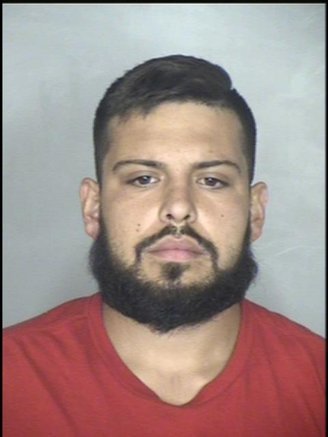
Rodriguez.
This morning 12 jurors were already seated, and attorneys were questioning prospective alternate jurors. The 27-year-old Rodriguez, wearing a dress shirt, sat at the counsel table next to defense attorney Andrea Sullivan.
The courtroom blackboard was filled with the names of trial witnesses, many of them from law enforcement. Officers from the Sheriff’s Office, state Department of Justice and the FBI are expected to testify.
Rodriguez lived in Chico but was growing marijuana in the China Creek area of Southern Humboldt. He allegedly shot Jeremy Kuemmel and Tiffany Ellebrecht, then placed their bodies in a vehicle and set it on fire.
He is charged with murder with the “special circumstance” allegation of multiple victims. If convicted Rodriguez could be sentenced to life in prison without parole.
Deputy District Attorneys Luke Bernthal and Trent Timm are the trial prosecutors. Judge Gregory Elvine-Kreis is presiding over the trial.
PREVIOUSLY:
- Chico Man Arrested in Connection to Two Bodies Found Inside Burning Vehicle Near Ettersburg Junction
- Chico Man Pleads Not Guilty to SoHum Double Homicide
- Preliminary Hearing Set for Chico Man Charged With SoHum Double Murder
- Chico Man Held to Answer for Murder of SoHum Couple in Dispute Over Stolen Weed
- COURT ROUNDUP: Trial for Suspect in Gruesome SoHum Double Murder Set for Christmas Eve; Godoy-Standley Judged Mentally Competent; Fortuna Murderer Gets Two Years’ Credit
- HUMBOLDT COURT ROUNDUP: Updates on Two Murder Cases, Two Attempted Murder Cases
- COURT ROUNDUP: Mck Woman to Plead Guilty to Manslaughter; Hoopa Man’s Murder Trial Set to Begin; More Updates
- TODAY in COURT: Bear River Triple-Murderer’s Sentencing Delayed; Double-Murder Trial Over SoHum Couple’s 2018 Deaths Scheduled to Start Next Week
Teenage Driver in Fatal Hoopa DUI Collision Released From Jail With No Charges Filed Yet
Rhonda Parker / Thursday, Jan. 20, 2022 @ 12:04 p.m. / Courts
PREVIOUSLY:
###
A Salyer teen arrested for suspected DUI and vehicular manslaughter has been freed from jail with no charges filed.
Keiahna Moody, 18, was released from Humboldt County Correctional Facility about 5:30 p.m. yesterday. She was booked the evening of Jan. 15 after wrecking her car in the Hoopa area about 3 p.m. that day.
One of Moody’s passengers, 18-year-old Carlie Kelley of Hoopa, was not wearing a seatbelt and was ejected and killed when the car overturned.
District Attorney Maggie Fleming said the case is still under investigation and more information is needed before deciding on the appropriate charges.
“I have discussed the investigation with CHP; the investigation remains in progress and we have yet to receive the results of her blood screen,” Fleming said in an e-mail. “We need the additional information to determine what charges fit her conduct and what charges can be supported.”
According to the California Highway Patrol, Moody lost control of the 2006 Chrysler PT Cruiser “due to (her) level of drug impairment.” The car crossed into the oncoming lane on Pine Creek Road, went into a ditch and overturned. Kelley was pronounced dead at the scene.
Moody and another passenger, a 20-year-old Hoopa man, were wearing seatbelts and suffered minor injuries.
With Pandemic Protections Gone, Essential Workers Face Omicron Surge Alone
Alejandro Lazo / Thursday, Jan. 20, 2022 @ 7:03 a.m. / Sacramento
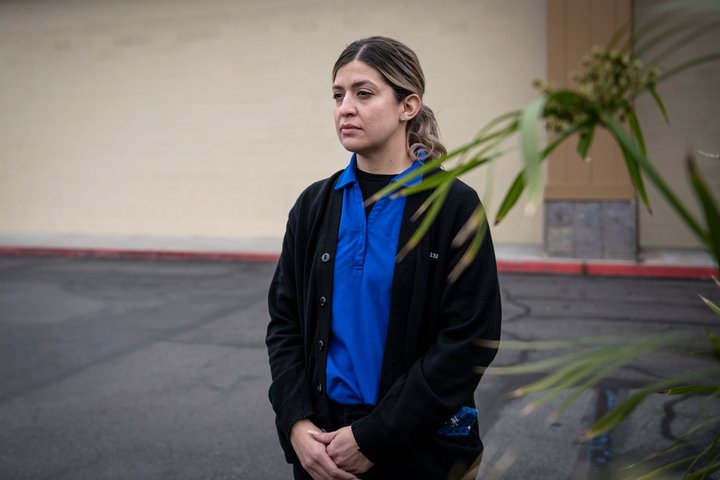
Brittannie Gulley is a cashier at Stater Bros. Market in Norwalk. Gulley has worked at Stater Bros. Market for 18 years, and throughout the pandemic things have changed for her. “It has been very stressful working in the pandemic,” Gulley said. “It’s scary because you don’t know if somebody has a cold, or the coronavirus.” Jan. 13, 2022. Photo by Pablo Unzueta for CalMatters
###
Essential workers such as supermarket cashier Brittannie Gulley are once again on the front lines of another COVID-19 surge. Only this time, they’re on the job without the initial policies intended to protect them.
As the pandemic unfolded, California funneled federal emergency unemployment benefits and tapped a budget surplus to help workers stay at home and weather the virus-induced recession. Sick pay benefits that were extended to 10 days for workers who needed to quarantine expired last year, along with other protections.
“I am the sole provider for my children,” said Gulley, a 34-year-old single mother from Norwalk who works at a Stater Bros. Markets grocery store. “I’ll really take a hit if I have to go out: whether I’m sick or I just have to quarantine, there’s nothing for me.”
Stater Bros. declined to comment.
This year, Gov. Gavin Newsom and legislative leaders, all Democrats, appear poised to reinstate some version of sick pay, though workers, advocates and union leaders fear that those measures are likely to come too late for many facing a fast-moving virus. Stimulus checks were left out of Newsom’s latest budget proposal and there’s been little discussion of an additional unemployment benefits in Congress. A spokesman said Newsom was working with the Legislature on sick pay.
Business groups are pushing back against further mandates they would have to shoulder. California had the highest November unemployment rate in the country, at 6.9%, and new regulations could further hamper the state’s recovery, they said.
“We’re very concerned that this year there’s going to be some overreaction, politically, and that’s going to hurt businesses more,” said Rob Lapsley, president of the California Business Roundtable.
Essential workers in food, agriculture, manufacturing and health care say they fear losing pay just as much as they fear falling ill during the latest omicron wave. Some who get infected are taking unpaid leave or vacation days to quarantine. Others are reporting to work infected, workers and union officials said.
Ingrid Vilorio, 40, who lives in the community of San Lorenzo in San Francisco’s East Bay, said she can’t leave her job working at a Jack in the Box restaurant, despite her fears of bringing the virus home to her family.
“If everybody quit their jobs, in what state would our economy be in?” Vilorio said. “If we all thought that way, well, California would be completely shut down.”
Economists said the omicron variant could mean more pain for California’s low-wage workers who were already struggling to make ends meet before the pandemic started. Unable to pivot to remote, work-from-home arrangements, these workers experienced the worst job losses at the outset of the pandemic and are lagging in the recovery.
Before the omicron wave arrived, low-wage sectors such as leisure and hospitality were 517,000 jobs short of their pre-pandemic levels, according to a California Department of Finance analysis of employment data through November. That compared to 309,000 fewer high-wage sector jobs over the same period.
Low-wage workers who lost their jobs at the onset of the pandemic may face more barriers than high-wage workers. Others remain sidelined by lack of child care and transportation.
Nearly two years into the pandemic, workers are feeling burnout and exhaustion with uncertain schedules that can’t accommodate another round of remote learning or having infected children quarantine at home. Various reports have tracked the pandemic’s negative impact on working mothers, sometimes sending middle-class families into poverty.
Christopher Thornberg, founding partner of research firm Beacon Economics, said that an upside of the omicron variant is that it was relatively mild. That, combined with its virulence, could help both society and the economy finally kick the pandemic.
“Omicron may be exactly what we needed,” Thornberg said. “It’s relatively mild and incredibly contagious, which means it’s going to rip through the population relatively quickly.”
Nevertheless, workers remain nervous. Maria Amaya, 38, a maid who works at the SLS Hotel in Beverly Hills, said she had a colleague who worked several days with a cough, refusing to get tested, before she ultimately tested positive for COVID-19 and was sent home to quarantine.
“The wellbeing of our employees and guests is of paramount importance. If an employee reports illness, we undertake specific protocols,” Alex Herron, a spokesman for the hotel, wrote in an email. “In addition, we continue to follow health officials guidelines regarding coronavirus, and take numerous steps throughout the hotel to enhance guest and employee safety.”
Amaya said she is concerned not only about spreading the virus to her children, ages 13 and 8, but also about infecting her elderly aunt, who often looks after her kids.
The latest wave is also hitting workers outside of low-wage industries. Cristiana Delgadillo caught her third case of COVID-19 days before New Year’s Eve. She’s convinced she got sick at the office. The hardest part, she said, was tapping her vacation days to quarantine.
“It kind of sucks,” said Delgadillo, a 48-year-old car dealership clerk from West Covina. “I actually use them for vacation, not, you know, for COVID.”
###
This article is part of the California Divide project, a collaboration among newsrooms examining income inequality and economic survival in California. CALmatters.org is a nonprofit, nonpartisan media venture explaining California policies and politics.
No Way Out: How the Poor Get Stranded in California Nursing Homes
Jesse Bedayn / Thursday, Jan. 20, 2022 @ 7 a.m. / Sacramento
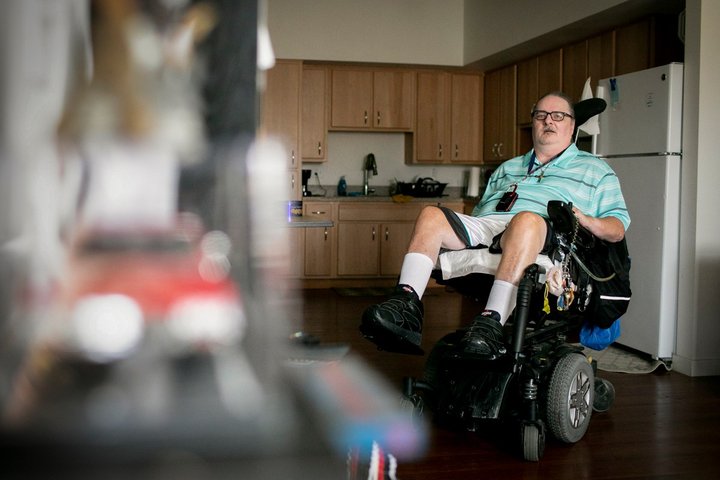
Bradley Fisher, 62, in the Antioch home he eventually moved into after spending 14 years in a Bay Area nursing home. Sept. 2, 2021. Photo by Anne Wernikoff, CalMatters
###
Bradley Fisher, a 62-year-old retired mechanic, lived in a Bay Area nursing home for 14 years.
Entering at age 39, Fisher had been partially paralyzed when bone spurs severed tendons in his spine. After a few years of rehabilitation, Fisher said, he could have lived at home with proper care.
“You don’t need to be here,” Fisher remembers a certified nursing assistant telling him around 2005, seven years in, as he sat in his wheelchair in the facility’s cafeteria. “You got all your faculties.”
“Yeah,” Fisher replied, “but I don’t know how to get out.”
While elder care advocates sound the alarm about patient “dumping” by some California nursing homes – kicking out their mentally ill or bereft patients who need stable housing and care – a parallel dilemma is also threatening vulnerable residents: how to get out of a nursing home.
The vast majority of people admitted to California skilled nursing facilities stay for less than three months to rehabilitate a broken limb or recover from a stroke or other ailment, according to the California Association of Health Facilities, an industry trade group.
After these short-term stays, residents typically return home.
But for thousands of poor nursing home residents, like Fisher, a temporary stay can become indefinite. Saddled with hefty Medicare copayments that can reach $5,000 a month – and later stripped of Social Security income, diverted to pay ongoing nursing home costs – they are often unable to hang onto their former housing. They become effectively stranded, with Medi-Cal and Social Security paying for housing and daily living in the facility.
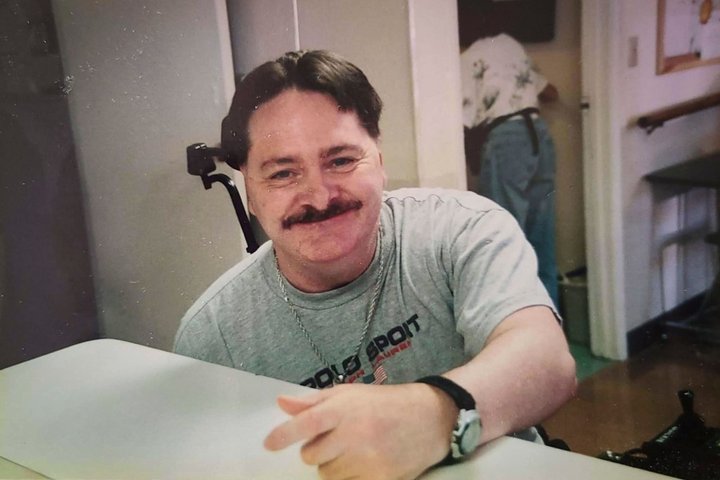
Bradley Fisher in the Bay Area nursing home he entered after bone spurs severed tendons in his spine, partially paralyzing him. Courtesy of Bradley Fisher
COVID has only intensified the urgency some residents feel to leave their nursing homes, where more than 73,000 have been infected and 9,522 have died as of Jan. 17, according to the California Department of Public Health. The department and Gov. Gavin Newsom have faced criticism of the state’s nursing home oversight as the public health crisis deepened and the death count climbed.
“Everybody wants out right now,” said Karen Stuckey, who has been transitioning residents out of nursing homes and into the community for 11 years with the nonprofit Choice in Aging. “They’re just there because they have no place to go.”
Over 9% of California nursing home residents, an estimated 37,000, have low-level care needs and could potentially live in the community, according to a 2017 estimate by the American Association of Retired Persons. In the organization’s 2020 long-term services scorecard, which analyzed the quality of life, living options and nursing home transitions in every state, California ranked 35th in “effective transitions.”
Federal regulations require nursing home staff to ask residents four times a year about their health and welfare – including whether they would like to speak to someone about leaving the facility. The requirement was adopted in 2010 by the Centers for Medicare & Medicaid Services, which regulates nursing homes that receive federal money. At the state level, the California Department of Public Health is tasked with ensuring that homes meet both federal and state rules.
If residents answer “yes” to the question of leaving – or ask to leave without any prompting – they are supposed to be referred to a program that can fund and organize their moves back into the community.
But thousands of residents’ appeals for help moving out have gone unanswered.
“Everybody wants out right now. They’re just there because they have no place to go.”
— Karen Stuckey, Choice in Aging
In 2020, California nursing home residents made nearly 14,500 requests to learn about moving back into the community, according to data from Centers for Medicare & Medicaid Services. Only a third of those requests were fulfilled, the federal data show.
And, CalMatters found, there are few consequences for nursing homes who fail to ensure residents’ requests are granted. The California Department of Public Health does not penalize facilities that fail to follow through on residents’ requests.
Nicole Howell investigates nursing home complaints as the Contra Costa County ombudsman, part of a statewide program that assists residents in long-term care facilities.
“You would be shocked by the number of residents who could live in a much less institutional level of care,” she said. “Unless an ombudsman comes across it and knows to ask, people just end up languishing there.”
The California Department of Public Health declined CalMatters’ request for an interview. In an unsigned email response, the department wrote:
“Our goal is to ensure that any nursing home resident that wishes to return to the community has the ability to do so. This is not always possible to achieve.”
The department said it enforces all applicable regulatory requirements and ensures residents’ rights are protected.
“You would be shocked by the number of residents who could live in a much less institutional level of care.”
— Nicole Howell, Contra Costa County ombudsman
Deborah Pacyna, spokeswoman for the California Association of Health Facilities, said the issue “is not on our radar.
“There are so many more important issues surrounding life and death matters, especially more recently,” she said of the devastation caused by the pandemic. “We need to be doing a better job, I mean, that’s the bottom line.”
The association represents some 900 of the state’s 1,223 nursing homes, which care for about 400,000 residents a year.
After CalMatters’ interview with Pacyna, the association sent a letter to its 7,000 members reminding them of the transitions program. “Eligible individuals of all ages with physical and mental disabilities have an opportunity to participate in (the transition program),” the association said in the June 10 letter.
Transitions deemed a civil right
The idea that nursing home residents should be able to transition back home – and get help in doing so – isn’t just on somebody’s wish list.
It’s a civil right.
In 1999, a U.S. Supreme Court decision gave people with disabilities living in nursing homes the civil right to live in the community, if they are able and want to do so.
The court’s reasoning was that “unnecessary institutional segregation… severely diminishes individuals’ everyday life activities,” wrote then-Justice Ruth Bader Ginsburg.
After the ruling, the federal government founded Money Follows the Person in 2008, a program that helps pay for residents to leave facilities and find housing. (In California, the federal program is called California Community Transitions.)
California has 18 transition programs charged with finding affordable housing; paying for a resident’s deposit, first month’s rent and furnishings; and organizing in-home care.
“We need to be doing a better job, I mean, that’s the bottom line.”
Deborah Pacyna, California Association of Health Facilities
Nationally, the program has moved nearly 100,000 nursing home residents back into the community since 2008, including some 4,000 in California. Though an average of $8,000 is needed to transition one resident, that person’s Medi-Cal costs drop from $85,000 a year to $18,000 on average, once outside the nursing home, according to the state Department of Health Care Services, which manages the program in California.
“Nobody gets up in the morning and goes, ‘Bucket list, I hope I break my hip today and go to a nursing home for the rest of my life,’” said Karen Jones, ombudsman in San Luis Obispo County, “and yet we have a huge expense to make people have that bucket list item.”
Those seniors who do make it out report a higher quality of life and are estimated to have saved California taxpayers hundreds of millions in Medi-Cal costs, according to a 2017 report to congress.
The program is some clients’ only hope for life in the community again, said Stuckey, who has had clients burst into tears on their first steps out of the facility.
But in California and elsewhere, the number of residents whose requests are being neglected is most likely a “gross underestimate,” said Kelly Bagby, vice president at the AARP Foundation Litigation Team. Bagby’s team is suing states for failing to protect residents’ right to live outside a facility.
“When a state knows that it’s not working, that only a small fraction of people are even aware that they have this right,” she said, “then the state has failed.”
Stuck in the ‘poverty pipeline’
In 2019, Virgil Steele was walking in Oxnard when he tweaked his neck and his right arm went limp – “like rubber,” he said.
Ever since a camper shell dropped on Steele’s neck two decades earlier, small neck injuries required surgery and rehabilitation.
At the time, the 62-year-old disabled mechanic was living out of his Volkswagen Bug, parked at the shop where he helped repair motorcycles from his wheelchair. Now he needed hospitalization.
On that day, Steele entered what elder care advocate Karen Stuckey calls the “poverty pipeline.”
As she describes it, this is a common scenario where people are injured, then shunted from the hospital to a nursing home where copays and required shared costs drain their coffers.
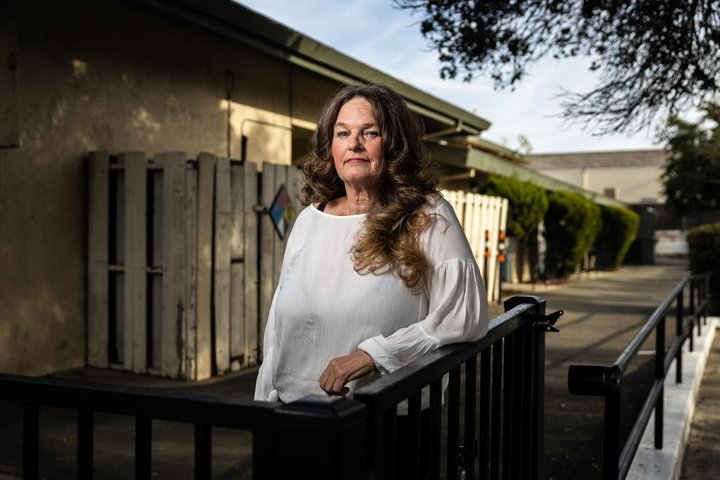
Karen Stuckey has spent the past 11 years moving poor seniors back into the community from nursing homes, such as San Pablo Healthcare & Wellness Center. Nov. 4, 2021. Photo by Martin do Nascimento, CalMatters
After a week in the hospital, Steele was discharged to an area nursing home.
There, Medicare covered Steele’s bill — but only for the first 20 days. After that, Medicare reduced its payment to 80% and Steele, like all nursing home residents, was responsible for the remainder – which can reach $5,000 a month.
Already short on funds, Steele qualified for Medi-Cal, the state’s low-income insurance, which picked up the 20% copayment. After three months of rehabilitation, a patient’s status becomes long-term care and Medicare stops paying altogether; now Medi-Cal foots the entire bill.
But Medi-Cal, the ostensibly free insurance, has a price. Once in long-term care, every cent of a nursing home resident’s Social Security Income, save for a $35 monthly allowance, is taken to help pay for the daily costs of living in the nursing home, such as food, housing and utilities.
Steele couldn’t pay rent for space to park his car on $35 a month. Eventually, his Volkswagen was towed, along with all his belongings, to pay off the rental debt.
“I lost everything,” he said.
Failure to pay rent is the leading reason nursing home residents lose their housing, according to several transition organizations.
“I was trapped there and the COVID was coming to get me.”
— Virgil Steele, former nursing home resident
By July 2020, the nursing home’s social worker linked Steele with a transition program called LIFE Incorporated in Camarillo, north of Los Angeles. But as preparations began to move him, medical dividers were raised in the facility’s hallways, staff donned PPE suits, and bodies were carried past him in blue bags.
“I was tempted to run,” Steele said. “I was trapped there and the COVID was coming to get me.”
Just before that Christmas of 2020, he was infected with the virus. On Christmas Day, his adult children called, but he couldn’t bring himself to tell them his diagnosis. That evening, the staff gave him peppermints and a Christmas card.
Steele, now 64, survived and was moved to an apartment in Oxnard a few months later. Though he’s thankful to be outside the facility, his life’s belongings are gone.
“When I left the (facility) I didn’t have anything anymore,” he said, “I don’t have anything now.”
No penalty for transition failures
In California, the Department of Public Health does not regulate how quickly a facility should refer a resident to a transition program. And it doesn’t cite or fine a home for failing to refer.
In 2020, two-thirds of California residents’ requests weren’t referred at all, according to federal data.
“The obligation to make the referral is explicit,” said Bagby, referring to the mandatory survey. But without a state regulation spelling out a timetable, she said, “the state can’t sanction facilities that don’t make the referral.”
Representatives of several California transition programs said the lack of consequences leaves residents at the whim of nursing homes.
A 2016 report by the U.S. Health and Human Services’ Office of Civil Rights found that most nursing homes “never ask, or nearly never ask” residents the question about their rights and living options. The federal investigation concluded that nursing staff weren’t properly trained and misinterpreted the quarterly survey’s instructions.
The agency recommended that nursing homes invite California Community Transition programs to present to residents and staff every six months.
Representatives of eight transition programs in California, which cover more than 700 nursing homes, told CalMatters that only three facilities had ever requested a presentation.
DeAnn Walters, a former nursing home administrator who is now at the California Association of Health Facilities, said she doesn’t recall the federal report and recommendations.
“It’s just like being put in a box and forgotten.”
— Jules Boddie, former Sacramento nursing home resident
The California Department of Public Health, which routinely issues “All Facilities Letters” about new requirements or regulatory changes, did not address the report’s findings and recommendations.
In its unsigned email response to CalMatters, the department wrote: “Recommendations by any entity do not mandate the issuing of an All Facility Letter.”
Advocates worry it can be a conflict of interest for nursing homes to be responsible for referring residents out of their facilities.
A Medicare resident brings a facility substantially more in federal money than the state provides through its Medi-Cal program for low-income Californians. To even be eligible for transition services, a resident must qualify for Medi-Cal.
Once nursing homes understand that California Community Transitions won’t likely move their more lucrative Medicare patients, said Stuckey, “They love what we do, and they want to refer.”
Jules Boddie, a 69-year-old retired state clerk who entered a Sacramento nursing home in 2018, said he lost his housing while awaiting transition help.
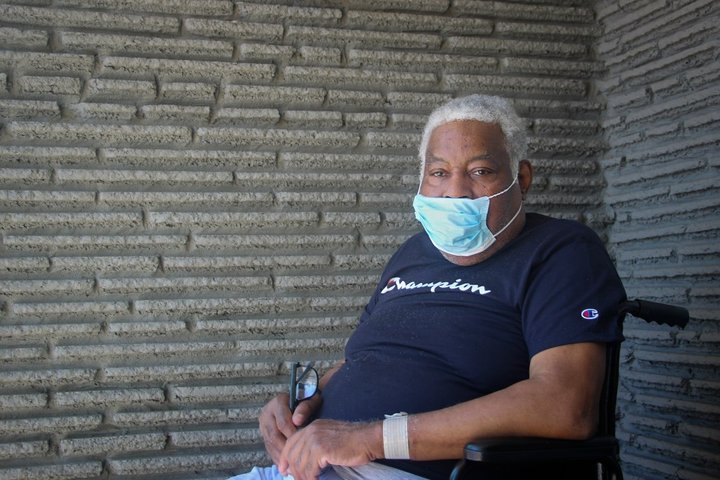
Jules Boddie, 69, outside the Sacramento nursing home where he spent nearly three years. Last summer, he was able to move into community housing. Photo by Jesse Bedayn, CalMatters
“It’s just like being put in a box and forgotten,” he said.
Boddie said he repeatedly asked for help returning home but waited more than a year and a half before getting any assistance.
The facility’s former director of nursing told CalMatters that, to her knowledge, Boddie never relayed such requests to staff. She produced quarterly assessments showing that Boddie had declined offers to receive help moving out.
Boddie, who is on Medi-Cal, said he has no memory of this.
But help eventually came. In the fall of 2020, he said, a new social worker came on board and quickly referred him to Choice in Aging, which placed him on a waitlist for affordable housing.
One week before Boddie moved into temporary housing, he was infected with COVID-19. As he gasped for air in the hospital, his new room was given to the next person on the waitlist.
He said he cautioned other residents: “You have a life outside the nursing home. Don’t give up on it.”
He was moved out of the facility and into shared housing in Sacramento on July 30.
‘The most peaceful I’ve ever been’
Even with the urgency of a pandemic, transitioning just one resident takes seven months on average, the Department of Health Care Services told CalMatters. Transition program workers say they face a gantlet of state regulations, reams of paperwork and affordable housing waitlists that can stretch five years.
“It’s such a process,” said Stuckey, “that unless they already have housing, we really have no control over it.”
The U.S. Supreme Court determined that, for patients hoping to transition, states must provide enough affordable housing so the waiting lists move at a “reasonable” pace.
The Department of Housing and Urban Development recommends states keep wait times below two years, but in California, the average wait time is more than 2 ½ years.
The governor’s Master Plan for Aging, released in January 2021, includes initiatives to expand affordable housing for seniors with $250 million in proposed funding. That could shorten waitlists for nursing home residents who’ve lost their housing.
Funding for Money Follows the Person ended in 2018, and Congress has passed five short-term extensions. The latest will keep the program running until 2027.
With funding shaky, nationwide transitions between 2018 and 2019 plummeted to 5,000, dropping below 10,000 for the first time since 2012. California reduced its transitions to under half of its 2014-2016 transitions, according to a 2020 report by the Community Living Policy Center.
Last year, the California Department of Health Care Services received a $5 million federal grant to help identify nursing home residents eligible to transition, like Bradley Fisher.
Over Fisher’s 14 years in the Bay Area facility, staff never asked him if he wanted to move out, he said, and did not inform him of his civil right to do so. The facility’s administrator told CalMatters in an email that records of Fisher’s quarterly surveys aren’t available.
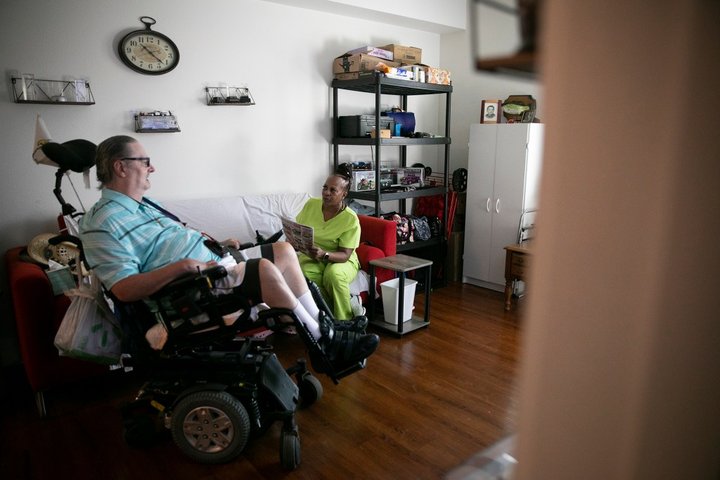
Bradley Fisher watches television with his caretaker, Carol Small, at his Antioch apartment nearly a decade after leaving the nursing home where he had lived for 14 years. Sept. 2, 2021. Photo by Anne Wernikoff, CalMatters
Fisher said he began taking antidepressants while inside the home.
“I felt like I was stuck,” he said. “I even thought that playing bingo would get me out of this funk, but it never did. Nothing would.”
In 2012, a fellow resident told Fisher about a woman named Karen Stuckey, who was organizing that resident’s move out of the nursing home.
“She can get you out, too,” Fisher remembers him saying.
Months later, Fisher was moved to a shared apartment in Antioch. Initially rocked by anxiety after leaving his home of 14 years – and hospitalized twice with panic attacks — Fisher stuck it out.
“It’s the most peaceful I’ve ever been,” he said. ”I feel like a knot in my gut has been removed.”
###
This story originated with the Investigative Reporting Program at UC Berkeley, with SCAN Foundation funding. CALmatters.org is a nonprofit, nonpartisan media venture explaining California policies and politics.
OBITUARY: Hunter Nathaniel Lewis, 2000-2021
LoCO Staff / Thursday, Jan. 20, 2022 @ 6:56 a.m. / Obits

Hunter Nathaniel Lewis sailed away on an adventure to hide treasure on December 30, 2021 from Trinidad Bay, and has not been seen or heard from since, although broken pieces of his canoe and treasure box have washed ashore in the days after. He is greatly missed, but we know he is moving on to his next big adventure in the cosmos now.
Hunter came into this world with a bang two weeks early on September 15, 2000, in Carson City, Nevada. He must have known he would have a lot to complete in a short life and was impatient to get here! From the very beginning he was a busy body, moving around in the womb so much that his mother’s water broke and he had the umbilical cord wrapped around his sweet little neck, not once, but twice. Once he was born he was a constant worry for his mother all his life as he went from one adventure to the next. Nothing scared him. He was so active as a toddler his mother would have to hold him down to get him to take a nap on some days. In these younger years, he climbed many mountains in the Sierra Nevada Range in a backpack on his father’s back, exclaiming, “go higher, Daddy,” as he pointed up the trail.
Once his brother was born, Hunter was so happy. He excelled at being a big brother and was so proud of Bodie. Even when he was away at college, he would call and check up on his younger brother. They shared a love of Dungeons and Dragons and when Hunter went away to college, Bodie carried on the tradition of hosting games for his friends. Hunter took these games very seriously, as he did all things he participated in. His life in itself was a meaningful quest. All things quest-like became his favorite. From video games to the Lord of the Rings and The Martian, to games with his friends, everything was a quest. An adventure. A meaningful experience, as I’m sure all of his friends can attest to. His last quest, The Lost Lewis Treasure Hunt, was two years in the making and was the most epic of them all, as he has now disappeared and became the lost Lewis treasure.
Hunter moved to Arcata at 5 years old and attended Pacific Union School from kindergarten to 8th grade, and Arcata High School from grades 9 to 12. His best friends made during these years in school were his best friends for life. When Hunter got into something, he got into it passionately. Swimming, soccer, cross country, tennis, mountain climbing, Tae Kwon Do (2nd Dan black belt), video filming and editing, DnD, and more recently piloting airplanes. Music was a passion throughout his life, as he played trumpet, guitar, bass guitar, ukulele, violin, mandolin, keyboard and melodica. Most of these were self-taught, and he played passionately with a great deal of skill. He loved to belt out songs for his friends or to himself, and he had a mature, eclectic taste in music. His current life goal was to be an astronaut, and everything he did recently went towards working to that goal. He was studying aerospace engineering at California State University, Long Beach, had earned his pilot’s license and had just been accepted into NASA’s early astronaut training program. There was no limit to what Hunter could achieve. If he could dream it, he could become it!
One of Hunter’s most joyous moments was meeting the love of his life, Kinsley. They met during quarantine last year on a trip with friends to Zion National Park and were inseparable from then on. They had happily just celebrated a year together and talked often of their combined future. She attended many holidays with our family here in Humboldt County, as well as with Corey’s extended family in Colorado, and Hunter would travel to Massachusetts to visit her family, which are all part of our family now.
Hunter is survived by his parents, Micki Vetrie of Arcata and Corey Lewis of Blue Lake, and his younger brother, Bodie, as well as many extended family and cherished friends from all over the country and world.
This world may be a little darker now that he is gone, but he made all our lives brighter when he was here. May we remember him with happiness and strive to brighten up the world and embrace life fully like Hunter did. “Live like Hunter.”
A public celebration of life will be held on Sunday, January 30, from 2-5 p.m. at the Arcata Community Center, 321 Martin Luther King Parkway, in Arcata. In lieu of flowers or donations to the family, donations can be made to Humboldt Bay and Fire at hbfire.org.
###
The obituary above was submitted on behalf of Hunter Lewis’ loved ones. The Lost Coast Outpost runs obituaries of Humboldt County residents at no charge. See guidelines here.
OBITUARY: Jean Ruth Fowler, 1937-2021
LoCO Staff / Thursday, Jan. 20, 2022 @ 6:56 a.m. / Obits
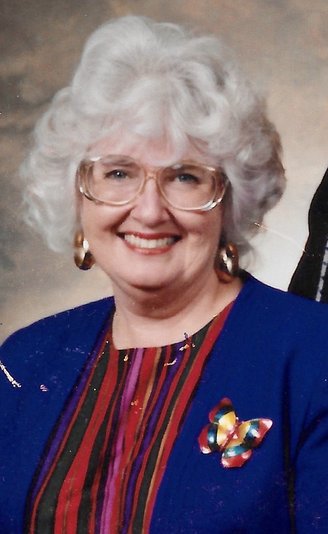
Jean
Ruth Fowler was about helping, something she did for 59 years, 51
of them in Humboldt County, as a psychotherapist ministering to the
needs of scores of patients. She emphasized the positive in life
while facing the negative. Her therapy slogan was “counseling with
caring,” and her business card featured a red heart.
The mother of two sons and loving wife of Jerry Fowler, died on Dec. 30, 2021, eighteen days before her 85th birthday. She had been struggling with pernicious impact of Alzheimer’s disease for several years and was promised by her husband that she would die at home. Hospice of Humboldt County help make her wish come true with compassionate care during the debilitating struggle to her final day.
Her husband Jerry described Jean a soft spoken, petite, beautiful inside and out. Very shy as a child, she overcame that to become more verbal and outgoing. She was a loving mother to her sons Scott and Brett and a faithful, caring spouse in a marriage that lasted fifty seven and one half years. Jerry said Jean taught him to be empathic.
She cherished dogs and the couple had nine Bassett hounds during their marriage. Jean said that she could not look at the dog without smiling. Jean also loved dancing (especially disco) and did not shrink from it even when it went out of style.
She was one of the original teaching numbers of the International Transactional Analysis Association and was a pioneer in revealing the problem of workaholism.
Jean was born Jan. 16, 1937 in Seattle and was the only child of Frank and Ruth Arndt of Washington. She graduated from Reed College in Portland, Oregon with a Bachelor of Arts in Psychology and then earned a Master of Social Work from Boston’s Simmons School of Social Work, where she was awarded a large scholarship based on need that she later used to tour Europe before going to work for the Monterey County Mental Health Clinic in Salinas. After she married, Jean willingly moved to Ann Arbor, Michigan to allow Jerry to obtain Master of Social Work degree at the University of Michigan.
Together they had a private practice of counseling and psychotherapy from 1971 on. Moving to Clam Beach in 1974 they renovated their home, which was featured in the Times-Standard. Jean loved the beach and taught her boys Brett and Scott to love it too. She adored nature and belonged to a local garden club for many years.
Surviving Jean are her spouse, Jerry, and son Scott (practicing Chinese medicine in San Diego) as well as two cousins Roger and Robert Monroe. Her son Brett died in 2017.
There will be a celebration of her life from 2 to 4 p.m. Sunday, Jan. 23, at the Fowler home overlooking Clam Beach. Those who knew Jean and have a positive memory to share are invited to attend. Anyone wanting to donate in Jean’s name may do so to Planned Parenthood in Eureka. Ayers Family Cremation funeral home oversaw final arrangements.
###
The obituary above was submitted on behalf of Jean Fowler’s loved ones. The Lost Coast Outpost runs obituaries of Humboldt County residents at no charge. See guidelines here.


