
Eureka City Schools Board Overturns Mural Ban, Making Way for BIPOC Student Art
Jacquelyn Opalach / Tuesday, Jan. 18, 2022 @ 2:10 p.m. / Education
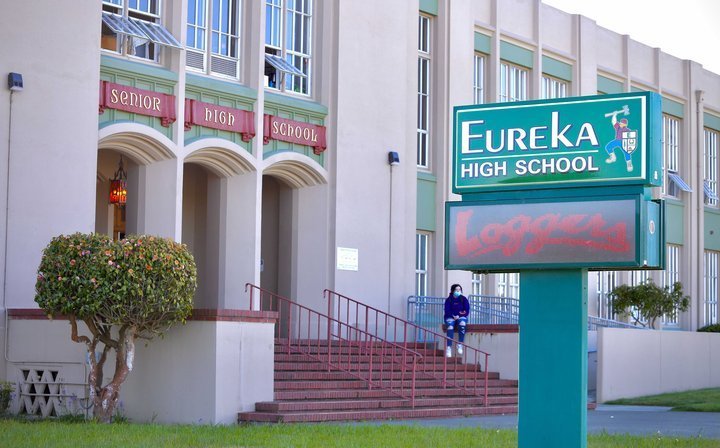
Eureka High School | Outpost file photo: Andrew Goff
###
PREVIOUSLY:
- After Eureka City Schools Board Votes to End Murals, Community Rallies for BIPOC Student Clubs That Were Planning Murals of Their Own
- Eureka City Schools Board Will Reconsider Recent Ban on Murals; Community Members Urge Board to Examine its Biases
###
Following a November vote to ban all future murals on Eureka schools campuses – a decision that sparked opposition from students, staff and community members – the Eureka City Schools Board of Trustees unanimously overturned the controversial no-mural policy at its regular meeting last week.
The mural ban was particularly controversial because the vote came in the midst of two-years-in-the-making mural plans by BIPOC (Black, Indigenous, People of Color) student clubs. The four murals, designed by Eureka High’s Black Student Union, Native American Club, Asian and Pacific Islander Club and Latinx Club, began as a project aiming to bring culturally relevant and representational art to one of Humboldt’s most ethnically diverse schools. The effort has been led by community member Naomi Doherty, who received a $2,500 grant from the Humboldt Area Foundation for the project two years ago.
Over time, the project gained wide community support. In April, Sharrone Blanck, president of the Eureka NAACP, launched a GoFundMe campaign that raised $5,000 to pay local BIPOC artists to paint the murals. The project later became a DreamMaker Project of the Ink People, and was renamed A.R.C. (Art. Representation. Culture.).
In the meantime, the four student clubs worked on their designs. Amaya Watson, president of the Black Student Union and a student board representative, told the Outpost that BSU planned a mural of David Josiah Lawson and his mother, Charmaine, surrounded by Black historical figures. Jennifer Celio-Aburto, vice president of Latinx Club, said their mural will represent Hispanic culture and traditions in the United States. “[We will] show our parents’ story and show our story in the mural,” Celio-Aburto said, with images of people immigrating to the US, establishing jobs and going to school as first generation students.
But in September, ECS asked Doherty to develop official mural guidelines for the district, something that hadn’t existed before. When the guidelines came before the board at meetings in October and November, trustees couldn’t agree on them, so the board voted 3-2 to no longer allow murals at Superintendent Fred Van Vleck’s recommendation. Trustee Susan Johnson was absent from the meeting.
The vote was upsetting to students, staff and community members. “I don’t really understand why they wouldn’t approve of us. I mean, it’s something so simple,” Celio-Aburto said, noting that Eureka City Schools’ mission statement touts embracing diversity. “I was really disappointed because if that’s their mission statement, they’re supposed to follow those guidelines. And they weren’t doing that because they disapproved of the mural project.”
Several people appeared at the board’s following meeting in December to protest the ban. At that meeting, Trustee Johnson said she felt bad about missing the vote and asked to revisit the mural guidelines in January.
That was on Thursday. The 20-minute public comment period was filled by two students, as well as advisors and community supporters of the project.
Celio-Aburto told the board that she’s always felt like an outsider, and recalled growing up in a predominantly white neighborhood while being one of few Hispanic students at her elementary school.
“All of my family lives in Mexico. When my parents came to the US, they left their family behind for a while before they were able to go back and see them. However, there are many people who can’t go back because they’re undocumented. This is a huge reason as to why we need murals at our school. There are students who don’t know anything about their culture or where they come from. But having this mural will allow everyone to be represented, including parents.”
Apart from Latinx club and Spanish classes, Latinx culture is underrepresented at Eureka High, Celio-Aburto said. She asked the board to support the murals.
“Considering the social issues in today’s world, we should be encouraged to fight for a better future, to dream big, and to celebrate our heritage. But instead we are being discouraged from doing so,” she said.
“I would like to encourage you all to be empathetic towards myself and everyone else who is in support of this project because this project is for the people.”
Several speakers, including four students, weren’t able to address the board because of the 20-minute public comment time restriction. (Doherty said that Trustee Mario Fernandez made a motion to extend public comment on the item, which failed due to lack of second.) Afterward, those four students – who aren’t involved in school clubs but want to see the murals come to fruition – told the Outpost that not getting to speak was upsetting.
“They say they want to hear from the students, but they really don’t,” said Cassie, one of the students. In an interview, Cassie and others recalled experiencing and witnessing racism at Eureka High School.
“As a first generation [student], I experience racism,” said Izzy, one of the students. “I get called names at school like ‘beaner’ and I hear racial slurs all the time. And I got in trouble for wearing a flannel by the administration, because, quote unquote, ‘stop looking like a gang member,’” Izzy said, adding that when a white student wore a “White Lives Matter” shirt to school during the Kyle Rittenhouse trial, administration didn’t confront him about it, to her knowledge.
In addition to commenting on racism at EHS, Izzy planned to ask the board to reverse the no-mural policy and to not enforce any guidelines. “I just think that art shouldn’t have any restrictions,” Izzy said.
“What I wanted to say to the board is that I’ve gone to this school for three years, and as a white student, I’ve heard so many people called the N word, the R word, fag and so many of these others that are just so awful and hateful and the school still won’t do anything about it,” said Cassie.
“Fifty-one percent of students at EHS are minorities, and all high school students want to do is fit in. And if the board really wants students to be more involved in school, they should help students feel like they belong and make them want to be involved by helping them feel more represented and safe in their high school.”
Without much discussion, the board made minor adjustments to the mural guidelines before approving them unanimously and overturning the ban.
“I’m super excited,” Celio-Aburto told the Outpost afterward. “It hasn’t been something super stable or guaranteed, so we haven’t been able to work on it. But now we’re really excited to move on.”
“Overall I’m happy. I’m glad,” Doherty said.
Seeing the guidelines’ approval by the end of this school year was important because several students contributing to the murals will graduate. Doherty thinks that all four murals could be complete by June. Three clubs have specific ideas or sketches that will soon be ready for approval, and the Black Student Union’s sketch has already been approved. According to the guidelines, Eureka High murals are approved by the Inter Club Council, which is made up of the school’s student club presidents.
“I’m just excited to get them up,” Doherty said, “and for the students to have a celebration to show them to the rest of the student body, and also the community, at the end of the year.”
BOOKED
Today: 12 felonies, 16 misdemeanors, 0 infractions
JUDGED
Humboldt County Superior Court Calendar: Friday, Sept. 4
CHP REPORTS
Central Ave / Hiller Rd (HM office): Trfc Collision-Unkn Inj
ELSEWHERE
RHBB: CDPH Issues Immunization Recommendations for 2026-27 Respiratory Virus Season
RHBB: Redway Transfer Station to Close an Extra Day for Construction
RHBB: Dows Prairie Road to Close for Two Months for Culvert Repair
ARCATA’S GATEWAY PLAN: Planners Propose Converting K and L to One-Way Streets; Transportation and Safety Committee Will Review Plan This Evening
Stephanie McGeary / Tuesday, Jan. 18, 2022 @ 1:33 p.m. / Housing , Local Government
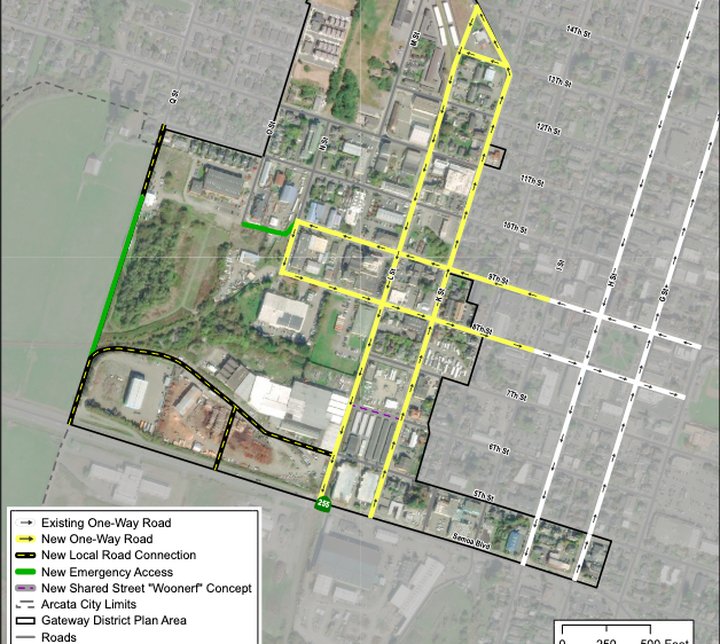
Map showing the proposed one-way roads | Images from the City of Arcata’s Draft Gateway Area Plan
###
If you pay the slightest amount of attention to what’s going on in Arcata, you’ve likely heard something by now about the city’s Gateway Area Plan — a plan to re-zone about 138 acres near downtown to allow for the creation of more housing. And if you haven’t heard much about it, now might be the time to start familiarizing yourself, because as the City is looking to adopt the plan this year and wants to gain as much public input as it can. There will be many upcoming public meetings surrounding the plan, including one this evening.
Arcata’s Transportation and Safety Committee will review the Gateway Area Plan during it’s meeting at 4:30 p.m. today (Tuesday, Jan. 18), specifically examining the transportation element of the plan, which encompasses proposed changes to roads, sidewalks, trails and public transportation.
.
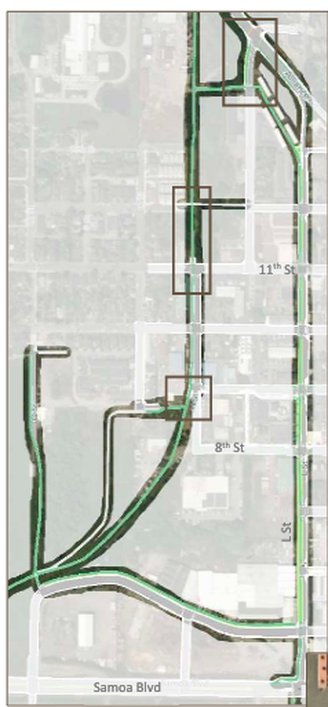
Map showing proposed trails
The Gateway Area Plan aims to facilitate the creation of up to 3,500 residential units in town and the creation of multiple new businesses. That means the city needs to plan for increased vehicle, bicycle and pedestrian traffic. One way city staff proposes the city address these changes is by extending L Street to connect Alliance Road and Samoa Boulevard and to convert both L Street and K Street to one-way traffic — with K Street running northbound and L Street running southbound. This plan would also necessitate the creation of a new intersection at L Street and Samoa Boulevard and the installation of a traffic signal and crosswalks.
A section of Eighth and Ninth Streets would also be converted into one-way streets (Ninth would be for westbound traffic and Eighth Street for eastbound traffic). The K, L, Eighth and Ninth Street conversions would also include the addition of left-turn lanes, additional crosswalks, buffered bike lanes and wider sidewalks.
The plan also includes the installation of a new trail system for bicycles and pedestrians. One trail would run along N Street, connecting M Street and Alliance Road. Another trail is proposed along Q Street, south of Tenth Street. Natural paths are also proposed to connect to the paved trails.
You can read more about these proposed changes in the Draft Gateway Area Plan’s “Mobility” section, which is attached to the Transportation and Safety Committee’s agenda.
You can join the Transportation and Safety Committee meeting, held entirely over Zoom, at this link. You can view the full agenda a directions on how to participate here.
###
PREVIOUSLY
- (UPDATE) Arcata Offers Walking Tour of ‘The Gateway District,’ Potentially a New Locus of Housing Development
- Walking Tour of Arcata’s ‘Gateway District’ Tonight! Learn About the City’s Plan to Develop More Housing in This Newly Named Neighborhood
- ARCATA’S GATEWAY PLAN: City Releases Draft Plan For Developing Housing in the 138-Acre ‘Gateway Area’ of Town, and Wants Your Input
- Arcata City Council Approves Plan to Convert Valley West Hotels to Homeless Housing, Reviews ‘Gateway Area Plan’ to Create High-Density Housing in Town
- THE ECONEWS REPORT: How is Arcata Planning for Growth? Learn About the Gateway Area!
- GUEST OPINION: Gateway Plan Does Housing the Right Way
CHRISTIE CASE: Judge Shoots Down Arcata Rancher’s Motion to Throw Out Evidence, Dismiss Animal Cruelty Charges
Rhonda Parker / Tuesday, Jan. 18, 2022 @ 11:16 a.m. / Courts
File photo: Andrew Goff.
###
PREVIOUSLY:
###
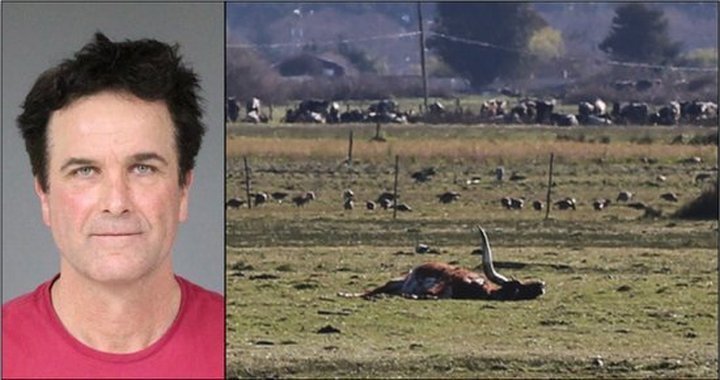
Judge Gregory Elvine-Kreis has denied motions to suppress evidence and dismiss charges against Arcata rancher Ray Christie, charged with four felony counts of animal cruelty.
Deputy District Attorney Steven Steward, the prosecutor in the case, said this morning that Elvine-Kreis ruled law enforcement did not act “in bad faith” in handling evidence. Defense attorney Rick Richmond had argued that some photographs were missing and others had been stripped of data.
The judge did, however, grant a motion to continue the jury trial that was set to begin in about two weeks. A doctor verified Christie is being treated for a medical condition.
The next hearing is scheduled for May 9, when a trial date may be set.
Christie’s ranch on the Arcata Bottoms, along with other properties Christie owns or leases for grazing cattle, were raided in 2018. A jury convicted him of about 25 misdemeanor counts of dumping cow carcasses near state waters, but could not reach a verdict on the felony charges. Only one juror did not vote to convict.
According to officers who testified during the first trial, cows on some properties had no access to food or water, and some were either dead or too weak to stand up.
Christie buys sub-par cattle at the Fortuna livestock auction and attempts to rehabilitate them, a practice that does not always succeed.
Richmond appeared this morning via Zoom.
Here’s How to Get Free At-Home COVID-19 Test Kits From the Federal Government
Ryan Burns / Tuesday, Jan. 18, 2022 @ 11:12 a.m. / COVID-19 and Humboldt

Photo via USPS.
###
As of Tuesday morning, every household in the U.S. of A. can order a set of four rapid antigen COVID-19 tests for free. We’ll skip right to the “how” part: Just click this link and fill out your info. If that link goes down, try this one.
Orders are expected to start shipping later this month. The free-test program comes from the Biden-Harris administration in the midst of the pandemic’s largest surge in cases and hospitalizations to date.
The administration estimates that it will cost $4 billion to purchase and distribute the 500 million tests included in this program.
“And we’re not saying we’re stopping there,” a senior administration official said during a press briefing last week. “And we’re going to keep — keep moving forward to expand testing so that Americans have it both now and moving into the future.”
As the omicron variant drives the latest dramatic surge, demand for at-home tests has also skyrocketed, making them hard to find in many stores.
While the omicron variant has proved to be highly contagious — able to infect vaccinated and unvaccinated people alike — local data shows that Humboldt County residents who are unvaccinated are 11 times more likely to be hospitalized or die after contracting COVID-19.
As of Monday, slightly less than 70 percent of Humboldt County residents have received at least one dose of vaccine with about 63.6 percent fully vaccinated. Vaccination rates among Latinos, Blacks and Native American or Alaska Native residents lag behind those figures, according to data compiled by the L.A. Times.
Vaccines and booster shots are available at many local pharmacies. Click here for more info.
One Teen Killed, One Arrested For DUI, Manslaughter Following Single-Vehicle Incident in Eastern Humboldt
LoCO Staff / Tuesday, Jan. 18, 2022 @ 9:27 a.m. / Traffic
California Highway Patrol press release:
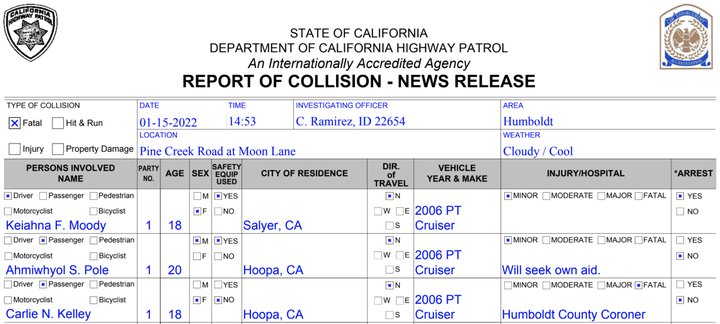
On January 15, 2022 at approximately 2:53 P.M eighteen year old Keiahna F. Moody of Salyer was driving her 2006 Chrysler PT Cruiser northbound on Pine Creek Road at Moon Lane at approximately 55 MPH, when she was involved in a solo vehicle traffic crash.
Due to Moody’s level of drug impairment, she turned her vehicle across the southbound lane of traffic and onto the west shoulder of Pine Creek Road. The Chrysler went into a ditch and overturned, coming to rest blocking Pine Creek Road.
An 18 year old unrestrained passenger, 18 year old Carlie Kelley of Hoopa, was ejected from the Chrysler.
Despite life saving efforts and medical aid, the Ms. Kelley died at the scene. Moody was arrested for Felony DUI of drugs and gross vehicular manslaughter.
The following agencies responded to assist: Humboldt County Sheriff’s Office, Hoopa Tribal Police Department, Hoopa Volunteer Fire Department and Hoopa Ambulance. The CHP is continuing to investigate this collision and asks anyone with information to contact the Humboldt Area CHP Office at 707-822-5981.
Newsom’s $50 Million Opioids Education Pledge Comes as Colleges Warn of Risks
CalMatters staff / Tuesday, Jan. 18, 2022 @ 7 a.m. / Sacramento
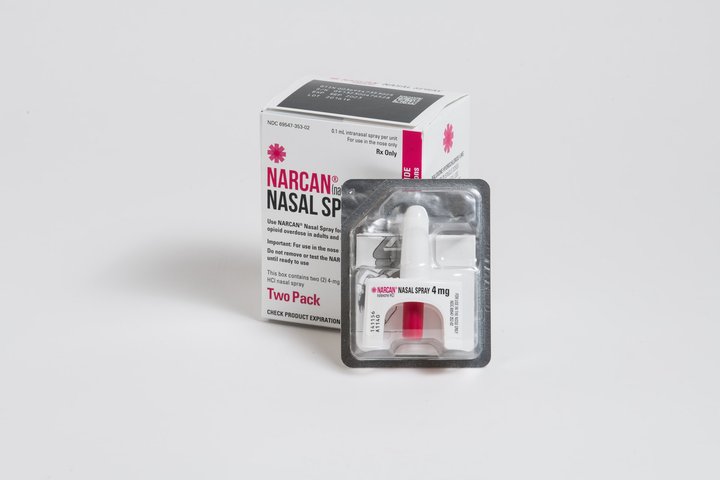
Photo by NEXT Distro on Unsplash.
###
This story is by Emily Forschen, Itzel Luna and Colleen Murphy.
Forschen and Luna are fellows and Murphy is the private colleges team leader with the CalMatters College Journalism Network, a collaboration between CalMatters and student journalists from across California. This story and other higher education coverage are supported by the College Futures Foundation.
###
California would funnel $50 million into educating young people about the risks of opioids and fentanyl under Gov. Gavin Newsom’s latest budget proposal, which comes as colleges are trying to make students aware of the dangers of those drugs.
Opioid overdoses nationwide have accelerated during the COVID-19 pandemic. The U.S. Centers for Disease Control and Prevention estimates that more than 100,000 Americans — and about 10,000 people in California — died of drug overdoses in the year ending in April 2021, a nationwide increase of 28.5% from the year before.
And opioid overdose deaths have been steadily increasing for years among Californians age 34 and under, more than tripling from 1999 to 2019, according to Kaiser Family Foundation data.
Fentanyl, a synthetic opioid, has led to overdose deaths on campuses in the last several years — a sophomore at Stanford University died from an accidental fentanyl overdose in February 2020, as did three students at the University of Southern California in 2019. Some California colleges have begun training students and staff in the use of naloxone, a medicine that can reverse overdoses and is frequently used under the brand name Narcan.
Increasing awareness among students could influence communities on a larger scale after they graduate, said Noel Vest, a postdoctoral fellow at Stanford University specializing in substance use disorders and recovery.
“We know that naloxone saves lives. And so, you know, especially among college-aged students, the more that we can get it in their hands, the more that we can help them understand how to effectively use it, the better as a society we are going to be,” Vest said.
When asked whether Newsom’s proposal would target college students, the California Department of Public Health said it would conduct research to craft the campaign and identify specific audiences and age ranges. The campaign would aim to reach both youths and adults, the department said in a statement to the CalMatters College Journalism Network, using social media, print and digital ads, and online toolkits.
“We need to be funding the education because the lack of education has a lot to do with why people are dying.”
— Shannon Knox, director of training and education at Community Health Project LA
The proposal is part of Newsom’s $286.4 billion budget plan for the fiscal year that begins in July. Funding for the proposal comes from the massive settlement states reached with opioid makers.
Newsom released the plan on Jan. 10. It serves as a marker of his priorities and is still subject to negotiation with state lawmakers, who must approve a budget by mid-June.
A separate bill authored by Sen. Melissa Hurtado, a Central Valley Democrat, would require campus health centers to distribute naloxone. It passed the Senate last session but stalled in the Assembly.
Narcan advocacy
Stanford University has already trained hundreds of graduate and undergraduate students to use the medicine over the last year, said Ralph Castro, director of the university’s Office of Substance Use Programs.
Cal Poly San Luis Obispo offers free overdose prevention kits to students that include Narcan, and trains them on how to use it. And Fresno Pacific University has Narcan available at several places on campus, including in the health center and the athletics department.
Marissa Gonnering, a third-year resident adviser at Cal Poly, attended a Narcan training on campus. The process only took about 20 minutes and felt important, she said, because as an RA, she knew she could be the first person to reach the scene of an overdose.
She hasn’t had to use Narcan yet, but said she feels safer knowing how to do so. The university should make sure students know it’s available and distribute the kits widely, she said.
“I think it’s super important to have that safety net if it’s possible,” Gonnering said. “But I think that if only a few people know about it, or have it, then it’s… not as helpful.”
Jarita Greyeyes, a fourth-year PhD student and member of Stanford’s Graduate Student Council, is among those calling on the university to ensure that everyone on campus has access to Narcan and related training, and that the resources are widely publicized to students.
When Greyeyes sought out Narcan training on her own more than a year and a half ago, it required multiple conversations with care providers and pharmacists on campus, and she faced questions about why she wanted the medicine.
Greyeyes said the experience would have discouraged her, if she hadn’t been so committed to being able to carry Narcan.
“As a person who loves and cares for people who use drugs, and who also has witnessed people in my own life struggle with substance use issues, I would never want to be in a situation in which someone mistakenly or in any way ingested a substance that could harm them and we weren’t able to offer them care and assistance,” Greyeyes said.
Colleges should make Narcan easily available — such as placing it in a bucket on the quad so students can walk by and anonymously grab it, said Aimee Moulin, a professor of emergency medicine and addiction medicine at the University of California, Davis.
“Every dorm room has a fire extinguisher in it. I mean, I would think that the best thing that you could do around this would be that every college housing unit has a place where they have Narcan.”
— Noel Vest, a postdoctoral fellow at Stanford University
The idea that having access to Narcan means people will use drugs more isn’t true, she said.
“It is a myth that is out there that, I think, is tied to stigma related to drug use,” Moulin said. “We’ve had these abstinence-only thoughts out there for a long time and universally they’ve been unsuccessful.”
Instead, Moulin advocates for harm reduction: a set of public health strategies meant to mitigate the potential negative consequences of drug use. President Joe Biden’s administration has touted the approach.
For Moulin, that means meeting drug users where they are, showing them healthier ways to use, and ultimately helping them get treatment.
The Department of Public Health said its campaign may include either prevention, harm-reduction messaging, or both, depending on the results of its research. Both approaches “are necessary to prevent and mitigate harm from opioids, including fentanyl,” the department said.
Educating students
Overdose prevention education should use compassionate language, never words that demonize people who use drugs, said Shannon Knox, the director of training and education at Community Health Project LA, which operates a syringe exchange and distributes free Narcan to L.A. County health care providers.
The education should also center safety measures: never using alone and always testing drugs before using a full amount, she said. Colleges should also communicate addiction treatments options to students, Knox said.
“We need to be funding the education because the lack of education has a lot to do with why people are dying. And it’s really hard on people like me and my staff to hear about all the overdose deaths that are happening, when we know how limited the resources are,” Knox said.

Gov. Gavin Newsom holds a nearly three-hour press conference to unveil his budget proposal for 2022-23 in Sacramento on Jan. 10, 2022. Photo by Miguel Gutierrez Jr., CalMatters
Kirsten Vinther, a health educator and prevention specialist at Cal Poly, said students need to feel safe to ask questions and receive straightforward responses.
“I have always been a proponent of honesty and awareness — be clear with the students that there are dangers inherent in the use of substances and show them the respect of honesty and the awareness that many of them have already made different decisions about their use — or will,” Vinther said in an email.
In Narcan trainings, Vinther said it’s also important to stress that the medicine won’t always reverse an overdose, and can only reverse an overdose for a short period of time. The person receiving Narcan still needs immediate medical attention.
Colleges should also make sure students are aware of medical amnesty policies, said Jeremy Sharp, regional outreach director at Students for Sensible Drug Policy. Such policies can shield students from punishment if they seek medical help for an emergency related to drugs or alcohol.
Fentanyl a ‘different animal’
The risk of taking drugs laced with fentanyl is upping the stakes. The rate of drug overdose deaths involving synthetic opioids, such as fentanyl and fentanyl analogs, increased 56% from 2019 to 2020, according to the CDC. Fentanyl analogs are chemically similar to fentanyl but require special toxicology testing to detect, the CDC says.
While doctors can prescribe fentanyl to patients with severe pain, most recent cases of fentanyl-related overdoses and deaths are linked to illegally made fentanyl that can be mixed with heroin and cocaine, sometimes without the user’s knowledge, according to the CDC.
Fentanyl’s many analogs mean those who use it don’t know what to expect, Knox said. People who have used heroin for 20 or 30 years may use fentanyl once and overdose. Those people would die without access to Narcan to reverse the overdose, she said.
With fentanyl, “we’re talking about a pretty different animal than we’ve ever seen,” Knox said.
Stanford and Cal State University Northridge are among the schools that have warned students about the risks of fentanyl. Fentanyl is 50 to 100 times more potent than morphine, according to the CDC.
“The biggest shift I see is that while we are not only attempting to educate students about the dangers inherent in the use of substances they are knowingly ingesting, we now also need to educate them about substances that they may not necessarily be choosing to use,” Cal Poly’s Vinther said.
More funding and education will help, experts said.
“Every dorm room has a fire extinguisher in it. I mean, I would think that the best thing that you could do around this would be that every college housing unit has a place where they have Narcan,” Vest said.
###
CALmatters.org is a nonprofit, nonpartisan media venture explaining California policies and politics.
Amid Low COVID Vaccine Rates, More California Children Hospitalized in Omicron Surge
Elizabeth Aguilera / Tuesday, Jan. 18, 2022 @ 7 a.m. / Sacramento
COVID-19 hospitalizations among California’s children — especially those too young to go to school — are the highest they have been since the pandemic began.
Chalk it up to the highly contagious omicron variant, kids exposed during in-person instruction at school and other public places, and infants and preschoolers being ineligible for vaccination.
The state has tallied nearly 850,000 cases of COVID among kids 0 to 17 since the beginning of the pandemic. Of those, 44 have died — equivalent to an entire school bus filled with kids.
“The wave of delta and wave of omicron challenged some assumptions we had that kids would not get it and got spared,” said Dr. Theodore Ruel, chief of the Division of Pediatric Infectious Diseases and Global Health at UCSF. “Now we know that kids absolutely do get infections, and even though they are small numbers they do get admitted and some die.”
This peak in hospitalizations of kids across the state has surpassed records set during last winter’s surge, said California Health and Human Services Secretary Dr. Mark Ghaly last week. The state reached a high of 90 pediatric admissions in one day on Jan. 4, according to the California Department of Public Health. The previous high of 41 pediatric admissions in one day occurred in January 2021, a record surpassed earlier during the omicron surge on Dec. 29 with 50 admissions.
“The case numbers in children are skyrocketing along with those in adults,” Ruel said. “Children were spared infections early on and I think it was because of the shut down and school closures, and children had less of an opportunity to run into infected kids.”
“The wave of delta and wave of omicron challenged some assumptions we had that kids would not get it and got spared.”
— Dr. Theodore Ruel, chief of Pediatric Infectious Diseases and Global Health, UCSF
California’s public health department is running a statewide marketing campaign and doing community outreach to raise awareness around vaccination. The campaign targets parents and is going out on social media platforms like Twitter and Snapchat. In an email the department said the community outreach is focused on the state’s more impacted communities.
Pediatric experts across the state say that so far families don’t need to go back to sheltering in place with children to avoid omicron or complications, including a rare multi-inflammatory syndrome known as MIS-C. They cite the need for schools and day care for working families as well as the social isolation that has made the pandemic tough for kids.
But they are advising families to revisit early pandemic precautions about limiting get-togethers, avoiding unnecessary activities and protecting their youngest and most vulnerable family members by masking, social distancing and getting vaccinated.
In Orange County, a child under 5 died from COVID complications in December, the county’s health agency said last week.
California mirrors the nation in seeing the highest number of pediatric hospitalizations with COVID-19 since the beginning of the pandemic, said Dr. Rochelle Walensky, director of the Centers for Disease Control and Prevention, in a briefing on Friday. Still, hospitalizations are relatively low with rates of 4 in 100,000 for those under 5 and 1 in 100,000 for kids five and above.
In Los Angeles, Dr. Colleen Kraft, a pediatrician at Children’s Hospital Los Angeles, worries about the number of sick kids because even a small percentage could mean thousands of ill children. Already this year, among symptomatic kids in the emergency department, 45% are testing positive, up from 2.9% in November, she said.
“Omicron is so contagious that the people that are unvaccinated are at highest risk,” Kraft said. “In many cases we have families and parents who could be vaccinated who are choosing not to and they are putting everyone at risk.”
At her hospital in the Hollywood area of Los Angeles, 41 children are currently admitted and a quarter of them are in the intensive care unit, she said. It’s the highest number of admissions in the last 12 months for the hospital.
She is most concerned about children who are not vaccinated, especially those under 5.
“Parents and family members that come in contact with them should be vaccinated,” Kraft said. “For the next few weeks while the cases are really high, they should think about whether they want to be doing their extra activities or things that are more optional.”
“Omicron is so contagious that the people that are unvaccinated are at highest risk.”
— Dr. Colleen Kraft, pediatrician, Children’s Hospital Los Angeles
In California, 65% of children aged 12 to 17 are vaccinated, while just 19% of youngsters aged 5 to 11 are vaccinated, according to state data. Those figures are just slightly ahead of national averages of 54% and 16%, respectively.
For one family in Orange County, the consequences of the surging omicron variant came due just after the new year when their toddler was hospitalized with COVID-19.
Adeline Zermeno, 2, developed a fever around Christmas and tested negative for COVID. A little more than a week later she landed in the hospital after a 10-day stretch of non-stop fever that reached 104.9, fatigue and a positive COVID test, said her mom, Lindsey Zermeno.

Adeline Zermeno, 2, in recovery after spending two night in the hospital because of COVID-19. Here she is enjoying her post-hospitalization meal. She requested Chik-fil-A. Photo courtesy of Lindsey Zermeno.
Adeline spent two nights in the hospital with ear and sinus infections brought on by COVID and is still dealing with a lingering viral rash. Her big brother and father got sick too but their cases were mild.
The family had gathered with their extended family for Christmas and everyone who could be was vaccinated. Still, nine of the 23 attendees got sick, including Adeline.
“It felt incredibly scary,” said Lindsey Zermeno, a nurse at Children’s Hospital Orange County where her daughter was admitted. “There is so much that is unknown about COVID and although for the most part many people get through it just fine, there are still so many unknowns.”
Adeline spent two nights in the hospital with ear and sinus infections brought on by COVID and is still dealing with a lingering viral rash.
Now she is vigilant for signs of MIS-C, a rare syndrome marked by inflammation in the body’s organ systems, including the heart, kidneys and brain.
“I pray to God that we get skipped over for that complication because it was so stressful having her in the hospital,” she said.
There have been 783 MIS-C cases in California during the pandemic.
“It is rare but it is very severe and kids have died from it, they can require life support, it causes decreased heart function,” said Dr. Angela Dangvu, a pediatrician at the Children’s Hospital of Orange County Primary Care Network who works at an off-site clinic. “It’s all a balance. Parents have to decide what kind of activities are important for their kids and the chance of them getting sick.”
In addition to the risk of MIS-C, children who have had COVID are also at risk of what has been dubbed “long COVID” and, separately, an increased risk for diabetes, according to a new study from the CDC.
For all these reasons, experts said vaccination among kids who can get it is critical. If they get a breakthrough case, their symptoms are typically mild and the vaccine helps prevent longer term complications, said Dangvu, who is Adeline’s pediatrician.
Doctors said drug-makers are conducting pediatric vaccine trials for those under 5 and recently changed the testing plan to include a third dose for those 6 months through 4 years old to see if that boosts their immunity to COVID.
As for Lindsey Zermeno, she can’t wait for the vaccine to be available for her daughter.
“I’m very anxious for the vaccine,” she said. “As a former pediatric ICU nurse, I’ve seen really bad things happen to kids because they were not vaccinated for the flu or pertussis.”
###
CALmatters.org is a nonprofit, nonpartisan media venture explaining California policies and politics.


