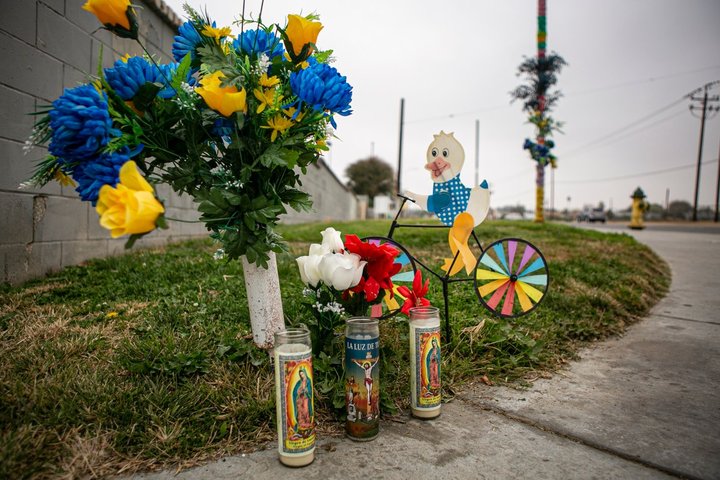
A memorial is set up on the corner of Foothill Road and Morning Drive for 17-year-old Jose Flores in east Bakersfield on Nov. 16, 2021. Flores was stabbed and killed in a fight near Foothill High School in January of last year. Photo by Larry Valenzuela for Calmatters.
With its back to the desert, Kern County is the southernmost band of California’s conservative Central Valley. Its western border forms a jagged staircase that mimics the shape of California’s coastline without ever approaching the water.
And along its rural northern border is a long-running war between rival prison gangs that helped make this county so violent.
The homicide rate in Kern County in 2020 was 12.7 per 100,000 residents, the highest of any California county, according to the Department of Justice. That’s about one for every 8,000 people in a county of about 900,000.
Beginning in the middle of the last decade, the county’s homicide rate began to grow, and Kern County has had the highest homicide rate in the state since 2016.
Crime is up across the country and especially in California. What this means, and who’s at fault, remains a useful political cudgel.
The state’s rising homicide rate – up 31% from 2019 to 2020 — was a central aspect of the unsuccessful recall of Gov. Gavin Newsom. Republican Larry Elder, the leading vote-getter among Newsom’s challengers, decried the “soft-on-crime ethos that we see emanating from Sacramento and from many of our major cities.” Kevin Falconer, another Newsom challenger, said the rising crime rate forced major employers to pull out of San Francisco.
Nationally, stories about rising crime focus on the big cities: Minneapolis after protests surrounding the murder of George Floyd. Portland since weekly clashes began between anti-fascists and right-wing paramilitary groups. And Chicago — always Chicago.
But one of the most violent places in California defies those explanations. There is no active movement in Kern County to change how police departments are armed or funded, no lenient district attorney pushing for lower sentences, and few black-clad agitators to be found.
Bakersfield, the largest city with about 380,000 residents, set a record in 2020 with 45 homicides. This year, it blew past that: By late November, 57 homicides had been recorded.
The Padre Hotel in downtown Bakersfield on Nov. 16, 2021. Photo by Larry Valenzuela for CalMatters
Residents woke up nearly every morning in the first 15 days of August to a new homicide.
Ask around Kern County about these grim figures and you’ll hear a variety of explanations: violent video games, the erosion of the nuclear family, the end of corporal punishment.
Some blame a state law that changed felonies to misdemeanors, a law that lowered prison sentences, a failed penny tax for more county deputies and a successful penny tax for more city cops.
The explanations are local, national, global: The closure of the local soccer field every day but Saturday, the wide availability of firearms, gang warfare, Donald Trump, Barack Obama, Gavin Newsom, Ronald Reagan, joblessness, hopelessness and the approaching fourth calendar year of a global pandemic.
So what makes Kern County’s homicide rate the highest in California? How did Bakersfield get named one of the top 10 most dangerous cities in the U.S.?
“Honestly,” said Manuel Carrizales, a pastor and former Bakersfield gang member, throwing his hands in the air and letting them fall to his lap in resignation, “a devil is on the loose.”
Leaders dodge unpopular topic
A long-range look at crime statistics, particularly homicide data, shows that the 2020 crime rate nationally and in California was still a fraction of its highs in the early 1990s, according to government statistics. Simply counting the year-over-year changes belies a larger truth: Crime is down significantly compared to recent history.
Even so, the year-over-year changes to the crime rate are notable, especially when it comes to the homicide rate, said Magnus Lofstrom, policy director of criminal justice at the Public Policy Institute of California.
“But I think it’s also important to take a step back and look from that longer-term perspective and recognize that, over decades, our crime rates — even in 2020 — were relatively low,” he said.
In 2015, amid the earliest signs of a rising homicide rate in Kern County, Bakersfield television station KGET started a homicide tracker.
The Padre Hotel in downtown Bakersfield on Nov. 16, 2021. Photo by Larry Valenzuela for CalMatters
Reporter Raphael Stroud joined the station in 2017, and it was his job to drive out to every homicide and tell the story of the deceased.
He kept looking to officials and elected leaders for explanations, he said. The ones he got were mostly complaints about the behavior and attitudes of school-age kids, he said.
“I stopped wanting to do interviews with officials because I kept hearing the same thing,” Stroud said.
The homicide rate apparently is not an issue local elected officials are eager to discuss.
CalMatters made multiple attempts to reach the Bakersfield mayor and all five Kern County supervisors. None returned calls. Kern County Board of Supervisors Chairman Phillip Peters’ chief of staff said he would not comment, and Bakersfield Mayor Karen Goh’s staff said in November she was traveling and too busy for a 15-minute interview on two consecutive record-breaking years of violence in her city.
In her 17-minute, 51-second State of the City address in July, Goh pledged a “new optimism” for solving homelessness in the city, praised a new regional branding initiative and mourned the lives and businesses lost to the pandemic.
“God bless you, Bakersfield,” she said. “We’re coming back better than before.”
She did not make a single mention of the number of people killed in 2020.
Gangs infiltrate rural towns
A decade ago, Kern County wasn’t notable for its homicide rate. In 2011, according to the Department of Justice, its homicide rate was 5.4 per 100,000, about the middle of the pack in California.
What happened?
Within the city, local crime data show, fighting among longtime local gangs divided by race and geography made up at least one-third of the city’s homicides in 2020.
The Bakersfield Police Department categorized 15 of its 45 homicides as gang-related that year. But that, acknowledges Bakersfield police spokesman Robert Pair, is only the number of homicides that police could prove were related to organized crime.
“The true number is likely much higher, but we don’t code it ‘gang-related’ just based upon suspicion, or the person’s history alone,” Pair said.
In several instances, Pair said, the homicide victims may not have had gang affiliations, but were killed based on suspicion alone.
“It’s a gang border. Gang activity has its peaks and valleys, kind of a roller coaster.” — Tyson Davis, Delano Police Chief
A farming county that grows and exports almonds, grapes and citrus, Kern County has California’s fifth highest poverty rate — nearly one in five lives below the poverty line, federal data show. The county’s median household income is about $20,000 less than the statewide median, according to the U.S. Census.
The county is made up of small commodity-dependent towns, and gang violence has spread from the city to those rural outposts.
Two are at the center of a war between two of California’s largest prison gangs, according to Kern County law enforcement.
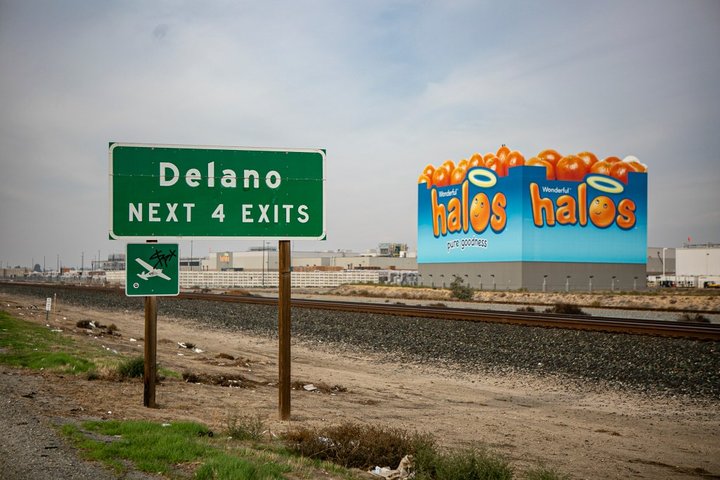
Delano, population 53,000, is centered around the Wonderful Company mandarin oranges packaging plant. The town of McFarland, seven miles to the south with 15,000 residents, is famous for its high school cross country team, which was the subject of a 2015 movie starring Kevin Costner.
Delano Police Chief Tyson Davis said his town is the southernmost one run by the norteño prison gang, who wear red. McFarland is the northernmost town run by the sureño prison gang, who wear blue.
The Wonderful Halos orange packing facility outside of Delano on Nov. 15, 2021. Photo by Larry Valenzuela for CalMatters
“It’s kind of a cut-off area,” said Davis, who took office in late October. “It’s a gang border. Gang activity has its peaks and valleys, kind of a roller coaster.
“This didn’t happen overnight. This has been a growing problem for years, and it’s going to take years to get out of it.”
Davis did not have statistics on gang activity in Delano, but some recent incidents and court cases tell the story.
On July 2, 2020, a tan Toyota sedan reportedly pulled up to a birthday party in Delano. Witnesses told police a man in a hoodie stepped out of the car and started shooting. Three adults were injured. Two girls, ages 11 and 12, were killed.
Delano police told television station ABC23 at the time that witnesses at the scene did not cooperate with police and were in some cases “flat-out hostile.” The Delano police coded the shooting as gang-related, but no arrests have been made.
Gang violence also claimed the life of the 21-year-old son of a pastor, killed at a vigil in Delano for a car-crash victim in February 2020.
Are statewide policies to blame?
Davis, a former Kern County sheriff’s deputy for 31 years, blames a pair of laws for the region’s violence: 2014’s Prop 47, which reclassified some drug and theft felonies to misdemeanors, and 2016’s Prop 57, which leaves to a judge’s discretion whether juvenile offenders are prosecuted in adult court.
Davis and other law enforcement officers in Kern County also blame the 2011 prison realignment created by AB 109, which made incarcerated people previously in state prisons eligible for sentences in county jails instead.
That, said Davis, caused a backup in the county jails, which then released more people onto the street.
“Those are people who like to commit crimes,” Davis said.
Researchers who looked at the impact of those measures did not find them associated with more assaults or homicides.
If Prop 47 contributed to any crimes, it was larceny, according to a Public Policy Institute of California analysis. Prop 57 has evened some of the racial disparities in juvenile sentences, but, according to the Center on Juvenile and Criminal Justice, Black and brown kids are still being sent to adult court far more than their white counterparts.
Realignment, according to multiple analyses, didn’t end up costing less – jails ended up taking on the costs passed down by prisons – but neither has it been shown to correlate with a rise in homicides.
“We do not find any evidence that violent crime went up as a result of the reforms,” Loftstrom said.
More money for police lauded, rejected
Is it money? Police departments regularly use a rising crime rate to advocate for more public safety dollars – as recently as late November, the Los Angeles Police Department asked for an additional $213 million to hire and retain officers, citing rising crime.
After the groundswell of protests against police violence following the death of George Floyd, the LAPD received $150 million less in 2020 than its original budget forecast. This year, the city added dollars back and the department’s budget is now more than $1.75 billion.
In Kern County, few people appear to be talking about defunding the police.
“I’m a liberal Democrat and I don’t believe that defund bullshit,” said Bakersfield defense attorney David Torres. “No one’s trying to take the sheriff’s money or his deputies’ guns away.”
The question, Torres said, is how those dollars are spent.
“Deputies are never going to stop bitching,” Torres said. “They are very well funded in this county.”
The problem in Kern County is law enforcement departments attempting to retain officers, said Davis and the county sheriff, especially when other local departments can pay better.
Kern County Sheriff Donny Youngblood said he’s been hamstrung by the failure in 2018 of a one-cent county sales tax that he said would have saved county sheriff’s jobs.
“We have been having a very difficult time recruiting and retaining deputy sheriffs.” — Donny Youngblood, Kern County sheriff
Three years ago, Youngblood shut down the sheriff department’s gang unit. In early November, he also cut the narcotics unit in half.
But in town, money hasn’t been the problem for the Bakersfield Police Department. In 2018, the city of Bakersfield successfully lobbied for a voter-approved one-cent sales tax that brings in about $58 million each year for public safety.
That, said Youngblood, has posed a problem for his office.
“It’s been horrendous,” Youngblood said. “We have been having a very difficult time recruiting and retaining the deputy sheriffs. Several have gone to the city because the city is offering a substantial pay raise, you know, it’s just very problematic.”
“We offer a $25,000 signing bonus for lateral transfers and in two years we’ve had zero successful takers,” Youngblood said. “We’ve had applicants apply, but they failed a background [check] from other agencies, or if they don’t pass the background [check], they refuse to sign a waiver for us to look at their background. We don’t hire them.”
When asked for a single driving cause for the rise in homicides in Kern County, Youngblood had a hard time identifying one.
“Did you say per-capita we’re the No. 1 in homicides?” Youngblood asked in an interview. “I didn’t realize it.”
‘It gets pretty wild here’
A restaurant owner, a bail bondsman and a private eye sit in the front seat of a black Dodge Challenger, rumbling through the streets of Bakersfield.
It sounds like the setup to a joke, but Glenn Pierce is all three. And he says he is willing to shell out more tax money for more police officers, though his opinions of the local cops are mostly unprintable.
Pierce owns Pierce Bail Bonds, operates a 30-seat soul food restaurant and works as a private investigator for criminal defense attorneys. He said his older brother is still a high-ranking Bakersfield Crip.
“The bad guys talk to me and the good guys talk to me,” said Pierce who, at 6-feet-4, is imposing even while driving.
“We need more substations… Not only more officers, but ones who know who you are, who the kids are.” — Natesha Johnson, Bakersfield community organizer
Ask around Bakersfield who has insight on violent crime here, and many – from cops to defense attorneys to journalists – will point you to Glenn Pierce.
Just like everyone else, though, he’s stumped.
On one fall afternoon, he pulled up to a six-foot white wall on a residential street, where graffiti reading “Peace Ghost” marks one of the first gang homicides in Bakersfield this year, Oscar Ortiz “Ghost” Cervantes.
“And that (homicide) probably led to another one,” Pierce said.
Community organizers argue that the police need to do more block-by-block policing, showing their faces and letting their presence be known.
“We need more sub-stations, more officers walking the beat,” said Natesha Johnson, a Bakersfield community organizer whose son joined the police department this year. “Not only more officers, but ones who know who you are, who the kids are.”
Pierce disagrees.
“No. No way,” he said. “That officer will end up stuffed in the back of a trunk. It gets pretty wild here at night.”
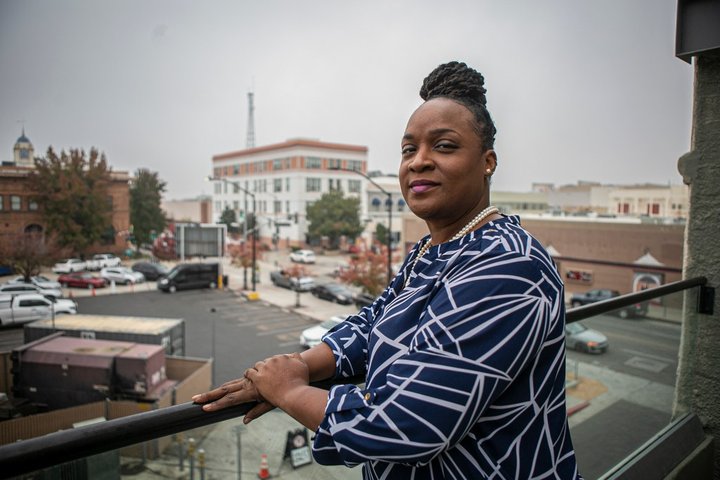
Natesha Johnson, CEO of Upside Productions and community organizer, at The Padre Hotel in downtown Bakersfield on Nov. 15, 2021. Kern County and Bakersfield have an elevated amount of gun violence and deaths. Photo by Larry Valenzuela for CalMatters
As he rumbles through town, Pierce points out the graffiti marking gang territory. “X3,” that’s a gang aligned with the sureños. The “OKC” on the side of an abandoned lumber supply store stands for the Okie Bakers, a Latino gang that Pierce said stopped paying its taxes to the larger sureño criminal network, and it’s getting their people shot.
But he also sees structural problems in Kern County.
“There’s no jobs here. There’s no training,” Pierce said. “The closest training area for the oil fields is 25 miles away and there’s no cars.”
That, he said, leads to trouble.
“They send them to prison, they send them to jail. There’s nowhere to send them to.” Pierce said. “They want to blame everything on the governor, but you can’t blame everything on one guy.”
He points to the success story of Monterey County, which saw a spike in gang violence at the end of the 2000s and again in the middle of the 2010s.
But, according to local media reports, a ceasefire between the gangs led by police agencies and nonprofits helped Monterey County reduce its homicide rate between 2015 – when it was higher than Kern County has ever reached – and 2020, when the rate was 3.2 per 100,000.
“The Monterey County gang unit started hammering the hell out of them,” Pierce said.
Chasing theories on county’s violence
For Raphael Stroud, the former Bakersfield TV reporter who covered every homicide in the city between 2018 and 2020, looking for a pattern ended fruitlessly.
“They’ll blame Sacramento, or they’ll say it’s got to be the community that comes together and won’t stand for this,” Stroud said.
He doesn’t mean to come off as dismissive, he said. But none of the explanations he said he heard from community activists, city officials, police officers or even the gang members themselves were satisfactory.
He chased theories: Maybe environmental pollutants were causing lower test scores in schoolchildren, leading to more crime. Maybe the density of state prisons led to more people staying around after their release – until he realized prisoners, upon release, are returned to the county where they were convicted.
Maybe the cheap real estate in Bakersfield – one of the last pieces of affordable housing left on I-5 – was drawing people in from Los Angeles and Oakland who were committing crime, until he realized many of the homicides he was covering came from families with decades-long roots in Kern County: “It’s home-grown.”
“When I wasn’t going to get straight answers from the city and the police, I tried to switch up to focusing on the pain it’s causing,” said Stroud, now a TV reporter in the Bay Area. “One thing that broke my heart, I think there’s a lot of apathy (in the community).
“They think there’s certain parts of Kern County where it’s the family’s fault, it’s the neighborhood’s fault. That’s what probably bothers me the most.”
On Nov. 17, police found a man shot to death in a Bakersfield home on Panama Lane just after 6 p.m. They have not released his name or any information on suspects. It was the city’s 57th homicide this year.
###
CALmatters.org is a nonprofit, nonpartisan media venture explaining California policies and politics.
Athleen
Grace Baker passed away November 3rd,
2021 in McKinleyville at the age of 73. Athleen herself wrote the
following on November 24th,
2013, noting additions to her family along the way.
###
I’m
writing this myself in preparation for the inevitable! It also saves
my family from this chore.
I
have had a good life! Starting in San Angelo, Texas, where I was
born on June 1st,
1948, to Levi Freeman Boatright, Jr. And Alvina Clara Grace
Boatright. My one and only sibling is my younger brother, Gary Levi
Boatright. Dad was from San Angelo so that’s how that happened.
Mom was from Portland, Oregon area, but had some family in Eureka.
Mom
and Dad settled in Humboldt County in 1955 after several moves across
country from Texas to Oregon and California. My first grade year was
spent at Adams School in Eugene, Oregon. I attended Janes School
(now Pacific Union) in Arcata for my second and third grade year. My
parents relocated to McKinleyville. I graduated from McKinleyville
High School in 1966, and attended one year at Humboldt State College.
I took a C/R Accounting class my high school senior year, and
attended various C/R classes during my early adult life.
It
seems I’ve always worked. I babysat in my early teens, buying my
own school clothes. At 16, I began working as office help on
weekends for Humboldt Trap and Skeet Club, which lasted two years. I
worked part time on week days for a local State Farm office as a high
school senior and HSC freshman. After that, I found full-time
employment in Montgomery Ward’s credit department for four months.
I was then hired by the Department of Social Services in 1967, where I
worked for the next 39 years. I spent the first six months as a
Clerk Typist, moved into an Account Clerk position for 2 ½ years,
then advanced to an Eligibility Worker I, II, and III. I ended the
last 22 years of my career as an Eligibility Supervisor.
I
enjoyed volunteer work. My first experience was as a candy striper
at the old General Hospital. I served as a Hospice bereavement
volunteer for one year. In 1990, my good friend, Lynn McKenna,
encouraged me to become involved in the annual Jazz Festival, a few
seasons of the Harley Run, and the Blues-By-The-Bay Fesitval. I also
volunteered in the second grade classroom for my youngest grandson,
Jesse.
I
married David G. Wildmark in 1970. We had two sons, and divorced in
1988. I began dating Scott R. Baker in 1994. We met dancing, and he
asked me out for a first date on Valentine’s Day. We spent many
weekends dancing, listening to music, and just being together in
those first years. We even took dancing lessons at one point. I
moved in with Scott in the Spring of 2002, and together we have been
since.
My
heart has been with my family, whom I have treasured. I love both my
sons so much, tried to raise them with what I thought was good, and
tried to help where I could as adults. I hope that my flaws will be
overshadowed by my heart. I have been blessed with the same
wonderful privilege that my mother and grandmother had of taking care
of grandchildren. I took care of my three granddaughters Cora,
Karly, and Taresa part time while their parents worked. I got to be
with my oldest grandson, Brandon, a lot in his preschool and early
school years. Jesse lived with us for five months at one point, and
has spent many weekends with us along with his sister, Harmony. My
grandchildren are special, and I have enjoyed every moment with each
of them. I visited mama a lot in her four-year stay at Seaview,
assisted Dad with his at-home care, and spent many hours with him in
his four-year stay at Granada. I feel I was a good daughter. And as
the saying goes to my brother: I smile because I’m your sister, and
I laugh because there’s nothing you can do about it. You’re
stuck with me. I love you.
I
have been blessed with Scott’s love of home. He has been the one
who has tended to the majority of household chores and things around
the house (chore boy!). And to his continued disbelief, I have
seldom understood the punch line of a joke. It has become a running
laugh of how he has been the lucky one – lucky to have me! We have
had a good relationship, one that fits, and one with love and
friendship.
I
have enjoyed so many friendships. A few years after being retired,
by good friend, Linda, retired. We’ve enjoyed many morning walks,
silly/serious chats, tea at the local establishments, and movies.
Lunch dates with Sally and JoAnn; trading occasional plants and
meeting for breakfast/lunch with Joan; tea and freshly baked cookies
with Mary at her house; and volunteer work and occasional concerts
with Lynn. I hope I have been a good friend.
Around
the age of 50, I gradually began relying more in my faith. God’s
grace and kindness, His mercies and little miracles, and the small
day-to-day joys. I have had a close relationship with my cousin,
Rachel. The two of us spent time together in our youth, and created
memories back then, such as when I taught Rachel to drive a stick
shift in my 1968 Camaro. Later in life, when that relationship was
renewed, Rachel became a lovely encourager for me. And I’m
thankful for the prayers and encouragement of my brother, Gary Levi,
and sisters-in-law, Asia and Melissa.
I
have always liked being out of the house, usually going somewhere and
doing something; like movies at the theater, walking, reading my
books and drinking ice tea at fast foods, meeting friends, shopping
at K-Mart and The Children’s Place, being with my dog, and of
course, being with my grandkids [and great-grandkids]. I have never
been much of a sit-at-home person. I have enjoyed working with my
perennials and bulbs during the spring and summer, watching the birds
at my feeders and birdhouses, taking pictures, sharing books, talking
on the phone, playing games and emailing. I have always loved
Christmas and birthdays! I love the music, the tree, my Christmas
village, the presents, the children, the season.
Scott
and I have enjoyed motels, camping with my little Scamp trailer, and
occasional travel; the Oregon State Parks, the Brookings/Gold Beach
area, Grants Pass, and short trips to Santa Rosa to visit Scott’s
sister. We once took a road trip that covered ten states. At age
59, I took a five-week road trip by myself that encompassed seven
states, visiting relatives, staying in motels, sending postcards, and
gathering souvenirs. During that trip, both Scott and my brother
checked in on me daily regarding my progress and adventures.
I
didn’t want to leave, but I’ve been tired and it was time. I
wish goodness and love to my partner of [26] years, Scott R. Baker;
my two sons Israel D. Widmark [deceased] and Aaron L. Widmark;
step-daughter Sari A. Baker and her husband Steven Lafferty; seven
grandchildren Brandon and Jesse Widmark, Cora, Karly, and Taresa
Smith-Widmark, Harmony Taylor, Jack Lafferty; great-grandchildren
Shanelle and Isaiah Widmark; brother Gary Levi Boatright and his wife
Joanna Fryz-Boatright; four nephews Gary, Dathan, Michael, and David
Boatright; first cousin Rachel Zollner-Fusi and her husband Rick;
daughters-in-law Jennifer Maury, Danielle Smith, and Stormy Taylor;
sisters-in-law Melissa Boatright and Jenny Roberts; good friends
Linda Walker, Lynn McKenna, Mary McCutcheon, Sally Call, JoAnn Mell,
Joan Ormand; and numerous cousins; Aunt Nadine Byrne; ex-husband
David Widmark.
This
pretty much sums up the highlights of my life. I join my [son,]
parents and grandparents, a few cousins and friends, and many aunts
and uncles. To my wonderful family and friends, I want to say how
much I have loved you and thank you for the joys you have given me in
life. We’ll see each other again.
Love,
Me
###
Friends
are invited to attend services on December 11 at 2 p.m. at the Church of God, located at 1470 Santa Clara
Street, Eureka.
###
The obituary above was submitted on behalf of Athleen Baker’s loved ones. The Lost Coast Outpost runs obituaries of Humboldt County residents at no charge. See guidelines here.
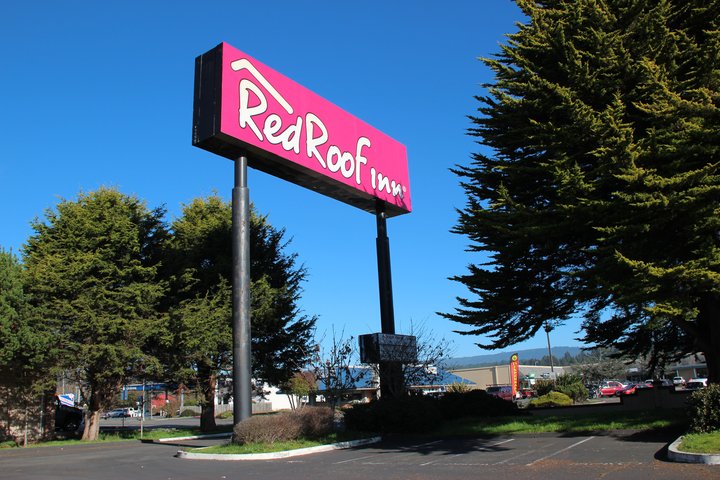
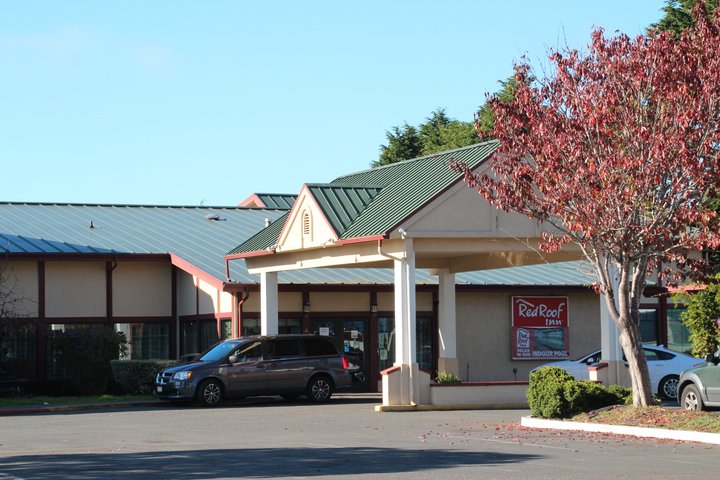
The Red Roof Inn in Valley West may soon be converted into housing for the homeless | Photos: Jacquelyn Opalach
###
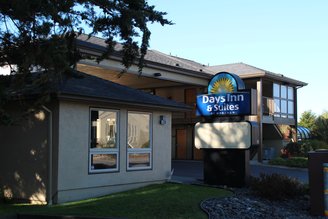
Faced with the ongoing challenge of securing housing for homeless people in our community, the City of Arcata is working with The Danco Group and Arcata House Partnership (AHP) to convert two Valley West hotels — the Red Roof Inn and the Days Inn & Suites, both on Valley West Boulevard — into housing for those experiencing homelessness.
The proposed projects, Arcata Community Development Director David Loya told the Outpost, will require a zoning change to allow the lots to be used for emergency housing and will need to be approved by both the City Planning Commission and the Arcata City Council. If approved, this project would provide approximately 130 rooms for homeless individuals in Humboldt.
“The challenge we’re facing with homelessness right now is unprecedented,” Loya said in a phone interview with the Outpost on Tuesday morning. “This [project] is a relatively simple fix. Those buildings are already there.”
The project would be largely funded though grant money from the California Department of Housing and Community Development’s Homekey program — a statewide effort, built on Project Roomkey,
to rapidly expand housing for people experiencing homelessness. The
Arcata City Council will also need to approve the grant application,
before the City can submit the proposal.
The Days Inn & Suites on Valley West Boulevard
If the grant is awarded, AHP would purchase the Days Inn and would provide rooms
for chronically homeless individuals. Darlene Spoor, executive director of AHP, told the Outpost that an individual is considered “chronically homeless” if they have been homeless for at least one year and have some sort of disability.
Last year AHP utilized Project Roomkey funds to place homeless individuals in rooms at the Days Inn, helping provide them with shelter during the pandemic. That program has since ended though, Spoor said, and she is eager to secure more housing for those in need.
“I think as we visibly see more people who are homeless, its important to know that a big part of that is because we don’t have housing,” Spoor told the Outpost. The community support is going to be critical to us, so we can help. The biggest question I get is ‘will this bring more homeless people to Valley West?’ And I say ‘they’re already here.”
Supplemented by funds from the Homekey grant, Danco would purchase the Red Roof Inn, allotting some rooms to chronically homeless individuals and some to other people who are homeless. Danco will do some minimal construction on the hotel — including remodeling the rooms and removing the swimming pool, which is expensive and difficult to maintain and could present potential liability issues.
Of course, converting the hotels into housing would have at least a small financial impact on the City, due to the loss in Transient Occupancy Tax. But Loya said the sacrifice is well worth it. “What we’re getting in exchange is the chance to provide our homeless community with housing,” he said.
In order to gather community feedback on these proposed projects, Danco and Arcata House Partnership will be hosting two public meetings on Wednesday, Dec. 1 to share information on the project. The first meeting will be held at noon in the Arcata House Partnership parking lot — 4677 Valley West Boulevard — and is specifically for residents experiencing homelessness. Loya told the Outpost that the meeting is open to all members of the public, but the main purpose of the meeting is to gain input from the people who would be served by the project. A free lunch will be served and socks and warm clothing will be handed out to those in need.
For other community members to learn more about the projects and provide their feedback, there will be a public meeting held over Zoom on Wednesday, Dec. 1 at 2 p.m. You can access the meeting at this link, or with meeting ID 863 2854 5516.
The public will also have an opportunity to comment on the project when it comes before the Planning Commission on Tuesday, Dec. 14 and when the project comes before the Arcata City Council during its meeting on Wednesday, Dec. 15.
Though Loya is not exactly sure how long the entire process will take, he said that, assuming the council approves the project and the grant application, he hopes the projects can be up and running by summer 2022.
“The sooner, the better” Loya said. “[This housing] is something our community is in desperate need of. But it’s just not happening fast enough.”
You can find more information on the project on the City of Arcata website.
On the West Lawn outside the U.S. Capitol, a tall white fir from Northern California known as “Sugar Bear” should soon rise and shine, adorned with tens of thousands of ornaments and lights.
Within days, House Speaker Nancy Pelosi is slated to light up the 84-foot-tall national tree, provided by the US Forest Service as part of a Capitol tradition that goes back 51 years.
The so-called People’s Christmas Tree began its more than 2,000-mile journey to Washington, D.C., months ago, having originated in a mountain forest in Humboldt County, known as California’s Redwood Coast and home to the world’s tallest trees.
To celebrate the season, participating Humboldt hotels will reimburse the $10 permit fee for guests who harvest their own Christmas trees from Sugar Bear’s home, the Six Rivers National Forest, a 1.2-million acre recreational wilderness featuring wild and scenic rivers, fishing, rafting, hiking, backpacking and the occasional Bigfoot sighting. (More at https://kingbigfoot.com.)
“All of our trees are majestic so we’re glad to share the yule tidings,” said Lowell Daniels, proprietor of the Victorian Inn in Ferndale, one of many hotels taking part in the promotion.
Ferndale, incidentally, boasts another world famous winter holiday tradition that has drawn guests since 1934, the lighting of America’s tallest living Christmas tree.
This year, town residents will turn on the switch on the 160-foot-tall spruce, just off the picturesque Main Street, at 5:30 pm on Sunday, December 5th.
Join them for free hot cocoa and homemade cookies for the ceremony and then walk over to the Ferndale Portuguese Hall for the annual Beans & Linguica Dinner.
Can’t make the event? No worries. The tree will remain electrified for the month, during which guests can enjoy holiday shopping featuring fine Americana curios in California’s best preserved Victorian village, and meals in Old World restaurants inspired by Ferndale native and TV chef Guy Fieri.
Other nearby natural wonders await in Humboldt County, including Redwood National Park, which protects Hyperion, the world’s tallest tree at 380 feet; and the Avenue of the Giants, where lives a rare albino redwood, a white beauty known as the Christmas Tree.
Only a handful of such forest ghosts, which lack chlorophyll, exist in the world, including this striking example in the Women’s Federation Grove. A short unmarked trail from the entrance leads to the tree, which stands next to a much larger conventional redwood. For additional directions, ask at the Humboldt Redwoods State Park visitor center in nearby Myers Flat or go here: https://tinyurl.com/albinotree.
More Information
The Humboldt Lodging Association is a nonprofit partnership of hoteliers dedicated to preserving and promoting the natural and cultural wonders of Humboldt County, called America’s most scenic rural region by the USDA and located on US Highway 101 about 3.5 hours north of San Francisco. For more information, go to https://VisitHumboldt.com.
For our final episode in 2021, we sat down with former Humboldt County Supervisor Mark Lovelace, who is now Senior Policy Analyst for HdL Companies, in which capacity he advises cities and counties in California on cannabis policies.
Our conversation with Mark included discussions of marketing, the value of the “Humboldt Brand,” the tax and regulatory structure in the cannabis industry, and the impact of the large unregulated cannabis market.
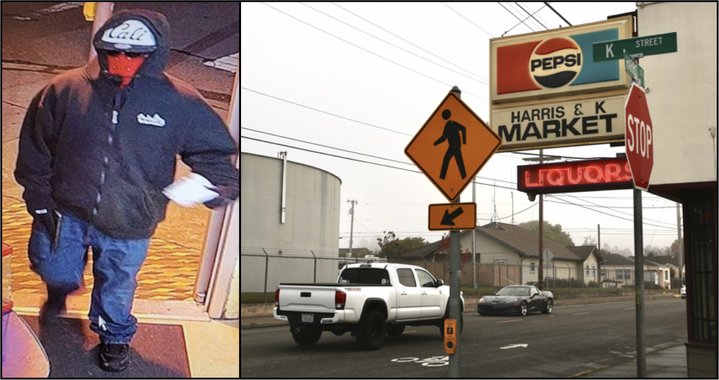
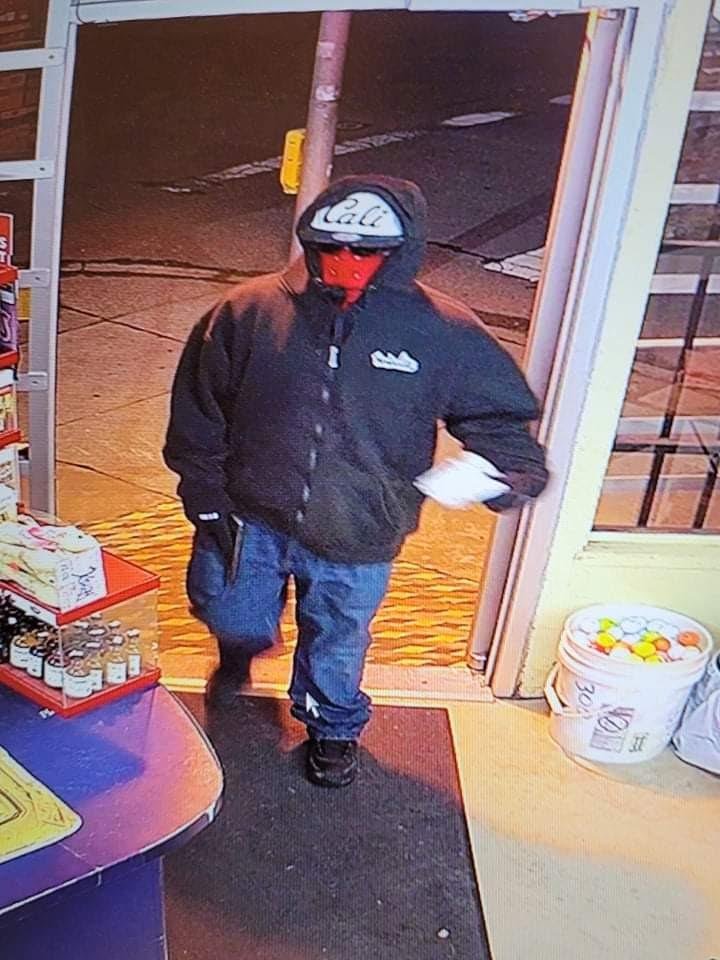
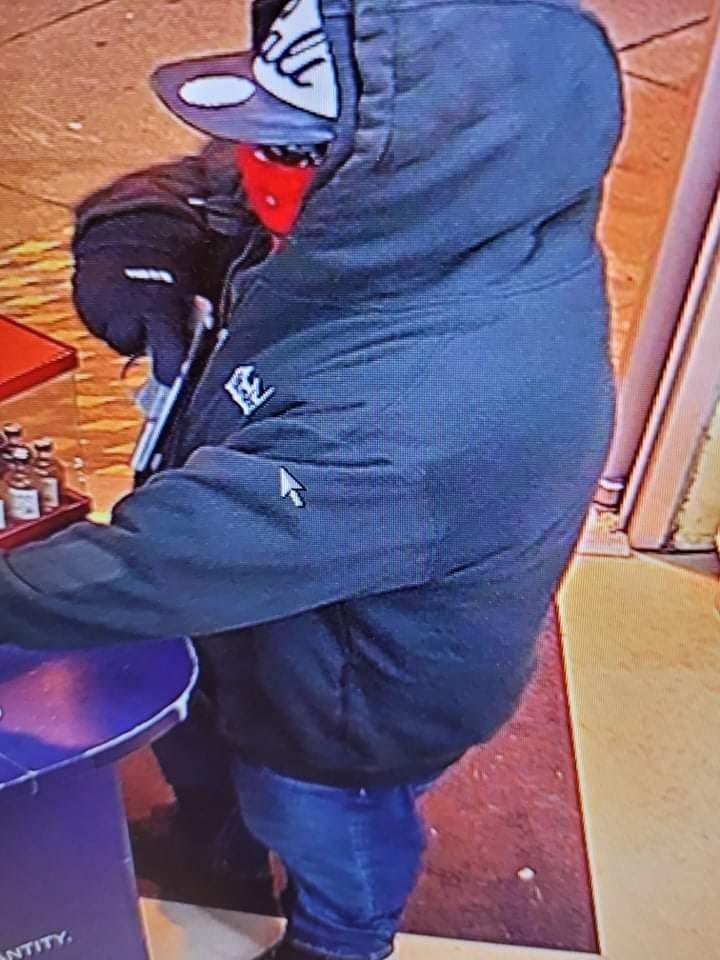
The suspect in Monday’s Harris & K Market armed robbery wore a “Cali” hat and a “Humboldt” sweatshirt. Scroll down for more imagery.
Eureka Police Department press release:
On November 29, 2021, just before 8 p.m., officers with the Eureka Police Department responded to a market on the 3100 block of K Street for the report that an employee had been shot in the arm during an armed robbery. It was reported the suspect fled the scene after the shot was fired.
Once on scene, officers contacted the employee who had a non-life-threatening gunshot wound to one arm. Humboldt Bay Fire and City Ambulance responded and transported the employee to the hospital for treatment.
Based on the investigation, it appears the suspect entered the store armed with a firearm. The suspect confronted the employee and demanded money from the register. While reaching over the counter to collect the money, the suspect’s firearm discharged, striking the employee. The suspect immediately fled the scene with an undisclosed amount of cash.
Based on store surveillance, the suspect is described as a male with a heavy build. He was wearing black shoes, blue jeans, black zip up hoodie with “Humboldt” logo, black gloves, red bandanna covering his face, sunglasses, and a hat with “Cali” printed on the front. The suspect was last seen running south on K Street in possession of cash and a firearm.
Anyone with information related to this incident is asked to contact Detective Sergeant Terry Liles at tliles@ci.eureka.ca.gov or (707) 441-4010. The suspect is considered to be armed and dangerous and should not be approached. Contact the police with information.
Press release from the Humboldt County Sheriff’s Office:
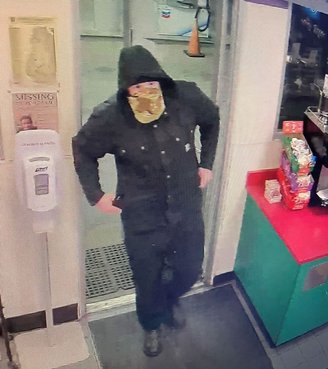
On Nov. 29, 2021, at about 6:22 a.m., Humboldt County Sheriff’s deputies were dispatched to a gas station on the 200 block of Main Street in Trinidad for the report of an armed robbery.
According to an employee, a male suspect entered the business and brandished a firearm, demanding money from the register. The suspect then fled on foot towards Patrick’s Point Drive, taking a small amount of cash from the business.
The suspect is described as a white male adult, last seen wearing a black hooded Carhart-style zip-up jacket, black pants and a camouflage neck gaiter mask.
This case is still under investigation.
Anyone with information about this case or related criminal activity is encouraged to call the Humboldt County Sheriff’s Office at (707) 445-7251 or the Sheriff’s Office Crime Tip line at (707) 268-2539.