

Who’s Dying in California From COVID-19?
Hannah Getahun / Wednesday, Sept. 22, 2021 @ 7:34 a.m. / Sacramento
It’s been longer than a year and a half since COVID-19 first arrived in California, and the demographics of who is dying from the virus are changing.
So far, 67,358 people have died in California during the pandemic, more than in any other state. In recent months, those who are dying are younger on average. And, unsurprisingly, people of color are still among the most devastated by COVID-19, with the highest death rates among Native Hawaiians/Pacific Islanders and Black people.
Here’s a by-the-numbers look at COVID-19 deaths in California.
How much younger are they?
Since the beginning of the pandemic, the average age for Californians who died from COVID-19 is 73. But in April through September the average age dropped to 67, and in August and September, it dropped to 66, according to a California Department of Public Health analysis of state data.
“We are observing that it’s not the older populations that were first dominating a number of fatalities in the pandemic,” said Fresno County Interim Health Officer Dr. Rais Vohra. “It’s now skewing younger and younger in terms of who gets hospitalized and — unfortunately — who goes on to have a very tragic outcome of a fatality.”
A major reason? Older people are vaccinated at higher rates than younger residents. About 67% of Californians 18 to 49 are fully vaccinated, compared to 73% for people 65 and older.
Hospitalizations and infections are on the rise for Californians under 18. But old age — and the underlying conditions that come with it — will still be an important factor in death rates, said Dr. George Rutherford, a professor of epidemiology and biostatistics at the University of California, San Francisco.
What’s the racial breakdown? Has it changed?
Latinos are dying at a lower rate than white and Black people in California, according to the state’s data. However, Latinos have had the sharpest increase in the death rate in the last month, rising from 2.4 deaths per 100,000 people in August to 4 per 100,000 in September. That rate, however, is far eclipsed by the peak last January, when 11 Latinos died per 100,000.
For Black people, 7.4 per 100,000 people died from COVID-19 this month, up from six deaths per 100,000 in August yet down from 9.3 last January. Death rates in Asian American populations and white people also increased this month. Asian Americans currently have California’s second lowest death rate.
The culprit is most likely vaccine disparities: Latinos make up 39.4% of California’s vaccine eligible population but they’ve only received 29.5% of the doses. This means that, proportionally, not as many doses are finding their way into Latino communities as they should, health experts say. Black people also make up a higher share of the vaccine-eligible population than the doses they have received.
“The myths and the misgivings… are real for the communities who have suffered at the hands, historically, of a racist, systemic problem.”
— Sarah Reyes, managing director of communications at the California Endowment
A reason for these disparities could be the barriers that communities of color still face to accessing vaccines, including medical misinformation and hesitancy stemming from medical mistrust, according to Sarah Reyes, managing director of communications at the nonprofit California Endowment, which focuses on improving health care access in underserved communities.
“People have to understand that the myths and the misgivings of the medical community are real,” Reyes said. “They’re real for the communities who have suffered at the hands, historically, of a racist, systemic problem.”
Native Hawaiian and Pacific Islanders have died at the highest rate of any racial group. But some good news: The rate decreased from 18.4 deaths per 100,000 people in January to 17 in August and 11.8 in September.
Is there a growing gender gap?
Men are dying at a slightly higher rate than they were in the beginning of the pandemic, according to the state data.
In September of last year, 45.2% of deaths were female and 54.6% were male. But in August 2021, it was 41% female and 58.9% male, which shows that the gap is widening in favor of women.
In Long Beach, 70% of deaths since July 2021 have been males, compared to 58% from March 2020 through July 2021.
Before vaccine availability, males made up a slightly larger percentage of deaths than females. Now as the gap widens, vaccinations may play a role.
“I can’t help to think that some of that is due to failure to vaccinate — differential failure to vaccinate, meaning that women are more likely to vaccinate than men,” Rutherford said.
Women are more likely to be vaccinated than men in the state, and there is still a slight gap between the proportion of men who make up the state’s vaccine population and those who still need to get vaccinated.
How do deaths in California compare to other states?
California, as of this past week, has the lowest seven-day death rate nationally — at five people dying for every million residents — and the lowest rate since January, according to data from the Centers for Disease Control and Prevention.
However, what is happening in California is happening across the country: People 64 and under make up a larger share of deaths in 2021 than they did in 2020. National data also shows that the older you are, the more likely you are to be vaccinated.
How do counties compare?
The average age of Californians dying from COVID is skewing younger across the state.
In Fresno County, people 50 to 69 years old now make up a larger share of COVID-19 deaths than they previously did, while those 70 and older are a smaller share.
In Long Beach, which has its own health department, the average age of COVID death since August 2021 is 59 years old, 13 years younger than March 2020 through July 2021. In Long Beach, 99% of people 65 and older are vaccinated.
In Riverside County, people under 45 made up 4.1% of total deaths between Jan. and March. Between June and Aug., that number jumped to 16.1%. Among adults, people under 45 have the lowest vaccination rates.
Eleven people died in Riverside County on Sept. 20 and five of those people were under 40, said Jose Arballo, senior public information specialist at Riverside University Health System-Public Health.
Were most of the people who died unvaccinated?
Vaccinated people make up a small fraction of the deaths — approximately 500. “Far and away without any doubt, without any question, 95% of (stopping deaths) is vaccines,” Rutherford said.
Although there’s still the potential for breakthrough cases, vaccination makes it much less likely that serious illness will develop.
So if the best way to prevent deaths is the vaccine, how do health officials get younger people to get the jab? It’s complicated, but mandates — like proof of vaccination to go to restaurants or work in certain places — can help, Rutherford said. Fear can be a motivator, too.
“People are scared of the Delta variant — as they should be,” Rutherford said.
###
CALmatters.org is a nonprofit, nonpartisan media venture explaining California policies and politics.
BOOKED
Today: 3 felonies, 8 misdemeanors, 0 infractions
JUDGED
Humboldt County Superior Court Calendar: Today
CHP REPORTS
Us101 / Sandmine Rd (HM office): Trfc Collision-1141 Enrt
9600 Mm1 S Men 96.00 (HM office): Trfc Collision-No Inj
Unnamed Street (HM office): Traffic Hazard
ELSEWHERE
RHBB: Magnitude 3.7 Earthquake Centered East of Hydesville
RHBB: Motorcyclist Injured in Solo Crash at 14th and California in Eureka
RHBB: Southbound Highway 101 Traffic Backs Up From Richardson Grove to Benbow
RHBB: Woman Suffers Possible Leg Fracture in Dyerville Loop Road Motorcycle Crash
OBITUARY: Arthur Hugh Moon, 1949-2021
LoCO Staff / Wednesday, Sept. 22, 2021 @ 6:56 a.m. / Obits
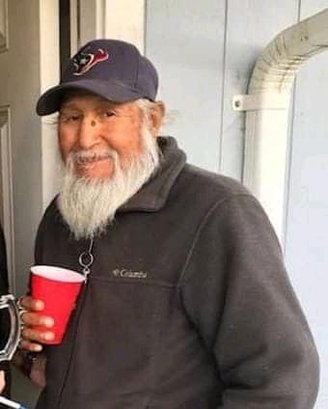
Arthur “Art” Hugh Moon was born on March 19, 1949 to Blanch and James
Moon. He was the youngest of eight siblings. He grew up in Fortuna attending
Rohnerville and Loleta Elementary schools and graduated from Fortuna Union High
school in 1967. Right after high school, he joined the Army, serving in the Vietnam war
from 1967 to 1970.
Art was a great man whom many people loved. You could always see him with a big smile on his face and a beer in his hand and he loved to hang out with everyone. He was a tribal member of the Bear River Band of the Rohnerville Rancheria. He will be dearly missed by all those who had the privilege of knowing him.
He was preceded in death by his parents Blanch and James Moon; siblings Geraldine Moon, Charlie Moon, Henry “Buster” Moon, and Virgil Moon; nieces Margarett and Shelly Moon, his nephew Nikki Metcalf, nephew Bob Johnson and children. Also, the love of his life, Rosie Crago.
Arthur is survived by his only child, Ryan Moon, his grandchildren Cameron and Tasheena Moon, daughter-in-law Toni Moody, brother Wayne Moon and family, Geraldine Moon, Cassandra Moon, Shelly Moon, Deanne Meyers and her children, Jesse Sherman, Darrell Sherman, Jason Sherman, Cody Meyers, Sarah Lopez and so many more, too many to mention.
There will be a viewing from 9 a.m to 2 p.m. at Gobles Mortuary on Friday, September 24, 2021. Immediately after, there will be a celebration of Life at the Tishnon Village Community Center across the way from Bear River Casino September 24, 2021 from 2 to 5 p.m. There will be a graveside service on October 8, 2021 at the Fortuna Masonic Cemetery on Rohnerville Road, Fortuna, at 11 a.m.
###
The obituary above was submitted on behalf of Art Moon’s loved ones. The Lost Coast Outpost runs obituaries of Humboldt County residents at no charge. See guidelines here.
OBITUARY: Lisa Jane Crenshaw, 1963-2021
LoCO Staff / Wednesday, Sept. 22, 2021 @ 6:56 a.m. / Obits
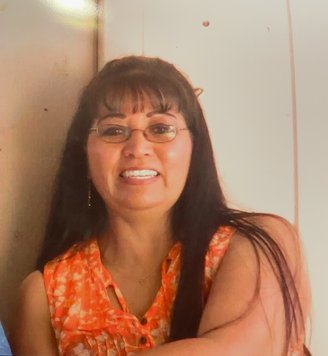
Lisa Jane Crenshaw was born June 24, 1963 in Garberville and entered into rest on Aug. 29, 2021 in Eureka.
She was born to Dwight and Nada Stillwell. She grew up in Alderpoint with her family.
She was a quiet, gentle person with a beautiful smile.
She graduated from South Fork High School in 1982.
She enjoyed reading, watching movies, listening to music, sitting on her front porch talking with her mom and taking care of her flowers and her rooster. But most of all she enjoyed spending time with her grandchildren and her family.
She leaves behind her son, Curtis Crenshaw, and his wife, Kaitlyn, of Alderpoint; three grandchildren — Carson, Kinley and Cooper; her mom, Nada Stillwell, of Alderpoint; her brothers, Dwight Stillwell Jr. and wife Kim of Covelo, and Shannon Stillwell of Garberville, and Kevin Stillwell of Fortuna; sisters, Tammie Carr of Alderpoint, Arlene Stillwell of Redway and Rachaelle Stillwell of Fortuna; nieces Tracy Stillwell (Matt), Stephanie Stillwell (Jimmie), Kacy Matthews and husband Kris, Kayla Davis, Ashley Elder and husband Josh, Jamme Anderson (Morgan), Kerra Stillwell, Kelsey Stillwell (Allie); nephews Elmer Stillwell, Derrick Stillwell and wife Beth, Travis Stillwell, Cody Mitchell and Clayton Mitchell. She had numerous great-nieces and nephews.
She was preceeded in death by her dad, Dwight; sister Tina; brother Dennis; nephew Justin, grandmother Amy and grandparents Alberta and Raphaela Wantt.
Lisa will be greatly missed by so many.
Services will be held Oct. 16, 2021 at Pine Grove Cemetery in Covelo.
###
The obituary above was submitted on behalf of Lisa Crenshaw’s loved ones. The Lost Coast Outpost runs obituaries of Humboldt County residents at no charge. See guidelines here.
TODAY in SUPES: Board Allocates $1M for Micro-Grants in an Effort to Help the ‘Failing Cannabis Industry’
Ryan Burns / Tuesday, Sept. 21, 2021 @ 4:26 p.m. / Cannabis , Local Government
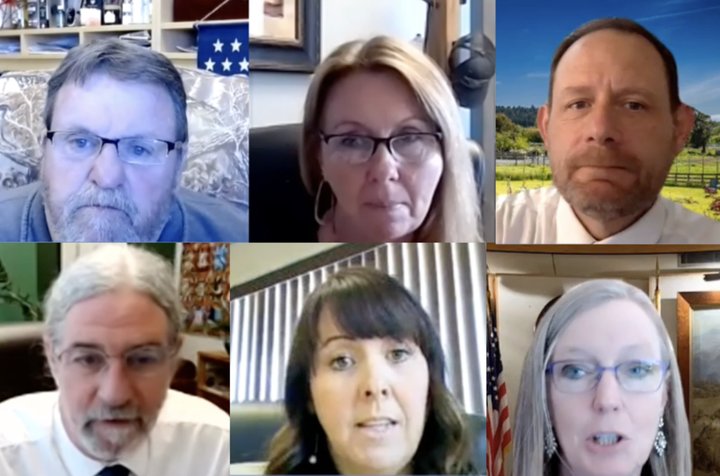
Screenshots from Tuesday’s meeting (clockwise from top left): First District Supervisor Rex Bohn, Second District Supervisor Michelle Bushnell, Third District Supervisor Mike Wilson, Fourth District Supervisor Virginia Bass, Interim County Administrative Office Elishia Hayes and Fifth District Supervisor Steve Madrone.
###
We’re now more than a year and a half into the pandemic — 18 months of meetings conducted via Zoom, of public commenters pressing 9 to chime in and of pledges of allegiance to pixelated U.S. flags.
However, Tuesday’s gathering of the Humboldt County Board of Supervisors did not include one of the regular COVID updates from the county health officer, and so the day’s deliberations largely focused on other matters. Weed featured prominently.
Let’s get right to our rundown.
‘The failing cannabis industry’
Prices for wholesale cannabis have cratered in recent months due primarily to massive overproduction in the state’s regulated marketplace, leaving local growers facing “an extinction event.” Add in crop-related challenges caused by wildfires and drought and, well, things are very bad in The Industry.
In an effort to alleviate at least a bit of the pain, county staff today proposed a few minor changes to Project Trellis, the county’s cannabis industry support program, which is funded primarily through Measure S cultivation tax revenues.
The major proposed change called for an infusion of an extra $1 million into Project Trellis coffers, with $800,000 of it going toward emergency micro-grants for struggling cultivators with the remaining $200,000 earmarked for “an emergency short-term cannabis marketing program.”
Scott Adair, the county’s economic development director, told the board on Tuesday that in recent weeks his office has been inundated with “urgent or perhaps even desperate pleas for assistance.”
Wholesale weed values have fallen so far, Adair said, that “the price per pound is now less than the cost to cultivate, process and distribute that product.” (Five hundred dollars is an oft-cited figure for a pound of outdoor these days, with some growers saying they can’t even get that much.)
Staff also proposed some changes to the county’s Local Equity Program manual, changes designed to enhance and expand availability of the program’s services.
As for the county’s weed marketing efforts, staff and a marketing ad hoc committee have been trying to get a campaign off the ground for more than two years. In an update to the board today, Economic Development Specialist Peggy Murphy said the county is extending the window to submit marketing proposals because the latest request for submissions, issued in May, attracted just one proposal. (It came from the Humboldt County Growers Alliance, the same industry nonprofit that completed a market analysis last year. [CORRECTION: Technically, the proposal was submitted by the Humboldt Community Business Development Center (HCBCD) a tax-exempt charitable organization that’s affiliated with, but legally distinct from, HCGA.])
After the staff presentation, First District Supervisor Rex Bohn said he’s been getting calls from local growers who were awarded micro-grants or equity grants in last year’s round of funding but have yet to receive the money.
Adair said those funds could be in jeopardy if the payments aren’t issued to recipients by October 1, and he explained that the process is tied up in other county departments — yet another example of the procedural fiscal woes that have bedeviled the county in recent years.
Second District Supervisor Michelle Bushnell referred to “the failing cannabis industry” and asked about the criteria to qualify for grant money. Would taking a loss on your product be enough?
Adair said the program doesn’t typically cover lost revenues but does support expenditures aimed at increasing revenues.
Bohn questioned what could be accomplished with a mere $200,000 to launch an advertising campaign and suggested that money be lumped in with the rest allocated to micro-grants. He also said that applicants for the full-fledged marketing contract should still be limited to local nonprofits, as the original RFP stated.
Fifth District Supervisor Steve Madrone agreed, saying, “I think a local nonprofit that’s deeply steeped in our industry would be best, but I understand the desire to see some competitive proposals.”
Madrone said the industry is so far back on its heels that he’d be open to throwing “a lot more than $800,000” at it in hopes of bolstering local growers until federal legalization comes through “in a couple years, hopefully.”
During the public comment period, a couple of growers asked why the Planning Commission is still approving new cultivation permits when the market is so saturated with product.
Dylan Mattole, a cultivator from Honeydew, suggested that this new round of micro-grants be awarded to growers who applied for the last round but didn’t get funded.
Both Bushnell and Madrone rejected the notion of placing a moratorium on cultivation permits.
“Who are we to say you don’t have the opportunity to apply?” Bushnell asked rhetorically.
Madrone agreed, saying it wouldn’t be right to cut off people who’ve spent their life savings getting prepared to join the industry. He made a motion to pass staff recommendations but double the micro-grant kitty to $1.6 million. However, after Interim County Administrative Officer Elishia Hayes explained that the extra money would have to come out of the county’s general fund, nobody seconded Madrone’s motion.
Taking another stab, Madrone made a motion to ditch the $200,000 marketing effort and add that sum to the $800,000 micro-grant pool, as Bohn had suggested. The motion also asked staff to come back at the next Board of Supervisors meeting, in two weeks, with a request for an additional staff member in the Economic Development division.
The motion passed unanimously.
Who’s got the power?
Should the County Administrative Officer have the power to make and enforce personnel policies during emergencies?
As noted up top, we’re now a year and a half into California’s statewide, COVID-triggered state of emergency, and Hayes, the county’s interim CAO, believes her role ought to include a bit more authority.
An item listed on the board’s consent calendar asked the board to grant it to her, but Bushnell pulled the matter for discussion.
Called upon to explain the rationale for the proposal, Hayes argued that the measure would simply allow for more efficient and effective operations. As an example, she recalled the county’s recent return to an employee mask mandate and said passing this resolution would allow her office to implement such policies directly. The board would still have the power to rescind such orders at any time, she said.
But not everyone liked the proposal. Sheriff William Honsal said he was uncomfortable with the enforcement part of the equation and asked, “Is this the amount of power we want to give one individual in an emergency?”
The wording of the resolution says the authority over emergency personnel policies would be delegated to the CAO “in consultation with the Director of Human Resources/Risk Management and County Counsel.” Honsal said that while he appreciates Hayes, he’s worried about some future scenario with a less reliable CAO. He argued that some authority over personnel policies and enforcement should be left to elected officials and department heads — or else the policies should have to be ratified by the board within a certain amount of time — say, a week.
Public Works Director Tom Mattson agreed, saying a hypothetical “bad CAO” could wind up wielding “an enormous amount of power.”
Bohn sounded amused by the talk of some terrible future CAO and pointed out that the county could just as easily “elect a crazy sheriff sometime.” He also said, in a revealing aside, that Hayes is “probably gonna be our CAO,” indicating that the “interim” may soon fall from her title.
Hayes said she’d be happy to add the sheriff/emergency services director to the list of people with whom the CAO would confer on such decisions, if that would alleviate any of the angst.
Bushnell said she liked Honsal’s suggestion of requiring that any new emergency personnel policy be ratified by the board within seven days. That provision was added to the resolution along with one requiring consultation with the emergency services director, as Honsal requested, and the board unanimously approved the measure.
Support facilities
One other cannabis-related matter came to the board today, this one a proposal to add some new draft amendments to the county’s Commercial Cannabis Land Use Ordinance (CCLUO).
The suggestion that proved a bit contentious was a proposal to eliminate an existing 600-foot setback requirement for cannabis distribution, testing and research facilities. Planning and Building Director John Ford said this requirement is causing problems in rural areas by preventing these much-needed support facilities from finding suitable locations.
“We’re proposing to remove that [setback requirement],” Ford said.
Third District Supervisor Mike Wilson said he wasn’t comfortable removing it entirely and suggested simply reducing the buffer to 100 feet. Madrone backed this proposal.
But Bushnell pushed back. She said these support facilities are badly needed and speculated that even a 100-foot setback could prevent an applicant from setting up shop — say, if their chosen location happened to be within 100 feet of a church.
Madrone and Wilson held firm, saying a 100-foot setback is a reasonable compromise. Ford said no projects that have come before the county to date would have run afoul of that stipulation.
The board wound up approving the amendments unanimously, though Bohn hesitated before voting “yes,” and Bushnell issued a warning to Madrone and Wilson. “If we see this [issue] in front of us again, I’m gonna say, ‘I told you so,’” she said. “Both of you.”
Fortuna’s Apple Harvest Festival Canceled Two Years in a Row, But That Doesn’t Mean There Aren’t Plenty of Apples For You to Enjoy
Jacquelyn Opalach / Tuesday, Sept. 21, 2021 @ 3:53 p.m. / Event
COVID has canceled yet another beloved Humboldt tradition: Fortuna’s Apple Harvest Festival, a trusty annual celebration of falltime for the Friendly City.

The festival, which is usually held the first weekend of October, was canceled last year, too. “[We were] trying to weigh all the options: keeping everyone safe vs having a fun family festival,” Drew Clendenen of Clendenen’s Cider Works told the Outpost. They’ve twice opted for the safe route.
The Apple Harvest Festival began in 1985 as a simple celebration of Clendenen’s Cider Works’ 75th anniversary, a family business spanning generations of apple growing, picking, pressing and vinegar-making. The orchard has more than 25 varieties of apples, according to their website.
“When they wanted to do it a second year, grandma Carol said, ‘Why don’t we call it the Apple Harvest Festival?’” Clendenen said. By the early ’90s, the Fortuna Chamber of Commerce hopped on the harvest train and helped initiate growth to the celebration it is today (or would be, if it weren’t for COVID): a citywide event featuring free hayrides that cart locals around town, stopping at Clendenen’s Cider Works, a downtown street fair, Rohner Park, Strongs Creek Plaza and the Fortuna Volunteer Fire Department, which each have some kind of attraction running for their patrons.
Though none of that fun will be happening this year, you can still honor apples, if you like, by buying ‘em local and catching a virtual hayride courtesy of the Clendenens and videographer John Graves. Created in lieu of last year’s apple festival, short videos posted to the business’s website take viewers through the family’s beautiful orchard, which you can still see here.

The Clendenen’s store | Clendenen’s Cider Works Website
Clendenen’s Cider Works has fared all right through the pandemic. Like many local businesses, they’ve met some labor challenges but have “lucked out” with recent hires, Clendenen said. Beyond that, “people have an interest in purchasing local food. That’s helped us to continue to operate.”
That said, Clendenen’s Cider Works is eager to reconnect with their community when safety allows. “We are optimistic that we’ll be able to hold [the festival] next year,” Clendenen said.
We hope so, too.
Body Found in Blue Lake Identified; Sheriff’s Office Now Investigating Case as Homicide
LoCO Staff / Tuesday, Sept. 21, 2021 @ 2:54 p.m. / Crime
PREVIOUSLY: Man Found Dead on Trail Off Hatchery Road in Blue Lake; Sheriff’s Office Investigating Case as Suspicious
# # #
Press release from the Humboldt County Sheriff’s Office:
The Humboldt County Coroner’s Office has identified the remains recovered Sept. 11, 2021, near Hatchery Road in Blue Lake as 65-year-old Eugene Steven Segal of Blue Lake.
An autopsy of Segal was conducted, and his cause of death was determined to be blunt force trauma and stab wounds. Segal’s manner of death has been determined to be homicide.
Anyone with information about this case is encouraged to call the Humboldt County Sheriff’s Office at (707) 445-7251 or the Sheriff’s Office Crime Tip line at (707) 268-2539.

CENSUS RESULTS: Eureka’s Population Shifted Pretty Dramatically in the Past Ten Years, and You Can Help Fix the Problems That Caused!
Hank Sims / Tuesday, Sept. 21, 2021 @ 2:15 p.m. / Local Government
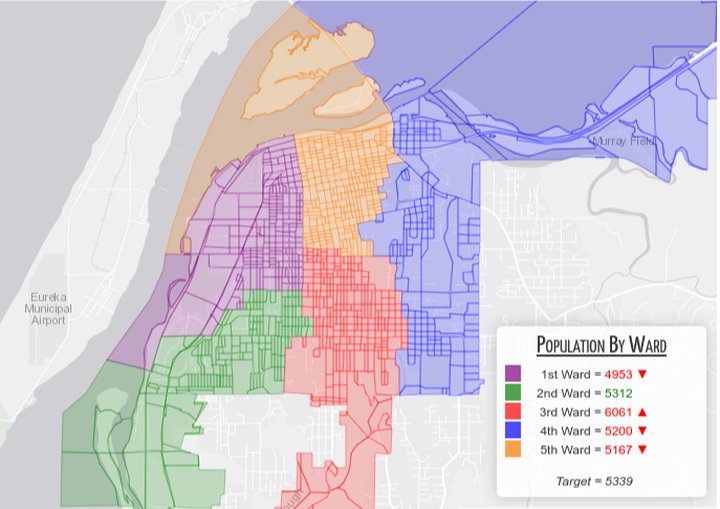
The current Eureka city electoral map is wildly out of balance.
###
PREVIOUSLY:
- CENSUS RESULTS! Humboldt County Has Grown a Little, and at Least on Paper It’s a Little Less White
- CENSUS RESULTS! The Northern Part of the County Has Boomed, and It’s Going to Make Local Redistricting a Little Tricky
###
It’s taken a little bit longer than expected, for reasons we’ll get to shortly, but here we are a month later with the final episode of CENSUS RESULTS, focused on the City of Eureka. Read all the way to the end – it comes with the reintroduction of a fun and productive LoCO game for you civic-minded Eureka citizens.
Why do the results of the 2020 Census matter? For lots of reasons (federal funding is a big one) but what we want to look at right now is how it matters for redistricting – the process of drawing lines between different electoral districts for legislative purposes. The California Citizens Redistricting Commission is charged with doing that for our state and federal offices – Assemblymember, state Senator, Congressmember – and they’re deep in the middle of that process right now. They have to divvy up the state into sections of roughly equal population so that each section elects its own legislators.
The same thing happens for county supervisors. Each of the county’s five supervisorial districts must be about the same size, so that – for example – Supervisor Mike Wilson represents the same number of constituents as Supervisor Virginia Bass. The lines between the two districts have to be rejiggered every 10 years to realign those population numbers. The Board of Supervisors itself will decide the new boundaries in the coming months, with input from a citizen-led Redistricting Advisory Committee convened for the purpose.
Since 2016, when Eureka adopted the “true ward” system for City Council elections, it has to do the same thing the county does. And as it turns out, it has to do it in very dramatic fashion, as for whatever reason – I’m not discounting poor Census response rates, or some other strange mishap – the official population in each of the city’s five wards vary wildly from each other now.
First, an overview: As you’ll recall, the 2020 Census figures that Eureka shrunk quite a bit over the last 10 years. In 2010, the Census had the city’s population at 27,191. In the 2020 Census, that was down to 26,512 – a loss of 679 souls.
In recent weeks – and on paper, at least – the city has gained some of that back. First, it appears that the Census has incorrectly excluded five census blocks in the Rosewood neighborhood from city limits. (See map here.) When we checked with Riley Topolewski, a senior planner and GIS specialist for city government, he told us that this sort of thing has happened before. In such cases, he said, they have notified the Census Bureau, and the Bureau quickly rectifies its error.
So we’re going to assume, until we hear differently, that those five blocks are actually within city limits. That would add 91 people to the city’s population, for a total of 26,603.
But there’s more, at least as regards the task at hand. California recently passed a law saying that people incarcerated in state prison should not be counted at the prison where they are located, but at their home addresses. The California Department of Justice was charged with providing that data to the California Statewide Database, which would then release revised Census population to redistricters around the state.
The Statewide Database released those figures yesterday, and 90 people so incarcerated were returned to the city of Eureka – not in body, but in spirit. The city’s population, for redistricting purposes, now stands at 26,693.
In an ideal world, then, each of the city’s five wards would have exactly 5,338.6 residents. (Let’s round that up to 5,339.) But they do not, at all! Check out how it actually breaks down:
| Ward | Councilmember | Population | +/- |
|---|---|---|---|
| First | Castellano | 4,953 | -386 |
| Second | Moulton | 5,312 | -27 |
| Third | Arroyo | 6,061 | +722 |
| Fourth | Bauer | 5,200 | -139 |
| Fifth | Bergel | 5,167 | -172 |
Big difference! For some reason, the Census Bureau says, Eurekans migrated in droves to the Third Ward (the pink one in the map up top, there) and away from the First Ward (purple), and from the Fourth and Fifth somewhat, too.
The pink ward has to shrink — a lot — and the other ones have to grow. Over the next few weeks, Eureka city staff and the council will work to draw new, equal-proportion maps of the city’s ward, and — if all goes according to schedule — adopt one by the end of the year. They’re also supposed to hold several public forums on the topic.
But why wait? If you remember, the current Eureka Ward Map was drawn right here on the Outpost four years by an anonymous user called “MAD Balancing Act” four years ago. Using our cool tools, MBA drew his fantasy ward map — and when the city council and its advisory committee saw it, they promptly tossed out all other alternatives and made it so.
So let’s do that again! The cool tool has been recharged for 2020, and you can find it at this link. Draw your own damn map! Be your own redistricter! A full set of instructions can be found at this link, but it’s pretty simple. Pick a map you like — either the current City map or one of the ones seeded by LoCO staff. Clone it. Name your cloned map. Start clicking to transfer census blocks to neighboring wards. When you’ve got it how you like it, and when all wards are balanced and contiguous (meaning every block in every ward is geographically connected to the other blocks in that ward), then go ahead and publish that sucker! Tell us your reasoning in the “description box.” You can’t do it on your phone, I don’t think.
→ ONCE AGAIN, LoCO REDISTRICTING 2020 EDITION CAN BE FOUND AT THIS LINK ←
Finally: You say you wish there were a similar cool tool for the county Board of Supervisors districts? There is! Click over to the “Districtr” app and map your county right there — your feedback will go directly to the county’s Redistricting Advisory Committee.


