
Arcata Man Who Murdered Brother Last Year Was Legally Insane at the Time, Prosecutors Agree, and Will be Sentenced to a State Hospital
Rhonda Parker / Friday, June 18, 2021 @ 12:44 p.m. / Courts
PREVIOUSLY
###
An Arcata man pleaded guilty this morning to murdering his older brother during a psychotic episode at their mother’s 11th Street home.

Steichen.
Jacob Eli Steichen, 35, stabbed 39-year-old Aaron Steichen to death on Sept. 20 during a family gathering. Today Judge Kaleb Cockrum accepted his pleas to second-degree murder and personal use of knife. But because it’s agreed Jacob Steichen was legally insane at the time, he will not be sent to prison.
“We will stipulate that he’s NGRI (not guilty by reason of insanity),” Deputy District Attorney Jane Mackie told Cockrum. “He will be sent to a state hospital.”
Defense attorney Russ Clanton said Steichen is on anti-psychotic medication and his symptoms have improved. Clanton stressed that Steichen, despite the medication, understands the legal process and the consequences.
Steichen, appearing via videocamera from the jail, told the judge the medication “does not hinder me.”
Informed that his crime was a serious and violent felony, also known as a strike, Steichen asked “Will this be a strike?”
“Second-degree homicide is a strike,” Cockrum told him. After speaking privately by phone with his attorney, Steichen said he wanted to go forward with his plea.
A few days after the killing, Beverly Steichen, mother of both men, spoke publicly about her younger son’s mental illness and the family’s increasingly desperate attempts to find help. For five weeks before the day he stabbed his brother in the heart, Jacob had been locked in his bedroom, refusing to come out.
During that time, the mother said, Jacob lit fires, screamed threats and threw burning trash out the window. He believed people were planning to harm him. She said the family pleaded for aid from various agencies. They were told repeatedly not to force entry into the room.
Three days before the murder, Beverly Steichen was informed that a mental health team would come to her home the following Wednesday. Jacob killed his brother on Sunday, as Aaron and his two other siblings were playing board games.
“There was a lot of consultation with not only Mr. Steichen but with his family,” Clanton said during the hearing this morning. “The family played a significant role in reaching this resolution.”
The next step will be for a state agency, Conrep, to make a recommendation on which hospital Steichen will be committed to for treatment.
A hearing on that issue is scheduled for July 15. In the meantime, Steichen is being held without bail.
BOOKED
Today: 7 felonies, 9 misdemeanors, 0 infractions
JUDGED
Humboldt County Superior Court Calendar: Today
CHP REPORTS
1 Mm162 E Men R0.00 (HM office): Assist with Construction
ELSEWHERE
KINS’s Talk Shop: Talkshop September 9th, 2026 – Michelle Bushnell
RHBB: HCSO Credits Jail Staff with Saving Inmate’s Life During Medical Emergency
Governor’s Office: Government, made easier. Governor Newsom introduces AskCA, a new AI-powered tool for Californians
RHBB: Large Law Enforcement Convoy Reported at Dyerville Overlook
OUT of SIGHT! The City of Eureka Wants to Help Beautify Opera Alley by Moving Dumpsters Into a Mural-Covered Enclosure
Stephanie McGeary / Friday, June 18, 2021 @ 12:14 p.m. / Community Services , Eureka Rising
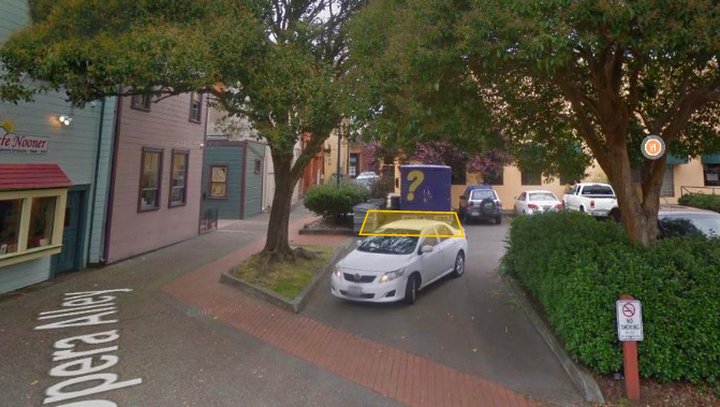
Rendering of proposed dumpster enclosure off Opera Alley | Image from Eureka Art and Culture Commission staff report
###
Dumpsters, while often necessary, tend to not be the most attractive vessels in the community and the ones in public places can even become a bit of a nuisance. They get dirty, they attract vermin, they become illegal dumping sites (in more ways than one) and they are also a popular target for arson. Sorry, dumpsters. Seems like it kinda sucks to be you.
This is why the City of Eureka is proposing the Opera Alley Dumpster Consolidation Project — a proposed solution to address the ugliness and misuse of some of the dumpsters in Old Town, by consolidating them into an enclosure and possibly decorating that enclosure with some beautiful art.
“We’ve had a lot of complaints of misuse in the area,” Christine Tyson, economic development coordinator for the City of Eureka, told the Outpost in a recent phone interview. “We’ve had a couple of dumpster fires. People go to the bathroom in between [the dumpsters.] Our goal is to alleviate all of that.”
The project targets the block of Opera Alley between E and F Streets, which Tyson said contains seven dumpsters, many of which do not get regularly filled. The City hopes to move a few of those dumpsters into a locked enclosure and remove the others from the alley. The enclosure would sit in the neighboring parking lot between E and F Streets, and would take up two parking spaces. The City also plans to have a local artist paint a mural on the enclosure, to help it match this art-filled section of Old Town. If this pilot project goes well, Tyson says that the City may try something similar in other areas.
Tyson said the dumpster project is still in planning stages and the City is in the process of reaching out to all the neighboring property and business owners. But the people the City has talked to so far seem to be on board, Tyson said, and she is hopeful that the project can be complete by the end of this summer. If all goes to plan, the City will be putting out a call for dumpster mural artists in the next couple of weeks.
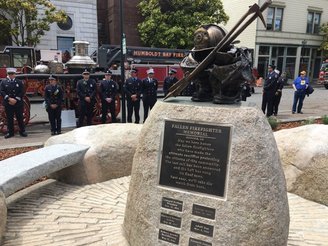
Fallen Firefighter Memorial recently installed in Clarke Plaza | Stephanie McGeary
Finding a more attractive way to store garbage is just one of many ways the City has been ramping up its efforts to beautify Opera Alley and Clarke Plaza and promote the use of the plaza as a social gathering place. Recently Humboldt Bay Fire partnered with the City to erect the Fallen Firefighter Memorial on Clarke Plaza and soon the City will be adding tables to the plaza, so people can eat takeout food there.
If you’re excited about all the improvements being made to Clarke Plaza, you can help out by joining the City’s volunteer cleanup on Saturday, June 19. Volunteers will meet on Clarke Plaza — on 3rd and E Streets — at 9 a.m. to help clean up, paint planter boxes and do some landscaping.
“Clarke Plaza is beautiful,” Tyson told the Outpost. “We’re really excited that this space will be living up to its potential.”
Employers! Here’s the New Rules as of Right Now Regarding Workers and Vaccination Status
LoCO Staff / Friday, June 18, 2021 @ 10:41 a.m. / COVID-19 and Humboldt
From the Humboldt County Joint Information Center:
The Division of Occupational Safety and Health, better known as Cal/OSHA, revised COVID-19 safety regulations for California’s workplaces. Yesterday, Gov. Gavin Newsom issued an Executive Order to implement the relaxed rules effective immediately.
Some of the revised regulations include:
Only unvaccinated workers are required to wear face coverings indoors or in vehicles.
Fully vaccinated employees are not required to wear face coverings, and no one is required to wear face coverings outdoors.
In certain high-risk settings such as health care facilities and during workplace outbreaks, all employees must wear face coverings indoors and outdoors when physical distancing cannot be maintained.
Fully vaccinated workers without symptoms of COVID-19 do not have to be tested or quarantine after an exposure to the virus.
Physical distancing and physical barriers are no longer required with exceptions only for outbreaks in the workplace.
Upon request, employers must provide unvaccinated employees with respirators at no cost for voluntary use.
Employers must offer no-cost testing for COVID-19 during paid time to unvaccinated employees who develop symptoms or are exposed to the virus, vaccinated employees who develop symptoms, unvaccinated employees in an outbreak, and all employees in a major outbreak.
Employers are also required to maintain confidential records of vaccination status for any employee not wearing a face covering. Options include:
Employees provide proof of vaccination (vaccine card, image of vaccine card or health care document showing vaccination status) and employer maintains a copy.
Employees provide proof of vaccination. The employer maintains a record of the employees who presented proof, but not the vaccine record itself.
Employees self-attest to vaccination status and employer maintains a record of who self-attests.
A person is fully vaccinated 14 days after completing a two-dose vaccine series or receiving a single-dose vaccine authorized by the US Food and Drug Administration or the World Health Organization.
Businesses are urged to read Cal/OSHA’s FAQ at dir.ca.gov/dosh/coronavirus/Revisions-FAQ.html#whatischanging.
This decision by Cal/OSHA aligns rules for workplaces with the State Public Health Officer Order issued on June 11, which outlines ongoing COVID-19 safety measures, and the California Department of Public Health’s (CDPH) masking guidance that allows fully vaccinated people to go unmasked in almost all public settings.
Unvaccinated people must continue to wear masks in indoor public settings, and all people must wear masks in the following places, regardless of vaccination status.
Public transit and transportation hubs
Indoors in K-12 schools, childcare and other youth settings
Health care settings
State and local correctional facilities and detention centers
Homeless shelters, emergency shelters and cooling centers.
Read the state’s order in full at cdph.ca.gov/Programs/CID/DCDC/Pages/COVID-19/Order-of-the-State-Public-Health-Officer-Beyond-Blueprint.aspx.
Cal/OSHA establishes masking policies for workers, while customer masking is determined by each individual business. According to CDPH (cdph.ca.gov/Programs/CID/DCDC/Pages/COVID-19/guidance-for-face-coverings.aspx), businesses have three options to accommodate unvaccinated individuals:
Provide information to all patrons, guests and attendees regarding vaccination requirements and allow vaccinated individuals to self-attest that they are in compliance prior to entry.
Implement vaccine verification to determine whether individuals are required to wear a mask.
Require all patrons to wear masks.
Gavin Newsom Under COVID: The Governor Dishes on His Pandemic Life
Emily Hoeven / Friday, June 18, 2021 @ 7:06 a.m. / Sacramento

Gov. Gavin Newsom with his youngest son, Dutch, during the annual Christmas tree lighting at the Capitol on December 15, 2019. Photo by Anne Wernikoff, CalMatters
###
It was strange, after 15 months of watching Gov. Gavin Newsom’s press conferences on my computer screen, to see him up close.
He was sitting in a conference room in the California Lottery building, wearing his signature bear-emblazoned face mask and typing on his phone. He had just held a press conference announcing the first 15 winners of a $50,000 cash prize in the state’s vaccine lottery, but the event hadn’t gone as expected. Unimpressed with the glitzy Wheel of Fortune decor and confetti fireworks, reporters had pummelled him with tough questions, and recall supporters had pounced on Newsom’s assertion that he wouldn’t give up his emergency powers when the state reopened on June 15.
When I walked into the room, the first thing Newsom did was apologize for being on his phone. I sat down and pulled out my own phone to record our interview, commenting that the coffee brewing in the corner of the room smelled good. To my surprise, Newsom jumped up and poured me a cup.
Actually, I was surprised to be meeting Newsom in person at all. For nearly a month, I had been trying to land a conversation with him for a fun project: a series of talks with California’s living governors about their favorite books, TV shows, movies, music, food, etc. His press office and I had settled on a phone call or Zoom, but we hadn’t picked a date, and I was beginning to think the interview wouldn’t happen. Then, the night before Newsom’s lottery event, I got an email offering a 15-minute in-person interview with the governor.
Fifteen minutes: That would be more than enough for Newsom to run through what he was reading, what he was watching on Netflix. But our conversation ended up being longer than 30 minutes, and it also ended up being more serious than I had expected, with Newsom talking about his childhood and his parents and his own experience as a father.
He also talked about his life during the COVID-19 pandemic, providing a rare glimpse into the behind-the-scenes of one of the country’s most visible governors — whose visibility has only grown with the looming election to oust him from office.
The recall, of course, looms over everything — and could very well have something to do with me getting an in-person interview in the first place. I didn’t go into the conversation with the intention of grilling him about the recall — that wasn’t the goal of the piece — but it came up anyway, because the political inevitably bleeds into the personal.
Thirty minutes: That was enough time for a portrait of Newsom’s personal life amid the pandemic to emerge. Here are key excerpts from our conversation, edited for length and clarity.
Me: Do you watch TV? Do you watch shows? Do you watch Netflix, Hulu?
Newsom: I do have four kids, so yes, but it’s not what I want to watch. The one show I cannot see another episode of is “Spirit.” My daughter loves horses, and every time I try to turn the channel it goes back to “Spirit” … We just finished the one Netflix series, we did finally get through all the seasons, my wife and I, and we did it late at night. It was not a great way to go to bed every night. We got through “Narcos,” which we’ve been obsessed with. Obsessed. We’re just like, at one in the morning, we’re like, “One more.” “No.” “One more.” “All right, let’s do one more.” And it’s 1:43 and we’re like, “I can’t believe we’re doing this.”
“I’ll take responsibility for everything in this state because at the end of the day I’m accountable, except for the fact that the kids bought a rooster and now we have a damn rooster waking us up every morning.”
— Gov. Gavin Newsom
Me: I actually was so curious about your sleep schedule, especially at the beginning of the pandemic. How many hours a day would you sleep and what is it like now?
Newsom: It’s wholly dependent on how the kids are doing. When you have so many kids this age, someone’s sick, someone’s scared, someone’s in the bed with you, someone’s angry, someone woke up early because the other person woke them up earlier, someone can’t go to bed. … And then we just made the worst decision of all times. I did not make it. I’ll take responsibility for everything in this state because at the end of the day I’m accountable, except for the fact that the kids bought a rooster and now we have a damn rooster waking us up every morning. … My wife is complicit in this, and deep accountability is required. And I don’t know what to do to sanction. I could sneak in and steal the rooster, I can invite in the bobcat that got one of our chickens…
Me: What’s your go-to date with your wife, I guess in non-pandemic times?
Newsom: The last date Jen and I had, true story, not making this up. So cute. I have photos, actually. The kids decided to dress up in little mini suits, and they did a date night … They surprised us. They made menus and nameplates like “Mom,” “Dad,” then went downstairs — freezing cold — it was like a cold little basement thing but it was so cute. And they set up dinner and they made us dinner and they were the servers. … And of course they sat with us the whole time. They were like, “Do you like it?” I’m like, “It’s good, OK, get out of here!”
Me: What do you eat in a day, actually?
Newsom: Eggs in the morning, religiously. Banana. Two eggs minimum, sometimes as much as four. Coffee. … Chicken salad, unless I’m on the road — then it’s a chicken sandwich or a turkey sandwich. … That’s pathetic, I’m not even interesting. And then, at dinner, I’d eat pasta every single night of my life until the end of time. I would eat tortellini — I mean, just, whatever the pasta is. … Lasagna, come on. It’s like the greatest thing ever created.
Me: What does your typical Saturday look like when you’re able to, you know, do what you want to do? Like, how do you relax?
Newsom: I just started, after a year and a half of not being able to get anywhere — save, literally, one fated infamous place — and then, on my mother and dad’s graves, literally only two other nights that we went to a restaurant in the last 14 months. … Been stuck in the house. Like, it’s this place, this place or with you guys 24/7 — you heard those wonderful questions and how wonderfully happy everyone seems to be when they’re around me. And so my staff, to their credit, had a little intervention.
Wade Crowfoot in Natural Resources says, “You’re in Sacramento — you gotta get out!” And so I’ve been doing these hikes every Saturday, which has just been game-changing, up in the Auburn trails. … I’ve had poison oak now twice already. … My passion as a kid was photography. My obsession. … Now I’m back out taking these just spectacular — I’m just so proud — I’m obsessed with the ones I’m taking of all the wildflowers.
Me: I’ve always wondered this — do you drive yourself anywhere in your private life or do you always have someone (with you)?
Newsom: I’ve tried, I’ve tried to sneak out. We’ve had a few, uh — you guys, lovingly, don’t have any sense of the threats. I mean, it’s comical, it’s bad. I mean, the protests in front of the house are never-ending. It’s bad. … And I’ve had, I mean, just getting coffee, people — it’s very emotional now, very raw. We’re shoving again as a society over these last few years, so it’s a little more intense. So I’ve come to be a little bit more like, “I kinda get it.” We’ve had two in particular that were actually serious that made me go, “I’m going to listen to these guys.”
“You have to move on, live your life, try not to hold grudges and remember that everybody else is struggling in a million different ways and their pain is unique and distinctive and just as profound.”
— Gov. Newsom
Me: How do you not crack under the pressure?
Newsom: This year’s been intense. I’m facing a recall … all my businesses are shut down for a year, employees, life, people are angry, stress across the board. Kids, their friends that don’t like me because their dads don’t like me. It’s intense. Life, right? Protests, the whole thing — it stacks a little bit. … When you know that at the end of the day, quite literally, no one cares — you have to move on, live your life, try not to hold grudges and remember that everybody else is struggling in a million different ways and their pain is unique and distinctive and just as profound. And you’re not a victim. I’m not a victim. We’re not victims. …
I’m really worried … in our society how this victimhood thing is taking shape. It’s a big part of the Republican Party. … It’s like the Republican Party’s been taken over by victimization, like mainstream media victimization. … I’m like, “My kids, you’re not victims. Don’t maintain a victim mentality. It’s decisions, not conditions, that determine your fate and future.” I keep saying that to them, and they’re like, “Oh, God.” And so that’s the resiliency that I want to see in them.
###
CALmatters.org is a nonprofit, nonpartisan media venture explaining California policies and politics.
Klamath Trinity Spring Chinook Salmon Added to California Endangered Species List
LoCO Staff / Thursday, June 17, 2021 @ 3:18 p.m. / Wildlife

A chinook salmon | UC Davis
Salmon River Restoration Council and Karuk Tribe release:
Yesterday, the California Fish and Game Commission ruled unanimously to add Upper Klamath Trinity Spring Chinook to the California Endangered Species List.
“We are elated that the Commission recognized the unique characteristics, cultural importance and true peril of Klamath River Spring Chinook.,” said Salmon River Restoration Council (SRRC) director Karuna Greenberg. “Tribes and grassroots activists have worked tirelessly for decades to preserve this iconic fish, and now we have a better chance at accomplishing that goal.”
The Karuk Tribe and SRRC jointly filed a petition to list Spring Chinook with the Commission in August 2018. The petition is based on the discovery of the genetic sequence that defines Spring Chinook as distinct from the more abundant Fall Chinook. That data was published in 2017 by UC Davis Professor Michael Miller and colleagues.
Adding Spring Chinook to the CA Endangered Species List will allow agencies to prioritize funding for restoration and ensure any projects in the fish’s range will have to avoid adverse impacts to the population.
Spring Chinook enter rivers in the spring when snow melt swells rivers allowing the fish to travel into the upper reaches of a watershed. Then they must reside in cold water areas all summer until they spawn and die in the fall. Fall Chinook migrate into rivers in the fall where they spawn and die relatively soon after entering fresh water. “Having two life strategies allow Chinook to take advantage of the entire watershed instead of just the upper or lower reaches,” explains Toz Soto, Senior Fisheries Biologist for the Karuk Tribe. “This behavioral diversity enhances the odds for long-term survival for the entire population.”
However, until Miller published his findings, the conventional wisdom of fisheries managers was that Fall and Spring Chinook were the same animal despite the differences in behavior. It was not until new scientific instruments and methods were developed that scientists could find the small but very significant changes in DNA sequence that result in the two fish having fundamentally different life histories.
The Karuk and other tribes that have depended on Spring Chinook for sustenance for millennia already knew the two fish were not the same animal. “These fish have different names, are used in different ceremonial events, they even taste different. I’m pleased to see western science finally catching up to traditional ecological knowledge,” noted Karuk Chairman Russell ‘Buster’ Attebery.
The population of Chinook salmon that swims up the Klamath River in the spring once numbered in the hundreds of thousands. In recent years, surveyors at the Salmon River Cooperative Spring Chinook and Summer Steelhead Population Snorkel Survey have counted only a couple hundred individuals in the Salmon River, which hosts the last viable wild run of these fish in the Klamath Basin.
“We thank the Commissioners for listening to the Tribe’s concerns and traditional knowledge in their decision to accept our petition. California is on the right track when it comes to working with Tribes,” noted Karuk traditional dip net fishermen and council member Troy Hockaday.
Spring Chinook advocates currently have January 2023 circled on their calendars. That’s when the removal of the lower four Klamath River dams is slated to begin pursuant to an historic agreement between dam owner PacifiCorp, California, Oregon, Tribes, and conservation groups. The project would be the largest salmon restoration project in US history. For Spring Chinook and the Karuk Tribe, it can’t come soon enough.
The National Marine Fisheries Service is currently considering a similar petition from Karuk and SRRC to list on the federal ESA.
Wiyot Tribe Declares State of Emergency Due to Drought and Low Flows on Local Rivers, Their ‘Sacred Cultural Resources’
LoCO Staff / Thursday, June 17, 2021 @ 12:38 p.m. / Drought
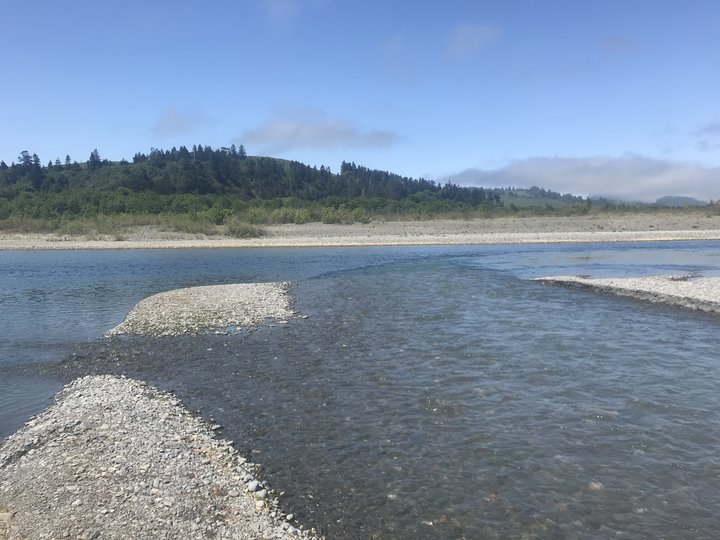
At the confluence of the Wiya’t (Eel River) and Gidughurralilh (the Van Duzen). Photo: Wiyot Tribe.
###
Press release from the Wiyot Tribe:
It was with heavy hearts that the Wiyot Tribal Council voted Monday night to declare a State of Emergency on the Wiyot’s ancestral rivers due to extreme low flows and drought conditions. The Wiyot Tribe shares its name with its ancestral river, the Wiya’t (Eel River). Waterways in the ancestral lands of Wiyot people include Baduwa’t (Mad River), Hikshari’ (Elk River), Wiya’t (Eel River), and Gidughurralilh (Van Duzen River). These rivers are sacred cultural resources to the Tribe and are considered the bloodlines of Wiyot culture, providing nourishment, medicine, spirituality, sustenance, and cultural knowledge to the Wiyot people.
Before Euro-colonial settlement, Wiya’t produced the largest salmon runs in California and provided salmon for the rest of the United States. Beginning in the early 1900s Wiya’t has suffered numerous deleterious impacts, including water diversions, invasive predators, logging, sedimentation, dams, overfishing, extreme summer conditions, and low flows, which have led to significant loss of habitat and ecological degradation, contributing to diminished native fish populations that are critical to the survival of the Wiyot culture and people. In recent years the Tribe has continued its active stewardship of its rivers and has been a driving force for activities aimed at restoring the gou’daw (Pacific lamprey), malhuk (salmon), ba’m (green sturgeon), and other native species of the Wiya’t.
Climate change is intensifying the impacts of drought on Wiyot lifeways, and our rivers are bracing for a second consecutive year of low rainfall and extreme summer conditions. Water diversions associated with agriculture and excessive nutrient runoff have severely impeded water quantity and quality, particularly in smaller tributaries that provide rearing habitat and cold-water flow during the dry summer months.
The combination of below-average rainfall and above-average temperatures has left unimpaired flows at the lowest on record: On June 10th of this year, the Wiya’t discharge at Scotia, based on 108 years of data, was at 12% of the mean. In the fall of 2014, a year when flows were higher than 2021 (300 cfs at Scotia in 2014 vs. about 210 this year), the lower Wiya’t ran dry near Fortuna, immediately above the reach where the tides affect the river’s height, impeding the rriqhawu’rruwalh (Chinook salmon) run and causing fish death from disease associated with high water temperatures.
According to Pat Higgins, “The Eel River Recovery Project shares the Wiyot Tribe’s concern about the health of the Eel River. Without very unusual summer rains, we expect problems similar to 2013-2015 to occur, when surface flow was lost in some reaches and others passed a tipping point to a very warm, stagnant ecosystem mostly supporting exotic aquatic species and toxic cyanobacteria. Lack of sufficient and timely rainfall is putting stress on salmon and steelhead stocks, and ocean conditions appear to be becoming less supportive of these fish as a result of climate change. To save the fish (and ourselves), we must remain hopeful and become even more dedicated to maximizing water conservation efforts throughout the Eel River watershed, to restoring watershed hydrology through measures like road decommission and restoration of forest and grassland health, and expeditiously restoring key pieces of salmon habitat like the lower Eel River.”
According to a statement by our sister Tribe, Blue Lake Rancheria, water quality sampling done along the lower Baduwa’t (Mad River) has already shown a presence of toxins in the water that are hazardous and potentially life-threatening to pets and small children. According to Jacob Pounds with the Blue Lake Environmental Department, “the timing and lack of precipitation this year is leading to poor water quality conditions much earlier in the year. In comparing this years’ drought to the previous drought (Water Years 2012-2016) the amount of precipitation is less and the timing is much later than typical, with the present water year much below average, and the timing of precipitation off from the 58-year data period along the Baduwa’t.” As of his June 11th sampling, “mainstem temperatures on the Baduwa’t were nearing the 18-degree Celsius mark, which is the level where fish begin experiencing acute levels of stress if exposed for extended periods of time.” (Jacob Pounds, Blue Lake Environmental Dept.)
The Hikshari’ (Elk River) is known as the most critically impaired Wigi (Humboldt Bay) tributary for sediment, and new evidence suggests that Eureka’s sewage plant has been contributing effluent to the lower river for many years, notes Jerry Martien with Friends of the Elk River; and “it’s hard to dispute that there’s enough mud there to choke the river, with the result being further aggradation and extreme low flows—as we’re seeing this summer.”
Friends of the Van Duzen River reports that Girrughurralilh (Van Duzen River) is seeing lower flows (20% of the average) in the main stem and tributaries that are more typical of later summer and early fall. June flows are now more like typical August/September flows and will have a negative impact on wildlife and recreation as the summer progresses. Blue-green Algal blooms have already been detected at Pamplin Grove and the William Dinsmore Bridge on Highway 36, where we usually see dozens of tswal (steelhead), but this June we only found three individual fish. In a very unusual observation, many underwater algal blooms are more prevalent than at any previous time observed. The tributary of Hely Creek no longer provides a viable connection to Girrughurralilh and no longer supports an active salmon run.
Presently, Wiyot people risk their health and safety when choosing to consume fish or eels out of Wiya’t because of hazardous algal blooms and diseased animals. The health of the Wiya’t is intrinsically tied to the health of the people. The survival of the people relies on the health of Wiya’t. Threats to the Wiyot’s subsistence practices through irresponsible water diversion on the Wiya’t represent a continuation of settler-colonialism and environmental injustice.
We know through oral histories about Wiya’t that salmon were so abundant that one could “walk across their backs” to cross the river. Elders have told us that they would go fishing and eeling and come home with more than enough food for their families so that they could always share with other Wiyot families who needed sustenance. This rich oral history and hard evidence illustrates that the Wiya’t was once a thriving and great river, that nourished not only Wiyot people, but early Euro-American settlers as well. There are so few salmon in the Wiya’t today that all permitted fishing is catch and release only.
Now, with the voice we share together, we have an opportunity to plead for the restoration and health of the Wiya’t, by working toward furthering our stewardship and role as caretakers, and by promoting practices that enhance ecosystem health rather than impeding it through unwise water diversions and unsustainable usage of nature’s precious gift of clean freshwater. We have an opportunity to allow this water to flow again freely in the Wiya’t, and to bring back our friends; the steelhead, salmon, sturgeon, and lamprey, to run again once more, on our majestic ancestral rivers.
“Our relationships with Wiya’t, Baduwa’t, Hikshari’, and Gidughurralilh was never broken, only suppressed. We remained quiet stewards throughout the last 160+ years. Now, it is our time to use our voices again. To raise them up and demand that responsible ecological practices are once again administered on our rivers,” said tribal council member Marnie Atkins.
The County is Upgrading its Communications Infrastructure, the Better to Serve Your Policing and Emergency Services Needs
LoCO Staff / Thursday, June 17, 2021 @ 10:48 a.m. / Infrastructure
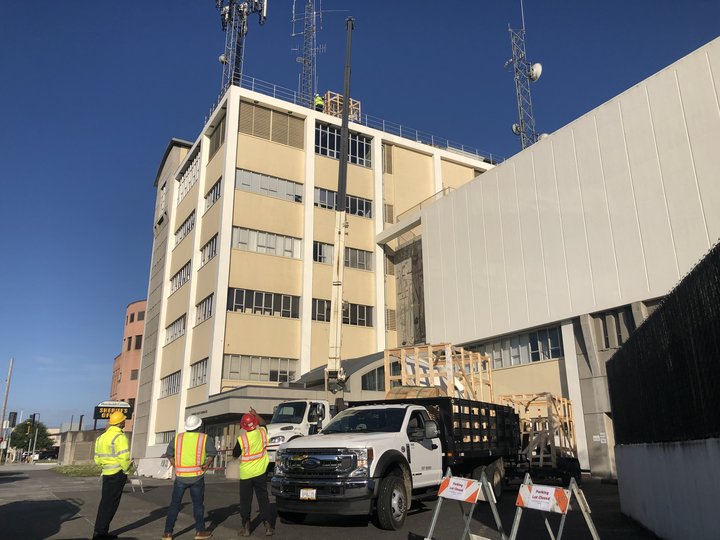
Photo: County of Humboldt.
From a press release the County of Humboldt sent out yesterday:
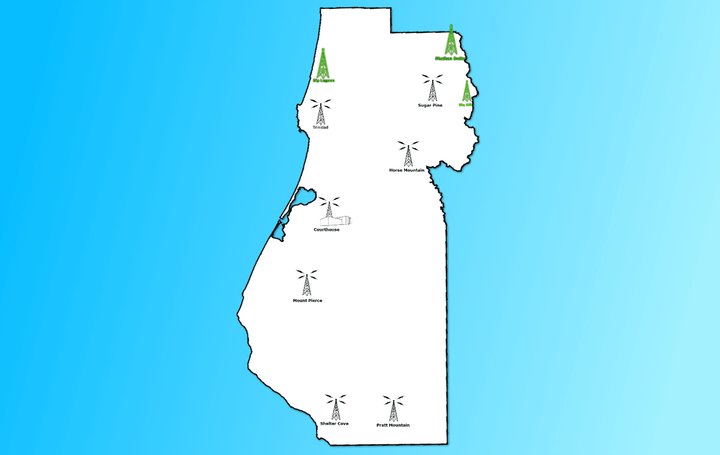
Communication is critical during an emergency and a long overdue radio system improvement project linking first responders and other agencies is underway for the County of Humboldt.
While work has already begun on radio towers in the outlying parts of the county, a significant portion of the project will occur this evening, June 16, when crews will install three microwave drum receivers, two antennas and other equipment atop the Courthouse. Crews will use a crane to lift the equipment onto the roof. Due to this work, the parking lot located next to the Sheriff’s Office entrance on 4th Street will be closed beginning at 6 p.m. The public is asked to stay out of the area until construction is complete.
The work tonight brings the county one step closer to completion of the improvement project, which will convert the county’s entire radio communications system to digital. Currently, not all areas in the county are covered by radio communication due to the limitations of the existing analog system with the county’s vast and rugged terrain. The new digital system will change that, allowing for a larger coverage area – something that is especially important for rural parts of the county which are increasingly at risk of wildfire and other emergencies.
“Communication is the cornerstone of any emergency response,” said Humboldt County Sheriff William Honsal. “This updated infrastructure will enable us to communicate countywide and will ensure that we have the proper communication in place to effectively coordinate and respond to any county emergency.”
Though predominantly used for emergency response purposes, many other county departments rely on the county’s radio towers and equipment for communications, including the District Attorney’s Office, the Office of Emergency Services, Probation and Public Works Departments.
The entire project is estimated to cost $6.8 million with funding from the County’s General Fund, Measure Z, Community Corrections Partnership, County Administrative Office – Information Technology Team, District Attorney’s Office and Public Works. The remote structures and equipment are exposed to extreme weather conditions, so proper maintenance is necessary for this project. All the towers will be linked to the Communications Center at the County Courthouse in Eureka.
“Modernizing our communication infrastructure will allow us to gain efficiencies that the digital environment provides, enhance our continuity of government efforts and futureproof our radio system hardware,” said Jim Storm, Humboldt County Information Technology Division Director.
The project is expected to be completed by next year.