

The County is Upgrading its Communications Infrastructure, the Better to Serve Your Policing and Emergency Services Needs
LoCO Staff / Thursday, June 17, 2021 @ 10:48 a.m. / Infrastructure

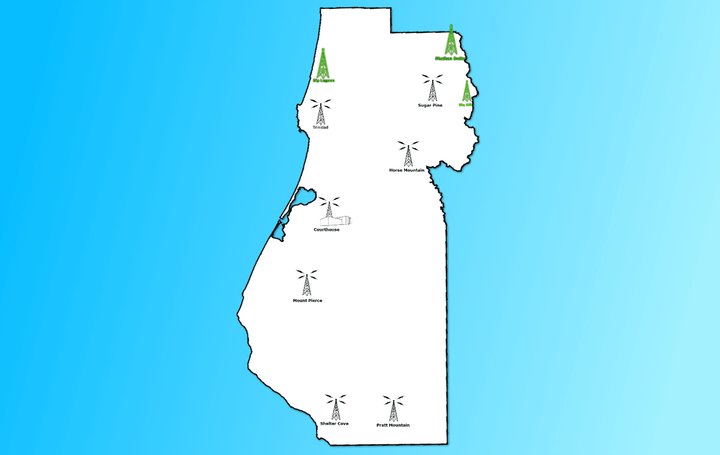
Photo: County of Humboldt.
From a press release the County of Humboldt sent out yesterday:
Communication is critical during an emergency and a long overdue radio system improvement project linking first responders and other agencies is underway for the County of Humboldt.
While work has already begun on radio towers in the outlying parts of the county, a significant portion of the project will occur this evening, June 16, when crews will install three microwave drum receivers, two antennas and other equipment atop the Courthouse. Crews will use a crane to lift the equipment onto the roof. Due to this work, the parking lot located next to the Sheriff’s Office entrance on 4th Street will be closed beginning at 6 p.m. The public is asked to stay out of the area until construction is complete.
The work tonight brings the county one step closer to completion of the improvement project, which will convert the county’s entire radio communications system to digital. Currently, not all areas in the county are covered by radio communication due to the limitations of the existing analog system with the county’s vast and rugged terrain. The new digital system will change that, allowing for a larger coverage area – something that is especially important for rural parts of the county which are increasingly at risk of wildfire and other emergencies.
“Communication is the cornerstone of any emergency response,” said Humboldt County Sheriff William Honsal. “This updated infrastructure will enable us to communicate countywide and will ensure that we have the proper communication in place to effectively coordinate and respond to any county emergency.”
Though predominantly used for emergency response purposes, many other county departments rely on the county’s radio towers and equipment for communications, including the District Attorney’s Office, the Office of Emergency Services, Probation and Public Works Departments.
The entire project is estimated to cost $6.8 million with funding from the County’s General Fund, Measure Z, Community Corrections Partnership, County Administrative Office – Information Technology Team, District Attorney’s Office and Public Works. The remote structures and equipment are exposed to extreme weather conditions, so proper maintenance is necessary for this project. All the towers will be linked to the Communications Center at the County Courthouse in Eureka.
“Modernizing our communication infrastructure will allow us to gain efficiencies that the digital environment provides, enhance our continuity of government efforts and futureproof our radio system hardware,” said Jim Storm, Humboldt County Information Technology Division Director.
The project is expected to be completed by next year.
BOOKED
Today: 7 felonies, 9 misdemeanors, 0 infractions
JUDGED
Humboldt County Superior Court Calendar: Today
CHP REPORTS
0 Tompkins Hill Rd (HM office): Report of Fire
1 Mm162 E Men R0.00 (HM office): Assist with Construction
ELSEWHERE
KINS’s Talk Shop: Talkshop September 9th, 2026 – Michelle Bushnell
RHBB: HCSO Credits Jail Staff with Saving Inmate’s Life During Medical Emergency
Governor’s Office: Government, made easier. Governor Newsom introduces AskCA, a new AI-powered tool for Californians
RHBB: Large Law Enforcement Convoy Reported at Dyerville Overlook
Will California Investment in New Job Training Programs Pay Off?
Sameea Kamal / Thursday, June 17, 2021 @ 8:03 a.m. / Sacramento

Marco Villanueva preps meals for low-income seniors as part of his program with Hospitality Training Academy at the Los Angeles Convention Center on June 14, 2021. Photo by Pablo Unzueta for CalMatters
By its own account, the state’s effort to train Californians for “green jobs” coming out of the Great Recession fell short in helping them find work and improving wages.
Using 2009 federal recovery act money, the state created training programs for jobs such as energy auditors or rooftop solar installation.
But the state Employment Development Department acknowledged the programs were based on “myths and misconceptions” about climate change-related jobs and what made workforce development programs effective. And as demand for these hyper-specific green jobs declined, so did job opportunities and wages — not quite the long-lasting, high-paying jobs the state hoped to create.
Since 2017, California has tried a different approach — High Road Training Partnerships — to build on those lessons, create a broader range of jobs and work more closely with industries.
Now Gov. Gavin Newsom and legislative leaders want to invest millions more in High Road partnerships to help California rebuild after another economic crisis.
Newsom proposed $25 million in his January budget and added $90 million in his May revision, totaling $115 million. He cited record unemployment rates caused by the COVID-19 pandemic and its long-term impacts on the state labor market — especially on women, people of color, at-risk youth and formerly incarcerated people, among the groups with barriers to employment.
On Monday, the Legislature passed its budget that included Newsom’s initial $25 million for High Roads and set aside $60 million for workforce development, tied to a larger jobs and economic development package.
While the final budget deal is still being negotiated, the Legislature also approved the governor’s request for additional $20 million for apprenticeship programs in residential construction, plus $10 million in federal funds, partnering with workforce boards, colleges and the housing industry.
Worth the investment?
Though growing in popularity as a part of state policy and spending, “High Road” is not a new idea. It started out as a concept discussed in academic and advocacy circles; in 1990, University of Wisconsin-Madison sociologist Joel Rogers defined it as “a family of strategies for human development under competitive market conditions that treat shared prosperity, environmental sustainability, and efficient democracy as necessary complements, not tragic tradeoffs.”
“The folks who are justifiably critical of the conventional approach say it’s about train and pray — train a bunch of people in skills that you think they might want and pray that they might get hired.”
— Carol Zabin, UC Berkeley Labor Center
In California, the foundation of the High Road training program was Proposition 39, approved by voters in 2012 to create “clean energy” jobs and give $1.7 billion over five years to K-12 schools for energy efficiency upgrades.
A 2013 analysis by the state’s employment department found “no discernible evidence that green firms were more likely to create jobs than non-green firms.”
Still, from 2014 through 2018, the California Workforce Development Board invested $13.3 million in Prop. 39 funds into 12 construction pre-apprenticeship training partnerships across the state, focused on industry hiring needs.They enrolled 2,701 individuals, of whom 2,100 completed the training at the end of the 18-month pilot program. Of those who completed the program, 79% had been placed in jobs as of February 2019.

Maracare Lopez places meal labels onto plastic lids inside an industrial kitchen on June 14, 2021, at the Los Angeles Convention Center, where 762 meals are made per day for low-income seniors as part of a partnership between the Culinary Training Academy and Serving Our Community Program. Photo by Pablo Unzueta for CalMatters
Building off these results, California invested $10 million in 2017 into a High Road pilot project, aiming to create partnerships in transportation, health care, hospitality and other sectors that delivered “equity, sustainability, and job quality,” according to the California Workforce Development Board.
“The folks who are justifiably critical of the conventional approach say it’s about train and pray — train a bunch of people in skills that you think they might want and pray that they might get hired,” said Carol Zabin, co-author of research for the UC Berkeley Labor Center that backed High Road.
High Road partnerships are designed to avoid those pitfalls with industry-led initiatives to ensure the jobs are there and workers stay in them.
The early results are unclear.
The California Workplace Development Board said it did not have outcome data yet, but some individual programs reported some findings. A pilot janitorial training program trained 445 people statewide in 2017-18. Another program for front-line health workers in Los Angeles County had 16 of 50 students complete the training and get jobs, while a water and wastewater treatment program in the Bay Area trained 30, including 13 women. Other grant recipients haven’t started their training due to the COVID-19 pandemic.
A ‘life-changing’ experience
A High Road hospitality program trained and placed 25 people in its pilot year. One of them was Alhagie Dampha, and for him it was life-changing.
Dampha, 34, came to the U.S. from Gambia and learned of the training from a brochure his wife brought home from her work at a nonprofit organization. At the time, he was living in Alhambra in Los Angeles County and working as a grill cook at a restaurant, where he’d started as a dishwasher.
Like others in the program, Dampha said the training was a good use of time during the pandemic. He completed courses on “high-level” Asian cuisine, and on workplace sanitization for culinary workers, among others. Dampha had three interviews with prospective employers who visited the training site to scout chefs — and landed a job after completing his training.
“After a while, my executive chef called me and asked me to give him my contact information, because he would like to hire more cooks from the program,” Dampha said.
The job placement had added benefits: Getting a union job meant Dampha had access to legal help in applying for citizenship. In January 2021, he became a U.S. citizen.
“Words can’t express how blessed and lucky I am,” Dampha said.
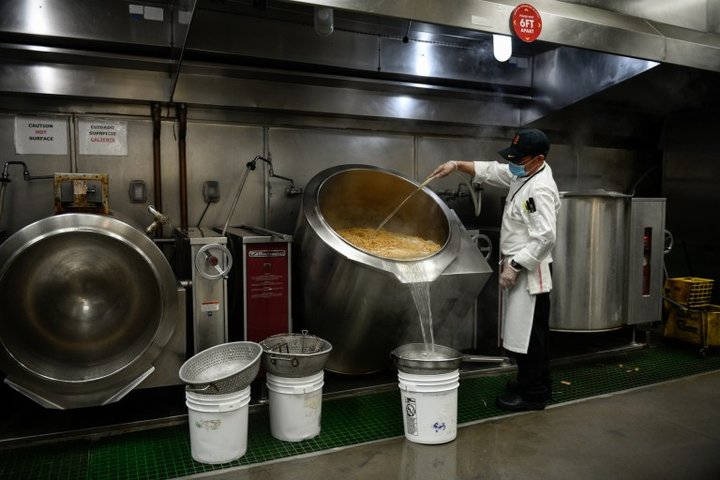
A Hospitality Training Academy participant drains pasta in an industrial kitchen at the Los Angeles Convention Center on June 14, 2021. The pasta will be prepared and sent out to home-bound seniors in Los Angeles County. Photo by Pablo Unzueta for CalMatters.
As in Dampha’s case, the aim of the program is to help not just the unemployed, but the underemployed.
While California has nearly 2 million unemployed residents, according to the federal Bureau of Labor Statistics, another 1.1 million have part-time jobs because of business conditions or because they are unable to find a full-time job. And another 270,000 Californians have stopped looking for work because they’re in school, are taking care of family or don’t believe a job is available.
Incentives and accountability
Crucial to the success of High Roads is flipping the traditional workforce training model upside down — having companies train for the work they need, instead of pushing people to compete for limited quality jobs.
And while getting companies to collaborate with competitors and invest in workers isn’t always an easy sell, Tim Rainey, executive director of the California Workforce Development Board, said many come to the table because they understand building skills and recruiting talent is hard on their own.
Sometimes, companies spend money on training, only to lose those workers when a project ends. When a new project begins, employers have to start from scratch — often using costly staffing agencies that don’t focus on equity.

Culinary Training Academy participant Jose Amado Diaz packages boxes of meals at the Los Angeles Convention Center on June 14, 2021. “During the pandemic last year, I got laid off and my unemployment was cut in October,” said Diaz, who has worked in hotels for 43 years. “If it weren’t for this program, life would be very difficult.” Photo by Pablo Unzueta for CalMatters.
Another effort to encourage companies to adopt High Road training is Assembly Bill 1192, authored by Assemblymember Ash Kalra, a San Jose Democrat. It would require all private companies with 1,000 or more employees to report annual employee metrics such as wages, benefits and safety for their entire U.S. workforce to the Labor and Workforce Development Board. Under the bilI, companies that meet High Road benchmarks would get preference for state contracts, tax incentives and more.
The bill passed the Assembly, but is opposed by groups representing airlines, the food and beverage industry and other businesses. Kalra agreed this month to hold the bill until next year; it wouldn’t take effect until March 2023.
The California Chamber of Commerce warns that the “snapshot of data” would unfairly subject employers to unwarranted criticism, as well as potential lawsuits that don’t take varying state employment laws into account.
“We don’t really think it would be giving an accurate picture, or be fair to then use this data to determine who is a good employer and who is not, and who should be worthy of certain state benefits or state contracts or tax credits or what have you,” Ashley Hoffman, a policy advocate with the Chamber of Commerce, told CalMatters.But Kalra said that’s not his goal. “Ultimately, this data is designed to create an incentive program — not to go after employers or shame employers,” he told CalMatters. “Quite to the contrary — you want to celebrate employers.”
A foot in the door
Kevin Coleman, 43, of Pomona, had already been working in construction for the last 23 years, but said taking part in the training exposed him to many more career options than he knew.
Through High Road training in the San Bernardino Community College District, Coleman obtained workplace safety and CPR certifications, learned to read blueprints and refreshed his math skills. But most valuable, he said, was networking with different companies, rather than chasing jobs down on his own.
“It’s at least a foot-and-a-half in the door as opposed to not having a foot in the door at all.”
— Kevin Coleman, a High Road trainee
He just graduated from the program, and wore a suit that the program gifted to him, since he didn’t have one. That suit is now wrapped carefully in plastic in his closet. He’s on the job hunt now.
“It’s at least a foot-and-a-half in the door as opposed to not having a foot in the door at all,” said Coleman.
For Robert Castro, 53, who lives in San Bernardino County, the benefit of taking part in the training after a 25-year career in construction was being exposed to the benefits of joining a union, he said.
“You learn what kind of trades are out there, not just one or two things,” he said.
Many of the partnerships work with unions, as well as with community-based organizations. But any industry can take the High Road approach, said Zabin from the UC Berkeley Labor Center.
“It really is a choice: Are we going to make it a sweatshop industry, or one where workers are valued and we value the quality of their work and we get a quality product that will last longer?”
###
CALmatters.org is a nonprofit, nonpartisan media venture explaining California policies and politics.
OBITUARY: Roland Joseph Pearce, 1921-2021
LoCO Staff / Thursday, June 17, 2021 @ 6:56 a.m. / Obits
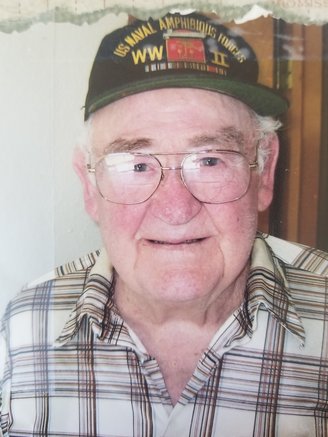
Dad
passed away peacefully the morning of June 5, 2021 at Frye’s Care
Home in Eureka at the age of 99. Dad was born on December 22, 1921 to
Alfred Stanley Pearce and Christine Nessier Pearce in Fields Landing.
Dad was one of two identical twin boys, the youngest of five
children, five minutes younger than his twin brother Robert. Dad and
his siblings grew up during the Great Depression in Eureka. He was
greatly affected by those hard times. He would tell me and my sister
how life was as a kid and having to make ends meet and to do without
at times.
Dad graduated from Eureka High School in 1941. He boxed Golden Glove while in high school and later boxed when he was in the Navy. He was a member of the Eureka Lions Club boxing team. Dad was well known in Humboldt County for his boxing skills. Scoop Beal, the sports writer for the Humboldt-Standard in those days, would do many boxing articles on his club bouts.
After graduating high school Dad enlisted in the U.S. Navy in 1942 during WW2. Dad saw combat during the invasion of Sicily, driving an invasion barge to the beachheads carrying troops and equipment. He was sent to Gila Italy, then to Gibraltar, Tunisia, North Africa in the war effort against Nazi Germany and Fascist Italy.
Dad and Mom were married February 14, 1949. They owned a paint store for a short time. Dad also owned the Bank Club bar in Eureka. He worked for Brinks driving the armored truck. He owned and operated Rol’s 3020 Club in Eureka on Broadway in the early ‘60s. He worked at Hammond Mill, drove for Callisons Freight Lines and was a Eureka city fireman. Dad’s last job was at the Eureka Post Office, where he worked for 20 years. He retired in 1986 as the VOMA — vehicle officer maintenance assistant – and driver trainer instructor/examiner, a job he thoroughly enjoyed. Dad was also a lifetime member if the Veterans Of Foreign Wars VFW Post 1872.
Dad was a wonderful caretaker to his mother-in-law, Maria Gonsalves, when she was suffering from cancer. He would perform all the necessary functions to keep her comfortable in her time of need. He was with her when she passed. Dad also took care of his wife, our mother, when she was ill with cancer. He did so without hesitation and with loving care.
Dad was an avid brant, duck and deer hunter. He enjoyed clamming and fishing as well. One could find him surf fishing in Orick or anywhere the fish were running. He would take his grandsons fishing at Freshwater Lagoon and Orick. One of his hobbies included racing hydroplane racing boats that they build on Big Lagoon with his friends. He also had a talent for art, drawing yard signs and sketches.
Dad was proceeded in death by his wife, Elsie A. Pearce, mother, Christine Nessier Pearce, father, Alfred Stanley Pearce, his older sisters, Alyce Giannini, Florence Girsback, Bernice Hemm, and twin brother Robert A. Pearce.
Dad is survived by his children, Roland M. Pearce (Denice), Deborah M. Butler (Steve), his Grandchildren, Jeffrey Pearce (Betsy), Jerrod Pearce (Jamie), Jason Pearce (Stacy), Stephen Butler and Brian Butler. He is survived by Great Grandchildren Katelyn Pearce, Leah Pearce, Parker Pearce, Jack Pearce (due in July), Benjamin Pearce, Hetty Pearce, Harper Pearce, and Kaylee Pearce. Dad is also survived by his many nephews and nieces.
A celebration of Roland J. Pearce’s life will be held at the Eureka Elks Lodge #652 on Herrick Avenue in Eureka on Tuesday, June 29, 2021 at 11 a.m. There will be an honor guard ceremony starting around that time in honor of his military service. Food and refreshments will be provided.
Our family would like to thank Frye’s Care Home, Dolly Frye, Dee Dee Frye, and their great staff for caring for him since 2012. Hospice of Humboldt (Coral) for his end of life care. Veterans HBPC nurse Rebecca Morris for Dads healthcare needs. We also thank Sanders Funeral Home and Oceanview/Sunset Cemetary for thier services. Donations in Dad’s name can be made to Hospice of Humboldt or Mad River Community Honor Guard, P.O. Box 152 Bayside CA 95524.
###
The obituary above was submitted on behalf of Roland Pearce’s loved ones. The Lost Coast Outpost runs obituaries of Humboldt County residents at no charge. See guidelines here.
OBITUARY: Joseph Lawrence Bessette, 1955-2021
LoCO Staff / Thursday, June 17, 2021 @ 6:56 a.m. / Obits
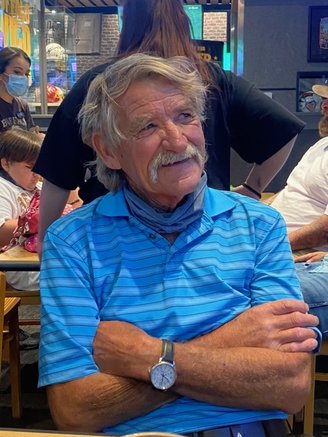
Joseph
Lawrence Bessette —“Pops” — left this world on Tuesday, June 8,
2021. He was 66 years old.
Joe was born on June 6th, 1955 in Eureka. He attended both St. Bernard’s and Eureka High School and it was at that time he met the love of his life, Terry Wright. In 1978, he married Terry and together they had two children, Joey and Jennifer.
Pops was a contractor by trade and there probably wasn’t a day that went by that he wasn’t doing two of his favorite things, fixing stuff and helping others. The list of people that benefited from Pops being included in their lives is endless. The Bessette home was welcoming to all and you knew you were accepted once he gave you the “Don’t knock on the front door, Just walk in” speech. Pops was a hard worker, a loving dad and husband, an incredible friend, and one of the best Papa’s his grandkids could ever ask for.
Pops is survived by his son, Joey Bessette (Kella), and daughter Jennifer McCormick (Patrick); grandchildren Lilly Bessette, Ryan McCormick, Isaac Scott, Sarah Scott, Carol McCovey; sister Michelle Van Winkle (Ray); brother Chris Bessette (Karen) and sister-in-law Kathleen Bessette; nieces and nephews, Donny, Sarah, John Dean, Jacob, Michael and Richard and their respective spouses and children.
He is preceded in death by his wife, Terry Bessette, parents John and Patricia Bessette and brother Will Bessette. His extended family is numerous and it is impossible to name them all, however some nearest to his heart included Rob Moore, his wife Jenn, and two daughters; Casey Wood, wife Natasha, and their two children; Toni Baya, husband Kevan and their daughter; Bob Pfannenstiel, wife Debbie and daughter Katrina; Nick Vulich girlfriend Kara and their two daughters; Crystal Perez, Steve Valentine, his wife Nicki and their children and so many others. He leaves behind his beloved dogs Bucky and Katy and the birds.
Pops’ final days were made much brighter thanks to his girlfriend Pam Cahill, with whom he was able go on new adventures with and was able to put a smile on Joe’s face like nobody had in quite a while.
Pops was well known in the community and loved pointing out the various buildings around town that he helped build. He loved his times at Wednesday night golf league at Eureka Golf Course and was one of the mainstays in that league for many years. He often said one of the highlights of his life was being able to stand on the tee box when his son, Joey, made his first and Hole-in-One. The void left by Pops’ passing will not soon be filled however we all must do what Joe would do in a time like this, get back to work and get the job done. The family would like to thank the staff, doctors, and nurses at St Joseph Hospital for their efforts with Joe’s healthcare.
There will be a celebration of life on Saturday, July 24 at 1 p.m. at 6525 Humboldt Hill Road in Eureka. Memorial donations may be made in Joe’s name to the Eureka Golf Course in support of Junior Golf.
###
The obituary above was submitted on behalf of Joe Bessette’s loved ones. The Lost Coast Outpost runs obituaries of Humboldt County residents at no charge. See guidelines here.
Eureka City Council Releases Three City-Owned Parking Lots for Affordable Housing Developments; Adopts Budget for the Upcoming Fiscal Year
Stephanie McGeary / Wednesday, June 16, 2021 @ 4:05 p.m. / Local Government
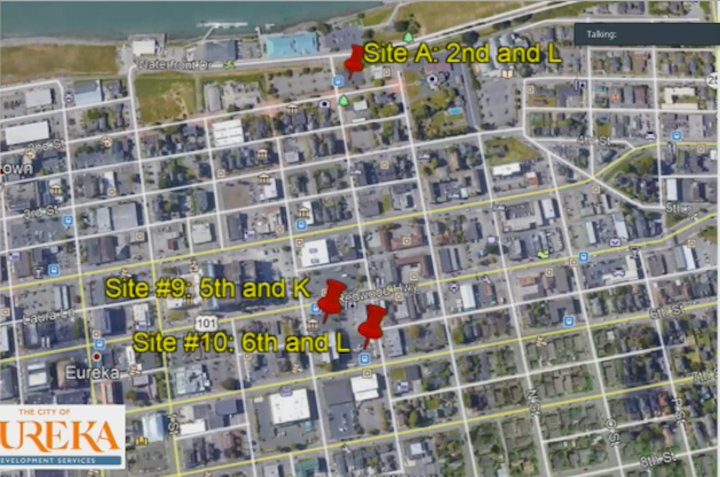
Locations of the next three city-owned parking lots to be converted into housing | Screenshot from Eureka City Council meeting
###
During its Tuesday night meeting, the Eureka City Council approved the release of three city-owned parking lots — the two lots directly next to City Hall and another on 2nd and L Streets, catty-corner from the Adorni Center — to be used for affordable housing developments.
This is the second batch of three parking lots to be released by the City for housing developments, (the first batch was released last year and will be developed by Long Beach-based company Linc Housing) as a part of Eureka’s plan to build housing on 12 city-owned sites over the next several years in order to meet state housing requirements. The plan was approved in 2019 as a part of the city’s Housing Element of the General Plan update.
Initially, the City planned to release three different lots this year — located at 5th and D Streets, 4th and G Streets and 3rd and E Streets — but swapped out the sites due to concerns raised by the community. Eureka Principal Planner Kristen Goetz explained during the meeting that city staff submitted a written request, which was approved by the California Department of Housing and Community Development, to put those sites on hold while the City looks for other sites to potentially replace them.
The council’s approval allows city staff to put out a request for proposals (RFP) for development of three sites, which will be officially released on July 1 and have a deadline of Sept. 9, 2021. Submitted proposals will then go before a selection panel, composed of city staff and community members. The panel’s selection or selections will then go before the council for approval in October. Applicants can submit proposals for either one or multiple parking lots.
The RFP requires that any housing development on the 6th and L lot include a minimum of minimum of 37 affordable units (17 low income and 20 very low income), the 5th and K lot needs to hold a minimum of 35 affordable units (16 low income and 19 very low income) and the 2nd and L lot would need 12 units (six low income and six very low income.) The RFP states that priority will be given to proposals that “include a diversity of housing units such as affordable-by-design studios, student housing, condominiums, and/or luxury penthouses” and that “mixed-use components such as corner stores, ground level or rooftop bars/restaurants, or child care facilities will also strengthen the application.”
Councilmember Leslie Castellano was concerned about the potential for mixed use at the 2nd at L lot and the small number of units required for that site. Because the site is located in the Coastal Zone, the number of units it can hold is limited. The lot is about 11,940 square feet and the coastal zoning requires a minimum of 1,000 square feet of site area per dwelling unit. The zoning also requires one on-site parking space per unit, also limiting the number of units that the site could accommodate.
City Manager Miles Slattery explained that applicants could possibly build more than 12 units by applying for a density bonus. However, any additional units would not count toward Eureka’s state housing requirements.
Slattery also reassured Castellano that the council will have the final say when it comes to approval of the proposals and can reject plans that it does not feel meets the needs of the City. In the end, the council unanimously approved the RFP for the three parking lots. Council members Natalie Arroyo and Kim Bergel were absent.
###
In other business, the council unanimously adopted the City of Eureka Budget for the 2021-22 fiscal year.
With last year’s budget severely impacted by the COVID-19 pandemic, the news surrounding the upcoming budget year was overwhelmingly positive, with the City estimating about $109 million in revenue in the next fiscal year – up from about $79 million in the previous year.
Eureka Finance Director Lane Millar explained during the meeting that these increases are largely from grant funding and the tax increase from the approval of Measure H, which raised the city’s sales tax rate from 8.5 percent to 9.25 percent, adding over $7 million to Eureka’s general fund.
With the increases in revenue the City will be able to restore several government positions that were cut last year, including in the accounting department, the police department and the zoo, and will also have a built in surplus for the upcoming year.
“When we look at the bottom line, you can see in 2021-22 we are expecting about a $3.1 million surplus — a big improvement from the 2019-20 fiscal year, where we saw about a $3 million deficit,” Millar told the council on Tuesday.
Looking for the Safest Local Seafood to Eat, Mercury-Wise? Baykeeper Has an Updated Chart for That
Hank Sims / Wednesday, June 16, 2021 @ 3:38 p.m. / Environment

The only way this leopard shark will hurt you is if you eat it. Photo: Tewy, via Wikimedia. Creative Commons license.
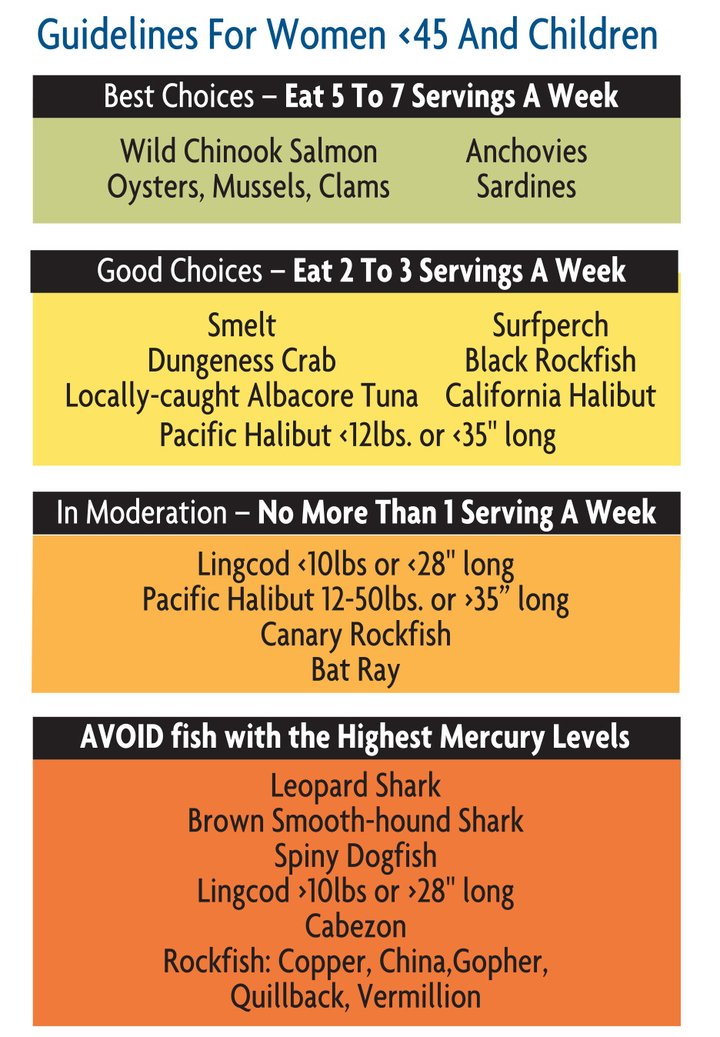
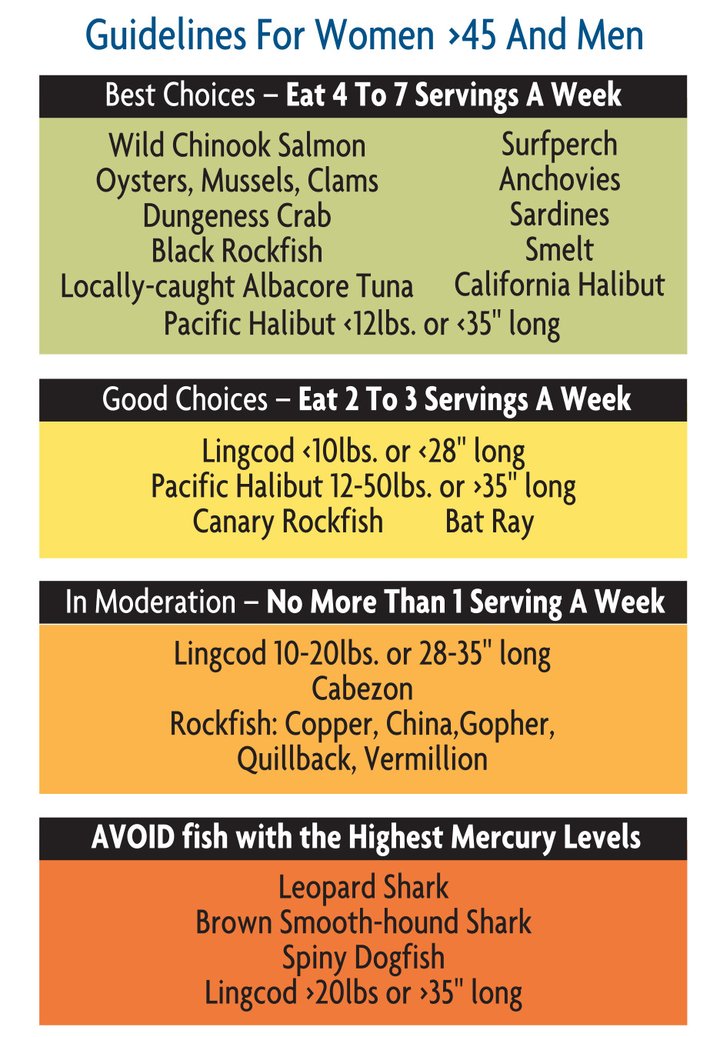
Worried about the mercury content of your seafood? You should be! Mercury is a nasty heavy metal that can cause any number of serious health conditions if ingested in large enough quantity, and that’s especially true if you are a child or a woman who may be/get pregnant. Seafood is the principal way that it enters the human food chain.
But some species of fish are more dangerous than others, depending on their habitat and their place in the food chain. Over the years, Humboldt Baykeeper has conducted mercury sampling of local seafood and, after a new round of testing on the catch found of coastal waters — not just in Humboldt Bay — they’ve put out a new eater’s guide to bounty of the Humboldt seas.
You can find a writeup of their work here, and download a PDF-printable version of the guide at this link. ¿Está interesado en una versión en español? Clique aquí para descargarla.
Below: A friendly version for your phone.
(VIDEO) Humboldt Rappers Area Sound Celebrate Fathers in ‘Next Man’ Video
Andrew Goff / Wednesday, June 16, 2021 @ 7:45 a.m. / :) , Music
May we interest you in some morning beats, Humboldt?
Just in time for Father’s Day, Humboldt’s own Area Sound has released their next video featuring music from their 2020 album Squeeze the Elephant. In the song “Next Man” rappers Liam “Steamer” Nelson and Zach “Zigzilla” Lehner — both parents themselves, you’ll recall — rhyme about the gratitude they feel for the example set by their dads, all during a picturesque North Coast day at the beach.
“We made this song and video to show love, appreciation, and respect for our fathers who each did an incredible job raising us,” Lehner told the Outpost. “This song is also a reflection on becoming fathers ourselves and carrying on our dads’ legacies by raising sons of our own.”
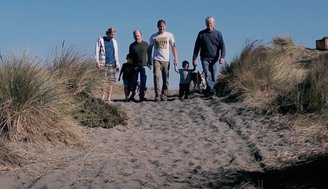
Shot near Humboldt’s North Jetty with the assistance of producer Joanna Galicha, the clip features two sets of three generations of both Nelson’s and Lehner’s clans interspersed with family photos dressed up as hip hop album covers.
“We are really proud of how this video turned out and even more proud of our dads,” Lehner said. He also wanted to make sure to add that today is his hip hop partner’s dad’s birthday. So, from all of us at LoCO, happy birthday to Steamer Sr. and happy Father’s Day to the rest of the Humboldt dads out there. Enjoy the clip for “Next Man” above and/or check out previous Area Sound offerings below.
PREVIOUSLY:
- (VIDEO) Humboldt Rap Dads Clean Diapers and Wash Dishes in New “Glamorous Lifestyle” Music Video
- (VIDEO) Humboldt Rap Dads of Area Sound Return With New Fantasy Music Video
- (AUDIO) HUMBOLDT HOLDING UP: Teacher and Rapper Zach ‘Zigzilla’ Lehner Talks Reopening Schools, Teaching Over Zoom; Freestyles An Educational Rap


_01.jpg)