

THE ECONEWS REPORT: Trump Attacks the California Coast
The EcoNews Report / Saturday, July 18 @ 10 a.m. / Government , Ocean

Photo: Jan-Rune Smenes Reite via Pexels.
###
The Trump Administration is going after California’s coast. To curb California’s power to stop harmful development off of its coast, NOAA has announced a new review of the California Coastal Management Program. The program is California’s way of implementing the Coastal Zone Management Act and allows more power for California to review and check federal projects off our coast. While NOAA conducts routine, periodic performance reviews of state coastal programs, it appears that this is deliberately to strip power from the state in order to advance more oil and gas developments and “space port” developments desired by Trump acolytes like Elon Musk.
Jen Savage of the Surfrider Foundation joins the program to talk about this and other threats from the Trump Administration to the California coast.
Want to learn more? Check out the Surfrider Foundation!
BOOKED
Today: 10 felonies, 12 misdemeanors, 0 infractions
JUDGED
Humboldt County Superior Court Calendar: Today
CHP REPORTS
1656 Union St (HM office): Missing Indigenous
ELSEWHERE
County of Humboldt Meetings: Behavioral Health Board - SUD/Dual Recovery Committee - Sept. 10, 2026
County of Humboldt Meetings: Behavioral Health Board Executive Committee Meeting - July 1, 2026
RHBB: Judge Overturns Search Warrant in Student Activist Case: Devices Ordered Returned
RHBB: Multi-Vehicle Crash Closes South Fortuna Boulevard Near Strongs Creek Plaza
HUMBOLDT HISTORY: Meet John Jefferson DeHaven, Probably the Most Consequential Political Figure Humboldt County Ever Produced
Lowell S. Mengell II / Saturday, July 18 @ 7 a.m. / History
John Jefferson DeHaven was one of the original leaders of the Republican Party in Humboldt County, and probably the most important political figure ever produced locally.
DeHaven was born in St. Joseph’s, Missouri, on March 12, 1849. He was the son of Jacob and Elizabeth DeHaven, who were traveling to California from the midwest, and who reached the present Golden State later in 1849.
The DeHaven family settled in Eureka in 1853. John J. DeHaven went to work as a compositor for The Humboldt Times in 1862, when he was 13. He studied law with Judge J.E. Wyman, who owned the Times from 1864 until his death in 1880. In 1866, when he was 17, DeHaven was admitted to the bar.
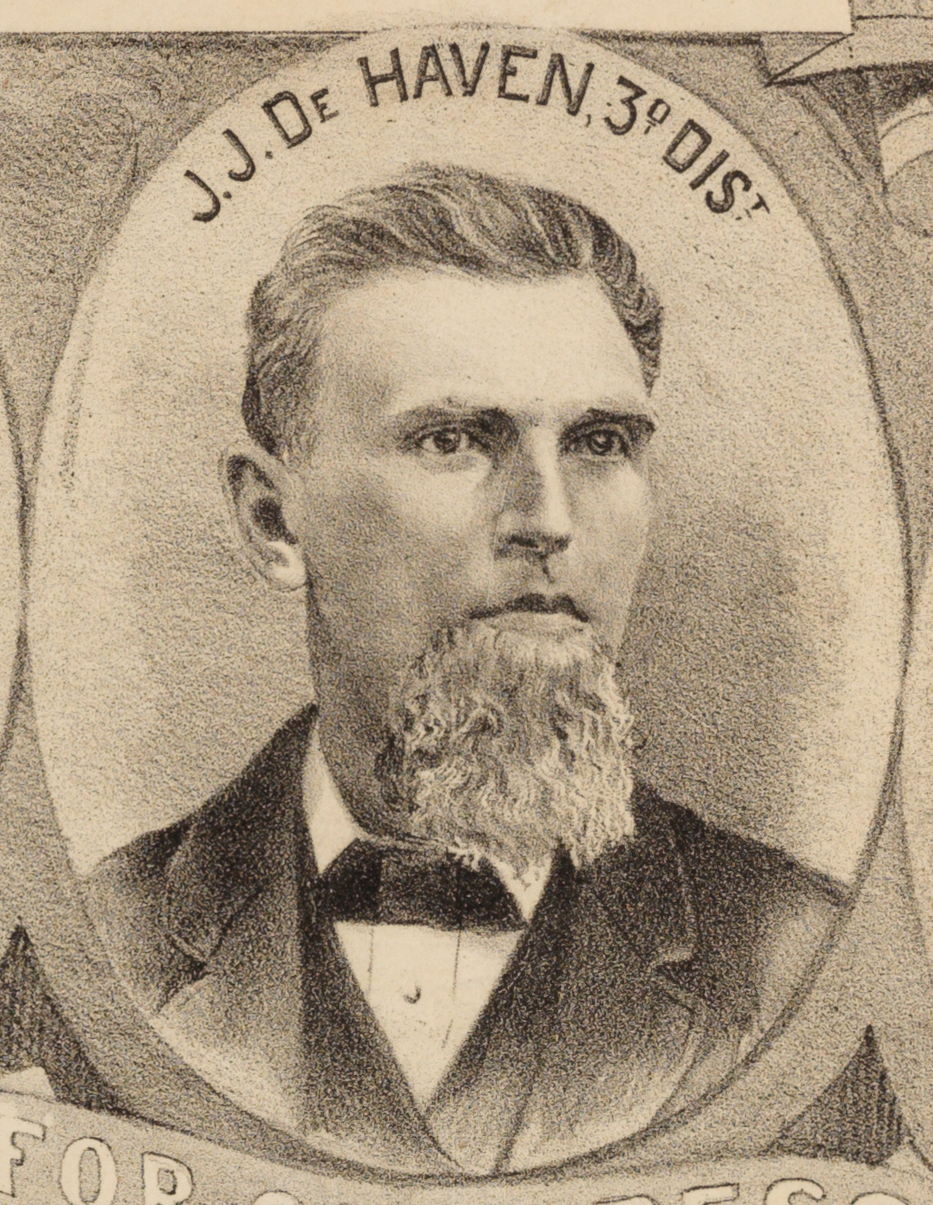
By Morse Photography. Britton & Rey Lithography - California State Library, Public Domain, Link
In 1867, DeHaven became District Attorney of Humboldt County. He resigned as District Attorney in 1869, after having been elected a Republican member of the State Assembly. When the Assembly was not in session, DeHaven had a law practice with J.D.H. Chamberlain.
From 1871 until 1874, DeHaven represented Humboldt, Del Norte, and Klamath counties in the State Senate, as a Republican.
On June 12, 1872, DeHaven’s sister, Sarah E. DeHaven, married John W. Connick, at the Eureka residence of Judge J.E. Wyman. The Connicks had four children — Harris DeHaven Connick, Edward (Ned) Connick, Walter Connick, and Pauline Connick. Mrs. Connick died June 8, 1899.
DeHaven lost an election in 1878 for the post of delegate to the State Constitutional Convention. The same year he did become Eureka City Attorney, serving until 1880.
In 1882, DeHaven was the Republican nominee for Congress, but lost to Democrat Barclay Henley of Santa Rosa. Henley received 21,807 votes to DeHaven’s 19,473 votes.
In 1884, DeHaven was elected Superior Court Judge for Humboldt County, DeHaven ran for Congress again in 1888, and won, defeating the incumbent Democrat, Thomas L. Thompson of Santa Rosa, by 19,345 votes to 19,019 votes.
The new Humboldt County Superior Court Judge was George W. Hunter, who had lived with DeHaven, studied law with DeHaven, and who was considered DeHaven’s protege. Hunter later held non-political statewide office, serving as Grand Master of Masons in California, in 1904.
Two other local attorneys who studied law with DeHaven were Kenneth Clyde and J.M. Melendy.
DeHaven began his service in the House of Representatives on March 4, 1889. He served on the important Ways and Means Committee with Congressman William McKinley of Ohio.
DeHaven found he was ignored in Congress by the autocratic Speaker of the House, “Czar” Thomas Reed of Maine. In disgust, DeHaven ran for a vacant short term on the California Supreme Court, and resigned from Congress effective October 1, 1890. He was elected to the Supreme Court on November 4, 1890, and served four years.
In 1897, DeHaven’s former fellow Congressman, William McKinley, was President and he appointed DeHaven a United States District Court Judge for Northern California. He served as a Federal judge from June 8, 1897, until his death. While serving as a State and Federal judge, DeHaven lived in San Francisco. When he died he was living at 2200 Eddy Street.
John J. DeHaven had married Z.J. Ball of Ohio in 1892, and they were the parents of two children — Jotham J. DeHaven, and Sarah DeHaven.
DeHaven died at his country home in Yountville, Napa County, on Sunday, January 26, 1913. He was 63 years old. His funeral was held in San Francisco on January 29, and he was buried at Mount Olivet Cemetery in Colma.
Under the leadership of John J. DeHaven, Humboldt County became a solid Republican County. During the years from the 1880s until the 1910s no Democrat could carry Humboldt County. Democrats occasionally represented the county but only because they received enough votes outside Humboldt County to overcome the local Republican margin. During these years Humboldt County was the most Republican county in California.
The Humboldt Times, in the 1870s had nicknamed the Republicans as the “DeHavens” in recognition of the political leadership of John J. DeHaven.
###
The piece above was printed in the September-October 1980 issue of the Humboldt Historian, a journal of the Humboldt County Historical Society. It is reprinted here with permission. The Humboldt County Historical Society is a nonprofit organization devoted to archiving, preserving and sharing Humboldt County’s rich history. You can become a member and receive a year’s worth of new issues of The Humboldt Historian at this link.
No Reported Cases of Cyclospora Infections in Humboldt County Amid Outbreak of Explosive-Diarrhea-Causing Parasite in Other States
Sage Alexander / Friday, July 17 @ 4:30 p.m. / Health

A outbreak of the parasite that hospitalized 94 people has been traced to iceberg lettuce served at Taco Bells in Indiana, Kentucky, Michigan, Ohio and West Virginia, according to the CDC. | Photo via Wikimedia Commons by user CostaPPPR. Creative Commons Attribution-Share Alike 4.0
###
While clusters of cyclosporiasis cases have popped up across the United States, the Humboldt County Department of Health and Human Services (DHHS) Public Health Branch hasn’t tracked a single reported case.
The Centers for Disease Control and Prevention reported at least 1,645 confirmed cases and over 5,100 suspected cases investigated across 34 states this week, a count much higher than the same period last year. Individual states are reporting thousands more, including Michigan at over 5,000.
The intestinal illness is caused by the parasite Cyclospora, typically spread through food or water contaminated by human feces.
But the parasite hasn’t been churning any stomachs lately in Humboldt County.
“Currently, there have been no reported cases in the county,” a spokesperson for DHHS told the Outpost in an email.
In California, fewer people have tested positive for cyclosporiasis than last year so far, and there are no known outbreaks in the state, according to the California Department of Public Health.
Still, state health authorities are calling on residents to thoroughly wash vegetables. Vulnerable populations are encouraged to cook fresh produce whenever practical.
Here’s some information from the California Department of Public Health on preventing the infection:
While California’s case numbers remain stable and fall within expected ranges, CDPH urges everyone to follow these prevention steps:
- Wash hands with soap and water before and after handling or preparing raw fruits and vegetables.
Wash all fruits and vegetables thoroughly under running water before eating, cutting, or cooking.- Scrub firm produce (like melons and cucumbers) with a clean produce brush.
- Remove and discard outer leaves from lettuce and leafy greens.
- For vulnerable populations (older adults, young children, pregnant women, immunocompromised individuals), cook vegetables and herbs whenever practical.
- Prevent cross-contamination: Use clean cutting boards, utensils, and food-contact surfaces. Keep ready-to-eat foods separate from raw produce during preparation.
- Refrigerate cut, peeled, or cooked fruits and vegetables as soon as possible (within two hours).
- Avoid food or water that may be contaminated by human feces, especially when traveling to countries where tap water or food may be unsafe.
Most foodborne outbreaks in the U.S. have been linked to imported fresh produce, including raspberries, cilantro, basil, snow peas, and mixed salad. While washing produce is important, it may not completely remove Cyclospora, so cooking is recommended when possible.
For more information on cyclosporiasis and safe food and water habits, visit CDPH’s cyclosporiasis webpage and see CDC resources on preventing cyclosporiasis.
(VIDEO) Eureka Man Detained by ICE in Wyoming; Daughter Describes Him as a Loving Family Man Who’s Been in the U.S. for Over 30 Years
Ryan Burns / Friday, July 17 @ 2:13 p.m. / Government

Gilberto “Rudy” Jimenez Gonzalez (left) with his daughter, Alina Kahoalii-Williamson. | Photo courtesy Kahoalii-Williamson.
###
Gilberto “Rudy” Jimenez Gonzalez, a 52-year old Eureka man who’s lived in the United States for more than 30 years, was detained by Immigration and Customs Enforcement (ICE) officers late Wednesday night in Wyoming, where he is currently being held in a federal detention facility.
His daughter, Alina Kahoalii-Williamson, shared video of the traffic incident that preceded his detention. In a social media post, she says her parents were driving through Rock Springs, Wy., on their way to a reunion when they were pulled over for a taillight issue. In the seven-minute clip, an officer can be heard asking Jimenez Gonzalez to exit the car to have a conversation.
While conversing with a Spanish-speaking ICE officer, Jimenez Gonzalez steps out of the vehicle, and the officer begins asking what country he’s from.
See the video below:
Reached by phone this afternoon, Kahoalii-Williamson said her parents have lived in Eureka since the late 1990s. He immigrated to the U.S. from Tuxpan, in the Mexican state of Nayarit, and despite multiple efforts over the years to gain legal status, he remains undocumented.
Jimenez Gonzalez first met with an immigration attorney in the late ‘90s. It was the same attorney who helped his wife secure naturalized citizen status. Kahoalii-Williamson is now trying to piece together the details of her dad’s efforts to gain legal status. She recently found a letter saying he’d been accepted for a green card, but the attorney who’d been helping him passed away. Kahoalii-Williamson is not sure what happened after that.

Jimenez Gonzalez with family.
She describes her dad as a generous and productive member of the Eureka community, a loving father and grandfather, youth football coach and frequent volunteer at his church.
“Any type of volunteer work, whether it was feeding the homeless or meeting with people that struggled with addictions, he would meet with them every Monday,” said Kahoalii-Williamson, who has launched a GoFundMe campaign in an effort to raise funds for her dad’s legal fees.
A father of five and grandfather of two, Jimenez Gonzalez met his wife in Eureka, and together they raised a family here and now run a painting business.
The Eureka neighborhood where Jimenez Gonzalez raised his family had a lot of kids from low-income homes. His daughter remembers her dad treating them like family.
“He would bring those kids in. He’d feed them. He’d bathe them,” she said, her voice starting to tremble. “I can’t tell you how many times he, you know, just brought people into his home and fed them. Like, that’s just his way of loving is feeding people.”
After our conversation, Kahoalii-Williamson sent a follow-up message, saying the memories keep coming to her.
“My parents would take [those neighborhood kids] to the park,” she wrote. “My dad even taught a few of those neighborhood kids how to ride a bike. One of those neighborhood kids (who is now an adult) came by today knocking on my parents door to check on my mom. … He just was always thinking about other people, and that’s just the kind of man that he is.”
In her GoFundMe message, Kahoalii-Williamson notes that her father has no criminal record. “He simply was detained because of his legal status. He is a devoted father and husband. He has played a huge role in our community.”
Watching the video of his detention, she noted that the officers appeared to racially profile her dad, and when he said he wanted to speak with an attorney he was told that’s something that only happens in movies. (In the United States, undocumented people still have constitutional rights.) She also noted that they never read her dad his Miranda rights.
Now she’s worried that he could be deported back to Mexico. She spoke with him by phone yesterday.
“He said they’re not treating him well,” she said.
Jimenez Gonzalez is currently on an ICE hold at Sweetwater County Detention Center in Wyoming, pending bond.
Eureka Mayor Kim Bergel Launches Re-election Campaign
Ryan Burns / Friday, July 17 @ 11:35 a.m. / Elections

Eureka Mayor Kim Bergel signs her nomination paperwork alongside Assistant City Manager/City Clerk Pam Powell. | Facebook.
###
Eureka Mayor Kim Bergel announced her re-election campaign via Facebook Thursday afternoon, thanking the 30 people who signed her nomination paperwork while happily boasting, “First one to get my paperwork in.”
Reached by phone this morning, Bergel offered a characteristically cheery explanation for her decision to seek another term.
“You may not know this about me, but I love Eureka,” she said. “I love our community. I love its challenges and all. And I love that our community steps up for each other. That’s one of the things that I really appreciate.”
It’s been nearly a dozen years since Bergel was first elected to City Hall in a nail-bitingly close race, beating incumbent Mike Newman by just 46 votes (50.1% to 49.4%). Four years later, following a redrawing of the city’s ward map and implementation of a “true ward” election system, Bergel won re-election by a much wider margin.
In 2022, having termed out as a city councilmember, Bergel ran an unsuccessful campaign for county supervisor, losing the Fourth District seat to Natalie Arroyo in a three-way race. She quickly dusted herself off and handily won the November municipal election to become mayor of Eureka.
Asked what she’d like to accomplish in a second mayoral term, Bergel said she plans to continue the mental health initiative she launched in 2023 as well as charting some new waters.
“We’re an innovative city, and we’re looking at ways to better our city all the time,” she said. “And in the last 12 years, the work that has happened in our city is phenomenal. It’s something that doesn’t happen in a lot of places. I’m talking about with the CSET [Community Safety Engagement] Team, with the CARE [Crisis Alternative Response Eureka] team, with the Uplift team, and all of these opportunities that are lifting people up who in the past have been marginalized.”
She also mentioned partnering with the business community and local organizations to foster positive change. And while she acknowledged that challenges certainly remain, Bergel said, “I believe that Eureka is having a renaissance, as [local artist and organizer] Jenna Catsos said years ago, and I believe we’re right there.”
The nomination period for candidates interested in challenging Bergel for mayor or running for Eureka City Council have until Aug. 7 to get their paperwork in. More details here. The General Election will be held on Nov. 3.
GREAT NEWS! Humboldt County Superior Court is Finally Set to Launch Online Access to Public Case Information
Ryan Burns / Friday, July 17 @ 10:53 a.m. / Courts

Photo by Dezmond Remington.
###
It’s a great day for public access here in Humboldt County. After years of slow but steady effort and multiple delays due to heavy workloads and staffing shortages, our local branch of the Superior Court of California is finally ready to deploy its Public Portal, which will grant convenient, remote access to case information to anyone with an internet connection.
If your Outpost reporters aren’t literally celebrating with confetti and streamers, it’s only because we didn’t have any nearby when this news dropped into our email inboxes a few minutes ago. No longer will checking the status of court cases require physical trips to the courthouse, through security and up to the second-floor self-service computer terminals.
More importantly, the whole community will soon enjoy this easy access, whether you’re wrapped up in your own litigation (let’s hope not), conducting research or helping friends and family navigate the court system.
Of course, that doesn’t mean every sordid detail of every case will suddenly be just a Google search away. The information available through the portal will still be governed by California’s rules of the court, which generally grant public access only to basic case data, such as registers of actions, calendars and indexes for all cases.
And information on more sensitive cases, such as family law, juvenile, criminal and civil harassment proceedings, will still be available only at the public terminals inside the courthouse, with identifying personal information redacted.
It’s all set to launch on Tuesday. See below for details.
###
Press release from Humboldt County Superior Court:
The Superior Court of California, County of Humboldt is pleased to announce the expansion of its online services with the launch of the Court’s Public Portal which provides convenient remote access to publicly available case information.
Effective July 21st, 2026, members of the public will be able to search for public cases filed in Humboldt County Superior Court. The portal provides access to court calendar information and Register of Actions information for eligible public cases, allowing users to view case activity online.
The Public Portal can be accessed on the homepage of the Court’s website at www.humboldt.courts.ca.gov. Additional information, including instructions for creating an account and using the portal will be available on the Court’s website.
The Court is committed to expanding access to court services through secure and convenient online resources and looks forward to making this new service available to the public. The information the Court is able to provide via remote access is outlined in the California Rules of Court, section 2.500 et seq.
Arcatans! Got a House That Could Use Some TLC? The City May Be Able to Offer You a Special Loan
LoCO Staff / Friday, July 17 @ 10:26 a.m. / Housing
Press release from the city of Arcata:
The City of Arcata is now accepting pre-applications for its Permanent Local Housing Allocation (PLHA) Owner-Occupied Pilot Housing Rehabilitation Program.
This program will provide low interest loans for eligible rehabilitation, accessibility and energy efficiency upgrades for income qualified Arcata homeowners. It gives priority to homes that have cited health and safety code violations. Because program capacity is limited, the pilot program is expected to assist approximately three to four households. Pre-applications will be placed on a waitlist and participants will be selected through a lottery system. The first round of pre-application reviews will begin on Monday, Aug. 10.
Available Loan Types
- Amortized Loans: Fixed simple interest rate of 1.5 % for households at or below 80% area median income (AMI).
- Deferred Payment Loans: Fixed simple interest rate of 1.5% with no required repayment for 15 years, for households at or below 60% AMI.
Who Can Apply
- Have a household income at or below 80% for Humboldt County’s AMI.
- Own and occupy a housing unit within Arcata city limits.
How to Apply or Get More Information
- Pre-Applications are available online on the City’s website under the Housing section.
- For questions or help with the pre-application, you can contact:
- Sam Sauter by email at ssauter@cityofarcata.org or by phone at (707) 822-2429
- Sara Cunha by email at scunha@cityofarcata.org or by phone at (707) 825-4876


