Why California Politicians Will Keep Drawing Their Own Election Districts
Sameea Kamal / Wednesday, Oct. 11, 2023 @ 7:04 a.m. / Sacramento
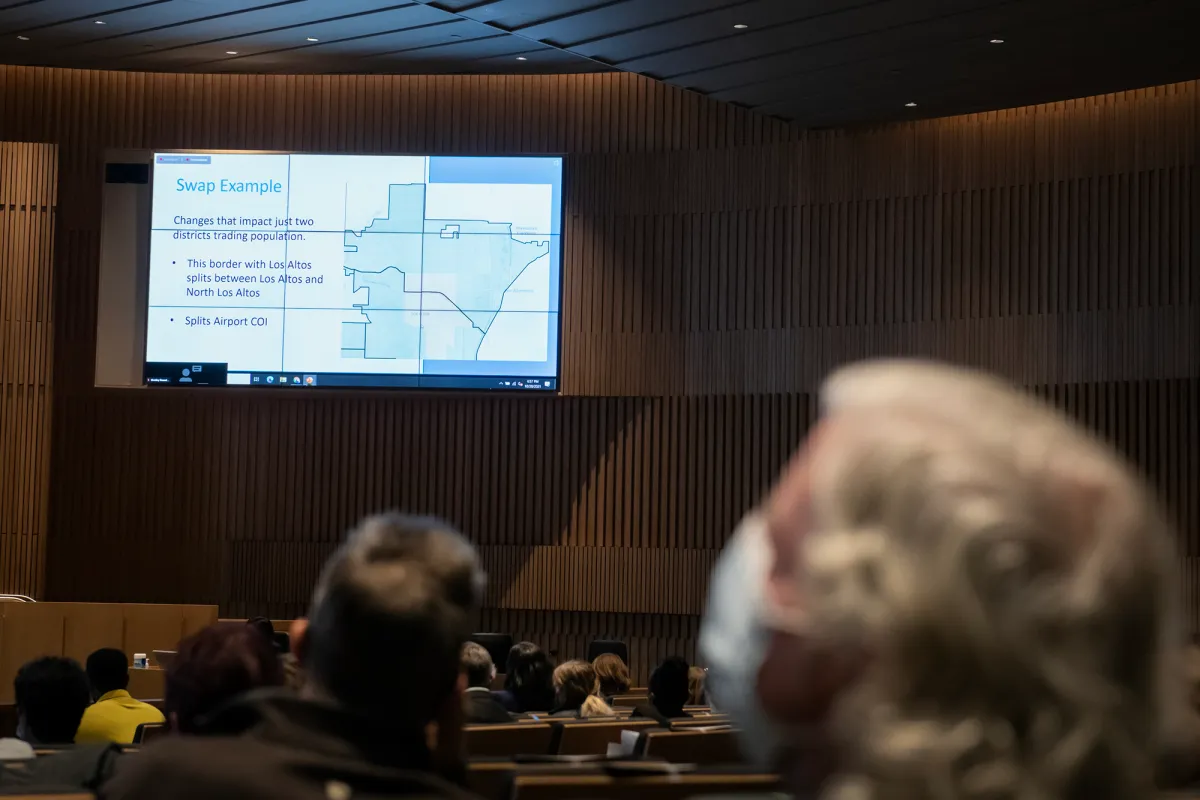
Redistricting Partners, the consulting firm hired to help the Long Beach Independent Redistricting Commission, shares insights on the newly drawn political lines during a commission meeting on Oct. 20, 2021. Photo by Pablo Unzueta for CalMatters
California’s push to have independent panels — not politicians — draw election districts has floundered into a more piecemeal approach.
Gov. Gavin Newsom vetoed the most ambitious bill passed by state lawmakers, Assembly Bill 1248, which called for independent redistricting commissions in every city and county across the state with more than 300,000 residents, and every school or community college district with more than 500,000.
He also blocked Senate Bill 52, requiring independent panels in large charter cities, which would have applied to the scandal-plagued Los Angeles City Council. It appoints some members of the existing redistricting commission, and last year, a leaked recording revealed city councilmembers strategizing, in a conversation packed with racist comments, about how to get lines drawn in their favor.
Newsom did sign two less sweeping redistricting bills that authors put forth in case the broader effort failed, but supporters were still bitterly disappointed.
“In Los Angeles we need an independent and unbiased commission to help mend the lack of trust between the community and its government,” Assemblymember Isaac Bryan, a Culver City Democrat and author of AB 1248, and Sen. María Elena Durazo, a Los Angeles Democrat and author of SB 52, said in a joint statement. “We will continue to do work to keep communities whole and allow communities to choose their elected representatives, rather than the elected officials choosing their voters.”
In his Oct. 7 veto message for AB 1248, Newsom said he shared the “goal of ensuring community control over the redistricting process.”
But he cited budget uncertainty, saying the bill would create a “state-reimbursable mandate in the tens of millions and should therefore be considered in the annual budget process.”
Common Cause, a good government group and sponsor of AB 1248, noted in a press release, however, that the bill’s cost wouldn’t be a factor in the state budget until closer to the next census in 2030, which kicks off the next round of redistricting.
“We’re deeply confused and frustrated, why the governor would choose to veto a proven democracy reform that provided California an opportunity to not just eliminate gerrymandering in the state but also lead the nation in pro-democracy reform,” Jonathan Mehta Stein, executive director for California Common Cause, told CalMatters. “It’s an enormous missed opportunity.”
Newsom did sign AB 764, the fail-safe measure also introduced by Bryan and sponsored by Common Cause that seeks to address ambiguities in current redistricting laws regardless of who does the mapping, such as explicitly banning consideration of incumbency, and increasing standards for public engagement.
He also signed SB 314, by Sacramento Democratic Sen. Angelique Ashby, that establishes a citizens redistricting commission for the Sacramento County board of supervisors, and AB 34, by Anaheim Democratic Assemblymember Avelino Valencia, that creates a similar commission in Orange County.
The two counties join a handful of others that are either required by previous state laws or have chosen to do redistricting through an independent panel. In Los Angeles, there’s also an effort by a city council committee to establish an independent redistricting commission through a measure on the November 2024 ballot. And in San Francisco, where chaos over map drawing was brought on by what some called a “toxic political culture,” there’s an effort to bring the city’s independent redistricting commission — established prior to the state version — up to date with best practices.
Redistricting is the process of redrawing election maps after every Census to make sure each district has about the same number of people, ensuring no one’s vote gets diluted. A statewide independent commission has drawn state Senate, state Assembly and U.S. House districts since 2010, taking that power from the Legislature, so they could no longer draw their own districts. But bringing independent panels to local redistricting has been a start and stop process.
“We’re deeply confused and frustrated, why the governor would choose to veto a proven democracy reform.”
— Jonathan Mehta Stein, executive director for California Common Cause
In 2019, Newsom vetoed a bill by Redondo Beach Democratic Sen. Ben Allen that would have required counties with more than 400,000 residents to set up independent redistricting commissions. His reason for vetoing the bill then was that local jurisdictions were already allowed to establish independent commissions, and that it should be considered in the budget process.
“We are left just flabbergasted that the governor continues to make this baffling choice,” Mehta Stein said.
“The forces that have been fighting against voting rights and against redistricting reform have been pouring money into that effort for decades. And the pro-democracy side of the argument has to be willing to put its money where its mouth is. We can’t build a better, more inclusive democracy for free. It will cost money and it’s worth it.”
But for some, the veto of AB 1248 was a win.
The California State Association of Counties, Rural County Representatives of California and Urban Counties of California opposed the bill unless amended, because they were concerned about the resources the bill would require.
Patrick Blacklock, president and CEO of the Rural County Representatives of California said the mandate should only happen with a corresponding budget allocation.
“Without this kind of support, we are concerned that counties will be set up for failure, and such a failure would only serve to validate public distrust in the redistricting process and in our democratic systems that are already under intense public scrutiny,” Blacklock said in a statement to CalMatters.
Michael Li, senior counsel for the Brennan Center’s Democracy Program, said that the veto wasn’t necessarily surprising since redistricting can be a controversial and sensitive subject — especially at the local level. But he did find Newsom’s reason for the veto surprising.
Still, while the lawmakers and sponsors haven’t said whether they’ll try to reintroduce the bills next session, Li noted that it took multiple tries to get an independent redistricting commission at the state level, too.
“Independent commissions are the wave of the future,” he said. “Even though these bills failed, I don’t think this will be the end of efforts to mandate stronger, better systems.”
“California has provided a lot of evidence that, if they’re well designed, they do work and do improve representation and results for voters — particularly for voters who haven’t had a seat at the table.”
###
CalMatters.org is a nonprofit, nonpartisan media venture explaining California policies and politics.
BOOKED
Today: 5 felonies, 9 misdemeanors, 0 infractions
JUDGED
Humboldt County Superior Court Calendar: Today
CHP REPORTS
No current incidents
ELSEWHERE
The Guardian: Secondhand clothes sales forecast to hit $289bn as AI helps shoppers find deals
The Guardian: ‘On a whole other level’: rapid snow melt-off in American west stuns scientists
BBC: Elon Musk’s SpaceX set to go public in $1 trillion share listing
OPB: Appeals court rejects HUD homelessness overhaul saying it would be “disastrous”
OBITUARY: Matthew ‘Matt’ Taylor, 1977-2023
LoCO Staff / Wednesday, Oct. 11, 2023 @ 6:56 a.m. / Obits

Matthew “Matt” Taylor
May 4, 1977 —
September 17, 2023
On September 17, 2023, Matt passed away peacefully in the arms of his loving wife Brandy, along with his brother Todd by his side at Hospice House of Humboldt. Matt had been diagnosed with Stage 4 Pancreatic Cancer on August 14, 2023. He endured multiple complications from the cancer, and he fought a difficult battle.
Matt was born to Paula Poncia and Robert Taylor in Eureka on May 4, 1977. Matt lived his entire life in Eureka. He was a Eureka High School Graduate in 1996. In high school, he had a passion for VW bugs and loud stereos. From a young age he had a passion for racing motorcycles and was an original member of the Humboldt Stunners Crew. His nickname was “Wheelie Instructor” for a reason and may have been known to ride the hard pack sand on Samoa Beach on a street bike in his younger days doing 80 m.p.h. wheelies. Things did calm down after his first son was born and he switched from street bikes to Harley’s. When his own boys were ready, he introduced them to BMX, flat track motorcycle racing, rock crawling, and 4-wheeling.
Due to a blind date of Brandy’s best friend in 2002, Matt met his future wife at E & O Bowl in Blue Lake. He told his friends that night he was going to marry this girl of his dreams one day and set to make that future a reality. As usual, Matt’s persistence and his charm won her over and they were together, a team, a force to be reckoned with, from that day on.
“Always family first” was Matt’s motto in life and he showed it every day with his dedication to his wife and his boys. He taught his boys to have a strong work ethic, integrity, honesty, kindness and perseverance. After Matt would finish his day at Recology, he’d pick up the boys and head to the shop to teach them how to work on his rock crawler other projects. He encouraged them to be self-sufficient and help others. If they weren’t at the shop, they would mow lawns to support their motorcycle and BMX racing needs because Matt believed the things you worked for were things you appreciated more. He thought his boys could do anything they set their minds to do and he never missed an opportunity to teach them life skills to be successful young men. At the motorcycle races or the BMX track, he cheered his boys on and was their number one fan.
Matt and Brandy built many strong friendships with race families up and down the West Coast from Washington to San Diego and every one of those friendships meant the world to Matt.
You could not find a more honest, genuine, caring guy, always there with a smile and helping hand. Matt was always a kick to be around. It was always an adventure with him. He loved rock crawling with his boys and long-time friends at Rowdy Creek, Fordyce, The Rubicon, Titlow, and O’Brien, 4-wheeling at the beach or in the snow, and riding motorcycles. Matt had a wild side, which he shared with his very large, tight-knit group of friends whenever he could. Matt had some rock-solid friends who loved him and that love and respect for each other was palpable. About a year ago, Matt and Brandy purchased a 1971 Camaro project that they wanted to complete with their boys. Ultimately his disease prevented its completion by Matt, but a group of his buddies rallied to complete the project. Although he didn’t get a chance to drive the car, the look on his face when the engine first fired up was something we will not soon forget. He had an unmistakable smile and whistle, and he loved offering positive and/or sarcastic advice when you needed it the most. Always smiling, even at the very end, his smile and laughter lit up a room
Matt was an EXCELLENT cook, Big Boy BBQ Pit master and fried rice aficionado. If you were camping with Matt at Ruth Lake, King of Hammers, just hanging out at Samoa Beach, or at one of the boys’ birthday parties at Sequoia Park, he could rustle up a meal you wouldn’t soon forget. He loved to feed people and see their amazement.
Matt worked at Recology of Humboldt for 18 years. His favorite part of his job was showing children how the truck worked at events or honking for them if they gave the signal. He enjoyed building and driving a decorated truck in the annual Christmas Truckers Parade. Matt was also quietly proud of an early morning on Aug 10th, 2021, when he saved a family from a house fire in Eureka he noticed off his route. It wasn’t unusual for him to pick up extra routes and fill in when needed. When it came to a strong work ethic, he walked his talk. On September 15, the full fleet of Recology trucks (25+) lined up in front of the Hospice House to welcome and honor their co-worker and beloved friend, who dedicated 18 years to Recology and even more years to the community. Tears were shed, stories were told, and most importantly–love was felt throughout the gathering as they said goodbye to a dear friend, husband, father, brother, and community member. Matt made many friends along his garbage routes and people looked forward to seeing him. Matt also told his family that he looked forward to seeing them.
Matt was preceded in death by his mother Paula Poncia, his mother-in-law Cindy Bilderback, both his maternal and paternal grandparents, Uncle Gary Poncia and Aunt Gretchen Howard.
Matt leaves behind his amazing wife of 20 years, Brandy (age 41); his three loving sons Trevor (age 19), Brody (age 13) and Jax (age 11); his brother Todd Taylor; his nephew, Andrew Taylor, his father Robert Taylor; his Uncle and Aunt Scott and Joyce Taylor; his cousins Dan and Lacey Comer, Billy Comer, Kevin Taylor, Adam Taylor; his in-laws Dan and Marlene Birnie, Gene and Karren Bilderback, and Eileen Ayers; his brother-in-law and wife Robbie and Nikia Birnie; his brother-in-law Matt Bilderback; his sister-in-law and family Jenny, Matt, and Raylan Orsua; his beloved dog of 13 years, Charlie; his turtle or 20 years, Tough. There are too many guys who were like brothers to Matt to name them all, but you know who you are. Matt spoke so highly of his friends, and they were a big part of his life, Matt loved all of you.
The support from the community, family and friends has been UNBELIEVABLE! Matt was blessed with family, many solid friendships and co-workers who gave him an incredible welcome to Hospice House on Friday, September 15, 2023. He was able to see the love and support of the community he called home before his passing.
His family and friends lost a special man who would drop everything to help someone in need. The world was a better place because of Matt. He left an imprint on all of us. Matt wished on his last day that everyone can learn something from this tragic loss, whether it be being kind to others, lending a helping hand when able, leading by example, working hard but playing harder, and of course family first. Be the friend to others that Matt was to all of us. Matt Taylor you’re a legend in all our hearts!
The family would like to acknowledge and thank the dedicated Oncology department, emergency department and hospital staff of St. Joseph Hospital for their care and support of Matt and his family. The family would also like to acknowledge and thank the Hospice House of Humboldt for providing Matt, his family, and his friends, the opportunity to participate in Matt’s last days in a serene and peaceful setting. We also have a special thanks to Joyce Taylor for being like a mother to Matt and being by his side during this battle at every single appointment.
Donations can be made to the family GoFundMe to support medical and service expenses.
https://tinyurl.com/Taylor-Go-Fund-Me
Please join Matt’s family in a Celebration of Matt’s life on Sunday, October 22, 2023, 1 p.m., at Redwood Acres, 3750 Harris St., Eureka.
###
The obituary above was submitted on behalf of Matt Taylor’s loved ones. The Lost Coast Outpost runs obituaries of Humboldt County residents at no charge. See guidelines here.
OBITUARY: Charles Richard Lloyd, 1961-2023
LoCO Staff / Wednesday, Oct. 11, 2023 @ 6:56 a.m. / Obits

Charles Richard Lloyd born Oct. 21, 1961 in Loma Linda — died Sept. 26, 2023, Fortuna.
How do I sum up our father’s life? Do I go back to his childhood? My grandmother says that he was a sweet boy that always liked to help out with everything. So I guess that is a good place to start. Fifteen years ago my dad moved to Fortuna and started going to the SDA church during which time he volunteered to bring food to the homeless. He built a life here trying to do for others even when he had nothing to give. He made friends everywhere he went with his sarcastic wit and his love of a good joke, although he’d still laugh at a bad one.
Our dad had three children starting with me in 1982, then my sister Mandy in 1984, and finally my brother James in 1996. In 2004 my sister gave him his grandson Daniel. He was married 3 times, first to my sister and my mother Wendy until they got divorced and he married my brother’s mother Darla where he gained a stepson Johnathan until she passed in 2005, then finally to his third wife until their divorce a few years ago. My mom also had another daughter Karrie after their divorce and even though she was not my father’s child he still treated her like she was one and when she had a daughter Trinity he treated her like a granddaughter. Maybe we all didn’t get along all of the time but we were a happy family for the most part.
He loved to create things with his hands, building fantastic pieces with any kind of wood that he could get his hands on. Beautiful cabinets that when into a friend’s home or the cabinets that helped our grandparents sell their house or the dresser he made for Trinity that was made to grow with her. He could do anything and watching him create will always be a strong memory for all of us.
There are a thousand little things we will miss. Like Mandy getting a happy birthday two days early and me getting one two days late, because no matter how many times we told him he had our dates switched he would still get it wrong every year. Sitting around the breakfast table waiting our turn to get his Spanish eggs, although it was probably not exactly traditional in any sense. Going off roading with him became a lifelong event that we shared with Daniel to carry on the fun we all had. Sitting and having conversations from things that were silly to philosophical debates and everything in between. We all carry on these memories and will pass them to the next generation to keep him in our hearts.
Sitting here writing this has made me nostalgic and miss when he was well before he started to feel sick. So many thoughts and wishes that he was still here to talk to just to see if there was some awkward and ridiculous joke that he thought I should add to this. Something silly and probably on the darker side. He would probably tell me not to cry or be sad. I’m only crying a little, but I’m not sad. Not really. We all miss him. We all wish his life wasn’t cut quite so short. I am not sad though knowing that he is finally not in pain and lives on in us. Every time I look at my hands I see his reflected in them, talking to my sister I hear his banter in ours, looking at my brother or hearing him laugh I hear a shadow of our dad in him and see how much he looks like him only a lighter version. Even Daniel has something of his that will always make me smile when I see it or hear it. We all got his sarcasm and quick wit. When we are all together we all do it and it’s because of him and his influence in each of us. We are all different, but there will always be that small part that makes us all the same.
He will be missed by his mother Ellen who knew him from the beginning of his life and his siblings that shared his childhood. He will be missed by his children, those that are by blood and those that are honorary. He will be missed by his friends, the old and the new. By all that loved him, faults and all.
James is wanting to get a service together, so if you know how to reach him he will let everyone know when he has put it all together. If you have any questions or a desire to attend please contact him and he will pass it along.
Thank you for listening to my musings. I know it turned out longer than I wanted, but it was still just a drop in time compared to a man’s life and all of the moments it contains.
###
The obituary above was submitted on behalf of Charles Richard Lloyd’s loved ones. The Lost Coast Outpost runs obituaries of Humboldt County residents at no charge. See guidelines here.
OBITUARY: Stephan Mark Pollard, 1950-2023
LoCO Staff / Wednesday, Oct. 11, 2023 @ 6:56 a.m. / Obits

Stephan Mark Pollard passed away on Sunday, Sept. 24, 2023.
He was born in Modesto and lived there his first 20 years of life. He had a loving father and mother and was very close to his two brothers. His father was a professor and his mother was a housewife. They spent summers traveling across the United States.
When he left home he moved to the Bay Area where he eventually met his wife, Kathi.
They fell in love and in 1979 moved to Humboldt County, where they decided to get married and start their lives together. Steve began working for the U. S. Forest Service until his retirement at the age of 63. He resided in Carlotta.
He is survived by his wife, two sons, his daughter-in-law and his six grandchildren. Also his youngest brother.
###
The obituary above was submitted on behalf of Stephan Pollard’s loved ones. The Lost Coast Outpost runs obituaries of Humboldt County residents at no charge. See guidelines here.
RING of FIRE! There’s an Annular Solar Eclipse on Saturday That Will Visible From Humboldt, Weather Permitting
Stephanie McGeary / Tuesday, Oct. 10, 2023 @ 2:57 p.m. / Science

An annular solar eclipse captured above Jinan, China in 2010 | Image: A013231, CC BY-SA 3.0, via Wikimedia Commons
###
If the weather decides to clear up this weekend, your eyes will be in for a special treat! An annular solar eclipse will cross North, South and Central America on Saturday morning and will be visible in many parts of the United States, including in our own little pocket of Northern California.
But what exactly is an annular solar eclipse? Well, as you probably already know, a solar eclipse occurs when the Moon passes directly between Earth and the Sun, casting the Moon’s shadow onto Earth. During a full eclipse, the Sun’s disc is completely covered by the Moon, but during an annular eclipse, the Moon is closer to the Sun, leaving a bright ring of the Sun, known as the “ring of fire,” visible around the Moon. Our area won’t quite get the full “ring of fire” experience, though, the US National Weather service notes.
“In NW California, the eclipse will be a partial eclipse,” NWS posted on its Facebook page. “A partial eclipse means that only part of the solar disk is covered by the moon. A partial solar eclipse will be visible in every U.S. state except for Hawaii.”
In Eureka, the eclipse will begin at 8:04 a.m., with the peak at 9:17 a.m., and end at 10:39 a.m. Unfortunately, it looks like the local weather won’t be the best for viewing this celestial event, with NWS saying the latest forecast for the North Coast calls for cloudy skies with a chance of rain on Saturday. But since LoCO is giving you several days to plan, maybe you have time to drive somewhere the weather is more agreeable and/ or more within the path of the annular eclipse! Might we suggest Alturas or Eugene? Or if you’re feeling really frisky, you could head to Battle Mountain, Nevada or Albuquerque, New Mexico, which both fall squarely within the eclipse’s path.
Check out this video from Great American Eclipse, simulating the path of the moon’s shadow if it were viewed from 125 miles above:
And if you’re someone who gets especially excited about eclipses, it might actually be worth traveling a bit to see this one, because we won’t have a chance to experience another annular eclipse until 2039. There will be a full solar eclipse on April 8, 2024, but our area is not in a prime viewing location for that event.
Whether the weather lets up, or you do decide to travel elsewhere, remember that this will not be a full eclipse, which means that even during the peak of the eclipse, it is not safe to look directly at the Sun! To view the event safely, you will need special glasses or an eclipse viewer. You can also make your own eclipse projector, using a few items that you probably already have at home. You can find more information on proper viewing safety and how to make your own projector box on NASA’s website.
Happy eclipse-viewing, everyone! Please don’t burn your retinas.
Dell’Arte Faces Closure, Lays Off Staff Due to ‘Critical Cash Flow Issues’
Isabella Vanderheiden / Tuesday, Oct. 10, 2023 @ 1:49 p.m. / News , Theater
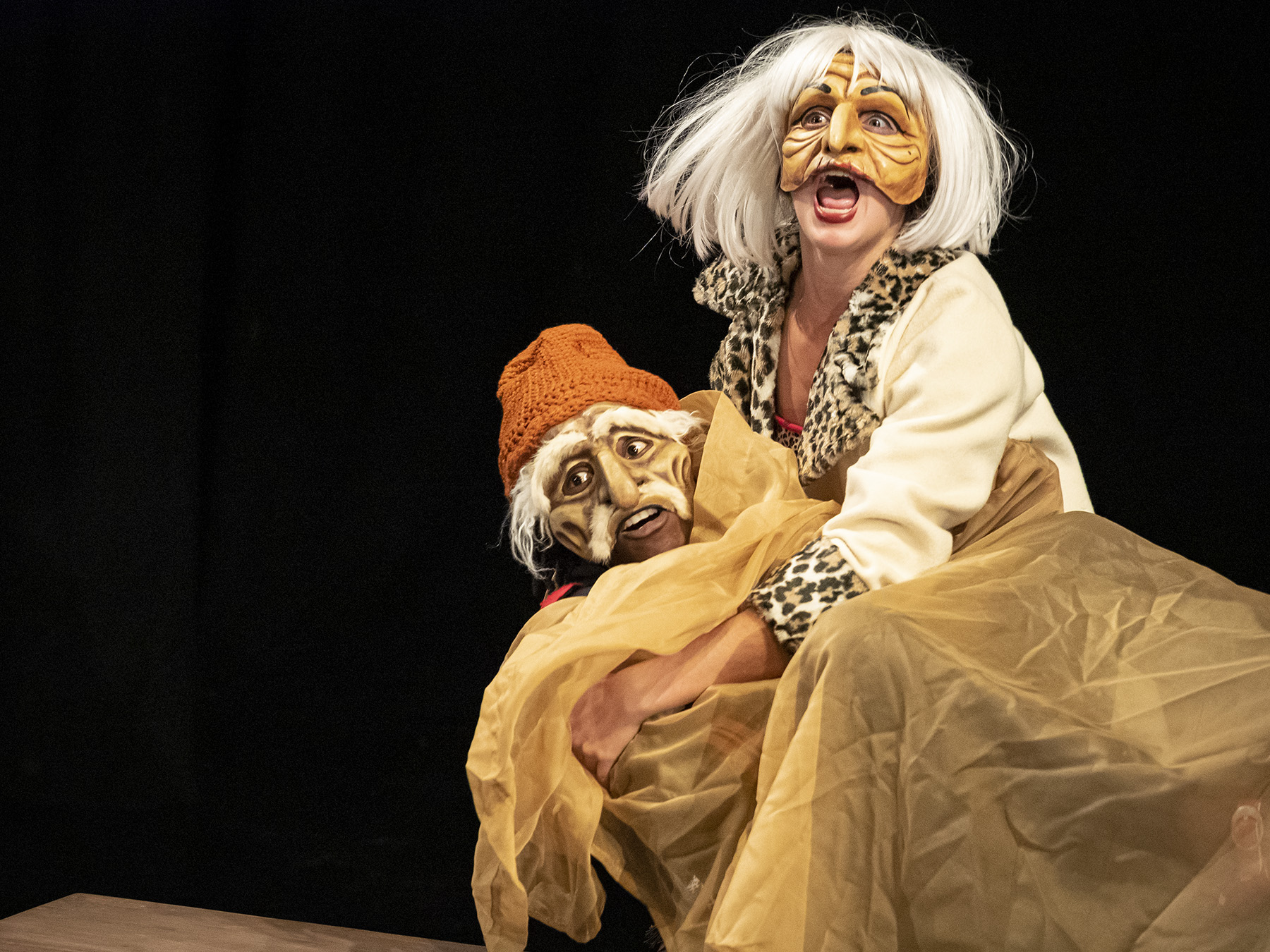
Photo: Dell’Arte International
###
After nearly 50 years on the local and international stage, Dell’Arte International is facing closure.
Dell’Arte has “suffered terrible financial hardship” in recent years as a result of the COVID-19 pandemic and “subsequent loss of support,” according to an Oct. 6 news release. “Critical cash flow issues” have forced the organization to “lay off nearly all staff,” prompting a campaign to save Blue Lake’s world-renowned theater company and school.
“Live theatre is fast becoming an endangered species, and it’s my heartfelt wish to play some part in its recovery,” Board Chair Libby Maynard said in a prepared statement. “My health does not currently permit me to play an active role in that recovery, but I am able to put money towards it. So this is my challenge to the community – help us raise at least $125,000 by the end of the year to keep the lights on and the doors open as the organization builds towards a more sustainable future.”
We’ll update this post when we know more.
###
Press release from Dell’Arte International:
Blue Lake, October 6, 2023 – Dell’Arte has been a source of laughter, inspiration, community and commerce in Blue Lake since 1974. We’d love to celebrate that in our upcoming 50th year, but we may not have a choice. The organization is currently unable to overcome critical cash flow issues and must lay off nearly all staff, while a small group working at greatly reduced hours continues to offer classes and workshops to the local community. The always-popular Holiday Show is also slated for cancellation unless much needed funds are donated to sponsor a production.
Like almost every theatre company in the world, Dell’Arte has suffered terrible financial hardship as a result of the COVID-19 pandemic and the subsequent loss of support, major national and state-wide changes in philanthropy and funding and significantly reduced audiences.
Libby Maynard, outgoing Chair of the Board of Directors of Dell’Arte International and co-founder and executive director emerita of The Ink People Center for the Arts, has seeded the Save Dell’Arte campaign with $5000.
“Live theatre is fast becoming an endangered species, and it’s my heartfelt wish to play some part in its recovery,” says Maynard. “My health does not currently permit me to play an active role in that recovery, but I am able to put money towards it. So this is my challenge to the community – help us raise at least $125,000 by the end of the year to keep the lights on and the doors open as the organization builds towards a more sustainable future.”
Dell’Arte is turning to its community in Humboldt and throughout the diaspora of Dell’Arte alumni around the world. We seek your help to survive and thrive into our 50th year and beyond. A new generation is preparing to meet the audiences of today. Dell’Arte’s Leadership Council (Alyssa Hughlett, Tony Fuemmeler, and Julie Douglas) are eager to bring entertaining and sharp-toothed new theatrical work to our stages and summer festivals, begin a new line of training programs for the actor-creator, and celebrate its artistic legacy and 50th Anniversary.
Head of Training Tony Fuemmeler adds “Dell’Arte is not a fixed entity with a timestamp in renaissance Italy (or 1970s California). Dell’Arte has been evolving from the beginning. It is meant to evolve. We must be awake. Over the coming decade, humanity (and Humboldt County) will be navigating unforeseen evolutions in the ways humans strive, encounter conflicts, and ultimately find meaning in our participation in the world. Humans need a story in which to locate themselves in, and tools for finding its expression. The need for Dell’Arte as a dynamic, ongoing destination for research, training and performance through the undeniable lens of the body in space remains as potent and vibrant as ever.”
Donations can be made online at www.dellarte.com/support-us, or by mail to PO Box 816, Blue Lake, CA 95525. Donations can also be made by calling 707-668-5663, but please note there are limited office hours.
###
About – Dell’Arte International Dell’Arte International is the North American center for theatre training, research and performance of the actor-creator. We are a committed community of artists who, for almost 50 years, have modeled and shared in a sustained, ensemble artistic practice. One of our deepest values is engendering the relationship between art and place, artist and community, expressed through training and performance at the highest levels and in partnership with local communities. Dell’Arte alumni can be found performing throughout the world, from Cirque du Soleil to Shakespeare and everything in between.
Eureka Police Department Asks for Public’s Help in Locating Missing 53-Year-Old Woman
LoCO Staff / Tuesday, Oct. 10, 2023 @ 12:34 p.m. / Missing
Press release from the Eureka Police Department:
The Eureka Police Department is requesting the public’s assistance in locating Christine Anne Randolph (aka “Clover”). Randolph is a Eureka resident and had last contact with friends and family on October 8, 2023.
Randolph is described as being a white female adult, 53 years old, with grey hair and brown eyes. She is approximately 5 feet 4 inches tall weighing 135 pounds. Anyone with information regarding the whereabouts of Randolph is asked to contact Sergeant Crnich with the Eureka Police Department Investigations Unit at 707-441-4318.