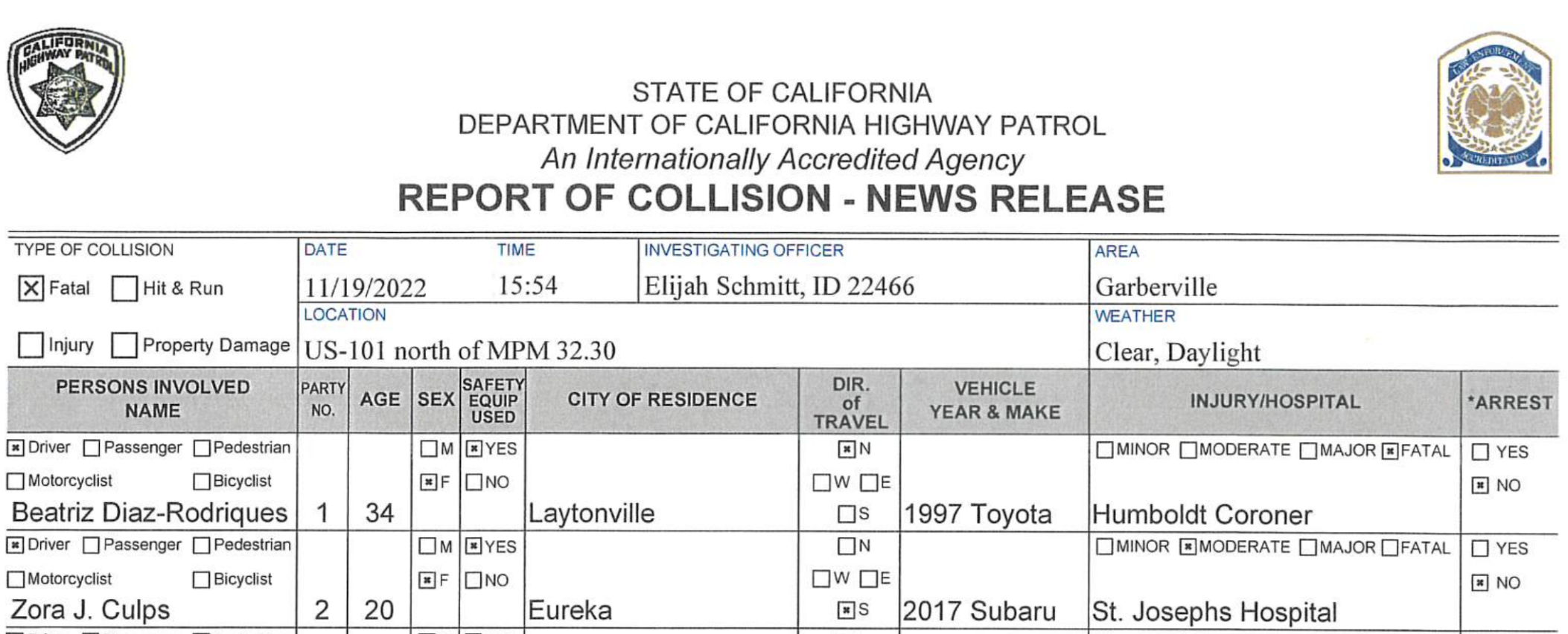
On, 11/19/2022, at approximately 1554 hours, a Toyota 4Runner, being driven by Beatriz Diaz-Rodriguez was traveling northbound on US-101 near mile post marker 32.30. A Subaru Impreza, being driven by Zora Culps was traveling southbound on US-101 north of mile post marker 32.30. For reasons still under investigation, the Toyota crossed from the northbound lane over the solid double yellow divider lines into the southbound lane into the direct path of the Subaru. The Subaru struck the Toyota head on, on the Toyota’s passenger side and both vehicles came to rest blocking the southbound #2 lane of US-101.
As a result of the crash, the driver of the Toyota succumbed to her injuries at the scene. The driver of the Subaru sustained moderate to major injuries and was transported to Saint Josephs Hospital from the scene for medical care. US-101 remained open with one-way traffic control for approximately five hours for the investigation, clean-up and vehicle recovery. It is unknown at this time if drugs or alcohol were a factor in this crash.
The California Highway Patrol, Cal-Trans, Miranda Fire Department, Cal Fire, and the Humboldt County Sheriffs Department all responded to the scene. This collision remains under investigation by the California Highway Patrol - Garberville Area.
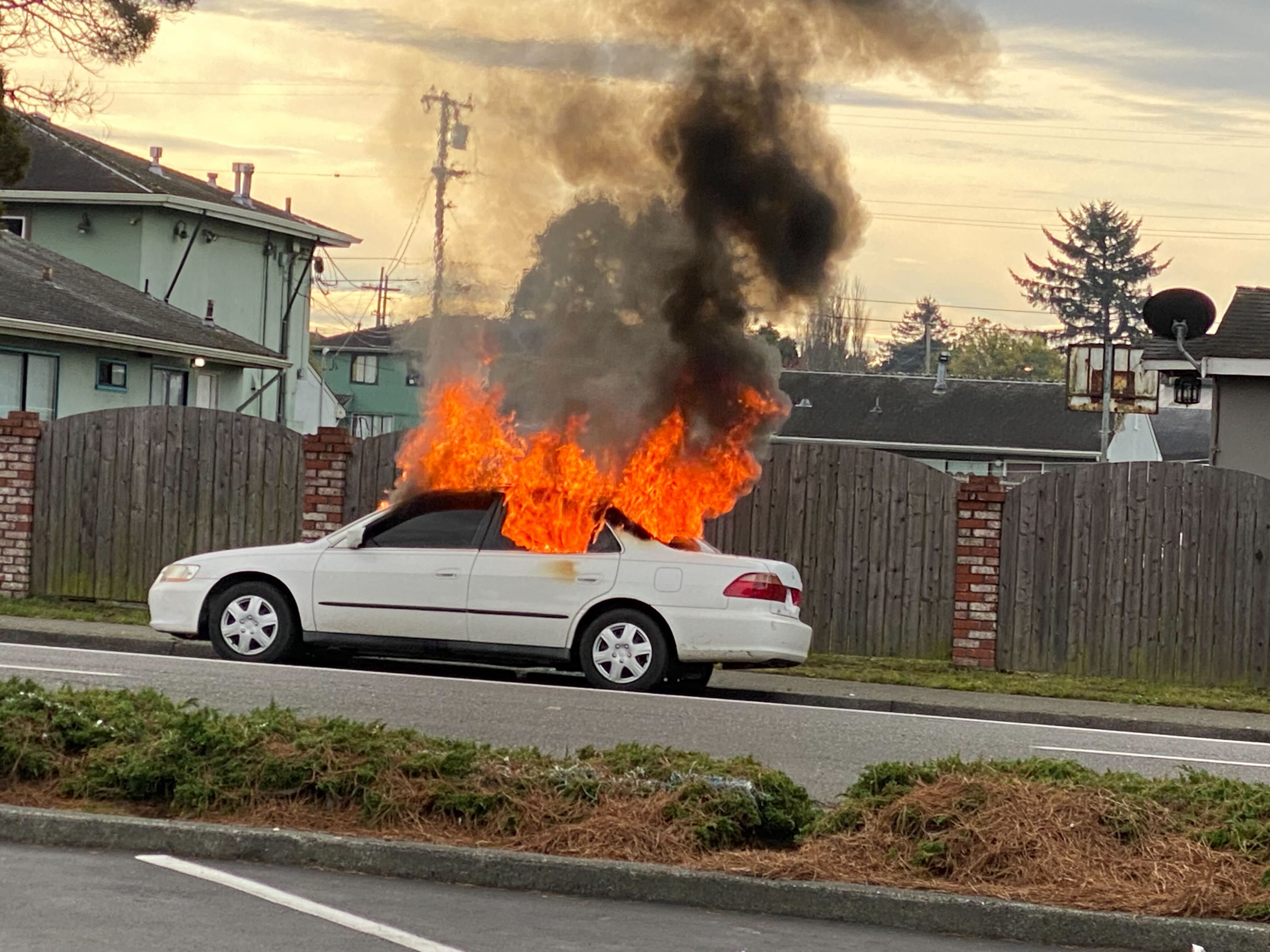
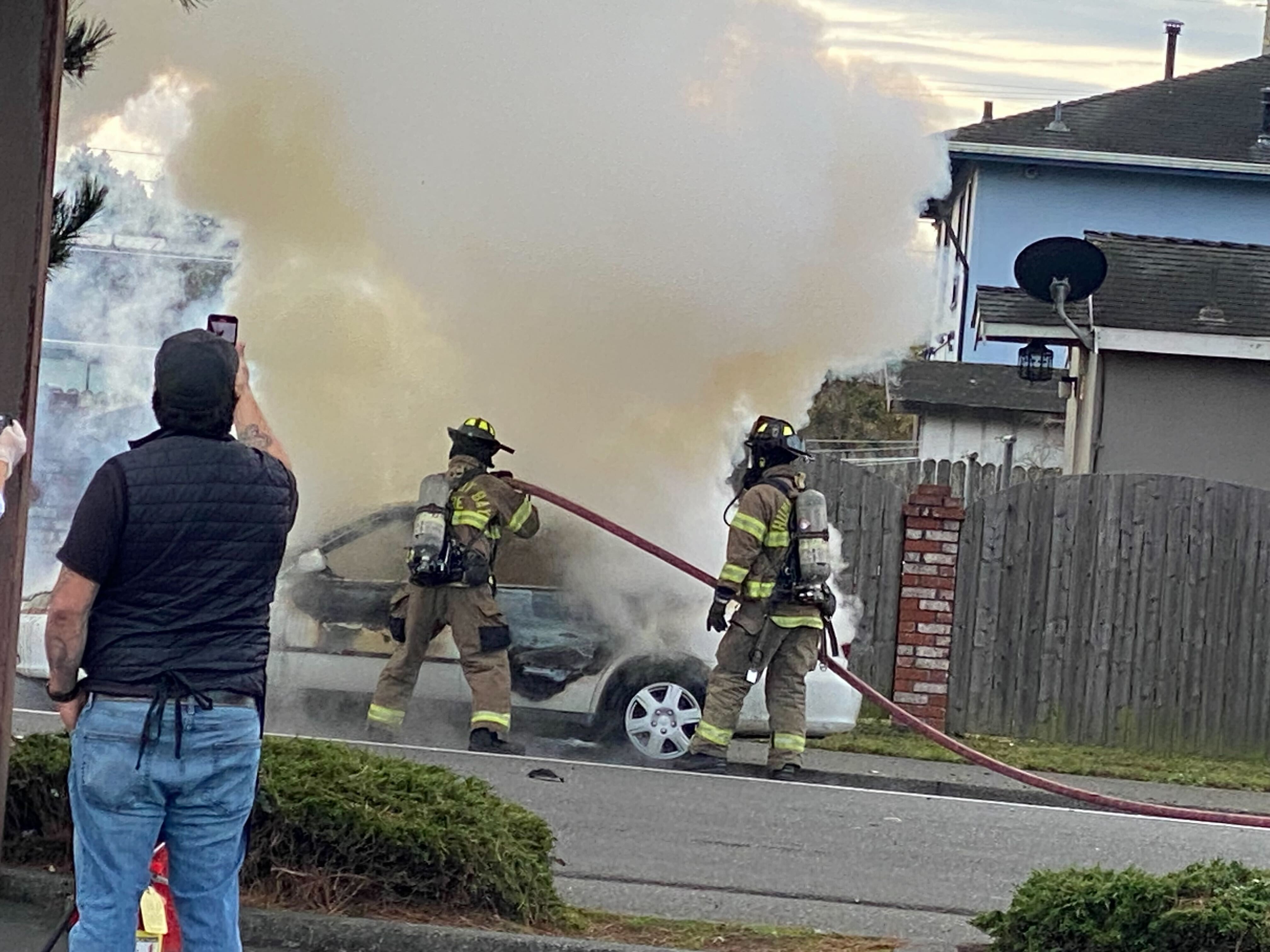
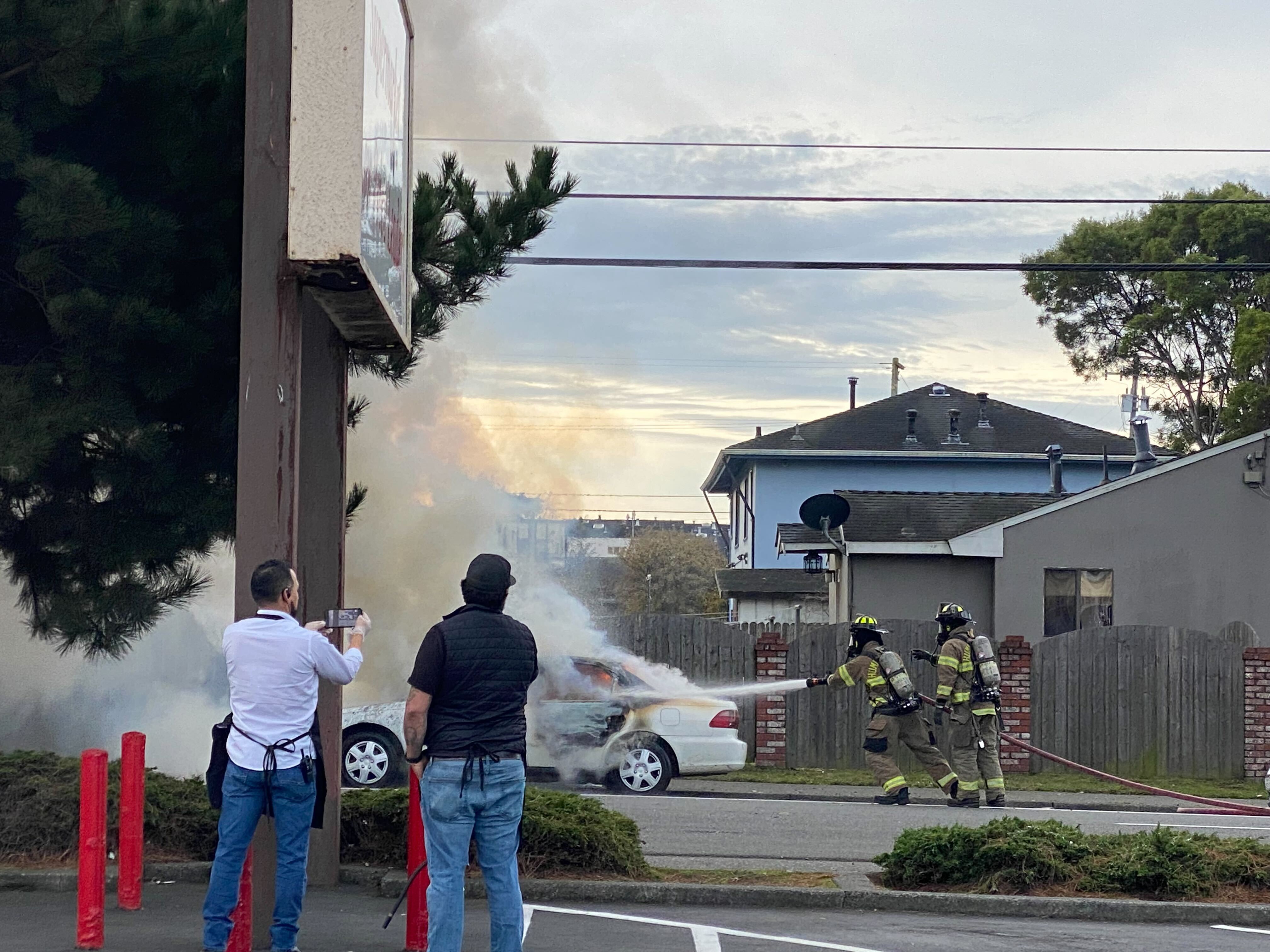
A few moments ago, a white sedan across the street in Winco went up in flames. Humboldt Bay Fire is on the scene. They’ve called Eureka Police to come provide traffic control.
Thanks to a reader for these photos and the video below.
Edwin
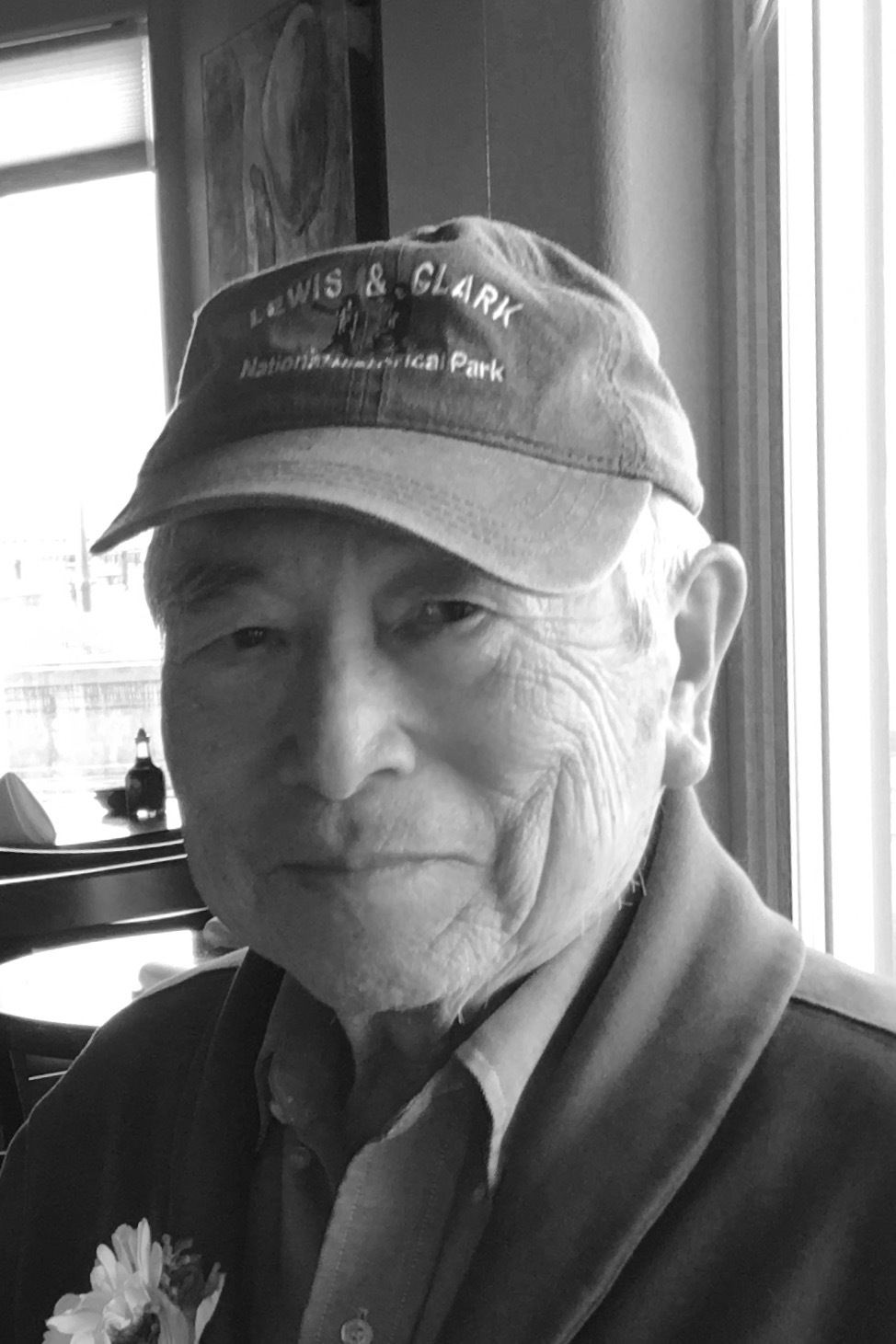
Masanori Uyeki died peacefully in his sleep at home on October 15,
2022. He was 94 years old. Ed, as he was known to all, was a
thoughtful and generous man of keen observation, dry wit, an
innovative, outside-the-box thinker, and a deeply caring family man.
He was devoted to Aiko, his wife of over 71 years, who was always in
his thoughts and heart.
Ed
was born in Seattle, the second of three sons, second generation
nisei
children to first generation issei
parents
from Japan. He had a happy and mischief-filled childhood, fishing and
having fun with his best buddy ‘Chuyo’ – freed from the
responsibilities of working in the family dry goods store, unlike
older brother Eugene, who was expected to help. Then their world
turned upside down with the bombing of Pearl Harbor, and his dread on
that day could not have prepared him for the time his family was
incarcerated, initially at the Puyallup ‘Assembly Center’
(formerly state fairgrounds), and finally three years in the Minidoka
‘Relocation Camp’ in the middle of an Idaho desert. Despite the
harsh conditions behind barbed wire, Ed and his family tried to make
the best of their time, whether swimming in irrigation ditches,
harvesting sugar beets or helping to build and play on a basketball
court. Ed excelled in his studies, graduating in his junior year and
delivered a hope-filled graduation speech to his high school class.
Over
the years, Ed battled and overcame the trauma of that incarceration,
to being at peace within himself.
Under
the mentoring wing of “Father Joe” Kitagawa, family friend and
Episcopalian priest, Ed and brothers Eugene and Lloyd all attended
private colleges on scholarships after they left the camp. Ed’s
children loved looking at his Kenyon College yearbook, especially the
pages with photographs
of the handsome and quiet college student. He shared stories of
playing pool with classmate Paul Newman (yes, that one!) Aiko and
daughter Terry cherish the memory of meeting Ed’s fellow alum Paul
on a film set in Kansas City, after he had welcomed Paul to KC,
sending him a copy of their yearbook photo. Paul graciously invited
Ed and family to the set.
Ed
met the love of his life, Aiko, at a party in Chicago, where they
were both students at the University of Chicago. She recalls how
handsome, worldly and ‘cool’ he was, well-read on the news of the
day, dressed impeccably in ironed shirts, and agile at blowing smoke
rings. After a short courtship, they were married on campus, and
before he received his doctorate in pharmacology, daughter Terry was
born, an early graduation gift, and the first of the third generation
sansei
in the Uyeki family. After two years, he began a post-doctorate post
at Case Western Reserve in Cleveland, and they had two more children,
Bill and Amy. Ed and Aiko enjoyed having family close, with his
parents and Eugene’s family living in the Cleveland area, with a
small Japanese American community providing cultural and familial
ties.
Ed’s
career as a cellular research scientist took the family across the
country, to doing radiation biology research for General Electric
Company at the Hanford reactor, outside Richland, Washington, to the
Midwest, teaching medical and graduate students as professor of
pharmacology at the University of Kansas Medical Center. Over 30
years, he did pioneering tissue culture research on the toxicity to
the immune system of anti-tumor drugs, studied effects of
insecticides on embryo development, and was among the first to
examine programmed cell death (apoptosis) rates as an early marker of
drug toxicity. Aiko and he formed life-long friendships with his
colleagues and
spouses through
the years, and his children fondly remember holiday dinners at which
visiting foreign researchers and lab technicians always had a seat at
the table. Ed
and Aiko traveled the world, through his sabbatical leaves and
professional meetings from Scotland to Japan.
Ed’s
hobbies and interests changed over the years, and the family
treasures the black and white photos he took of family and developed
in his home darkroom. His children attest to his influence on their
career and recreational
passions, beginning
with his skills as a teacher and his own athleticism from his younger
days. Bill’s lifelong passion with fishing began with Ed, from
reservoirs in Washington state, the streams of Colorado, to the first
day of trout-fishing in Missouri. Amy and Bill were key players on
their sports teams from grade school through high school, excelling
in baseball, softball, football, tennis, and basketball, aided by
Ed’s enthusiastic coaching and encouragement to do one’s best.
Terry’s love of folk
music came from listening to Ed’s favorite artists like the
Weavers, Harry Belafonte, and John McCutcheon. She
worked for Ed, writing grant proposals and research papers, and
because of his mentoring, worked towards a career in research. The
family cherishes memories of his harmonica playing and his love of
music of all genres, including classical and opera.
Ed
was a huge sports fan to the end. His first favorite professional
teams were the Cleveland Indians baseball team and the Cleveland
Browns football team. His allegiance shifted with his family’s
Midwest move to the Kansas City Chiefs and the Kansas University
Jayhawks men’s college basketball team. Though Ed and Aiko moved
from Kansas City in 1994, he continued to follow KU with shared
enthusiasm from other family members.
When
Ed and Aiko retired to McKinleyville, they joined the local Unitarian
Fellowship, and to this day, their closest friends locally have been
fellowship members. Ed participated in bird watching and mushroom
hunting with friends, meditation at the local Zen center, and read
religious thought by such spiritual leaders as Krishnamurti, Pema
Chodron, and Shunryu Suzuki. He was an
inventive chef, and Thanksgiving feasts took on a North Coast flavor
when he smoked salmon in his cast iron kamado smoker served with his
secret citrus wasabi sauce. Before the “mule” shoe came in vogue,
Ed creatively had cut out the back of his tennis shoes for easy
on-and-off.
Above
all, Ed was devoted to and supported his children and grandchildren.
Ed and Aiko were once-a-week willing babysitters for their four
grandchildren, Brooke, Robin, Chisa, and Mei Lan. He was a constant
presence at their soccer, basketball games, plays and dance recitals,
and there was mutual enjoyment of conversations with his adult
grandchildren on topics ranging from philosophy and science, to
childhood recollections. Children and grandchildren felt cherished
and special in Ed’s eyes – this type of affection
from a man of few words is a quality that we will always hold deep in
our hearts.
The
love and care that Ed and Aiko bestowed upon their family is their
intergenerational legacy.
Ed truly adored his sweetheart of 72 years, Aiko. Her brief
hospitalization at the beginning of this year, after
her
breaking a hip and having a stroke, with COVID lockdowns prohibiting
family visitors, was an extreme hardship for Ed as he missed her so.
But his and Aiko’s deep love for each other overcame that hardship,
as it had numerous times during their marriage spanning decades.
Together, he and Aiko met
the
challenges of raising a family as post-incarcerated nisei,
embodying
gaman,
the strength to endure the unbearable with patience and dignity.
In
a reflective presentation about his spiritual path he gave to the
Unitarian Fellowship 5 years ago, he closed
with,
“… in the December of my life, I can only say that I have tried
to support my children and grandchildren, to embody truth and love in
their lives.” And indeed, he did.
A
celebration of life will be planned for the spring of 2023. Persons
wishing to honor his legacy may make donations in his name to one
of the following:
For
the establishment of a fund for scholarships for Asian American
first generation college students, the Uyeki Scholarship Fund [c/o
HAF+WRCF, 363 Indianola Road, Bayside CA 95524,
or online https://hafoundation.org/UyekiScholarshipFund].
Student
scholarships at his alma mater, Kenyon College [The Kenyon Fund,
1 Kenyon College, Gambier, OH 43022-9623 or
online at gift.kenyon.edu].
The
Humboldt Asian and Pacific Islanders in Solidarity [c/o
The Ink People, 627 3rd St. Eureka, CA 95501]
###
The obituary above was submitted on behalf of Ed Uyeki’s loved ones. The Lost Coast Outpost runs obituaries of Humboldt County residents at no charge. See guidelines here. Email news@lostcoastoutpost.com.
Roman
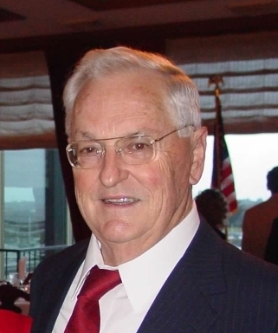
“Rick” Edward Pavlich passed away November 21, 2022 in Eureka. He
was born on September 17, 1935 to Albert and Ann Crnich Pavlich at
General Hospital. Rick was very proud to be of Croatian descent. He
attended St. Bernard’s Grammar School and graduated from Eureka
High School in the class of 1953. Rick attended and graduated from
the University of California at Berkeley, where he was a member of
the Sigma Chi Fraternity. Rick completed his formal education with a
law degree from Lincoln Law School in Sacramento. Rick proudly served
his nation as a United States Marine and member of the Army Reserves.
Rick practiced law for 35 years in Eureka with his lifelong best
friend and law partner Jeremiah R. Scott, Jr. at their firm of Scott,
Scott, and Pavlich.
In
December 1992, Rick had a liver transplant and a second one 14 days
later. He and his family have been blessed all these years by the
donors.
He
first love, beside his wife Linda, was hunting and fishing. He was
very knowledgeable regarding all kinds of firearms, ammunition, and
reloading. Friends would call upon him for advice. He was a member of
oldest chartered duck club in California, which is now the Humboldt
Bay Wildlife Refuge. He had many good years duck and pheasant hunting
at Cedarville and Tulelake with dear friends like John Morrison and
Steve Cobine. Rick also hunted deer, pig and turkey in Humboldt
County. He was a member of Trap & Skeet Club, Redwood Stumpers
and the Elks.
Rick
Pavlich was a kind soul and great friend to many. It was often said
of him, “if you can’t get along with Rick Pavlich, you can’t
get along with anyone.”
He
is proceeded in death by his wife Linda, parents Albert and Ann
Crnich Pavlich, his son Michael and Jeremiah R. Scott, Jr. He will be
happy to be reunited with his tabby cat Sam, and labs Molly &
Raven.
He
is survived by daughters Julie Townsend (Bob) of Springfield, Miss.,
Megan Magness Sparks, of Nevada, granddaughter Ashley Townsend Powell
(Noah), Great Grandson Atticus, Great Granddaughter Ember, stepson
Shawn Johnson of Eugene, Oregon, sister-in-law Mary Scott and niece
Catherine Scott of Eureka, and nephews McGregor Scott of El
Dorado Hills, Calif. and Stuart Scott of San Juan Bautista, Calif.
The
family wishes to express their gratitude to the staff at Frye’s
Care Home for the outstanding care Rick received in his final days.
The family is also grateful for the many friends, neighbors and
family members who helped Rick after Linda’s passing. In lieu of
flowers, please become an organ donor and tell loved ones you love
them often.
###
The obituary above was submitted on behalf of Rick Pavlich’s loved ones. The Lost Coast Outpost runs obituaries of Humboldt County residents at no charge. See guidelines here. Email news@lostcoastoutpost.com.
Press release from the Humboldt County Sheriff’s Office:
On Nov. 20, 2022, at about 12:12 p.m., Humboldt County Sheriff’s deputies were dispatched to a residence on the 3600 block of Old Arcata Road near Eureka for the report of an assault.
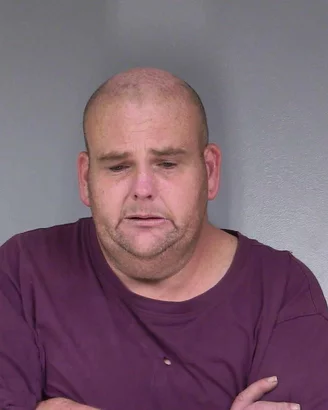
Deputies contacted an adult female victim at the residence. During their investigation, deputies learned that an acquaintance of the victim, 45-year-old Bobbie Gene Bagley, reportedly arrived at the residence uninvited. When asked to leave, Bagley reportedly physically assaulted the victim with a knife and then threatened to kill her if she contacted law enforcement. The victim was able to escape, and Bagley reportedly fled the residence.
On November 21, at about 1:28 a.m., a Sheriff’s deputy on patrol in the Eureka area located Bagley’s vehicle parked on Commercial Street. Deputies conducted a vehicle investigation and located Bagley inside. Bagley was arrested without incident. During a search of the vehicle, deputies located approximately .16 grams of methamphetamine, pepper spray and a knife.
Bagley was booked into the Humboldt County Correctional Facility on charges of assault with a deadly weapon other than a firearm (PC 245(a)(1)), false imprisonment (PC 236), intimidating a victim (PC 136.1(b)(1)) and unlawful possession of pepper spray (PC 22810(A)).
Anyone with information about this case or related criminal activity is encouraged to call the Humboldt County Sheriff’s Office at (707) 445-7251 or the Sheriff’s Office Crime Tip line at (707) 268-2539.
Press release from the Humboldt County Sheriff’s Office:
On Nov. 20, 2022, at about 3:10 p.m., Humboldt County Sheriff’s deputies were dispatched to a residence on the 4000 block of F Street, in the county’s jurisdiction of Eureka, for the report of a domestic violence incident with a stabbing victim.
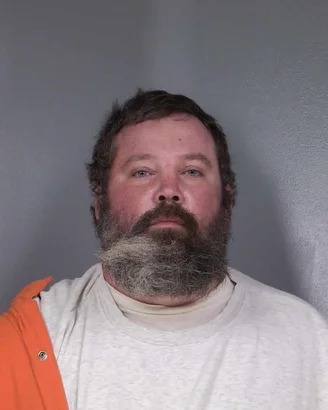
Deputies arrived at the residence and located an adult female victim with serious injuries. She was transported to a local hospital for medical attention. While at the residence, deputies also contacted and detained 42-year-old Robert James Duncan. Through further investigation, deputies learned that Duncan reportedly physically assaulted the victim and then stabbed her following a disagreement.
Duncan was booked into the Humboldt County Correctional Facility on charges of attempted murder (PC 664/187(a)), inflicting corporal injury on a spouse (PC 273.5(a)) and child endangerment (PC 273a(a)).
Anyone with information about this case or related criminal activity is encouraged to call the Humboldt County Sheriff’s Office at (707) 445-7251 or the Sheriff’s Office Crime Tip line at (707) 268-2539.
Anthony Leland Obie was born July 19th, 1964 and passed away on November 17th, 2022. Anthony is preceded in death by his paternal grandparents; Albert Obie and Adelia Norris-Obie; his maternal grandparents Jackson Ames and Carolyn Jake Ames; his parents Milton and Matilda “Tillie” Obie; his Obie Uncles and Aunties; His Ames Uncles and Aunties; his siblings Jon Obie and Denise Obie-Timmons; and his nieces Kimberly Obie and Cicelly Gabriel. Tony is survived by his wife Jolanda Ingram-Obie; his siblings Sharon Obie-Brown and Greg Brown, Judith Gabriel, and Roxanne Obie. He is survived by his children; Anthony Winterhawk Obie and Leah May-Obie, Teresina Obie, Lindsey Jackson, Ernie Jackson, and Taylor Obie and Bubu Beaman, Jalea and Troy Aubrey, and Jeff Mathison-Walker. He is survived by his grandchildren Kimimila Obie, Ku’ukoa Obie, Lucas Jackson, Laila and Lawrence Walker-Orcutt, Milan, Jeffery, and Evelyn James-Mathison. His nieces and nephews Michael Gabriel, Dominic Obie, Rainey and Kash McCovey, and many great nieces and nephews that he loved.
Anthony was from the villages of Sregon, Pecwan, Requa, and Tsewinaldin. He was a proud member of the Yurok Tribe. Anthony was born in Hoopa and started his life Down River until the 1964 flood destroyed his family’s home and they moved to Hoopa. Anthony attended and graduated Hoopa Valley High School. As a young adult he played football for the College of the Redwoods and played in many All-Indian Basketball and Softball tournaments; receiving many All-Indian trophies and other recognitions. Anthony is well known for his outstanding athletic talents in Basketball, Baseball, Football, Stick Games, and horseshoe games. He had many teammates that he considered family and would share stories about the “good o’l days.” He loved spending time with family, hunting, fishing, participating in Yurok and Hupa ceremonies, and attending church. He was also known for his charismatic personality, his contagious laugh, and his radiant smile.
Anthony spoke fondly of the logging days. He learned from his father, and while working for Hoopa Forest Industries, and other logging outfits. He hung his tin hat up after a serious injury in the woods and had to reinvent himself. He was very proud of his days at the Friendship House and his 14 years of sobriety. He enjoyed passing along what he learned about recovery and spirituality. During his career he worked with the developmentally delayed at Supportive Living Services in Del Norte County, as a Youth Advocate at Yurok Tribal Court, and as a Native American Spiritual Leader at High Desert State Prison in his final days.
Anthony passed away at their home, from a longstanding illness, in Susanville, California with his loving wife nearby. Although he passed too soon, he lived a full life and touched many hearts. As he makes his journey, he is forever loved by his family, friends, and teammates. The love that he had for his wife, kids, and grandchildren is what kept him alive.
Pallbearers: Michael Gabriel, Dominic Obie, Winterhawk Obie, Marcus Obie-Brown, David “Sonners” Hostler IV, Jeff Mathison-Walker, Mike Obie, and Kash McCovey.
Honorary Pallbearers: Lester Obie, Wally Obie, David O’ Neill, Greg Brown, Roger Sanderson, Ricky Sanderson, Marion “Inker” McCovey, Dickie Myers, Fred Timmons, Darryl Obie, Frank Ruiz, Larry Jordan, David Ruiz, Seth Ruiz, Clarence Hostler, Troy Aubrey, Junior Farmer, Joe James, Milton Stewart, Gary Obie Stewart, Boyd Ferris, Freddie Brown, and the SweatHogs.
Due to the untimely passing of Anthony, the family apologizes for names of family members, teammates, and friends we did not mention. He loved many and all.
He will make his journey to Hoopa from Susanville on November 22nd, 2022. His wake will be at St. Kateri Hall on Pine Creek Road on November 22nd at approximately 9pm. Services will be at St. Kateri Catholic Church at 11 am on November 23rd, 2022. Anthony will be buried at the Obie Cemetery at Sregon Village. After the burial, there will be a reception at St. Kateri Hall following the graveside burial. Flowers and food can be received at Kateri Hall. Jeanerette Jacups-Johnnie Jacups and Harold Jones, Sr. will officiate.
###
The obituary above was submitted on behalf of Anthony Obie’s loved ones. The Lost Coast Outpost runs obituaries of Humboldt County residents at no charge. See guidelines here. Email news@lostcoastoutpost.com.