

California Spent Millions to Boost COVID Vaccination Rates Medi-Cal Members — but They Lag Even More
Ana B. Ibarra / Wednesday, May 11, 2022 @ 7:29 a.m. / Sacramento

A nurse draws up a dose of the COVID-19 vaccine at a mobile health clinic in Los Angeles on March 16, 2022. Photo by Alisha Jucevic for CalMatters
To boost COVID-19 vaccination rates among California’s low-income residents, last year the state launched a $350 million incentive program. But since then, the gap between those Medi-Cal members and the general population has actually grown wider.
While 84% of all Californians 5 years and older have received at least one dose of the COVID-19 vaccine, only about 57% of those in Medi-Cal, the health insurance program for low-income residents, have done so as of April, according to the latest vaccination update from the California Department of Health Care Services.
That’s a gap of 27 percentage points, and it’s slightly bigger than the gap recorded last summer.
In September, the state rolled out a six-month incentive program for Medi-Cal health plans to boost Covid vaccination rates among their 14 million members. CalMatters compared those health plans’ most recently published vaccination rates to what they looked like in August of 2021, before the start of the incentive program, to see how much each plan’s vaccination rates had grown in that time. This comparison looks at the 12 and over age group because vaccines for younger children were not available last summer.
Between last August and this April, the most improved Medi-Cal plan, CalViva in Fresno, Kings and Madera counties, went from 42% to 54% vaccinated members ages 12 and over. The plan with the lowest gains, United Healthcare Community Plan in San Diego County, went from 46% to 48%. Five Medi-Cal plans still have Covid vaccination rates under 50% — although that’s an improvement from last summer, when 11 plans were under the half mark.
The fact that rates are trending up is a good thing, but the growing gap between Medi-Cal members and the general population is concerning, said Kiran Savage-Sangwan, executive director at the California Pan-Ethnic Health Network. “They’re not making the type of progress that one would hope for,” she said. “I think it’s possible that health plans may need to reevaluate their strategies.”
Data has persistently shown that people living in the poorest zip codes and enrolled in the Medi-Cal program are vaccinated at lower rates, leaving them more susceptible to serious disease from an infection. People who are not vaccinated are 8.6 times more likely to be hospitalized than those who have been vaccinated and boosted, according to the state’s public health department.
Through the incentive program, the state paid Medi-Cal plans some money upfront to roll out efforts to get more of their members vaccinated. The plans would then get additional dollars if they met certain targets, such as increasing vaccination among their homebound members and among Latino and African American members, who have been vaccinated at lower rates than other racial and ethnic groups.
The incentive program has now ended, and the state’s Department of Health Care Services is still analyzing data provided by the health plans to determine whether targets were met. “Final performance and financial data for the current program will be evaluated before considering whether a follow-up future program would be helpful,” Carol Sloan, a department spokesperson, said in an email.In general, a health plan’s vaccination rate reflects that of the region it serves. For example, plans serving the Bay Area — where vaccination has typically been more popular — report higher Covid vaccination rates than those serving the San Joaquin Valley or the Inland Empire. But because vaccination rates in the valley were lower to begin with, Medi-Cal plans there saw the most growth in the six months of the state’s incentive program.
Officials at health plans interviewed for this story said that while they were already doing their own outreach to members prior to the incentive program, state dollars allowed them to ramp up those efforts and get creative.
Some plans increased the number of vaccination events — one even hired an event planner to redesign its pop-up clinics, bringing in balloon artists and bubblegum machines in hopes of attracting more people. Plans have offered Medi-Cal members gift cards and free days at a local museum in exchange for a vaccine. They’ve teamed up with celebrities on social media campaigns and partnered with local organizations like churches to set up clinics in zip codes with the lowest Covid vaccination rates. Plans also used the money to boost their efforts in combating vaccine misinformation via mailers and phone calls.
“They’re not making the type of progress that one would hope for.”
— Kiran Savage-Sangwan, executive director at the California Pan-Ethnic Health Network
Dr. Takashi Wada, chief medical officer at Inland Empire Health Plan, which serves 1.5 million people in Riverside and San Bernardino counties, said a key component of its vaccination strategy was to pass on incentive dollars to the health providers they contract with. “Because we really wanted our providers to be talking to their patients about the importance of the vaccine…and administer the vaccine themselves,” he said.
The percentage of the plan’s providers administering the vaccines in their offices, rather than referring out, went from 40% to 60% during the six months of the incentive program, Wada said.
Still, despite the ongoing efforts and an improvement of about 8 percentage points since August, less than half of Inland Empire Health’s members 12 and older have received a shot.
“There are still absolutely opportunities (to grow), and that’s why we’ve been working so hard to come up with ways to try to make the vaccine more accessible and to gain trust,” Wada said.
Early in the vaccine distribution process, access was often cited as the primary challenge — supply was scarce, especially in the state’s rural or more remote areas. Now health plans hear a lot more about hesitancy due to mistrust, misinformation and political ideology, Wada said.
Jake Hall, deputy director of provider contracts at Kern Health Systems, which covers about 330,000 people in Kern County, said a common reason members give for turning down the vaccine is that they’ve already had a COVID-19 infection. Pregnancy is also another common reason, Hall said. Officials at the Centers for Disease Control and Prevention recommend vaccination for people who are pregnant and for those who’ve had a previous infection.
Officials at health plans with higher Covid vaccination rates said one of their focus points now is to increase vaccination among young children. As of mid-April, 28% of California children 5 to 11 enrolled in Medi-Cal had received at least one dose, according to the Medi-Cal data. By comparison, 40% of all children statewide in this age group had received a shot.
“I think in our community there has been a lot of support for getting kids vaccinated, but it’s short of a mandate. It makes it tricky,” said Christine Tomcala, chief executive officer at Santa Clara Health Plan.
“There are still absolutely opportunities (to grow), and that’s why we’ve been working so hard to come up with ways to try to make the vaccine more accessible and to gain trust.”
— Dr. Takashi Wada, chief medical officer at Inland Empire Health Plan
Last month state legislators pulled back a bill that would have required vaccination for kids to attend school. That same day, the Newsom administration also postponed its proposed vaccine mandate for school children until at least July 2023.
In the coming months, health insurance plans will also face a change in their membership numbers as California expands Medi-Cal to undocumented people 50 and over — adding new people who might not yet be vaccinated.
Also, during the declared federal COVID-19 public health emergency, the state suspended efforts to verify Medi-Cal eligibility. Assuming the emergency declaration ends as expected this summer, about 2 million people are estimated to lose their Medi-Cal coverage if they no longer qualify for the program either because their income has increased or they’ve gained access to other types of health coverage in the last two years.
“We’re adding people who may not be vaccinated, but we could also be losing people who are, so it might look like we’re going backwards,” Tomcala said.
###
CalMatters COVID and health care coverage is supported by grants from the Blue Shield of California Foundation, the California Health Care Foundation and the California Wellness Foundation. CalMatters.org is a nonprofit, nonpartisan media venture explaining California policies and politics.
BOOKED
Today: 7 felonies, 6 misdemeanors, 0 infractions
JUDGED
Humboldt County Superior Court Calendar: Today
CHP REPORTS
Elk Valley Rd / Parkway Dr (HM office): Traffic Hazard
10000 MM1 N MEN 100.00 (HM office): Trfc Collision-Unkn Inj
2700 MM199 N DN 27.00 (HM office): Trfc Collision-No Inj
ELSEWHERE
KINS’s Talk Shop: Talkshop September 4th, 2026 – Pam Powell
Governor’s Office: California’s public safety strategy works: Governor Newsom’s commitment helps lower crime as new study shows violence prevention saves lives
Humboldt Last Week: 394: Dorm sex-assault arrest twice, Hoopa homicide teens, trafficking bust, 6-victim abuse case, Miranda suspended, more
State Unveils New Climate Change Blueprint Packed With Strategies Tackling Fossil Fuels
Nadia Lopez / Wednesday, May 11, 2022 @ 7:10 a.m. / Sacramento

Photo: Bureau of Land Management, via Flickr. Public domain.
California’s clean-air regulators on Tuesday unveiled a highly anticipated roadmap packed with strategies for tackling the climate crisis. But it falls short on a key component: the role that its signature environmental policy — cap and trade — will have in cutting greenhouse gas emissions.
The California Air Resources Board’s draft of its ambitious proposal, called a scoping plan, outlines policies that focus on reducing reliance on oil, capturing carbon dioxide emitted by industries and increasing dependence on renewable power sources, such as wind, solar and electric cars. The plan makes a bold commitment to eliminate 91% of oil used in the state by 2045.
The purpose of the plan is to fulfill state mandates that require reducing carbon dioxide and other climate-warming emissions 40% below 1990 levels by 2030 and achieving carbon neutrality by 2045. The strategies would cost an estimated $18 billion in 2035 and $27 billion in 2045.
In their earlier version of the plan, adopted in 2017, air board officials had estimated about 38% of gas reductions would come from the state’s emissions-trading program, called cap and trade. According to the new plan, cap and trade will play a smaller role in meeting the state’s goals as it transitions to renewable energy.
But just six pages of the 228-page document address cap and trade, without providing a detailed analysis of how significant that role will be. That’s a problem, one expert said, because the modeling that air board staff used to make projections for each measure doesn’t provide any evidence of how cap and trade is working.
“They haven’t given us the basis for how much work cap and trade has to do over the next decade,” said Danny Cullenward, an economist and vice chair of the Independent Emissions Market Advisory Committee, a group of five experts who assess the effectiveness of the program. “Their projections show emissions that are significantly lower than what’s in the official emissions inventory. There’s not enough here to go on.”
In order to meet its goals, the state needs 27% less emissions reductions from cap and trade than what was initially expected in 2017, according to the plan.
Air board officials said they will be evaluating the cap-and-trade program in 2023 and providing more details after the plan is finalized and voted on by the board this summer.
They said they need additional data because of regulatory changes that went into effect in January 2021, which included reduced offsets and a new price ceiling for allowances.
“We need additional data — potentially another years-worth of data — into this new program before we go into that level of detail,” Rajinder Sahota, the board’s deputy executive officer of climate change and research, said in response to a CalMatters question during a press conference on Tuesday. “That also means that the scoping plan is not meant to be a design or a change to an existing program, it is meant to be a high-level planning document that serves as a guidepost.”
Cullenward disagreed, saying the staff shouldn’t need to wait because those regulations were written and available to the staff in 2018. Instead, he said, they’re “delaying the process.”
Too many allowances in the bank, critics say
The state’s landmark cap-and-trade program, which launched in 2013, has long been hailed as a crucial strategy to help California curb climate change. But it also has been widely criticized by legislators, analysts and environmentalists.
At a hearing in February, Ross Brown of the nonpartisan Legislative Analyst’s Office told lawmakers that the current design of cap and trade presents “a very real risk” that California’s climate goals will not be met. Sen. Bob Wieckowski, a Fremont Democrat who chairs the Senate’s environmental budget subcommittee, pressed the air board to be more transparent about cap and trade.
The program works by putting a price on carbon. The state sets caps on the volume of greenhouse gases that companies are allowed to emit, which reduce over time. Major polluters such as refineries and power plants must operate below those caps or buy and trade carbon credits, called allowances, from companies that already meet their limits.
The goal is to incentivize companies to reduce their carbon footprint. But one big problem stands in the way — the oversupply of allowances. For years, companies have been stockpiling allowances that environmental justice groups say undermines the notion that a price on pollution could reduce planet-warming emissions.
As of 2020, air board officials estimate that 310 million unused allowances were left, representing 5% of the total number since cap and trade first went into effect, according to the report.
“Offsets and allowance banking are essentially accounting gimmicks that enable big polluters to continue fueling climate disasters.”
— Marie Choi, the Asian Pacific Environmental Network
Critics say that so many banked allowances is a problem because it could allow companies to keep polluting past the state limits in later years. That means those companies would have little incentive to cut emissions.
“Cap and trade began with too many allowances and millions more were given away,” said Marie Choi, who is the communications director for the Asian Pacific Environmental Network. “Offsets and allowance banking are essentially accounting gimmicks that enable big polluters to continue fueling climate disasters and concentrate even more pollution in working class communities of color while papering over their contributions to climate change.”
A plan to minimize job losses but slow climate gains
The new plan includes measures that would require a massive shift away from the state’s reliance on fossil fuels.
The air board’s plan relies on a strategy that aims to minimize job losses and costs while achieving net zero emissions by 2045 rather than earlier, as some options would have accomplished.
Air board officials in April recommended an option, known as Scenario 3, that has the least impact on the state’s economy rather than accelerating the pace of achieving carbon neutrality. Net zero emissions or carbon neutrality means achieving a balance between the greenhouse gases that are emitted and those that are eliminated or removed.
The state’s scoping plan aims for an 80% reduction of greenhouse gases below 1990 levels by 2050. Among its strategies are strengthening the low-carbon standard for fuels and increasing investments in engineered technologies that remove carbon from companies’ emissions.
The plan is designed to counter job losses in industries reliant on fossil fuels while promoting job growth in other industries as the economy increasingly is powered by renewable energy.
It emphasizes the transportation sector’s transition to clean energy as a crucial component to achieving its carbon goals and clean air standards, including the phase-out of new gas powered cars by 2035. If adopted by the board this summer, the mandate for 100% zero-emission car sales would be the first-of-its-kind and could set a nationwide standard.
“A new scoping plan needs to take into account how Californians really live, and not rely on theory and infrastructure that does not exist.”
— Catherine Reheis-Boyd, Western States Petroleum Association
Catherine Reheis-Boyd, president and CEO of the Western States Petroleum Association, which represents oil and gas companies, said the scoping plan places too heavily on mandates and regulations rather than beefing up market-based approaches to cut emissions.
Oil industry officials have expressed concern about the lack of charging stations for electric cars and other changes needed before the state can shift away from fossil fuels.
“The plan would impose more bans, mandates and expensive regulations that are designed to affect, as the report says, ‘every aspect of how we work, play and travel,’” she said in a statement. “A new scoping plan needs to take into account how Californians really live, and not rely on theory and infrastructure that does not exist.”
The public has 45 days to comment on the plan. A public hearing is scheduled for June 23, while the board is expected to vote on the plan in the fall.
###
CalMatters.org is a nonprofit, nonpartisan media venture explaining California policies and politics.
County Supervisors Approve Deal to Bring in $4.8M Federal Recovery Funds for Local Childcare Industry
Ryan Burns / Tuesday, May 10, 2022 @ 4:51 p.m. / Community Services , Economy , Local Government

Photo by Aaron Burden on Unsplash.
###
At Tuesday’s meeting, the Humboldt County Board of Supervisors approved a professional services agreement with the Arcata Economic Development Corporation (AEDC) to administer nearly $5 million in American Rescue Plan Act (ARPA) funding that will go toward supporting the local childcare industry.
The massive windfall, which comes to the county via a federal economic impact grant program, will allow local childcare providers to take advantage of a host of benefits, including childcare retention bonuses, employee hiring bonuses, loan forgiveness, subsidies and business support.
Deputy County Administrative Officer Sean Quincey said the concept for program emerged from research that the county’s Economic Development Division conducted with the local business community. These business leaders identified three priority areas to support economic success: childcare, housing and broadband.
People involved in the local childcare industry also helped to develop the program, identifying factors needed to help stabilize the local childcare system, which has been ravaged by the COVID pandemic and various economic factors. The number of childcare providers in Humboldt County dwindled dramatically during the pandemic, causing many parents to drop out of the workforce, according to industry workers.
Quincey passionately thanked the board for its efforts.
“This is one of the items that I have been most honored to work on in my career here at the county and I think your board should be applauded for the work that you are doing here in adopting this program,” he said.
Mary Ann Hansen, executive director of First Five Humboldt, also thanked the board.
“By taking this action today, your board is recognizing that children and families are core to Humboldt’s health,” Hansen said. She added that the board was “listening and responding strongly to the priorities of Humboldt’s business community.”
The program should be able to address the needs of families across the county, in part by building up the many informal childcare arrangements families have made, especially in more rural, outlying areas, Hansen said.
Susan Seaman, who works as program director of AEDC in addition to serving as mayor of Eureka, explained a bit about the organization and how the program will work. AEDC is a community development financial institution that oversees about $30 million, including money from the county’s Headwaters Fund and $5.5 million in its own portfolio.
Seaman recounted the story of a former mill worker with a kid at home and another on the way. He found that it was cheaper to stay home and care for his kid than to deal with full-time childcare.
“The biggest issue we have with employers is finding the local workforce,” Seaman said. “So access to child care is such an important part of that puzzle.”
When the county approached AEDC to see if the organization would be willing to administer these ARPA funds, Seaman and others in the agency asked about focusing a significant amount of the investment on stabilizing and revitalizing local childcare providers, she said. “And the reason is because the funds will be distributed through the entire region, from the most rural communities to the city center in Eureka.”
Kerry Venegas, executive director of Changing Tides Family Services, said she’s incredibly proud of Humboldt County.
“And I’ll tell you what,” she said. “Our proposal is something that other counties are paying attention to, because they haven’t yet taken this important step and they want to know how and why our county is leading the way and copy and replicate it.”
The professional services agreement with AEDC will allow the agency to distribute up to $4,856,500 between now and the end of 2026.
###
(PHOTOS) Oh No! The City of Eureka is Taking Its Wild Security Camera Pole Placement Aesthetic Worldwide!
Andrew Goff / Tuesday, May 10, 2022 @ 4:20 p.m. / Eureka Rising

Blam! Bang up job, team
As LoCO reported this morning, the City of Eureka is experimenting with ways to better surveil its citizenry while also discouraging future encroachment by annoying tourist-types who might have previously desired to take their own photos of Old Town’s most recognizable landmark.
Cap those lenses, moochers! This gazebo is no longer for your ‘gram.
After looking at yesterday’s security camera pole deployment and thinking to themselves, “Hell yeah! We nailed that!”, city officials reached out to other organizations and municipalities around the globe to offer their expertise on how to tastelessly monitor their high-traffic areas. Shockingly, many were eager to apply Eureka’s peculiar concepts to their own renowned locations. We’re not sure how, but within hours, city crews were dispatched around the globe and, well, see for yourself.












Not Only Did County Supervisors Vote Not to Defend Paz Dominguez Against State Lawsuit, But They’re Adding a Cross-Complaint Against Her on Behalf of the County
Ryan Burns / Tuesday, May 10, 2022 @ 4:13 p.m. / Local Government

Humboldt County Board of Supervisors. | Screenshot from Tuesday’s meeting.
###
It has come to this: Humboldt County is suing its own auditor-controller, Karen Paz Dominguez.
That was one of two bombshell announcements from Deputy County Counsel Natalie Duke this morning as county supervisors emerged from a closed session conference with legal counsel during Tuesday’s Board of Supervisors meeting.
The other bombshell was that the five county supervisors had voted not to defend Paz Dominguez in the State of California’s lawsuit against her, in both her personal and professional capacities, for failure to comply with government-mandated financial reporting requirements.
The county itself is named as a co-defendant in the suit, which was filed in Humboldt County Superior Court on May 2. During this morning’s closed session conference the board voted unanimously to hire Grass Valley-based law firm Colantuono, Highsmith & Whatley as defense counsel.
The vote not to defend Paz Dominguez in the process was also unanimous, as was the decision to have Colantuono, Highsmith & Whatley file a cross-complaint against Paz Dominguez.
Asked for more information on the cross-complaint, County Administrative Officer Elishia Hayes submitted the following statement:
The action brought by the California Attorney General and the State Controller’s Office has the full attention of the Board of Supervisors, and the county will take all appropriate action to rectify the issues in the complaint.
All of these circumstances affect the county’s ability to provide services, and the Board remains focused on protecting the most vulnerable in our community, and that will not change.
However, these are now legal matters. While others may try to litigate these issues in the press, the county is choosing to preserve the integrity of the legal process and will not discuss these issues further with the media.
That last remark likely refers to another story the Outpost is working on regarding a threatened lawsuit from two Paz Dominguez supporters, Thomas Edrington and Kent Sawatzky. Last month, Edrington emailed a “notice of intent to sue” the Humboldt County supervisors over allegations that county leaders have actively sought to sabotage Paz Dominguez and her electoral prospects in violation of state and county regulations.
The Outpost asked Paz Dominguez and other county personnel to respond to more detailed allegations from Edrington, and while other departments declined to comment on the threatened litigation, Paz Dominguez did so via email, corroborating a number of Edrington’s accusations. We’ll report on those matters in more depth in a future post. Edrington and Sawatzky have not yet filed a lawsuit.
Asked to respond to today’s announcements, Paz Dominguez said she doesn’t know what the county’s cross-complaint will allege and “can only speculate on the Board’s political motivations for choosing to take this action without seeking understanding and resolution with my office first.”
She plans to review the situation with her own legal counsel and “will provide information as deemed appropriate by them until this matter is resolved.”
To recap from our previous coverage, the People of the State of California (as represented by the state Attorney General’s Office) are suing the county and Paz Dominguez for failure to file the county’s adopted budgets on time for two years in a row and failure to file two years’ worth of Financial Transaction Reports “in the time, form, and manner prescribed by the State Controller.”
The state is asking the court for an order requiring Paz Dominguez to pay a forfeiture of $10,000 — two fines of $5,000 apiece — and an order requiring the county to pay a forfeiture of $2,000 for these delayed and/or improperly submitted reports. The state also seeks a writ of mandate requiring Paz Dominguez “to perform her mandatory statutory duties” and submit the overdue reports correctly.
Today’s announcements reflect the unprecedented degree of animus that has developed and steadily worsened in recent years between Paz Dominguez and county leadership, including department heads and the Board of Supervisors.
In November the board approved a vote of “no confidence” in Paz Dominguez over concerns about delinquent fiscal reporting, communication problems and other financial management issues. Last month, 13 of the county’s 19 department heads signed a memo alleging that Paz Dominguez has failed to fulfill the duties and responsibilities of her position, causing a financial crisis for the county.
Paz Dominguez, meanwhile, has alleged that individual supervisors and various department heads have actively worked to sabotage her efforts to modernize the county’s fiscal management operations. She says they’ve left her office chronically short-staffed while refusing to cooperate with her reform efforts and demands for thorough substantiation of charges.
###
PREVIOUSLY:
- Attorney General’s Office Threatens Legal Action Against Auditor-Controller Karen Paz Dominguez Over Failure to Submit Financial Transactions Report
- Paz Dominguez on the Offensive: Auditor-Controller Riles Supervisors, Staff With Allegations of Fiscal Shenanigans
- Attorney General’s Office Confirms ‘Final Notice’ to Auditor-Controller Was Not Sent By Mistake
- TODAY in SUPES: Delinquent Financial Reports are Making County’s Budgeting Process a Challenge, Chief Financial Officer Says
- Auditor-Controller Karen Paz Dominguez Blasts Humboldt County Board of Supervisors During Reelection Announcement
- Auditor-Controller Submitted Overdue Report to the State After 10 Last Night; Special Meeting to Present Proof Behind Her Recent Allegations Canceled
- State Sues Paz Dominguez and Humboldt County for Failure to Comply With Reporting Requirements
Four People Arrested, Five Vehicles Abated in Raid on Alleged Humboldt Hill Drug House, Drug Task Force Says
LoCO Staff / Tuesday, May 10, 2022 @ 3:32 p.m. / Crime
From the Humboldt County Drug Task Force:
On Tuesday May 10th, 2022, the Humboldt County Drug Task Force (HCDTF), with the assistance of the Humboldt County Sheriff’s Office Special Services Deputies (HCSO), served a search warrant in the 2000 block of Burns Dr. on Humboldt Hill. This warrant was the result of an investigation into multiple community complaints about drug activity at the residence negatively affecting the entire neighborhood.
Agents detained 4 subjects inside the residence without incident:
- Kevin Nazelrod (64 years old from Eureka)
- Kevin Daggett (55 years old from Mckinleyville)
- Kaylem Branson (53 years old from Blocksburg)
- Amber Maynard (34 years old from Eureka)
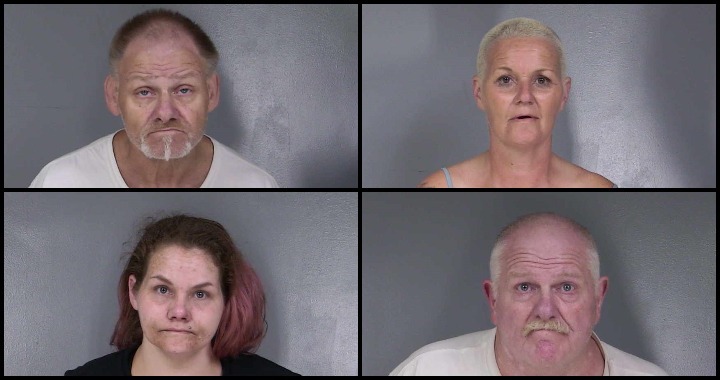
Clockwise from top left: Daggett, Branson, Nazelrod, Maynard.
During a search of the residence agents located 3 loaded firearms, 2 ounces of methamphetamine, 1 ounce of heroin, along with small amounts of ketamine and Norco pills. Agents also located digital scales, cutting agents, and packaging materials. Branson was also found to have 1 ounce of fentanyl concealed inside of her person. All four suspects were arrested and transported to the Humboldt County Jail where they were booked for the above charges:
11351 H&S Possession of fentanyl/heroin for sale
11378 H&S Possession of methamphetamine for sale
11370.1 H&S Possession of controlled substances while armed
11366.5 H&S Maintaining or operating a drug house
Related to the problems caused by this drug house agents tagged 5 total vehicles, trailers, and a motorhome parked in front of the residence for abatement.
Anyone with information related to this investigation or other narcotics related crimes are encouraged to call the Humboldt County Drug Task Force at 707-267-9976.
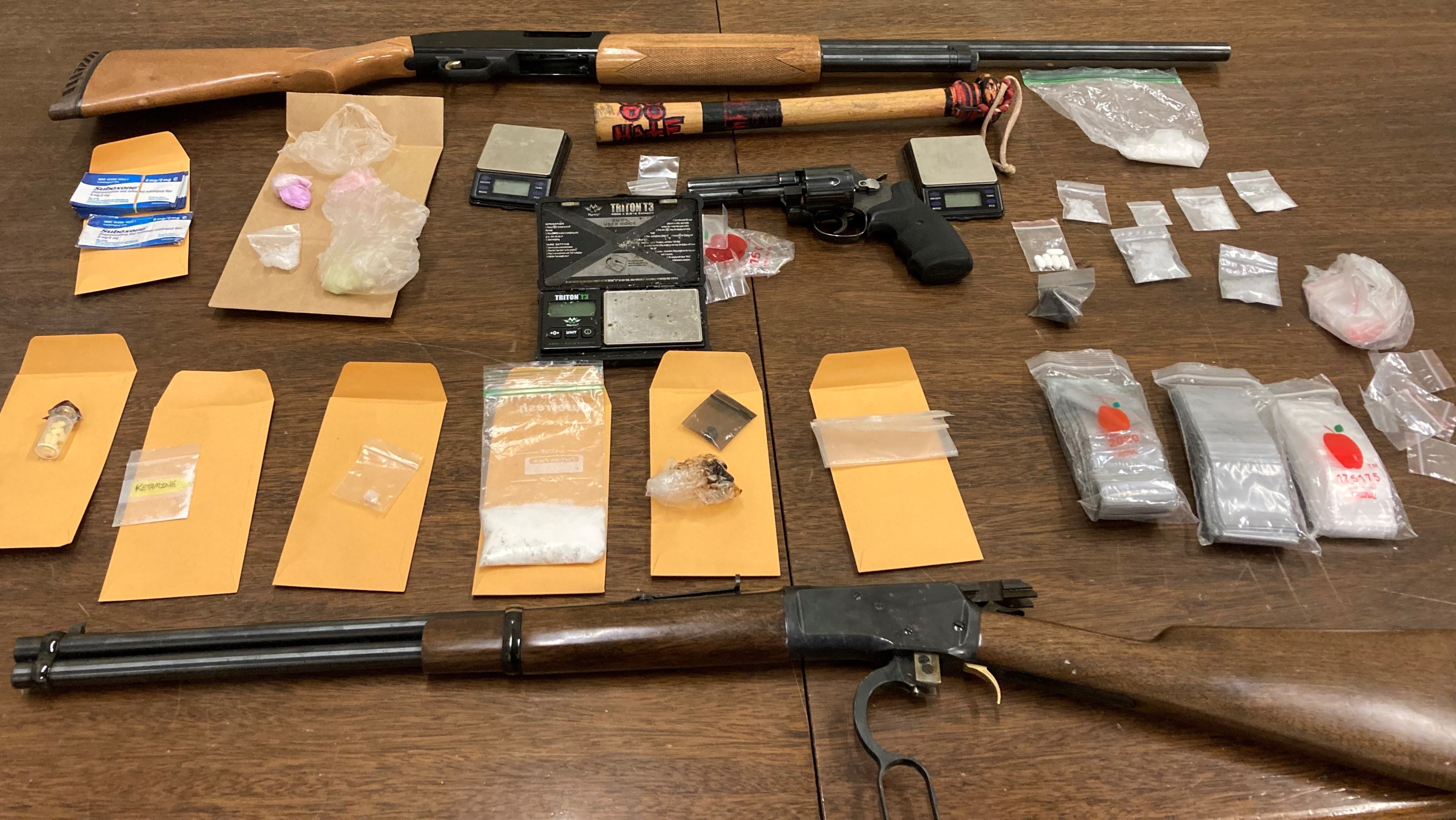
Photos: HCDTF.
TODAY in COURT: Second Ray Christie Trial Scheduled for August; Mother of Convicted Bear River Murderer Can Stand Trial in Humboldt
Rhonda Parker / Tuesday, May 10, 2022 @ 1:56 p.m. / Courts

Photo: Andrew Goff.
###
Arcata rancher Ray Christie’s second trial on animal cruelty charges has been scheduled for August.
This morning Judge Gregory Elvine-Kreis, after denying a defense motion to exclude most of the prosecution’s trial evidence, set Aug. 1 as the date for the new trial. Including jury selection, the trial is expected to last about five weeks.
Christie himself is scheduled for cancer surgery later this month and will then undergo follow-up treatment.
Defense attorney Rick Richmond wanted the judge to withhold photographs, all shown during Christie’s first trial, of the large pile of cattle carcasses found on his Arcata Bottoms ranch. Some carcasses were also found on other property Christie owns or leases for grazing cattle.
Judge Christopher Wilson had already ruled the photos could be used as evidence, and this morning Elvine-Kreis said he agreed.
“All the misdemeanor photos can come in,” the judge said, referring to Christie’s misdemeanor convictions on dumping cattle carcasses near state waters. The jury in the first trial, held in late 2019, convicted Christie of more than 20 counts of littering. But the jury deadlocked 11-1 on four felony counts of animal cruelty. Just one juror voted to acquit.
Deputy District Attorney Steven Steward and Deputy District Attorney David Moutrie will be the trial prosecutors. Steward argued the carcass photos are valid evidence because they provide context for the animal cruelty charges.
During the first trial the prosecutor was former Deputy District Attorney Adrian Kamada, now a deputy public defender who is campaigning to be district attorney. Richmond’s latest motion included attacks on Kamada, even quoting Deputy District Attorney Roger Rees’s recent letter criticizing him. The letter was published by blogger John Chiv.
Elvine-Kreis said this case is becoming too personal and too political, and he’d like that to stop.
“I want to dial this back,” the judge said. “No more personal attacks on anybody.”
He called it all “layers of nonsense.”
“It means nothing to me,” said Elvine-Kreis, who is often the target of Chiv’s criticism.
Another personal attack occurred during a recent hearing when Richmond appeared via Zoom. He accused Steward, a candidate for judge, of being more interested in his campaign than in dealing with the “nasty realities” of the latest defense motion.
Although Elvine-Kreis ruled against the defense as to the carcass photos, he did exclude two potential prosecution trial exhibits: one was a map of where carcasses were found, and another of a single carcass.
Steward said outside the courtroom it’s not clear whether that photo relates to one of the misdemeanor convictions. The jury deadlocked on a few of those counts.
Elvine-Kreis also noted that some issues raised by the defense should be decided “by a jury, not a judge.”
“We’re not going to have a court trial here in this court and then a jury trial,” he said.
Charges were filed against Christie in June 2018, three months after a multi-agency raid on his properties.
PREVIOUSLY:
###
In other court news, Shasta County is not interested in prosecuting a Humboldt County woman who says she didn’t realize until she reached Redding that her son was suspected of a triple murder.
The Shasta County district attorney has ceded its jurisdiction over Melissa Sanchez-Johnson, who was driving behind her son Mauricio Johnson as he fled east after the killings. Sanchez-Johnson says she checked her cellphone at a gas station in Redding and got the message about the murders.
“My client is willing to accept responsibility but she doesn’t want to lie,” defense attorney Kathleen Bryson told Judge Christopher Wilson this morning. Bryson said she knew “something had happened” but didn’t know what.
Both Sanchez-Johnson and her former boyfriend Von Keener are expected to plead guilty to being an accessory after the fact. Keener was in the car with Mauricio Johnson when he was arrested in Utah.
The next hearing is set for June 16.
###
PREVIOUSLY
- TODAY in COURT: Alleged Accomplice of Bear River Triple Homicide Suspect Arraigned in Utah Court; Updates on ‘Manila Five,’ Anderson Cases
- DA Files Charges in Bear River Triple Murder; If Convicted, Teen Suspect Could Face Life Without Parole or the Death Penalty
- Affidavit From Utah Cop Offers Details of Police Investigation Into Last Month’s Triple Homicide at the Bear River Rancheria
- Bear River Triple Murderer Gets 150-to-Life Sentence as Relatives of the Deceased Speak Their Truths; Killer Can Apply For Parole in 25 Years
- Plea From Mother of Bear River Murderer Delayed; Can She be Charged as an Accomplice in Humboldt if She Didn’t Learn About the Crime Until They Reached Shasta?