Tamara Myers can hardly put the importance of the Freshwater Community Guild into words.
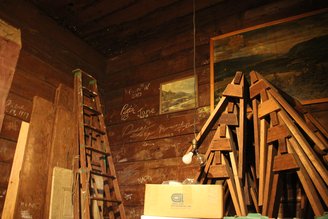
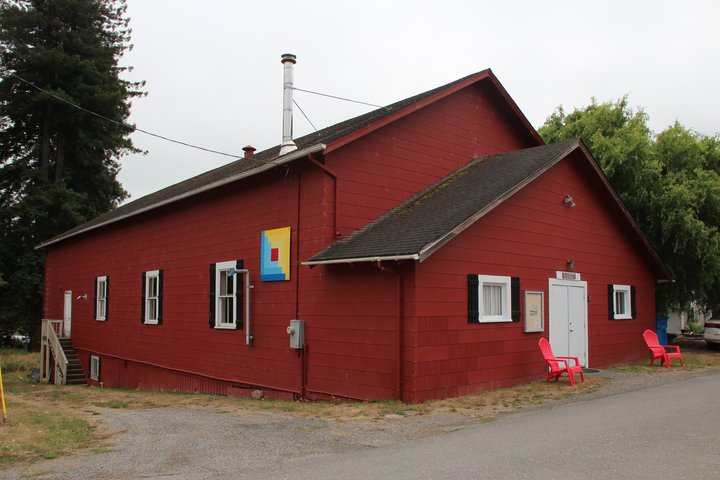
For one, there’s its relationship with Garfield School, which dates back 137 years, by Myers’ estimate. Across a small lane and parking lot from one another, the hall and school, both bright red, might easily pass as the same entity to any passerby unfamiliar with Freshwater. It’s where Myers tested out her acting chops in a school production of Oliver Twist, and where she scribbled her name on a wall backstage alongside dozens of other childrens’ graffiti, chronicling back to the early 1900s.
Kiddos have been graffitiing backstage at Freshwater Community Guild since the 1910s. | Photos by Jacquelyn Opalach
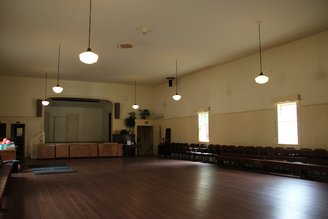
And then there’s the fact that the hall is the only public space Freshwater has for neighbors to connect. Thousands have do-si-doed on the hall’s wood floors over decades of dances. Every Halloween, the hall is a warm, festive refuge for families taking a break from Freshwater’s epic trick-or-treating scene. And for generations, folks have known that missing the monthly pancake breakfast means missing the latest local gossip, Myers’ mother, Mary Myers, who has been the organization’s secretary for more than 30 years, told the Outpost.
And so for Myers, it’s hard to talk about the Freshwater community without talking about the hall.
“I just can’t imagine it not being there,” she told the Outpost. “It’s very much a part of my reality, my world.”
But Freshwater Community Guild — formerly known as the Freshwater Grange — might close its doors.
Until several years ago, Freshwater Community Guild was part of the Grange, a nationwide organization founded in 1867 to advocate for farmers and rural communities. The California State Grange chapter wants Freshwater’s hall to become a Grange once again, and they want its volunteers to become Grange members, or Grangers.
But locals don’t want to. So the State Grange sued for their property.
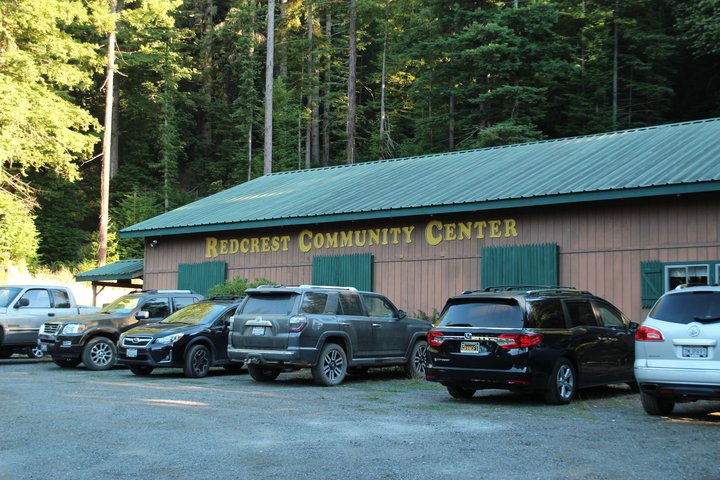
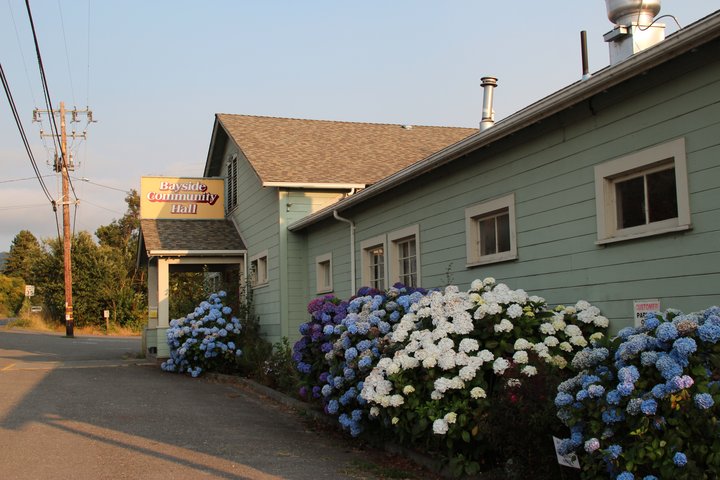
The same conflict has risen at community halls across the state, and Freshwater Community Guild, as well as three other halls in Humboldt — Bayside Community Hall, Van Duzen River Guild and Fieldbrook Community Hall — continue to resist the Grange.
They resist it because the California Grange didn’t buy and hasn’t maintained the properties — local communities did. They resist it because they believe the Grange no longer represents their communities’ interests, and because it honors traditions and rituals that locals find off-putting. One hall leader said the organization feels cultish.
They resist it because they don’t want to be Grangers, but they also don’t want to lose their halls.
If these halls are successful in beating back the Grange, it would be a first. Over the last few years, dozens of local California halls have resisted the Grange. Each was independently sued and fought isolated from their neighbors. The few California renegades that remain unswallowed by the Grange — half of which are in Humboldt County — are putting forward a question untested by California courts: Whether California property law and corporate rights trump the dated, amendable rules of a fraternal organization.
The Grange of the Order of Patrons of Husbandry — referred to here as a singular organization, although it is composed of national, state, regional and local chapters — argues that their intention is to retain these halls as local grange chapters for the benefit of small communities. But the local volunteers who run them worry that if the Grange is successful in seizing the properties, its leaders will fail to maintain them from afar, and some of Humboldt’s tightest-knit communities will lose the gathering places they’ve loved for generations.
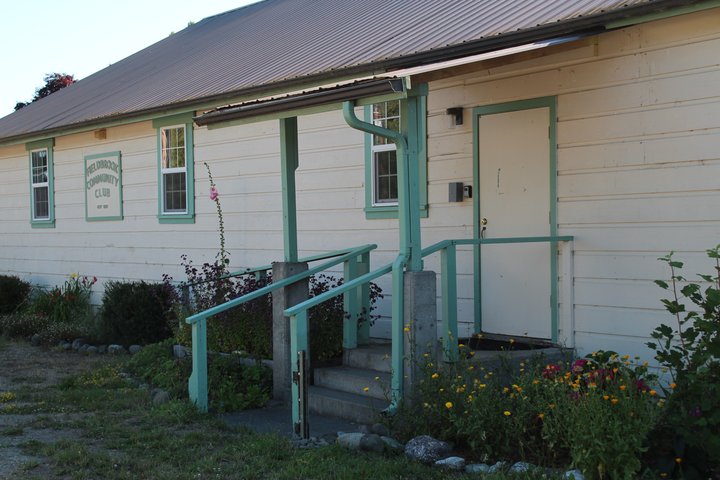
Freshwater Community Guild
A decades-old clash
The lawsuits are the result of a conflict that began years ago between the state and national grange chapters. Due to what Myers summed up as “personality conflicts” between leaders of each chapter, the National Grange revoked the California State Grange’s charter, intending to deactivate the state organization.
But instead, the California State Grange decided to operate as an entity separate from the National Grange. Its president, Bob McFarland, renamed the California organization the California Guild (because of a trademark lawsuit from the National Grange), and most local halls followed suit over the next few years by changing their own names from “grange” to “guild” or “community hall.”
The number of Grange-affiliated halls dropped from about 180 to 26, according to Lillian Booth, secretary of the California State Grange.
Freshwater Community Guild’s hall
At the request of those 26, the National Grange rechartered the California State Grange with new leadership. At that point, there was both a California State Grange and a California Guild, but the rechartered State Grange soon sued the Guild for its property and assets and won.
“When National Grange revoked the charter of the State Grange, they did not revoke any of the charters of the local granges,” Booth told the Outpost. “All those charters stayed in effect, until they took some bad advice, which was to change the name of their organization, change their corporation and change the deeds on the property.” According to rules of the organization, taking those actions was illegal.
And so because halls made those changes, the State Grange revoked dozens of local charters from 2018-2020 and asked halls to turn their properties over.
“When people say we left the Grange — no, actually, that’s not what happened,” Myers said. “We got kicked out. They revoked our charter.”
The State Grange followed up with lawsuits in pursuit of halls’ properties soon after revoking their charters.
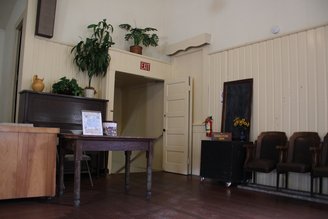
A cozy corner of Freshwater’s hall.
“The lawsuits unfortunately had to start because that was the only way to retain the property, and, hopefully, the members who wanted to come back to the Grange,” Booth said. “It breaks my heart we had to go down this road.”
Over the years, the conflict has been hashed out in more detail by otherpublications around California, including theNorth Coast Journal. The State Grange also has a summary of events posted on its website.
Different halls are in different spots of their lawsuit timelines, but so far nearly every case has been resolved through summary judgment, in which the judge decides the legal questions presented without a trial. The speed of that resolution process has been upsetting to local halls, who feel their cases should warrant a trial. The Grange has won almost every case, but an appeal of that decision could lead to a trial and reverse the outcome.
Today, about 100 of 180 original halls have returned to the Grange, Booth said. Many returned as the result of a lawsuit. Others did so to avoid one. “Many of them said that they were just glad to be back doing what they had already been doing in the community,” Booth said.
As of early August, about 10 halls were still battling lawsuits, although that number is decreasing as more halls agree to rejoin the Grange. About 20 halls are empty and in a custodial status, meaning the Grange is actively trying to find a membership for them. A few of the 50-some granges unaccounted for in the original 180 may have only ever existed on paper, Booth said. Others were sold or demolished by the State Grange and no longer exist.
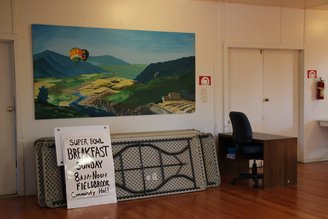
An old backstage painting at Freshwater Community Guild.
Carolyn Jones, president of the Bayside Community Hall, believes that the State Grange is operating in this heavy-handed manner because few local halls in California have any attachment to the Grange name.
“I’m sure they would disagree with this, but I believe that they are feeling very insecure about attracting members to the organization in its own right,” she said. “And so now, the way that they have attracted the membership they currently have is by essentially holding these halls hostage.
“There are many halls, I believe, that would not be grange chapters if they didn’t think they had to be in order to maintain control of their hall.”
Property law on the Grange’s terms
Founded in 1867, the Grange system is a fraternal, hierarchical organization spanning from national, to state, to regional and local control. Each pillar of the organization is chartered by the national chapter and is meant to follow its own sets of rules, or bylaws, as well state and national bylaws. The National Grange’s Digest of Laws has been amended a number of times since the organization’s genesis.
One of those National bylaws — 4.12.1 — states that if a local, regional or state grange ever loses its charter, it becomes an “inactive grange,” and its hall and assets — bank accounts, business interests, all property — become the responsibility of the grange level above it. While in that “custodial” status, the State Grange attempts to reorganize a local grange chapter for the hall. In other words: Once a part of the Grange, always a part of the Grange.
Because this bylaw didn’t exist when some halls were chartered, and because the deeds of these halls specify local ownership — rather than State or National Grange ownership — local hall leaders don’t see how the Grange’s legal argument holds water, marking the root of this conflict.
Issued by the National organization, “the charter is essentially the birth certificate of a grange,” Booth said. “It goes from one generation to the next, and that’s how it’s been able to be a viable organization for over 150 years now.”
The leading volunteers of Humboldt’s local halls disagree.
“Until the National is gone, as far as they’re concerned, no piece of property that we own is actually ours, which would appear to be in violation or in contravention of certain parts of California law,” Jones said.
“The real legal issue here, I think, is this one-page charter, and that’s what all of us is dependent on — a single page charter with a nice little seal in the corner, and not a whole lot of writing on it — that single page document and its power is up against all of California law.”
Fieldbrook Community Hall
‘Not a single dollar donated’
Equipped with kitchens, stages and often yards, Humboldt’s four renegade community halls are used for private and public events like weddings, dances and pancake breakfasts. By providing an affordable rental space or by hosting fundraisers, each hall also helps local entities like schools, emergency response teams and nonprofits.
All were built using local funds and local labor, and have since been maintained — one of them for more than a century, and others for nearly that long — by local volunteers. Some were built specifically for the grange chapters they held; others predated their grange.
Hall members might feel differently about the lawsuit if the Grange had a history of helping with disasters, repairs and upkeep, but locally, at least, it doesn’t. In Bayside alone, volunteers have raised and completed $400,000 worth of renovations for their hall over the last three years.
“They’re not willing to invest,” said one member of the Freshwater Community Guild. “Not a single dollar donated.”
When a 1964 flood wiped out the Redwood Grange — now the Redcrest Community Center, which this week opted to rejoin the Grange — and its nearby communities, it was left up to a few local Grangers to rebuild. Pacific Lumber Company donated a lot, and using local funds and labor, volunteers rebuilt without help from the State and National Granges.
More recently, when the Van Duzen River Guild — formerly the Van Duzen River Grange — needed a new roof in the 1990s, it applied for a loan from the California State Grange, which ran a credit check and denied their request. It took donations and volunteer help from Alves Inc and the community to get the job done.
“That left a really really bad taste in the mouth of the community,” said George Warner, president of the Van Duzen River Guild. “They were really incensed by the fact that nobody would help us.”
Fieldbrook Hall’s hall
That would be handled differently today, Booth said. “Things are not the same now as they were then,” she said, adding that communication is a two-way street, and that grange halls need to let the state know when they need help. That help would be in the form of a loan, via the Grange’s loan fund, Booth said.
But animosity is not what’s fueling these halls’ efforts to fight their lawsuits. They’re more concerned about what it would mean for their communities, and the partnerships they’ve built, if the Grange wins.
All four halls have developed important relationships with nearby schools.
For instance, Freshwater Community Guild does more than just allowing Garfield School to use their hall for performances and graduations. The hall leases its parking lot to Garfield School for one dollar a year, and the hall once raised $10,000 to fund speed humps on the road nearby.
“If we were to close for any reason, it would have such a detrimental impact on Garfield School,” Myers said. “The amount of kids that could be enrolled would go down.”
In Hydesville, Cuddeback School has been hosting graduations at the Van Duzen River Guild for decades. “My mom walked across that stage in 1943 in the middle of World War II. Graduated eighth grade,” said Warner, president of the hall. “It’s part of us. Part of our family, part of our community.”
Similarly, when Fieldbrook School was being rebuilt, lower grades held classes in Fieldbrook Community Hall.
And Bayside Community Hall does the same.
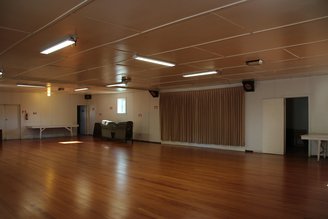
A corner of Fieldbrook Community Hall
“We have a school right next door. They use our yard, they use our hall for performances and meetings and things like that in exchange for maintenance work on the property,” Jones said. “The hall has morphed, I think, like all of ours have, into what the local community finds useful and helpful and valuable. And it doesn’t appear to be the kind of one-size-all that the Grange wants to sell us.”
Led by longtime member Margie Plant, Redcrest Community Center in Southern Humboldt resisted the Grange alongside the other four halls for years. Particularly important to this hall was a partnership with the Redcrest Volunteer Fire Department, which recently began construction of a fire truck security building on the hall’s property. With direct access to the freeway, the fire department deemed the property ideal for immediate emergency access, and so in 2012, when the hall was still a grange, hall volunteers agreed to the building’s construction and secured permission from then-State President Bob McFarland to do so. Construction commenced shortly after the hall received notice of their lawsuit.
To discuss potentially rejoining the Grange, Redcrest Community Center met with four Grange representatives, including Booth and state president Kent Westwood, earlier this month. At that meeting, the Grange wouldn’t promise that they would allow completion of the building, claiming they hadn’t seen the paperwork.
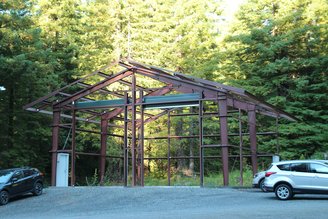
Unfinished, the fate of this Redcrest Volunteer Fire Station security building is in the State Grange’s hands.
On Monday seven members of the hall voted to rejoin the Grange, Margie Plant, the hall’s former president, told the Outpost. Attendance at that meeting, which had only the vote on its agenda, was poor, Plant said, adding that it seemed like the members not in attendance felt put off and disheartened by their prior meeting with the State Grange.
Deflated, Plant resigned following the vote. “I don’t want anything to do with the Grange organization,” she told the Outpost.
It’s unclear whether the State Grange will allow completion of the fire truck security building, or whether they’ll charge rent if it is completed. The remaining members are hopeful they’ll come to an agreement for its completion in a settlement with the Grange, Plant said, but nothing is guaranteed.
“It is difficult to fathom that when the community donates land, builds the building, and maintains it consistently over all these years, that a large corporation could suddenly lay claim to it,” Rowetta Miller, executive chair of Fieldbrook Community Hall, told the Outpost. “This corporate land grab would be an obvious injustice.”
Redcrest Community Center will soon again be Redwood Grange.
No comfortable option
The lawsuits would disappear if halls opted to rejoin the Grange, which is the organization’s goal. Members would apply to become Grangers, take an oath to follow the Grange’s bylaws and pay dues of $30 per year to the organization.
Walking away from their halls would have the same outcome as losing the lawsuit: surrendering the properties to the Grange, which would hold the halls in a custodial status — temporarily claiming jurisdiction over the property and assets — while attempting to reorganize chapters for each building in no less than seven years. To do that, the Grange would host an open house at the hall and invite locals to learn about the organization.
Once there are 13 or more members — with at least four men and four women, according to bylaws — the charter is restored and the State Grange steps out, Booth said. “The good work that they have been doing will continue. But unfortunately, they need to continue as a grange, not as a community hall or as a guild. They need to come back into the Grange, and we welcome everyone back into the Grange.”
Locals doubt the Grange will find enough folks willing to join, but Booth told the Outpost that it hasn’t been a problem in other parts of the state, and she doubts it would be a problem here. In Redcrest, for instance, seven current members will become Grangers. If the Grange were to win Fieldbrook, though, none of the hall’s existing 25-30 members are willing to join the organization, Miller said.
In the interim, the State Grange would attempt to meet existing obligations of these halls, like weddings, dances, or other events renters have booked in the coming months. They would also be responsible for maintaining the hall during that time. Booth said that the Grange usually tries to find a local willing to volunteer to do that work.
If a new chapter isn’t formed within seven years, the State Grange can sell the property. Halls are only sold if in irreversible disrepair, Booth told the Outpost, and 85 percent of the profits go to the Grange loan fund — which finances repairs for grange halls — while the other 15 percent goes to the State Grange general fund.
Appealing lost cases is a gamble. To maintain local control during their appeals, which will likely take more than two years, halls would need to post bond, and bonds on halls around California have ranged from $50,000 to more than $200,000.
The State Grange will take control of halls that don’t post bond during their appeal.
If a hall wins its appeal, the case will go to trial locally, and the ruling of that trial will finally determine who owns the hall.
“Those of us who have insurance, we’re able to fight, but we’re losing,” Jones said. “Almost every motion for summary judgment has been granted, giving the Grange hall property without a trial.”
Three of Humboldt’s halls have been able to fight because they have liability insurance to fund their legal defenses. Fieldbrook Community Hall doesn’t have insurance because they thought they had a valuable edge to their case: a clause in their grange chapter’s original deed, which specifies that if the Grange were to ever dissolve, the title to the property would revert back to the Fieldbrook Community Club, the hall’s original owners.
“This makes our situation unique and a bit different than other halls. We thought we were safe as our property was secured with a legally recorded agreement,” Miller, the hall’s executive chair, told the Outpost. “They sued us anyway. Because we do not have directors and officers insurance, we’ve had to limit our legal representation to what we can afford.”
Jones thinks she’s worked out a reasonable compromise to this conflict that would satisfy the goals of each side. She wants the Grange to institute a new type of membership, and wrote a petition to garner support for the idea, which has so far collected 218 signatures:
We petition the California State Grange to declare that all halls are owned by their local communities. We petition for development of a membership option that allows a former grange to become a non-voting affiliate, to pay dues and provide a meeting place for a chartered local chapter, but to otherwise function as an autonomous organization. We believe that this would provide the best opportunity for success for both local halls and the grange organization.
Booth declined to comment about the idea, claiming she hadn’t been made aware of the compromise.
A former grange in Shasta County — Palo Cedro Community Guild — is ahead of all the others. Determining their case warranted a trial, the Shasta County judge denied the motion for summary judgment requested by the Grange. Their case will go to trial in September.
“If they win, that would be huge,” Jones said. “If they lose it, that’s it.”
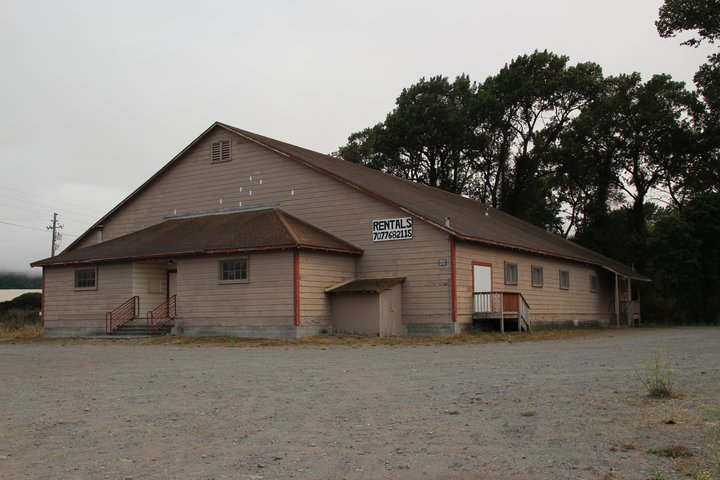
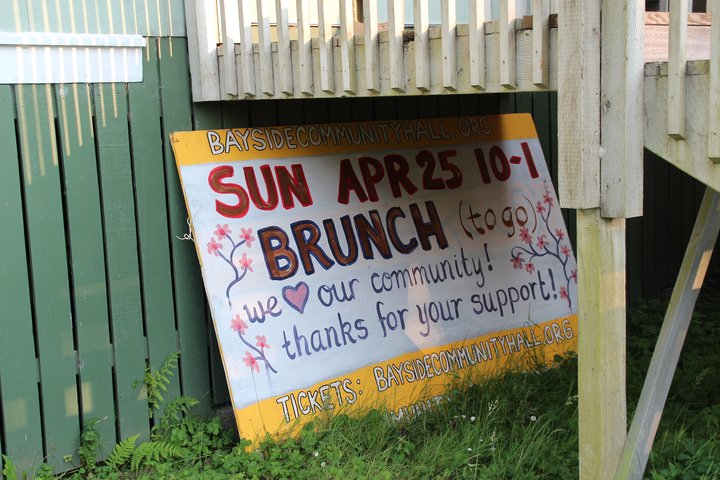
Bayside Community Hall
Why not join the Grange?
Some locals deep in lawsuits wholeheartedly believe the Grange served its purpose well in these communities for a long time and respect the organization’s mission, and there are few other halls in Humboldt County successfully operating as granges. But today, aside from the lawsuit fiasco, current volunteers of these four halls largely aren’t interested in joining the Grange because they don’t personally identify with its values.
Since its post-Civil War establishment in 1867, the National Grange has marketed itself as a bipartisan advocacy group for rural farmers and communities. Local halls are meant to drive that advocacy.
“We don’t take our partisanship into the Grange. We support issues, not candidates. We advocate on so many different levels. And if that’s not for you, then we have the other parts of the Grange, which are educational,” Booth told the Outpost.
Rather than attracting Arcata residents, Jones thinks the advocacy element is probably off-putting for most, given that the city is not so rural anymore.
Bayside Community Hall has renovated their entire kitchen since 2018.
“We have a really mixed community, way more mixed than appears to be the demographic of the Grange. They say: ‘We’re rural, we’re agricultural, we can advocate for you!’ Well, my point is that almost any position that they take is probably gonna piss off half of our community,” Jones said. “We want to be there for the entire community.”
As a fraternal organization, the Grange must offer something of tangible value to its members. At one time, that thing was super-affordable insurance, which, some say, is what encouraged folks to join their local grange back in the day.
“The Grange insurance was cheap. I can’t think of hardly anybody that I’ve talked to over the years that, at one point, their family or somebody in their family hadn’t had Grange insurance,” Warner said. “We had almost 400 members in the late 80s, early 90s because to get insurance, you had to be a member.”
But years ago, before this conflict even began, the insurance provider, Grange Insurance Association, took their company public. And now, as far as local hall leaders can tell, there’s not much of anything tangible the Grange is offering up.
Booth didn’t deny it and pointed to the intensity of the split and its consequential loss of membership. “Because the split happened in 2012 — this is nine years ago — and when you lose that force of membership behind getting tangible benefits, it takes time to rebuild that,” Booth said. “You have to have the membership behind it, you know, the numbers. It has to make sense for the companies,” she said, adding that the Grange is actively seeking out new benefits.
Bayside Community Hall’s hall
She mentioned a potential partnership with AmeriGas, a propane company, which currently offers a discount to grange members in certain regions of California. “We’re looking at talking to them about doing that on a statewide basis,” she said. “So, yes, it applies mostly to rural communities that have propane, but it’s still a tangible benefit.”
Beyond lack of interest in the Grange’s basic offerings and benefits, members are wary of the organization’s bylaws and practices. For instance, new Grangers must be unanimously voted in by the existing local membership.
“It has the inherent potential for being a closed organization. We may all run ours in such a way that anybody who fills out the form, we want in.” Jones said, but “it is very easy for a grange to deny someone membership or to vote someone out by their rules.”
And their rules are extensive. Local granges must use a state-developed template to create a set of bylaws that cannot conflict with the bylaws of the state and national chapters. These bylaws run to more than 100 pages long, and in theory local granges are supposed to follow to the letter.
“How many people are actually going to go and really learn about what [they’re joining]?” Jones wondered. “They’re joining to be part of their community, right? Not to pledge faithful allegiance to a complex set of national rules that have changed over the years. And a lot of us don’t even really know what those rules looked like when our halls were chartered, which should be a really important issue, one would think.”
Locals claim that in the past, bylaw enforcement seemed to ebb and flow.
“They used to send people around to our meetings to intimidate us and threaten [us to] follow their rules,” Warner said. “It didn’t sit well.”
Nowadays, though, the bylaws are apparently no big thing. Local hall volunteers say that other grange halls have encouraged them to just rejoin, claiming that as long as member dues are paid, the State Grange gives little attention to whether local granges are actually following bylaws.
“That also makes me very uncomfortable: The idea of joining something, and saying you’ll follow the rules, and then just ignoring the rules until such time as the state or national organization decides that they want to call on you for not obeying the rules,” Jones said. “I mean, they can do that at any time.”
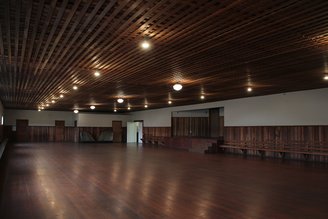
Inside Bayside
That’s a rumor, Booth said later in an interview, the Grange mentors local halls and keeps an eye out. “If there’s a problem with the bylaws, then we help them understand the bylaws,” she said.
People are also perplexed by the organization’s traditional practices, and are worried about joining something with antiquated beliefs. The Grange has a history of honoring farming-themed rituals, which state president Kent Westwood told the Outpost are basically little performances that local halls are not required to practice. Jones, who in her life has attended just one formal grange meeting, said it felt cultish.
For instance, the State Grange constitution outlines that members of local granges work their way through four degree ranks, which each bear different responsibilities. Each degree is represented by two gendered titles, like the First Degree’s “Laborers” and “Maids,” for example. That type of thing is just a part of Grange history, Westwood said, and most halls just ignore it nowadays.
Booth implied that the only required practice is the opening ceremony, which takes three minutes.
That said, the Grange continues to honor religious practices. Here are a couple of bylaws from the National organization’s Digest of Laws, from the Code of the Junior Grange and Code of Ritual, Degrees and Regalia, respectively:
“The Chaplain shall encourage reverence to God through the opening prayer. The emblem of the office is the Bible, the book in which all should look for guidance.” And: “All Granges shall have the Bible open on the altar and the flag of the United States of America properly displayed in the Grange meeting room.”
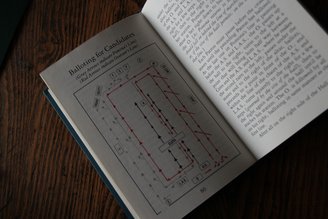
Grange ritual diagram outlining where certain members are to walk and stand during a traditional ceremony.
Touting the organization’s bylaw resolution process — which is meant to be driven by local granges — Booth said the California State Grange is interested in amending that second rule to allow any holy text, and said the State Grange has brought that resolution to the National Grange convention three years in a row now and will continue to do so until that bylaw is more inclusive.
“If you don’t like the rules, there is a system to change them,” Booth said in an interview. “But until you do that, granges have to follow the rules.”
Today, Grange membership is declining. In its heyday, all 50 states had state and local charters; now only 34 do. Before the lawsuits between the state and national organizations began, California membership was at 10,000; now it is half that. Since 2000, Humboldt County and Del Norte have lost more than a dozen granges, Jones said.
Few locals are jazzed about joining the Grange, but some are willing to do it to maintain control of their hall. A recent poll of 55 Bayside Community Hall members, published in a regular Mad River Union column written by Jones, found that more than half will become less involved with the hall if it returns to the Grange. Seven people would be highly interested and ten somewhat interested in joining the Grange, the poll found, but 78 percent of respondents agreed that the hall should not voluntarily return to the Grange.
Van Duzen River Guild
Bleak and less bleak outcomes
If the Grange wins, these halls, their assets and accounts would become the Grange’s responsibility, which would attempt to recharter a new grange chapter in these buildings within the next seven years. In the meantime, though, it’s unclear whether partnerships — like those with the schools — would survive the transition, and whether the Grange would manage to honor upcoming events scheduled at the halls.
“What’s gonna happen to all of those? Are they actually going to come in and unlock the doors, and clean bathrooms between events, and clean up the yard, and pay the bills and make sure that the trash is taken out? ” Jones said. “Are they gonna do all that stuff?”
Van Duzen River Guild’s hall
The State Grange says it will.
Some hall volunteers, who have been trying to gauge Grange interest in their communities without much luck, worry their halls will sit, shuttered, until being sold due to disrepair in seven years. That’s a huge concern of Myers’, who said Freshwater’s hall needs pretty consistent attention to keep standing.
Booth seriously doubts the Grange will lose. “We have not lost any of these. And I don’t anticipate us losing any of them, either,” she said. “The loss is the fact that we aren’t able to sit down and talk.”
The fighting hall volunteers are exhausted.
“[I’m feeling] disenchanted but hopeful,” said Warner of the Van Duzen River Guild.
“Me personally? I’m not terribly hopeful,” Jones said. “I don’t think there’s any justice in what’s going on at all. It doesn’t make any sense to me … Our ruling, to give away, you know, all of our property, was a page and a half long. It did not address any of the legal arguments made by our attorneys.”
Myers is thinking along the same lines. “I am incensed that there has not been a day in court, not at the state level. It’s all been motions for summary judgment,” she said. “I am worried. I am worried about our community. That’s really what keeps me up at night. I am worried the school will not have an asset. Every day.”
At least one white man is known to have moved out of Arcata in the last 10 years, but the town’s booming. File photo: Andrew Goff.
###
Yesterday the U.S. Census Bureau released the local-level numbers from the 2020 Census. These numbers go all the way down to the neighborhood and block in each community, and so give us our first look at how the county — and each town or neighborhood therein — has grown or shrunk, population-wise, since 2010.
The main purpose of the current data release is to give people in charge of drawing new political lines — Congressional districts, state Senate and assembly districts, Board of Supervisors districts, city wards, etc. — time to get them in place well in advance of the 2022 elections. Most jurisdictions are required by law to redraw the lines every 10 years, after the Census, in order to ensure equal representation.
We’re going to be taking a look at that aspect of Humboldt County’s census results next week. First up, though, we’re going to take the 10,000-foot view at our new demographic reality.
According to the Census Bureau, Humboldt County grew just a little bit since the last decennial count. Its best estimate is that we now have 136,463 residents, up from 134,623 in 2010.
That amounts to a 1.4 percent population increase over 10 years — much slower growth than California as a whole, which grew by about 6.1 percent over the same period, or the nation, which grew by about 6.3 percent.
Meanwhile, the population of the county’s incorporated cities variously swung up and down, sometimes wildly.
Total Population, 2010-2020
HUMBOLDT COUNTY
134,623
136,463
+1.4%
EUREKA
27,191
26,512
-2.5%
ARCATA
17,231
18,857
+9.4%
FORTUNA
11,926
12,516
+4.9%
RIO DELL
3,368
3,379
+0.3%
FERNDALE
1,371
1,398
+2.0%
BLUE LAKE
1,253
1,208
-3.6%
TRINIDAD
367
307
-16.3%
The top line, here, has gotta be the big population boom in Arcata and the more modest one in Fortuna, coupled with the fact that Eureka shrank a bit. Tiny Trinidad got relatively much tinier — probably, as a local would surely tell you, thanks to the Airbnb boom in that picturesque seaside village.
Another key component of the data released yesterday: Race and ethnicity. Redistricting bodies such as the California Citizens Redistricting Commission are required by the Voting Rights Act to not use the redistricting process to dilute the power of certain protected classes, including racial and ethnic minorities. So the Census Bureau passes on that data at this time as well.
What does it show in Humboldt? That we have become pretty markedly less white than we were even 10 years ago! Ten percent fewer Humboldters identified as “white, non-Hispanic” in the 2020 census than they did in 2010.
Meanwhile, every other major racial/ethnic group jumped up very dramatically. The number of people who identified as belonging to “two or more races” more than doubled. Half again as many people said they belonged to “some other race” — i.e., not white, Black, Native American, Asian or Pacific Islander.
Humboldt Race and Ethnicity, 2010-2020
WHITE, NON-HISPANIC
103,958
93,316
-10.2%
HISPANIC or LATINO
13,211
18,535
+40.3%
BLACK or AFRICAN AMERICAN
1,505
1,879
+24.9%
AMERICAN INDIAN or ALASKA NATIVE
7,726
8,481
+9.8%
ASIAN
2,944
3,615
+22.8%
NATIVE HAWAIIAN or PACIFIC ISLANDER
352
455
+29.3%
SOME OTHER RACE
5,003
7,782
+55.5%
TWO OR MORE RACES
7,173
16,156
+125.2%
(A note here: “Ethnicity,” in Census Bureau terms, consists of two choices — Hispanic or non-Hispanic. “Race” consists of the other choices listed above, sometimes in combination, and includes that “some other race” category, which The Atlantic explained and explored at this link.)
Why the huge decline in the white, non-Hispanic population here in Humboldt County? Part of it is down to the fact that some people moved out and other people moved in, of course — but part of it is also the fact that the Census Bureau changed the way it asked the questions this time around.
The 2020 Census used the required two separate questions (one for Hispanic or Latino origin and one for race) to collect the races and ethnicities of the U.S. population — following the standards set by the U.S. Office of Management and Budget (OMB) in 1997.
Building upon our research over the past decade, we improved the two separate questions’ design and updated our data processing and coding procedures for the 2020 Census.
…
The improvements and changes enabled a more thorough and accurate depiction of how people self-identify, yielding a more accurate portrait of how people report their Hispanic origin and race within the context of a two-question format.
These changes reveal that the U.S. population is much more multiracial and more diverse than what we measured in the past.
So the Bureau believes that it is more thoroughly capturing the way people identify themselves, racially and ethnically, than it has in the past — according to which, it follows, that its previous measures of whiteness were flawed.
Therefore, the Census Bureau is saying, it may be a bit shaky to compare numbers from 2010 and 2020 — as we have, uh, done here — because they are sort of two different metrics. But as noted above, the changing numbers, whatever the cause of the change, do have real-world consequences, so we don’t feel too bad about including them.
Anyway: Stay tuned! Next week we’ll have more fun facts from the Census, with a focus on redistricting at the local level. Hopefully there will be fun maps and stuff. Both county government and the City of Eureka will have to redraw the lines that make up its political districts or wards, and in some cases the changes will be pretty dramatic!
The following is a letter co-signed by members of the Humboldt-Del Norte County Medical Society:
Dear Community,
We are your physicians. You have honored us by entrusting your lives to us, as well as the lives of your
loved ones. We are also your neighbors, your friends, and your relatives. We share with you a deep love
of this region and of our communities. Like you, we dream of a safe, Covid-free future.
Please get vaccinated. We ask this from the bottom of our hearts. As your physicians, and as the people
with whom you have worked, played, laughed, and cried, we must admit we are tired. We will keep
working, of course. But we are tired. We are tired of the suffering, pain and death that can be avoided by
getting vaccinated.
We have studied the data, and we have seen the benefits of vaccination with our own eyes. The vaccines
are well tested, very safe, and highly effective. Yes, masking must continue, especially with the highly
contagious Delta variant. But nothing is as important as being vaccinated.
You’ve trusted us with every other aspect of your health. Please trust us with this. We are not asking
you to do anything that we have not already done. Please, for the sake of our community: the young, the
old, and all the in-betweens, get vaccinated.
Signed,
G. Beth Abels, M.D. (Internal Medicine)
Igor Z. Abolnik, M.D. (Infectious Disease)
Christian D. Agricola, M.D. (Psychiatry)
John Aryanpur, M.D. (NeuroSurgery)
Steven E. Aussenberg, M.D. (Family Medicine)
Donald I. Baird, M.D. (Family Medicine)
Gary H. Baker, M.D. (Radiology, Ret.)
Connie V. Basch, M.D. (Family Medicine)
J. Kim Bauriedel, M.D. (Urology, Ret.)
Brandon E. Bireley, D.O. (General Surgery)
Michael T. Borrello, M.D. (Interventional Pain Management)
Kevin J. Caldwell, M.D. (Family Medicine)
William P. Carlson, M.D. (Family Medicine)
Joseph E. Carroll, M.D. (Family Medicine, Ret.)
Katie M. Cassel, M.D. (Family Medicine)
Luther F. Cobb, M.D. (General Surgery)
Christopher L. Cody, M.D. (Pediatrics, Ret.)
Caroline L. Connor, M.D., MPH (Family Medicine)
Nathan R. Copple, M.D. (Family Medicine)
Emily L. Dalton, M.D. (Pediatrics)
Amy L. Darwin, M.D. (Family Medicine)
Tamara S. Dennis, M.D. (Family Medicine)
Stephen R. Dieker,Jr., M.D. (Anesthesiology)
John Disiere, M.D. (Age Management/Cosmetic)
Stephanie S. Dittmer, M.D. (Family Medicine)
Ishai Erez, M.D. (Anesthesiology)
Kim S. Ervin, M.D. (Gynecology)
Katherine A. Estlin, M.D. (Family Medicine/ Deputy Health Officer)
Neal E. Feuerman, M.D. (Anesthesiology)
Alan J. Fischel, M.D. (Anesthesiology)
Leslie S. Fittinghoff, M.D. (Pediatrics)
Matthew M. Fluke, M.D. (Radiology)
Teresa L. Frankovich, M.D., MPH (Pediatrics)
Corinne E. Frugoni, M.D. (Family Medicine)
Eric H. Gerdes, D.O. (Emergency Medicine)
Gregory N. Gibb, M.D. (Ophthalmology)
Bret R. Gorham, D.O. (Emergency Medicine)
Peggy L. Grossman, M.D. (Family Medicine)
Lei H. Han, M.D. (Family Medicine/Hospitalist)
Jennifer A. Heidmann, M.D. (Internal Medicine)
Gregory S. Holst, M.D. (Family Medicine)
Ian P. Hoffman, M.D., MPH (FM / Public Health Officer)
Malia A. Honda, M.D. (Internal Medicine)
May C. Hong, M.D. (Family Medicine)
Ted R. Humphry, M.D. (Pediatrics, Ret.)
George W. Ingraham, M.D. (Ophthalmology, Ret.)
Kendra N. Iskander, M.D. (General Surgery)
Erik J. Janssen, M.D. (Ophthalmology)
Andrew C. Johnston, M.D. (Internal Medicine)
Jeffrey S. Johnston, M.D. (Anesthesiology)
Stephen M. Kamelgarn, M.D. (Family Medicine, Ret.)
Michelle M. Keeter, M.D. (Family Medicine)
Martin E. Kernberg, M.D. (Radiology)
Bruce E. Kessler, M.D. (Internal Medicine, Ret.)
Charles I. Knoll, M.D. (Phys. Med/Rehab)
Steven J. Korenstein, M.D. (Family Medicine)
Marissa L. Kummerling, M.D. (Family Medicine)
John C. Kurylo, M.D. (Orthopedics)
Courtney C. Ladika, M.D. (Family Medicine)
Lee R. Leer, M.D. (Family Medicine)
Harry B. Lesch, M.D. (Psychiatry)
Join Y. Luh, M.D. (Radiation Oncology)
Tuan A. Luu, M.D. (Emergency Medicine)
Dusten M. Macdonald, M.D. (Radiation Oncology)
Marcelle O. Mahan, M.D. (Family Medicine)
M. Ellen Mahoney, M.D. (General Surgery)
Thach D. Mai, D.O. (Anesthesiology)
Michael F. Mangahas, M.S., M.D. (Pediatrics)
John S. Mastroni, M.D. (Ophthalmology)
Allen S. Matthew, M.D. (Nephrology)
Kate McCaffrey, D.O. (Family Medicine, Ret.)
Mary L. Meengs, M.D. (FM / Deputy Health Officer)
Louise A. Minor, M.D. (Ophthalmology, Ret.)
Michael B. Mizoguchi, M.D. (Ophthalmology)
John A. Montgomery, M.D. (General Surgery, Ret.)
Christopher R. Myers, D.O. (General Surgery)
Michael A. Newdow, M.D. (Emergency Medicine)
Julie M. Ohnemus, M.D. (Family Medicine/Addiction Medicine)
Margot L. Oliver, M.D. (Family Medicine)
Philip L. Olkin, M.D. (Family Medicine, Ret.)
Alison M. Palacios, D.O. (Family Medicine)
William B. Parks, M.D. (Pediatrics)
Lorien M. Paulson, M.D. (Otolaryngology)
David A. Philips, M.D. (Interventional Cardiology)
Madeleine S. Ramos, M.D. (Allergy and Immunology)
Jerryl L. Rubin, M.D. (Psychiatry, Ret.)
Thomas J. Rydz, M.D. (General Surgery)
Sarah A. Scher, M.D. (Family Medicine)
Uzi M. Selcer, M.D. (Infectious Disease, Ret.)
Lawrence A. Senffner, M.D. (Internal Medicine)
Nicole C. Shattuck, D.O. (Emergency Medicine)
Alexey Shereshevsky, M.D. aka Dr. Shev (Family Medicine)
Glenn O. Siegfried, M.D. (Emergency Medicine)
Robert E. Soper, M.D. (Psychiatry)
Candy A. Stockton, M.D. (Family Medicine/Addiction Medicine)
Kusum G. Stokes, M.D. (Gastroenterology)
Aaron M. Stutz, M.D. (EM / Del Norte Public Health Officer)
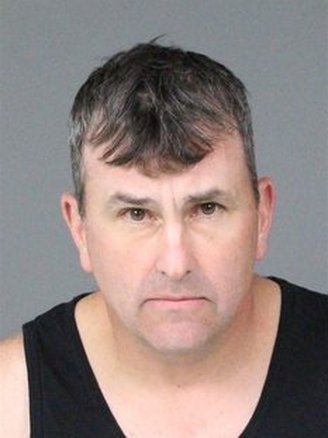
Former county building inspector Patrick William McTigue, who bilked Southern Humboldt residents out of thousands of dollars in cash and goods, pleaded guilty today to felony counts of bribery and grand theft.
McTigue is eligible for probation but could be sentenced to up to one year in jail, District Attorney Maggie Fleming told Judge Kaleb Cockrum at the hearing this morning. McTigue’s jury trial had been set to begin next week.
Fleming said all victims were contacted, and all approved of this resolution.
McTigue, 50, admitted to one count of bribery and two counts of grand theft involving three of his six victims. His crimes against the other victims will be considered at sentencing on Oct. 5. Also at sentencing, all six victims will have a chance to say how much McTigue owes them.
As a building inspector, McTigue promised to expedite the planning process for would-be marijuana growers who were attempting to obtain a permit. Once McTigue got the money, he was never heard from again.
McTigue also made the rounds asking people to invest in an imaginary marijuana-delivery business he claimed to be setting up in Sacramento. One Weott couple gave him $50,000 in cash. A Fortuna business owner did the same. Another man who had known McTigue since childhood invested $27,000.
After receiving the cash, McTigue would ignore the hundreds of phone calls placed by his investors.
McTigue, a Fortuna resident, was arrested in May 2018. He posted bail and has remained out of custody.
McTigue is represented by Deputy Public Defender Casey Russo.
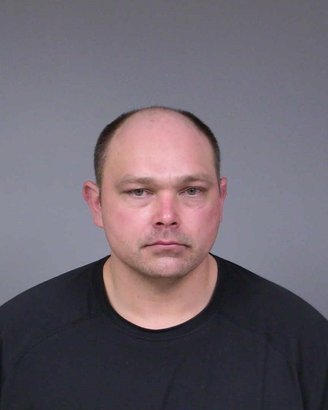
Also this morning, Judge Timothy Canning issued a no-bail ruling for McKinleyville resident Cory Michael Nelson, who managed to post bail on a case that could put him in prison for life.
Nelson has four criminal cases pending, including one alleging he shot a man in the groin, depriving him of one testicle. In that case he is charged with mayhem and assault with a firearm, along with a special allegation that he personally discharged a firearm and caused great bodily injury. That allegation can add up to a life sentence to any sentence imposed.
Back in February, when Nelson was arrested in the mayhem case, Canning set bail at $75,000. Nelson posted bail and has been out of custody all these months. And on Aug. 8, while out on bail, he allegedly kidnapped a woman at the Dean Creek Resort in Redway. The alleged assault was witnessed by the woman’s young son.
This morning Deputy District Attorney Trent Timm said the $75,000 bail was “drastically low” and should have been a minimum of $750,000. Being out of custody allowed Nelson to accost the woman, dragging her by the hair and forcing her into a small black Toyota.
When a bystander tried to stop him, Timm said, Nelson said, ‘I’m taking my wife. Shut the fuck up.’ ‘’
Nelson is a prison parolee “fresh out of prison,” Timm said, and he has a long history of violent crime.
Canning granted the prosecutor’s request that Nelson be held with no bail on the kidnapping case, the mayhem case and the alleged parole violation.
He is scheduled for a preliminary hearing on Wednesday.
Nelson is represented by private attorney Russ Clanton.
A new COVID-19 variant — named lambda — has arrived in California.
The emerging lambda variant has been popping up in the news as it spreads rapidly throughout South America. In California, at least 152 cases have been reported, the first as early as September 2020, according to state public health officials.
Experts say lambda could be more infectious and resistant to vaccines than the original SARS-CoV-2 virus. But there is no evidence, at least so far, that it’s as infectious as the delta variant that now dominates California.
So do Californians need to worry about this new variant? Not just yet, infectious disease specialists say. Here’s what you need to know about lambda.
What is the lambda variant?
The lambda variant — also known as “C.37” — was first reported in Peru a year ago and it’s now spreading across South America, according to the World Health Organization. Researchers say its unique new gene deletions and mutations signal that lambda may be more infectious than the original “wild type” coronavirus and may be potentially resistant to current vaccines, although more studies are needed.
Because of those new genetic markers, the WHO in mid-June declared lambda a “variant of interest.” The U.S. Centers for Disease Control and Prevention has not yet done the same, in part because so few cases have been reported nationwide.
The delta variant dominating U.S. COVID-19 cases is considered a “variant of concern” by both WHO and CDC, in part because it’s much more infectious than the original virus.
Why am I hearing about lambda now?
Lambda sparked headlines this summer after the WHO noted its rapid spread in South American countries, including Peru, Ecuador, Argentina and Brazil. It’s since been detected in 29 countries, according to the WHO, including Germany, Spain, the United Kingdom and the United States.
While WHO considers lambda a “variant of interest,” the CDC and California’s public health agency have not followed suit.
More recently, two highly publicized laboratory studies from Japan and Chile – both in preprint and not yet peer-reviewed – have suggested that lambda may be more infectious and less susceptible to current vaccines than the original coronavirus. The Japanese researchers suggested that WHO’s current “variant of interest” designation for lambda may underplay its potential threat.
Is lambda here in California? What about other states?
Yes and yes. Since September 2020, the lambda variant has accounted for 152 genetically sequenced COVID-19 cases in California, according to the state Department of Public Health. The first case was found in September, with another 10 in March, 88 in April, 43 in May, eight in June and, most recently, two cases in July.
The state agency declined to identify the counties where the cases occurred.
Commercial and government laboratories test for variants by sequencing the genome of the coronavirus that caused a particular COVID-19 case and looking for mutations and changes in the virus’ characteristic spike protein.
Still, not every COVID-19 case is genetically sequenced to determine whether it was caused by a variant, so the number of lambda-caused cases could be higher. Nationwide only about 15 of every 1,000 cases are sequenced.
At least 1,311 sequenced lambda cases have been reported in at least 40 states since the start of the pandemic, with 18 cases identified in the past four weeks, according to the public virus genetic sequence database GISAID. Just one-tenth of 1 percent of the cases that are genetically sequenced involve lambda, according to GISAID.
How does the lambda variant compare to other known variants?
Scientists believe lambda is less infectious than the delta variant but more infectious than the original “wild-type” virus – at least in laboratory tests.
But they don’t yet know how lambda’s different genetic profile will affect community transmission, severity of symptoms or vaccine resistance around the world. Some early clues are emerging.
The Chilean researchers tested lambda against antibodies from health care workers who received the Chinese-made Sinovac vaccine, finding that the vaccine failed to work as well as it did with the original virus.
Also, New York University researchers tested lambda against the vaccines authorized in the United States and found that the Johnson and Johnson one-dose vaccine was less effective against it and the delta variant compared to the Pfizer and Moderna two-dose vaccines.
Again, these are studies in test tubes that have not been peer reviewed, scientists caution.
Just because vaccines appear less effective when pitted against lambda in a test tube doesn’t mean they won’t protect against severe illness, said Dr. Peter Chin-Hong, a University of California, San Francisco infectious disease specialist. Nearly all hospitalizations and deaths in California and nationwide have occurred in unvaccinated people.
Do I need to worry?
Not for now, Chin-Hong said. Lambda has been around for months, yet it hasn’t gained a foothold in California and other states so that should be reassuring, he said.
So far the delta variant has definitively crowded out other variants nationwide. It now accounts for at least 86% of California’s sequenced COVID-19 cases and more than 94% of U.S. cases.
“Delta’s aggressive all over the world and lambda hasn’t really taken off,” Chin-Hong said. “At the end of the day, it’s survival of the fittest.”
###
CalMatters COVID-19 coverage, translation and distribution is supported by generous grants from the Blue Shield of California Foundation, the Penner Family Foundation and the California Health Care Foundation.
CALmatters.org is a nonprofit, nonpartisan media venture explaining California policies and politics.
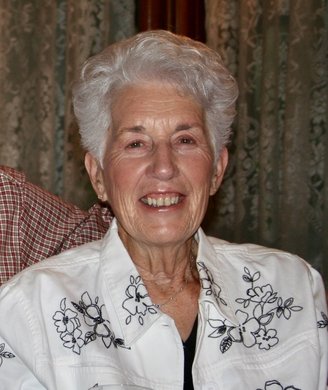
Vilma Pecchia Myers Francesconi
died peacefully at home on July 29, 2021, just
a few weeks after her 90th birthday. She was a first generation
Italian American and grew up in Eureka, attending St. Bernard’s
Elementary School and graduating from Eureka High School.
Vilma
had an extraordinary life. Her resilience was tested after her first
husband’s sudden death, when she became a single parent and
provider. After his passing, she returned to Eureka to be near
family, and she found success in the retail industry, where she went
to work for Daly’s. Next, she moved to the Bay Area for a new
retail position, and from there she was promoted to manage her own
department in Honolulu, HI; with the “Aloha spirit” always
holding a special place in her heart. She then returned to Eureka and
went back to work for Daly’s, this time as the Lingerie and
Foundations Buyer. It was there she met her second husband, John
Myers. After they married, she moved to Sacramento, and together they
started and owned a successful lingerie retail business, which they
ran for 12 years until she retired. After John’s death, she
returned to Eureka to be near her family. In her later years, she and
Leo Francesconi married and spent several years traveling and
enjoying family. She was a member of St. Bernard’s Parish and was
very active in the church for many years. She was also a lifelong
member of the Native Daughters of the Golden West. She was an
excellent gardener, a skilled cook, travelled to many foreign
countries and throughout the US. Her wit and wisdom are a continued
inspiration to her family and friends.
She
is survived by her daughter, Deborra Allen (husband, Mark) and her
granddaughters, Elizabeth Allen and Stephanie Allen (wife, Dana
Maher).
She
is also survived by her extended family, stepdaughter, Sandra Taylor,
and her children, Kim Oliva (husband, Joe) and family, Jeff Taylor
(wife, Amy Taylor) and family, and Chris Taylor (wife, Melissa) and
family. Also survived by her stepson, Bob Francesconi (wife, Mollie)
and family, stepson, Jim Francesconi (wife, Shelley) and family, and
stepdaughter, Susan Francesconi and family.
She
is also survived by her niece, Sharon Carter, and nephews, Steven
Pera and Dennis Pecchia.
She
also leaves behind her close and lifelong friend, Peggy Van Doorn, as
well as other close friends, Esther Allen, Barbara Hill, Frances
Hill, Lisa Center, and many more.
She
was preceded in death by her husbands, Robert Pecchia, John Myers,
and Leo Francesconi, as well as her parents, and her sister, Anita
Pera.
We
are incredibly grateful to her extraordinary caregivers, Lusi
Vainuku, Becca Liufau, and Kelly Lund. The loving care they brought
to her was outstanding. They became a part of our family, and there
are no words to say how much we appreciate their commitment and
caring. These women made it possible for Mom to live out her final
years in her own home, which was her biggest wish. We would also like
to thank all the wonderful caregivers at Hospice of Humboldt, their
care and support was invaluable, and it made Mom’s last few months
comfortable and peaceful.
Visitation
will be from 1 to 3 p.m. on Thursday, August 19, 2021, at Sanders
Funeral Home, 1835 E Street in Eureka. Funeral services will be held
Friday, August 20, 2021 at 10 a..m at St. Bernard’s Catholic
Church, 615 H Street, Eureka, with internment to follow at Ocean View
Cemetery. In lieu of flowers, donations may be made to Hospice of
Humboldt and St. Bernard’s Catholic Church.
###
The obituary above was submitted on behalf of Vilma Francesconi’s loved ones. The Lost Coast Outpost runs obituaries of Humboldt County residents at no charge. See guidelines here.
UPDATE, Friday, Aug. 20: Public Health has given Pho Thien Long the all-clear to reopen. Here’s a summary of work done and work being done, from today’s health inspection report:
Facility has cleaned impacted surfaces and utensils, is using sanitizer stations to sanitize working food contact surfaces, has
cleaned floors and walls impacted by infestation, and has contracted with pest control service who has begun cockroach and
mouse treatments.
Facility will make the following corrections for long term exclusion and control of mice and cockroaches:
Replace improperly fitted rear door and threshold, replace soffit vent screening, seal open wall penetrations around pipes at rear
of facility, and trim back tree overhanging the roof. These corrections must be completed by 9/1/21 as noted on reinspection dated
8/18/21.
Continue to contract with pest control operator for at least weekly service. Submit pest control reports to this office weekly until
further notice.
Clean all food debris from floors, walls and equipment each night.
Facility will conduct a professional deep clean service to remove hard to clean, built up grease that has stuck to some wall
sections, rear of cooking equipment and portions of floors. This should be completed by 9/17/21.
Replace janitorial sink with properly installed and fitted unit and close wall voids in janitorial cubby. By 9/1/21, you must submit
sink and faucet specifications/plan to this department for pre-approval. The repairs must then be completed by 9/17/21.
Your food facility permit is now reinstated. Continued operation is contingent on making the above corrections within time frames.
DEH may conduct billable reinspections as needed to verify continued compliance with these parts.
###
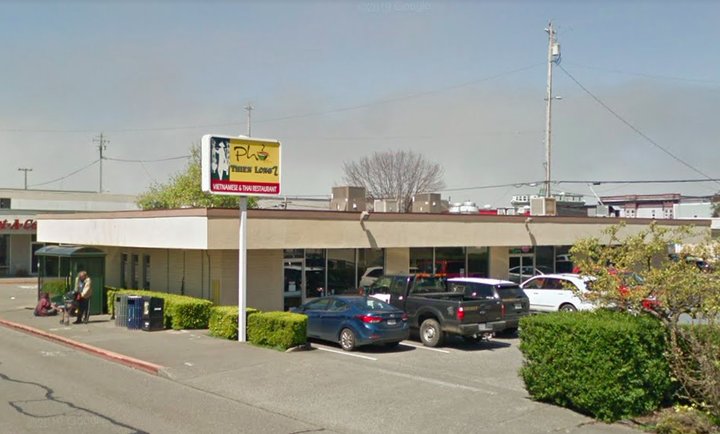
Google street view.
###
Pho Thien Long, a popular Vietnamese restaurant on Fourth Street in Eureka, was shut down earlier today by the Environmental Health Division of the county health department after a routine inspection revealed a number of health code violations, including evidence of mouse and cockroach infestation.
The restaurant’s food service permit was suspended and the owner, Sonny Nguyen, has been instructed to remedy the infestation before the permit will be reinstated.
The inspection report says, “Mouse feces and chew marks [were] observed throughout the facility,” including on countertops, behind dining booths, on the drinks station counter and windowsills, inside cabinets and elsewhere.
“Also observed was an active cockroach infestation as evidenced by live adults, nymphs, empty egg cases, full egg cases, and dead adult and nymphs,” the report states.
There was a total of seven health code violations recorded in the inspection report, though the others were decidedly less icky: One of two hand-washing stations lacked hot water, for example, and a dishwashing machine had run out of sanitizing solution.
The restaurant had some household pesticides and boric acid on hand — apparently for use in trying to rid the place of cockroaches — but the health department requires restaurants to use pesticides that have been specifically approved for food facilities.
The county has ordered Pho Thien Long to come into compliance by Monday.