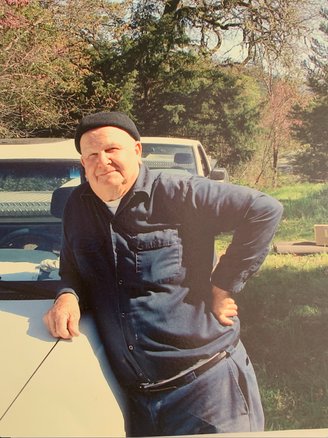
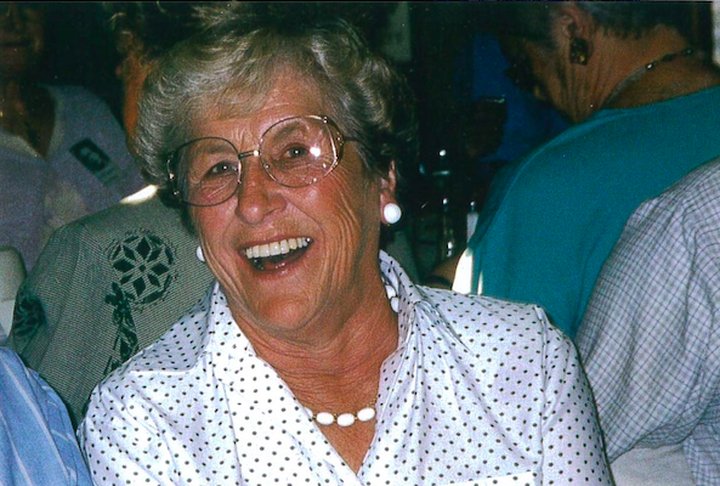
Is it possible for you or anyone to recognize these two?
Press release from the Humboldt County Sheriff’s Office:
On June 23, 2021, at about 4:08 a.m., Humboldt County Sheriff’s deputies were dispatched to the California Redwood Coast - Humboldt County Airport in McKinleyville for the report of a burglary.
Airport employees reported to deputies that upon arrival to the airport, the employees found a front window of the building shattered. Inside, employees discovered an ATM was missing and a vending machine had been vandalized.
The getaway rig
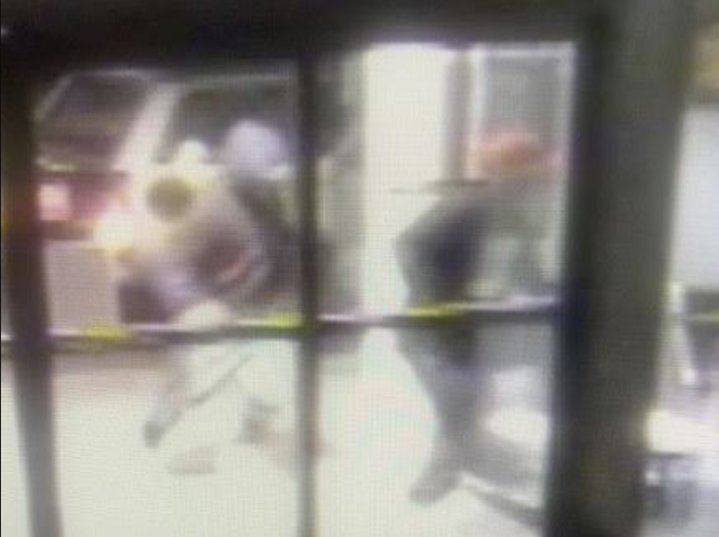
Security footage from the airport shows two unknown suspects arrive at the airport in a light-colored Nissan Pathfinder just after 2 a.m. today. The suspects forced entry into the airport, stole the ATM and then fled in the vehicle.
The suspects are described as follows:
Suspect One: A male wearing a dark-colored sweatshirt and pants, a red hat and white shoes.
Suspect Two: A heavy-set male wearing light-colored pants, a dark-colored hooded sweatshirt, a hat and light-colored shoes.
This case is still under investigation.
Anyone with information about this case or related criminal activity is encouraged to call the Humboldt County Sheriff’s Office at (707) 445-7251 or the Sheriff’s Office Crime Tip line at (707) 268-2539.
Over the objection of the prosecution, a McKinleyville woman was sentenced this morning to the shortest possible prison term for the crime of gross vehicular manslaughter while intoxicated.
Shala Bianco
Judge John Feeney sentenced Shala Marie Bianco to four years for manslaughter and five additional years for fleeing the scene after her car struck and killed Clinton Deckert on May 18, 2019. Bianco, 27, was given credit for 768 days served and 768 days “good time” credit, for a total of 1,536 days or a little more than four years.
The 47-year-old Deckert was walking along Central Avenue early in the morning when Bianco’s Toyota Rav 4 drifted off Central Avenue and struck him. Bianco, who had been up all night drinking and taking various drugs, fled the scene. She called the California Highway Patrol about 40 minutes later to admit she was the driver.
This morning Deputy District Attorney Whitney Timm pointed out the prosecution disagreed with Feeney’s decision to impose the low penalty for manslaughter, saying Bianco should receive the middle term of six years, along with the five years for hit-and-run. Timm said Deckert’s family is upset with the outcome.
Deckert’s father chose not to speak at the sentencing, Timm said, because he believed nothing he could say would change the judge’s mind and “it caused him too much stress to appear on this case.”
The family believes the sentence does not serve justice, the prosecutor said.
Timm said when the probation officer wrote her report on the sentencing recommendation, she erred in not characterizing Deckert as “a particularly vulnerable person,” a factor that would weigh against Bianco.
“The victim was a pedestrian who was walking along our roadways,” she argued. “We do have a duty to pedestrians to be driving in a careful manner.”
The low term “is not appropriate here,” Timm said.
Feeney had said previously that he chose the four-year term because Bianco is so young and has no criminal history.
In Los Angeles, people have been hearing about the dangers of drought for decades. But in this land of infinity pools and backyard putting greens — better suited for rattlesnakes and scrub — water never seems to run out.
Yet little Redwood Valley in Mendocino County, which gets a bountiful 38 inches of rain in an average year and sits near the headwaters of the Russian River, has been devastated by this year’s drought. Each resident has been told to use no more than 55 gallons per day — enough to fill a bathtub and flush a toilet six times.
And in San Jose, where less than half of its usual rain has fallen this year, people have been asked to cut water use by 15% — a target that could become mandatory if locals fail to comply.
When it comes to the impact of drought, location is key. Rain and snow vary greatly across California’s myriad microclimates, leaving some towns, mostly in the north, accustomed to yearly refills of their rivers, reservoirs and aquifers. Others farther south have fewer natural supplies of their own, and in parts of the Central Valley, the drought never really left.
But drought resilience is manufactured, too. Decades of planning and extraordinary engineering and technology keep the water flowing to arid places.
“There is, of course, no single Northern California or Southern California when it comes to water,” said Peter Gleick, founder of the Pacific Institute, a global water think tank. “Water is a very local phenomenon. And every region and every water district has a different mix of water supply options and water demands.
This satellite image shows how full Lake Oroville, which supplies much of the state’s drinking water, was in June 2019 and how shallow and dry it is in June 2021. It’s currently holding only 41% of its historic average for this time of year. Credit: NASA Credit: NASA
During the last drought, in 2015, Californians were ordered to cut their water use by an average of 25% statewide. This time, there is no statewide emergency, no universal mandate and no standardized water waste rules.
Instead, residents are facing a patchwork of restrictions. Bracing for a crisis, towns relying on the hard-hit Russian River have imposed stringent mandates on residents and coastal communities may have to truck in water to make it through the year. At the same time, most of California’s urban hubs are prepared to weather the summer with only voluntary cuts and limited restrictions that in many cases are holdovers from previous droughts.
A CalMatters survey of the state’s 10 largest water agencies found only one — in San Jose — has issued new limits on watering yards, washing cars and other outdoor uses. Eight, including Sacramento, already had rules curbing irrigation and water waste on the books. And four, including water agencies in the East Bay and Riverside, have asked people to voluntarily cut back between 10% and 25%.
Even though Southern California is more arid, it’s better hydrated, too: That’s because it has largely relied on water transported from elsewhere, dating back more than 100 years in Los Angeles and 50 years in neighboring cities and counties. About half of the water that flows from taps in the region is imported, while half comes from carefully nurtured groundwater reserves and recycled sewage.
As a result, Los Angeles residents are unlikely to face new water restrictions this summer. After a soggy 2019 plus declines in water use since the last drought, the Metropolitan Water District, which supplies imported water to 19 million people in six counties, entered 2021 with record levels of water in storage.
The grip of drought even varies within single counties. For instance, one Mendocino County town is flush with recycled water and groundwater stores, but in another, residents are ordered to reduce use.
“We have a patchwork in part because (water) is managed locally,” said Felicia Marcus, who led the state’s response to the 2012-2016 drought under former Gov. Jerry Brown.
“The situation is dire in some places, and those places are making calls for higher levels of conservation,” Marcus said. “In other places, they may be prepared, or they may be dreaming.”
Southern California’s manufactured resilience
Southern California goes to extraordinary lengths to take water from elsewhere. This nature-defying engineering keeps the region replete with water even when little falls from the sky. (Downtown Los Angeles averages about 14 inches per year, about a third as much as Mendocino.)
First came the city of Los Angeles’ aqueduct — backed by San Fernando Valley investors and approved by voters in 1905 — sucking up mountain-fed streams and lakes in the Owens Valley and transporting it 137 miles.
But it wasn’t enough.
Then came the Metropolitan Water District’s aqueduct, drawing from California’s share of the Colorado River, snaking through the desert and tunneling through mountains to deliver water to the Los Angeles basin in 1941.
But that wasn’t enough, either.
Finally, the state in the 1960s began building a massive system to carry river water from Northern California, pumping it over the Tehachapi Mountains and through 700 miles of pipelines and channels to deliver it to San Joaquin Valley farmland and 27 million people, mostly in Southern California.
And that is enough — for now.
These three extraordinary engineering feats have made much of Southern California able to pull water from a variety of places all at once, transforming its landscape and satisfying the region’s thirst.
Los Angeles County also pioneered recycled water, building the nation’s first reclamation plant in 1962 to treat sewage and use it to replenish its aquifers. Neighboring Orange County has been a world leader in recycling water, purifying its own sewage and capturing the Inland Empire’s to feed its groundwater.
San Diego, too, has built up its resilience since the last drought. For decades it was almost totally reliant on Metropolitan Water District’s imported water. But since the 1990s, the San Diego County Water Authority has added desalinated and recycled water, built one dam and raised another, pumped groundwater and cut a deal to get Colorado River water from Imperial County. The water authority announced the region is “drought-safe this summer” with “no shortages or mandates in the forecast.”
Construction of the 137-mile Los Angeles Aqueduct, which brought water from the Owens River to the San Fernando Valley, began in 1907 and took six years.
“It’s really the growth machine of Southern California … by providing all this water to inland places, and allowing the sense that there’s unlimited water and the sense that you can build as far as the eye can see,” Pincetl said.
Still, she said, “You can point fingers a lot, but you can also be reassured that you can actually turn the tap on and have water come out of it, most of the time.”
But is it enough to weather droughts aggravated by climate change?
This year, California regulators announced that they would deliver only 5% of the State Water Project’s supplies because of extreme drought conditions.
Metropolitan, flush with funds from the cities and agencies it supplies, has spent billions to store water, nearly doubling its reservoir capacity with the completion of the $1.9 billion reservoir at Diamond Valley Lake in 2000.
Between stowing water in reservoirs, pouring it into aquifers and banking it in Lake Mead, Metropolitan Water District’s storage has increased 13-fold since 1980, shoring up supplies for residents from Ventura to San Diego to San Bernardino.
Los Angeles also doesn’t anticipate issuing new water use restrictions, at least not yet.
“We don’t see any need right now, because storage levels are still very good,” said Delon Kwan, the Los Angeles Department of Water and Power’s assistant director of water resources. “If you still have water in storage, why are you asking customers to do more?”
But water experts caution about the potential for more dry days ahead, exacerbated by climate change, so a gallon of water used now is one less saved for later.
“Maybe Southern California is happy this year and jumping up and down. But if this drought continues for two more years, what will happen? Would they be as happy in two years?” said Newsha Ajami, director of urban water policy at Stanford University’s Water in the West program.
Deven Upadhyay, Metropolitan’s chief operating officer, said that it could take several dry years in a row before the district imposes mandatory reductions in Southern California. “If we just continue to get dry year after dry year after dry year, there’s going to come a time where we’re going to be wrapping up messaging and asking for mandatory reductions. But that’s not where we are right now,” he said.
Imported water, recycled wastewater and collected stormwater runoff are used for irrigation and fountains at Los Angeles County’s Descanso Gardens in La Cañada Flintridge. Photo by Pablo Unzueta, CalMatters
Still, some parts of Los Angeles County are already struggling.
Palmdale, an aerospace hub in the Mojave Desert north of Los Angeles, draws water from snowmelt off the San Gabriel Mountains, taps into the State Water Project directly and pumps groundwater to supply more than 120,000 people.
The Palmdale Water District doesn’t have enough storage to bank water during wet years or enough money to easily increase its supply.
“We’re not as financially nimble as some of the really big players,” said Peter Thompson, Palmdale’s director of resource and analytics. “We’re just getting to the point where we can start investing in those projects that have already benefited places like Metropolitan.”
Residents of this desert city, where less than an inch of rain has fallen this year, were asked in the spring to voluntarily cut water use by 15%. In July, the water district’s board may consider making it mandatory.
“Out in the desert, you need more water to keep things alive. So when we experience drought, then you also experience increased demand,” Thompson said. “That’s one of those double-edged swords that we deal with out here.”
Mendocino County’s isolation means no resilience
Water is much more precarious in Mendocino County, which is isolated from state and federal aqueducts. Instead, residents rely on patchy aquifers and water that’s stored in Lake Mendocinoand released into the Russian River.
Properties for sale along the oak-lined roads of Redwood Valley boast their water sources in the listings. One $675,000 home touts a water district hook-up and a seasonal spring. Another $699,000listing flaunts its “elaborately designed 22,000 gallon water storage system.”
Known for its wine, weed and wild coast, Mendocino County was one of the first places where California Gov. Gavin Newsom declared a drought emergency.
In other parts of the state, “when there’s a problem, there’s a pipe and there’s a canal, and you can connect one water system to the next,” said Mendocino County Supervisor Glenn McGourty in a June meeting of the county’s drought task force. “We don’t have things like that in Mendocino County, so we’re going to have to be really creative in our solutions.”
This year’s drought is the most dire situation they’ve faced in decades. At the end of May, Lake Mendocino hit a record low of just 40% capacity. Earlier this month, the county faced projections that the reservoir could be dry by the end of the year. In response, the state adopted emergency regulations that could stop 2,400 water right holders from diverting water from the Russian River as early as July 5.
Lake Mendocino in January 2020. Photo by Anne Wernikoff, CalMatters
Lake Mendocino in January 2021. Photo by Bobby Cochran Photography
Although Redwood Valley lies just north of Lake Mendocino, its water supply is never guaranteed. Residents rely on sales from a nearby water agency and any surplus left in the reservoir by nearby communities.
But at this point, there’s no surplus. Agricultural connections have been shut off in Redwood Valley and residents are limited to 55 gallons per person per day — enough for just a 22-minute shower and nothing else.
“My dream was to garden,” said Darrell Carpenter, a 61-year-old artist and handyman whose family has lived in Redwood Valley for three generations. Carpenter moved back full time after his partner died six years ago. When the water restrictions and rate changes were announced, he wondered, “Do I sell and move?”
Carpenter was lucky, able to restart an inactive well on his property and keep his garden alive, which he has slowly been converting to native plants and succulents. Still, he worries that his luck and the water will run out as more people stick straws into the ground.
“It might be a false sense of security,” he said.
Darrell Carpenter is converting his garden in Redwood Valley to native and drought-resistant plants. Photo courtesy of Carpenter
The water district’s cuts have left the reservation for the Redwood Valley Band of Pomo Indians with nothing to refill its tank for irrigating a community garden and filling its fire truck. Hydrants are still operating, but outdoor water use is banned and rancheria officials are investigating whether they can draw water from an old well.
“We don’t have any access to any other water,” said tribal administrator Mary Camp. “We’re really concerned.”
Farther out along the coast, in the town of Mendocino, residents depend on private wells pumping from rain-fed groundwater stores. The town declared a stage 4 water shortage emergency in May requiring residents to use 40% less water than allotted.
“I’m nervous. I’m definitely nervous,” said Mendocino City Community Services District Superintendent Ryan Rhoades. “I’m sure that some wells will run dry this year, probably more than last year.”
McGourty, the Mendocino County supervisor, blamed the county’s predicament on its limited water storage.
“We’ve been lulled into the idea maybe that we have lots and lots of water. And we do have lots and lots of water. The problem is that we don’t store lots and lots of water,” McGourty told water officials across the region. “We’re in a different world now, because of climate change.”
Ukiah, just ten miles from hard-hit Redwood Valley, is weathering the drought much better because of steps taken after the last dry spell.
Five decades ago, the Doobie Brothers described Ukiah as a land where “mountain streams that rush on by show the fish a jumpin.’” Today the city is facing extremely dry conditions in the Russian River, which typically makes up about half of the supply for its 16,000 residents.
Ukiah will lean more heavily on groundwater, bolstered after the last drought with a state grant that helped pay for three new wells. The city also built a $34 million recycled water plant that pumps out irrigation water, making up a third of its supply.
“The city saw the writing on the wall, and was looking to improve our drought resiliency, before it was cool,” said Sean White, director of water resources for the city of Ukiah.
“It’s kind of a disparate tale. If you live in the city of Ukiah, (the drought) is really not that big of a deal … If you live in some of the adjoining ones, it’s either bad or terrible.”
Silicon Valley’s perfect storm
In Silicon Valley, aging dams and drought have collided this year, making Santa Clara County among the hardest hit in the Bay Area. Storage in reservoirs has dwindled by 74%. And supplies from state and federal aqueducts have dropped far below expected levels.
Making matters worse, the area’s largest reservoir is all but empty, drained last year to retrofit it for earthquakes. Without it, the amount of water stored locally for 2 million people in San Jose and nearby communities has been cut by more than half.
“We’re seeing the perfect storm building up and it’s right in front of us,” said Rick Callender, Valley Water’s CEO, at a June board meeting. “We’re indeed in a dire situation.”
If dry conditions persist through next year, land could sink and wells could go dry. In the southern part of Santa Clara County, groundwater is the only drinking water source.
“The aggressiveness and the severity of this drought, the way the drought is increasing is much greater than the previous drought,” Aaron Baker, chief operating officer at Valley Water, said at the hearing. “Conditions will be far worse in 2022 if drought conditions continue and no action is taken.”
Valley Water’s board this month ordered a mandatory 33% cut in residential water use from 2013 levels — a 15% reduction from 2019. Individual water providers will enforce it, which means rules for residents could vary depending on who sends water to their taps.
Cupertino’s director of public works, Roger Lee, warns that if water providers fail to coordinate, it could lead to a patchwork of restrictions in neighborhoods served by multiple retailers.
“We can have customers with one set of rules on one side of the street and different sets of rules on the other side of the street,” Lee said at the hearing. “It gets very difficult with messaging.”
Marin County’s largest water provider, too, has been hit hard by shortages in its own reservoirs and those in Mendocino and Sonoma counties. Marin Water, which aims to cut use across the county by 40%, has banned watering plants during the day and limited sprinklers to two days a week, among other mandatory restrictions,
Most of the Bay Area isn’t in such dire straits — at least not yet. Residents of the East Bay were asked to reduce water use by 10%, and San Francisco golf courses, parks and other irrigation customers were asked to cut back. Both water districts already prohibit wasteful use, like washing down sidewalks.
And both, like Los Angeles, pipe water from far away.
“Our forefathers (thought) to create this massive infrastructure that has been our source, our lifeline to the East Bay and has positioned us well during these dry times,” said Tracie Morales, an East Bay Municipal Utility District spokesperson. Still, Morales said, “We’re concerned about what another dry year will bring.”
San Francisco, where residential use per person falls well below the state average, draws about 85% of its water from Yosemite’s Hetch Hetchy, which was dammed in 1923, flooding the territory of the Tuolumne Me-Wuk people. San Francisco’s reservoirs remain in decent shape at 75% of maximum storage, said spokesperson Will Reisman.
“The Santa Clara Valley used to be orchards here, but we didn’t have the population that San Francisco had and we didn’t have the impetus of the 1906 quake and the resulting fires to go grab the Hetch Hetchy water,” said Gary Kremen, vice chair of Valley Water’s board of directors. “They were there first, so they got the better deal.”
Counties urgently seeking state help
Some areas, like Santa Clara, are looking for Newsom to expand drought emergencies that could unleash greater enforcement powers and reduce regulations to speed construction products and ease pricey purchases of emergency water supplies.
Compared to the counties already under drought emergencies, “we’re in just as bad shape as them, if not worse,” Kremen said at a press briefing.
Palmdale spokesperson Judy Shay also said her water district is looking for stronger messaging from the state as it ramps up its drought response.
“We also don’t want to be the ones making all those strict rules,” Shay said. “We also need direction from the state.”
An oak woodland is among the lush features at Descanso Gardens in La Cañada Flintridge. The Los Angeles region was transformed with the use of imported water and recycled wastewater. Pablo Unzueta for CalMatters
The Pacific Institute’s Gleick calls for urgent collective action throughout the West.
“The speed with which the western drought is accelerating and worsening makes it urgent that the governors of the western states declare water conservation mandates and targets and provide resources to help cities and farms cut water use,” Gleick said.
The issue is bigger than simply responding to the current drought, said UCLA’s Pincetl. Californians will need to reimagine what the future could look like and rethink their relationship to water.
“We don’t actually know where we live … we live in this kind of irrigated bubble that insulates us from the actual California,” Pincetl said. “And having easily accessible water is part of that story.”
###
CALmatters.org is a nonprofit, nonpartisan media venture explaining California policies and politics.
Richard was born July 5, 1932, in Omaha, Nebraska to Byron Rowland and Josephine Baiber Rowland.
Richard’s father, Byron moved the family to Portland, Oregon around the start of WWII, for work at an aircraft plant. In 1946 they made their way down to Orleans, CA and lived on a ranch in the area called the Cooper Ranch. During these younger years Richard spent quite a bit of time as an avid hunter and becoming a skilled fisherman. He joined the United States Navy as soon as he could and was able to see some of the world. After receiving an honorable discharge from the Navy in 1954, Richard came back to Humboldt to find his father and to work with him for several years as a skilled carpenter. At this time, Richard’s father was living in Weitchpec, and both helped construct many buildings in the area, some of which are still standing today.
Richard married Margaret Ann Longenbaugh in 1958, and together they had three children: Kevin, Kerri and Keith. During their early years together, Richard and Margaret built and operated the Deep Sleep Motel. Around 1964, just after the ‘64 flood hit the Humboldt County area, Richard started his own rock crushing and cement business. He called it Hoopa Valley Redi-Mix. He and Margaret ran the business until his retirement. Richard spent the majority of his life living in Hoopa.
Richard was blessed with a green thumb and took a lot of pride in his yard and trees. But if he was not in his trees somewhere, he was moving earth and crushing rock. He had his hands on many, many projects, and buildings in the surrounding area. Some reading this might be standing on a foundation he poured or using a septic tank he made. You may have even crossed over one of the eight bridges he poured in the area to get to where you needed to be today.
Richard is survived by his wife Margaret Rowland, children and their spouses; Kevin (Katia) Rowland, Kerri Rowland-Mendez and Keith (Pileta) Rowland, and grandchildren; Sarah and Natalie Rowland, Sarita, Dillon and Anthony Mendez.
Richard desired no memorial services and was cremated. His immediate family and friends will be holding a celebration of life sometime during the summer when the COVID-19 situation has a chance to improve. He will be greatly missed by his friends and family.
###
The obituary above was submitted on behalf ofRichard Leon Rowland’s loved ones. The Lost Coast Outpost runs obituaries of Humboldt County residents at no charge. See guidelines here.
It is with deep sadness we share with our community that on June 15th, Nita Cannandy’s soul left this earth. If you knew her, you knew how loving and kind she was.
Nita was born in Scotia and raised in Humboldt county, growing up in Fortuna. Nita worked at Pam’s restaurant, and her parents’ dry cleaning business Quality Cleaners. She then went to work in Scotia for Coast to Coast /Ben Franklins until the shopping center burned down from the 1992 earthquakes. Nita then found work at Fortuna Ace Hardware where she eventually retired as the paint department manager or otherwise known as The Paint Lady.
She met and married her husband, Ernie Cannady in 1970 who worked as a delivery driver for Quality Cleaners. They married in 1971 and welcomed their oldest daughter, Michale Hale, into the world. She recently shared that becoming a mother was the most wonderfully terrifying thing she had ever done. Ten years later, her youngest daughter, Kristie Cannady, was born in 1981.
Nita loved her two daughters, and she was incredibly proud of her grandchildren. When her oldest grandchild, Ethan, was born, she beamed with pride and loved being a grandmother. Next came her only granddaughter Emmalee, followed by grandsons Emmit and Everett.
Whatever Nita put her mind to, she accomplished it. Twenty-five years ago, she began her Tang So Do journey. She loved martial arts and developed many deep, meaningful relationships with her Tang So Do family. Most probably don’t know that there was a fierce warrior hiding behind that smile. She broke boards and bricks and competed in Tang So Do tournaments. She worked hard and became a 2nd-degree black belt and loved teaching along with her continued training.
Nita had recently retired and was living life to its fullest. She loved being out on the ocean fishing with her boyfriend, David Smith, who brought her immense joy the last couple years of her life. They made homemade donuts, cookies, baked bread, pressed fresh apple juice, listened to music, took long drives and created much joy together. They truly had a beautiful connection and filled each other’s hearts.
Nita is preceded in death by her parents, Joe and Marcia Selby, and her husband, Ernie Cannady. She is survived by her daughter Kristie, her husband Rio and grandsons Emmit and Everett and her daughter Michale, her husband Jim, grandson Ethan and granddaughter Emmalee. She is also survived by her siblings Cheryl Cunha, Lynn DiStanislao-Selby, Darryl Selby, and Dorothy (D.J.) Zimmerman, their families and her boyfriend David Smith along with more friends than one could begin to count.
The family invites anyone who would like to come and celebrate Nita’s beautiful life. Please join us on Saturday, June 26, at the Turf Club inside the Ferndale fairgrounds from 1-5 p.m. We are celebrating with a potluck, service and a celebration of her life. Please come and share your memories, joy, and laughter for she is going to be forever missed.
###
The obituary above was submitted on behalf ofNita Cannady’s loved ones. The Lost Coast Outpost runs obituaries of Humboldt County residents at no charge. See guidelines here.
Doreen V. Landing, 88, passed away on May 24, 2021 after a long battle with Alzheimer’s Disease.
Doreen Landing was born November 1, 1932 in Verwood, Saskatchewan Canada to Theodore and Ina
Wenaus. Doreen was the youngest of eight children and in 1934 moved to Ashland, Oregon. Doreen
attended Ashland Highschool where she was a cheerleader and excelled in numerous sports. During her
senior year of High School, she met the love of her life, Dale Landing. In 1951 Doreen and Dale married
and later welcomed two beautiful children, Michael Landing (1953) and Marla Landing (1955). In 1955
the Landing Family moved to Eureka, CA where Dale began working for Levi Zentner Produce. In 1962
Doreen and Dale started Dale Landing Wholesale Produce supplying the North Coast from Garberville,
CA to Bandon, OR.
In 1966 Doreen and Dale welcomed their third child, Gregg Landing. Doreen and Dale loved the
outdoors. They spent a great portion of their time on family camping trips, spending time at the family
ranch, and hosting parties for friends and family. Following the death of her beloved Dale in 1976,
Doreen took up golfing where she made lifelong friends and served on the Board of the Eureka
Women’s Golf Association. Doreen also participated in the local Eureka Bowling leagues where she
made her teams outfits when they went to state championships. Doreen’s hobbies included playing
cribbage, having a ceramics studio in her garage, gardening, puzzles of any nature, and knitting dish rags
that she always gave as Christmas gifts. Her beautiful backyard became the place for Super Bowl
parties, family BBQs and countless hours of whiffle ball games with the grandchildren. In 2010 Doreen
was diagnosed with Alzheimer’s Disease but continued to live a life filled with dancing, laughing, and
enjoying the company of family and friends. A special thank you is extended to her children, Michael,
Marla, and Gregg and Son-In-Law Charlie Bassett for taking care of her towards the end of her life.
Doreen was proceeded in death by her parents Theodore and Ina Wenaus, husband Dale Landing, son
Michael Landing, siblings Kenneth Wenaus, Lloyd Weanus, Fern Browne, Eula Weanus, Norma Farmer,
Eunice Surber, and Maxine Spruill and numerous aunts, uncles, and cousins. Doreen is survived by her
children Marla Landing (Charlie Bassett), Gregg Landing (Denise Pope), her grandchildren Amy Landing
(Michael Cyphers), Krista (Shane) Ranstrom, Mathew Landing, Jack Senicola, Dale Landing II, great
grandchildren Gannon Cyphers, Taylor Cyphers, Barrett Ranstrom, best friend Judy Wolfe and numerous
nieces and nephews.
A celebration of life will be held at the Eureka Women’s Club 1531 J St. Eureka, CA on Saturday July 31 st
starting at 3:00pm. In lieu of flowers donations can be made to the Alzheimers Association at
act.alz.org/donate or 1-800-272-3900.
###
The obituary above was submitted on behalf ofDoreen Landing’s loved ones. The Lost Coast Outpost runs obituaries of Humboldt County residents at no charge. See guidelines here.
After more than six hours of often meandering deliberation on Tuesday, the Humboldt County Board of Supervisors opted to punt the decision on Sun Valley’s proposal for an eight-acre cannabis farm in the Arcata Bottoms. The hearing for this controversial project was continued to July 13.
All five supervisors expressed a willingness to allow Arcata Land Company (a Sun Valley-controlled entity) to establish a grow operation next to the existing flower bulb farm, but they had widely divergent criteria in mind for the appropriate size and conditions of approval.
In the end, three of the five — First District Supervisor Rex Bohn, Second District Supervisor Michelle Bushnell and Fourth District Supervisor Virginia Bass — said they’d be willing to consider permitting a grow of more than two acres. Bushnell’s support is contingent on the effectiveness of odor-control technology, and she asked county staff to reach out to officials in Santa Barbara County and ask how well the proposed technology is working at established cannabis farms there.
Third District Supervisor Mike Wilson, meanwhile, said he is unwilling to approve a grow any larger than two acres because that’s the established limit on lands zoned for agriculture. While the property in question is currently zoned heavy industrial, during the county’s long general plan update process a previous iteration of the Board of Supervisors decided to convert it to ag zoning, in part because the City of Arcata requested that change. County staff, however, has yet to implement that zoning change due to various bureaucratic and litigation-related delays.
Public comment was pretty hot in this one. The Outpost will have a more thorough recap of the meeting on Wednesday.





 This satellite image shows how full Lake Oroville, which supplies much of the state’s drinking water, was in June 2019 and how shallow and dry it is in June 2021. It’s currently holding only 41% of its historic average for this time of year. Credit: NASA Credit: NASA


 Construction of the 137-mile Los Angeles Aqueduct, which brought water from the Owens River to the San Fernando Valley, began in 1907 and took six years.
 Imported water, recycled wastewater and collected stormwater runoff are used for irrigation and fountains at Los Angeles County’s Descanso Gardens in La Cañada Flintridge. Photo by Pablo Unzueta, CalMatters
 Lake Mendocino in January 2020. Photo by Anne Wernikoff, CalMatters
 Lake Mendocino in January 2021. Photo by Bobby Cochran Photography
 Darrell Carpenter is converting his garden in Redwood Valley to native and drought-resistant plants. Photo courtesy of Carpenter
 An oak woodland is among the lush features at Descanso Gardens in La Cañada Flintridge. The Los Angeles region was transformed with the use of imported water and recycled wastewater. Pablo Unzueta for CalMatters