

(VIDEO) Humboldt Redwoods State Park Naturalist ‘Griff’ Talks Viral Bear Pushing Video, Gives Tips on How to Handle a Bear Encounter
John Ross Ferrara / Tuesday, June 8, 2021 @ 12:25 p.m. / Nature , Wildlife
Humboldt County’s favorite naturalist John “Griff” Griffith is back with another informative video chat from Humboldt Redwoods Sate Park.
During the chat, Griff riffs about a recent viral video that reportedly shows a teenager pushing a mother cinnamon black bear off of a wall in LA County to protect her dogs.
The original video, which was posted to TikTok a week ago, has amassed more than 70 million views on the social media app alone. In response to this video, Griff decided to give park visitors some tips on how to handle a black bear encounter.
“Black bears very rarely ever attack people,” Griff said. “If there is a bear that’s gonna attack you, it’s probably because it’s a bear that’s been fed regularly.”
Griff’s first tip is to never feed wildlife.
“Please do not feed wildlife, because what happens is they get food-conditioned on humans,” he said. “They see humans and they associate them with food. A lot of times they develop ‘demand behaviors.’ A demand behavior may involve something like a bear coming right up to you and hitting your pocket to see if there’s food coming out of the pocket.”
Griff’s second tip is to be stern.
“When you come to the park and see a bear, [have your] biggest person up front, arms big, and talk to the bear very sternly like: ‘Bear, I don’t want you to come over here next to my family!’” he said. “And then the bear will usually leave.”
As a last resort, Griff said you can try throwing a rock at the bear’s keister.
“Then go sideways and slowly return from whence you came,” Griff added. “Do not run, do not get too crazy, don’t challenge the bear to attack you. Do not let your dog go up to it. You just want to leave the bear alone.”
Watch Griff’s full list of tips and the viral encounter that sparked this discussion in the videos embedded at the top of this story.
BOOKED
Today: 7 felonies, 9 misdemeanors, 0 infractions
JUDGED
Humboldt County Superior Court Calendar: Today
CHP REPORTS
Sr255 / Samoa Blvd (HM office): Report of Fire
1900 Mm96 E Hum R19.00 (HM office): Report of Fire
1 Mm162 E Men R0.00 (HM office): Assist with Construction
ELSEWHERE
Governor’s Office: Governor Newsom signs first-in-the-nation AI safeguards to protect Californians, calls on the federal government to do its part
RHBB: Body Recovered from Humboldt Bay Near Foot of Commercial Street
KINS’s Talk Shop: Talkshop September 9th, 2026 – Michelle Bushnell
RHBB: HCSO Credits Jail Staff with Saving Inmate’s Life During Medical Emergency
Will California Public Schools Continue Free Lunches for All?
Sameea Kamal / Tuesday, June 8, 2021 @ 7:20 a.m. / Sacramento
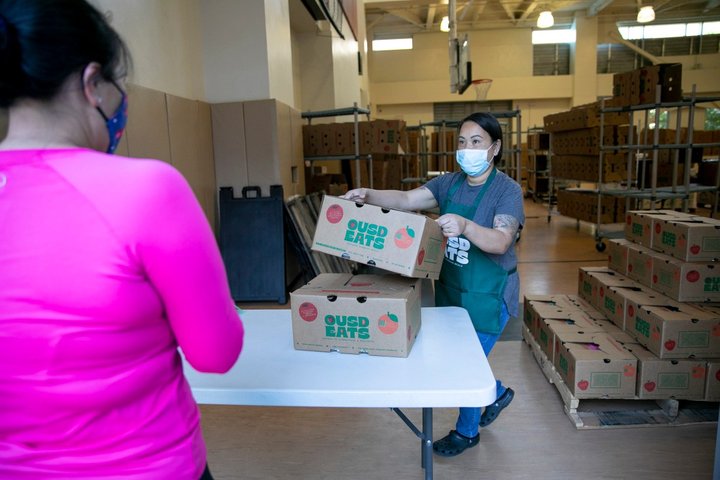
Food service manager Nakheu Saephanh hands out boxes of food to family members at La Escuelita in Oakland on June 7, 2021. Oakland Unified has been providing boxes for pick up or delivery containing seven days worth of breakfast, lunch and snacks to all students since spring 2020. Photo by Anne Wernikoff, CalMatters
###
Early in the pandemic, the only source of milk for some struggling families was from school lunches, recalls Stacy Johnson, director of nutrition services at Glendora Unified School District.
Even for families who weren’t as strained financially — or for families of picky eaters — getting meals during lockdown was something to get excited about: A chance to get out of the house, and to see teachers and friends.
And while the days of empty grocery store shelves and lockdowns have passed, for many, the benefit of meals at schools continues.
At Sellers Elementary in Glendora, east of Los Angeles, that was evident by the busy meal service last Friday. At pickup time, parents walked younger students home carrying bags filled with food, enough to last through the weekend, while older students jammed the bags into their backpacks.
“My kids eat at school here during the year at the cafeteria when it’s open just because they love the experience of seeing other kids and going through the line,” Julie, a parent of students who asked to be identified only by her first name, said Monday.
Before the pandemic, in January 2020, the district served more than 35,000 lunches to students. In April 2021, with the return of in-person classes, 50,822 lunches were picked up. The district, where about 29% of the 7,200 students were eligible for free and reduced meals last year, continues to serve take-home lunches to students as it wraps up its school year.
The help to families, along with support from dozens of children’s nutrition advocacy groups, is behind the state’s push to continue free school meals for all students past the pandemic.
Last week, legislative budget leaders unveiled a deal that includes $650 million for the Universal Schools Meal Program, which would allow schools to serve free breakfast and lunch year-round to all students — no paperwork or eligibility checks required.
If approved in budget negotiations this week between the Legislature and Gov. Gavin Newsom, the program would be funded by the influx of state money from taxpayers and federal aid. The state would take over the program — funded during the pandemic with federal money — beginning in the 2022-23 school year.
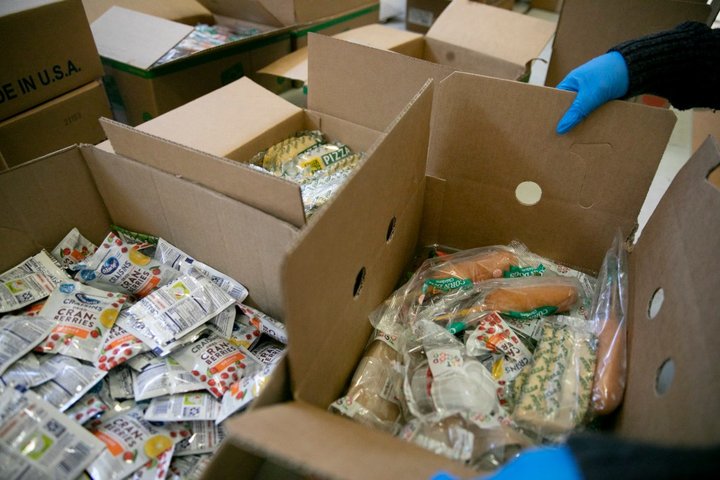
District employees prepare boxes filled with breakfast, lunch and snacks for Oakland Unified students at La Escuelita on June 7, 2021. Families can request or pick up one box per child enrolled in district schools. Photo by Anne Wernikoff, CalMatters
In the 2019-20 school year, more than 3.6 million California students received free or reduced price meals — nearly 60% of all students in the state, according to the California Department of Education. In the 2020-21 school year, even during the pandemic, about 3.5 million students were served.
The legislature’s proposal calls for a $54 million increase in state reimbursements for the 2021-22 fiscal year, then $650 million a year starting in the 2022-23 fiscal year to cover the costs of offering breakfast and lunch for all public school students.
Newsom, meanwhile, proposed $150 million a year in his May budget to encourage public school districts to participate in programs that allow high-poverty schools to provide meals to all students without requiring applications.
While the Legislature’s price tag is significantly higher, lawmakers expect that reduced paperwork and overhead costs will reduce the cost.
Also, a Senate Education Committee analysis of a similar bill authored by Sen. Nancy Skinner, a Berkeley Democrat and chairperson of the Senate Budget Committee, noted that immigration status, language barriers or lack of awareness could be preventing students who qualify for the free or reduced meals from receiving them.
Kathy Saile, director of the California chapter of the national advocacy group No Kid Hungry, said offering free school meals to all will increase participation, reduce stigma for students and improve nutrition for children.
“The Legislature’s budget proposal will help ensure all of California’s kids have access to the healthy meals they need to learn and thrive, and we urge Governor Newsom to approve this funding,” Saile said in a statement.
“Hungry children can’t learn. Whenever your belly is growling, you’re not learning.”
— Laura Howe, nutrition services supervisor at the Manteca Unified School District
Laura Howe, a resident of Salida, in Stanislaus County, remembers the ease of being able to have her kids eat breakfast at school when they were young and she had to go to work early.
“Hungry children can’t learn,” she said. “Whenever your belly is growling, you’re not learning.”
Howe now works as a nutrition services supervisor at the Manteca Unified School District in San Joaquin County, and she sees the benefits it could bring to schools, too: less time and resources spent on paperwork, and cost savings in the long run.
Under free and reduced meal programs that were in place pre-pandemic, school districts had to pay the difference when students can’t or don’t pay. That can total hundreds of thousands of dollars. Under the Legislature’s plan, that gap would disappear, with federal reimbursements and state aid.
And while Howe is glad to see the state’s initiative, she hopes to see similar initiatives at the federal level — the primary source of districts’ funding.
During the pandemic, the federal government gave $13 billion to support school districts around the U.S. for food programs, sanitization measures and technology needs.
Schools did have some early roadblocks during the pandemic — a major one was supply shortages. But Howe said the Manteca Unified School District was still able to provide breakfast and lunch, as well as snacks and supper. And that helped families who normally wouldn’t receive the free meals.
“I’ve talked to parents that are just my friends that don’t qualify,” Howe said. “They were so thankful.”
Parents aren’t the only ones who are grateful.
Back in Glendora, third-grade students at Sellers Elementary took the time to write thank you notes to the meal services staff — noting their favorite foods like pumpkin bread, honey buns and pizza. That’s on top of flowers and treats parents dropped by. Glendora is a tight-knit community where many students’ parents or grandparents went to schools in the district, or have businesses in the area now.
“I did have a mother — she was literally in tears because she didn’t know how she was going to feed her child. He came home with food and he said, ‘Mom, look!’ and she said she just broke down in tears,” said Johnson, known as Ms. Stacy. “And she called to thank us and let us know she was appreciative, and she never would have asked for that.”
John Sasaki, communications director for the 50,000-student Oakland Unified School District, said its food program will continue through the end of July and will pick up in the fall, in some form.
“Last summer, our need for meals continued pretty unabated,” he said, “and I would imagine it will continue the same way at least until our families really get back to work as the pandemic allows the economy to start back up.”
Krystal Oriadha, senior programs and policy director at the Washington, D.C.-based National Farm to School Network, said universal school meals can ensure students don’t fall through the cracks. But they’re also a tool to pursue racial equity, economic and environmental justice, and animal welfare.
“School meals are so much more than just a vehicle to feed children,” Oriadha said. “Hopefully what happens in California is a ripple effect of how other states move.”
###
CALmatters.org is a nonprofit, nonpartisan media venture explaining California policies and politics.
OBITUARY: Sam Nicholls, 1958-2021
LoCO Staff / Tuesday, June 8, 2021 @ 6:56 a.m. / Obits

Sam Nicholls passed away suddenly on February 3 in Blue Lake. He was born on November 4, 1958 and raised in Healdsburg. He graduated from Healdsburg High School in 1976 and attended Humboldt State University.
Sam worked at Safeway in McKinleyville and retired after 23 years. He also worked with his father in Nicholls Trucking, the family business.
He was predeceased by his parents Jack and Bernice Nicholls. He is survived by his husband Earl Thomason and his brothers John and Jim Nicholls. He also left Savannah Rose, his beloved Jack Russell.
Sam was one of the most generous, non-judgmental, and loving human beings you could ever meet and he will greatly be missed.
There will be a Hawaiian-themed celebration of his new journey at 1 p.m. on Saturday, June 19 at Sam and Earl’s home in Blue Lake. For more information about the celebration of life, contact Earl Thomason at (707) 630-1189.
###
The obituary above was submitted on behalf of Sam Nicholls’ loved ones. The Lost Coast Outpost runs obituaries of Humboldt County residents at no charge. See guidelines here.
OBITUARY: Ginger Gail Gouthier, 1947-2021
LoCO Staff / Tuesday, June 8, 2021 @ 6:56 a.m. / Obits
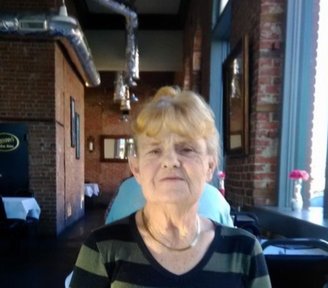
Ginger Gail Gouthier was born on June 10, 1947, in Porterville, Calif. She passed away on May 21, 2021, surrounded by her loving family.
Ginger was preceded in death by her first husband, Leon Moran, and by her daughter, Bettinia Perkins. The many loved ones she leaves behind include her husband of 20 years, James Gouthier, daughters Brenda and Bernelle and son Roy. Ginger’s family includes seven grandchildren and eight great-grandchildren.
Ginger was a loving mother, wife sister and grandmother. She was a good provider for her family and at times worked more than one job. Her time away from home was spent managing or waitressing at family restaurants in the Central Valley and on the North Coast.
Ginger had a green thumb and spent much of her free time gardening and enjoying time with her family. She also enjoyed a night out occasionally, at the local casinos for dinner and entertainment.
The family is planning to hold a private celebration of life at a future date.
###
The obituary above was submitted on behalf of Ginger Gouthier’s loved ones. The Lost Coast Outpost runs obituaries of Humboldt County residents at no charge. See guidelines here.
Korea-Based Microbrewery The Booth Closes Eureka Facility; Landlord Places Heaps of Industrial Brewing Equipment Up for Auction
John Ross Ferrara / Monday, June 7, 2021 @ 5:15 p.m. / Beer , Business

The Booth Brewing Company’s Eureka facility. | Outpost file photo
Tens of thousands of dollars’ worth of industrial brewing equipment is up for auction after Eureka’s Korea-based brewing company The Booth shut down its local facility without notice in December.
The online auction, which began on May 21, features a warehouse-full of expensive-sounding machinery, like a complete Wild Goose 16-oz. can line and labeler, an Alfa Laval centrifuge, a Sympac Bottle Filler, a York Glycol chiller and more.
“All equipment to be sold at auction — wall to wall, floor to ceiling!” the auction company Schneider Industries stated on its website in partnership with the liquidation company Tiger Group.
Speculation over the fate of the brewing company, which set up shop in Eureka in January of 2017, began to build after the company’s American social media pages went dark last July. It’s unclear if the company is still functioning in Korea. However, The Booth’s Korean social media pages have been silent since February.
The Outpost was unable to confirm the current owner of the Booth’s 20,000-square-foot warehouse at 123 W 3rd St. in Eureka, which also previously housed Lost Coast Brewery. But according to a press release issued by Tiger Group last week, the auction is being conducted by the present landlord.
“The landlord’s decision to market the property to other uses creates an excellent opportunity for craft breweries, cider-makers and other food and beverage manufacturers to acquire top-grade equipment that continues to be maintained by one of the facility’s brewers,” Tiger Commercial & Industrial Senior Director John Coelhol was quoted as saying in the press release. “The property’s numerous tanks are also suited to other processing industries.”
Bidding for the auction is set to close on June 17.
###
PREVIOUSLY
- South Korean Microbrewery Looking to Set Up Shop in Eureka
- South Korean Brewery Up and Running in Eureka, Hosting Tasting Party Friday
- (VIDEO) THE BOOTH: Inside Eureka’s South Korean Brewery, Set to Release its New Line of Craft Beer With a Kickoff Event
- (VIDEO) OYSTER EXTRAVAGANZA! Arcata’s 27th Annual Oyster Fest Ranks as Biggest Best Year Ever
- Local Brewing Company to Unveil Pride Month Beer; All Proceeds to Be Donated to LGBTQ Groups
- Eureka Brewery Joins Long List of Companies Donating Beer Sales to Camp Fire Relief Fund
- Eureka City Council Will Consider Approving Pedal-Powered Tour Buses That You Can Drink Booze On
- (PHOTOS) Stockings Stuffed During ‘Tease the Season’ in Eureka
Meet Humboldt’s Teacher of the Year! Pine Hill Kindergarten Educator’s Dedication to Students Cited, Honored in Annual Award
LoCO Staff / Monday, June 7, 2021 @ 3:15 p.m. / Education
From the Humboldt County Office of Education:
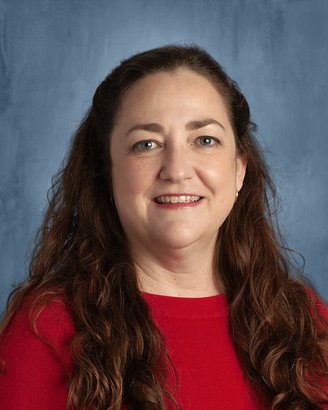
Diane Blanchard, Kindergarten teacher at Pine Hill Elementary School has been selected as the 2021 Humboldt County Teacher of the Year.
“I am so surprised and honored to be receiving this award. Thank you! Teaching young children and watching them make progress has always been a huge reward for me, and that is why I love teaching Kindergarten,” Blanchard was quoted as saying upon winning the award.
Blanchard was selected from among the 13 local educators who received the Humboldt County Office of Education’s Excellence In Teaching award in May. She is the Humboldt County nominee for the California Teacher of the Year. Last year’s nominee, Nora Wynne from McKinleyville Middle School was chosen as a California State Teacher of the Year.
Blanchard earned her teaching credential from Humboldt State University in 1994 after receiving her Bachelor of Arts in English at California State University, Chico, CA in 1992. She received the Outstanding Student Teacher award in the Delta Kappa Gamma, California Area 1 in 1994. Blanchard currently teaches Kindergarten at Pine Hill Elementary School. She previously taught first grade and served as a Master Teacher. She also is active in Professional Development, participating in ongoing programs like the research-based “Success For All” reading and writing program.
In his nomination letter, Tim Grimmett, Principal at Pine Hill Elementary School said, “Mrs. Blanchard has proven herself dedicated to her craft spending a significant amount of time and energy into her teaching. Because of her kindergarten students’ wide range of needs, Diane provides a variety of accommodations and supports to help them acquire their education.” Grimmett added, “Her dedication to her students and the field of education, as well as her ability to build strong, collaborative relationships with her colleagues are to be commended.”
Blanchard’s win for Humboldt County Teacher of the Year means she will vie for California State Teacher of the Year. That award is traditionally revealed in October. To learn more about HCOE’s Excellence in Teaching Awards, visit hcoe.org/awards/ or contact Stacy Young, M.A., Visual & Performing Arts Program Manager at (707) 445-7077.
When Is the Newsom Recall Election? Maybe Sooner Than You Think
Laurel Rosenhall / Monday, June 7, 2021 @ 8:12 a.m. / Sacramento

Illustration by Anne Wernikoff.
Californians will almost certainly vote this year whether to throw Gov. Gavin Newsom out of office. But when?
There’s surprisingly little certainty about the date of an election that has the potential to upend the leadership of the world’s fifth largest economy and disrupt the lock Democrats have had on the state Capitol for the last 11 years.
The range of probable dates is shaping up as a Tuesday between mid-September and early November — with signs pointing to the likelihood of an election sooner rather than later.
One reason for the confusion is because the procedure leading up to a recall election involves a few steps that could take as much as three months or as little as a few days, depending on how the officials involved decide to roll things out.
“These processes that are remaining now are totally in the hands of Democrats. If they want to truncate it, they can truncate it. And in my estimation they should,” said Garry South, a Democratic political consultant who managed campaigns for Gray Davis, the only California governor to be recalled.
“Let’s get this thing over with.”
Senate Elections Committee chairperson Steve Glazer suggested the election should be held as soon as August because Newsom is doing well in the polls as the state rebounds from the COVID-19 pandemic. But it seems more likely that officials would wait until after Labor Day, when summertime distractions settle down. And recent activity at the Capitol indicates that the election will probably be called earlier than the traditional first Tuesday in November.
State finance officials and lawmakers who control the budget have already begun figuring out how much it will cost counties to conduct the election — a step they could drag into August if they wanted. Last week, the Department of Finance received cost estimates from election officials in almost all of California’s 58 counties. And Sen. Nancy Skinner, the Berkeley Democrat who leads the Senate’s budget committee, told reporters that she may not need the full 30 days the law gives her panel to review recall election costs because “we already know” the price tag.
County election officials said last month that putting on the recall election will cost them about $400 million, five times more than what Newsom had estimated. Similar to last November, all registered voters will receive mail ballots and counties can also offer drop-off and in-person voting.
If lawmakers include the funding for counties in the budget they’ll pass by June 15 — which seems likely, since they’ve received the cost estimate and have a massive surplus — it could be a major indication that the election will probably be in September instead of later in the fall.
But if the funding is not included in the budget, it means lawmakers and Newsom’s finance officials could spend more of the summer analyzing the costs, thus delaying a vote. The recall law gives them lots of leeway — finance officials and the Legislature each get as long as 30 days for this phase of the process.
The timing is more of an issue for him than it is for us.”
— Anne Dunsmore, recall campaign manager
Democratic lawmakers added more steps to California’s recall process in 2017 as they unsuccessfully tried to fend off the recall of Democratic state Sen. Josh Newman of Fullerton. In addition to adding two months for the fiscal analyses, they also added six weeks for voters who signed the recall petition to remove their signatures if they want, a period that in Newsom’s case ends Tuesday.
“A lot of lag was put in,” said Joshua Spivak, a fellow at the Hugh L. Carey Institute for Government Reform at Wagner College in New York who lives in the Bay Area and writes the Recall Elections Blog.
“It’s this change in the law that has given some uncertainty to the proceedings.”
Newsom has answered questions about when he’d like the election to be held by saying it’s not his decision, and he’ll work hard to defeat the recall by focusing on getting Californians vaccinated and rebooting the economy. While he’s been touting a return to “business as usual” when the state reopens on June 15, Newsom said Friday that he will not lift the official state of emergency on that date. The emergency status allows the state to waive certain rules and expedite federal funding even as businesses more fully reopen.
“This disease has not been extinguished,” Newsom said after drawing the first winners in his vaccine lottery. “It’s not taking the summer months off.”
His opponents who are campaigning for the recall jumped on that comment, saying it will add fuel to their movement, which began as a conservative critique of Newsom’s liberal policies but evolved to encompass voters frustrated with his pandemic-induced restrictions.
“That seals the coffin,” Anne Dunsmore, a recall campaign manager, said of Newsom’s decision to hold onto his emergency powers. “People don’t feel that he understands the pain they’ve been through.”
The politics of timing
Dunsmore said an election later in the fall is slightly better for recall supporters because it gives more time for candidates to jump in the race, which could attract more voters. It also allows more opportunity for Newsom to anger voters by his response to potential disasters — think wildfire, drought and power shut-offs — or his own gaffes, like the French Laundry dinner party that spiked support for the recall.
“The timing is more of an issue for him than it is for us,” Dunsmore said.
Opinions vary on whether holding the election sooner is better for Newsom — or even if the date of the recall matters much. There’s not really a playbook since only two governors in modern American history have faced a recall — Davis, who was booted from office in 2003, and Wisconsin’s former Republican Gov. Scott Walker, who defeated a recall in 2012.
Spivak believes that Newsom would benefit if the election is held later, arguing that sufficient time to raise campaign funds helped Walker win. Newsom is already outraising recall supporters, who raised and spent most of their cash to collect signatures, and he seems poised to dominate the money race.
“The longer he has, the more he can put that money to use and overwhelm the opposition,” Spivak said. “The air war hasn’t started and when it does, he might have a big advantage.”
Also, holding the election in early November could help Newsom by driving turnout, since voters are accustomed to voting then. On the other hand, Spivak said, holding it at an unusual date could help Newsom win more support by emphasizing that it’s an irregular election and an extra cost to taxpayers.
“Watching him go over those bills with his reading glasses on, the whole room hung heavy with the specter of the recall.”
— Garry South, campaign manager for recalled Gov. Gray
South says that Newsom would be better off if the election were sooner — before he faces the intense period of signing and vetoing bills from Sept. 11 to Oct. 11. His decisions could anger some voters. And an election scheduled soon after could cause more scrutiny of whether it is influencing how Newsom evaluates bills involving a range of powerful interests.
“That was a huge mess for us in 2003,” South said, because Davis faced a recall on Oct. 7.
“Watching him go over those bills with his reading glasses on, the whole room hung heavy with the specter of the recall.”
Ultimately, South said, it prompted Davis to sign legislation he’d previously vetoed, and veto some bills he otherwise wouldn’t. For instance, just before the recall, Davis signed a bill to give driver’s licenses to undocumented immigrants — something he had vetoed twice before, South said. The vetoes had cost Davis the endorsement of the Legislature’s powerful Latino Caucus in an earlier election, and he didn’t want to risk that again during the recall.
“Even if Newsom looked at all those thousand bills and vetoed and signed them all in good faith — he will be accused by both the right and the left of playing politics,” South said.
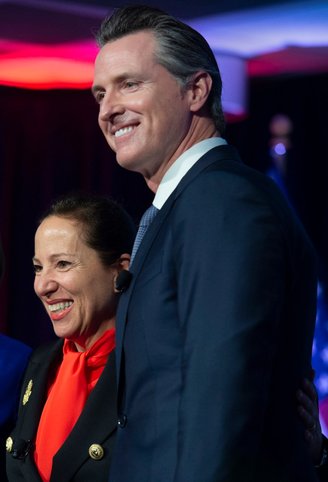
Lt. Gov. Eleni Kounalakis and Gov. Gavin Newsom stand together on stage at the Tsakopoulos Library Galleria on January 7, 2019 in Sacramento. Photo by Randy Pench for CalMatters
The decision on the election date falls to Lt. Gov. Eleni Kounalakis, a Democrat and Newsom ally. The recall law says she must call the election for between 60 and 80 days after Secretary of State Shirley Weber — who was appointed by Newsom — certifies that enough people have signed the recall petition to trigger an election, which follows the Legislature’s cost analysis.
“Frankly, it will probably be somewhere in the middle,” Kounalakis said in an interview. “It is my job to set this date within that narrow window, in a way that serves the public interest, and that is what I will do.”
One thing Kounalakis said she won’t do? Follow in the footsteps of Cruz Bustamante, who held her position when Davis was recalled and decided to run right after calling the election.
“I’m absolutely not going to put my name on the recall ballot,” she said.
###
CALmatters.org is a nonprofit, nonpartisan media venture explaining California policies and politics.


