OBITUARY: Andrew Wayne Nelson, 1977-2021
LoCO Staff / Saturday, May 1, 2021 @ 6:56 a.m. / Obits

It is with heart-wrenching sorrow that we have to announce that
Andrew Wayne Nelson, aka “Bub,” “Bubbers,” or
“Bull Dog” left this world suddenly and unexpectedly on
April 3, 2021 at the age of 43.
He is survived by his mother, Dorothy (Dottie) Nelson of Kneeland, CA; Sister Marlaina Steil, brother-in-law, James Steil and niece Mallory (9) Steil of Medford, Oregon; and sister Monica Witte, brother-in-law Daniel Witte, niece Heidi Witte (15) and nephew Brody (13) Witte.
The third child of Ron and Dottie, he was pure delight! Born on his maternal grandfather’s birthday, July 26, 1977….he had another plan than his expected arrival date in May, and chose to (finally)come into this world on July 26!
With the same sense of humor, he carried on the Nelson/Andersen traditions of joking and fun-loving teasing - always a joy. Perhaps his sisters were not always appreciative - as many times from the back seat we would know he was up to something as one of the girls would shout out: “Mom, he’s LOOKIN’ AT ME!” and he would be the only one laughing.
Andy spent a lot of time thinking about what was next after EHS ‘96 and years of football!
One summer he had 4 part-time jobs at the same time - and developed quite an impressive work ethic. Landing in Las Vegas he eventually received his Bachelors Degree from UNLV. He had a career in hospitality and loved every minute of it. Life-time friends and new friends were all very important to him. He embraced his co-workers as his family, as they did him.
Many of you will be happy to hear that his “kids” — the two puppies — are doing well with James, Marlaina and Mallory in Medford and are settling into their new surroundings.
We never missed an opportunity to say “I love you” to each other and hope you do the same.
Family and friends are encouraged to attend Andrew’s Celebration of Life at 2-4 p.m. on Saturday May 15, 2021 at the Moose Lodge in Eureka at 4329 Campton Rd. He will be interred in Kneeland.
Please
come and help us celebrate Andy’s life.
There is plenty of outdoor space for those wishing to have some distance.
God’s blessings to all. Love, Dottie and family.
###
The obituary above was submitted on behalf of Andrew Nelson’s loved ones. The Lost Coast Outpost runs obituaries of Humboldt County residents at no charge. See guidelines here.
BOOKED
Yesterday: 7 felonies, 9 misdemeanors, 0 infractions
JUDGED
Humboldt County Superior Court Calendar: Today
CHP REPORTS
5345 Walnut Dr (HM office): Trfc Collision-1141 Enrt
ELSEWHERE
RHBB: Fire restrictions ease in Klamath National Forest wilderness areas
RHBB: Cutten Road Work Starts Monday: ADA Ramps, Drainage, and Cedar Street Resurfacing
RHBB: EPD Launches New Online Alarm Registration System, Resets False-Alarm Counts to Zero
OBITUARY: David Keith Nicholson, 1954-2021
LoCO Staff / Saturday, May 1, 2021 @ 6:56 a.m. / Obits
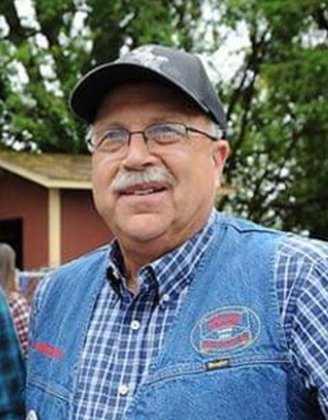
Dave was born on April 4, 1954 at the old Scotia Hospital. He died on April 24, 2021 at the age of 67 from complications of multiple myeloma in Bakersfield while on vacation with his wife Cheryl.
Shortly after he was diagnosed with cancer in 2017, Dave wrote his own obituary:
Dave grew up on the family dairy farm at Grizzly Bluff in Ferndale. He graduated from the old Grizzly Bluff School and Ferndale High School, one of the “mighty crew of ’72”.
After graduation, Dave went to work for Peers Motor Sales, selling parts. When the dealership closed, he purchased the Ferndale Garbage Company, and operated it for 10 years. He was a partner in another agriculture business for 10 years and finished his parts career at Fernbridge Tractor.
After retiring, he and Cheryl planned to travel, and since Dave loved the Giants, their first trip was to spring training to see the San Francisco Giants in Scottsdale. The trip was cut short when Dave was called back to Eureka, where he learned he had cancer.
While living on the Ferndale side of the river, Dave was baptized, confirmed and an active member of Our Saviour’s Lutheran Church. He was a member of the Ferndale Volunteer Fire Department, serving many years as Assistant Chief. In 1994 he was named Fireman of the Year. Also in Ferndale, he served two terms on the City Council (two years as mayor). Dave was also a charter member of the Ferndale Kiwanis club.
After moving across the river to the Fortuna side of Fernbridge, Dave continued his community service. He was a volunteer firefighter, and served as Captain of Company 1, and as an Assistant Chief. After going exempt, he served the Fortuna Fire District as a Commissioner. He was a member of the Fortuna Rodeo Association, served on the Fortuna Parks and Recreation Commission, and was an active member of Christ Lutheran Church. In 2011, Dave and Cheryl were named Volunteers of the Year by the Fortuna Chamber of Commerce. Dave was a member of AA and recently received his 20-year chip.
For many years Dave played Santa for Eel River Valley families and other groups. Anyone who asked. He loved seeing the families grow and knew many of the children and their parents by name.
Dave was preceded in death by his parents, Keith, and Helen (Farley) Nicholson, and his grandparents, Milton and Matilda Nicholson and Ambrose and Mary Farley.
He is survived by his wife Chery, and his stepchildren, who he loved like his own: Tina Mallo, Cherie Mallo, and Grant Bryant, and his grandchildren Tarin, Talin, James and Vivienne. Also, his brother Larry Nicholson and wife Helene, and sister Shirley Bianco and husband Dan. And too damn many nieces, nephews, and cousins to list. (His words.) Dave was a 4th-generation Humboldter, and now the Nicholsons can claim seven generations, with family still on the dairy at Grizzly Bluff.
Dave was a proud Republican! He thought Reagan was the best President and Truman was okay for a Democrat.
A Celebration of Dave’s Life will be held as soon as we can safely gather. In lieu of flowers donations can be made to UCSF Cancer Research.
###
The obituary above was submitted on behalf of Dave Nicholsons’s loved ones. The Lost Coast Outpost runs obituaries of Humboldt County residents at no charge. See guidelines here.
OBITUARY: Heidi Monson, 1980-2021
LoCO Staff / Saturday, May 1, 2021 @ 6:56 a.m. / Obits
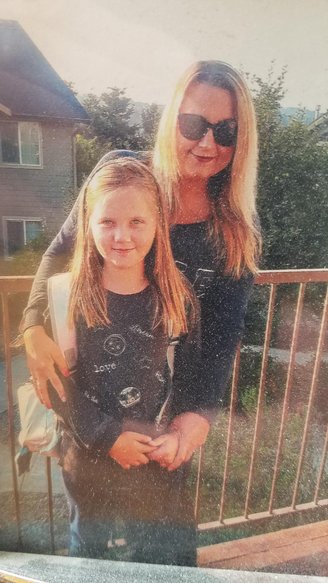
Heidi Monson, born Aug. 16, 1980 in Arcata to Tom Monson and Leanne McDonald Monson, passed away on the morning of April 7, 202. She grew up in Blue Lake, where she loved the school and her teachers, then went to Arcata High school and graduated in 1997.
Her first job was at E&O Market, learning the grocery business. She then worked for Safeway in McKinleyville. With her artistic ability she ended up in the floral departmet, where she worked until moving to Country Living Florists in Arcata.
Heidi loved camping at Burney Falls Park with all the family, which started when she was five. Enjoying her grandparents, aunts, uncles and cousins. The happiest enjoyment of her life was her daughter, Makenzi Watkins. The two were best buddies.They loved doing crafts and watching movies together.
She was preceded in death by her grandfather, Bill McDonald; grandmothers Eleanor McDonald and Edith Monson and uncle Tim McDonald. She is survived by her father Tom and wife Cleone Monson, daughter Makenzi Watkins of Eureka, mother Leanne and husband Ken Hunnel of Sun City Calif., brother Cameron and wife Nichole Monson and family in Burien, Wash., along with many aunts, uncles, cousins and lifelong friends.
###
The obituary above was submitted on behalf of Heidi Monson’s loved ones. The Lost Coast Outpost runs obituaries of Humboldt County residents at no charge. See guidelines here.
(VIDEO) Cute Humboldt Seal Video Comin’ In Hot
Andrew Goff / Friday, April 30, 2021 @ 4:20 p.m. / Hardly News
[STOP: The following post is only for people who have already read LoCO’s report on the first county audit committee meeting. Veggies before dessert. If you’ve cleared your plate, continue scrolling.]
# # #

hullo.
Look. LoCO is trying to get the hell out the door in an attempt to get to something that resembles a weekend. Hopefully you’ve arrived at a place in your life where you get to do that now too. Like the old days! Be safe, of course! But yeah!
Anyway, one last thing before we part ways. Yesterday, we are told, a camera-toting individual named Kai Simons was blessed enough to take a tour of our beautiful coastline as a guest of Kayak Trinidad. As it goes, a curious seal decided it wanted to take a closer gander at the humans in its harbor which resulted in the following brief bit of video cuteness.
Watch it now. Then step away from all of your screens for a time, not unlike the seal (who appears to be living pretty good).
Humboldt County Audit Committee Held Its First Meeting … and the Auditor-Controller was Absent
Ryan Burns / Friday, April 30, 2021 @ 4:15 p.m. / Local Government
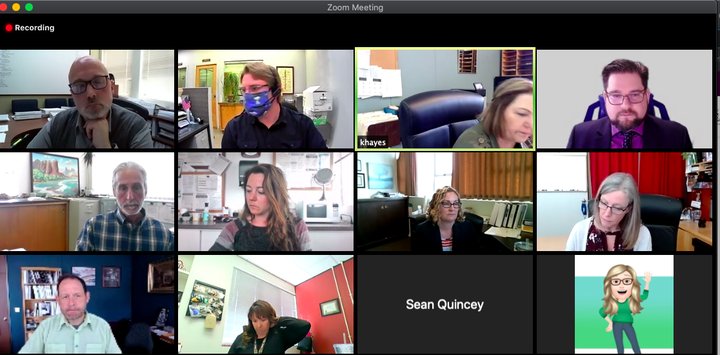
Members of the Humboldt County Audit Committee with advisory staff and other county employees. | Screenshot of Zoom meeting.
Humboldt County’s fiscal management has been a hot mess in recent months, with chronically delayed reports, payments and other transactions causing headaches for county employees, department heads and outside vendors.
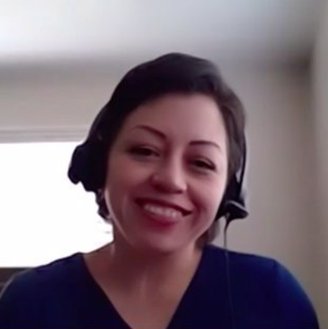
Paz Dominguez. | File image (screenshot).
In an effort to solve some of these problems — and perhaps to quell some of the internal strife that has developed around them — the Board of Supervisors agreed in February to form an audit committee comprised of county officials and qualified members of the public.
On Friday, the Humboldt County Audit Committee held its inaugural meeting via Zoom, and while the tone remained calm and civil throughout, forward progress was largely stymied by the absence of Auditor-Controller Karen Paz Dominguez, who is arguably the most central figure in these matters.
Reached by the Outpost prior to this morning’s meeting, Paz Dominguez said she had informed people involved with the committee that she’d be unable to attend because today represents an end-of-the-month regulatory reporting deadline, so she’d be far too busy. She sent Senior Accountant/Auditor James Hussey in her place.
The five-member committee consists of Fourth District Supervisor Virginia Bass, Third District Supervisor Mike Wilson, Assistant County Superintendent of Schools Corey Weber, county Administrative Analyst Mychal Evenson and former Assistant Auditor/Deputy County Administrative Officer Cheryl Dillingham. Paz Dominguez will serve an advisory role along with County Administrative Officer Amy Nilsen and Treasurer-Tax Collector John Bartholomew.
At the outset of the meeting, Nilsen outlined the committee’s purpose and responsibilities, explaining that it has been charged with providing independent oversight of county audits, internal controls, financial statements and other fiscal matters. It will report to the Board of Supervisors and provide “open avenues of communication” among county staff, officials, independent auditors and the board.
The committee will also be empowered to receive complaints and conduct investigations, though Nilsen noted that its authority does not supersede that of the Humboldt County Grand Jury nor the Auditor-Controller.
After Nilsen’s introduction, Rich Gonzales, an external auditor from the firm CliftonLarsenAllen, explained his role in conducting an annual audit following the close of each fiscal year. Primarily, he said, it’s to provide the county with “reasonable assurance” that its statements of accounting are reliable and “free from material misstatement.” This external “single audit” also assesses the county’s major programs, such as transportation, social services and health services, to make sure they’re compliant with state and federal regulations.
At the end of his presentation, Gonzales noted that Paz Dominguez’s office has yet to fully close the books on fiscal year 2019-20, so he couldn’t provide a timeframe for the next audit. “There’s not much we can do until we obtain that information from the county,” he said.
That prompted Bass to note that it seems awfully late to have not closed the books yet, and she asked Gonzales, who works with numerous other counties, what a typical timeframe is for closing the books.
“Most of our clients close in September [or] October,” he said, though he allowed that the pandemic caused some delays. (Fiscal years end on June 30.) The standard deadline for submitting county audit reports to the State Controller’s Office is March 31, but this year, because of the pandemic, that deadline has been extended until the end of September.
Weber, who represents schools on the committee, said they, too, have to prepare an audit, and their deadline is earlier. This year’s delay from the county is causing problems. School audits can’t be completed until the county calculates and posts taxes and interest for the fiscal year, he said.
Bartholomew said the delay is causing problems for his office, as well. Per state law, treasurers are supposed to report their county’s interest apportionment rate to the State Controller’s Office by the end of September, but since the books have yet to be closed — three months after that deadline — he’s been unable to do so.
Eventually, the meeting arrived at an agenda item that called for a status report on the corrective action plan from the 2018-19 fiscal year, and Nilsen said Paz Dominguez was supposed to provide that report.
In her absence, Bass asked Hussey if he had anything to report. He did not.
The next item on the agenda was another status report that was supposed to be delivered by Paz Dominguez — according to Nilsen, anyway.
Dillingham spoke up to say that in a recent email, Paz Dominguez said nobody had asked her to present anything today. Somehow that message didn’t get to the rest of the group.
This highlighted another theme in the county’s ongoing fiscal mess — poor inter-department communication. Today’s meeting offered evidence that this issue persists. Indeed, nobody present could say why Paz Dominguez was not in attendance.
“I know she’s been invited multiple times, and she saw the agenda,” Bass said.
“Well,” Nilsen replied, “there were several Doodle polls and emails requesting availability, and the agenda was distributed in advance … .”
“So, I guess, in the future, perhaps we should have these [agenda items listed] under which person would be presenting,” Bass said. “Then Jim [Hussey] might have been able to come here with some information.”
Instead, the committee skipped ahead on the agenda. Bartholomew said the county is currently out of compliance with a California statute because in 2019 the Auditor-Controller stopped issuing certificates that verify deposit amounts. She did this, Bartholomew explained, because the deposits in question get made to bank via the Treasury Department, rather than her own office. However, there were checks and balances between the two departments, he said, “so everyone was on the same page with the exact same information.”
Paz Dominguez’s decision to stop issuing those certificates left the county without a “control procedure” to verify that data posted to the county’s General Ledger accurately reflects each deposit.
“Long story short,” Bartholomew said, “we need to agree to alternate control procedures, and we’d like to propose a shift in how those procedures are done in the future.”
Amy Christensen, a senior treasury/tax assistant, explained the county’s financial software provides such an alternative — and it’s a method employed by at least four other counties, according to Bartholomew. He said he’d reach out to the Auditor-Controller’s Office to make sure its staff is on board, adding that he thinks it will be less work for everyone in the long run.
Finally, the committee talked about when to meet next, and once again Paz Dominguez’s absence was an issue. The suggested date on the agenda for the next quarterly meeting was the week of August 9, but Bass said she’d prefer to do it sooner.
“I’d benefit [from] having the auditor with us, rather than waiting until August,” she said.
Weber said he agreed “because a lot was discussed [today] that I’d really like to have her point of view on, to get a fuller picture, especially starting off our work with this committee.” He suggested holding another meeting soon, “before we dive too deep into the year.”
“I do believe we worked with the auditor, trying to schedule this, but something didn’t work out,” Bass said. “It’s important she’s there … . We have to confirm dates she can set in stone. I was really frustrated we didn’t get to have the conversation today.”
Wilson acknowledged that the end of the month is a difficult time for the auditor’s office.
The committee agreed to try to schedule a meeting for May. Hussey said he’d check with Paz Dominguez about availability, though he warned, “I can’t make any promises.”
###
PREVIOUSLY:
- The Auditor-Controller’s Ongoing Beef With Other County Departments is Getting Ugly
- Supes Call Special Meeting, Say County at ‘Serious Risk of Losing Millions’; Auditor-Controller Says She’s Being Asked to Cut Corners
- County Department Heads and Local Agency Leaders Voice Frustration, Concern With Auditor-Controller
- In Ongoing Conflict With Its Own Auditor-Controller, County Opens Investigation, Looks to Outsource Some of Her Key Fiscal Oversight Duties; A-C Asks to Retain Outside Counsel
- ‘Nobody is Outsourcing the Auditor’: County Administrative Office Responds to Claims By and About Paz Dominguez
- TODAY in SUPES: Board Agrees to Appoint Outside Attorney for Auditor-Controller, But Not the One She Picked
- TODAY in SUPES: Auditor-Controller Gets Staff She Requested; Bohn Abandons Controversial COVID Resolution
- State Suspends County’s Purchasing Account for Overdue Payment; Auditor-Controller Takes Responsibility
- County Abandons Investigation Into Fiscal Management Delays, Having Never Interviewed the Auditor-Controller
- TODAY in SUPES: COVID Vaccine Rollout Woes, Suddenlink’s Local TV Blackout and More Fiscal Headaches
- TODAY in SUPES: Board Approves ‘Audit Committee’ in Hopes of Solving the Ongoing ‘Dysfunction’ Surrounding Financial Transactions
- The Agency Running Humboldt County’s Workforce Services is Ready to Bail Over Chronically Late Payments
- TODAY in SUPES: Board Approves Creation of Chief Financial Officer Position as Staff Emphasizes Distinctions From Auditor-Controller
GUEST OPINION: As Someone Who Has Two Active Lawsuits Against Caltrans, Let Me Say That Caltrans is Doing a Great Job With Last Chance Grade
Tom Wheeler / Friday, April 30, 2021 @ 2:25 p.m. / Guest Opinion
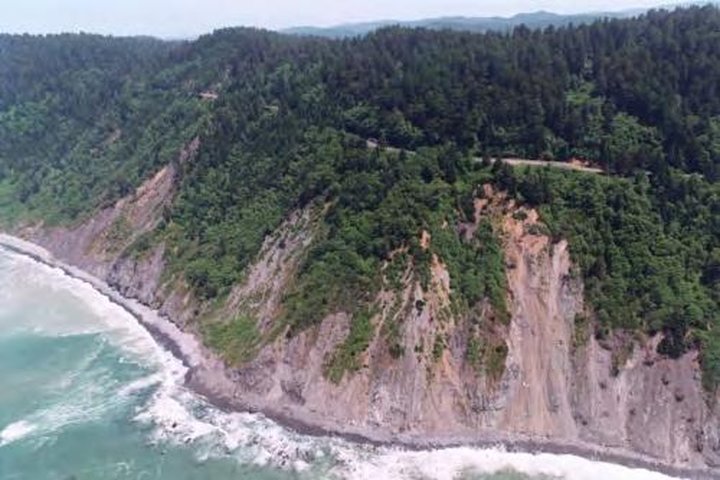
Last Chance Grade, an oft-closed and perilous section of Highway 101 just south of Crescent City. Photo: Caltrans.
###
PREVIOUSLY:
###
As the executive director of EPIC and someone who is currently suing Caltrans — twice — for projects on Highway 197/199 and at Richardson Grove, I can’t believe I am writing this, but: Caltrans is doing an impressive job with the Last Chance Grade Project. Recently, Caltrans announced it had narrowed its range of alternatives to just two options for the Last Chance Grade Project. Take it from someone who has been watching this project develop for over five years: This is a big deal. While EPIC normally would be upset that an agency has limited the scope of study to just two alternatives so early in the process, for the Last Chance Grade Project, we will make an exception. The reason is that these two alternatives are the direct result of consistent, good-faith community engagement. By talking to the community early about its concerns with the project, Caltrans has knocked years off the timeline, slashed the bill by millions of dollars, and has likely threaded a narrow needle to produce a project that all sides can live with.
First, it is important to understand the herculean task of trying to fix Last Chance Grade. The road hugs tightly the steep and highly erodible coast, which gets pummeled with winter rains causing landslides ranging from the sudden and scary to the slow sloughing of the hill into the ocean. Today, the road is so fickle that it demands almost constant construction. And the surrounding landscape makes permanently fixing the problem complicated. To the West is the Pacific Ocean, to the east are equally steep and erodible hills that are also home to endangered species, salmon runs, and old-growth redwoods.
Alternatives analysis is at the heart of environmental impact review, where an agency investigates all of the potentially feasible ways to achieve the same goal of a proposed project. In doing so, an agency might discover that there are alternative ways to achieve the same end goal that would result in fewer environmental impacts. Applied to Last Chance Grade, Caltrans is obligated to consider feasible alternatives that would accomplish the same goal of providing a safe and reliable road.
After decades of patching together a road with what might feel like bailing wire and duct tape, Caltrans began planning to replace the road. Given the complexity presented by trying to build a road through some of the most landslide-prone lands of California and given the likely tension of a major road replacement through a state park (with the potential cutting of old-growth redwoods), Caltrans deliberately and methodically studied alternatives before starting environmental impact review. What’s more, instead of the usual “black box” of government, where decisions are made in some government office using some process that is obtuse and opaque to the public, Caltrans sorted through these initial alternatives with the public.
Through this deliberate environmental review process, Caltrans was able to consider and study a wide range of alternatives, some of which likely never left the desk of the engineer who dreamed it up and others brought forward for consideration by the public. Through study and data collection (and a lot of engagement with the public), the wastebasket of rejected alternatives became larger and larger — A1, A2, B1, B2, C3, C4, C5, D3, D4, D5, E3, E4, E5, and L — until two alternatives remained: X and F. These two left standing were the product of years of study, and based on their review by Caltrans and the public, are hands-down the “best” alternatives to provide a reliable and safe road that also avoids significant environmental and cultural impacts.
Alternative X would be a full rebuild of 1.1 miles of highway, but unlike the other alternatives, this alternative would maintain the current alignment as much as possible. Caltrans strongly suspects that current sliding is largely a result of too much water in the soil, which promotes landsliding. X would rebuild the road, including digging back and armoring the slope in areas, as well as dewatering the route through wells and pumps to promote greater soil stability. Dewatering as a form of slope stabilization has been successfully pursued in other areas of California. Because this alternative would more-or-less stay in its current alignment, the ground disturbance impacts from the project are the least significant, with 10 acres of coastal shrub likely affected. The pricetag is also among the least expensive, at $300 million, and a relatively quick construction timeline at 3.5 years to complete. The downside? While dewatering would significantly reduce the threat of landsliding, it would not remove it completely. There is also a perception problem. Because the road would be rebuilt at, more or less, its current location, many in the community might question whether this is truly a fix to the site-specific issues encountered before.
Alternative F is the “big tunnel” alternative: two bored tunnels, set next to each other with one-way traffic through each, dug east of the active landslide and capable of withstanding large earthquakes — a feat of engineering that Caltrans believes is achievable. As a tunnel, it would avoid most above-ground environmental impacts except for the tunnel mouth openings, which would result in some loss of mature or old-growth trees. Caltrans has worked hard, however, to reduce that impact and each iteration seems to save more trees. The downside? Cost. A large tunnel through Last Chance Grade won’t come cheap, likely topping one billion dollars. But given the importance of the road and the significant effort to build support for the project, we believe that this amount is doable.
By narrowing down alternatives to these two, we have avoided additional months if not years of resource-intensive study by Caltrans of some of the “lesser” routes. (If you want to get any idea of the cost of environmental analysis, in many areas that have now been released from further consideration, Caltrans would have needed to ferry in drilling equipment into old-growth forests by helicopter—a cost, both to the state and to the environment, that can now be avoided.) And the two alternatives brought forward are the least environmentally impactful of all that had been studied, which both maintains our world-famous redwoods for future generations to enjoy and avoids risk of project-delaying litigation. In sum, Caltrans’ progress on Last Chance Grade is a big #$^@ deal.
In giving thanks for a job well done, there are a couple important people to mention. First, to my surprise and delight, Caltrans has done a very good job on Last Chance Grade. At Caltrans, Jaime Matteoli, Steve Croteau, Sebastian Cohen, Charlie Narwold, Talitha Hodgson, Matt Smith and Matt Brady have gone above and beyond to reach this stage. Congressman Jared Huffman also needs significant credit. In 2015, Congressman Huffman convened a stakeholder group to try and work through the likely issues that would arise as the project developed — a deliberate attempt to avoid another fiasco like Richardson Grove. Joy Keller-Weidman from the John S. McCain III National Center for Environmental Conflict Resolution at the Udall Foundation has been the glue that has held the stakeholder group together.
I am going out of my way to praise the stakeholder engagement process and its fruits because this sort of process — sometimes long and frustrating, sometimes tedious and boring, always above what is legally required — should be a model for the government in pursuing other potentially contentious projects. Process matters. Robust stakeholder engagement both results in a both better end product — I like to think that the different expertise and perspectives brought by stakeholders has informed the project’s design for the better—and less friction in the community. When stakeholders can see the competing demands and various interests that have to be managed, we can become more forgiving of the compromises that have to be made. If other contentious projects, like the Richardson Grove Project that has been mired in litigation for over a decade, were put forward through a similar process, I am positive that we would have seen a different project emerge and a different public response.
###
Tom Wheeler is the executive director of the Environmental Protection Information Center.
Eureka Police Department Identifies Suspect in Last Month’s Hit-and-Run That Send a Pedestrian to the Hospital; Charges Filed
LoCO Staff / Friday, April 30, 2021 @ 1:58 p.m. / Crime
PREVIOUSLY:
###
From the Eureka Police Department:
On March 18, 2021, at about 9:10 p.m., officers with the Eureka Police Department (EPD) responded to the intersection of Pine and West Hawthorne Streets for the report of a hit and run vehicle vs pedestrian collision. Surveillance from a nearby residence showed a small SUV flee the scene. Surveillance was made public and EPD asked the community to assist in identifying the vehicle and/or driver. The driver did not come forward.
A Detective from EPD’s Problem Oriented Policing Team (POP) was assigned to investigate the case, with the assistance from an EPD Evidence Technician and an Investigator from the Humboldt County District Attorney’s Office. After an in-depth investigation, utilizing numerous resources, the team identified the driver as 48-year-old Eureka resident, Demmeri Carr. Carr has been formally charged with felony hit and run and will be arraigned next week. The female pedestrian from this collision was released from the hospital and is recovering.
EPD would like to thank the numerous residents in the area that provided high quality surveillance, it was invaluable to the case. EPD would also like to remind those involved in collisions to remain on scene to speak to police. If for some reason it is unsafe to do so, call the police immediately and provide your information. Failure to do so will leave you open to charges of hit and run.