On February 25, 2021, at about 5:00 a.m., officers with the Eureka Police Department
responded to a gas station on the 1000 block of Broadway for the report of an
attempted robbery that had just occurred.
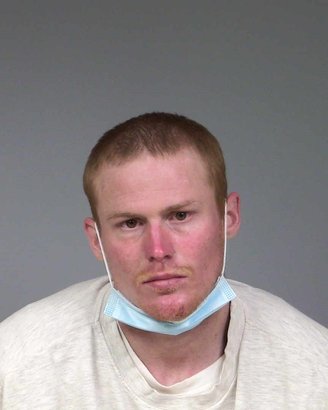
Dylan Anderson. | EPD
The employee stated an unknown male suspect entered the store claiming to have a
firearm and demanded money. The employee further stated that he hit the suspect
causing him to fall to the ground in an attempt to stop the robbery. The suspect then
fled on foot.
Officers located the suspect a few blocks away thanks to the assistance of several
witnesses. After a brief struggle, the suspect was detained and identified as 27-year-old
Dylan Anderson of Eureka.
Anderson was positively identified by the employee as the
suspect. Anderson was placed under arrest and booked into the Humboldt Country
Correctional Facility for robbery and resisting arrest.
Judge Kaleb Cockrum has dismissed the special-circumstance charge of torture against murder suspect Bronson Moon Lewis Jr., but denied a defense motion to toss out counts of murder, mayhem, conspiracy and weapons violations.
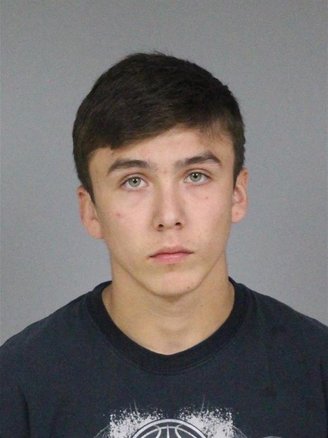
Lewis.
At a hearing this morning, Cockrum also granted defense attorney Russ Clanton’s motion to unseal a search warrant in the case. The warrant pertains to calls the 18-year-old Lewis placed or received while in Humboldt County Correctional Facility, where he has been for six months. Deputy District Attorney Trent Timm has been monitoring the calls and gathering information, including admissions Lewis reportedly made during the conversations.
Timm said Lewis now knows his phone calls are being monitored, which “changes the landscape” of the case and makes the investigation much more difficult.
Cockrum pointed out, however, that all inmates are advised their calls will be recorded.
Lewis is charged with murdering Hoopa resident Julian “Jules” Tripp in August 2020 during an altercation on Highway 96 between Hoopa and Weitchpec. According to testimony in the preliminary hearing, Lewis first attacked Tripp with a knife, severing his hand. As the wounded Tripp lay down a roadside bank bleeding, Lewis and his companions drove to Hoopa and got an assault rifle, which Lewis allegedly used to finish Tripp off.
Prosecutor Timm argued Tripp was tortured. He was left alone in the woods, bleeding out “and not knowing if he was going to live or die,” Timm said.
But Cockrum, in making his ruling, said there was no direct evidence of intent to commit torture, meaning an intent to cause “extreme pain and suffering.” Lewis’s apparent intent, the judge said, was to kill.
Cockrum refused to dismiss a charge of conspiracy to commit a crime, in this case the alleged conspiracy between Lewis and 19-year-old Daniel Armendariz, who also is charged with murder.
Evidence from the preliminary hearing shows Lewis and Armendariz “worked in tandem,” Cockrum said.
He pointed out that both men got out of Lewis’s truck and banged on the sides of Tripp’s vehicle (he was asleep in his camper at the time.) Lewis and Armendariz were both involved in a physical altercation with Tripp, and Armendariz allegedly handed Lewis the knife he used to stab Tripp and cut off his hand. It was reportedly Armendariz who suggested throwing the knife away.
When Lewis went to his cousin’s house in Hoopa to get the rifle, Armendariz accompanied him into the residence and came out with him. Once they drove back to the area where Tripp lay, they walked to the spot together. After one or two shots were fired, both returned to Lewis’s truck “looking shaken.”
With the special-circumstance charge of torture dismissed, Lewis is no longer facing the prospect of either the death penalty or life in prison without possibility of parole. But if convicted of murder and the special allegation of personally and intentionally discharging a firearm, he could be sentenced to two life terms.
Lewis’s jury trial is scheduled to begin April 19. But the timing could get complicated. Timm hopes to try Lewis and Armendariz together, and Armendariz has not even had his preliminary hearing.
Lewis was arrested on Aug. 26 and Armendariz on Nov.17.
Lewis appeared today from the videoconference room at the jail.
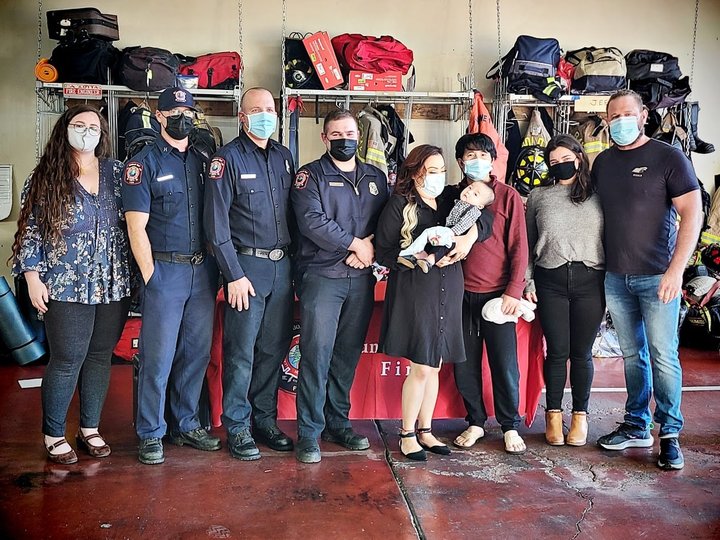
On Wednesday afternoon, Baby Phoenix and his family were reunited with some of the folks who had a hand
in saving his life on Christmas Eve, 2020.
Pictured from left to right: Eureka Police and Fire Dispatcher Laura Altic who took the 9-1-1 call; HBF Fire
Captain/Paramedic John Goodman, Engineer Brett Egbert; Firefighter Logan Bongio who responded as
Engine 8113; the Family, Mother Pa Yang, Baby Phoenix, and Father Long Moua; E.R. Nurse Katt Smith
and E.R. Doctor Jason Bourland who received Baby Phoenix and provided hospital care. Not pictured: City
Ambulance of Eureka Paramedic Jake Rubinson and EMT Carli Hollis who also provided ALS care to baby
Phoenix and transported him to the hospital.
Additionally not pictured but deserving of mention is all the other heroes who played a hand in Phoenix’ care
including other hospital staff, the supportive family and friends of Phoenix and his parents, and the
community at large who has risen up to care for this family in their time of need through thoughts, prayers,
and monetary donations to their GoFundMe page.
This reunion was emotional for all as each person recounted their role that day, bound together in purpose
by the thread of Baby Phoenix’ precious life.
Pheonix’ mother provided an update on how he is doing now, after returning from UCSF: “It’s scary having to
hear that he has severe brain damage, and that he might not be the same Phoenix he was before. But he’s
fighting, he’s starting to show signs of the same Phoenix. We’re just happy that he’s home.”
She also indicated that Phoenix has begun virtual physical therapy, and that his legs are already getting
stronger and he is able to follow better with his eyes. Next, they hope to see further improvement in his
hands and neck as they strengthen.
Baby Phoenix has already defied so many odds, and we have so much hope and belief that he will continue to
do so as he recovers, forever having the support and love of the Humboldt Bay Fire.
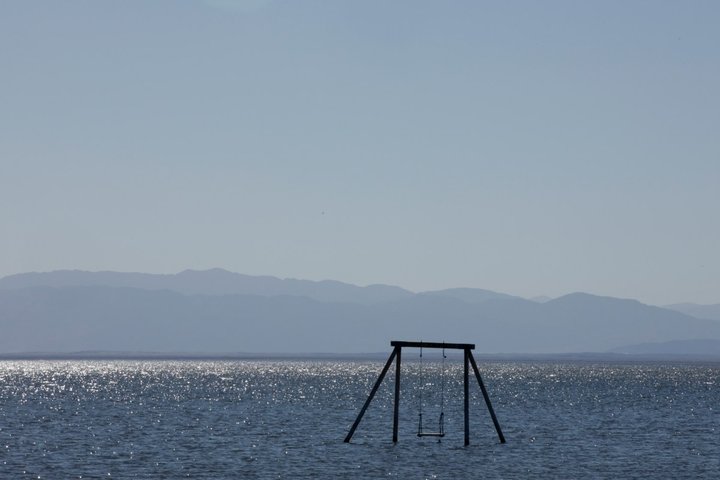
A swing set stands alone in the Salton Sea. State officials are helping fund experimental projects to extract valuable lithium from the lake’s brine. Photo by Shae Hammond for CalMatters
###
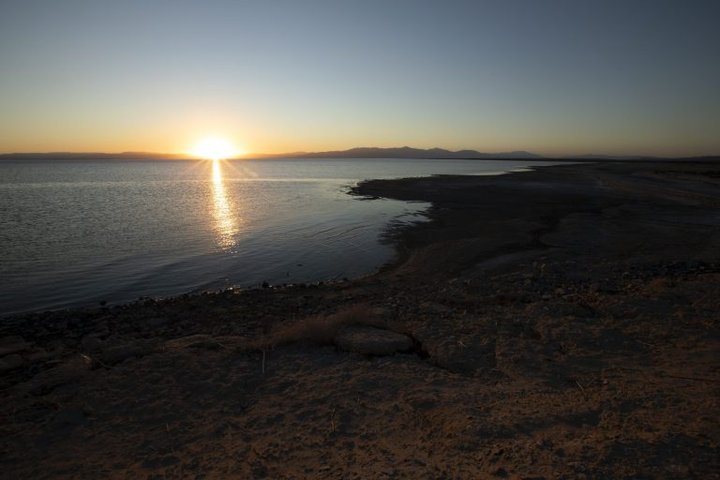
California’s desert is littered with remnants of broken dreams — hidden ghost towns, abandoned mines and rusty remains of someone’s Big Idea. But nothing looms larger on an abandoned landscape than the Salton Sea, which languishes in an overlooked corner of the state.
The water shimmers and broils in the desert like a rebuke: born of human error, made worse by 100 years of neglect and pollution. California’s largest lake is also one of its worst environmental blights, presenting a problem so invertedthat its toxic legacy intensifies as its foul water disappears.
For generations, Imperial Valley residents have been breathing in a Periodic Table of minerals and metals, as well as agricultural chemicals. But for all the misery that these receding waters have unleashed — asthma and other respiratory ailments triggered by dust clouds — the Salton Sea now offers a potential way out: A bounty of lithium, called “white gold,” one of the planet’s most prized elements, used to manufacture batteries that power electric cars and drive a fossil-fuel-free future.
And the state of California wants to be in on it.
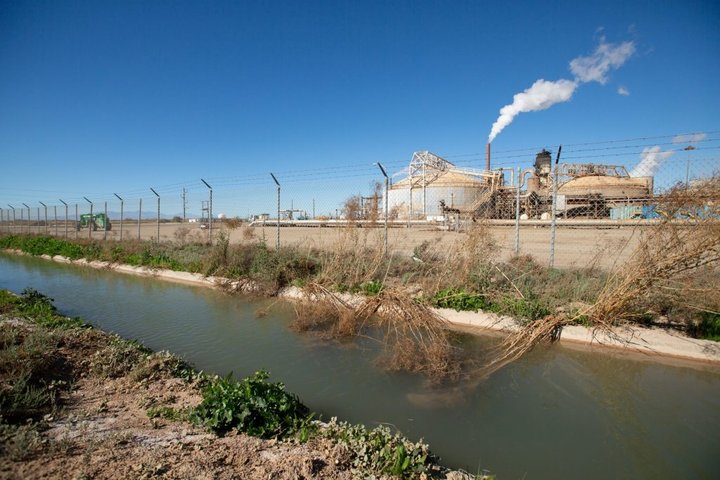
Geothermal plants near Brawley pull superheated brine from deep beneath the Salton Sea to produce energy. Photo by Shae Hammond for CalMatters
The California Energy Commission has stepped in as an angel investor, doling out $16 million in grants to a handful of companies to determine if it’s technically and commercially feasible to extract lithium from the brine that geothermal plants are already pulling from the Salton Sea.
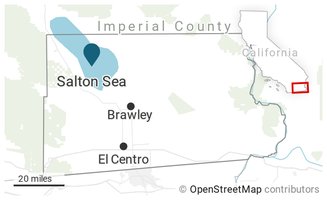
One of the recipients, CalEnergy Resources, a subsidiary of the giant Berkshire Hathaway Energy Renewables, is using $6 million in state grants to piggy-back a lithium-extraction pilot project onto its existing geothermal plants near Calipatria, at the southeast end of the dying sea. The company, which expects to break ground soon, will build a small-scale demonstration plant to begin operating next year. Should all go well, it envisions that it could eventually produce nearly a third of the world’s lithium.
From the standpoint of California public policy, the project offers a unique intersection of two state priorities: increasing sources of renewable energy and encouraging new battery technology for electric cars and energy storage. The state’s target for electric cars, for example, could use a boost. Gov. Gavin Newsom last year directed the state to ban all new gasoline-powered cars by 2035.
Assemblymember Eduardo Garcia, a Democrat from Coachella, gave the idea a jump start last year, writing a law that created the Lithium Valley Commission, an optimistic reference to the economic juggernaut that is Silicon Valley. The blue-ribbon commission members, appointed by state agencies, legislators and the governor, hold their first meeting today, and will file a report to lawmakers next year.
State officials envision not just lithium extraction and power plants, but also constructing links along the supply chain, battery-building facilities, electric vehicle manufacturing plants and everything else local authorities can dream of.
“Disadvantaged communities are always going to be on the losing end.” — Luis Olmedo, executive director of Comite Civico Del Valle
Such an expansive project would transform the entire Imperial Valley, home to 174,000 people, 85% Latino, who face chronically high unemployment and few job opportunities outside farm fields.
But environmental justice advocates worry about the potential impacts of additional waste and air pollution from extracting and processing lithium at the Salton Sea. Since it’s an experimental technology, the environmental effects have not been analyzed yet.
The Imperial Valley already is perennially ranked at the top of California’s most polluted places — with all the serious health problems that go along with it.
“Disadvantaged communities are always going to be on the losing end,” said Luis Olmedo, executive director of Comite Civico Del Valle, a health and social services organization in Brawley.
“Do we see opportunity for jobs, do we see opportunity for economic benefit for community development? We see all of that, but unfortunately the way the system is set up right here in this region, the monies are not reaching those vulnerable disadvantaged populations.”
On the ‘Toxic Tour’
Geothermal plants at the Salton Sea, with their huffing stacks and snaking pipelines, are difficult to miss, jutting up from the Imperial Valley’s flat desert floor.
Getting to the facilities requires negotiating narrow county roads bordering alfalfa fields and past teeming cattle feedlots. But the out-of-the-way plants are not out-of-mind to valley residents. They are included on a local group’s “Toxic Tour” when state officials come to town.
The state is mounting a costly project to restore the depleted Salton Sea, which is suffering from tainted water and dust storms that can trigger asthma attacks in nearby towns. Photo by Shae Hammond for Cal Matters
Even as Garcia ushers in a project that could invigorate the economy of his ailing district, he is adamant that whatever future industry materializes, it cannot make things worse in the environmentally-challenged region.
“One of the main principles is to do no harm,” Garcia said. “A lot of information is still to be gathered and understood before we are able to determine that this is going to be the best thing to happen and will have the return investment from a social, human health, economic perspective. Otherwise, we are not meeting the overall goals.
“It would do us no good if all we were doing is extracting the minerals and leaving behind an environmental mess on top of an existing mess that we are making strides to address. We cannot regress.”
This “mess” was created in 1905, when engineers cut into the west bank of the Colorado River, diverting water to slake the thirst of Imperial County’s agricultural field. Water sluiced into the valley. Heavy flooding overwhelmed the man-made channels, and for two years the river ran unimpeded into the Salton Basin.
The floodwaters were tamed, but the great lake, cut off from its freshwater supply, began the inexorable process of evaporating and receding. It stayed alive with surplus agricultural water and runoff, but the tainted water that fed the sea began to lay down generations of toxic sludge buried in sediment.
Fish died, migratory birds that fed on them detoured and the yacht clubs, marinas and shoreline vacation homes were left stranded in muck. The exposed lake bed’s mineral-laden soil is whipped by frequent winds, and the dust clouds contribute to the region’s chronic respiratory health problem.
“It would do us no good if all we were doing is extracting the minerals and leaving behind an environmental mess.” — Assemblymember Eduardo Garcia, D-Coachella
Today the Salton Sea’s nearly 350 square miles of shallow water remains one of the state’s most stubborn and expensive repair jobs, and as each new restoration plan is unveiled but not implemented, the legacy continues to make residents sick.
“The community faces high rates of asthma and respiratory conditions that have been existing ever since this valley was created. You have all different sources of pollution, the sea being one of the strongest ones, and the (geothermal) plants out there,” said Miguel Hernandez, co-chair of the Environmental Justice Enforcement Task Force for Imperial Valley and the Eastern Coachella Valley.
Anyssa Garcia has lived in Brawley, population 26,000, a dozen miles from the southern edge of the Salton Sea, her entire 21 years. Her family and friends are frequently sick with respiratory illness.
“My mom and my cousins have asthma, I see the struggle they go through,” she said. “Everyone carries an inhaler. I’m paying more attention to the air we breathe now.”
Anyssa Garcia said the environmental problems are so intractable that she longs to join the diaspora of young people away from the valley.
“I’ve never seen my family struggle like this,” she said. “I would love to get out of this valley, the conditions here are very unhealthy.”
Anyssa Garcia, who lives in Brawley, said her mother and other family members have asthma that is worsened by poor air quality in the Imperial Valley. Photo by Shae Hammond for CalMatters
State officials just launched a $200 million wetlands and air quality project, part of a pledge to spend nearly a half-billion dollars to restore the lake for fish and birds and cover the exposed playa to control the dust.
The lithium extraction efforts are not connected to the Salton Sea restoration projects, but there is a great temptation to conflate them and imagine how the lithium bonanza might improve the health of both the lake and those who live around it. At least one geothermal developer has floated the idea of contributing to a long-term fund dedicated to lake remediation.
To David Hochschild, chairman of the California Energy Commission, it’s inevitable, and even fitting, that the Salton Sea’s lithium windfall might be leveraged to fix its age-old problems.
“It’s not possible to work in a region like the Salton Sea and not deal with the pre-existing issues, which are substantial,” he said.
Extracting ‘white gold’
Although the costliest of clean energy options, geothermal is in many ways the ideal renewable energy — not dependent on wind blowing or sun shining, and ever-ready to provide reliable power.
“Lithium is the oil of the clean energy future,” Hochschild said. “I do think the revenue from the industry as it grows can be part of the solution. What I think you’re going to see over time is rather than geothermal facilities that produce lithium on the side, it will be that lithium facilities produce geothermal power on the side.”
CalEnergy’s 23 geothermal wells pull up naturally superheated water from deep beneath the salty lake and use the steam created to run turbines, providing reliable renewable energy to the state’s power grid. The brine is brimming with lithium and other coveted elements, including cobalt and zinc.
“Lithium is the oil of the clean energy future.” — David Hochschild, chairman of the California Energy Commission
The pilot project will extract lithium from the brine, then, in a two-part process, convert the raw material first into lithium chloride and then into battery-grade lithium hydroxide. The company aims to have the two small processing plants operating next year.
CalEnergy hopes that lithium plants will have the side benefit of lowering the price of geothermal energy, making it a more competitive renewable power source.
“If successful, lithium could be the tail that wags the geothermal dog,” said Jonathan Weisgall, vice president for government relations at Berkshire Hathaway Energy, which has committed $40 million to the ongoing research. The federal Energy Department awarded its Salton Sea project a $15 million grant.
While lithium extraction projects at the Salton Sea are still unproven, the idea is “tantalizing and intriguing” said Rod Eggert,deputy director of the Critical Materials Institute at the Colorado School of Mines. As investors anticipated the growth in demand for lithium-ion batteries 10-15 years ago, he said, developers began to look at unconventional sources for the element, including geothermal brine.
“It’s a tantalizing opportunity, but it hasn’t been demonstrated.” — Rod Eggert, Critical Materials Institute at the Colorado School of Mines
Two types of lithium harvesting take place in the world today: open pit mines, found in Australia, and vast evaporation ponds in the Lithium Triangle — Chile, Argentina and Bolivia. China also produces lithium, and there is one production facility in Nevada.
“As with any resource extraction, there are environmental consequences that need to be managed,” Eggert said.
If California industries do develop the new lithium-geothermal process that carries a small environmental footprint, it would likely create a competitive edge globally, Eggert said.
“It’s a tantalizing opportunity,” he said, “but it hasn’t been demonstrated.”
“Not only is geothermal generating an economic benefit, but it’s also generating waste streams and emissions, and has been doing so for years,” said environmental justice advocate Olmedo.
Olmedo, a member of the Lithium Valley Commission, said he intends to make sure that the group is not so dazzled by the promise of jobs and revenue that it overlooks potential environmental issues from lithium extraction and processing.
“We support economic development, but we support responsible economic development where we are not adding burdens to the already disadvantaged environmental justice community,” he said.
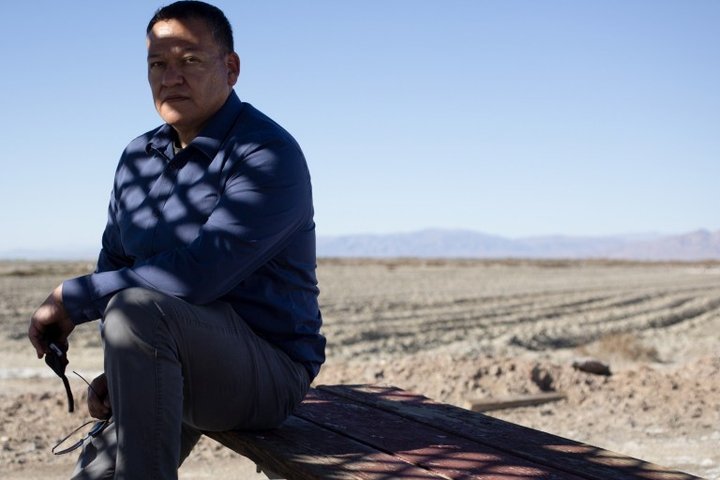
Luis Olmedo, executive director of Comite Civico Del Valle, called lithium extraction a “huge opportunity” but wants to ensure that low-income, mostly Latino communities in the Imperial Valley benefit. Photo by Shae Hammond for CalMatters
Imperial County planners exempted the lithium pilot project from environmental review requirements because the existing geothermal plant is already permitted. Full-scale commercial plants, however, would require environmental impact studies and new permits.
Most of the waste, which contains heavy metals, is reinjected in the ground from which it came, but some waste is held temporarily in ponds that are regulated by state officials to protect groundwater. The water board concluded that the lithium extraction would not alter the chemical properties of the waste, according to its 2020 report.
“We don’t anticipate any environmental issues,” Berkshire Hathaway Energy’s Weisgall said. Researchers at the Lawrence Berkeley National Laboratory and University of California, Riverside will test the demo project’s waste and emissions, he said.
Yet Katie Burnworth, who monitors the Salton Sea for the Imperial County Air Pollution Control District, said she worries that the waste might be hazardous. “It’s a dangerous, dirty process, with a lot of unknown material,” she said.
In 2006, CalEnergy’s geothermal facility was cited by state authorities for failing to properly dispose of hazardous materials after an inspection found elevated levels of arsenic and lead had been released into the environment. The company in 2007 entered into a consent agreement with state officials requiring a cleanup.
Another of the company’s power plants at the Salton Sea was fined by the air district for operating for seven years without an emissions permit.
The CalEnergy plants emit several toxic air pollutants, including hydrogen sulfide, ammonia and fine particles, according to state Air Resources Board reports.
Imperial County is eager to work with the industry to streamline the permitting process for lithium production.
“We’ve got to let them know that we want them here by making the permitting and planning process as least hard as it can be,” said Tim Kelley, CEO for the Imperial Valley Economic Development Corp., a public-private organization. “It’s never going to be easy and we want to make it easier for them.”
“We are fighting two fronts. One is supporting this huge opportunity. The other is whether those dollars are going to benefit the population of this region.” — Luis Olmedo, executive director of Comite Civico del Valle
Unemployment in the rural county hovers at 18%, about twice the state average. “Our biggest exports are water, crops and people,” Kelley said. “We want the jobs.”
CalEnergy, which employs about 250 people, estimates it would double its workforce if lithium production takes off.
“The first thing they are dangling is jobs, said Eric Reyes, an organizer with the group Amigos de la Comunidad. “We are all for jobs. But we cannot let everyone do whatever they want. Our community has a history of bending over for industry. We need to be smarter now. We are on the cusp of environmental disaster.”
James C. Hanks,president of the Imperial Irrigation District, which leases land to three geothermal operations, welcomes the potential for growth, but said desert denizens are ever-watchful for speculators.
“The toughest part is sorting through and figuring out who’s the real deal or not,” said Hanks, who also serves on the state’s new Lithium Valley Commission.
Business as usual is not going to be acceptable this time, Olmedo said. Jobs and a healthy environment are the goals. Whatever economic boon the county has gained from past development has not improved life in the region’s poorest communities, he said.
“They’re not getting more libraries. They are not getting better schools. They are not getting better community services,’” Olmedo said. “They are not getting better health care. They are getting nothing but sickness and exposure to unhealthy conditions.
“We are fighting two fronts. One is supporting this huge opportunity. The other is whether those dollars are going to benefit the population of this region. Now the real work begins.”
###
CALmatters.org is a nonprofit, nonpartisan media venture explaining California policies and politics.
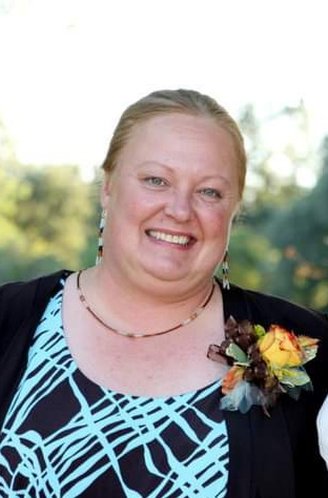
On Wednesday, February 17, 2021, Teresa “Mo” Wold passed
away at the age of 58 after a long battle with COPD and heart
failure.
Teresa
was born on August 13, 1962 in Eureka to Wayne and Emilie (Davis)
Vahldick. She attended Arcata High School, Class of 1980, earning her
GED during junior year while working full time.
In
the summer of 1982, Teresa married Rick Wold and they had two
children, Rachel and Jason. Though their marriage only lasted 6
years, their friendship remained lifelong.
Teresa
was caring, strong willed, independent and hard working. She was an
avid music lover, attending countless concerts and dancing freely to
the Grateful Dead, blues and rock ‘n’ roll.
Throughout
her career, Teresa worked primarily in radio and TV, doing voiceovers
and book keeping. In 2007, she earned her AA in business at the
College of the Redwoods and went on to become a tax preparer and
notary public.
Teresa
enjoyed riding horses and while doing so, she met and started dating
Steve Pettit in 1992 which led to a 29 year partnership. Together
they found a love for riding motorcycles, becoming members of the
Humboldt County Fog Dogs, United Bikers of Northern California (UBNC)
and Bikers Against Child Abuse (B.A.C.A.). They went on many
adventures on their bikes, creating endless friendships and memories
along the way.
Teresa
was known for her quick wit, infectious smile and wild spirit. She
was a dedicated daughter, loving sister, selfless mother and adoring
Grammy.
Teresa
was preceded in death by her mother, Emilie O’Neil and her father,
Wayne Vahldick. She is survived by her step father, Larry O’Neil,
partner Steve Pettit, daughter and son in law, Rachel and Chris
Boomgarden, grand daughters, Hayley and Emilie Boomgarden, son Jason
Wold, brother and sister in law, Jeff and Christy Vahldick, niece
Hannah Vahldick, half brother and sister in law, Phillip and Kelly
Erskine, nephew and nieces, Thomas, Sarah and Emily Erskine, step
brothers Shane, Jim and Larry O’Neil.
A
celebration of life will be scheduled at a later date. In lieu of
flowers, donations can be sent to B.A.C.A. at PO Box 6891, Eureka, CA
95502.
Teresa
“Mo” Wold left a lasting impression with all who knew her.
Her big personality lit up a room when she entered, the world will be
a darker place without her and she will be forever missed.
###
The obituary above was submitted on behalf of Teresa Wold’s loved ones. The Lost Coast Outpost runs obituaries of Humboldt County residents at no charge. See guidelines here.
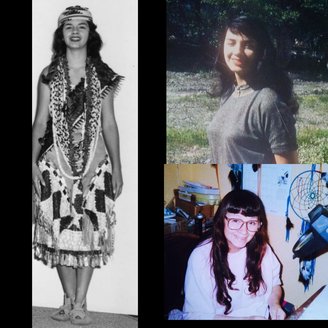
Delores
was born November 28, 1932 in Hoopa. She passed away February 21,
2021 in Hoopa surrounded by family. She was a member of the Hoopa
Tribe and of Yurok and Tewa Pueblo descent.
Dee
was an avid jewelry maker and well known for her abalone chip
necklaces/earrings, sampler necklaces and her manzanita branch
display with $1 necklaces and friendship bracelets. She always took
great pride in her creation’s necklaces, earrings, dream catchers
and pottery and always had them displayed just perfectly. There
wasn’t anything she couldn’t make.
Dee was
survived by her children Merwin Clark Sr., Clara Clark, Mekila (Tony)
Smith, and Randy Clark Sr., her grandchildren; Sunni Ulestad,
Carmelita Navarro, Michael (Misqiy’ts) Baldy, Falona (Michael)
Bailey, Brentley Clark, Merwin (Virginia) Clark Jr., Felicia (Monica)
Luna, Charlena (Rico) Tello, Abigail Luna, Mattaya Smith, Macie
Smith, Destiny (Matthew) Douglas, Shelby Clark and Randy Clark Jr.
and great grandchildren; Rodney, Merwin III and Brennan Clark, Tajia
Ulestad, Cohen Haller, George, Shaun and Mekila Navarro, Jaycee,
Bella, Rosaly, Jacklyn and Cy Baldy, Nate Baldy, Kylee and Charles
Sorrell, Khoko, Lola, Eliana, Liam, Eliyanah and Jerimiah Bailey,
Michael and Clara Tello and Beau Douglas. Siblings; Roger (Diggy)
Masten, Marla (Tooie) and Lou Blum, Nancy Redinous and numerous
nieces and nephews.
Dee
is preceded in death by her spouse of 56 years George (Bud) Clark,
daughter Charlene Baldy, parents, Cecil and Lorencita (Boots) Masten,
sisters Lorencita
(Gosee) Berry, Carmelita Fambrini and Cecil (Honeybunch) Jensen and
brother Larry Masten.
It
was her wishes not to have a burial or celebration of life.
*If
you are one of the lucky ones to have purchased or received one of
her beautiful pieces of work please display it proudly and often and
remember the beautiful lady who put so much love into it.
Grammy
Dee Today
Today
we must say our goodbyes Today
we must move forward Today
we must remember all the love you shown and taught us Today
we will not forget Today
we will not hold on Today
we will remember all the love you shown and taught us Today
we won’t say goodbye but see you later Today
we won’t move forward without forgetting where we came from Today
we won’t forget all the love you shown and taught us Today
we love you Today
we miss you Today
we remember all the love you shown and taught us
###
The obituary above was submitted on behalf of Dee Clark’s loved ones. The Lost Coast Outpost runs obituaries of Humboldt County residents at no charge. See guidelines here.
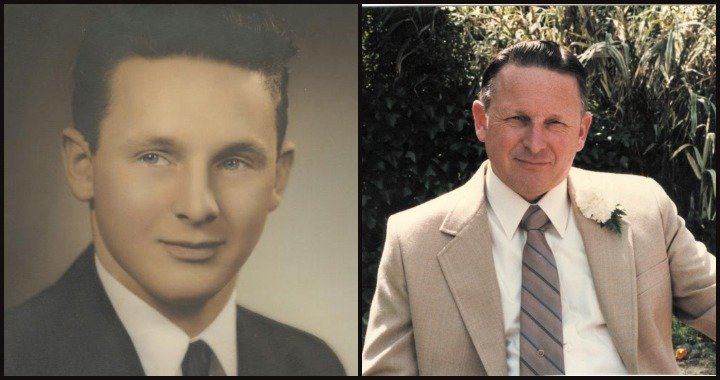
Dennis Leslie Grate was born
April 4, 1937 and died February 18, 2021.
He
was born in Olympia, Washington and at the age of 8 moved with his
family to Eureka where he spent the rest of his life, met his wife of
64 year, raised his family and lived a life of love, adventure and
friends. He never held a grudge and would help anyone who asked for
it. He was a bear without a bite. He loved old western movies a good
steak, surprising his wife with birthday parties, his dogs and being
a Knight of Columbus in the church.
He
had a passion for traveling and adventure via RV or cruise ships — it
didn’t matter as long as he was discovering something new. He
taught his kids how to camp, water-ski, drive, ride motorcycles, mow
the lawn, work hard and to enjoy the outdoors.
He is survived by his
wife Claudia, daughter Debbie and her husband Lynn Skidmore, daughter
Pamela and her husband John Stafford along with grand children Amber,
Michael, Brian, Skylar, Danie and Simone; as well as 5 great grand
children, numerous cousins and nephews.
He
is preceded in death by his daughter Dena, mother Mary, Father Les,
brothers Ron and Rick, sisters Sandy and Marsha.
He
will be missed by everyone who loved him. A celebration of life will
happen when we can all get together again.
###
The obituary above was submitted on behalf of Dennis Grate’s loved ones. The Lost Coast Outpost runs obituaries of Humboldt County residents at no charge. See guidelines here.