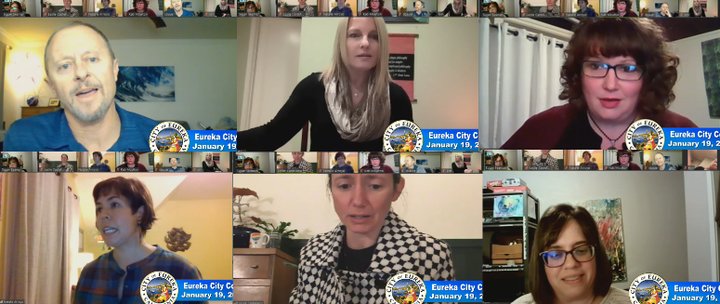
Eureka City Councilmembers (clockwise from top left) Scott Bauer, Kim Bergel, Kati Moulton, Natalie Arroyo, Leslie Castellano and Mayor Susan Seaman | Screenshots from online meeting Jan. 19
###
The Humboldt Area Center for Harm Reduction (HACHR) will again be allowed to provide needle exchange services in Eureka, after the City Council voted on Tuesday to allow the controversial nonprofit to operate a mobile syringe exchange program (SEP) in the city during the COVID-19 pandemic.
The council’s decision follows multiple meetings and countless hours of deliberation surrounding HACHR and syringe exchange programs. Last month the council temporarily banned SEPs entirely and, at the most recent meeting, the council adopted an emergency resolution allowing mobile SEPs during the pandemic. Like with some of those previous discussions, the council members did not see eye to eye and the vote to approve HACHR’s plan was 3-2, with Councilmembers Kim Bergel and Scott Bauer dissenting.
Most of the council’s disagreement surrounded the language used in HACHR’s proposal, which disparaged some of the council’s requirements for mobile SEPs, including that they adhere to a strict one-for-one exchange.
“HACHR will abide by a one-for-one exchange rate, with the understanding that this is implemented for the purpose of ‘optics’ and community relations, since there is no scientific proof that this measure reduces syringe litter,” HACHR Executive Director Lasara Firefox Allen read from the proposal during the meeting.
Allen then explained why the organization chose to include this language, saying that they had consulted with other agencies and experts and that, because it is a “precedence-setting document” that it was important for HACHR to note its reasons for dissent.
Both Bergel and Bauer felt that the language in the proposal was unnecessary. “To fill an operations plan with commentary is very disappointing to me,” Bauer said.
Like in several recent meetings, Bergel expressed that she no longer had any interest in working with HACHR, saying that the organization’s attitude has been unprofessional.
“I do not support this plan and as a city I think we can do better with partnerships,” Bergel said during the meeting. “… If you want to work together and collaborate then you don’t pick every little thing apart. We are not 16 in high school. We are grown-ups and this is not the way to do business. I think that, once again, the attitude is ‘we are entitled and we’ll do what we want and get what we want.’ And that ship has sailed, at least for me. “
Though many of the councilmembers shared a distaste for the commentary in HACHR’s proposal, councilmembers Natalie Arroyo, Leslie Castellano and Katie Moulton felt that the plan did adhere to the city’s requirements and that Eureka needs more syringe services during the pandemic. “I would support anything to address that, and this proposal meets all the requirements,” Councilmember Moulton said.
City Attorney Bob Black recommended that the council request the dissenting language be removed from the proposal and that the word “interim” be added to clarify that this would be a temporary SEP plan. The council can come back and revoke the approval at any time, Black added, if the council feels that the program is not working out.
There was also a lot of discussion surrounding the proposed locations of the mobile exchange, with city staff identifying two of HACHR’s proposed locations as not suitable, due to nearby environmentally sensitive habitats. Allen said that HACHR was completely open to changing locations, and agreed to have those spots removed from the proposal.
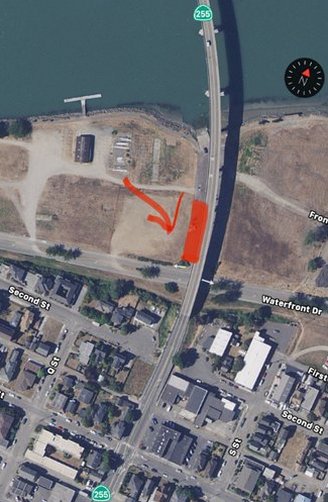
Map showing one of the proposed mobile SEP locations near the Samoa Bridge | From HACHR’s proposal
Ultimately, the council approved three locations for HACHR to operate the mobile SEP: under the Samoa Bridge, the north end of the Bayshore Mall parking lot and a parking lot on A Street near the St. Vincent De Paul free meal. The third location will require written permission from the property owner.
Some councilmembers and community members in attendance also expressed concern over the cleanup process and, at the request of Councilmember Bergel, HACHR and city staff will do a walk-through of each site to identify what portion of the surrounding area HACHR staff will be responsible for cleaning up. Bergel also made a separate motion — which the council unanimously passed — requiring HACHR be responsible for cleaning up any waste related to drug paraphernalia, including cookers, alcohol wipes and needle caps.
HACHR will also need to go through some additional steps in the approval process before it can begin operating the program, including providing proof of auto insurance, liability insurance and workers’ compensation insurance. Once operational, HACHR’s mobile outreach vehicle will also provide other harm reduction services including smoking kits and overdose prevention supplies.
Councilmember Arroyo wanted to remind the community members who are invested in this topic that the council’s decision is temporary and the council will continue to work toward drafting a more permanent ordinance governing syringe services in the city.
“I really do look forward to having a more robust resolution that includes all of your concerns and I see this as an interim measure only and I also look forward to seeing any other proposals that might come forward,” Arroyo said.
Humboldt County Administrative Office press release:
Tools for building trails in the McKay Community Forest that were recently stolen have been replaced thanks to the generosity of several local businesses.
Shafer’s Ace Hardware, Pierson Building Center, Katri and Dart Electric and Revolution Bicycles have all aided in the cause to replace the stolen items which included 11 round and 4 square point shovels, 8 rakes and 3 pruning loppers with a total value of approximately $750.
“We are so lucky to live and work in a community with so many giving individuals and companies,” said Humboldt County Public Works Director Tom Mattson. “The needed tools will allow the county to move forward with this community project.”
The burglary was reported on Dec. 18, 2020, after it was discovered the tools were taken from a county-owned storage container that was broken into. The tools were intended to be used by the California Conservation Corps and Volunteer Trail Stewards to help build and maintain forest trails. The four businesses contacted the Humboldt County Public Works Department immediately after the news of the burglary was announced and offered to assist with replacing the tools or moving the storage container to a more secure location.
The county recently released the final McKay Community Forest Trail Plan along with the associated environmental report. The trail plan proposes a trail network with 31 miles of multi-use roads, multi-use trails, hiking trails, and mountain bike trails. Trail building will begin after the Board of Supervisors adopts the environmental report and public health guidelines allow group gatherings.
Anyone with information on the stolen items is asked to call the Sheriff’s Office at 707-445-7251 or the Sheriff’s Office Tip Line at 707-268-2539. The case reference number is 202006293.
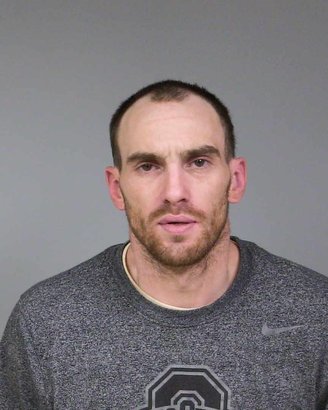
Since August of 2019 the Humboldt County Drug Task Force (HCDTF) has served three search warrants on Dustin Lawler (36 years old Mckinleyville). The three search warrants were all served on his previous residence in the 3500 block of Dows Prairie Rd. in Mckinleyville. In January of 2021 the HCDTF received information that Lawler was now selling drugs out of a mobile home in the 1900 block of Palomino Ln. in Arcata. This address is located within the Lazy J 55+ senior living park. HCDTF agents conducted an investigation and were able to obtain a search warrant for Lawler and his residence.
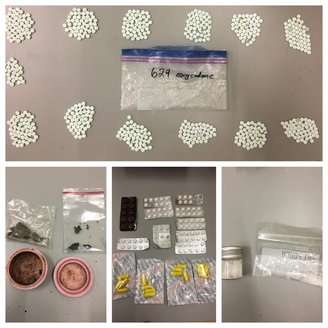
On January 20th, 2021 special agents with the HCDTF served the search warrant on the residence. Lawler was detained on scene along with three other visitors. Agents conducted a search and located the following evidence:
629 Oxycodone pills
16 steroid/HGH pills
20 Xanax pills
85 misc. pills
7 grams heroin
2 grams methamphetamine
two digital scales and packaging
$4,980 in US currency
Lawler was arrested and transported to the Humboldt County Jail for the following charges:
H&S 11351 Possession of controlled substance for sale
H&S 11375(B) Possession of controlled substance for sale
PC 12022.1 Committing a felony while out on bail
H&S 11366 Operating or maintaining a drug house
Lawler has shown a consistent pattern of selling drugs in Humboldt County with no intent to stop. Based off this HCDTF agents requested a bail increase for Lawler along with a requirement to provide proof of where bail funds were obtained from pursuant to penal code sections 1269/1275 PC. A Humboldt County Superior Judge signed the order and Lawler’s bail was raised to $360,000.
Anyone with information related to this investigation or other narcotics related crimes are encouraged to call the Humboldt County Drug Task Force at 707-267-9976.
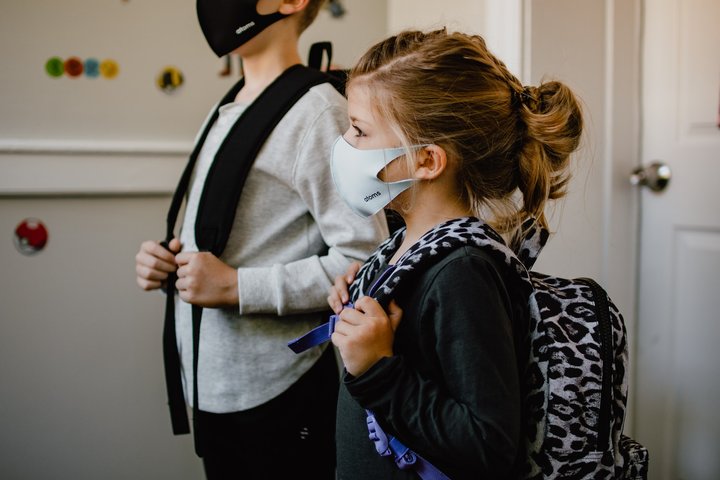
With a slew of incoming federal and state funds, Humboldt’s school
districts will soon have money coming at ‘em from all sides, and
with it districts will continue to pursue progress — whether it be
by officially breaking from distance learning, instituting learning
loss programs or further addressing COVID-related equity gaps. Aside
from districts’ hopes and dreams for them, though, the funds
themselves (particularly those from California) come with some
uncertainty.
At
the end of December, Governor Gavin Newsom unveiled his Safe
Schools for All plan, a $2 billion, yet-to-be approved
proposal encouraging elementary schools to reopen. Claiming that “the
right precautions can effectively stop the spread of COVID-19 in
schools — particularly in elementary grades,” Newsom’s
administration maintains that in-person instruction is important to
both the academic and social-emotional wellbeing of students. By
promising funding of $450 to $700 per student to schools that reopen,
Newsom hopes to help grades K-6 return to the classroom this spring,
with grades K-2 returning under the plan as soon as February. The
plan coincides with the projected time vaccines will likely be
available to childcare and education workers in California.
Only
schools located in counties with an average daily infection rate
below 25 cases per 100,000 are eligible to partake in the program (at
the moment, Humboldt falls within that margin at a daily
infection rate of 18.3), and to participate, schools
must submit a reopening plan for approval to state and local health
authorities by February 1 (a later submission would result in lower
funding allocations).
“If I have $450 to $700 per student, but each test costs me $50, where’s the rest of that going to come from? Where’s the infrastructure for administering the test to staff and students?” — Alyse Nichols, Trinidad Union School District superintendent
A
couple of local superintendents contacted for this article didn’t
want to comment on the Safe Schools for All plan because the
information they had was only preliminary, and they felt too unsure
of the yet-to-be approved legislation to discuss it. As the $2
billion proposal awaits approval (it’s a part of California’s
2021-2022 budget, but Newsom will seek early action by the
legislature for this specific piece of the budget so it can get
started ASAP), local elementary superintendents are unaware of
certain details and whether the plan is logical for Humboldt’s
schools at all.
For
instance, participation in Safe Schools for All requires weekly
testing of staff and students in counties with an average daily
positive infection rate above 14 per 100,000. Some superintendents
say weekly testing is likely not feasible. Furthermore, under the
plan, districts would be able to purchase tests at one-third the
market rate from Valencia Branch Laboratory, a state-run testing lab,
but elementary school administrators aren’t sure it would be
affordable, despite the extra cash.
Trinidad
Union School District Superintendent Alyse Nichols said she’d like
to participate, but has hesitations about the testing requirement. “I
don’t know how much it’s going to cost me to run a test. So if I have
$450 to $700 per student, but each test costs me $50, where’s the
rest of that going to come from? Where’s the infrastructure for
administering the test to staff and students?”
Nichols
also wonders whether it’s feasible to depend on the state for PPE
— another promise of Safe Schools for All — remembering that
Trinidad Union School District was set to receive PPE from the state
at the beginning of the school year. “It trickled in through
October, but it still wouldn’t [have been] enough if we had our
students back on campus,” Nichols said.
Though
Newsom’s plan would allow for Trinidad to reopen in the purple —
provided Humboldt stays below an infection rate of 25 per 100,000 —
Nichols said that the district won’t open under current conditions,
and will opt out of Safe Schools for All if local infection rates
don’t send Humbodlt back into the orange (moderate) or yellow
(minimal) tier. The staff is “excited to get kids back in the
classrooms, but we just really want to do it safely,” Nichols said.
Beyond inviting about 15 students in need of extra support to campus
while Humboldt wasn’t in the purple tier, Trinidad hasn’t
reopened their campus since COVID arrived.
In
Fortuna, the elementary school district has been offering in-person
instruction since early October — a decision that was driven by
opinions provided by the majority of families and employees who
responded to district surveys about modalities. Superintendent Jeff
Northern told the Outpost in an email that he hopes to
participate in Safe Schools for All, which would allow the district
to continue offerings initially made possible by CARES Act aid. With
those funds, they extended the full-time equivalent of English
Learners and Intervention teachers, were able to pay some staff extra
hours, upgraded technology and secured licenses for online teacher
seminars. But Northern expressed similar skepticism about the
feasibility of testing students and staff weekly, describing the
undertaking as “completely overwhelming and likely not possible.”
“I
am hopeful the state will resolve those questions and eventually
streamline the process so that educators will have access to the
funding that includes more reasonable expectations and/or
requirements,” he wrote.
The
Safe Schools for All plan has received pushback from other California
superintendents. Seven superintendents of California’s largest
districts co-authored a letter to Newsom, which said that the plan
“does not address the disproportionate impact the virus is having
on low-income communities of color.”
Newsom’s
hopes to fund reopening fits nicely with the stimulus plan President
Joe Biden announced last week, which would, if approved, direct 130
billion toward K-12 schools. These relief funds won’t be contingent
on reopening, but Biden has expressed intentions to assist in safely
reopening most American schools during his first 100 days in office.
Right
now, all that’s guaranteed to districts is federal relief funding
from the stimulus package that passed in late December, which
included 54 billion in aid for K-12 schools (the CARES Act
distributed 13.2 billion).
We
reached out to several superintendents to ask how these funds will be
spent in contrast to CARES Act funding, but few responded, mostly
saying that it’s too early to tell.
Humboldt
County Office of Education Superintendent Chris Hartley told the
Outpost in an email that most districts continue to face needs
in distance learning, but are looking onward toward reopening and
addressing learning loss. “General areas of need for most our
districts are around increasing technology access for students and
families that are in geographical areas of limited internet
availability (including hardware/software), student meals, continued
COVID-19 related safety equipment, potential facility upgrades
related to HVAC and/or ventilation systems, looking boost to after
school and possible summer remediation programs, staffing and
professional development,” Hartley said.
““We’ll definitely be using some of that money to add opportunities for kids, whatever that could be — whether it’s tutorial, or whether it’s actually more sections so we can have more courses offered to help kids catch up.” — Roger Macdonald, Northern Humboldt Union High School District superintendent
A
couple superintendents reached for this story said that the federal
stimulus funding will be spent similarly to how CARES funding was
spent.
“The
funds will assist us to maintain the quality of services we have been
offering while attempting to address aspects associated with
potential learning loss,” Heidi Moore-Guynup, McKinleyville Unified
School District superintendent said in an email in regard to incoming
federal relief aid. Their district, which has stuck to distance
learning so far, is looking at a summer school opportunity,
Moore-Guynup said, which would address learning loss.
At
the Northern Humboldt Union High School District, CARES funds bought
technology, internet devices, PPE, air purification systems and
on-site intervention for students in need of in-person support during
distance learning. And with the new semester, they’ve launched a
credit-recovery class for students who have fallen behind during
COVID, which was also paid for in part with CARES funds.
“That
was the gist of it: What did we need for distance learning, and what
do we need to do to prepare for having our kids come back on campus,”
Superintendent Roger Macdonald told the Outpost.
With
more funds to come, Macdonald’s assessment of how new money might
be spent reflects progression of COVID in education. With distance
learning equipment now accounted for, the focus continues to be on
what the district needs for returning to campus (such as hand washing
stations or more PPE, Macdonald explained). But in addition to that,
the district will also use “a big chunk” to further address the
impacts of distance learning, by instituting programs similar to the
one NoHum introduced earlier this month.
“As
we look at the grades, if we see that students have fallen way
behind, we may need to use some of that money to hire more teachers
or pay teachers to teach an extended day,” Macdonald said. “We’ll
definitely be using some of that money to add opportunities for kids,
whatever that could be — whether it’s tutorial, or whether it’s
actually more sections so we can have more courses offered to help
kids catch up.” Macdonald added that these are initial thoughts,
and there are other directions the funds might go as well.
Humboldt’s,
California’s and the nation’s infection rates are far higher now
than they were at the beginning of the school year, but a lot has
changed since then. Most monumental is vaccinations. Education and
childcare workers are in line to be vaccinated during phase 1B, which
is projected to happen early- to mid-February. Many districts have
addressed logistical setbacks to reopening by updating outdated
filtration and ventilation systems.
At
the NoHum board meeting this month, trustees voted to move forward
with reopening schools five or six weeks after staff have had the
opportunity to get their first dose of vaccine, with the health
department’s approval. At the meeting, Macdonald noted that whether
the district can reopen will depend on the county’s infection rates
at that time. In their company is the Eureka City School District,
which earlier this month also passed a motion to reopen once staff
have been vaccinated, on an estimated date of February 22.
At
the beginning of the 2020-2021 academic year, only 10 schools opened
with in-person instructional models. Now there are 55 schools in
Humboldt offering either in-person or hybrid instruction, according
to this
spreadsheet, which is regularly updated by the
Humboldt County Office of Education. With the help of federal and
(maybe) state funding, more are planning to follow.
Three days after the state placed a pause on administering 330,000 doses of Moderna’s COVID-19 vaccine due to reports of allergic reactions, California Public Health officials have announced that there is “no scientific basis to continue the pause.”
The previously suspect lot, Moderna 041L20A, represented a week’s worth of doses for the state. Humboldt County Public Health had 4,100 doses of that batch in its freezer and had already administered some doses to local residents, according to Public Heath Officer Dr. Ian Hoffman.
California State Epidemiologist Dr. Erica Pan issued the following statement late Wednesday, advising providers that they can immediately resume use of the vaccine:
Our highest priorities are to ensure that vaccines are safe and effective, and distributed equitably and efficiently.
Out of an abundance of caution, we recommended that providers pause the distribution of Moderna COVID-19 vaccine lot 41L20A on Sunday evening. Yesterday, we convened the Western States Scientific Safety Review Workgroup and additional allergy and immunology specialists to examine the evidence collected. We had further discussions with the County of San Diego Department of Public Health, the FDA, CDC and manufacturer, and found no scientific basis to continue the pause. Providers that paused vaccine administration from Moderna Lot 41L20A can immediately resume.
These findings should continue to give Californians confidence that vaccines are safe and effective, and that the systems put in place to ensure vaccine safety are rigorous and science-based. Members of my family who have qualified to receive the vaccine as health care workers or because of their age have already received the COVID-19 vaccine, and I encourage every Californian to get the vaccine when it’s their turn.
Press release from the Humboldt County Sheriff’s Office:
The Humboldt County Sheriff’s Office has recently received several reports of a common phone scam circulating again around the community.
As part of this scam, the scammer claims they are from the Humboldt County Sheriff’s Office, or another law enforcement entity, and may use several different names, including the names of current and former HCSO employees, such as Lt. Kevin Miller, Investigator Scott Hicks or Lt. Steve Knight. The scammer may tell the victim:
They have warrants for their arrest (may be for a variety of reasons, including missing jury duty or a criminal violation) and would be arrested immediately unless they sent money to the scammer;
They are raising funds for fallen officers and would like the victim to make a donation;
Their loved one is in jail and needs their help to post bail.
In all of these situations the scammer may ask for gift cards, cash or personal information, and may threaten to arrest you if you do not comply.
Protect Yourself from Theft
Spot imposters
Scammers often pretend to be someone you trust, like a government official, a family member, a charity, or a company with which you do business. Don’t send money or give out personal information in response to an unexpected request – whether it comes as a text, a phone call or an email. If a scammer is impersonating a loved one or government official, call back at a publicly listed number for the organization from which the scammer claims to be or contact your loved one directly.
Do online searches
Type a company or product name into your favorite search engine with words like “review,” “complaint” or “scam.” Or search for a phrase that describes your situation, like “Social Security call” or “grandparent scam.” You can even search for phone numbers to see if other people have reported them as scams.
Don’t believe your caller ID
Technology makes it easy for scammers to fake caller ID information, so the name and number you see aren’t always real. If someone calls asking for money or personal information, hang up.
Talk to someone
Before you give up your money or personal information, talk to someone you trust. Con artists want you to make decisions in a hurry. They might even threaten you. Slow down, check out the story, do an online search, consult an expert — or just tell a friend.
Don’t rely on personal information
Living in the digital age, access to information is easier than ever. Scammers are often able to get their hands on very personal information, including the names, ages, and addresses of your loved ones, providing it to their victims to make their scam look more legitimate. Don’t trust a scammer who is able to provide your or your loved one’s personal information.
Sign up for the Federal Trade Commission’s scam alerts at ftc.gov/scams.
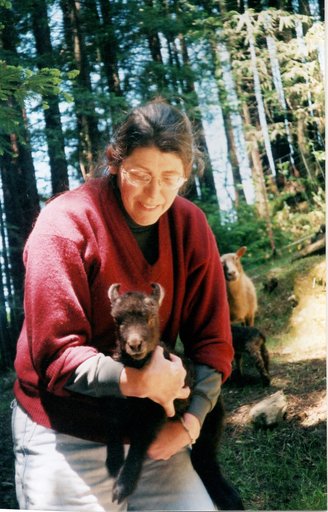
In
loving memory of Kathleen Capps, who lost her battle with kidney
disease at the age of seventy-two, two days after Christmas
2020.
Kathleen grew up in Half Moon Bay, California with
her older sister and younger brother, a few blocks from the Pacific
Ocean. Her childhood was mostly spent between the outdoors, with her
father’s extensive, Portuguese family in Los Banos, and reading a
LOT of books. From an early age, she decided upon a career as a
writer. Her first piece was published when she was a senior in High
School, a poem titled “Light.” The pursuit of writing
led Kathleen to academia, and Humboldt State University, where she
met John, her first husband. Kathleen and John had two children,
Jeremy and Abby, settling in Jacoby Creek, on a cabin and fifteen
acres of redwood trees, with the plan to raise goats. Kathleen fell
in love with the land, but the marriage was not long lasting, and she
craved a return to return to school, so went back to attending HSU,
and living in Arcata. After she received her B.A. in English in
1978, and a couple years spent studying for an M.A. in Monmouth,
Oregon, Kathleen purchased the land in Jacoby Creek, and moved back
out to the cabin and woods she loved.
Kathleen
was slowly going blind and losing her hearing, which meant learning
braille and sign language, Fiercely independent, and not wanting to
be treated as “disabled”, Kathleen still did as much as she
could. She even was able to drive a car for a few years, equipped
with low vision glasses that had mini-telescopes. She purchased a VW
Bug from Roger’s Garage, across from Jacoby Creek Elementary school
in Bayside, and drove back to visit her parents in Half Moon Bay for
Thanksgiving 1981. The trip was slightly marred by a dramatic
mechanical failure in the middle of crossing the Golden Gate
bridge.
Despite her vision loss, Kathleen was an avid
photographer, joking that she could not see, but the camera could.
She would take on carpentry projects, even building additional rooms
onto the Jacoby Creek cabin, and refinished antique furniture,
stashing bits of wood in all corners for “future projects”.
Kathleen also loved the visual arts, trying her hand at bronze
sculpture, as well as acrylic on canvas, and filled many sketchbooks
with ink and charcoal.
In
1986, Kathleen received her M.A. from HSU, and spent a few years
working on novels, poems, and short stories at the cabin. Craving
the Ivory Tower, Kathleen moved to Eugene, OR, and dove into the
study of semiotics, especially the connection between the poetry of
Ezra Pound and the art of Pablo Picasso. After receiving her PhD in
Literature from the University of Oregon in 1998, now almost
completely deaf and blind, Kathleen moved back to the cabin at Jacoby
Creek, this time to raise Icelandic sheep.
She
spent most of her last years with 20 sheep, spinning and knitting
their wool in Jacoby Creek, until her age and health dictated she
move into Arcata, late 2016. Kathleen could not bear to be parted
from her last lamb born in Jacoby Creek, Bummer, so named as he was
rejected by his mother, so kept him in the backyard of her Arcata
house until she passed.
Kathleen
is survived by her sister Sylvia, her brother Paul, and her children,
Jeremy and Abby.
Donations in her memory can be made to Shannon
Miranda’s in Fortuna, now caring for Bummer (link here), or PACE,
the organization that helps seniors live in their own home as long as
they can (at this link).
###
The obituary above was submitted on behalf of Kathleen Capps’ loved ones. The Lost Coast Outpost runs obituaries of Humboldt County residents at no charge. See guidelines here.