NOTE: Humboldt County is not in the purple tier at this time.
###
From the Office of Governor Gavin Newsom:
In light of an unprecedented, rapid rise in COVID-19 cases across California, Governor Gavin Newsom and the California Department of Public Health (CDPH) today announced a limited Stay at Home Order requiring generally that non-essential work, movement and gatherings stop between 10 PM and 5 AM in counties in the purple tier. The order will take effect at 10 PM Saturday, November 21 and remain in effect until 5 AM December 21. This is the same as the March Stay at Home Order, but applied only between 10 PM and 5 AM and only in purple tier counties that are seeing the highest rates of positive cases and hospitalizations.
“The virus is spreading at a pace we haven’t seen since the start of this pandemic and the next several days and weeks will be critical to stop the surge. We are sounding the alarm,” said Governor Newsom. “It is crucial that we act to decrease transmission and slow hospitalizations before the death count surges. We’ve done it before and we must do it again.”
This limited Stay at Home Order is designed to reduce opportunities for disease transmission. Activities conducted during 10 PM to 5 AM are often non-essential and more likely related to social activities and gatherings that have a higher likelihood of leading to reduced inhibition and reduced likelihood for adherence to safety measures like wearing a face covering and maintaining physical distance.
“We know from our stay at home order this spring, which flattened the curve in California, that reducing the movement and mixing of individuals dramatically decreases COVID-19 spread, hospitalizations, and deaths,” said California Health and Human Services Secretary Dr. Mark Ghaly. “We may need to take more stringent actions if we are unable to flatten the curve quickly. Taking these hard, temporary actions now could help prevent future shutdowns.”
“We are asking Californians to change their personal behaviors to stop the surge. We must be strong together and make tough decisions to stay socially connected but physically distanced during this critical time. Letting our guard down could put thousands of lives in danger and cripple our health care system,” said Dr. Erica Pan, the state’s acting Public Health Officer. “It is especially important that we band together to protect those most vulnerable around us as well as essential workers who are continuing their critical work amidst this next wave of widespread community transmission across the state. Together we prevented a public health crisis in the spring and together we can do it again.”
COVID-19 case rates increased by approximately 50 percent in California during the first week of November. As a result, Governor Newsom and California’s public health officials have announced a list of measures to protect Californians and the state’s health care system, which could experience an unprecedented surge if cases continue their steep climb.
On Monday, the state pulled an emergency brake in the Blueprint for a Safer Economy putting more than 94 percent of California’s population in the most restrictive tier. The state will reassess data continuously and move more counties back into a more restrictive tier, if necessary. California is also strengthening its face covering guidance to require individuals to wear a mask whenever outside their home, with limited exceptions.
Late last week, the state issued a travel advisory, along with Oregon and Washington, urging people entering the state or returning home from travel outside the state to self-quarantine to slow the spread of the virus. The travel advisory urges against non-essential out-of-state travel, asks people to self-quarantine for 14 days after arriving from another state or country, and encourages residents to stay local.
On November 19th, 2020, special agents
with the Humboldt County Drug Task Force (HCDTF), with the assistance
from the Humboldt County Sheriff’s Office (HCSO), Federal Bureau of
Investigation (FBI), and a K-9 Officer from the Arcata Police
Department (APD) served a federal Steagald warrant on Glendale Dr. in
Blue Lake. This warrant was issued to apprehend federal fugitive
Terrance Reeves on a federal probation violation warrant.
When
agents arrived at the property Reeves was standing next to a vehicle
in the driveway. Reeves immediately ran from agents into a wooded
area behind the residence. The APD K-9 Officer and agents pursued
Reeves for approx. 150 yards through the woods with the APD K-9
Officer giving several warnings to stop or he would deploy his K-9.
Reeves continued to flee at which time K-9 Baron was deployed and
apprehended Reeves.
Baron.
Agents
searched Reeves incident to arrest and located ammunition and
methamphetamine in his pocket. Reeves suffered injuries during the
K-9 apprehension. An agent from HCDTF who is also an EMT provided
medical assistance to Reeves prior to an ambulance arriving. Reeves
was transported to a local hospital for medical clearance and then
was booked at the Humboldt County Jail. Reeves will be transported to
a federal detention center by the US Marshalls.
The
HCDTF would like to thank the HCSO, APD, and FBI for their assistance
with this investigation.
Anyone
with information related to this investigation or other narcotics
related crimes are encouraged to call the Humboldt County Drug Task
Force at 707-267-9976.
Press release from the Department of Health and Human Services:
Mental health and substance use challenges are increasing as the pandemic stretches into the winter months, prompting local health officials to remind residents of resources that can be accessed remotely.
According to a recent Centers for Disease Control and Prevention (CDC) Morbidity and Mortality Weekly Report on “Mental Health, Substance Use and Suicidal Ideation During the COVID-19 Pandemic,” U.S. adults reported increased anxiety and depression symptoms, trauma and stress-related symptoms, new or increased substance use and having seriously considered suicide in the last month.
“Younger adults, racial/ethnic minorities, essential workers and unpaid adult caregivers reported having experienced disproportionately worse mental health outcomes, increased substance use and elevated suicidal ideation,” the report states.
The Substance Abuse and Mental Health Services Administration stated the findings of the report are troubling, but unfortunately not surprising. “Research is clear on the effect of shutdown and social isolation on an individual’s mental health,” the organization stated. “The negative health effects are potentially long-lasting and very consequential for individuals and their families.”
Humboldt County Department of Health & Human Services (DHHS) Behavioral Health Substance Use Disorder Administrator Raena West said the pandemic has been difficult on everyone and can especially be challenging for those experiencing addiction, in recovery from a substance use disorder, suffering from mental health issues and those in at-risk populations cited by the CDC.
“It’s important that the community knows that Behavioral Health services are available,” West said. “We invite people to call so we can explain the expanded services available to meet people where they are in their recovery. You’re not alone. We know times are tough right now, and we are here to help.”
DHHS resources include:
Substance Use Disorder Services — 707-476-4054
Behavioral Health Warm Line — 707-268-2999
24-Hour Behavioral Health Crisis Line — 707-445-7715
The good news: The recession California officials predicted in the early months of the coronavirus pandemic has not been as dire as they thought it would be, leaving the state with a $26 billion windfall heading into the next fiscal year.
The bad news: A reason for the unanticipated cash reveals the state’s stark economic divide. Pandemic-induced job losses have been concentrated among low-wage workers, who pay relatively little taxes to begin with, while wealthy residents have continued to make money and pay taxes, leading to much greater tax collections than officials predicted in early summer.
“We’re ending up in a place where the overall fiscal picture of the state doesn’t look nearly as bleak as the conditions for the people who are weathering the pandemic and all of its negative effects,” said Chris Hoene, executive director of the California Budget and Policy Center.
“It’s a very weird situation.”
That was the picture that emerged Wednesday as California’s nonpartisan Legislative Analyst released an annual forecast that lawmakers will use in crafting next year’s state budget. The report precedes Gov. Gavin Newsom’s January budget proposal, which kicks off months of negotiations with the Legislature.
Though the windfall will likely make some of their decisions easier, the report also came with a warning: California is heading toward a $17 billion deficit in three years because expenses are growing faster than revenue. That leaves lawmakers with two politically unappealing choices: make ongoing spending cuts or raise taxes.
“While the budget is better off than we had feared several months ago, deficits are still on the horizon, and better-than-expected revenues haven’t translated into an economy that’s fully rebounding,” Newsom’s finance spokesperson H.D. Palmer said in a statement.
“The state’s 11 percent unemployment rate in September is still nearly three times its rate before the pandemic, and more than one in every five California workers are receiving some form of unemployment assistance.”
Legislative leaders were quick to say they hope to use some of the windfall to restore cuts made in this year’s budget. That could include restoring $602 million to universities, reversing the roughly 10% pay cut state workers took, and canceling plans to delay some payments to schools and suspend some programs for people who are elderly and developmentally disabled. They also suggested using some of it to repay recent borrowing, prepare for emergencies and help people who don’t have homes.
“California is the fifth largest economy in the world, the cutting edge, but we have people hurting,” said state Senate leader Toni Atkins, a San Diego Democrat.
A forecast showing strong state finances likely sounds jarring to millions of Californians who are out of work, or strained by having their children home from school, or whose businesses have suffered from government-ordered shutdowns, Atkins said: “Not everybody feels this forecast. They don’t feel it personally.”
Assembly Speaker Anthony Rendon said he agreed with Atkins’ priorities and also plans to push for a budget that allows schools to reopen safely, ensures distribution of a COVID vaccine when it becomes available and improves the Employment Development Department, which has been plagued with problems in the crush to distribute unemployment checks to millions of people.
Republicans hold so few seats in the Legislature — about one-fourth — that they are essentially powerless in shaping the state budget. Still, GOP Sen. Jim Nielsen of Tehama urged his Democratic colleagues to be prudent, saying “This is the right time to reverse the state’s borrowing from schools, replenish the Rainy Day Fund, pay down debt, and invest in struggling Californians.”
Illustrating the extremely unpredictable nature of the pandemic-era economy, the Legislative Analyst described how several factors combined to lead to the estimated $26 billion one-time surplus:
Californians paid more taxes than officials projected.
Unemployment did not get as bad as predicted.
Fewer people than the state budgeted for sought government-funded health care and food assistance.
The California-based tech industry is doing very well during the pandemic, contributing to a strong stock market.
“Many of us thought that state revenues were headed for a plunge in response to the severe economic pullback and COVID-19 pandemic,” Legislative Analyst Gabe Petek told reporters in a video conference call.
“But as it turns out, revenues have proven to be much more resilient. And as a result of that — the difference between what the budget assumed and this more steady performance of the state tax revenues — we see a very large revenue windfall taking shape.”
He cautioned, however, that it remains difficult to predict economic conditions over the next year, given massive unknowns that could shape state finances for better or worse. Those include how bad the virus gets, how soon a vaccine becomes widely available and whether the federal government passes another stimulus package.
“Because of that uncertainty… this $26 billion windfall could be anywhere from $12 billion all the way up to $40 billion,” Petek said. “And that’s just within sort of what we consider a more likely range of outcomes.”
Translation: For California’s finances, the unpredictable nature of 2020 is poised to continue in 2021.
###
CALmatters.org is a nonprofit, nonpartisan media venture explaining California policies and politics.
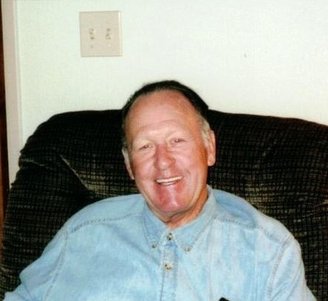
Thomas
(Tom) Lee Page was born July 17, 1940 in Arcata to Otha and Helen
Page. He passed away on October 18 after a long battle with dementia.
Tom
grew up in Arcata and graduated from
Arcata High School in 1958. After high school he worked at Durable
Mill until the age of 22, when he enlisted in the U. S. Army for two
years. While in the Army Tom was stationed in Germany as a tank
turret
mechanic.
Once back from the Army in 1964 he returned to work at Durable Mill
and later began working at Simpson Mad River Mill.
In
August of 1968, on a blind date, Tom met the love of his life Delores
(Dee) Andrada. They were engaged in December of that year and married
on February 14, 1969. The couple purchased their first home together
in Arcata in 1970 and welcomed their daughter Sherry into the world
in the summer of 1971. Dee worked as a LVN at Granada convalescent
until they decided to open a business. In 1985 Tom and Dee began
having a new home and business constructed in the Grace Park
neighborhood of McKinleyville. In the summer
of 1986 the family moved into their new home, where the couple opened
Page’s Care Home, a six-bed residential care home for the elderly.
They successfully operated this business together until 2005 when
they retired.
Tom
loved to tinker, fix things and
take broken things apart and save parts that “might come in handy
someday.” He was a quiet person, but to those who knew him well he
was a kidder and loved to joke around (particularly with his
grandchildren). Tom was very sentimental, particularly to things that
had belonged to his parents. He was always kind and considerate to
others and never wanted to upset anyone. Tom enjoyed attending North
Fork Full Gospel Church with Dee where he met new caring church
friends that were very supportive as his health declined.
Tom
was survived by his wife of 51 years, Dee Page, his daughter Sherry
Guffey & son-in-law Derek Guffey, grandchildren Sara Guffey and
Cole Guffey and great-granddaughter Tilly Hungness. Tom also survived
by his brother Gary Page and sister-in-law Evelyn Page, sister-in-law
Patrica Holtgrewe (Ken Holtgrewe) and sister-in-law Debbie Andrada
(Cliff Bell) as well as nephews Jason Page and Aaron Holtgrewe and
nieces Nicole Page and Andrea Holtgrewe. Tom was preceded in death by
his parents Otha and Helen Page and his in-laws Tony and Matilda
Andrada.
The
family would like to extend sincere appreciation and gratitude to the
Hospice of Humboldt care providers. Donations in memory of Tom may be
made to Hospice of Humboldt.
###
The obituary above was submitted on behalf of Tom Page’s loved ones. The Lost Coast Outpost runs obituaries of Humboldt County residents at no charge. See guidelines here.
Thousands of dollars in donations from community members have already poured into a GoFundMe campaign established to help Eureka City Councilmember Kim Bergel cover court costs incurred during her recent legal battle with constituent and longtime tormenter Cornelius Loewenstein.
As of this writing, the campaign, set up by Bergel’s attorney Eric Kirk, has raised over $5,000, nearly half of the $11,200 goal.
If you have not been following this saga, we’ll attempt to quickly catch you up. Back in February Bergel sought a restraining order against Loewenstein citing the daily barrage of caustic online messages the former Old Town leather shop owner sent to her via Facebook and email, at least one of which mentioned her children. Loewenstein had long made his presence known at council meetings where he aggressively voiced his opposition to the city’s needle-exchange program among other grievances. He also regularly posted long-winded, expletive-laden rants to his Facebook page, which often singled out Bergel.
Bergel said it was the comments about her family that drove her to seek the restraining order.
“I realize I am a public official and vitriol is something I will have to deal with,” Bergel told the Outpost at the time. “He messages me five times a day and has his minions spreading lies that aren’t true. I can deal with that, but don’t mess with my kids. Don’t mess with my kids.”
“Unfortunately, the man had just enough self-awareness to avoid saying anything which was overtly threatening,” Kirk wrote as part of Bergel’s GoFundMe campaign. “He knew the law and was clever enough to stay within its boundaries, on a technical level, while obtaining his goal.”
Loewenstein hit back. He and his attorney filed a motion to have Bergel pay his over-$35,000 in legal fees. In October, the judge ultimately granted him just over $11,000. Bergel spoke to the Outpost the day of the ruling and said she was disappointed but that she was ready to move on from the episode.
“It is what it is,” Bergel said. “I am just hopeful that after all of this he will finally leave me alone, always and forever, and we’ll call it good.”
Loewenstein, however, remains indignant. Yesterday he sent a long email to Eureka’s individual council members and, for good measure, CC’d the Outpost. In the letter he blasts the “neo-fascist” council for its handling of homelessness, Eureka’s crime levels and the city’s failure to adequately celebrate “International Alexander von Humboldt Year.” He also claims to have been interviewed by German Rolling Stone and predicts the imminent coverage of his story in the publication will hurt Eureka’s standing with would-be German tourists. If you are the type, you can read Loewenstein’s latest screed below:
This council is a disgrace on every and any level. From having sold Eureka to the lowest bidder on every front possible (Aegjs, Verizon 5G, Industry of Misery) to the “most pressing and imminent issues in this community “, as Judge Neely put it, commonly referred to as needle litter, crime wave, homeless crisis, and the unsolved environmental catastrophe that all that poses.
Not only did the council fail in making Eureka the Little Amsterdam of the West Coast, they also missed out on the once-in-a-lifetime chance to build bridges and establish exchange programs and collaborations with Berlin, Alexander von Humboldt’s (and my) birthplace, during the 2019 International Alexander von Humboldt Year.
Seeing how a city government and the PD chief ganged up on a single critic is a shame. Having been blocked at one time or the other by every single one of you prior to the 2018 election shows your clear intent to silence political opponents. The collusion between the local press and you is truly neo-fascist. I cant wait for the further Freedom of Information requests and the findings that will reveal more of your provincial discriminatory practices.
My mother, Princess Constanza zu Loewenstein, just received the Great Medal of Achievement from the Federal Republic of Germany, and during her acceptance speech she mentioned how her son is being treated here in Humboldt, and in the land she was born in, on a July 4th, during the exile of my brave grandparents that stood up against Hitler just the way I stood up and will continue to stand up to you and your ruthless actions.
If you would have any integrity and self awareness, you’d resign in shame. But you don’t. So… see ya in court. Can’t wait. The PR disaster you created will haunt you for decades to come. Because no German tourist or investor will set foot into this place that has been racist, discriminatory, anti-semitic, corrupt, complicit and compliant in a long-time campaign against a lawful permanent resident and German citizen of Jewish descent. You are screwed. German Rolling Stone magazine already interviewed me and looooves the story. Lol. To mess with me was the dumbest thing Bergel ever suckered you into. Schmucks.
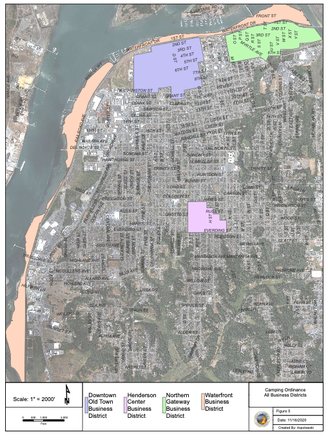
Map showing the business districts where camping is prohibited. From the City of Eureka
Following hours of discussion on Tuesday night, the Eureka City Council voted to move forward with an ordinance that prohibits camping in city parks, near trails and in several business districts. The vote was 4-1, with Councilmember Leslie Castellano dissenting.
City Attorney Robert Black explained to the council that the new ordinance would replace the city’s existing camping ordinance — which essentially says it is illegal to camp anywhere in the city at any time — with something that is less restrictive and in “compliance with the state of current law.”
The decision is in response to the court ruling in the 2019 Martin v. City of Boise case, in which the Ninth Circuit Court of Appeals overturned Boise’s camping ordinance on the grounds that it criminalized “conduct that is an unavoidable consequence of being homeless — namely sitting, lying, or sleeping on the streets.”
The new ordinance allows for “involuntary camping” — meaning camping when no other shelter is available to the person — in most parts of the city during nighttime hours, specifically precluding the “the period from fifteen minutes after sunrise to fifteen minutes before sunset.” As written, the ordinance bans camping any time of the day or night in city parks, near trails, and anywhere in the Downtown/ Old Town Business District, the Waterfront Business District, the North Gateway District and Henderson Center.
Many community members spoke during the meeting against the council adopting the replacement camping ordinance, some voicing concerns about the new ordinance potentially criminalizing homelessness.
“Rewriting an ordinance that has been found unconstitutional due to criminalizing one’s status as homeless does not bode well for or appear consistent with the city’s goals,” Rebecca Smith who works for Legal Services of Northern California said to the council.
Several commenters, including Nezzie Wade of Affordable Homeless Housing Alternatives (AHHA), also had concerns about how much of the city would be rendered off-limits for camping.
“This is really extensive, if you look at the maps and see what’s being suggested,” Wade said to the council. “The idea is to get people off the street…Where do they go?”
Councilmember Leslie Castellano echoed many of these concerns and suggested that the council reduce the areas where camping is restricted, something the council may revisit during the next reading of the ordinance at a later meeting. Castellano also had concerns about the enforcement of the ordinance, and what would be considered “involuntary camping” currently, with some individuals wary of staying in a shelter during the pandemic.
Several other council members expressed concern about the enforcement and whether this ordinance would result in the jailing of homeless people. Attorney Black and Eureka Police Captain Brian Stephens both said that enforcement would be “dialogue based” and more about finding alternatives for the camping individuals, using enforcement as a last resort.
“Services are our primary goal,” Stephens said during the meeting. “That’s the ultimate goal is to get people off the streets…This will give us a better enforcement tool to address that.”
The council ultimately decided to alter the ordinance, changing the penalty for illegal camping from a misdemeanor to an infraction. The council also directed the city attorney to make changes to the language defining “involuntary camping” to make it more specific. The ordinance will come before the council for a second reading and adoption at a later meeting.
Councilmember Kim Bergel said that, although she does not feel this ordinance is “perfect” she felt that it was a necessary step in addressing the needs of the community. “I support this ordinance because I think it gives some relief to our business owners,” she said. “It gives a feeling of safety to our community who is walking on the trails…The reason I support this is that it supports our local business and our city as a whole.”
###
In related business, the council also unanimously adopted the Crowley Site Local Coastal Program Amendment, changing the zoning of the site to allow Betty Chinn’s PG&E trailer housing project to finally move forward. The Outpost will have more on this later.