

GROWING OLD UNGRACEFULLY: God’s Reset
Barry Evans / Sunday, Dec. 17, 2023 @ 7 a.m. / Growing Old Ungracefully
“I don’t know of any expedition that ever went looking for the ark and didn’t find it.”
— Paul Zimansky, professor of archeology, Stony Brook University
###
In a book of weird tales — and the Bible is nothing if not a veritable cornucopia of very weird tales — the weirdest of all is the story of Noah’s ark. Forget that sexless birth thing, or Satan and God playing dice for Job’s soul, or raising of the dead, or the sun standing still in the sky. They’re all business-as-usual compared to Noah and his ark, for one simple reason: It begins with God — all-knowing, all-powerful, all-everything — saying, “I fucked up.”
Here He is, just ten generations in, having gotten the whole ball of wax rolling back in the Garden of Eden, realizing that it was all a mistake. His glorious creation, mankind, had morphed in no time at all into a mess of sinful ingrates. “And God saw that the wickedness of man was great in the earth…and the LORD said, I will destroy man whom I have created from the face of the earth.” Not just folks, either. Apparently the fruit of His other creations were similarly evil: “…both man, and beast, and the creeping thing, and the fowls of the air; for it repenteth me that I have made them.”
(I’m quoting from the King James Version because I went to school in England where Catholicism-lite, aka Church of England, wouldn’t have been seen dead with the Vulgate or any of those new-fangled translations.)
It takes a big man, and an even bigger God, to admit a mistake, but that’s the bottom line: I fucked up and you’re going to pay for it. All of you, men, women and babies, birds and fish, cats and dogs. And just killing you off quickly is too good for you, so a hard rain’s a-gonna fall and you’re gonna drown.
All except Noah, he’s cool, he’s 600 years old, after all. His family, too. (It doesn’t say if they also “found grace in the eyes of the LORD,” so best give them the benefit of the doubt.)

Painting by Edward Hicks (1780-1849), now in the Philadelphia Museum of Art (Public domain)
Sure enough, the rains came. “… all the fountains of the great deep broken up, and the windows of heaven were opened.” Everyone and everything drowned, other than Noah and his wife and his three sons and their wives, who emerged safe and sound after the ark grounded on Mount Ararat. Not much of a gene pool there, but it was even worse for the animals — they had to start over, once things got going again, with just one of each sex. (Don’t get me started about the dangers of incest.)
They survived because they were in an ark, of course, 300 x 50 x 30 if you were measuring in cubits. Along with two each of elephants and hippos and lions and camels and etcetera. And their feed, and their poop. No hanky-panky while they were in the ark, of course. (The Gnostic Hippolytus of Rome, who died in 235, explained that male and female animals were separated by sharp stakes.)
###
What’s interesting, given that the various ark stories were written down are hundreds of years apart, is the similarity of the deck areas. Noah’s ark, at 15,000 square cubits, is practically identical — within 4 percent — to the deck area of two previous arks built by earlier flood heroes. Atra-Hasis, who appears in the Sumerian king lists, built a circular ark with a deck area of 14,400 square cubits. While Utnapishtim, celebrated in the Epic of Gilgamesh as the king of Shuruppak, built a cubic ark, deck area also 14,400 square cubits.
So the writer(s) of the Genesis “flood” (chapters 6 thru 9) who put pen to paper — or rather, quill to papyrus — sometime after 500 BC, plagiarized from at least nine earlier Mesopotamian flood stories. Much earlier — the Epic of Gilgamesh goes back to at least 2100 BC. In it, the Sumerian God Enik, or Ea, commands Utnapishtim to demolish his house and build a boat to keep living beings alive before the flood arrives — it’s the Noah story practically word-for-word. (One intriguing theory is that the original flood story is actually a dim remembrance of a Black Sea flooding around 5600 BC, when the Mediterranean broke through a rocky sill in the Bosphorus channel, turning what had been a freshwater lake into a saline arm of the Med.)

Noah’s Ark Encounter “replica” in Williamstown, Kentucky. Kaleeb18, CC BY-SA 4.0, via Wikimedia Commons
And just in case you think that’s all long-gone ancient history/myth/legend, consider that at least a dozen expeditions, by my count, have searched for Noah’s ark in Turkey since 1948. That’s when the Associated Press reported that Kurdish villagers had discovered “a large, petrified wooden ship on Mount Ararat.” As recently as November 2019, Fox News reported the most recent discovery on its website under the headline “Noah’s Ark ‘Buried in Turkish Mountains’ as Experts say 3D Scans Will Prove Biblical Ship’s Existence.”
The science of arkeology is, apparently, alive and well.
BOOKED
Today: 10 felonies, 12 misdemeanors, 0 infractions
JUDGED
Humboldt County Superior Court Calendar: Today
CHP REPORTS
1656 Union St (HM office): Missing Indigenous
ELSEWHERE
County of Humboldt Meetings: Behavioral Health Board - SUD/Dual Recovery Committee - Sept. 10, 2026
County of Humboldt Meetings: Behavioral Health Board Executive Committee Meeting - July 1, 2026
RHBB: Judge Overturns Search Warrant in Student Activist Case: Devices Ordered Returned
RHBB: Multi-Vehicle Crash Closes South Fortuna Boulevard Near Strongs Creek Plaza
Toys for Tots Seeking Last-Minute Donations to Replace Stolen Toys
Isabella Vanderheiden / Saturday, Dec. 16, 2023 @ 3:36 p.m. / News

PREVIOUSLY
- Real-Life Grinch Breaks Into Toys for Tots Warehouse, Drives Off With Truck-Load Full of Christmas Gifts
- HUMBOLDT GRINCH PINCHED? EPD Makes Arrest in Connection With Toys For Tots Caper
- More Toys Recovered From Nefarious Toys for Tots Heist; Stolen Handgun, Ammo, Body Armor and Digital Scales Also Seized
###
The folks at Toys for Tots are seeking last-minute donations to replace a truckload of toys that were recently stolen from a warehouse in Eureka.
Local law enforcement made an arrest in connection to the toy heist last week. Unfortunately, less than one pallet of toys has been recovered so far, according to Gregg Gardiner, a longtime coordinator for the Toys for Tots in Humboldt, Trinity, Del Norte and northern Mendocino counties.
Anyone wishing to help can send a donation to 2383 Myrtle Ave. Eureka, CA 95501, or donate through the Toys for Tots website.
###
Press release from Toys for Tots:
Toys for Tots are grateful to the Eureka Police Department and Humboldt County Sheriff’s Department for their quick work in apprehending a suspect in stealing toys for underprivileged needy children at Christmas time.
Unfortunately, less than one pallet of toys was recovered — out of a semi truck trailer of toys.
Our local Toys for Tots covers Humboldt County, Trinity County, almost all del Norte County, and the northern part of Mendocino County. Well, over 11,000 square miles. Last year the local chapter supported over 8,000 local children. They need your help to ensure the thousands of children we help each year.
Please donate to help.
Checks should be made out to: Toys for Tots Foundation 2383 Myrtle Ave. Eureka CA 95501
To securely donate online to the Humboldt/Del Norte/Trinity Toys for Tots using the national Toys for Tots donation system, please:
1. Go to the national website at: toysfortots.org
2. Click “Find a local chapter” on the top menu bar.
3. Select: California, and then Humboldt.
4. Donate using the link.
5. Or use this link to there: Secure Donation Link to Humboldt Toys for Tots
The Toys for Tots office is located at 2383 Myrtle Ave next to Eureka Floor Carpet One. Toys can be dropped off anytime during business hours throughout the year.
(VIDEO) Cal Poly Humboldt’s Beloved Mascot Featured in Jeopardy Question Last Night
Isabella Vanderheiden / Saturday, Dec. 16, 2023 @ 11:59 a.m. / :) , Our Culture
###
Our very own Cal Poly Humboldt was mentioned on Jeopardy last night!
During the second round of last night’s episode, Jeopardy host Ken Jennings offered contestants the following clue: “They chop down opponents for Cal Poly Humboldt, & they’re okay.”
Contestant Tyler Vandenberg hesitated for a moment but responded correctly with “What are the … Lumberjacks?” and went on to finish first in last night’s contest with a cool $17,600 in winnings.
Humboldt has been featured on Jeopardy several times in recent years. Local folks may recall a virtually identical Jeopardy clue from 2017: “They chop down opponents for Humboldt State, & they’re okay.”
If you’re wondering why our beloved Lumberjacks are just “okay,” please see the video below for Monty Python’s rendition of the “Lumberjack Song,” the university’s unofficial anthem.
###
PREVIOUS EXAMPLES OF LoCO CARING ABOUT JEOPARDY:
- (VIDEO) Ooo! You Know This One!
- (VIDEO) Carson Mansion, Eureka Featured in $800 ‘Jeopardy!’ Question Last Night
- (VIDEO) Jeopardy Contestant, Minor League Baseball Enthusiast Correctly Identifies Humboldt Crabs as THE BEST
- (VIDEO) LoCO Will Be Very Upset if You Don’t Know Last Night’s Final Jeopardy Question
THE ECONEWS REPORT: Barred Owls Impact More than Spotted Owls
The EcoNews Report / Saturday, Dec. 16, 2023 @ 10 a.m. / Environment

The barred owl. Photo by Mdf, CC BY-SA 3.0, via Wikimedia.
On this week’s EcoNews Report, spotted owl experts Dave Wiens and Peter Carlson join bird nerds Ken Burton and Tom Wheeler to discuss barred owls and their impact to West Coast ecosystems. The barred owl is in the news because of a draft strategy released by the U.S. Fish and Wildlife Service to cull the invasive owl to benefit the native northern spotted owl and California spotted owl. The impacts of barred owls are well-documented — together with habitat loss, barred owls are driving the spotted owls to extinction! — but the barred owl’s impact to other species is a deep concern for ecologists. The more varied diet and higher densities of the barred owl result in significant and new impacts to basically anything that moves and is smaller than the barred owl, from birds to rodents to amphibians and crayfish.
Listen and nerd out!
(VIDEO) HUMBOLDT OUTDOORS: Ray Olson Takes Us on the Second Leg of His Journey Along Jolly Giant Creek
Isabella Vanderheiden / Saturday, Dec. 16, 2023 @ 9:44 a.m. / Humboldt Outdoors
###
Ray Olson’s trek along Jolly Giant Creek continues!
In today’s edition of “Humboldt Outdoors,” Olson takes us on the second leg of his four-mile journey from the headwaters of Jolly Giant Creek, located deep in the Arcata Community Forest, and follows the stream as it traverses through the campus of Cal Poly Humboldt, under Highway 101 and across downtown Arcata.
Olson links up with Jack Murphy, a lecturer in Botany and Environmental Science at Cal Poly Humboldt, at Shay Park where the creek emerges after being confined to underground culverts for more than a half mile.

Murphy and Olson chat beside Jolly Giant Creek.
“I love Jolly Giant Creek,” Murphy tells Olson. “We have a creek that has been here since water has fallen from the sky. … We’ve just temporarily impacted it with our civilization. It connects the Arcata Community Forest to Humboldt Bay. And if you love nature, why not invite that nature into the heart of your town?
Olson also chats with former Arcata City Council member and Mayor Julie Fulkerson about the city’s efforts to preserve and protect Jolly Giant Creek over the years.
“I thought it was important to protect the creek for a number of reasons, partly because I wanted people who would live here eventually in these apartments to have this experience,” Fulkerson says, referring to a 1987 city council decision to keep the creek open during the development of a nearby apartment complex at Ninth and J Streets. “But also, in a broader way, for people walking by to have this same enjoyable moment in the middle of an urban community.”
From there, Olson follows the creek over to the Arcata Marsh and Wildlife Sanctuary, where it eventually flows into Humboldt Bay.
Click the video above to learn more!
###
PREVIOUS HUMBOLDT OUTDOORS:
- (VIDEO) HUMBOLDT OUTDOORS: The Covered Bridges of Humboldt County
- (VIDEO) HUMBOLDT OUTDOORS: A Look at the Historic Ghost Town of Falk
- (VIDEO) HUMBOLDT OUTDOORS: The Ruins of Humboldt County’s First Lighthouse
- (VIDEO) HUMBOLDT OUTDOORS: Mysterious Wood Carvings in the Arcata Community Forest
- (VIDEO) HUMBOLDT OUTDOORS: Ray Olson Cracks the Case on the Mysterious Arcata Community Forest Wood Carvings
- HUMBOLDT OUTDOORS: Venturing Inside the Loleta Tunnel
- (VIDEO) HUMBOLDT OUTDOORS: Retracing Jack London’s 1911 Journey Through Humboldt County
- (VIDEO) HUMBOLDT OUTDOORS: Ray Olson Takes Us on a Camping Trip to Prairie Creek Redwoods State Park
- (VIDEO) HUMBOLDT OUTDOORS: Ray Olson Takes a Peek at the Timber Heritage Association’s Future Railroad Museum in Samoa
- (VIDEO) HUMBOLDT OUTDOORS: Ray Olson Goes Back in Time to Teach Us About the History of Earth Day
- (VIDEO) HUMBOLDT OUTDOORS: Ray Olson Traverses Jolly Giant Creek From Its Headwaters in the Arcata Community Forest to Humboldt Bay
- (VIDEO) HUMBOLDT OUTDOORS: Ray Olson Meets the Group of Local Veterans Working to Restore the WWII-Era Ship Beached in Samoa
- (VIDEO) HUMBOLDT OUTDOORS: Ray Olson is Joined by Local Authors Barry Evans and Jerry Rohde for a Tour of the Historic Table Bluff Cemetary
- (VIDEO) HUMBOLDT OUTDOORS: Ray Olson Takes Us Through the Lower Deck of Historic 1091
- (VIDEO) HUMBOLDT OUTDOORS: Ray Olson Introduces Us to Humboldt’s Cutest Herd of Lawn Mowers
HUMBOLDT HISTORY: Rolph Shipyards Brought Life and Prosperity to Fairhaven
Unknown Author / Saturday, Dec. 16, 2023 @ 7:30 a.m. / History
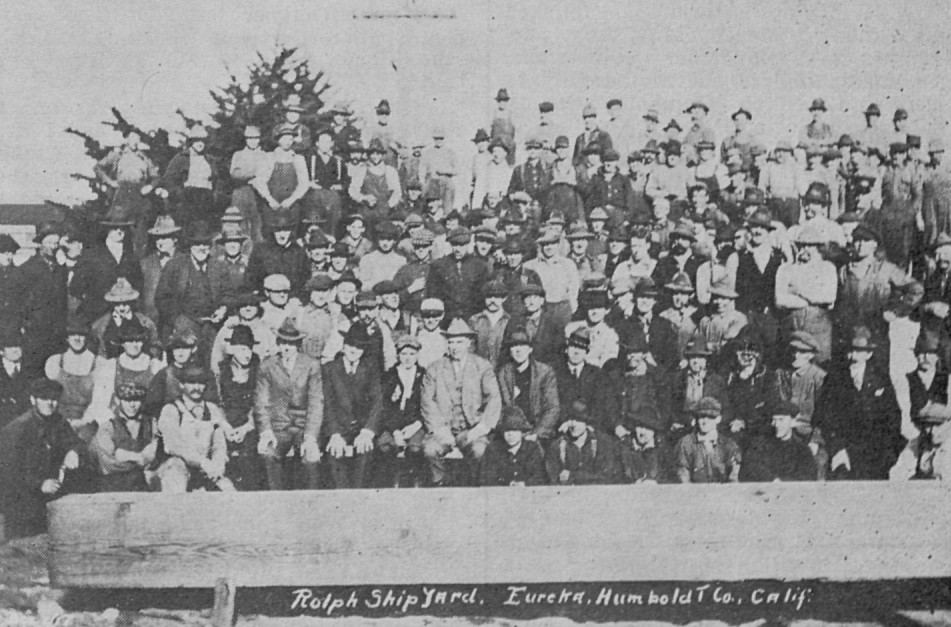
Mayor James Rolph (front row, center) pictured with the men who built his ships. Upwards of 250 men were employed at the Rolph Shipyards during World War I. Photos via Humboldt Historian.
NOTE: This article is reprinted from the January 16, 1918 issue of the San Francisco Chronicle.
###
It was only a few days after the United States declared war against Germany that James Rolph, Jr., Mayor of San Francisco, entered the ranks of shipbuilders. He had long forseen what was going to happen to the shipping trade, and in other ways he had been preparing for it, in his capacity as head of the Rolph Navigation and Coal Company.
Seeing an opportunity to purchase the old Bendixsen shipyards, located at Fairhaven, across Humboldt Bay from the city of Eureka, he did so. And since then perhaps no individual has done more than he to increase America’s merchant marine by building vessels to replace those sunk by the enemy.
The plant now known as the Rolph Shipbuilding Company’s yards was established in 1868 by the late H. D. Bendixsen, one of the pioneer shipbuilders of the Pacific Coast. During his career up to the time of its being taken over by the Rolph Shipbuilding Company, it turned out and launched 208 craft of all kinds and sizes, both sail and steam.
A generation ago shipbuilding on Humboldt Bay was virtually all Bendixsen. Today it is virtually all Rolph, for Rolph dominates the field not alone in the size of the yards and their productiveness, but also in the number of employees, the up-to-dateness of the plant, and the fair and persistent manner with which he goes about to do things and do them right.
The original Bendixsen property, purchased by the Rolph Shipbuilding Company, has a water frontage of 850 feet. It was under lease at the time of the sale to another concern, which occupied it with a couple of half-completed ships.
Instead of sitting down and waiting until the lease should expire, Rolph, who was anxious to do his bit toward combating the submarine menace, negotiated for and purchased a frontage of 950 feet, the old Fay property, adjoining the Bendixsen place on the north.
A little later he bought another 250 feet directly south of the Bendixsen plant, giving him a water frontage of 2050 feet in all, with a depth of about 500 feet to the property.
In April the Bendixsen yards were purchased. On June 10 following, the keel of the first vessel was laid on the adjoining property and construction work began with a rush.
Four vessels were entirely in frame by October. On December 7, 1917, the lease on the Bendixsen property expired and the plant was taken over, the keels of three more vessels being laid there immediately, making seven in all on the ways.
When it came into being, the Rolph Shipbuilding Company fixed as one of its foundation policies the fair treatment of its employees. The men were allowed to unionize and were paid highest union wages.
The working day was cut to eight hours and each Saturday was made pay day. Moreover, the employees were given to understand that the company was their friend. They were told that, for instance, no charge would be made for hospital service, and that in every other way they were to be made to like their jobs. Just in passing it might be mentioned also that Rolph a few weeks ago made a standing offer of a $100 bank account for every baby born at Fairhaven.
The unionization of a plant that for decades had been nonunion made friends for the Rolph Shipbuilding Company in all but one or two quarters. Those who did not feel as Rolph felt about labor and its rights happened to control the lumber situation. But this availed themselves nothing, for barges were sent by the company to the Columbia River and Puget Sound and the necessary fir timber brought from there — and the Rolph yards continued thrive.
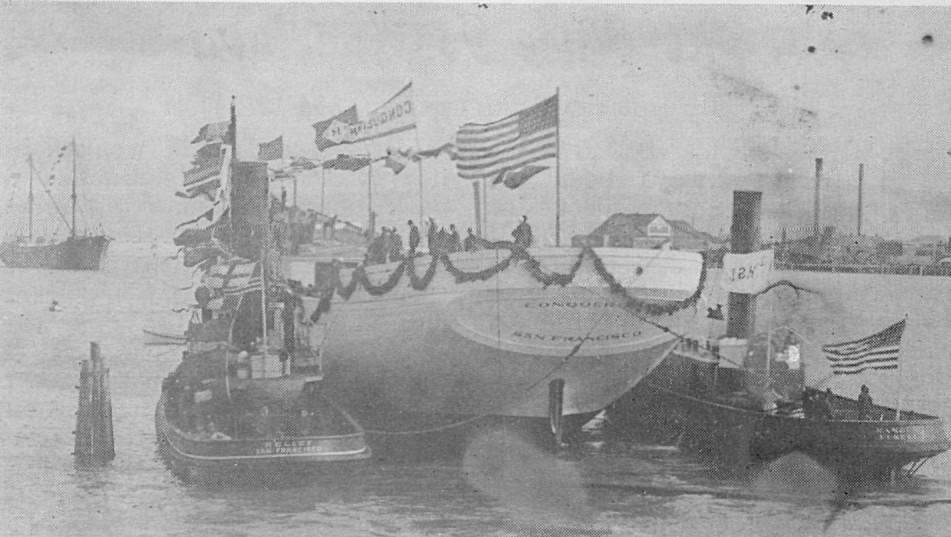
With flags flying and a number of guests aboard, the barkentine Conqueror was launched from the Rolph Shipyards on February 22, 1918. The tugs Relief (left) and Ranger have picked her up and are about to tow her back to the outfitting dock.
Of the four vessels first started, three are 2500-ton general cargo vessels (steamers). They are 250 feet long between perpendiculars, with a beam of 45 feet 6 inches, and a depth of hold of 19 feet 6 inches.
They are being equipped with 1000-horsepower reciprocating engines and Heine water-tube boilers built and installed by the Union Iron Works of San Francisco.
The fourth vessel is a barkentine, four-masted, of about the same dimensions. It will carry 1,650,000 feet of lumber, or some 2200 tons dead weight.
The three vessels, whose keels were but recently laid, will all be barkentines. Not one of the craft but is being built to the highest classification of the American Bureau of Shipping, the American Lloyds. For instance, other shipyards leave as much as ten inches between the frames of their wooden vessels. In the vessels built at the Rolph yards, six inches is being left between ribs, so that all the ships will be given the maximum of sturdiness, though at a greater cost to build.
The first vessel to be launched will be a barkentine, which will take to the water on Washington’s birthday, February 22. Then one steamer will be launched each month until the three under construction are in the water As soon as one craft is afloat another keel will at once be laid on the vacant ways.
Besides the new construction going on at the yards, old craft are being overhauled and remodeled and made fit for sea again. The once famous clipper ship May, which for the past few years has been used by the Rolph Navigation and Coal Company as a barge, was recently repaired and fitted out as a three-masted barkentine.
###
The reprint above appeared in the January-February 1977 issue of the Humboldt Historian, a journal of the Humboldt County Historical Society. It is reprinted here with permission. The Humboldt County Historical Society is a nonprofit organization devoted to archiving, preserving and sharing Humboldt County’s rich history. You can become a member and receive a year’s worth of new issues of The Humboldt Historian at this link.
(VIDEO) Humboldt Bay Fire Thanks Community for Donating to ‘Share the Magic of Christmas’ Toy Drive
LoCO Staff / Friday, Dec. 15, 2023 @ 5 p.m. / :)
It sure feels like Humboldt has been ultra generous with the toys this season. And now we can add the dozens of barrels gathered by the Humboldt Bay Fire Department to our collective haul. Score!
For the past month community members have been filling receptacles spread across the county with fun goodies as part of HBF’s “Share the Magic of Christmas Toy Drive,” a tradition the department has partnered with the Salvation Army for for decades.
Watch HBF bask in the culmination of their efforts in the clip above.


