On Wednesday February 22, 2023 the Humboldt County Drug Task Force served a search warrant on the 2600 block of Hall Avenue in Eureka after receiving information that 60 year old Brian Fleming was selling large amounts of methamphetamine out of his residence. When agents arrived on scene, Fleming was scene attempting to flee out the rear of the residence where he was detained without incident.
Upon a search of the property agents located over two pounds of methamphetamine, a firearm, ammunition, metal knuckles, and a digital scale. Fleming was subsequently arrested on the following charges:
H&S 11378(a)- Possession of a controlled substance for sale
H&S 11370.1- Possession of a controlled substance while armed with a firearm
H&S 11366.5(a)- Maintaining a residence for narcotics use
PC 29800(a)(1)- Felon in possession of a firearm
PC 30305(a)(1)- Felon in possession of ammunition
Anyone with information regarding this case is encouraged to contact the Humboldt County Drug Task Force at 707-267-9976
A College of the Redwoods student died this morning after being found unresponsive in her dormitory room, located on the school’s main campus, a college spokesperson confirmed to the Outpost this afternoon.
The student, whose identity has not yet been released, was taken by ambulance to Providence St. Joseph Hospital in Eureka, where hospital staff were unable to resuscitate her, according to Molly Blakemore, CR’s director of marketing and communications.
“Local authorities are currently investigating the cause of death and we are working with them to determine the events and circumstances surrounding the event,” Blakemore said via email.
We will update this post when and if any further information comes in.
Thomas and Cody Nicholson Stratton | Image via CAFF
Press release from the Community Alliance with Family Farmers:
Humboldt-based farmers the Foggy Bottoms Boys have been honored as the 2023 “Climate Smart Farmers of Year”, an annual recognition awarded by Community Alliance with Family Farmers (CAFF) to producers who exemplify practices that sequester carbon and promote a healthy ecosystem.
Every year, CAFF honors change-makers, trailblazers and those giving back to their local food and agricultural communities throughout California. Selected from nominations that pour in from every corner of the state, this year’s honorees represent the changing face of California farming and a commitment to equity, access and sustainability. “From innovative farmers to grassroots organizers, this year’s honorees give us hope for the future,” said Evan Wiig, CAFF’s Director of Membership & Communications.
For six generations, this family farm has operated in the foggy bottoms of the Eel River Valley. Today, Foggy Bottoms Boys is led by Thomas and Cody Nicholson Stratton, with help from their father, grandfather and even their little son. This duo is bringing new regenerative practices to their farm, while improving upon time-tested traditions. Their highly-diversified farm produces organic dairy, beef, lamb, poultry, eggs, and even yarn made from their sheep, goats and angora rabbits. From cover crops to maintaining wild habitat for biodiversity to ensuring a pasture-based approach, they pay close attention to the health of their land and animals.
Today Thomas and Cody are experimenting with new methods, such as no-till to increase their soil organic matter, sequester carbon and preserve a healthy soil biome. With a strong focus on their local community, the Foggy Bottoms Boys are working hard to ensure a healthy future for even more generations to come.
“Congratulations to the Foggy Bottoms Boys,” said Wiig. “We commend them for their integrity and their commitment to ensuring a healthy food future amid a fast-changing climate.”
This year’s awards ceremony will take place virtually on Tuesday, February 28th at 6pm as part of this year’s California Small Farm Conference.
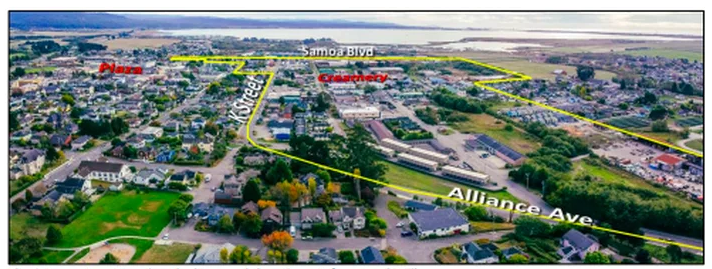
Do you have thoughts and feelings about Arcata’s Gateway Area Plan? Of course you do! The somewhat controversial plan to rezone 138 acres of land surrounding the Creamery District to facilitate the creation of more high-density housing has been the talk of the town for more than a year now. And if you live in Arcata (or even if you don’t), you must have some opinions that you’re dying to share.
Well, now is the time to speak your mind! Because over the next couple of months the City of Arcata will be holding multiple public workshops and meetings to provide the community with an opportunity to learn more about the plan – specifically the form-based code that the city will be using to guide proposed developments in the Gateway Area – and to give you a chance to tell the City what you want new buildings in Arcata to look like. And the next workshop you’ll want to attend is on Thursday, Feb. 23.
“We’re basically asking the community for input on design that we will turn into code, so that the community, future developers and decision makers can all look at the code and have a good expectation of what the buildings might look like when they get built,” David Loya, Arcata’s community development director, told the Outpost in a phone interview on Tuesday.
Since late last year, Arcata’s Planning Commission and city staff have been discussing every detail of form-based code and how it can be used to guide the Gateway Area Plan. If you don’t fully understand what a form-based code is, you are not alone. It’s a new planning concept for the city. Loya helped give an explanation of how this code works and why the City is utilizing it for the Gateway Plan.
“[Form-based code] is really all about the design of the buildings and how those buildings interact with the public space,” Loya explained to the Outpost. “That contrasts with a typical zoning code, which pays a little less attention to how buildings look… and focuses much more on land uses and trying to segregate land uses.”
The City has broken up the Gateway Area into four smaller zones: the Barrel District (pale yellow), the Gateway Corridor (orange), the Gateway Hub (teal) and the Gateway Neighborhood (brown)
Because the Gateway Area Plan aims to facilitate mixed-use developments –buildings that contain a mix of things like housing, offices, restaurants and storefronts – the City does not want the land to be zoned for different specific purposes, which is what has been done in the past. Instead, the City is looking to zone the different sections of the Gateway Area in such a way that there are specific design requirements that developers must adhere to, including materials, setbacks (how far the building is from the sidewalk), window design, roof design, landscaping/open space and even paint colors. By having all of the code elements established ahead of time, the city will have more control over the aesthetics of future developments.
Of course, this code also includes what has probably been the most controversial aspect of the plan – building heights. There has been a lot of talk about new buildings in the Gateway Area possibly being as high as eight stories, which many people say is too tall. The Planning Commission has discussed building height many times and, although no decision will be officially made on height restrictions until the plan is adopted, the commission has agreed to allow for seven stories in the Barrel District, six stories in the Gateway Hub, five stories in the Gateway Corridor and four stories maximum in the Gateway Neighborhood. Again, the maximum building heights could change by the time the council reviews and adopts the plan.
Loya said that the public workshop on Thursday evening will primarily focus building design, open space (parks, recreational spaces or green spaces that the developments will leave undeveloped) and streetscape improvements, which include how sidewalks will look, how the buildings will interact with the sidewalks, and how the stoops of the buildings will look.
The workshop will include guided group discussions and surveys, allowing all participants to voice their thoughts on the design elements of the code. The feedback provided at the meeting will be used to guide the Planning Commission’s next study session on the form-based code. The exact date of the study session has not yet been set. But like the most recent session, Loya said, it will take place on a Saturday and will be roughly four hours long.
There will be several more public workshops on form-based code between now and April, which will continue to guide the Planning Commission’s discussions and decisions. The goal, Loya said, is to then release a draft of the form-based code, a revised draft of Gateway Area Plan and an Environmental Impact Report by late June or July. If everything goes to plan, Loya said the City may be able to adopt the Gateway Area Plan and the City’s General Plan by the end of December.
“I know that we’re asking a lot of the community to keep coming out time and time again,” Loya said. “We just really appreciate everyone’s persistence and everyone who has made a comment. I think it’s really important to engage in what’s going on in our community. So I just want to encourage people to stick with it for just a few more months. Keep coming out, telling us what you think and bring a friend.”
The Gateway Area Plan workshop will be held on Thursday, Feb. 23 at 6 p.m. over Zoom. You can join the meeting by following this link. The meeting ID is: 868 1570 1066 and the passcode is: 492062.
As you might’ve expected, the weather has made it a bit hairy on North Coast roadways today. This morning Highway 101 was briefly closed after a big rig driver failed to navigate the curve in front of the Legend of BigFoot gift shop just north of Richardson Grove State Park. The truck spilled its logs onto the roadway, but the driver was reportedly not badly injured.
Local Mike White has supplied the Outpost with some of the gift shop’s security camera footage that shows the scary incident. Watch below.
In closing, we have a couple days of rough weather left ahead, Humboldt. Let’s take extra care when we’re trying to get where we’re going (so we actually get there).
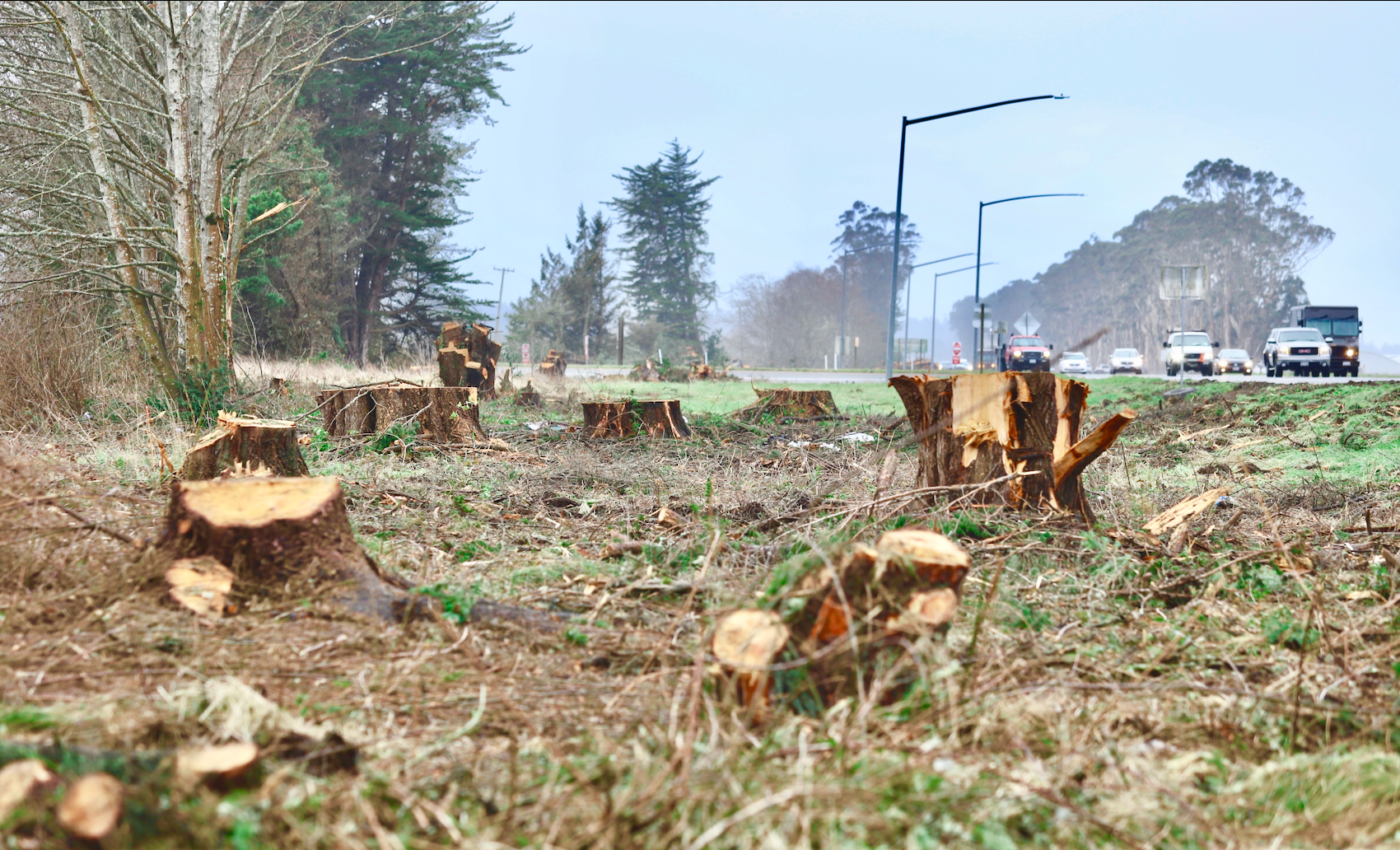
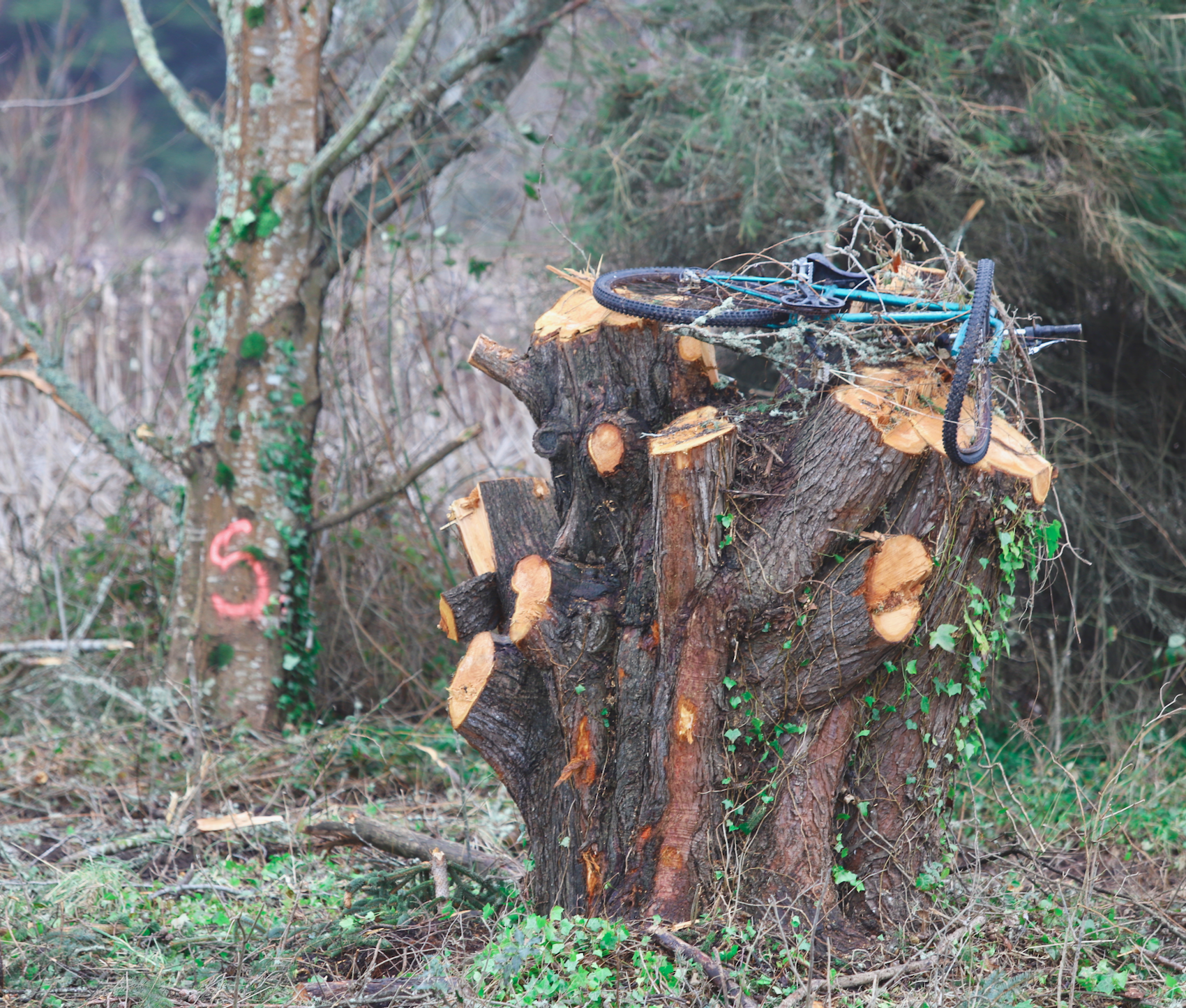
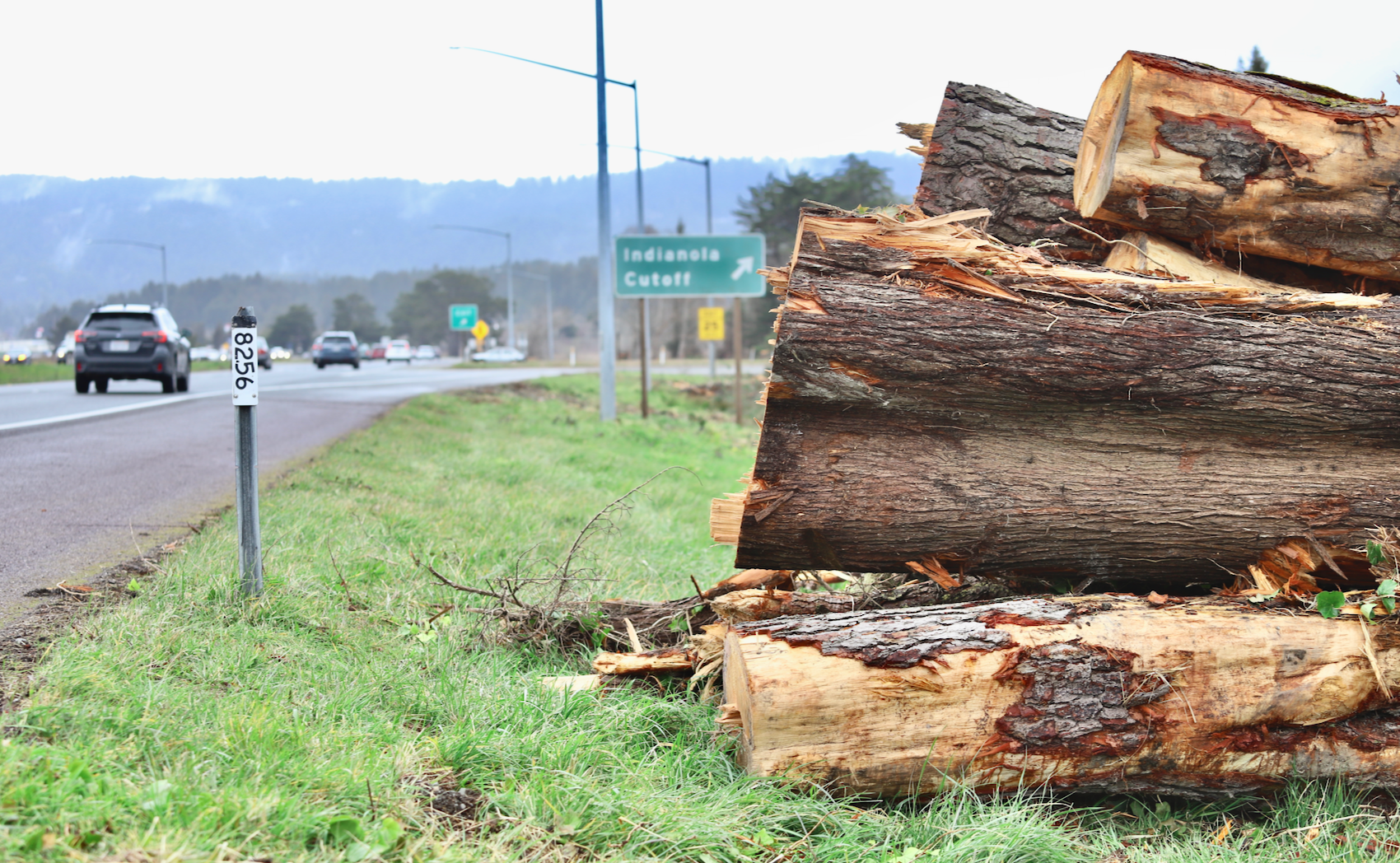
Anyone driving between Arcata and Eureka over the past couple weeks has likely noticed the assorted stumps left behind from freshly chopped trees on the east side of Hwy. 101 near the Indianola Cutoff.
Approximately 75 trees, including pine, spruce, cypress, cottonwood and alder, have been removed in preparation for construction of a new undercrossing, one of the final components of a major redesign of the six-mile stretch of freeway between the two coastal cities.
“The project, which will see the Indianola Cutoff run underneath a slightly elevated U.S. 101, is intended to reduce collisions and save lives,” Caltrans spokesman Myles Cochrane tells the Outpost via email.
All of the removed trees were in the project’s construction zone, he added.
For anyone mourning the loss, know this: Caltrans intends to mitigate the impact onsite by planting 2.5 trees for every one that’s been removed.
Construction activity will begin in earnest in June.
“In the first phase of the project, northbound 101 traffic will be detoured inland as folks will see crews installing fill and constructing an embankment with columns,” Cochrane said. “In the second phase, southbound traffic will be detoured inland while undercrossing work remains ongoing.”
We’re not talking about major detours. Cochrane said the re-routes will “a slightly larger-scale version” of what southbound motorists encountered during the construction of a new Jacoby Creek Bridge last year.
Low water levels at Shasta Lake on April 25, 2022. The reservoir as of Feb. 21 , 2023 was at more than 86% of historic average levels. Photo by Miguel Gutierrez Jr., CalMatters
California’s water board decided Tuesday to temporarily allow more storage in Delta reservoirs, waiving state rules that require water to be released to protect salmon and other endangered fish.
The waiver means more water can be sent to the cities and growers that receive supplies from the San Joaquin-Sacramento Delta through the State Water Project and the federal Central Valley Project. The state aqueduct delivers water to 27 million people, mostly in Southern California, and 750,000 acres of farmland, while the Central Valley Project mostly serves farms.
The flow rules will remain suspended until March 31.
Environmentalists reacted today with frustration and concern that the move will jeopardize chinook salmon and other native fish in the Delta that are already struggling to survive.
“The flow standard they relaxed is probably the most important regulation we have,” said Gary Bobker, program director at The Bay Institute. He said the rule is aimed at simulating natural runoff in rivers, which is critical for native fish to reproduce and thrive.
The order from the State Water Resources Control Board, signed by Executive Director Eilleen Sobeck, comes eight days after Gov. Gavin Newsom suspended two state environmental laws and urged the board to act. Water suppliers and growers had criticized the state for “wasting” water during the January storms by letting it flow through rivers out to sea instead of capturing it in reservoirs.
On the day that Newsom issued his order, the state Department of Water Resources and the U.S. Bureau of Reclamation — which oversee reservoirs and water exports in the Delta — petitioned the board to lift the flow rules.
San Francisco Baykeeper Science Director Jon Rosenfield said this is the third year in a row, and the sixth time in 10 years, that the state has waived its rules that set basic flow standards in the Delta. The previous waivers were issued because of severe drought conditions, while the new waiver was triggered by the opposite: high-volume storm conditions.
“The governor is taking water from winter-run Chinook salmon, which just experienced their worst incubation season ever,” Rosenfield said. “The few that remain could be given a better chance of surviving to the ocean. Instead, they’re going to get worse conditions.”
Water that flows through the Delta and into San Francisco Bay helps young salmon complete their seaward migrations through the estuary, and it improves the estuary’s salinity conditions to the benefit of many species.
If the state’s Delta flow rules had remained in effect, water would have to flow through the Delta at a rate of 29,200 cubic feet per second. But as of Feb. 21, outflow was less than half that,14,300, Rosenfield said.
Sobeck acknowledged in her order that fish benefit from the flow rules and they “are specifically intended to provide for some population growth of native estuarine species.” But after weighing the cost of harming fish with the benefit of providing water for farms and cities, she made the choice “to maintain and expand water supplies given prolonged drought and uncertain climatic conditions.”
Sobeck wrote that the waiver is permissible only if it’s made in the public interest and “that the changes will not result in unreasonable effects to fish and wildlife.”
Winter-run and spring-run Chinook salmon, tiny Delta smelt and several other Delta fish species are listed as threatened or endangered by the state and federal Endangered Species Acts, which prohibit harm to protected species.
Karla Nemeth, director of the California Department of Water Resources, and Ernest Conant, regional director of the U.S. Bureau of Reclamation, said that lifting the flow requirements was unlikely to harm Delta fish.
“Our modeling shows that January’s wet hydrology, along with operational actions…, created conditions that will be protective of species throughout February and March,” they wrote in a letter to the water board.
To allow the water board to waive the flow rules, Newsom’s order suspended two state laws — Water Code Section 13247, which requires state agencies to comply with all water-quality rules, and Public Resources Code, Division 13, which ensures environmental quality, and its regulations.
Environmentalists lambasted Newsom last week, saying that the governor was “putting his thumbs on the scale in favor of extinction in the Delta” and “eviscerating environmental laws” with the stroke of his pen.
But water suppliers applauded the decision today, saying the water is needed to help provide enough water to cities and farms. Currently they are only receiving 30% of requested deliveries from the state aqueduct.
“This grants water users a little cushion,” said Tim Quinn, an affiliate with Stanford’s Water in the West program and a former executive director of the Association of California Water Agencies. “It leaves a little more water in storage than we would have had.”
Fed by the January storms, the state’s main reservoirs, Oroville and Shasta, which had been parched by drought, are at 116.5% and 86.6% of historic average levels.
Although the state received heavy criticism last month for not capturing more water, Bobker said California “did a pretty good job.” His organization estimated that almost half the rain that fell in the Sacramento and San Joaquin watersheds in December and January was captured in reservoirs.
The storms also heavily padded the Sierra Nevada snowpack, which is now at about 200% of average and will melt and drain into reservoirs later this spring.
“But they wanted more, so they suspended the rules,” Bobker said. “It’s not even a drought. If we can’t provide good conditions for fish in a year like this, then we are totally bankrupt as resource managers.”
###
CalMatters.org is a nonprofit, nonpartisan media venture explaining California policies and politics.