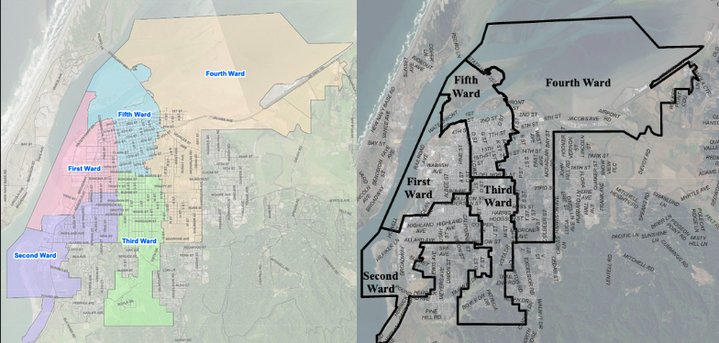
Eureka’s current ward map (left) and the slightly different new Ward Map (right) | Images from the City of Eureka
###
The 2022 election is already shaping up to be a pretty interesting one in Eureka, with the City adjusting its ward boundaries and implementing a Ranked Choice Voting system — two changes advanced by the Eureka City Council during its Tuesday night meeting.
Following several meetings discussing adjustments to the City’s ward boundaries — an action deemed necessary after the 2020 Census data revealed changes to Eureka’s population — the council voted unanimously to move forward with redrawing Eureka’s wards and selected a map that made minimal changes. The Third Ward sees the most adjustments, since the Census data showed substantial population growth in that ward, but sections of all five wards will be adjusted at least slightly. So if you live on the cusp of any two wards, you might want to take a closer look at the realignments to see if you’ll be affected.
If you have concerns about this process, the issue will come before the council once more — likely at its next meeting — before the wards are adjusted. Of course, impacted residents will also be notified of the changes made.
###
Also during Tuesday’s meeting the council voted unanimously to implement a Ranked Choice Voting system, which was approved by Eureka voters in the 2020 general election. City Attorney Bob Black told the council that, if everything goes well, the system will most likely be in place by the 2022 election.
In 2022 Eureka residents will be electing a mayor and councilmembers to represent the First, Third and Fifth Wards and Ranked Choice Voting will be used in any of the races where more than two candidates are running. Voters are given the choice to “rank” the candidates by selecting their first, second and third choice, etc. The votes are then counted in rounds. In the first round, each ballot is counted as a vote for the first choice candidate on that ballot. If no candidate receives a majority of the votes, then the candidate receiving the lowest number of votes is eliminated. Every ballot counting towards the eliminated candidate is then counted again for votes cast for the next-ranked continuing candidate. This process continues until a majority is reached for one candidate.
In the unlikely event that two candidates tie in the final round, the council decided that whichever of the tied candidates received the highest number of first round votes will win.
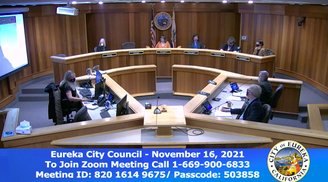
Screenshot from video of Nov. 16 Eureka City Council meeting
Because this will be a new system to Eureka voters, the city plans to
launch some educational efforts once staff gets the go ahead from the
County Elections Office. Eureka City Clerk Pam Powell told the council
that since Eureka does not hold its own elections, the process of implementing Ranked Choice Voting will require the County Elections Office to install a new type of software, or to agree to do a hand count, if it does not yet have the proper software capabilities. Powell said that the City should have an update from the elections office by the first of the year.
###
In other business, the council also unanimously passed an ordinance prohibiting the handling or storing of coal or petroleum coke on city-owned property or property held in the public trust.
The ordinance — prompted by concerns over potential corporate attempts to facilitate large-scale coal exports by train between Humboldt Bay and the San Francisco Bay Area — amends the City’s municipal code to declare the storing or handling of coal an “unlawful nuisance” and would subject violators to a fine or potential jail time.
There are exemptions for storing or handling small amounts of coal, for the purposes of non-commercial or craft use. At the request of Councilmember Natalie Arroyo, the City added a definition of “small amount,” defining it as less than 25 lbs. over a 24-hour period.
Several councilmembers expressed relief that this issue had been addressed, mentioned that they had heard overwhelming support for the ordinance from the community.
“I just want to thank the community,” Councilmember Scott Bauer, who attended the meeting remotely, said. “I don’t think I’ve ever received so many emails in support of an ordinance. I can’t believe this is even an issue that we’re facing that we would have to be concerned about burning coal, given the state of the climate.”
Deep, ominous voice: “The following story is inspired by real threats faced by California’s National and State Parks. Due to strong language and adult themes, listener discretion is advised.”
As we here at LoCO have worked diligently to help prove, humans are currently living in an age when there are more available podcasts to listen to than any reasonable person with only two ears could ever want or need. So much so, somehow three episodes of a new, based-in-Humboldt scripted aural offering slipped by us before we got wind of it. Such content!
Yes, from drama expert Dick Wolf and Wolf Entertainment — creators of popcorn-ready television hits Law and Order, FBI, Chicago P.D., Chicago Fire, Chicago Med, Chicago Justice and, eh, Chicago Auditor-Controller, to name a few — comes Dark Woods, a weekly “immersive audio experience” that takes place in a world somewhat resembling our neck of the woods that is available for your listening pleasure wherever you acquire your ‘casts.
But what about the Humboldt depicted in Dark Woods? Would it be familiar to people who dwell in IRL Humboldt? Well, the Outpost listened to the first few episodes of this thing and is now prepared to disperse some spoilers.
Dark Woods’ story centers on the exploits of Department of Fish and Game warden Mark Ellis who is investigating the suspicious death of a young employee whose body was discovered in Fern Canyon. Meanwhile, Laura Romero — Ellis’ ex-wife and Eureka City Councilmember — is coping with her city’s flailing tourism industry while attempting to fend off the advances of Petras West, a mining company seeking permits that would level thousands of acres of redwood forest. Also, what is poisoning the state park’s fisher population? Could it have anything to do with the well-guarded trespass cannabis grow just discovered in the middle of the forest? How will all these small town tales intertwine! Ahh!
If these are the types of stories you can’t help but thrust your brain into, LoCO will do you a solid and feed you all the thus-far released episodes below.
In an interview with CinemaBlend, the show’s executive producer Elliot Wolf — son of Dick — attempted to compare this new endeavor to his company’s past successes.
“It’s a little bit different than an episode of Law & Order, as an example, in the sense that it’s serialized,” Wolf said. “But at its core, we’re aiming for the same quality of storytelling. And at the end of the day, it’s a story that fans can immerse themselves in and will enjoy, whether it’d be for the two episodes that came out [first], or all eight.”
Eight episodes! Something to look forward to. But to get back to the query posed in our headline: Is Dark Woods something you need to devote time listening to? Well, maybe not, it turns out! That’s because news broke earlier this week that Universal Television already has tentative plans to adapt the podcast into a television show you’ll be able to watch with your eyeballs.
Hmm! A television show that makes Humboldt seem like a creepy, lawless place? Has that been tried before?
Press release from the Humboldt County Sheriff’s Office:
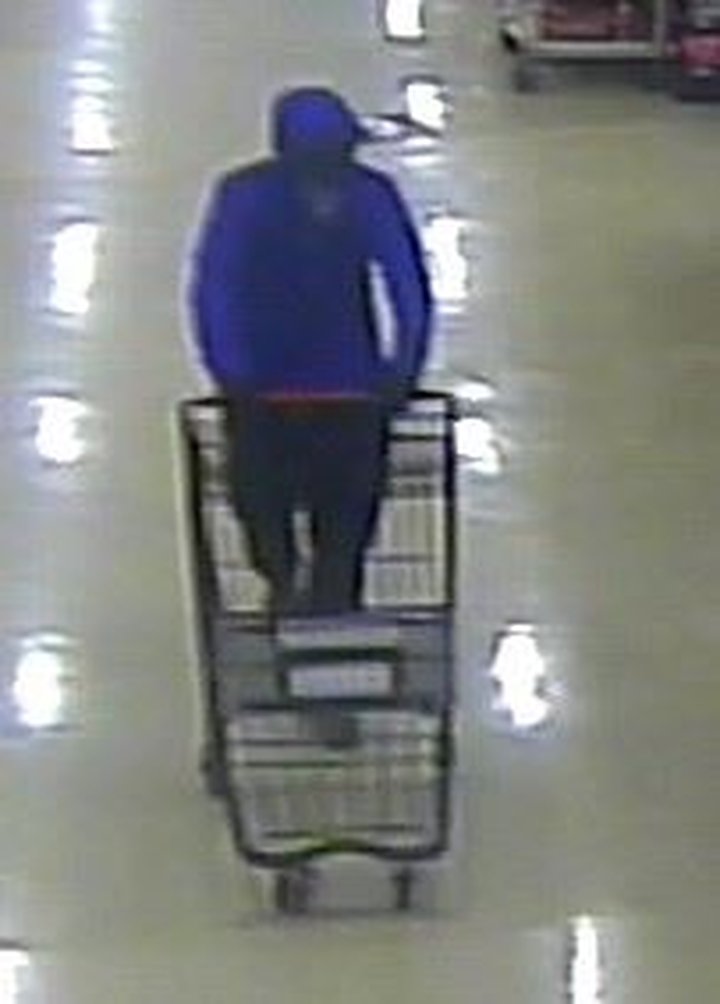
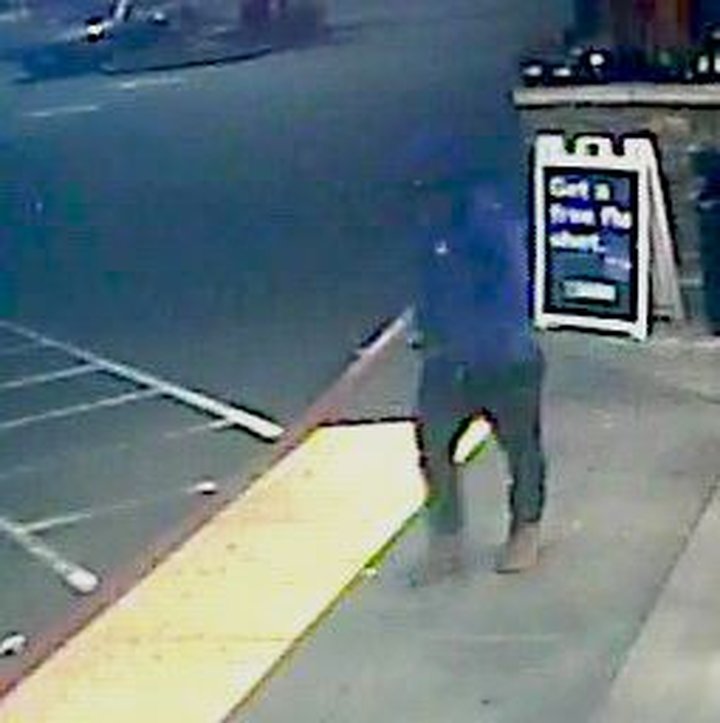
On Nov. 14, 2021, at about 6:42 a.m., Humboldt County Sheriff’s deputies were dispatched to a grocery store on the 2500 block of Harris Street, in the county’s jurisdiction of Eureka, for the report of an attempted robbery.
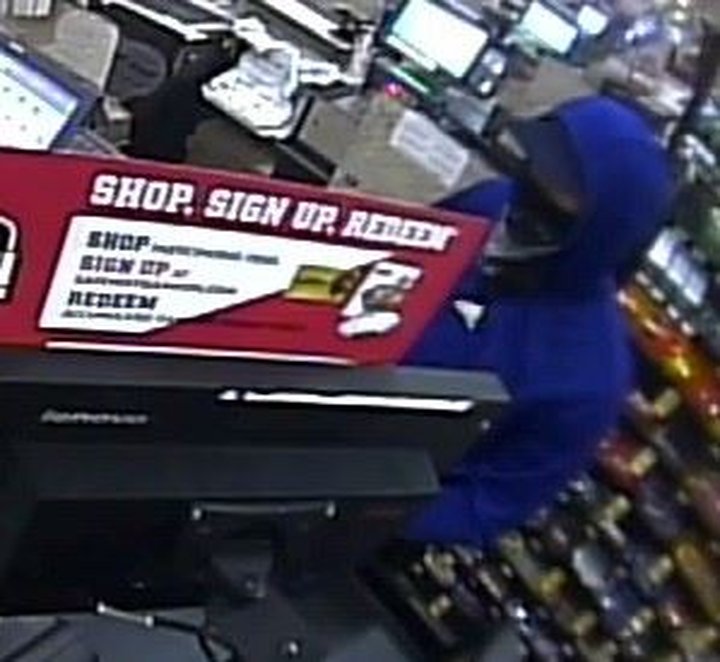
According to a store clerk, an unknown male entered a checkout line with a half-eaten donut taken from the store. The male refused to pay for the donut, brandished a firearm at the store clerk and demanded cash from the register. The store clerk denied the suspect’s request and the suspect fled the store.
The suspect is described as a white male adult, approximately 5 feet 9 inches tall with a thin build. He was last seen wearing a blue hooded sweatshirt, a navy hat, black gloves and jeans.
This case is still under investigation.
Anyone with information about this case or the identity of the suspect is encouraged to call the Humboldt County Sheriff’s Office at (707) 445-7251 or the Sheriff’s Office Crime Tip line at (707) 268-2539.
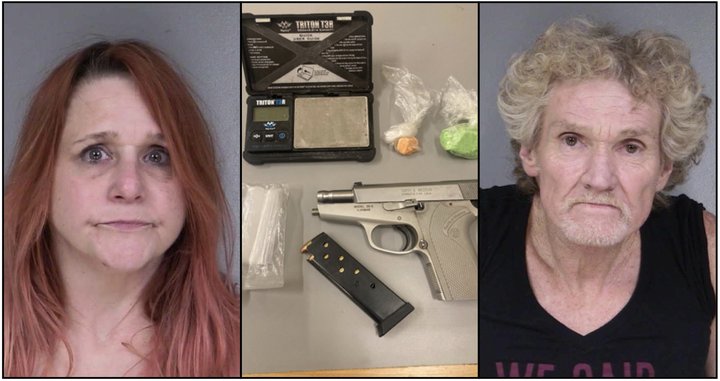
On Tuesday November 16th, 2021, the Humboldt County Drug Task Force (HCDTF), with the assistance of
the Humboldt County Sheriff’s Office (HCSO), made a traffic stop on Don Scoville (58 years old from
Fortuna) as he entered Humboldt County on northbound Highway 101. The HCDTF had been
investigating Scoville for trafficking fentanyl from the Bay Area into Humboldt County. Agents had
obtained a search warrant for Scoville and his vehicle. Silke Allen (45 years old from Fortuna) was
detained in the vehicle along with Scoville.
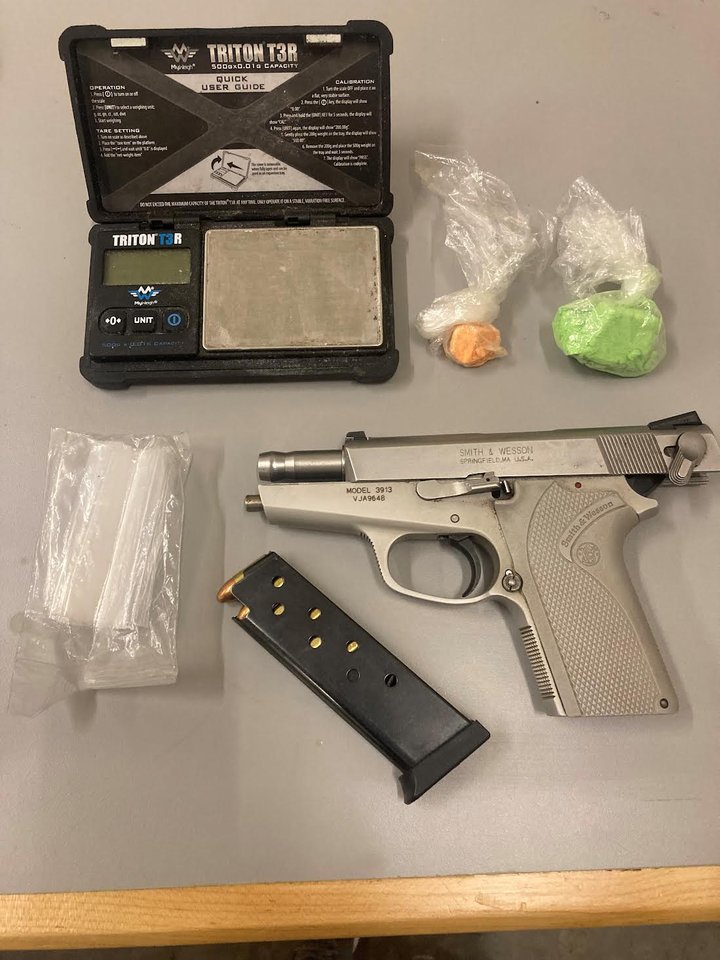
Agents conducted a search of Scoville’s vehicle and they located the following evidence:
Approx. 1 ounce of fentanyl (green and orange in color)
Digital Scale
Packaging materials
Smith & Wesson 9mm handgun
Scoville and Allen were both arrested for the following charges:
H&S 11352(b) Transportation of fentanyl across non-contiguous counties
H&S 11352(a) Transportation of fentanyl
H&S 11351 Possession of fentanyl for sale
PC 182 Conspiracy to commit a crime
It was determined that Allen was not aware that Scoville had a loaded 9mm handgun concealed within
his vehicle. Scoville was also arrested for the following charges:
H&S 11370.1 Possession of controlled substance while armed
PC 25850 Loaded firearm in a vehicle
PC 25400 Carrying a concealed firearm
Scoville and Allen were both booked at the Humboldt County Jail.
Anyone with information related to this investigation or other narcotics related crimes are encouraged to
call the Humboldt County Drug Task Force at 707-267-9976.
Press release from the Humboldt County Sheriff’s Office:
The Humboldt County Sheriff’s Office has recently received reports of a disturbing phone scam targeting local residents.
As part of this scam, the scammer may call or send a text to the victim claiming that they are a member of a cartel. The scammer then threatens to kill the victim’s loved ones if they do not send thousands of dollars to the scammer immediately. The scammer has also reportedly sent graphic and disturbing images to victims attempting to convince the victims to send money.
If you receive these scam calls or texts, do not send money, but notify your local law enforcement.
Remember these tips to help protect yourself from fraud:
1. Spot imposters
Scammers often pretend to be someone you trust, like a government official, a family member, a charity or a company with which you do business. Don’t send money or give out personal information in response to an unexpected request – whether it comes as a text, a phone call or an email.
2. Do online searches
Type a company or product name into your favorite search engine with words like “review,” “complaint” or “scam.” Or search for a phrase that describes your situation, like “IRS call.” You can even search for phone numbers to see if other people have reported them as scams.
3. Don’t believe your caller ID
Technology makes it easy for scammers to fake caller ID information, so the name and number you see aren’t always real. If someone calls asking for money or personal information, hang up. If you think the caller might be telling the truth, call back to a number you know is genuine.
4. Talk to someone
Before you give up your money or personal information, talk to someone you trust. Con artists want you to make decisions in a hurry. They might even threaten you. Slow down, check out the story, do an online search, consult an expert — or just tell a friend.
5. Don’t rely on personal information
Living in the digital age, access to information is easier than ever. Scammers are often able to get their hands on very personal information, providing it to their victims to make their scam look more legitimate. Don’t trust a scammer who is able to provide your personal information. If you followed the above tips and still aren’t sure, call back at a publicly listed number for the organization from which the scammer claims to be or contact your loved one directly.
Sign up for the Federal Trade Commission’s scam alerts at ftc.gov/scams.
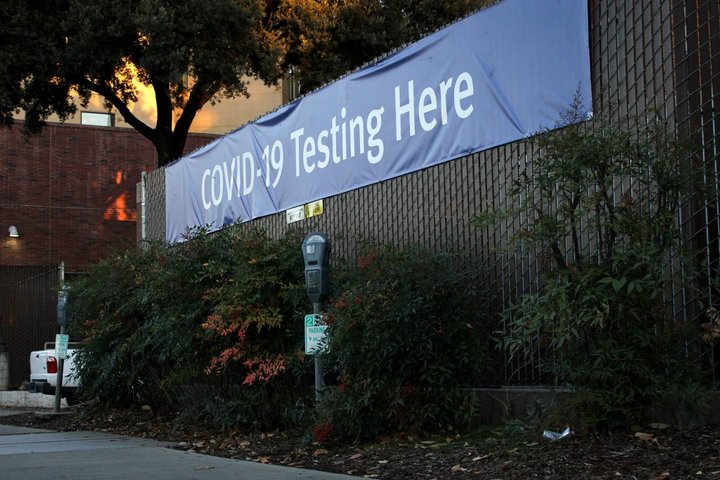
A COVID-19 testing site at Chico State University. Photo by Julian Mendoza for CalMatters
###
This story was reported and written by Michaella Huck, Zaeem Shaikh and Julian Mendoza.
For the record: This story has been updated with corrected student vaccination data provided by Cal State East Bay. A spokesperson for the university said she had misunderstood a reporter’s original question. She provided new numbers which she said accurately showed the vaccination rate for all students.
###
In July, with the Delta variant of the coronavirus on the rise, California State University announced that all students and employees going to campus would need to prove they were vaccinated against the virus, or apply for a religious or medical exemption, no later than Sept. 30. The move by the nation’s largest four-year public university was driven by “the overarching goal of achieving population-level immunity throughout the CSU,” Cal State Chancellor Joseph Castro wrote.
But while the vaccine mandate likely has helped avoid large outbreaks of COVID-19, it is being unevenly enforced across the system more than a month after the deadline. Some campuses barred students from in-person classes and on-campus buildings after they failed to upload proof of vaccination or request an exemption, while others allowed them to continue attending.
The lack of enforcement makes some students feel unsafe, and public health experts say it risks undermining the rule’s effectiveness. Yet others, including the Cal State Student Association and some campus administrators, say the flexibility is necessary to avoid penalizing students who come from communities where they might have less access to the vaccine.
“The policy is that if you’re accessing campus facilities, you need to be vaccinated. How they enforce that is up to the discretion of the campuses,” said Cal State Chancellor’s office spokesperson Michael Uhlenkamp.
The CSU Chancellor’s office is allowing campus presidents to take their needs and resources into account when deciding how to implement the mandate, Uhlenkamp said, but told them to do everything possible to avoid disenrolling students.
After the Chancellor’s office told the CalMatters College Journalism Network in late September that it was not tracking campus-level vaccination data, reporters requested vaccination rates for all students from Cal State’s 23 campuses. Cal State Stanislaus and Cal State Bakersfield ranked the lowest in student vaccination percentages, with about 66% of their student bodies vaccinated. Cal State Long Beach, Cal Maritime and San Diego State University have seen near complete compliance with vaccination rates at or above 95%.
The Chancellor’s office later began reviewing data on vaccination and exemption requests from only students who were enrolled in in-person classes or other campus-based programs. This data shows considerably higher vaccination rates; the overwhelming majority of in-person students were vaccinated as of Nov. 9. Across the 23 campuses, 18,695 students requested religious exemptions and 4,304 requested medical exemptions.
The way the Chancellor’s office is tracking the numbers, however, could exclude students who are enrolled online but are using campus facilities like libraries and dining halls, depending on the campus’s tracking and enforcement. And knowing that kind of information is key to preventing the virus’s spread on campus, said Dr. Kirsten Bibbins-Domingo, chair of epidemiology at the University of California San Francisco.
“You should know the rates for everyone,” she said. “Mandates are only as good as your ability to enforce them or monitor them.”
That’s especially important given the large number of Cal State exemption requests and the threat of another winter COVID surge, Bibbins-Domingo said.
Several campuses told CalMatters they are not enforcing the mandate for students in virtual classes. Cal State Bakersfield exempted 1,113 students and staff who are not accessing campus this semester, a university spokesperson said. Three campuses – Cal Poly Pomona, Cal Poly San Luis Obispo and Cal State Monterey Bay – said they approved all exemption requests for students and staff.
A more lax approach
Even among students attending in-person classes, enforcement varies by campus. At Cal State Long Beach and Cal State Los Angeles, students who did not upload their vaccine verification or apply for an exemption by the Sept. 30 deadline can still attend in-person classes and visit other buildings on campus — though they are unable to register for spring classes.
Cal State Long Beach spokesman Jeff Cook said university leaders took into account low community case numbers and a lack of evidence of classroom transmission when they decided to prioritize offering students help to meet the requirement, only penalizing them if outreach fails.
“Our large population of first-gen students deserve a caring and compassionate response given how much they’ve been impacted by the pandemic,” Octavio Villalpando, vice president for diversity, equity and inclusion and student life at Cal State LA, said in a statement.
Some vaccinated students, however, said they are troubled by the threat of breakthrough infections and the lack of enforcement. Nicolette Elia, a senior studying communication disorders at Cal State Los Angeles, began a petition last month calling for more online classes in the spring semester; as of Nov. 11, it had garnered over 3,600 signatures.
Elia said she is fully vaccinated but is nervous about the possibility of transmitting the virus between campus and the elementary school where she works.
Since her campus is not publicly sharing information about student and staff vaccination rates, she doesn’t know how safe she is from contracting COVID-19 on campus. “You’re just kind of wondering, you know, how do I know how many people are vaccinated?” she said.
There have been no outbreaks on individual campuses of case numbers large enough to change campus operations, Uhlenkamp said. Students can look up their campus’ weekly COVID-19 case numbers on a central website.
“Mandates are only as good as your ability to enforce them or monitor them.” — Dr. Kirsten Bibbins-Domingo, UC San Francisco chair of epidemiology
But campuses still must work to increase vaccinations, or enforce mask mandates and offer widespread testing on campuses where they don’t want to restrict access, said Bibbins-Domingo.
“The CDC has monitored college campuses throughout and the activities on a college campus — in-person classes, socializing — do actually fuel transmission,” she said. “This is an important issue for college campuses, but it’s also an important issue for communities that surround college campuses.”
The ideal approach to prevent COVID spread involves carefully vetting exemption requests and enforcing a mandate that actually prevents non-compliant students and faculty from coming to campus — two things her university is doing, said University of Southern California chief health officer Dr. Sarah Van Orman.
When policies are not universally applied, “there may be some levels of confusion…that can interfere with people’s interpretation of what the policies are,” said Anji Buckner-Capone, a public health and recreation professor at San Jose State University.
But public universities with fewer resources, like the Cal State system, also have to consider their students’ needs and their own capacity for enforcement, Van Orman said.
“They may have students who have a lot more barriers to being vaccinated and you have to make a decision about, do we want to exclude that person from campus or do we want to encourage them?” Van Orman said.
Even with mixed enforcement, multiple campuses’ student vaccination rates are higher than the counties in which they are located
And though Cal State’s mandate is unevenly enforced, there’s some evidence that it’s increasing vaccination among students. San Jose State’s vaccination rate, for example, increased by 11 percentage points to 85% a little more than two weeks after the self-certification deadline.
“Any enforcement is better than none,” Van Orman said, “because you’re going to get a whole bunch of people vaccinated.”
Systemwide student advocates have pushed for more lenient enforcement of the mandate. Communities already marginalized by the education system, including Black and Latino students and homeless students, are less likely to have received the vaccine, said Cal State Student Association president Isaac Alferos.
Students who have a more difficult time accessing the vaccine should not be punished even more academically, he said. “We want to make sure that as much as we are trying to keep our students safe, that we are also not exacerbating problems that exist within the CSU as well,” Alferos said.
The stricter schools
Some Cal State campuses have opted for stricter enforcement. Humboldt State placed what the university called a “health and safety hold” on students who had not complied with the vaccine mandate by Sept. 10. When classes began in mid-September, those students could not use campus facilities including classrooms, dining halls, and the gym.
Officials were motivated by the Delta variant along with a high level of hospitalizations and community transmission in Humboldt County, said Humboldt State spokesperson Grant Scott-Goforth. The campus is also offering only 30% of classes in person.
Cal State Northridge also moved up the deadline to align with its start of in-person classes and held a vaccination fair where about 200 students got the jab.
“We wanted to make sure our students not only felt safe, but also supported on a university level,” said Linda Reid Chassiakos, director of Cal State Northridge’s student health center.
Chico State students who did not upload their vaccine verification on time were withdrawn from in-person classes and barred from registering for in-person courses in spring 2022.
Rae Helms, a vaccinated senior at Chico State, said they feel safer knowing the vaccine mandate is enforced on campus, but still wish they could see the exact numbers of how many students are vaccinated. “It’s kind of scary not knowing if everyone else is vaccinated or not,” they said.
But some students said they thought their own vaccination was enough to protect them — even at campuses with higher percentages of unvaccinated students.
“I took the initiative to be vaccinated because I wanted to help protect my family,” said Nicole Hovland, a junior psychology major at Cal State Stanislaus. “However, I don’t judge someone else because they don’t want to.”
The safety of students in the same room may vary among campuses based on a number of factors, including ventilation and social distancing, Buckner-Capone said. It is important, she said, to combat misinformation that’s contributing to vaccine hesitancy.
“I took the initiative to be vaccinated because I wanted to help protect my family.” — Nicole Hovland, Cal State Stanislaus student
Over the summer, she conducted a survey of student perceptions on vaccination and returning to campus. Of the 1,760 respondents from San Jose State University, 82% of students said that they were vaccinated prior to the start of the fall semester, while 16% of students said they were not going to get vaccinated. The latter group had a variety of reasons, Buckner-Capone said.
“Students cited concerns about the side effects of the vaccine, the speed of development, vaccine safety – so again in line with a lot of the things that we’re seeing nationwide,” Buckner-Capone said.
Charlie Pereda, a senior studying environmental research at Humboldt State University, shares those concerns. He doesn’t want to get vaccinated and has not applied for an exemption.
In his family, Pereda said, “We believe in natural medicine. Like, I genuinely believe that my body would take care of it.”
Pereda is taking all online classes this semester, so he hasn’t been too affected by the hold placed on his student account that prevents him from accessing campus facilities.
Still, Pereda may want to take in-person classes next semester, so he’s planning on submitting an exemption request. If that doesn’t work, he said, he might just give in and get the vaccine.
###
Huck, Mendoza and Shaikh are fellows with the CalMatters College Journalism Network, a collaboration between CalMatters and student journalists from across California. Senior fellow Omar Rashad and assistant editor Sonali Kohli contributed to this story.This story and other higher education coverage are supported by the College Futures Foundation.
CALmatters.org is a nonprofit, nonpartisan media venture explaining California policies and politics.
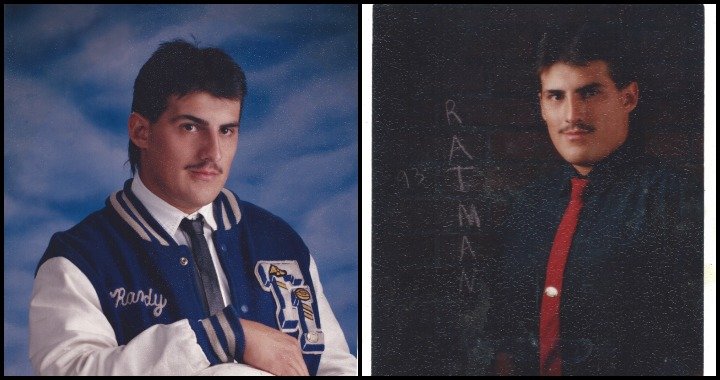
Randy Gene “Rats” Clark Sr. was brought into this world kickin’ and screamin’ on Hot-tember
(September) 3, as he called it, 1972 and unexpectedly passed away November 3, 2021.
Rats grew up in Hoopa then moved to Silverake, Washington where he attended high
school at Toutle High. He later attended the Universal Technical Institute in Arizona with a focus
on diesel mechanics. After graduating, Rats returned to Hoopa and started his family.
He provided for his family by working for the tribe at departments such as HVPUD and Hoopa
Modular. In the end he found fulfillment in working for himself as a local mechanic where he was
able to take full advantage of his “injun-uity.” He had an innate ability to make things work on a
budget and with what he had. As we cleaned his house we found a custom notification system
made out of fishing line, eye bolts, and bells so that his late mother could get his attention when
needed as he was her caregiver. We also found a fishing pole that he fashioned into a duster for
cleaning around the house.
Friends and family would come to him looking for help with their
vehicles, chainsaws, and household projects. He was a jack-of-all-trades. Speaking of which,
we found a certification for Gnome Hunting among his treasured items. Given his good-willed
and joking personality people would often come to his shop just to visit and enjoy his company.
Rats had worked on many auto projects throughout his life. He was mostly proud of his cherry
red K model Chevy truck that he had rebuilt himself.
He was rich in his caring and compassion for his family. He spoiled and loved his three kids
unconditionally. Rats would constantly offer support and love and would find ways to surprise
them with gifts whenever he could. Without question he would do what he could to make his
children feel cared and loved.
Rats had a special connection with his grandson Beau Douglas. He would bring Beau candy
and toys almost everyday. During the summer they would share a “hopsicle” out on the front
porch. Beau was often annoyed with his grandpa when he revved up the vehicle or tool he was
fixing. Anytime Rats would hear Beau he would yell, “Hey, Grandson! Love you!” from across
the yard.
He is preceded in death by his parents George “Bud” and Delores Clark. Along with his sister
Charlene Baldy (Michael) and wife Rachel McCovey-Clark.
He is survived by his Children Destiny Douglas (Matthew) Shelby Clark (Willy) and Randy Clark
Jr. Grandson Beau Douglas. Siblings Merwin Clark, Clara Clark, Mekila Clark (Tony Smith).
Nieces and Nephews Merwin (Virginia) Clark, Brently Clark, Sunni Baldy, Carmalita Navarro,
Falona (Michael) Bailey, Michael (Misqiy’ts) Baldy, Felicia (Monica) Luna, Charlena (Rico) Tello,
Abigail Luna, Mattaya Smith, and Macie Smith. Along with numerous cousins, and great nieces
and nephews.
###
The obituary above was submitted on behalf of Rats Clark’s loved ones. The Lost Coast Outpost runs obituaries of Humboldt County residents at no charge. See guidelines here.