Debra Marie Fontaine, 62, of Rio Dell, passed away on November 13, 2021 in Carmichael, California.
Debbie Fontaine was born in Truckee to Virgil Maldonado and Joan Terry on December 1, 1958. She went to school at Eureka High School. She married Paul Fontaine on April 30, 1976 in Las Vegas. Debbie worked for Renner Petroleum as Mike Renner’s personal assistant for 17 years. She was also a CASA advocate at one time.
Debbie loved to camp with her family every year. She loved living in Humboldt County. She loved all things crafting and made shirts, cups, and all kinds of different items. She loved her family, especially her grandchildren. She enjoyed creating and designing themes and outfits for her grandchildren’s photo shoots. She loved watching her children play sports growing up and attended many of her grandchildren’s games. She was always there to lend a hand when someone was in trouble, including helping 3 family members through their cancer battles.
Debbie is preceded in death by her mother and father, and her two sisters, Dorene and Dianne.Debbie is survived by her children: Evan Fontaine and Briar Parkinson and son in law Nathaniel Parkinson, her extra children: Cassie Holmgren and Heather Watkins, her siblings: Denise Sproat and Robert Higgs, the JOYS of her life; her grandchildren: Kaleya Parkinson, Ryder Cree, Lania Fontaine, Tayla Fontaine, Kasyn Parkinson, Rykin Fontaine, and numerous nieces and nephews.
There will be a private family celebration of life to follow.
###
The obituary above was submitted on behalf of Debra Fontaine’s loved ones. The Lost Coast Outpost runs obituaries of Humboldt County residents at no charge. See guidelines here.
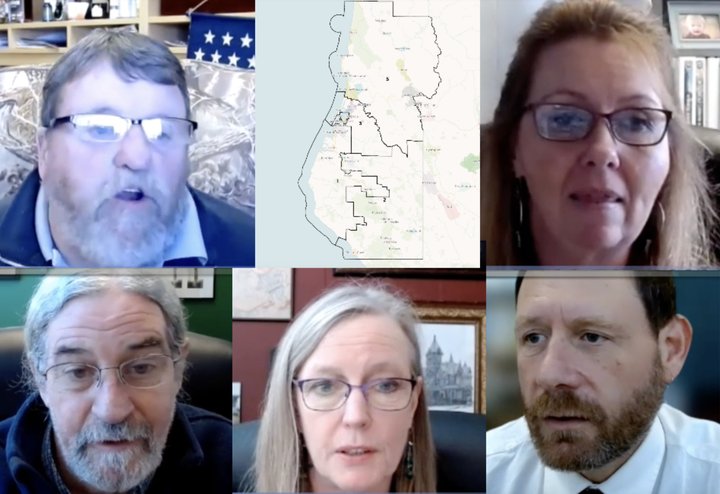
Screenshots from Tuesday’s meeting, and also a map (clockwise from top-left): First District Supervisor Rex Bohn, the aforementioned map, Second District Supervisor Michelle Bushnell, Third District Supervisor Mike Wilson, Fourth District Supervisor/Board Chair Virginia Bass and Fifth District Supervisor Steve Madrone.
However flawed the process may have been — and most seem to agree that it was pretty damned flawed — a lot of time and effort went into Humboldt County’s decennial redistricting effort: consultants, an advisory committee, several batches of draft maps and multiple public hearings. But in the end, the Humboldt County Board of Supervisors opted to stick with the existing district boundaries, drafted a decade ago.
It wasn’t for lack of trying from Supervisor Steve Madrone who on Tuesday made a concerted effort to convince his four board colleagues to redraw the line boundaries one of a couple different ways, both of which would have added the City of Blue Lake to the Fifth District (that is to say, ahem, his own district).
In doing so, Madrone renewed the argument he’d begun two weeks earlier, when he introduced a map he’d drawn himself and reasoned that it’s only fair to add Blue Lake to the Fifth, alongside the nearby Glendale community, because the Fifth lacks a sizable incorporated city. His map also would have put Scotia and Rio Dell into the same district.
At today’s meeting, Madrone said the board had received “a significant amount of input” over the past week — six comments from community members who wanted Glendale and Blue Lake to be united in the same district. Bolstered by this influx of feedback, Madrone made a motion to adopt Draft Plan 2, one of two maps prepared for today’s meeting.
That map would place Blue Lake in the Fifth, but in doing so it would render the district drastically overpopulated compared to the other four, as Outpost Editor Hank Sims noted previously. The state allows a population variance of up to 10 percent between the most- and least-populous districts, and Madrone’s preferred Draft Plan 2 would put the county right up against that limit, with the Fifth District containing 9.9 percent more residents than the Fourth.
Madrone said that this lopsided population didn’t bother him, personally, since it’s within the legal limit, but if it bothered others he suggested a possible fix: lopping off a large swath of rural land at the southern end of the Fifth District, the region south of State Route 299 around Titlow Hill, and giving it to the Third District.
Third District Supervisor Mike Wilson seconded the motion “for the sake of discussion,” but Madrone’s pitch failed to gain much traction. First District Supervisor Rex Bohn said the vast majority of feedback he’s gotten urged the board not to change the lines much, if at all. And he reiterated a conclusion he’d made two weeks ago — that Madrone’s proposal appeared rather self-serving.
“This looks like somebody setting something up,” he said.
Wilson said he’d be reluctant to make the population so unbalanced and also reluctant to redistrict the residents around Titlow Hill so late in the process.
During public comment, Humboldt County Planning Commissioner Thomas Mulder said Madrone’s preferred map looked to him like a politician trying to preserve his seat.
County staff had failed to publish the two draft maps under consideration today by the legally mandated seven-day minimum before Tuesday’s meeting, which put pressure on the board to settle on a single draft map today, thereby allowing the map to come back for final approval at the Dec. 7 meeting, narrowly beating the state deadline of Dec. 16.
Madrone pushed back against some of the skepticism, insisting that his motives arose purely from community feedback, not political calculations. He also expressed a desire to see the board to settle on a map unanimously, even if it wasn’t his preferred option, for the sake of unity.
“I’m willing to work with the board,” he said. “I just wish you guys were willing to hear me and hear that [Blue Lake/Glendale] community of interest.”
That comment didn’t sit especially well with Fourth District Supervisor/Board Chair Virginia Bass, who said the matter was more complex than that, adding that she was uneasy with Madrone having created his own map.
Seeing the writing on the wall, Madrone unhappily rescinded his motion. Bohn then made a motion to keep things exactly as they are, and after a bit more discussion the board voted unanimously to do just that. Thus, the existing map will be brought forward for final approval — and another decade of use — on Dec. 7.
Catholic Charities efforts to provide legal services to individuals and families navigating the immigration and visa system in Del Norte and Humboldt counties were extended an extra year by a $15,000 grant from the Humboldt Area Foundation and Wild Rivers Community Foundation.
“The immigrant communities in Humboldt and Del Norte counties face great challenges, namely a shortage of trained service providers as well as immigration attorneys who lack the experience necessary to properly address the need,” said Dina Lopez, Director of Immigration for Catholic Charities of the Diocese of Santa Rosa. “This generous grant from HAF and WRCF will help Catholic Charities continue offering a variety of free legal services.”
Catholic Charities serves more than 5,000 immigrants each year with a suite of legal immigration remedies including Family-based Petitions, DACA, green card renewals, naturalization, U Visa and T Visa. Accredited by the Department of Justice, Catholic Charities staff serve historically underserved immigrant communities — mostly clients from Mexico, Honduras, Philippines — in Sonoma, Humboldt, Lake and Del Norte counties.
Lopez said her organization strives to make immigration remedies available to working families that are forced to travel outside of the area for help or pay significant fees for unreliable counsel.
“We strive to make services more accessible than they have ever been,” she said. “And we remain steadfast in our commitment to those exploring legal permanent residency across the entire Diocese of Santa Rosa.”
This is the second HAF/WRCF grant to Catholic Charities, which has expanded immigration outreach and education in Humboldt County the last five years. From November 2020 to September 2021 a $12,000 grant to the organization allowed them to bring $90,000 worth of pro bono legal aid to Humboldt County, reaching 152 workers and their families.
“Supporting the services that allow our neighbors to achieve or maintain legal immigration status is key to ensuring the safety and protection of these families,” said Lindsie Bear, vice president or Community Solutions at HAF/WRCF. “We are grateful to our local community leaders at True North Organizing, Centro del Pueblo, and in the Promotores Network for helping the foundation identify this gap in essential services. And to Catholic Charities for working with local leaders to bring trusted educational and technical expertise where it is so deeply needed.”
Catholic Charities will use the new HAF/WRCF grant this year and in 2022 to expand services in Del Norte County as the number of immigrants working low-wage service and agriculture jobs continues to rise. Specific services will include free, one-to-one legal assistance, and free education and outreach events that help clients learn their rights and the legal pathways to citizenship. The work will be done virtually in partnership with trusted, local agencies and Catholic parishes. Once COVID restrictions are lifted, they will return to in-person events.
For more information about Catholic Charities of Santa Rosa, visit www.srcharities.org. Learn more about Humboldt Area Foundation at hafoundation.org, and Wild Rivers Community Foundation at wildriverscf.org. For more information about this press release, contact Jarad Petroske at jpetroske@hafoundation.org
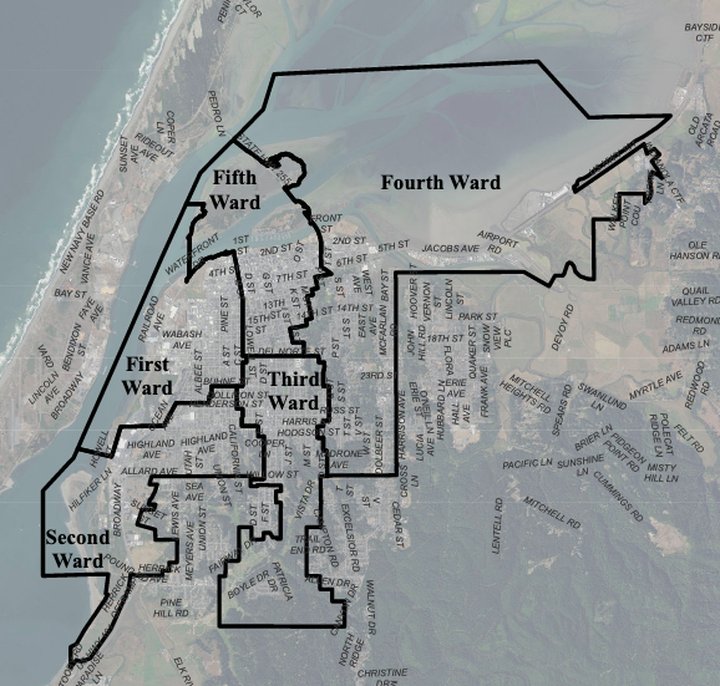
Map of the new proposed Eureka Wards | Image from Eureka city staff report
###
If you live in Eureka you’ll want to pay close attention to tonight’s Eureka City Council meeting — during which there will be a public hearing on the adoption of new ward boundaries in the city — because, depending on where you live, there is a chance you will soon inhabit a different ward.
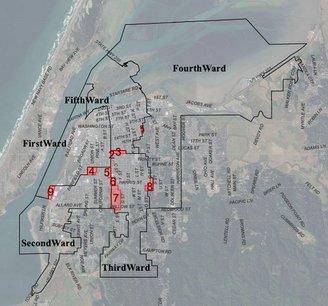
The proposed changes to Eureka’s ward boundaries are actually pretty minimal, so you will only be affected if you live in one of the nine relatively small pockets of the city where the ward lines will be redrawn. The proposed map — drawn and recommended by Eureka city staff — was selected by the council out of six different maps, which the council reviewed during its Oct. 19 meeting. The other five maps were drawn by members of the public through LoCOs very own “Let’s Redistrict Eureka!” game, but sadly did not make the cut. The primary reason the council favored the map it did is that it contains the least amount of changes to the existing ward map, meaning less people will be affected.
So, why is the City changing the ward boundaries at all? Because the 2020 Census data showed that Eureka’s population has shifted pretty dramatically since 2010, leaving the current ward populations out of balance. The purpose of adopting the new map is to ensure that the ward populations are as balanced as possible and that each councilmember represents roughly the same number of people.
Map showing the areas of change with the new ward boundaries
If you are one of the Eureka residents who would be moved to a different ward, don’t worry! The change won’t affect you much, except — since the city adopted the true ward system — it will impact who you are able to vote for in city council elections. If you live in the First, Third or Fifth Ward, then you’ll be electing a councilmember in November 2022.
Whether or not you’ll be impacted by the change, you can voice your comments or concerns during the public hearing tonight, which will occur toward the beginning of the council meeting.
###
In other election-related business, the council will look at implementing a Ranked Choice Voting (RCV) system, which was approved by Eureka voters in 2020 by way of Measure C. The passage of Measure C essentially authorized the city council to amend the city’s charter to institute ranked choice voting, the process for which the council will begin during tonight’s meeting.
If you voted on the issue during the 2020 election, you probably understand at least a little about how the system works. But in case you’re confused, here is a quick rundown from the city staff report:
RCV is an alternative to the standard methods of conducting municipal elections in California. These are either (a) a primary election followed by a potential separate run-off election in order to achieve a 50%+1 winner or (b) a single election with the highest plurality (not necessarily majority) vote-getter being elected. The second is Eureka’s current method of choosing Council members and the Mayor.
When there are more than two candidates for one seat, RCV [Ranked Choice Voting] allows voters to rank candidates for that seat in order of preference when marking their ballots. Only one candidate can represent each of the voter’s first, second or third, etc., choices.
Functionally, when electing a single candidate using RCV – as in a race for mayor or ward council member with more than two candidates – all first choices are tallied in the first round. If any candidate receives a majority of the first choices, that candidate is elected.
If no candidate receives a majority, the “instant run-off” process is triggered. The candidate receiving the fewest first choices is eliminated, and the voters for that eliminated candidate now have their second choices counted. The ballots are again tallied and the process will continue through subsequent rounds until one candidate wins a majority.
This does mean that Eureka voters will need to get used to a new system for casting and counting votes and there will probably be a bit of a learning curve. But the changes will likely not happen right away. If the council moves forward with an ordinance tonight, it will be brought back for adoption as soon as the next council meeting. The City Elections Office will then need to coordinate with the Humboldt County Registrar of Voters to implement the system. Ranked Choice Voting could be implemented as soon as the 2022 Municipal General Election, but may be as late as the 2024 election.
###
The council will also consider adopting an ordinance that would prohibit storage and handling of coal and coal-related substances on city-owned property, an action prompted by news that a mysterious corporation is attempting to take over North Coast Railroad Authority’s right-of-way between Humboldt Bay and the San Francisco Bay Area in order to facilitate large-scale coal exports.
The ordinance, which council discussed during its Oct. 19 meeting, was initially designed to also prohibited the transportation of coal over city-owned property. But the council agreed that it would be legally difficult to regulate the transportation of coal. The ordinance has also been changed to include the prohibition of petroleum coke on city-owned property. Petroleum coke, as defined by the staff report, is “ solid carbonaceous residue produced from a coker after cracking and distillation from petroleum refining operations, including such residues produced by petroleum upgraders in addition to petroleum refining.”
###
The Eureka City Council meets virtually on Tuesday, Nov. 16 (tonight) at 6 p.m. You can view the full agenda and directions on how to participate here.
###
CORRECTION: This article has been changed to reflect that residents of Eureka’s First, Third and Fifth Wards will be electing councilmembers in Nov. 2022.
Press release from the Humboldt County Sheriff’s Office:
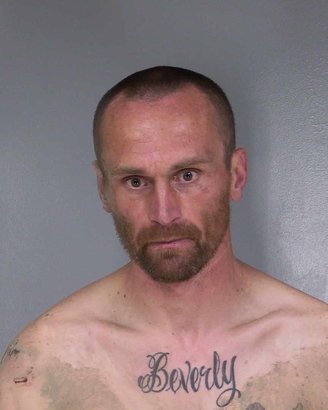
On Nov. 15, 2021, at about 2:39 p.m., Humboldt County Sheriff’s deputies were dispatched to a residence on the 1900 block of B Avenue in McKinleyville for the report of a residential burglary in progress.
According to the reporting party, the victim arrived home and found a man, later identified as 41-year-old Jason Edward Balke, who had forced entry into the residence. Balke reportedly fled the residence and the victim followed while contacting law enforcement.
Deputies located Balke walking in the area of the 1800 block of A Avenue. Upon seeing deputies, Balke fled and a short foot-pursuit ensued. Balke refused to comply with deputy requests to stop and at one point turned toward deputies brandishing a large rock. During this interaction, a deputy deployed a department-issued taser, effectively gaining compliance. Balke did not sustain injuries from the taser deployment.
Balke was arrested and booked into the Humboldt County Correctional Facility on charges of burglary (PC 459/461(A)), vandalism (PC 594(b)(1)), resisting a peace officer (PC 148(a)(1)) and parole hold (PC 3000.08(c)).
This case is still under investigation.
Anyone with information about this case or related criminal activity is encouraged to call the Humboldt County Sheriff’s Office at (707) 445-7251 or the Sheriff’s Office Crime Tip line at (707) 268-2539.
Transportation safety has been recognized as a priority for the Eureka City Council and in 2020 the
City Council directed Mayor Susan Seaman to create and lead a regional Traffic Safety Task Force to
address the issues of traffic safety in and beyond Eureka. On March 10, a coalition began meeting to
create a campaign that addresses our shared commitment to transportation safety.
A press conference will be held to announce the campaign, “Go Slow, Watch the Road” on Wed.
Nov. 17 at 11 a.m. at Eureka City Hall. The event will include a reading of the proclamation that
the task force created, which will be shared with local jurisdictions and agencies. The conference will
also provide a preview of campaign materials and activities as well as general information about
transportation safety in our region.
“Transportation safety, specifically speed, has been a consistent concern for people I talk to in every
corner of the city. Speed also came up in the task force as a priority,” said Susan Seaman, Mayor of
Eureka. “This campaign is a shared commitment throughout the county to work towards improving
safety for everyone who uses our roads, including pedestrians, cyclists and other drivers. It is also an
appeal to the public to remember that driving a cooperative activity and we’re asking them to commit
to watch their speed and remain alert to create safer roads. ”
Participants in the task force included: Eureka Mayor Susan Seaman; Virginia Bass, Board of
Supervisors; Beth Burkes, Humboldt County Association of Governments; Colin Fiske, Coalition for
Responsible Transportation Priorities; Caroline Griffith, City of Eureka Transportation Safety
Commission; Lisa Fryrear, State Farm Agent; Rio Dell Mayor Debra Garnes; Brian Gerving, Public
Works, City of Eureka; Debbie Hart, Slow the F Down neighborhood group; Emily Hogan,
Department of Public Health; Blue Lake Mayor Adelene Jones; Tom Matteson, Public Works, County
of Humboldt; Captain Shawn Morris, California Highway Patrol; Brittany Powell, Eureka Police
Department; Captain Brian Stephens, Eureka Police Department; Bob Walters, Eureka Driving School;
and Jenny Weiss, RCAA.
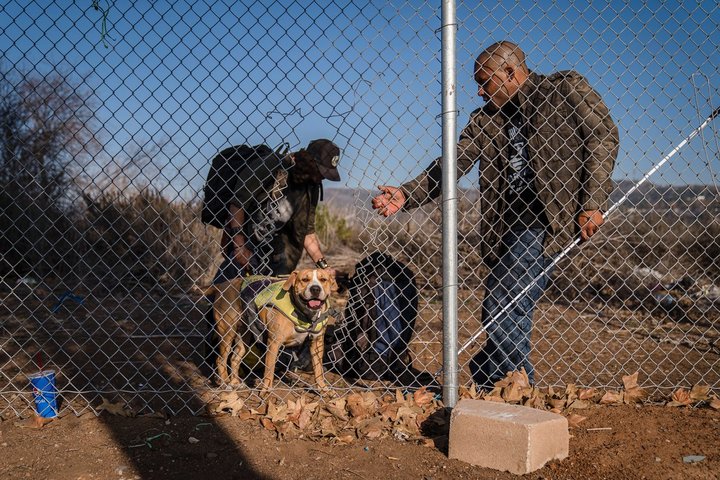
William Brown, right, and Josh Lowe with his dog near the encampment where they both were staying before it was cleared by Caltrans in San Clemente. Photo by Ariana Drehsler for CalMatters
###
The first time William Joseph Brown filled out a survey to try to get into permanent housing, he was living beside a highway. That was December 2019.
In late August this year, when California’s transportation agency cleared him from the same strip of land tucked behind the San Clemente off-ramp on the northbound Interstate 5, he still had nowhere to live.
Caltrans removed Brown and about 20 other campers due to the “immediate safety threat of fire,” as they were “using open flames to cook near dry vegetation,” a spokesperson told CalMatters.
The agency said six of those people were matched to permanent housing. Brown said he got a voucher for a hotel room for about a week, and then another, which recently expired.
But he’s still waiting on the permanent housing voucher he was promised two years ago. Brown said none of his friends exited homelessness since they were removed from the camp, either: “They’re just in a different place.”
“We were on the off-ramp because we were out of the way,” he said. “People don’t want to see homeless people. A lot of us were there because that was the last place to go.”
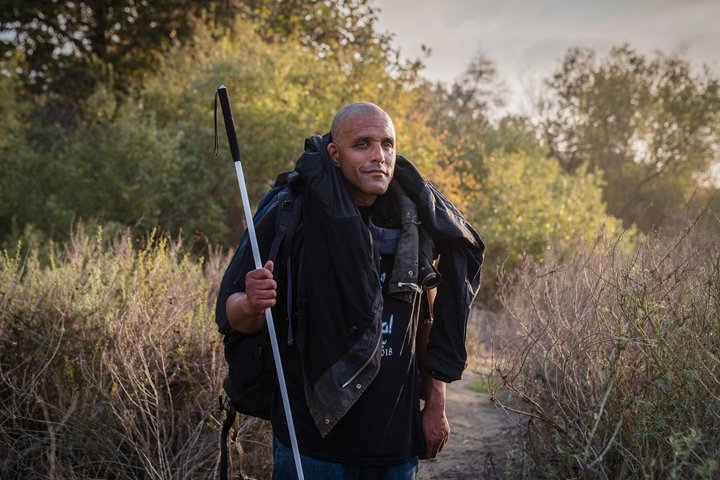
William Brown, 42 , in the woods in San Clemente on Nov. 6, 2021. Brown said he lost $1,000 worth of belongings while being removed from an encampment on Caltrans property and was left with only a backpack and bag. Photo by Ariana Drehsler for CalMatters
California is spending more than ever before on homelessness — $12 billion between 2021 and 2023 — which also means there’s more pressure to make an impact. The bulk of that money will go to creating more living spaces and providing mental health resources for people who are now on the streets.
But some of the money is being used by Caltrans in a ramped-up effort to move people like Brown off the state’s bustling freeways in the name of safety.
“We’ve got to deal with homelessness,” Gov. Gavin Newsom said at the 2021 California Economic Summit in Monterey on Nov. 9. “We’ve got to deal with cleaning the state, the streets, cleaning up our thoroughfares, our underpasses, our overpasses, removing graffiti, dealing with encampments.”
But while it may be good politics to move homeless people out of visible public locations, experts say it’s just moving the problem somewhere else.
“Spending state money on harassing people who are struggling under the impacts of local, state and federal policy failures is counterproductive,” said Margot Kushel, director of the Benioff Homelessness and Housing Initiative at the University of California, San Francisco. “I would present the radical idea of taking the perspective of the people living there.”
There aren’t enough beds
The last time volunteers and local officials counted the number of people experiencing homelessness in California was on a January night in 2020. They came across more than 161,000 people, in and out of shelters. That is the largest number in the nation, but the tally is widely considered an underestimate, and it doesn’t take into account the economic devastation brought on by the COVID-19 pandemic that started two months later.
About 36% of those people had been homeless for at least a year, which means the other two-thirds were newly homeless, according to federal data.
Meanwhile, cities and counties across California reported last year a little more than 53,000 beds in either an emergency shelter or transitional housing — or fewer than one bed for every three people. In some areas, the ratio is as high as five people per bed; no county has at least one full bed per person.
There are, however, some shelter beds — in churches for example — that aren’t counted in these official statistics because they don’t receive any money from the federal government.
A lot more beds became available in California during the pandemic in hotel and motel rooms leased or bought by the state at a record clip. Project Roomkey has provided temporary shelter to more than 48,000 people during the pandemic, and Project Homekey temporarily sheltered thousands more across 94 hotels that created about 6,000 permanent housing units.
Funding for the latter program was tripled in the most recent budget, from $846 million to $2.75 billion. Another $2.2 billion over the next three years will go to create behavioral health facilities.
In Los Angeles, officials found that between the loss in warehouse-style shelter capacity brought on by COVID safety measures, and the gain mostly in motel rooms made available by the state, total shelter capacity in the city didn’t vary significantly between 2020 and 2021.
But advocates say achieving a one-to-one ratio on shelter beds for people shouldn’t be the ultimate goal. Running shelters can be very expensive, and while it treats the problem temporarily, it can be a dead end when there’s no permanent housing on the other side. The Los Angeles Housing Authority, for example, found it needed more than triple the existing permanent supportive housing supply to match demand.
Besides, many people say they don’t want to go into congregate shelters, where they oftenare not only exposed to substandard living conditions, but potential assault.
“If you offer traumatized people to be in a huge shelter where there can be violence, where there can be no end in sight, where your things will get stolen, or could get stolen, that’s not not really an offer,” Kushel said.
At Brown’s camp by I-5, he said he and two other campers were offered a shelter bed, but turned it down. He suffers from a degenerative eye condition that blocks his peripheral vision, and said he had his belongings stolen multiple times at shelters.
What’s in the budget for Caltrans?
The budget includes $1.1 billion for a project called Clean California, with most of the money going to litter pickup and beautification. Newsom has said it will add about 11,000 jobs over three years, with at-risk youth and people who were formerly homeless or incarcerated getting priority. Caltrans is also using a small portion of the funding to clear homeless encampments.
“We’ve got to deal with cleaning the state, the streets, cleaning up our thoroughfares, our underpasses, our overpasses, removing graffiti, dealing with encampments.” — Gov. Gavin Newsom at Nov. 9 Economic Summit
“The situation with encampments in California is unacceptable,” Newsom said in a recent statement. “I refuse to accept the status quo — our fellow Californians suffering in tents, under highway overpasses, exposed to the elements, and living in unsanitary conditions.”
During the economic summit, the governor said that his office had identified 100 encampments as top priorities and was working with Caltrans to clear them “in a thoughtful and strategic way” — a promise he has made multiple times.
But so far his office and Caltrans have declined to identify the locations, citing privacy and security concerns for the campers.
“How are we supposed to know what’s happening with these resources?” asked Christopher Martin, policy director at Housing California, a nonprofit advocacy group. “It’s very behind closed doors, and I think that’s a little bit frightening because we need some accountability.”
Caltrans also got an additional $2.7 million this fiscal year for homeless coordinators to mitigate safety risks at encampments, clean trash and debris, and connect people living in these camps to support services and housing.
In a statement to CalMatters, Caltrans said it spent more than $15 million in the fiscal year that ended Sept. 30 and projects to spend nearly $36 million in the next year specifically on homeless camp cleanups. It conducted just 19 encampment relocations in all of 2020, when federal health officials advised against them during the pandemic. This year, Caltrans has completed 347 through mid-October.
When asked how the agency deals with the shortage of shelter and housing units, Caltrans officials said they “coordinate with cities and social service providers, which can connect people experiencing homelessness with services. However, on high priority encampments where an immediate threat to safety or to essential infrastructure has been identified, the department must proceed with the encampment clearing.”
None of that money will fund encampment clearings, according to Russ Heimerich, a spokesman for the California Business, Consumer Services and Housing Agency. Instead, he said, grantees will get funds to provide services tailored to the needs of people in those camps.
Heimerich directed any questions about the Caltrans cleanups to the transportation agency, while Caltrans directed questions about the encampment service programs to the California Homeless Coordinating and Financing Council. Both declined multiple requests for phone interviews.
Martin said the apparent lack of coordination between the programs was “a little concerning.”
California’s state auditor in February raised concerns about a lack of coordination between the multiple agencies dealing with homelessness in California: “At least nine state agencies administer and oversee 41 different programs that provide funding to mitigate homelessness, yet no single entity oversees the State’s efforts or is responsible for developing a statewide strategic plan.”
The new programs raise a bigger question for Josh Barocas, an associate professor of medicine at the University of Colorado who studies homelessness and substance use: Why is transportation money going toward clearing homeless camps?
“It doesn’t actually take into account the long-term health effects of those being displaced and doing the displacement, and their future needs,” he said.
Through a computer modeling study that did not undergo peer review, Barocas found that in Boston, disbanding a homeless camp was more likely to drive up overdoses, hospitalizations and mortality.
“It’s what I would call social theater,” he said. “It’s showing your neighborhood that you are trying to do something by literally sweeping the problem away….The only way to actually fix this problem is to get at the social and structural issues that are perpetuating poverty, perpetuating homelessness in the city.”
While Barocas doesn’t believe in clearing encampments, he said there is value in continued community outreach, even when the housing isn’t there yet. “Bringing resources to where people are, and literally meeting them where they’re at, never loses utility,” he said.
“It’s what I would call social theater. It’s showing your neighborhood that you are trying to do something by literally sweeping the problem away.” — Josh Barocas, an associate professor of medicine at the University of Colorado who studies homelessness
Eve Garrow, a homelessness policy analyst and advocate at the ACLU of Southern California, said many of the people now camping alongside California’s highways were originally in safer spots such as parks and restrooms. But they’ve moved into the fringes because of law enforcement harassment, often brought on by calls to service made by their housed neighbors.
“The answer is simple,” she said. “Stop criminalizing people.”
In a recent report, Garrow and her colleagues argue housing status should be a protected social group, a policy Martin’s group and the Western Center on Law and Poverty hope to advance in the Legislature’s next session.
Seeking stable shelter
Brown, who is 42, said he had worked with several county health workers to get on the waitlist for a permanent housing voucher, but all of them had since quit. “It just seems like nobody can even give me an answer as to why it’s not moving forward,” he said.
The voucher would subsidize Brown’s housing so he has to spend only a third of his disability check on rent. But he’ll still need to find a landlord willing to rent to a man who’s been homeless for more than five years.
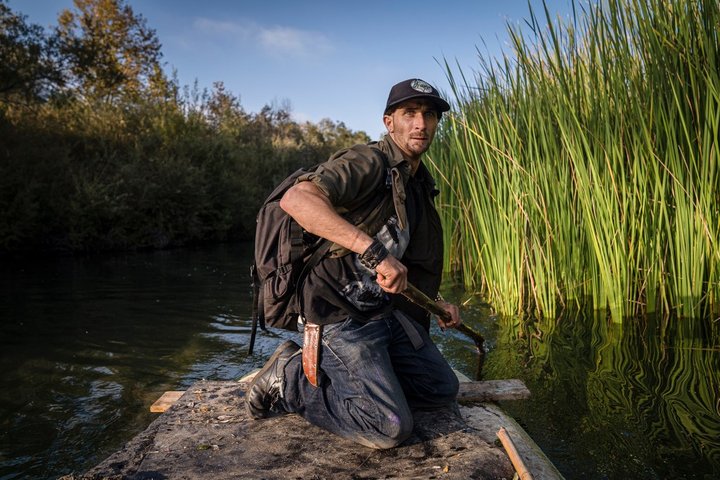
Josh Lowe, 32, made a raft out of longboards and wood to cross the San Mateo Creek and reach where he has been staying in San Clemente. Lowe moved to the woods with his dog after an encampment on Caltrans property was removed on Aug. 27. Photo by Ariana Drehsler for Calmatters.
Eventually, he wants to be able to host his grandmother, which he couldn’t do on the side of a freeway. He also wants a cure for his vision; he learned about a clinical trial when he was living in the camp, but said it was very difficult for him to consider the option if he had to take medication, as it would likely get stolen. And he wants to stop worrying about getting his stuff stolen every night, when he can barely see.
Since getting kicked out of the camp, Brown connected with another service provider who’s scheduled to call him to sort out his case. Staying in a hotel with his friend, Megan, provided some much-needed stability. “I got very used to that, and then we were told we had to leave.”
Brown and three of his fellow campers wrote a letter urging elected leaders, public officials, and service providers involved in the camp clearing to be honest about the plight of many homeless people:
“Admit that the process of getting assistance is lengthy, that there is not enough housing for everyone who qualifies for it, and that there are people on the street who do want help and are doing what they’re supposed to do to receive it.”
###
CALmatters.org is a nonprofit, nonpartisan media venture explaining California policies and politics.