The Humboldt County Sheriff’s Office continues to search the McKinleyville area for Matthew Dilley, a man wanted for a number of serious crimes who has managed to evade law enforcement for over a day now after ditching his vehicle following an initial high-speed pursuit on Highway 299.
Friday midday, HCSO announced that they are conducting operations near Macktown’s Sutter Road and that nearby residents should be wary of venturing outside.
HCSO tweets below:
An additional HCSO post on Facebook narrows the search to Sandpiper Lane where residents “are asked to STAY INSIDE and TAKE COVER due to the threat of possible gunfire.”
Location of McKinleyville’s Sandpiper Lane
Meanwhile, the North Coast Journal’s Thad Greenson is live-tweeting from Sutter Road and characterizes the scene as an “armed standoff” between Dilley and deputies before recommending that people don’t come there.
A view of the sunset rainbow from near the Arcata bottoms | Photo: Stephanie McGeary
If you happened to be looking at the sky during sunset on Thursday evening, you may have been one of the many lucky Humboldt residents to catch an incredible sight — a full rainbow with a backdrop of orange, pink and purple clouds. At moments you could even catch glimpses of a faint double rainbow. It was really something!
The eerie orange sky one year ago above HSU | File photo: Andrew Goff
In addition to the almost overwhelming beauty of overlapping sky art, what made the event particularly special is that it landed on the one-year anniversary of what some refer to as “smokeageddon” — the strange day when smoke from multiple nearby wildfires enveloped our coastal skies, choking out the sun and casting an eerie orange light.
While the orange sky day signaled a particularly bad wildfire season and left many of us feeling uneasy, the orange-ish rainbow that graced our skies one year later seemed to give many a moment of hope, especially during a time where the rain is badly needed.
In 2014, Humboldt County voters passed Measure Z, a half-cent sales tax meant to fund public safety. In the years since, that revenue has been spent on a number of different countywide departments and agencies, including the Sheriff’s Office, local fire departments, the Eureka Police Department, mental health services and more.
But the Humboldt Deputy Sheriff’s Organization — the bargaining unit representing frontline Sheriff’s Office employees — is now charging that this money has been ill spent, and cites current staffing levels inside its own department as evidence. The deputies are calling for change, and they go so far as to threaten political action — without relief, they say, they are prepared to “go back to the voters to consider changing or eliminating Measure Z altogether and starting over.”
As President of the Humboldt Deputy Sheriff’s Organization (HDSO), I wrote to you on June 16th (link) to alert you that your committee and the Board of Supervisors has absolutely wasted $70 million on a wrong-headed and counterproductive “hire rookies and hope for the best” strategy that is actually making public safety worse. Over two months has gone by with no change in strategy, and public safety coverage continues to erode for Humboldt County residents.
Today, our dedicated deputies are protecting our homes and property with more than 1 out of 3 patrol positions vacant - this is dangerous to residents and to our staff who already work one of the most rugged, rural, and dangerous law enforcement jobs in the country. When neighboring Mendocino County pays their law enforcement personnel 40% more to cover a smaller community with less crime, it is no wonder that we are losing our best deputies and cannot fill vacant positions. Even the rookies you are paying to train are either failing the basic requirements or using Humboldt County tax dollars for “free training” and moving on to a different community.
The Measure Z Committee cannot continue spending tens of millions of taxpayer dollars on their same failed strategy and expect different results. Seven years ago, HDSO members asked Humboldt County taxpayers to dig a little deeper to provide the $15 million a year to fund public safety services, and the public did their part. But your Measure Z Committee and the Board of Supervisors have failed to do your part. The result is our members give more, the public gives more, and we all lose. This cannot continue.
Again, we would like to meet with your committee as soon as possible to discuss changing strategies. If nothing changes, we will be forced to go back to the voters to consider changing or eliminating Measure Z altogether and starting over.
Today, more than 25 positions for the sheriff’s department are vacant, leaving large swaths of Humboldt County and entire communities like McKinleyville, Garberville, Blue Lake, Redway, Willow Creek and many others without recommended or even basic law enforcement protections. Even some of our most dedicated HDSO members are actively applying for better paying jobs in other communities where their families can be protected with adequate public safety patrols.
It’s not too late for you to help stop this crisis. Please let me know when you can meet as soon as possible to stop throwing hard earned public tax dollars down the toilet and start investing in what works.
Sometimes very famous people eat the same things we eat.
This week we at LoCO learned a few things of slight interest that we will share with you now because things of great interest are always such a bummer these days. First, for those still keeping score on which major celebrities see fit to slip into our lovely county, you may have heard that New Zealand pop star Lorde recently took in some views of the Lost Coast while shooting a cover spread for Vogue magazine. (If you’re not immediately familiar with who is Lorde by name, just know that you’ve absolutely heard one of her songs in particular dozens of times in the mall or at your preferred grocery store or dispensary or wherever. You have.)
Welcome to Humboldt, Lorde! That kind of luxe just ain’t for us either.
But what does Lorde in Humboldt look like, you ask? Luckily, the Humboldt Del-Norte Film Commission secured the rights to some of the shots from Vogue’s photoshoot for their Facebook page which allows us to embed them here. Behold!
Good, Lorde!
But what was even more exciting to discover — thanks to some hungry social media commenters — is that Lorde maintains an oddly popular second Instagram account — onionringsworldwide — devoted to reviewing onion rings she’s nommed on her numerous globetrotting adventures. And yes, as this post’s headline foretells, Lorde had HumBrew’s onion rings — the same ones you’ve totally had! Wow!
And here, now, are the very rings Lorde ate.
Those rings ring a bell, right? Uh huh. In her Instagram post, Lorde tells the important tale of how she came to gobble said rings.
“These were from an establishment called the Humboldt Brewery, and referring to my notes, tasters confusingly said ‘nice crunch’ but also ‘soft all the way through’.” Lorde writes. “Honestly I was delirious from two days of 4 a.m. starts and immersion in very cold water but these appear to be golden and glistening with a shattery coat so i’ll give them a 3/5 just to be safe. Absolutely incredible experience, massive thanks to the entire team … and to rings.”
Now you know what Lorde thinks of HumBrews’ onion rings. As you were.
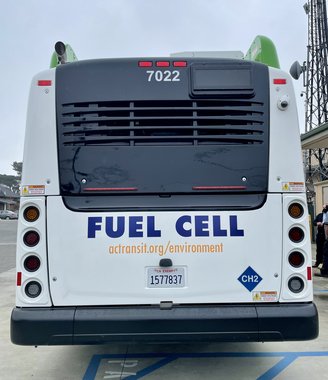
A 40-foot, hydrogen fuel cell electric transit bus, manufactured by New Flyer of America, came to the Humboldt Transit Authority yard in Eureka on Thursday. | Photos by Ryan Burns.
###
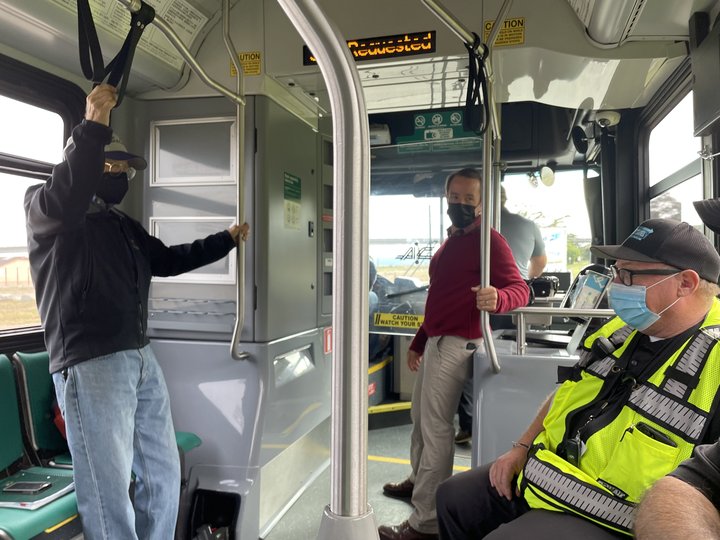
Peter Lehman gripped a metal handrail and leaned forward in his seat to peer out the windshield of a million-dollar bus.
The zero-emission vehicle, powered by hydrogen gas and a 85-kilowatt fuel-cell battery, coasted downhill, the driver maintaining a good clip as he navigated the S-curve where Eureka’s West Avenue becomes V Street.
“Whoa,” Lehman exclaimed. “That was impressive!”
A fuel-cell battery is housed in the back of the hydrogen bus, and the only emissions are water vapor.
Lehman is the founding director of the Schatz Energy Research Center at Humboldt State University, which has been working on hydrogen and fuel cell technology for 30 years. In the 1990s the Center built the nation’s first solar-powered hydrogen fueling station, for use by SunLine Transit Agency in the Coachella Valley, and in the 2000s Schatz helped AC Transit, an Oakland-based public transit agency, acquire some of the first hydrogen fuel cell buses.
“Now we’re finally, finally — after all these years — getting it here in Humboldt County,” Lehman said this morning, just before climbing aboard as one of about a dozen passengers on a test drive around Eureka.
Staff members at Schatz are helping Humboldt Transit Authority (HTA) apply for a grant of nearly $25 million from the state’s Transit and Intercity Rail Capital Program. If successful, the grant would allow HTA to purchase 10 hydrogen fuel cell buses (at around $1.1 million apiece) and build a hydrogen fueling station, which would be open for public use at the agency’s bus yard on Second and V streets in Eureka.
Greg Pratt, HTA’s general manager, told the Outpost that the money would also fund construction of an intermodal transit station, providing a home for a range of public transit provisions and equipment, including electric bikes, a bike shop and facilities for Uber, Lyft, Greyhound buses and more.
In a conversation prior to Thursday’s test drive, Pratt said the agency was enjoying a “huge boom” of success before the COVID-19 pandemic hit. HTA, which operates as a joint powers authority between Humboldt County and the cities of Arcata, Eureka, Fortuna, Rio Dell and Trinidad, had secured a number of operating grants and was looking to expand services.
Doing the math on hydrogen buses has been more complex — “like Pandora’s box,” he said. If HTA starts running hydrogen buses, it could be eligible for Low Carbon Fuel Standard credits through the California Air Resources Board. However, the hydrogen, which is produced in Sacramento by a company called Air Products, would need to be shipped to Eureka in diesel-powered trucks. That would make HTA ineligible for the grants — that is, unless the agency purchased larger volumes of fuel, enough to supply, say, 10 of the zero-emission buses.
“Trying to figure all that out has been difficult,” Pratt said.
The bus for Thursday’s test drive was manufactured by New Flyer of America, one of just two companies in the United States producing hydrogen buses. (The other, ElDorado National, produces a bus that doesn’t do great on big hills, Pratt said.) It has a driving range of 325 miles, according to Dan Trujillo, a regional salesman with the company who was on hand for the excursion.
Standing beside the bus, Trujillo explained a bit about how it works. A fuel cell affixed to the the back of the bus holds the hydrogen, which, when electrified, sends power to a battery atop the bus. “And then you have regeneration,” he said. “When you come off the accelerator, just like a golf cart, it wants to rewind those wheels, and that’ll kick energy directly back to the battery.”
Eighty percent of hydrogen buses in operation today were funded at least in part through the U.S. Department of Transportation’s (USDOT) Federal Transit Administration, and Trujillo said they’re expected to last 12 years, though it’s possible to run them longer. Standard diesel-powered buses cost about half as much, but Trujillo said maintenance is cheaper with hydrogen fuel cell buses because they’re so much simpler.
“So you have a fuel cell, you have a battery, you have brakes, you have steering — you have all that, but what you don’t have is a big engine, so you have no oil seals, you have no gearing ratio, no transmission … .”
The bus crested the hill near Zane Middle School and hung a right at the light onto Buhne Street.
“That’s pretty smooth,” Pratt said as the bus accelerated.
“It’s quiet,” said a driver named Cody, one of several HTA employees who were given turns behind the wheel.
Trujillo said some drivers complain that the the turn signal’s clicking sounds seem too loud with no engine noise to drown it out. Aside from a subtle, mechanized whine of the battery during acceleration and deceleration, the only sounds the bus makes come from an automated woman’s voice, which makes announcements such as, “Watch your step” and “Remain seated until the bus comes to a complete stop.”
Pratt said the longer range of these buses would make them ideal for longer routes, such as those to Trinidad, Willow Creek and Southern Humboldt. If the grant comes through, hydrogen buses could replace nearly a third of HTA’s existing fleet, which includes an all-electric bus and several hybrids.
The official call for applicants will come next month, and while Pratt said he expects it to be very competitive, with a team that includes Schatz working on the proposal, he’s as confident as he can be in landing the grant.
Peter Lehman (left) and Jerome Carman (in red) of Schatz Energy Research Center talk with HTA Operations Manager Brian Connors during Thursday’s ride.
Housing activists and rent strikers participate in a vigil for tenants who they say will not be covered by Gov. Gavin Newsom’s rent relief plan at the Elihu M. Harris, State of California office building in Oakland on Jan. 29, 2021. Photo by Anne Wernikoff, CalMatters.
###
California’s eviction protections will almost certainly not be extended once they expire after Sept. 30, the state Assembly Housing chairperson said today.
The legislative session ends Friday, so that’s the last day that lawmakers could push off that deadline. But the political appetite just isn’t there to act, according to David Chiu, a San Francisco Democrat who spearheaded the previous efforts to stall the displacement of tenants amid the pandemic.
“I believed our eviction protections for tenants should be extended beyond September 30. The delta variant and the end of many unemployment benefits make that even more urgent,” Chiu told CalMatters. “Unfortunately, some of my colleagues feel differently, and there’s not enough consensus for that.”
The current round of eviction protections were extended on June 25, just days before they were set to expire. At that point, Assembly Speaker Anthony Rendon said he hoped the economy would be in full swing so that another moratorium would not be necessary. Rendon’s office declined to comment on the absence of another extension.
“The Legislature has kind of set a trap for itself because it won’t be in session when that expires,” said Brian Augusta, legislative advocate for the California Rural Legal Assistance Foundation, who has been lobbying for stronger protections throughout the pandemic. “So, that means, what we see is what we get.”
Augusta said the governor could still call a special legislative session to extend protections before the end of the month, or issue an executive order as he did at the beginning of the pandemic to pause court proceedings relating to evictions. But he said that’s unlikely.
The governor’s office also declined to comment.
The California Rental Housing Association, which represents more than 20,000 landlords and has sued the state over the last round of protections, was pleased by the decision, but not surprised.
“Our lobbyists did not come to us and say, ‘Hey, you know, we’re going to have to compromise somewhere or anything like that,’” said Sid Lakireddy, a board member for CalRHA. “So, I think the legislators are starting to get it as well. This can’t go on at infinity.”
The eviction protections in place state that tenants will have a defense in court should their landlord evict them over non-payment of rent through Sept. 30. They still have to submit a declaration saying they are unable to make full rent, and pay at least 25% of their monthly rent since Sept. 1, 2020, in installments or in bulk, by Sept. 30.
The protections are tied to $5.2 billion in federal aid for rent relief. People making less than 80% of their area median income who were financially affected by COVID-19 can still apply for the full amount of missed rent and stave off eviction. They can also now apply for three months of forward rent.
But distribution of those dollars remains a problem. While the state has received applications for about $1.9 billion in rental aid, it has distributed only about $491 million. Still, that’s about a 500% increase since the current moratorium passed at the end of June, according to Russ Heimerich, spokesman for the state’s Business, Consumer Services and Housing Agency.
“I think everybody’s hope was that more families would have received the funds by now, and that the people who didn’t apply or were denied were a minority, as opposed to an overwhelming majority,” said Francisco Dueñas, executive director of Housing Now!, a tenant advocacy group.
Existing law has some stopgaps that, in theory, should prevent the tsunami of evictions tenant advocates and researchers have predicted. Heimerich said tenants will be shielded from an eviction procedure by the courts for 15 more days to apply for their missed rent — a provision that extends through March 2022.
To take advantage of those protections, tenants will have to show evidence they applied for the rental assistance program in court, Heimerich said. He said the state agency is working closely with the Judicial Council to inform judges of the procedure.
While the stopgap might seem promising on paper, tenant advocates are leery of its application.
“The problem with relying on the courts is it requires people to go to court,” Dueñas said. “And a lot of people don’t respond to a court notice. They just move.”
###
CALmatters.org is a nonprofit, nonpartisan media venture explaining California policies and politics.
Julia
Scalvini Bass was born May 14, 1924 in Ferndale, and
passed away on September 5, 2021. Her parents were George Scalvini,
Sr. (born in Bagolino, Italy – came to America in 1909) and
Angelina Bettiga Scalvini (born in Colico, Italy). She was the
second of five children (Albert, Julia, George Jr., Florence and
Guy).
Julia
attended Grant Union and Centerville School (the Little Red School
House) and graduated from Ferndale Union High School in 1942. She
was a high school volunteer for Civil Defense, a plane watcher at
Centerville Beach, during World War II. She went to a business
college in Eureka and later became a bilingual telephone operator for
PacBell in Richmond, California, during World War II. She worked as
a telephone operator with her friend from Ferndale, Alma DaOro
Sukacz. It was during this time working as a telephone operator that
she met her future husband, James Bass, Sr. They were married April
14, 1947 in Ferndale at the Assumption Church. They first lived in
Richmond, California and later moved to Ferndale where they had their
own dairy. James later worked on other dairies in Ferndale and
Loleta.
Having
grown up on a dairy she developed a love of animals and always had a
cat or dog and took care of her son’s chickens. For years you
would find her delivering eggs to people in the Ferndale area.
One
of her many jobs were working in the Bakery for Primo Marca frying
doughnuts. Later she and James owned the Western Shoe Store on Main
Street in Ferndale for six years. Julia ran the shoe store and James
later became an insurance sales person for AAA in Eureka.
During
the flood in 1964 she volunteered her time working at the Nilsen Feed
store as she was familiar with farming and knew all the farmers. Her
volunteer time turned into a full time job and you could still find
her at the Nilsen Feed store on Saturday and Monday mornings until
she really retired at age 94. When she first started working at the
hardware store she would bring home screws, nuts, bolts and plumbing
parts and study them. She wanted to know what they were used for so
she could help her customers find the right item for the job they
were doing. Her knowledge of hardware was amazing.
Julia
had been a volunteer at the Ferndale Museum for many years, only
retiring her position a year ago. She also volunteered at the
Veterans Breakfast, and was a long-time member of the Pedro Club.
While her children attended the Assumption School she was an active
member of the Catholic Ladies Guild. She was a fan of all Ferndale
Wildcat Sports. She and her brother George Scalvini were Booster
Club King and Queen. Julia was a daughter, a sister, a wife, a
mother, a Nonie (grandmother), a great grandmother, a Zia (aunt), a
friend, and a PROUD citizen of Ferndale.
Julia
loved to travel, garden, and was always there when someone needed
help. She was the tractor driver when hay was being hauled and she
was known for her large pots of soup that were on the stove for one
and all.
Julia
was preceded in death by her husband James Bass Sr., her mother
Angelina, father George Scalvini Sr., brothers Albert, George Jr.,
Guy and sister Florence.
Julia
is survived by her two children, James Bass Jr. (Nadene) and Juanita
Bass Petersen (Dale). She has six grandchildren Regina Bass Byrd,
Phillip Bass (Tina), Garrett Petersen (Sandi) and Grant Petersen.
She is great grandmother to Hayley and Jayden Byrd, Vincent and Luci
Bass and step great grandmother to Mattea, Caiden and Gunner Bertain.
She is also survived by many nieces, nephews and cousins.
The
family is so blessed to have had her in their lives for so long. She
will be dearly missed.
In
lieu of flowers memorials can be made to the Ferndale Museum or the
charity of your choice.
###
The obituary above was submitted on behalf of Julia Bass’s’s loved ones. The Lost Coast Outpost runs obituaries of Humboldt County residents at no charge. See guidelines here.