LoCO is proud to present the second episode Studio Space, KEET-TV’s 13-part series profiling some of the numerous artists who’ve chosen to rely on Humboldt County to provide a backdrop for their creative pursuits.
In this edition, host David Ferney enters the studio of Steven Vander Meer who utilizes 3x5 cards for his intricately hand-drawn animations. Later, host Kati Texas ventures out into the magical realm of metal sculptor Dan McCauley, whose work regular LoCO readers may recognize as the adornments of downtown Rio Dell. Watch below!
Studio Space is made possible, in part, by funding from the California Arts Council. Episodes will be available to watch free online for a month after their original air date. (LoCO plans to post the episodes here for your convenience too.) After that grace period, you’ll need to become a sustaining member of KEET to access ‘em. To learn more, head over to the Studio Space website and for more info on how you can support local programming like this, head on over to KEET.org.
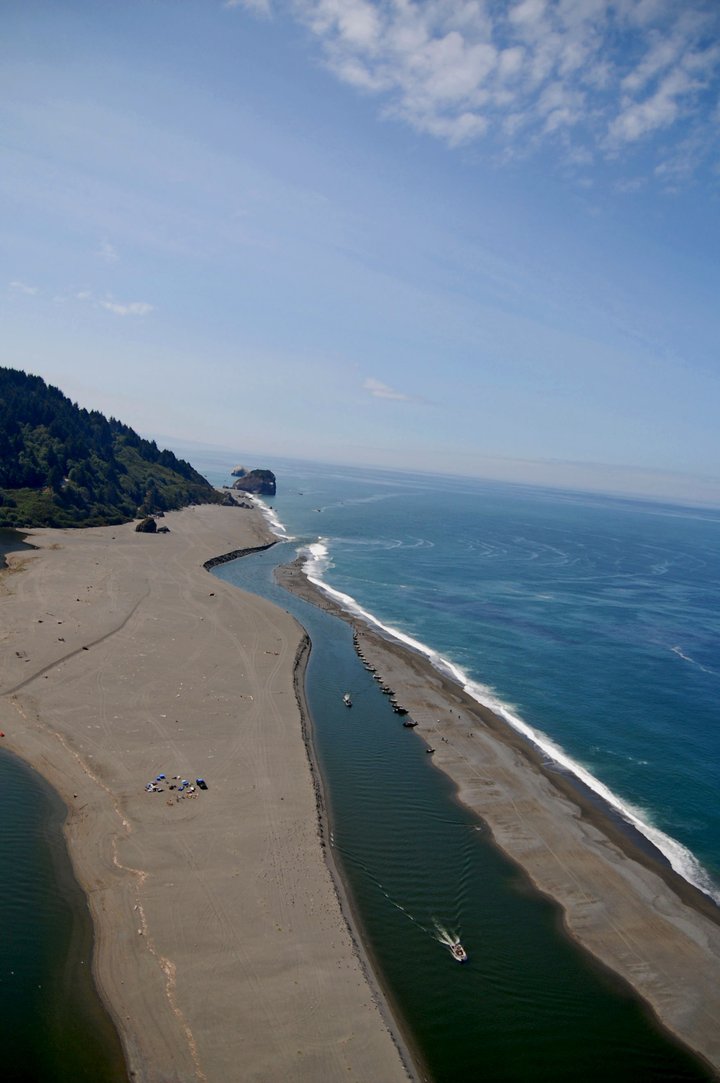
The mouth of the Klamath. | Photo via Yurok Tribe.
Press release from the Yurok Tribe:
The Yurok Tribe is gravely concerned about the rapidly declining salmon stocks in the Klamath Basin, where
communities from the headwaters to the coast are suffering due to past water management decisions and
drought.
Yesterday, the US Bureau of Reclamation released a temporary operations plan for the basin in an attempt to
minimize the ecological and economic damage caused by a combination of last year’s water mismanagement
and the current drought. The plan provides bare-minimum flows for imperiled Klamath salmon and sucker
fish populations.
“It is unfortunate that a severe drought and climate change, coupled with risky decisions made in 2020, have
left us all in this impossible bind this year,” said Frankie Myers, the Yurok Tribe’s Vice Chairman. “Based on
the current conditions, the Yurok Tribe is acutely concerned about the health of the entire river from the
headwaters to the sea, because it is the beating heart of all the Tribes in the basin. The Klamath salmon are
now on a course toward extinction in the near term.”
In a typical April, Upper Klamath Lake rises with the spring snowmelt, but water levels are currently
dropping. Equally worrisome, the prevalence of Ceratonova shasta, a deadly juvenile salmon disease, is climbing
at a rapid rate and it is nearly inevitable that there will be a repeat of 2014 and 2015 when approximately 90
percent of sampled juvenile fish were infected by the deadly pathogen, and most died. In the next few
months, many juvenile salmon are expected to die from the disease if additional flows are not released to
flush the pathogen out of the river. During the past five years, the Klamath has experienced some of worst
salmon runs on record. To protect these invaluable fish stocks, the Yurok Tribe will be cancelling its
commercial fishery for the fifth time this year.
“Following five years of record-low fish runs, juvenile salmon kills and commercial salmon fishing closures,
the Yurok people have paid a heavy price for the past mismanagement of the river. While we are sympathetic
to our upstream neighbors, many Yurok families are also unable to pay basic bills due the fishing closures. We
don’t have enough salmon for our ceremonies or to feed our elders as we have since time immemorial.” said
Yurok Attorney and Ridges to Rivers Conservation Fund Principal Amy Cordalis. “We are concerned that
conditions on the river are so dire that even if Reclamation’s plan is followed and minimum flows are provided, we are going to face a catastrophic loss of this year class of fish and the ecological collapse of the
Klamath River. We have a duty as Yurok people to prevent that from ever happening.”
BOR’s plan provides $15 million in emergency assistance funds for irrigators in the upper basin and $3
million for Tribes. It also contains a real-time management component, but Tribes were not included in that
process. Yesterday, the USDA committed another $10 million for farmers.
“Reclamation’s plan does not provide for adequate tribal consultation in the real-time management aspect of
the 2021 water year. The Yurok Tribe is suffering significant economic damage on top of the extreme
cultural and social impacts of failing fish runs,” Vice Chairman Myers said. “While we have never and will
never put a dollar value on our fishery, there is a clear disparity in the federal relief to Tribes.”
There is an urgent need to resolve the ecological and economic threats to the communities in the Klamath
Basin. The Yurok Tribe is calling for the creation of a long-term, stakeholder-driven plan that contemplates
the impact of climate change and resolves the complex water challenges.
“All of this points to the need to find equitable and durable solutions that result in sustainable communities
from the top to the bottom of the Klamath Basin,” concluded Vice Chairman Myers.
###
The Yurok Tribe is the largest Tribe in California with more than 6,300 members. The Tribe’s
ancestral territory comprises 7.5 percent of the California coastline, spanning from the Little River
to the south and Damnation Creek to the north. The eastern boundary is the Klamath River’s
confluence with the Trinity River. The Tribe is a leader in natural resource management, fisheries
restoration and cultural protection.
Good afternoon, we’re here with Lindsey Mendez, COVID-19 vaccine task force member and family
nurse practitioner for the April 15th Media Availability.
Thanks for being with us, would you like to start by addressing the community?
Yes, hi Humboldt, this is Lindsey Mendez, family nurse practitioner again.
Today I’m coming to give you a first an upfront about the Janssen vaccine, as there are many
questions in the community and all around the United States.
At this time the CDC and FDA have made the decision to put the Janssen vaccine on hold
because of a very rare medical condition which is a rare clotting disorder.
Right now they are looking at evidence and data that’s being presented to them on six
cases out of 7 million that have presented with this uncommon disorder.
We are not canceling this vaccine but we merely have it on hold so that we can use safety
as our highest priority in this investigation.
At this time we would like you to be aware that this is a clotting disorder and so if
you have any questions and have gotten this vaccine in the last two weeks and you have
any severe symptoms listed by the CDC then you should call your health care provider
or perhaps seek emergency care.
With that said, this is a very rare condition and we are waiting on more evidence from the
CDC.
Thank you, we’ll get into questions from the media. From KMUD News: If vaccines are now proven effective for six months plus, are people
going to have to receive another vaccine by next winter?
Right now we are still doing research with Pfizer, Moderna and Janssen and I do not have
an answer for that at this time but we will continue to present research as it comes.
From KMUD News: Are we seeing any vaccinated individuals contract COVID-19?
If someone is unaware that they are COVID positive and receives the vaccine could there
be complications?
At this time in Humboldt County I am not aware of any major cases of COVID-19 in affiliation
with persons who have been vaccinated with the COVID-19 vaccine.
With that said, if you happen to be COVID positive and you receive the COVID-19 vaccine,
we are not aware of any safety warnings for that.
From KMUD News: Why do you think the traditional vaccines like J and J and the European approved
Astrozenica have been linked to blood clots?
From the North Coast News: When people are experiencing a fever after receiving the COVID-19 vaccine are they contagious for spreading the virus? — Actual question
The disorders that were linked to the blood clots, so the clotting disorders that Astrazeneca
and both Janssen have been researching around the world are extremely uncommon and usually
due to a severe immunological response that is rare.
Right now the research continues to tell us why this might be the case and how this occurs
in these certain individuals.
From KMUD News: If someone misses their appointment for their second dose what should they do
to still receive timely protection?
If you still need your second dose of the COVID-19 vaccine I would encourage you to
continue to mask and socially distance yourselves and wash your hands like we would do in any
other time during this pandemic.
If you are having trouble making your second dose appointment and you don’t know how to
do it I would welcome you to call the Joint Information Center at 441-5000 or the place
that you originally got your dose of the vaccine from.
From KMUD News: Can you remind folks the differences between the J and J vaccine and its mRNA counterparts?
Yes, the J&J vaccine is an adenovirus vaccine and when we look at that the difference between
the mRNA and the DNA is that in the in the J and J vaccine you have a virus that doesn’t
cause us problems coming into the body through an injection and then it is traveling into
the host cells or your cell.
If you got the injection and this would carry to the nucleus of the cell the DNA required
to make the spike protein, excuse me, so this is extremely similar to how the mRNA vaccine
works, it’s just where we are putting the information to make the spike protein.
From the North Coast News: When people are experiencing a fever after receiving the COVID-19
vaccine are they contagious for spreading the virus?
At that time, no.The fever is the body’s natural reaction to building immunity and does not mean that you
are contagious and you are not contagious after you have received the vaccine.
From the North Coast News: Do you anticipate the temporary pause of the J&J vaccine to
increase vaccine hesitancy in Humboldt County? Could this potentially pose a problem in those communities where the vaccine may be preferable such as in outlying communities and among people without transportation?
Yes in previous discussions about the J&J vaccine in Humboldt County we were using this
vaccine as a priority in areas that were rulely isolated with persons experiencing homelessness
and other people that maybe don’t have proper transportation or can’t get a second dose
in a timely manner.
This will cause some of a delay with getting to this population and with the logistics
of how we were going to give vaccine.
We understand that it could be complicated when we’ve had to cancel appointments for
this specific vaccine but we would encourage you that if you have been offered a dose of
another vaccine to take this at this time.
We would hope that even if there is some hesitancy around this that you would understand that
as we look at the data and the research about the side effects and possibly this rare condition
with the Johnson vaccine that the CDC and FDA do this for safety purposes and that we
are hopeful that we will move forward with the Johnson vaccine in the future.
From the Times-Standard: This week it was reported that more than 200 people in Washington
state who were fully vaccinated tested positive for coronavirus. Have there been any cases of fully vaccinated people in Humboldt County testing positive
for COVID-19?
I am not aware of any specific cases of fully vaccinated people testing positive for COVID-19
I would stress though that if you are feeling ill or you have been in contact with another
person with COVID-19 to get tested and that the Humboldt County Public Health branch and
laboratory continue to work extremely hard to do investigations.
From the Times-Standard: If people are getting COVID-19 after being vaccinated is there an
indication of a need for booster shots?
Right now the booster shots are still being researched with all three vaccines of the
timing of when we would need one and we do not have the research out yet and we will
present that to you when we have it.
From the Times-Standard: The Association of American Physicians and Surgeons said this
week that all three vaccines offered in the U.S. are tied to rare blood clots.
Can you speak to that?
Misinformation is everywhere, especially on the internet or in communities where we are
talking to each other and speculating. I really would encourage everyone to talk to their primary care provider or look on
the CDC or CDPH website for the safety information of the COVID-19 vaccines.
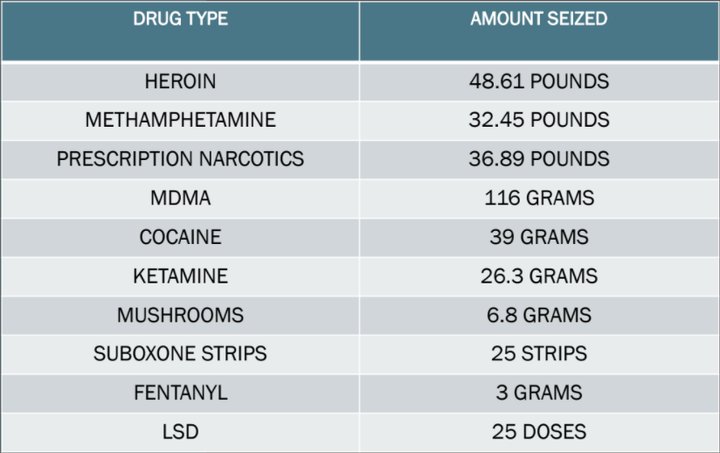
Controlled substances seized by the Humboldt County Drug Task Force in 2020. | Images via HCDTF.
###
Going purely by weight, heroin, methamphetamine and prescription narcotics were the most-commonly seized controlled substances last year by the Humboldt County Drug Task Force (HCDTF), according to a report released Thursday.
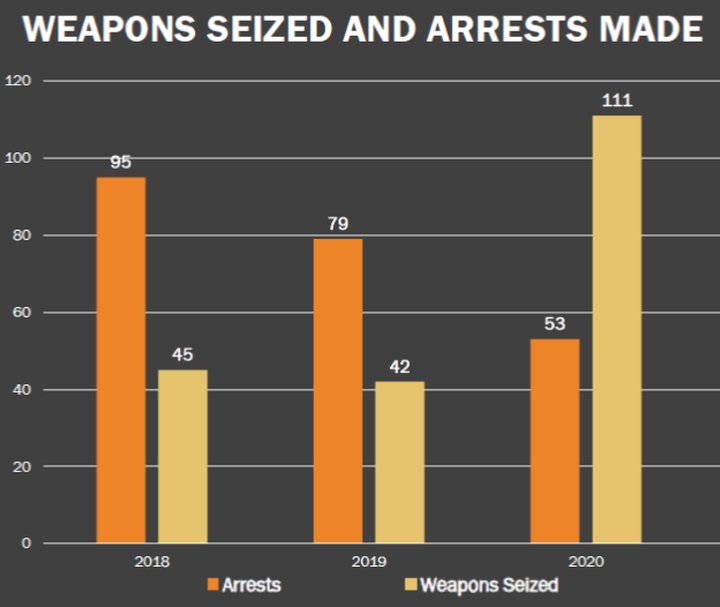
The HCDTF, which is composed of special agents from the Humboldt County Sheriff’s Office, the Humboldt County District Attorney’s Office, the California Highway Patrol and the police departments from Eureka, Arcata and Fortuna, made 53 arrests last year, a significant drop from the 79 arrests made in 2019 and the 95 made in 2018. And yet the task force seized more weapons in 2020 than in the two previous years combined.
The county’s drug figures reflect the nationwide opioid epidemic. According to the Centers for Disease Control and Prevention, more than 70 percent of overdose deaths from 1999 to 2019 involved an opioid, including prescription pills, heroin or synthetic drugs such as fentanyl.
Reached by phone Thursday afternoon, Sgt. Matt Tomlin with the HCDTF said the task force’s drug-seizure figures are comparable to the past couple of years. He considers the 32.45 pounds of methamphetamine more serious than the nearly 37 pounds prescription narcotics, which include pills for drugs such as Xanax.
But what’s most concerning, he said, is the synthetic opioid fentanyl. While just three grams of the drug were seized by the HCDTF last year, it was responsible for nine overdose deaths in the county, according to an alert issued Wednesday by the Humboldt County Sheriff’s Office.
Since the start of the year, the influx of fentanyl has exploded. In the first three-and-a-half months of 2021, HCDTF agents seized more than 187 grams of fentanyl and eight county residents died from a fentanyl overdose.
“An ounce of fentanyl is comparable to probably a pound of heroin or two pounds of meth,” Tomlin said.
In yesterday’s press release, HCDTF Commander Shawn Sopoaga said, “Fentanyl is being transported to Humboldt County in a raw form and used as a cutting agent, by dealers, to produce more product.”
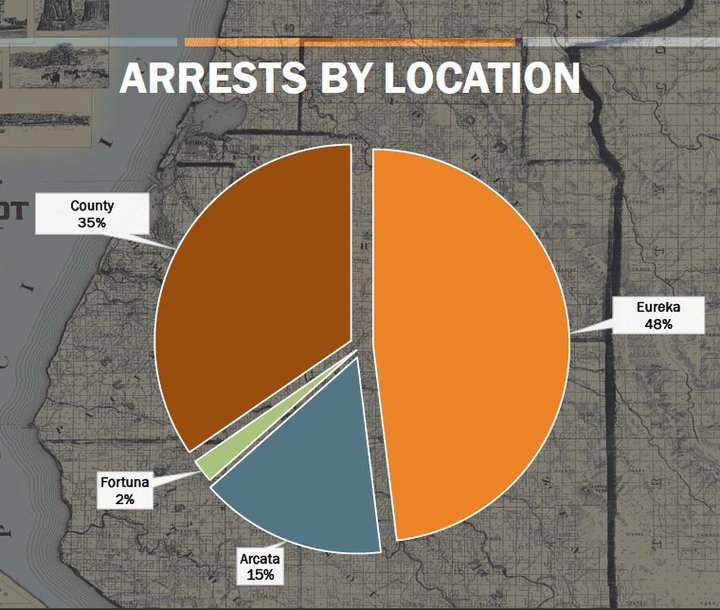
Nearly half of the arrests made by the task force in 2020 occurred in Eureka while 15 percent were in Arcata and just two percent were in Fortuna. The remaining 35 percent occurred in the unincorporated parts of the county.
A crime analyst with the HCDTF said this is the first year that the task force has issued an “annual report.” The name suggests that we should see more in the coming years.
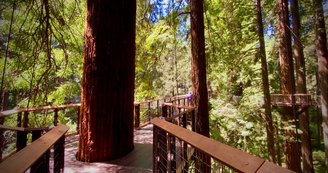
The moment many Humboldt County residents have been eagerly awaiting, has finally arrived! Eureka’s new Redwood Sky Walk is complete and ready for limited access. The first groups to be admitted to the towering forest walkway are Sequoia Park Zoo members, who can now reserve a one-hour time slot on the Sky Walk, the zoo announced on Wednesday evening.
“The much-anticipated wait is finally over!” states an email sent out to zoo members. “Beta-testing of the Redwood Sky Walk has begun and you are cordially invited to be some of the very first to experience the Redwood Sky Walk exhibit at Sequoia Park Zoo!”
The Sky Walk previews begin this Saturday, April 17 and will continue on Saturdays and Mondays through May 10. Those who enter the Sky Walk will be asked to fill out a survey before their time slot and another after their experience, to provide the zoo with their feedback.
If you are a Sequoia Park Zoo member and did not receive the email, you can follow this link to reserve your spot. And for those who may be tempted to game the system, don’t do it! You will be required to show your membership card and ID for entry.
As for when the Sky Walk will be open to the rest of the public, an official date has not yet been set. But Eureka City Manager Miles Slattery did tell the Outpost in the past that shortly after zoo members have been granted access, the invitation will be extended to all local residents and lastly the attraction will be open to tourists.
Not a zoo member, but can’t wait to get up on that thing? Well, now might be the time to think about becoming a Sequoia Park Zoo member. Executive Director of Sequoia Park Zoo Foundation Leigh Pierre-Oetker told the Outpost that joining now would make you eligible to reserve a ticket. However, Pierre-Oetker said, buying a membership will not necessarily guarantee you a spot, as there are limited reservations available and they are filling up quickly.
The Outpost was lucky enough to already grab a sneak peak and we just have to say, it’s pretty darn incredible. Check out the above video to help get you excited!
Press release from the Humboldt County Sheriff’s Office:
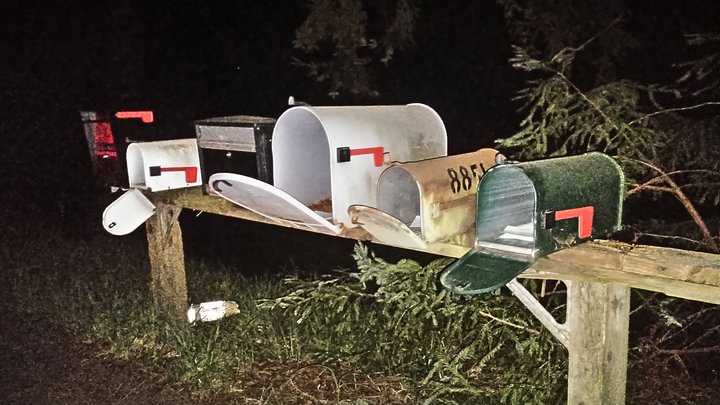
On April 14, 2021, at about 11:51 p.m., Humboldt County Sheriff’s deputies were dispatched to the 8200 block of West End Road near Arcata for the report of a suspicious subject in the area.
Deputies arrived in the area and observed several open and empty mailboxes. Nearby the mailboxes deputies located the reported suspicious subject, later identified as 38-year-old John Wayne Merrell, walking along the roadway. During their investigation, deputies learned that Merrell was in possession of more than 30 pieces of stolen mail from residences on West End Road.
Merrell was arrested and booked into the Humboldt County Correctional Facility on charges of mail theft (PC 530.5(E)).
The stolen mail was recovered and is currently being held at the Humboldt County Sheriff’s Office McKinleyville Substation. Residents receiving mail within the 8200 and 9400 block of West End Road, in addition to residents on Dutch Lane and Barley Lane, who believe they had mail stolen should contact the McKinleyville station at 707-839-6600 to inquire whether their mail has been recovered.
Anyone with information about this case or related criminal activity is encouraged to call the Humboldt County Sheriff’s Office at (707) 445-7251 or the Sheriff’s Office Crime Tip line at (707) 268-2539.
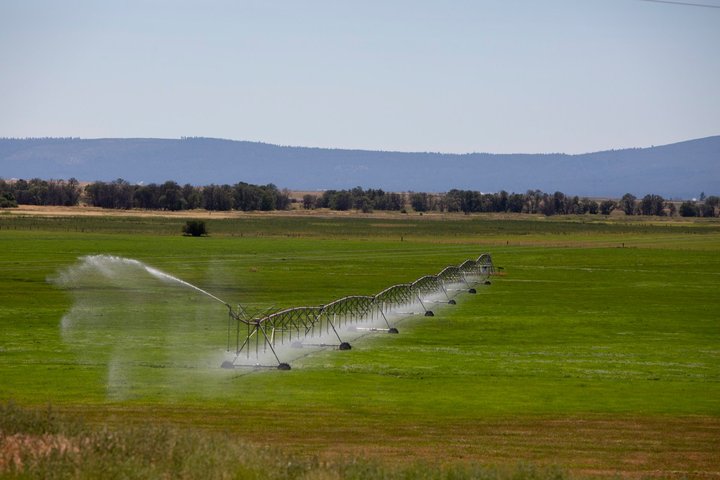
Agricultural land near Adin, a small town in Modoc County, is irrigated in July 2019. The USDA declared a natural disaster in California due to the drought, which means farms become eligible for loans. Photo by Anne Wernikoff, CalMatters
###
Stop if you’ve heard this before: California is in the grip of a severe drought. Again.
Now the federal government is stepping in to help.
To assist California, which is the nation’s largest food supplier, the U.S. Department of Agriculture recently declared a drought disaster for 50 counties. That makes growers throughout the state who have been struggling with parched conditions eligible to seek federal loans.
“This declaration emphasizes the devastating and far-reaching impact of climate change on the agricultural producers that feed and power America,” Under Secretary of Agriculture Gloria Montaño Greene said in an emailed statement.
Here’s what you need to know about the disaster declaration and its effect on California:
There’s a big difference between a drought emergency and a USDA disaster
A drought disaster sounds alarming, but officials say the reality is more mundane: It simply opens up emergency federal loans to California farmers who are struggling with back-to-back dry years. Growers in the 50 counties but also in all the counties next door (including 16 in Oregon, Arizona and Nevada) are eligible for loans.
“The bar is set very low to qualify, because the purpose of the disaster designation is to quickly make financial assistance available to (agricultural) producers,” said Jeanine Jones, interstate resources manager with the California Department of Water Resources.
This federal designation is very different from declaring a drought emergency under California’s Emergency Services Act, which would allow the governor to take more sweeping actions affecting all Californians, such as mandating conservation, waiving some state regulations and reallocating funds. Under state law, declaring a drought emergency would require “conditions of disaster or of extreme peril to the safety of persons and property within the state” that local governments can’t cope with on their own.
Comparing Vilsack’s designation of drought disaster areas to a state drought emergency is “like (comparing) apples to pineapples, because it’s a really large difference,” Jones said.
The decision was ‘as close to automatic as it can get’
So what is the federal decision based on? The USDA looks at how dehydrated California has been.
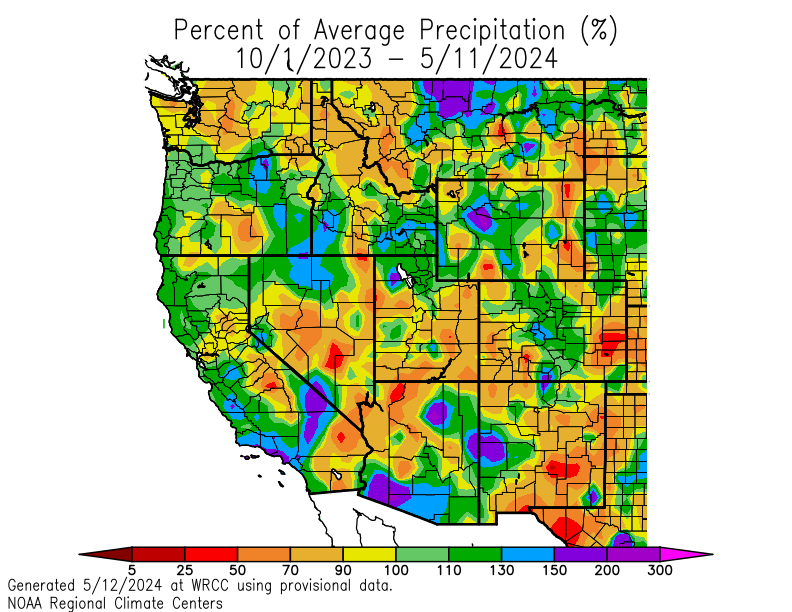
“Much of the state has had two pretty darn dry years,” Jones said, adding that the most recent wet season — last October through March — ranks as the fourth driest on record in California.
The USDA’s designations hinge on that map. Counties can be considered drought disaster areas if any part enters the driest red and brown “extreme” and “exceptional” categories during the growing season, or if they move into the orange “severe drought” category and stay there for eight consecutive weeks.
These categories are based on various measurements, not just precipitation and snowpack. They include vegetation health, soil moisture, surface water and other criteria. The map authors also work with local experts to gauge on-the-ground conditions.
“The disaster declaration process is almost as close to automatic as it can get” because it’s based on the drought map, said Jacque Johnson, acting state executive director of the USDA Farm Service Agency’s state office. “What happened in California on March 5 was 50 of our 58 counties were disasters.”
Farms in all counties are eligible for loans
Vilsack’s letter designated 50 California counties as primary disaster areas. The other eight are listed as “contiguous” counties. What gives?
Contiguous counties are exactly what they sound like: the counties that didn’t quite hit the drought threshold at the time but are adjacent to primary disaster areas. The eight counties are Orange, San Diego, Ventura, Santa Barbara, San Luis Obispo, Monterey, Santa Cruz and San Benito. None of them, at the time of the declaration in March, had entered the more severe dry conditions of the other 50.
Growers throughout the state are eligible to apply for emergency federal loans until early November. Some also may qualify for other federal assistance programs.
“The assumption is that collateral damage falls into the next door neighbor county,” Johnson said. “The county line is not a barrier.”
Legislators are pressuring Newsom to declare emergency
Newsom has so far resisted calls to declare a drought emergency. He said on Tuesday that his staff had been “talking for months internally” and drought plans were in place, but he was opaque when it came to providing specifics.
“We are prepared to move very quickly when we are prepared to move,” Newsom said.
Officials have said that they believe the state has enough administrative tools to respond to the drought without declaring an emergency.
The governor, under the threat of a recall, may be in triage mode, taking his pick of emergencies to respond to: drought, predictions of another monster wildfire season and the ever-present global pandemic.
Lawmakers have been quick to pounce on what they see as Newsom’s inattention or indifference to a pressing problem that hits rural communities hard. A bipartisan group of legislators, led by Senate Agriculture Committee Chair Andreas Borgeas, a Republican from Fresno, and Assembly Agriculture Committee Chair Robert Rivas, a Democrat from Hollister, requested a statewide drought emergency declaration.
“From the Oregon border to the Mexican border, California farmers will see sharp cuts in water supplies this year.” — Jamie Johansson, president of the California Farm Bureau
The legislators noted that allocations from the State Water Project, which draws water from the San Francisco Bay-Delta and sends it to cities and farms, have been reduced to 5% of normal. They urged the governor to forestall a catastrophic loss in farm revenue.
In a reference sure to get under Newsom’s skin, the letter referred to actions taken by former Gov. Jerry Brown in 2014 when similar drought conditions prevailed. That emergency declaration, the letter said, provided “flexibility and commonsense streamlining to utilize our limited water in the most efficient way.”
At that time, Brown issued conservation mandates for all state agencies and told local water agencies to immediately implement their water shortage contingency plans, which restricted residential water use. The declaration also modified reservoir releases, accelerated funding for water projects ready to break ground and lifted requirements that water projects comply with California’s environmental quality law.
The loans can make or break farms and ranches
The State Water Resources Control Board in Marchput California’s 69,000 farms on notice that they should start planning now for severe impacts this summer.
This comes after climate change and inadequate water supply are already battering California’s growers, who produce more than 400 commodities, worth nearly $50 billion a year, including about half of the nation’s fruits and vegetables and nearly a fifth of its milk.
Legislators estimate that about 1 million acres of San Joaquin Valley farmland will be fallowed over the next two to three decades because of reduced groundwater and surface water supplies. They project the loss of 85,000 jobs as a direct result of reduced water access.
Against that backdrop of dire news, the federal disaster declaration opens up aid for the state’s beleaguered growers and ranchers. The loans assist them for loss of crops, trees, land and livestock.
Each farm operation could receive a loan of up to $500,000, based on its loss. The USDA’s emergency loans were budgeted at $1.21 billion nationwide for this year.
The federal agency “considers each emergency loan application on its own merits, taking into account the extent of production losses on the farm and the security and repayment ability of the operator,” Vilsack told Newsom in his letter.
Agricultural land near Adin, a small town in Modoc County, is irrigated in July 2019. The USDA declared a natural disaster in California due to the drought, which means farms become eligible for loans. Photo by Anne Wernikoff, CalMatters
For farmers, the loans can make or break their operations, which are already on tight water allocation budgets.
“From the Oregon border to the Mexican border, California farmers will see sharp cuts in water supplies this year,” said Jamie Johansson, president of the California Farm Bureau. “That means hundreds of thousands of acres of land will lie idle. It means thousands of people will lose jobs, in both rural and urban areas. It means Californians will have less locally grown food available.”
The expenses can pile up. Because of the drought, ranchers may have to lease additional pasture, buy extra feed and pay to haul and store water to replace the natural water sources that have dried up, Johnson said.
The USDA has already received inquiries from California cattle ranchers interested in applying for the loans.
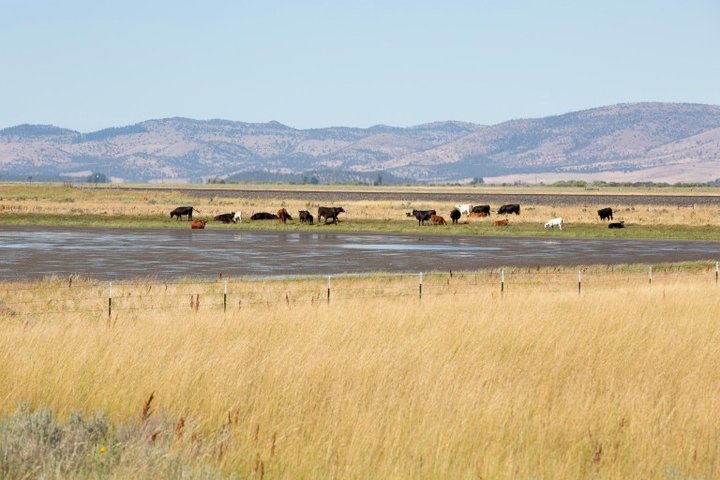
The state has about 13,000 cattle operations, with more than 5 million cattle and calves. The San Joaquin Valley, particularly Tulare, Merced and Kings counties, has the most.
Katie Roberti, a spokeswoman for the California Cattlemen’s Association, said ranchers are facing the most severe conditions in decades, worse than the last drought.
“While the federal designation is welcomed assistance, without precipitation many California cattle producers are going to be forced to make the difficult decision to reduce the size of their herds, some more drastically than others,” she said. “Feed on rangelands will be limited and we are hearing hay prices will be high. These herd reductions will have a lasting impact on the number of cattle in the West for years to come.”
###
CALmatters.org is a nonprofit, nonpartisan media venture explaining California policies and politics.