

[2ND UPDATE] Civil Grand Jury Report Lays Blame for County’s ‘Financial Chaos’ Mostly at the Feet of Auditor-Controller Karen Paz Dominguez, Noting $2.3M in Losses, $9.7M at Risk
Ryan Burns / Thursday, June 2, 2022 @ 4:51 p.m. / Local Government
SECOND UPDATE, Friday, 10:45 a.m.:
There has been some speculation that the Civil Grand Jury report published yesterday was leaked early by county employees aligned against Karen Paz Dominguez and that this was done in violation of the Grand Jury’s planned release schedule.
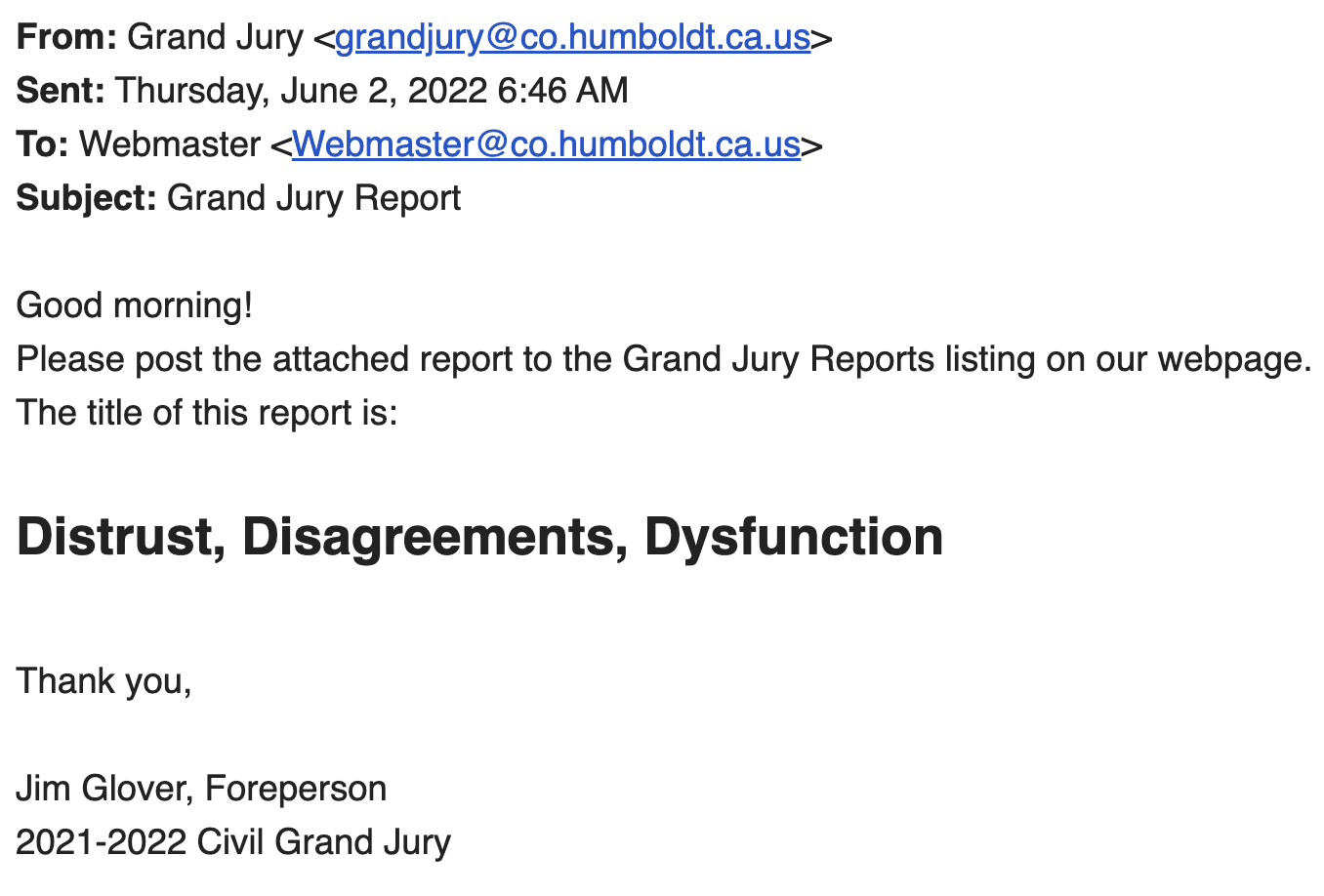
It’s true that, historically, Civil Grand Jury reports get emailed to media outlets whereas yesterday’s report was uploaded to a Grand Jury page on the county website before any official notification went out. But the email below, forwarded in response to an Outpost inquiry, shows that the current Civil Grand Jury foreperson, Jim Glover, asked the county’s IT department to upload the report early Thursday morning.
We were also provided with an email showing that Glover was not expecting the report to be uploaded as soon as it was. He told Paz Dominguez in an email Wednesday that the report would be made available to the media at noon on Friday, June 3. In a follow-up email to Paz Dominguez he said the county’s webmaster “usually takes several days to post a report.” He added, “I regret it was done speedily this time and conflicted with your instructions” not to speak publicly about the report until it was made public.
Commenters here on the Outpost have also pointed out that a previous Civil Grand Jury announced a policy concerning the release of Grand Jury reports in election season. To quote from the 2018 press release:
Beginning this year, the Court implemented a new policy regarding the release of Grand Jury reports during June election years. The policy allows the release of reports until the second Monday in February; reports completed subsequent to that date must be released after the June election.
We reached out to Glover this morning for an explanation. He responded via email, saying he intends to issue a press release later today that will “better explain the hows and whys of our process.”
###
UPDATE, 7:30 p.m.:
Civil Grand Jury foreperson Jim Glover released the following statement addressing the timing and content of the report released earlier today:
In one of the most exhaustive investigative reports seen by a Grand Jury in recent years, the Humboldt County Civil Grand Jury has just released its report related to the ongoing struggle of the County of Humboldt and its embattled Auditor-Controller.
This report follows dozens of hours of interviews and inquiries into the matter. The report is a lengthy, detailed, but serious attempt to balance findings and recommendations among the many individuals involved.
Due to the complexity of this report, the time required to complete the investigation was longer than customary. It is the practice of any Grand Jury for reports to be released as soon as they are completed and authorized by the court, thus today’s release.
###
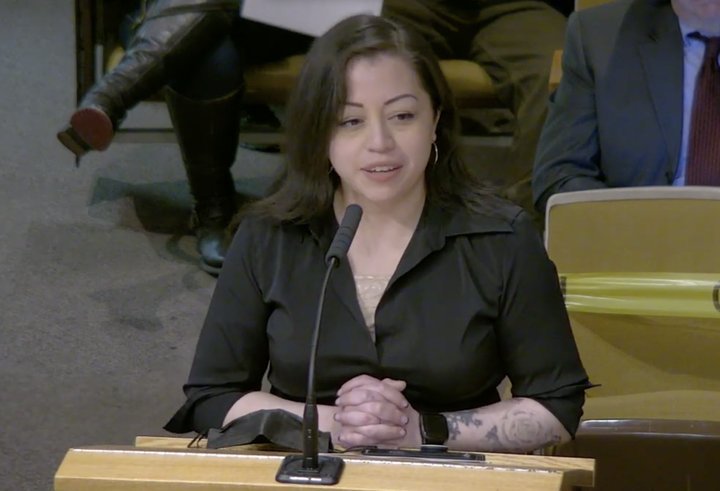
Humboldt County Auditor-Controller Karen Paz Dominguez. | Screenshot from a March Board of Supervisors meeting.
###
The latest report from the Humboldt County Civil Grand Jury, which was posted to a Grand Jury page of the county website just a few short days before Election Day, takes a deep dive into the county’s well-documented financial mismanagement woes and emerges with a handful of culprits, though none take as much heat as embattled Auditor-Controller Karen Paz Dominguez.
“Significant deficiencies in the performance of the Auditor-Controller are identified, including the failure to meet the legally required deadlines for filing financial reports,” the report says in its opening paragraph. It goes on to note that these late reports have caused Humboldt County to permanently lose more than $2.3 million in funds and placed another $9.7 million-plus at “significant risk.”
Hundreds of thousands of dollars have been siphoned off by late fees, penalties and lost interest, and the Board of Supervisors has agreed to shell out as much as $971,000 to consultants for help in cleaning up the mess, an amount the report calls “extraordinary.”
The scathing report is titled “Distrust, Disagreements, Dysfunction” and carries some rather unfortunate word algebra for a sub-headline: “Non-Communication Minus Cooperation Divided by Variable Policies and Multiplied by Missing Reports Equals Financial Chaos.”
That’s awfully wordy, but it does encapsulate the gist of the report, which identifies structural impediments, outdated procedures, poor inter-departmental communication, insufficient oversight from the Board of Supervisors and the aforementioned deficiencies of Paz Dominguez as major problems threatening not only the county’s own solvency but also that of outside special districts, including local schools and nonprofits.
There’s also a bit of dark innuendo contained within the report’s preface. It notes that the Civil Grand Jury can conduct formal investigations resulting in reports like this one, but it can also make less formal inquiries into “misconduct by a public officer.”
This Grand Jury did exactly that, conducting “an informal inquiry into allegations of willful misconduct by the Auditor-Controller.” But the investigative body didn’t receive “sufficient information” to justify a full investigation until near the end of its current term. “The Grand Jury will continue to inquire about allegations of willful misconduct by the Auditor-Controller and can consider legal options, up to and including an accusation,” the preface concludes.
‘A History of Inefficiency’
The Grand Jury launched its investigation after receiving complaint of financial inefficiencies, ineffective communication and a lack of cooperation on the part of Paz Dominguez and her office, though the report doesn’t single her out for scrutiny. Nor does it suggest that all the problems began with her.
The A-C’s office has “a history of inefficiency,” some of which was addressed in a report from the 2018-19 Civil Grand Jury. Many of the problems identified in that report remain unresolved.
But the current report notes that the difficulties have been exacerbated by the “contentious relationships” between Paz Dominguez and virtually everyone she interacts with outside of her own office: “the Board of Supervisors as well as … the County Administrative Office, County department directors, County employees, other elected and appointed officials, school districts and special districts.”
The report does credit Paz Dominguez for making some improvements to the county’s accounting practices, including updating some outdated policies, addressing existing policies that weren’t being followed and requiring approved service contracts and itemized invoices from departments and vendors. “However,” the report notes, “progress was hampered due to the Auditor-Controller making changes without giving notice to or consulting with other County departments.”
Meanwhile, the Board of Supervisors “has been slow to respond and exercise its authority” to supervise this mess. Immediately after making this observation the report drops another “However,” pointing the finger back at Paz Dominguez: “However, on Nov. 22, 2021, the Board gave specific direction by adopting a resolution directed to the Auditor-Controller regarding the calculation and payment of interest to the General Fund. The Auditor-Controller did not comply.”
‘The Doors Remain Closed’
Since before being elected in 2018, Paz Dominguez has complained of understaffing in her office, though the Grand Jury report notes that staffing shortages exist throughout the county workforce. Also, Paz Dominguez has not taken advantage of “the established procedure” for requesting extra staffing, which is done through the budget process. She did not submit a budget request for any of the past three fiscal years, according to the report.
When the COVID pandemic hit in March 2020, county staffers switched to working from home, but most departments have since reconvened and opened their doors. Staff in the Auditor-Controller’s Office have returned, the report says. “[H]owever, the doors remain closed to other County employees and the general public.”
The report also notes that, this past December, employees with financial experience in other departments were offered to the Auditor-Controller to help with the backlog of unfinished work, including journal entries, bank reconciliations, payroll and overdue financial reports.
“Although the assistance was accepted, some employees were underutilized by being assigned data entry,” the report says. “Within a few days of being assigned, the assisting employees were returned to their own departments without the backlog being significantly improved.”
Late Reports
The middle section of the report identifies the multiple legally mandated financial reports that have been submitted late or remain outstanding. These include delinquent budget reports and Financial Transaction Reports from the 2019-20 and 2020-21 fiscal years, the absence of which prompted an investigation from the State Controller’s Office followed by a lawsuit from the Attorney General for failure to comply with financial reporting requirements.
Other late or delinquent reports include the 2019-20 Single Audit (more than eight months overdue); the Cost Allocation Plan for 2019-20 (filed a year and three months late); the Cost Allocation Plan for 2020-21 (filed a year and four months late); the Cost Allocation Plan for 2021-22 (due Dec. 31, 2020, yet to be submitted); and the Cost Allocation Plan for 2022-23 (due Dec. 31, 2021, yet to be submitted).
The continued delinquency of those last two documents is “putting the County at substantial risk of losing future grants and reimbursements from the State and Federal governments,” the report says.
Other mandatory fiscal reports, including county expense claims and an accounting of redevelopment property tax trust fund distribution, remain outstanding, with the latter impacting the cities of Eureka, Arcata and Fortuna.
Communication Problems
The expense claims require the involvement of both the A-C’s office and the Department of Health and Human Services (DHHS). The report says that, at one point, Paz Dominguez agreed to accept less detailed summary sheets from DHHS, only to turn around and reject those sheets when they were submitted.
“When the Auditor-Controller rejected the summary sheets, she did not identify the changes that were needed,” the report says. “The Auditor-Controller did not respond to emails requesting a meeting and eventually stopped signing the claims.”
The breakdown in trust and communication extends to other departments, including the Treasurer-Tax Collector and the County Administrative Office (CAO), though the report’s authors note that “Communication and cooperation must be two-way.” That has not been the case.
In light of ongoing conflicts with the CAO, “The Auditor-Controller stopped taking phone calls and directed all communication be done by email to allow her staff to focus on their work without interruptions,” the report says. “Emails inquiring about the status of requests made months earlier often received no response.”
Relationships with other county departments deteriorated further after Paz Dominguez made “unannounced changes to financial procedures” and then “severely curtailed communications.”
Communication problems exist throughout local government, the Grand Jury notes, but Paz Dominguez is unique. “During this Auditor-Controller’s first year in office, she effectively stopped accepting and returning telephone calls from other County departments, thereby cutting off direct relations with finance managers,” the report says.
Instead, department heads and finance managers were instructed to send communications via a centralized email address, one that went to more than one person in the A-C’s office. Often, there was no response for long stretches of time, and many county employees consider this email a “black hole,” the report says.
As noted above, some of the problems are clearly structural, and some are related to what the report calls “antiquated” systems, such as paper timecards and a tracking system that requires departments to input revenues and expenses into spreadsheets, resulting in duplication of effort by the Auditor-Controller’s staff.
Paz Dominguez has updated some of these processes, but her “inconsistent application of procedures” has caused confusion and delays. In the previous two fiscal years, she stopped processing journals for months at a time, the report says.
‘Inappropriate’
The 25-page report goes on to identify mistakes and misunderstandings from Paz Dominguez in managing the finances of schools and special districts. For example, in two previous fiscal years, she incorrectly reported redevelopment agency funds as property tax revenue, causing four local education agencies to be underpaid by $475,304, according to the report.
She also incorrectly filed inflation pass-through funding, causing the Fortuna Union High School District (FUHSD) to suffer a $197,963 cash shortage. And when the funds were eventually received by the county, Paz Dominguez did not notify FUHSD, the report says. (That district’s board later passed a vote of “no confidence” in Paz Dominguez.)
Furthermore, there have been regular delays in Paz Dominguez’s transferring of funds from treasury accounts to school and special district accounts, putting payrolls at risk, the report says. And she has “inappropriately” asked those districts for substantiation, checking to see if claims are legitimate, before agreeing to district fund draws. The report notes that this responsibility properly rests with each school district’s board of trustees or special district’s board of directors, “not the Auditor-Controller.”
As for the estimated loss of $2.3 million in lost revenue, the report says that stems from mandated welfare expense claims, Cost Allocation Plan reimbursements, grant funding, public health claims, Public Works project funds and Planning and Building grants.
The $9.7 million at risk, meanwhile, stems from the late single audits, Financial Transaction Reports and Cost Allocation Plans, jeopardizing state and federal funds, according to the report.
Findings and Recommendations
The report concludes with a list of 17 findings and 19 recommendations. One of the findings blames county supervisors for not responding to the dysfunction in an effective manner. Others blame Paz Dominguez for such things as late reports and audits, unnecessary credit card interest coupled with lost bank interest and making changes to procedures without sufficient notification.
Most of the recommendations are aimed at Paz Dominguez’s office. The Grand Jury suggests, for example, that she maintain an accessible and comprehensive operations policy and procedures manual that’s made available to all staff. They also recommend she submits budget proposals each year and file all required financial reports and audits by their due dates.
The report recommends that the Board of Supervisors “act promptly” when notified of conflicts and establish an advisory committee consisting of the A-C, the CAO and at least three other elected officers or department heads. The board should also direct the Auditor-Controller to standardize accounting methods used throughout county government, the report says.
The timing of this report’s release does seem a bit suspect. When the Outpost was first informed of it, we were told it was set to be released tomorrow (Friday), only to discover later in the day that it was already posted online. This morning we sent an email to the Civil Grand Jury asking why they chose to release the report so close to Election Day. As of the time of this post we had not heard back.
In a possibly related development, Paz Dominguez sent out an email this morning notifying local media outlets that she’ll be holding a press conference on the Courthouse steps tomorrow at 2 p.m. The Outpost will be there.
###
DOCUMENT: Grand Jury Report: Distrust, Disagreements, Dysfunction
BOOKED
Today: 7 felonies, 6 misdemeanors, 0 infractions
JUDGED
Humboldt County Superior Court Calendar: Today
CHP REPORTS
Us101 N / Sr299 W Us101 N Con (HM office): Report of Fire
ELSEWHERE
RHBB: ‘Check In With Your People’: Humboldt’s Suicide Rate More Than Twice the State Average
RHBB: HAF+WRCF Opens Fall Grant Round for Artists, Seniors and Holiday Programs
New Fortuna POP Team Cleaned Up on Fentanyl Busts Last Month, Police Department Says
LoCO Staff / Thursday, June 2, 2022 @ 2:51 p.m. / Crime

From the Fortuna Police Department:
In late April, the Fortuna Police Department established a Problem Oriented Policing (P.O.P.) Team. The team is comprised of sworn officers who share a common interest in improving the quality of life issues facing our community. The P.O.P. team will also work on complex criminal investigations and conduct targeted enforcement operations.
We are pleased to share that the team is already producing exemplary results. The following highlights illustrate the team’s impact thus far.
- 10 people were arrested for a variety of narcotics violations over the past month. During these arrests, Fentanyl was the drug most prevalent. In one of these operations, two subjects were found in possession of nearly 2 ounces of Fentanyl.
- In addition, 13 people were arrested for outstanding felony and misdemeanor warrants.
- 3 subjects were also issued citations for Fortuna Municipal Code violations.
- A number of search warrants, probation compliance searches, and targeted enforcement operations were conducted.
The Fortuna Police Department works closely with allied agencies and the P.O.P. Team has already assisted allied agencies with operations with criminal investigations that affect our community, the Eel River Valley and the local county region. The P.O.P. Team has assisted allied agencies with the service of search warrants which have resulted in numerous arrests, the seizure of firearms, and the seizure of dangerous drugs including Fentanyl.
The Fortuna Police Department is grateful for the dedicated police employees and their commitment to combating crime and addressing quality of life issues in our communities.
The Public Can Comment on Nordic Aquafarms’ Proposed Land-Based Fish Farm During Tonight’s Humboldt County Planning Commission Meeting
Isabella Vanderheiden / Thursday, June 2, 2022 @ 2:20 p.m. / Business , Environment

Computer-generated photo illustration showing how Nordic Aquafarms’ proposed recirculating aquaculture system facility would look on the Samoa Peninsula. | Image via County of Humboldt.
###
During the Humboldt County Planning Commission’s meeting this evening the public will have an opportunity to weigh in on the onshore fish farm that Nordic Aquafarms plans to build on the Samoa Peninsula.
The Norway-based seafood company is requesting a coastal development permit and a special permit for demolition and remediation of the defunct Samoa pulp mill facility to construct the world’s largest land-based recirculating aquaculture system, a 17.6-acre, state-of-the-art facility that would produce up to 27,000 metric tons of Atlantic salmon annually. The fish will be raised from eggs to the juvenile stage in a hatchery at the center of the five-building facility, then transferred via underground pipes to two massive grow-out modules where the fish will grow to market size.
(A more detailed description of the project can be found in the Executive Summary.)
The item will be presented as an informational workshop to formally introduce the project and the associated environmental impact report (EIR) to the commission and the public, but it will not be voted on just yet.
The Humboldt County Planning Commission will meet at 6 p.m. tonight in the Humboldt County Board of Supervisors chambers – 825 Fifth Street in Eureka. The meeting will also be live-streamed here.
###
PREVIOUSLY:
- Nordic Aquafarms Plans to Grow Atlantic Salmon in Land-Based Fish Farm on Former Pulp Mill Property
- County Declares No Significant Environmental Impact for Proposed Samoa Fish Farm; Will Receive Comments, Critiques Through May 24
- In a Surprise Move, Nordic Aquafarms Agrees to Conduct Full Environmental Impact Report for Its Land-Based Fish Farm on the Samoa Peninsula
- Local Environmental Groups Laud Nordic Aquafarms’ Decision to Complete a Full Environmental Impact Report
- (PHOTOS) Nordic Aquafarms Execs Lead Tour of the Corroding Remains of the Pulp Mill Property Where They Plan to Build a Big Land-Based Fish Farm
- PENINSULA RISING: County Creating a Financing District to Supercharge Development in and Around Samoa
- (VIDEO) Take a Virtual Tour, With a Brief History, of Nordic Aquafarms’ Proposed Peninsula Project Site
- County Releases Draft Environmental Impact Report for Nordic Aquafarms’ Fish Factory Project on the Samoa Peninsula
- With Just Days Left for Public Comment, Enviro Groups Seek More Detail, Assurances in Nordic Aquafarms’ EIR
Jury Convicts Sotolongo of Second-Degree Murder for 2016 Hoopa Stabbing
Rhonda Parker / Thursday, June 2, 2022 @ 1:56 p.m. / Courts

A jury has convicted Hoopa resident Gearold “Roldo” Sotolongo of second-degree murder for the February 2016 killing of Roger Alan Yale, stabbed in the heart as the two men scuffled outside the mini-mart and gas station in Hoopa.
Jurors also found the 31-year-old Sotolongo guilty of the special allegation of personal use of a knife, a conviction that could add time to the standard second-degree sentence of 15 years to life. The verdict was announced about 11:30 a.m. today, the third day of deliberation
Sentencing is scheduled for June 24.
Jury forewoman Bambi Ward-Roller said outside court that jurors felt Sotolongo’s crime did not amount to premeditated first-degree murder, but it also wasn’t self-defense.
Yale was carrying a stick when the confrontation began, but he never acted aggressively and was trying to avoid a fight, Ward-Roller said. And when Sotolongo testified, he didn’t claim he feared for his life.
“We never heard him say that once,” she said.
Sotolongo testified he was aware Yale was carrying a knife. During the autopsy the knife was found folded in the back pocket of Yale’s pants. As for the knife used to kill Yale, Sotolongo testified he found it under a bridge and gave it away after the stabbing.
The fatal incident was captured on video tape, beginning with Sotolongo and four other people following Yale and challenging him to meet them behind the gas station. Yale weaved in and out of cars and gas pumps, trying to get away from them. He was heard saying he didn’t want to fight.
“We ran that video tape like nobody’s business,” Ward-Roller said. Jurors discussed at length the difference between first- and second-degree murder before reaching their decision.
Yale’s father, Jon Yale, was furious this morning. He drove to Eureka from Orleans to attend every day of the trial.
“I don’t think it’s fair,” he said. “He murdered him. Straight-up first-degree murder.”
And the father told Deputy District Attorney Jessica Watson, one of the trial prosecutors, that Sotolongo is guilty of “flat-out murder.”
Roger Yale, 30 when he was killed, was the oldest child of Jon Yale and his wife.
Jury forewoman Ward-Roller said it would have been helpful if another person in Sotolongo’s group had testified to what they saw that morning.
“We needed to hear from even one of them,” she said. At least one of the group has died since 2016, and another is in prison.
Watson and Deputy District Attorney Roger Rees were the trial prosecutors, with appointed attorney Zack Curtis defending Sotolongo.
Sotolongo has spent the past six-plus years in Humboldt County Correctional Facility and has been involved in numerous physical fights with other inmates.
Judge Larry Killoran presided over the trial.
###
PREVIOUSLY:
- SOTOLONGO TRIAL: Eyewitnesses Recall Fatal Stabbing at the Hoopa Mini-Mart Six Years Ago
- SOTOLONGO TRIAL: More Witnesses Identify the Accused as the Person Who Stabbed Victim in the Heart
- SOTOLONGO TRIAL: New Evidence Shows That Victim in Hoopa Stabbing Was Carrying Knife in His Pocket
- SOTOLONGO TRIAL: Defense Witnesses Say Victim Had Threatened the Accused’s Life and Beaten His Uncle Into a Coma in the Weeks Before the Stabbing
- SOTOLONGO TRIAL: Defense Presents Self-Defense Case, While Prosecution Points to the Accused’s History of Jailhouse Fights
- SOTOLONGO TRIAL: Testimony Ends; Closing Arguments to Begin Tomorrow Morning
- SOTOLONGO TRIAL: Jury Deliberates But Fails to Reach a Verdict
- SOTOLONGO TRIAL: Jury Asks for Clarification, Re-examines Evidence in Hoopa Stabbing Case
COAL TRAIN NOT DEAD: Shadowy Corporation Files its Paperwork After the Deadline Due to ‘Vacation Travel Delays,’ Hopes Federal Surface Transportation Board Will Give it a Pass
Hank Sims / Thursday, June 2, 2022 @ 12:39 p.m. / Trails
Sen. Mike
McGuire’s “Stop the Toxic Train” town hall meeting last night
began on a triumphant note. The interests backing the titular train
had declined to file their paperwork with the federal Surface
Transportation Board by the May 31 deadline, McGuire announced, and
he was ready to pronounce it kaput.
“We have beat back big coal and the toxic train,” McGuire said. “This is amazing news. This is late-breaking from the federal government tonight.”
Excerpt from Sen. Mike McGuire’s “Stop the Toxic Train” online Town Hall meeting last night. Full video available on Facebook at this link.
But McGuire spoke too soon.
In fact, earlier in the day the North Coast Railroad Company LLC — the shell company representing the obscure interests who hope to snatch the defunct rail line from the public — had, in fact, filed its Surface Transportation Board paperwork. They were a day late, but they hope the STB will overlook that.
They explain:
NCRCo requests leave to late file this notice of intent on the basis that its counsel was unavailable to complete the filing on May 31, 2022, due to unforeseen vacation travel delays and related issues associated with securing the information necessary to submit this notice of intent. Counsel is very mindful of the Board’s strict regulations related to the OFA process, but urges acceptance of its NCRCo’s submission under these circumstances on the basis that no party will be prejudiced thereby.
The future of the Great Redwood Trail, the McGuire-backed state initiative to railbank the 300-mile rail line from the Bay Area to Humboldt County, and to build pedestrian and hiking trails along the state-owned right-of-way, may well hinge upon whether or not the Surface Transportation Board accepts this dog-ate-my-homework excuse.
Will it fly? Scott Greacen of Friends of the Eel told the Outpost that he is operating under the assumption that that the Surface Transportation Board will grant the coal train clemency.
“Unfortunately, my sense is that their late filing won’t be enough reason for the STB to reject it,” he said. “But it should be, because this thing will be an unholy mess for the board to face, and they should take this opportunity to punt it.”
(As this story was about to be published, McGuire’s office issued a statement on the matter. It’s reproduced below.)
Three other entities notified the Surface Transportation Board of their intent to file their own offers of financial assistance to take over portions of the right-of-way. One was Mendocino Railway, owner of the Skunk Train, which said it wants to take over the tracks between Willits and a point about 15 rail-miles north of Willits, for purposes unspecified.
The Samoa-based, nonprofit Timber Heritage Association, which occasionally runs small “speeder” trains in Eureka and the Samoa Peninsula, told the STB that it would like to own the tracks around Humboldt Bay, presumably to continue such operations. The association notes that if its bid is successful, it would continue to allow trail-building alongside its right-of-way.
The final notice came from Arcata resident and frequent LoCO commenter Uri Driscoll, operating under the name “Seeker Enterprises.” Driscoll told the STB that he would like to buy much of the railroad line around Humboldt Bay in order to run a business that would offer pedal-powered rail excursions along that line. He told the STB that he had secured a $200,000 line of credit on his home to finance the costs of assuming that stretch of the line, and also offered up his retirement account as collateral.
The full “offers of assistance,” which should contain much more detailed proposals from each of these entities, will be made public in the coming weeks – unless, that is, the Surface Transportation Board sticks firm to its May 31 deadline and rules the coal train interests’ application too late. At that point, the STB will made determinations on whether any or all of the remaining proposals are viable. If they are, the board is bound by law deny the state’s bid to railbank the line, and to allow the viable railroad operator to take over.
Stay tuned.
DOCUMENTS:
- Notice from North Coast Railroad Company.
- Notice from Mendocino Railway.
- Notice from the Timber Heritage Association.
- Notice from Seeker Enterprises LLC.
PREVIOUSLY:
- END OF THE LINE? State Senator Mike McGuire Drafting Legislation to Dissolve North Coast Railroad Authority, Form ‘Great Redwood Trail Agency’ to Manage Humboldt, Mendocino Assets
- Aiming to Ship Coal Out of Humboldt Bay, Shadowy Corporation Makes Bid to Take Over NCRA Line
- Sen. Mike McGuire Introduces Legislation Meant to Derail Proposed Humboldt Bay Coal Train Route
- ‘Coal Does Not Align With Our Values’: Wiyot Tribe Executives Say Proposals Did Not Specify Cargo, Council Would Not Support Project
- Huffman, Thompson Pen Letter to Buttigieg Opposing Federal Loans for ‘Disastrous’ Coal Train Project
- McGuire’s Bill to Help Stop Coal Train Project Passes Senate Transportation Committee
- Surface Transportation Board Ruling Issues Serious Blow to Annie and Mary Trail Efforts, Opens Door for Coal Train Interests to Make Their Case to Scuttle Great Redwood Rail-to-Trail
- THE ECONEWS REPORT: Coal Trains Inch Forward with Surface Transportation Board Decision
###
From the office of Sen. Mike McGuire:
In late breaking developments, the North Coast Railroad Company, which is privately held by coal interests based out of Wyoming, has filed a late petition with the Federal Surface Transportation Board (STB) to ship millions of tons of coal from Utah, Wyoming and Montana to Asia through the Port of Humboldt.
The truth is: they missed the federal regulator’s deadline. Big Coal missed a crucial application deadline on Tuesday, effectively killing this terrible project. But as the North Coast was celebrating, Big Coal’s attorneys were plotting and working furiously to sidestep the rules and resurrect their dangerous proposal.
“We are flabbergasted and appalled that Big Coal thinks they can play by their own rules. Like a zombie rising from the dead, the Toxic Coal Train is back. The bottom line is this: Our communities are united in our response – ‘Hell No to Coal!’,” said Senator Mike McGuire, who along with Congressman Huffman is leading the opposition to the dangerous proposal.
“First off, there hasn’t been a freight operation for over 25 years on this line because it’s simply not financially feasible. Second, there is no way in hell any rail outfit in this nation has the billions it will take to improve this dilapidated infrastructure that’s literally falling into the Eel River.”
“Our ongoing state and federal efforts, together with strong community opposition, will continue unabated,” said McGuire. “We will stop this toxic train dead in its tracks once and for all.”
61-Year-Old Eureka Man Killed in Highway 299 Incident
LoCO Staff / Thursday, June 2, 2022 @ 8:10 a.m. / Traffic
California Highway Patrol release:
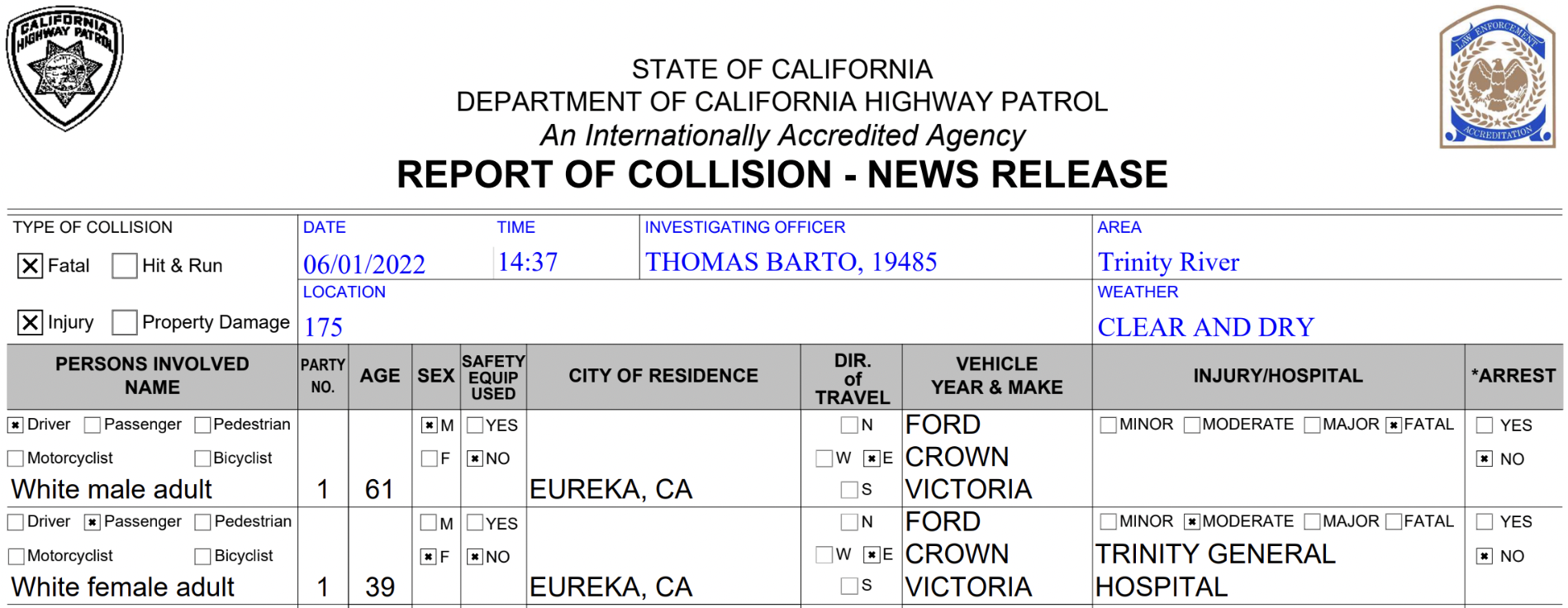
The driver of a Ford Crown Victoria was traveling eastbound on SR-299, east of Rose Road, within Trinity County, proceeding straight at approximately 55 miles per hour. For an unknown reason, the driver made an unsafe turning movement to the right, causing the Ford to leave the roadway onto the south shoulder and down a steep embankment. As the vehicle continued in a southeasterly direction down the steep embankment, it overturned onto its roof on the steep rock embankment, and came to rest submerged in the Trinity River.
The passenger was able to extricate herself and attempted to assist the driver but was unable to. The passenger was able to swim to shore, and passing kayakers and rafters were able to pull the driver to the shore where he was later pronounced deceased by arriving medical personnel.
The passenger suffered minor to moderate injuries and was not wearing her seatbelt at the time of the collision. She was transported by ambulance to Trinity General Hospital for treatment and later released. The driver was not wearing a seatbelt and suffered fatal injuries as a result of the collision.
Drugs and/or alcohol have not been ruled out as a possible contributing factor to the cause of this collision.
PREVIOUSLY: Highway 299 Closed After Vehicle Careens Into Trinity River
Thirty-Year-Old Medi-Cal Income Limit Leaves Some Seniors Without Needed Care
Ana B. Ibarra / Thursday, June 2, 2022 @ 7:09 a.m. / Sacramento
California living is expensive. So imagine having to get by on $600 a month. That’s essentially what some seniors and people with disabilities have to do in order to access Medi-Cal, the state’s health insurance program for low-income residents.
Individuals with significant medical expenses — but whose income is too high to qualify for free Medi-Cal — may still access the program if they pay some of the costs.
That share of cost works like a monthly deductible; people are allowed to keep $600 for personal use and must spend the rest of their income on health care expenses before their Medi-Cal coverage kicks in.“If you make $1,600 a month, $1,000 has to go toward paying for your care,” said Tiffany Huyenh-Cho, a staff attorney at Justice in Aging, an organization that is urging state lawmakers to update the income rule. Because people using this type of Medi-Cal usually have costly care, for some it’s worth paying, but most can’t afford it, she said.
In January of this year, the latest month for which state data is available, there were about 81,000 people who were enrolled in Medi-Cal but couldn’t use it because they did not meet their share of the cost. The majority are over 65 or have a disability, data show.
Take Maxine Wells of San Diego — she is 91, and with the help of her son, Keith Wells, she recently applied for Medi-Cal. Her Social Security monthly income of $2,000 puts her over the limit for free coverage. Keith is still waiting to get official word from the state on his mom’s eligibility status, but isn’t sure they’ll be able to meet her share of the cost.
The dollar amount that people get to keep, $600 for an individual and $934 for a couple, hasn’t changed since 1989, when the minimum wage was $4.25 an hour.
“It was shocking to hear it hasn’t been updated since then,” Keith Wells said.
Older adults like Wells also qualify for Medicare, the federal health insurance program for seniors and people with disabilities. But Medicare doesn’t cover all her needs or at-home care. Wells, a former beauty shop owner, suffers the aftermath of a heart attack, which left her heart muscle damaged. She has chronic obstructive pulmonary disease (COPD), dementia and anxiety. Medi-Cal would supplement her Medicare coverage. About 1.4 million Californians are enrolled in both programs.
California has put forth sweeping and first-in-the-nation policies to expand health insurance coverage to more people. It has one of the lowest uninsured rates in the country — about 6% of California residents don’t have health insurance. Still, pockets of people continue to struggle to afford the coverage and care they need, meaning they go without it.
Aging advocates say older adults tend to live on fixed incomes but are sometimes subject to rules that haven’t kept up with the current cost of living.
Aging and health advocates are now asking legislators and the governor’s office to allow Medi-Cal recipients who need to pay a share of cost to keep more of their income. Assembly Bill 1900 by Assemblymember Dr. Joaquin Arambula, a Fresno Democrat, proposes to raise the monthly limit from $600 for an individual, which is about 55% of the federal poverty level, to $1,562, or 138% of the federal poverty level.
This adjustment would require federal approval, according to the Department of Health Care Services, which oversees the Medi-Cal program.
Arambula’s bill made it out of the Assembly last week and is now before the Senate. “This is simply a matter of fairness for Californians who are struggling to make ends meet and need access to health care,” Arambula said about his bill in the Assembly Health Committee hearing earlier this year.
Linda Nguy, a policy advocate with the Western Center on Law and Poverty, said it would be difficult to pass the bill if funding for it isn’t included in this year’s state budget. Funding for this proposal was not included in the governor’s May revision of the budget.
However, the version of the budget released Wednesday by the Legislature’s Democratic leaders allocates $31 million to reduce the share of cost for this population. The Legislature and Gov. Gavin Newsom must now come together and hammer out a final budget.
The Legislative Analyst’s Office has estimated that this proposal would cost anywhere between $53 million and $151 million, of which half would be paid for by the state and the other half through federal funds. Without that funding, Arambula’s bill would likely get stuck in the Senate’s fiscal committee, Nguy said.
At least nine other states and the District of Columbia allow people who pay a share of cost for Medi-Cal (Medicaid in other states) to keep a higher amount for personal use than California does, according to the Kaiser Family Foundation.
“If you make $1,600 a month, $1,000 has to go toward paying for your care.”
— Tiffany Huyenh-Cho, attorney at Justice in Aging
“It’s so unfair,” said Naty Chavira, a teacher in the Los Angeles area whose parents, Jose and Alicia Chavira, are struggling to afford expensive medication and in-home assistance. “Do you know how hard my dad worked? He paid his taxes, he’s a good citizen, and here he is today in survival mode. I know that his finances are taking a toll on his health.”
Jose, 77, a former welder, has been struggling with a number of health issues and symptoms — diabetes, depression and vertigo, among others. He has spent most of his retirement caring for his wife, Alicia, 78, a former housewife who raised six kids and was diagnosed with Alzheimer’s disease a few years back. But now his health is deteriorating too.Naty would like her parents to get some in-home assistance and for her dad to get the hearing aids he needs, but Medicare won’t pay for those expenses, so she helped them apply for Medi-Cal. However, in order to get that coverage, the couple would get to keep only $934 of their $2,600 monthly Social Security income.
When you take $500 away for bills, they’d get to keep $400 for their food and medication. “It’s insane,” Chavira said.
###
CalMatters COVID and health care coverage is supported by grants from the Blue Shield of California Foundation, the California Health Care Foundation and the California Wellness Foundation.
CalMatters.org is a nonprofit, nonpartisan media venture explaining California policies and politics.


