

Local Man Killed in Head-On Samoa Bridge Crash; 6-Year-Old Among Occupants That Suffered Major Injuries, CHP Says
LoCO Staff / Tuesday, Jan. 25, 2022 @ 12:15 p.m. / Traffic
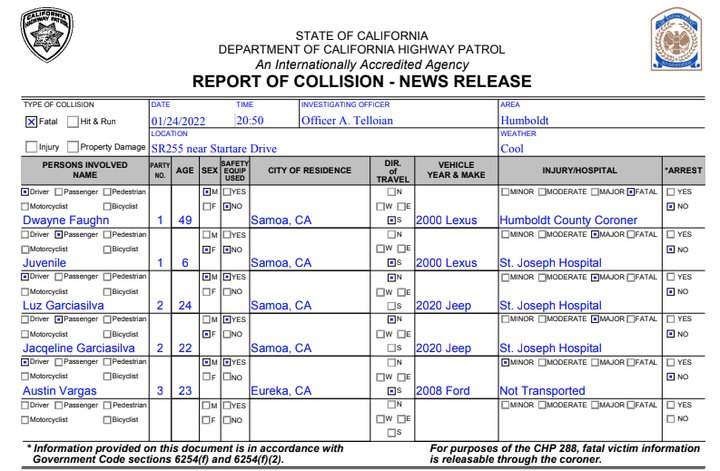
CHP collision report. | CHP
California Highway Patrol press release:
On 01/24/2022, at approximately 8:54 p.m., Humboldt Area CHP received a report of a head-on crash on SR-255 near Startare Drive (near Woodley Island).
Personnel from Eureka Police Department, Humboldt Bay Fire Department, Humboldt County Sheriff’s Office, City Ambulance of Eureka, California Department of Transportation, and California Highway Patrol responded to the scene.
Based on the preliminary investigation, CHP has determined that a 2000 Lexus was being driven southbound on SR-255 approaching a 2020 Jeep being driven northbound on SR-255. For reasons yet to be determined, both vehicles collided head-on, causing major injuries to all occupants of the involved vehicles, and came to rest blocking the roadway.
Shortly after the initial collision, a 2008 Ford being driven southbound on SR-255, crashed into the stationary Lexus and Jeep, causing minor injuries to the driver of the Ford.
The driver of the Lexus, 49-year old Dwayne Faughn of Samoa, Calif., succumbed to his injuries on scene and was pronounced deceased by emergency medical personnel.
A juvenile passenger in the Lexus, whose identity is being withheld due to her age, suffered major injuries and was transported from the scene by emergency medical personnel.
Both the driver and passenger of the Jeep were transported to St. Joseph Hospital for treatment of their injuries.
The CHP Humboldt Area Office is continuing its investigation and asks anyone who witnessed the crash, or has any additional information related to the crash, to contact the California Highway Patrol at 707-822-5981.
The California Highway Patrol extends its condolences to the family of the deceased, and thanks all responding agencies, as well as the citizens who stopped to help, for their assistance in managing the scene.
BOOKED
Today: 12 felonies, 16 misdemeanors, 0 infractions
JUDGED
Humboldt County Superior Court Calendar: Friday, Sept. 4
CHP REPORTS
No current incidents
ELSEWHERE
RHBB: CDPH Issues Immunization Recommendations for 2026-27 Respiratory Virus Season
RHBB: Redway Transfer Station to Close an Extra Day for Construction
RHBB: Dows Prairie Road to Close for Two Months for Culvert Repair
HSU Begins Renovation on Historic Trinity Annex, Expects to Complete New Children’s Center and Child Development Lab By Next Year
LoCO Staff / Tuesday, Jan. 25, 2022 @ 10:35 a.m. / HSU
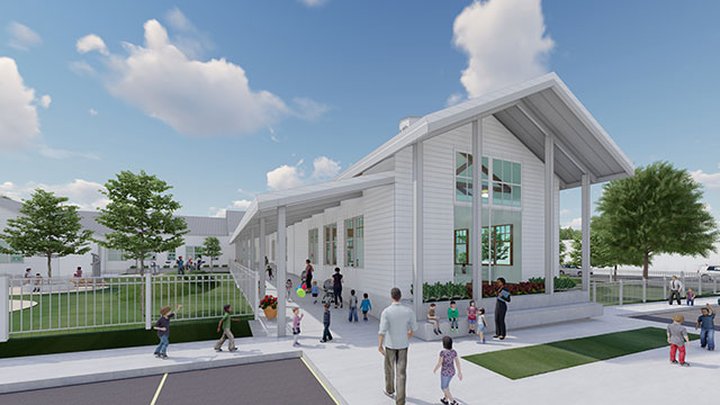
A rendering of the Trinity Annex project looking west. | HSU
NOTE: HSU told the Outpost that hazardous material abatement was completed prior to the recent construction in order to remove any asbestos from the building.
###
Humboldt State University:
Humboldt State University recently broke ground on the renovation of the historic Trinity Annex, located just off campus at 14th and B streets. The extensive remodel and expansion will be the future home of the University’s Children’s Center and Child Development Lab; the project is slated for completion June 2023.
This week, demolition and abatement efforts are underway, as contractor S & B James removes hazardous materials, tears down buildings, clears landscaping, and begins lead paint abatement. The full scope of the project includes tearing down the dilapidated eastern wing of the building but retaining the aesthetic of the original, west-facing facade. Additional square footage for the Child Development Lab will come from a new wing and main entrance that complements the existing architecture. Once completed, the renovated Annex site will house children’s classrooms, staff offices, educational space, support spaces, and play yards.
“Over the past year and half, we’ve been working with staff and faculty from the Children’s Center and Child Development department to design a space that meets their growing needs and harmoniously fits in with the landscape of the neighborhood,” explains Jason Baugh, Facilities Management project manager. Additionally, the University has worked closely with the Secretary of Interior Standards to evaluate the site for significant impacts to historical resources and aesthetics.
Originally built in 1944, the building served as the Trinity Hospital until 1972. After being purchased by the University, the Annex was used as classroom space until the early 2000’s, and most recently, repurposed for campus storage. Despite the toll of age and underuse, the original old-growth redwood structure has preserved the Annex to the degree that renovation is possible.
The project is partially funded by $8.6 million from the state budget, allocated by the California State University in 2019. The total project budget will exceed $14 million with additional funding coming from the University and other project sources.
The renovated Children’s Center will include expanded outdoor play areas and offer improved access to families who use the Center via bus, bike, or foot. The city bus stop that services the Center will be relocated from 14th to B Street and short-term parking will be dedicated to pick-up and drop-off.
“The new facility will allow us to increase our ability to provide high quality child care to families in the University community, as well as training opportunities for the many student assistants we employ,” says Children’s Center Director Betsy Wilson.
Established in 1971, the HSU Children’s Center has continually provided affordable, subsidized high quality child care and early education programs for children aged three months to five years of HSU students, staff, and faculty families. Along with providing a broad range of comprehensive services to families, the Children’s Center also employs student assistants as supervised “teachers in training” each semester.
For 54 years, HSU’s Child Development Lab has been a special environment designed to provide a model preschool for children, create a learning center for University students and faculty, support and educate parents of young children, and serve as a research and instructional center at Humboldt State.
“We are thrilled to see this project move to a new phase,” says Child Development Professor and Lab program leader Hyun-Kyung You. “The new facility will feature developmentally appropriate and culturally unique indoor and outdoor spaces for young children, continuing our legacy with the National Association for the Education of Young Children (NAEYC) beyond the state-level child care licensing regulations. Moreover, this facility, equipped with the latest technology, will significantly enhance our students’ hands-on learning experiences by teaching preschool children and learning from their relationships.”
RODRIGUEZ TRIAL: First Testimony in SoHum Double Murder Trial Describes How the Burning Vehicle and Bodies Inside Were Found
Rhonda Parker / Tuesday, Jan. 25, 2022 @ 7 a.m. / Courts
Testimony in the trial of double-murder suspect Ulisses Rodriguez began yesterday with the jury hearing descriptions of the roaring fire that consumed a vehicle with two bodies in the back.
Moses Danzer, the first person to call 911 about the blaze, testified he was driving past a large turnout on Briceland Road on Aug. 14, 2018, when he saw a parked SUV on fire, the flames soaring up to 50 feet and “brushing the limbs of a fir tree.”
Danzer turned around and drove about 2 minutes to a place with cellphone service. He called 911 and then Peter Lawsky, chief of the Telegraph Ridge Volunteer Fire Department.
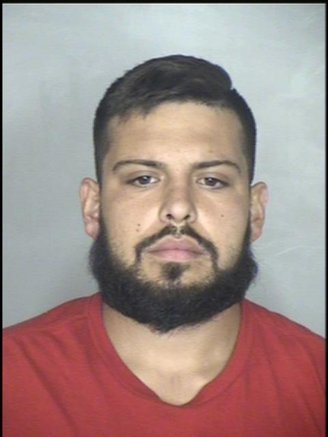
Rodriguez.
The fire threatening the trees was about a half-mile from Danzer’s home, and his main concern at the time was getting his dogs out of the house. It was after Rodriguez was arrested, with his mugshot posted in local media, that he remembered what he saw on Briceland Road before he saw the fire: a man standing behind a sedan parked in an area “with barely any shoulder.”
“It seemed like a bizarre place for someone to park,” Danzer said under questioning by Deputy District Attorney Luke Bernthal. Danzer didn’t mention the man on the road, and his resemblance to Rodriguez, until he spoke with an investigator on the phone just a few weeks ago.
Under cross-examination by defense attorney Andrea Sullivan, Danzer said he had never been shown a photo lineup.
Rodriguez, 27, is accused of shooting Tiffany Ellebrecht and Jeremy Kuemmel to death when they returned to his marijuana grow site after he had kicked them off the property. Some plants had gone missing and he reportedly blamed the couple.
In opening statements, Bernthal said two workers at the grow site heard an argument and then “multiple gunshots.” Witness “John Doe” will testify Rodriguez forced him to help him with the bodies, which were wrapped in a tow chain and dragged into Kuemmel’s green Ford Expedition.
Bernthal told the jury that at the grow site, blood from both victims was found. Law enforcement also found seven .357-magnum shell casings. When Rodriguez was arrested about a week later in Chico, investigators found a box of .357 shells, a .357 gun with seven bullet chambers and a cellphone photo of Rodriguez holding the weapon.
Jurors also saw a video, taken at the Shell gas station in Redway, of Rodriguez filling up a gasoline can at the pump. The video was filmed about 90 minutes before the fire was spotted.
Lawsky, the volunteer fire chief, said when he arrived the SUV was “fully engulfed.”
“Not only was the vehicle burning but the ground was on fire,” Lawsky recalled. “Flames were coming out all the windows … it looked like gasoline had been used.”
A butane torch was found on the front floor of the Expedition.
Another witness was California Highway Patrol Officer Keven Hayslett, the first law enforcement officer at the scene of the fire. Hayslett said that after firefighters doused the flames, he inspected the SUV to determine whether there was “anything of value that had not been burned.”
“It was obvious that everything in the vehicle was burnt and unrecognizable,” he said. Then he observed “two masses” in the back of the SUV. He found the masses were bodies, and the bodies were wrapped in a chain attached to the rear of the car. At that point he called the Sheriff’s Office.
Defense attorney Sullivan, in her opening statement, suggested there were other culpable people involved.
“It is not the law of the land,” she said, “and it has never been the law of the land, that the first person to make it to an attorney is not prosecuted.”
Sullivan also described the slain couple as homeless and, at the time they were killed, so high on methamphetamine that one expert had never seen levels so toxic.
“Is it possible this could have anything to do with their deaths?” she said.
Testimony was expected to continue Tuesday morning before Judge Gregory Elvine-Kreis.
PREVIOUSLY:
- Chico Man Arrested in Connection to Two Bodies Found Inside Burning Vehicle Near Ettersburg Junction
- Chico Man Pleads Not Guilty to SoHum Double Homicide
- Preliminary Hearing Set for Chico Man Charged With SoHum Double Murder
- Chico Man Held to Answer for Murder of SoHum Couple in Dispute Over Stolen Weed
- COURT ROUNDUP: Trial for Suspect in Gruesome SoHum Double Murder Set for Christmas Eve; Godoy-Standley Judged Mentally Competent; Fortuna Murderer Gets Two Years’ Credit
- HUMBOLDT COURT ROUNDUP: Updates on Two Murder Cases, Two Attempted Murder Cases
- COURT ROUNDUP: Mck Woman to Plead Guilty to Manslaughter; Hoopa Man’s Murder Trial Set to Begin; More Updates
- TODAY in COURT: Bear River Triple-Murderer’s Sentencing Delayed; Double-Murder Trial Over SoHum Couple’s 2018 Deaths Scheduled to Start Next Week
- TODAY in COURT: Two Local Murder Cases Moving Forward
OBITUARY: Charley Raymond Winkle, 1924-2022
LoCO Staff / Tuesday, Jan. 25, 2022 @ 6:56 a.m. / Obits
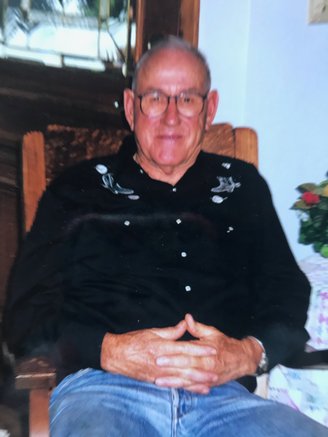
Charley Raymond Winkle
April 19, 1924 – Jan. 22, 2022
Charley was born in The Dalles, Oregon to John and Sarah Winkle. He was born at home and was one of 10 children. Life was different back then, and at a very young age Charley worked on the family farm. At the age of 5 he was driving a team of horses and had many responsibilities on the farm. His dream was to become a lawyer, but unfortunately, education was not valued at that time and he was only allowed to go to school consistently until about third grade and then only sporadically (when life on the farm allowed). When people complained about having to go to school, he would tell tales about how he would run away from home to go to school and would only go home when the sheriff would come and get him and make him leave (hence laws now requiring children to be in school).
His family moved to California when Charley was a young teen. Some of the family’s favorite stories are of him riding his horse from Bald Mountain to Arcata for various adventures including his job setting pins at the Marino’s Bar Bowling Alley (yes, there were two lanes in the back room back in the day). After a full day of work, he would ride his horse into town to set pins at Marino’s and then ride his horse home to Bald Mountain, quite often sleeping while his faithful horse took him home.
Charley moved out on his own around the age of 14 and began working. He lived in a bunk house and was entirely responsible for his well-being. This started Charley’s official journey into the world of full-time employment and he didn’t stop until he was in his 80s. He retired twice but because of his expertise was always being asked to come back to work. In addition to logging, Charley operated heavy equipment and built many of the roads in Humboldt County. He worked on the original landscaping of College of the Redwoods, the installation of US 101 and many other roadways in our region.
At the age of 18, during World War II, he joined the National Guard. He was stationed in the Presidio in San Francisco where he guarded the bay and bridges.
Charley’s hobbies included fishing, golfing, bowling, horse shoes, traveling in the U.S., and his all-time favorite was hunting. He was an avid deer hunter but ironically did not like venison, fortunately, his family did!
Charley was active until the last few months of his life. His eye-sight and hearing were limited but he managed to live a full life. Most of his friends had already passed so he spent his time with family. He was always ready to be picked up and taken to family events (graduations, birthday parties, family dinners, weddings and funerals). He enjoyed going out to breakfast every Wednesday morning with his children and monthly lunch adventures with his grandchildren and great-grandchildren. He spent his time at home mowing his property on his riding lawn mower and cleaning up brush. He was as active as he could be for the age of 97! Charley was a hard-working, practical guy who told it like he saw it. Shortly after Christmas he announced that he was going to make it to the new year, but not much further than that, and once again, he was right. He passed peacefully in his sleep in the care of his children on the afternoon of January the 22nd, 2022.
Charley is survived by his wife, Donna Winkle; children Don Winkle, Ida Pittman (Terry), Shirley Atkins (Terry), Judy Dorvall (Rocky) and David Winkle; step-sons Randy Cornelius and Kevin Cornelius; 16 grandchildren and 17 great-grandchildren. He was larger than life, but in a quiet way and he will be missed by many.
Thank you, Dr. Skye Heston and Staff and Hospice of Humboldt for your kind and professional care of Charley and valuable support to the family.
In lieu of flowers please make donations to Hospice of Humboldt. Thank you.
###
The obituary above was submitted on behalf of Charley WInkle’s loved ones. The Lost Coast Outpost runs obituaries of Humboldt County residents at no charge. See guidelines here.
OBITUARY: Barry Joe Savage, 1941-2021
LoCO Staff / Tuesday, Jan. 25, 2022 @ 6:56 a.m. / Obits
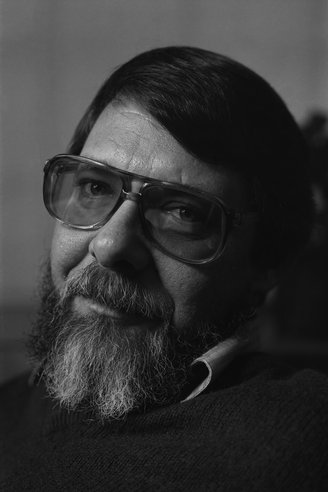
Barry Joe Savage passed away on December 21, 2021 at the age of 80 at Seaview Wellness and Rehabilitation Center in Eureka of various medical conditions.
Barry was the oldest of seven, born in 1941 in Clay Center, Kansas. His parents were Enid and James Savage. As a child he moved out to Northern California with his family. As a teenager, he developed an interest in music and learned to play guitar. He also became interested in radios and electronics. In his early twenties, he played in many local rock bands in the area around Eureka and often played with his brother Steve. His other many jobs included: delivery truck driver, hospital worker, and working in sawmills He later joined the National Guard reserves as a radio operator.
His intense curiosity and passion for learning lead him to pursue a degree in sociology at Humboldt State University. There, he soaked in all the knowledge he could, aside from his major. Some his other interests were biology, linguistics, painting and even flower arranging. It was there that he met his first wife, Janet Rider, whom he married in 1965. The next year, his son, Barry Jr. was born. After earning bachelor’s and master’s degrees, he also got certification to teach at both high school and at the university level. In 1974, he moved to the Portland Oregon metro area where he worked at Portland State University in the administration as a researcher, Information Systems coordinator and Data Base Manager. By the early and mid-‘80s he was working at the University of Oregon as an Associate Professor, Assistant Registrar and Information Systems Coordinator.
In 1985 he moved back to Eureka and eventually went to work at the College of the Redwoods as the Director for Institutional Research. In the early 2000s, Barry started working at the Humboldt Senior Resource Center teaching seniors how to use computers and the internet, which he enjoyed immensely. It was there that he met Perry Mauer, the woman with whom he would form a close romantic relationship and later marry. Soon they made home for themselves in a small victorian house in Eureka. It was there that they enjoyed cooking, gardening and improving their home. In 2016 Perry passed away, after many happy years with Barry.
To all who knew him, he was an extremely intelligent, and curious person who enjoyed life. He had too many interests to include here, but among them were music, woodworking, art, science, literature, computer coding, electronics, cooking, philosophy, statistics and sociology. His excitement and passion for learning inspired all who knew him. Beyond that, his warmth, compassion and sense of humor made him fun to be around for everyone he met. He enjoyed learning, teaching and sharing information and his enthusiasm was infectious. Many of those he taught formally or informally later used what they had learned from him as the basis for their own careers or interests. Often he would get out his yellow notepad and diagram or sketch out ideas to help illustrate abstract concepts.
He is survived by his son, Barry Jr, his brother, Steve and his sisters, Janna and Paula Sue and his two grandchildren Joseph and Sarah.
###
The obituary above was submitted on behalf of Barry Savage’s loved ones. The Lost Coast Outpost runs obituaries of Humboldt County residents at no charge. See guidelines here.
Corps of Engineers, U.C. Berkeley Return Remains of Wiyot People Presumed Killed in the Indian Island Massacre
Hank Sims / Monday, Jan. 24, 2022 @ 4:22 p.m. / News
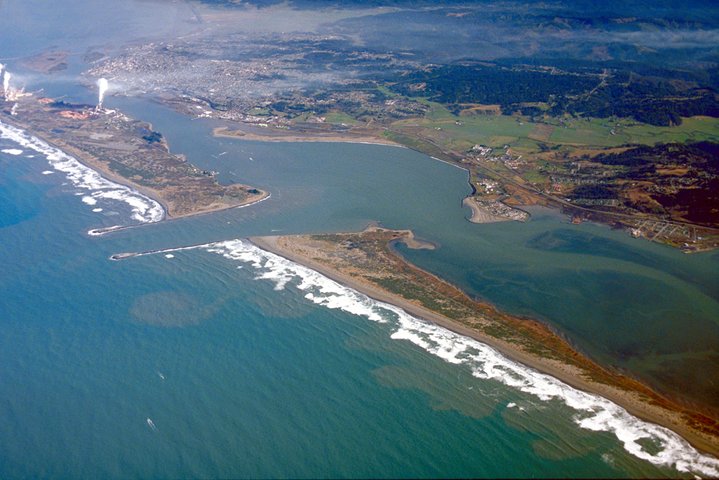
The north and south jetties and the entrance to the bay, with Tuluwat Island in the far background.Photo: US Army Corps of Engineers, via Wikimedia. GNU public license.
###
This is quite something.
Today, the Army Corps of Engineers announced that it and UC Berkeley have worked to repatriate the remains of 20 people who were discovered during the construction of the jetties in the 1950s.
According to a press release, some time ago the remains — which were in the custody of an anthropology museum on the campus of UC Berkeley — were determined to be those of Wiyot people. Then, last year, researchers determined that they were likely to have been killed during the Indian Island Massacre of 1860.
“We had a feeling that’s who they were,” Ted Hernandez, tribal historic preservation officer of the Wiyot Tribe, told the Outpost “because of some of the stories we’ve heard about how some of the individuals that were massacred were brought to that certain spot where they were at, and some were taken to certain other spots.”
We reached out to UC Berkeley to ask how it was the bodies were likely those of massacre victims, but Dr. Thomas Torma, the university’s liaison under the Native American Graves and Repatriation Act, would say only that the research was done at the request of the Wiyot Tribe and is “held in confidence with them.”
Hernandez said that the bodies, along with 136 objects of cultural significance, were returned to the tribe last month.
Press release from the U.S. Army Corps of Engineers:
The U.S. Army Corps of Engineers San Francisco District and the University of California, Berkeley, have successfully repatriated 20 human remains and 136 objects of historical, traditional and cultural importance to the Wiyot Tribe of Loleta, Calif.
The collection resided in the Phoebe A. Hearst Museum of Anthropology at UC Berkeley. The remains and associated items were uncovered in 1946 during construction activities related to the Humboldt Bay Jetties, which were built by the Corps. A cultural affiliation study conducted by Statistical Research Inc. for the Corps found the human remains were likely to be lineal descendants of the Wiyot people, based on ethnographic, linguistic, osteological and archaeological data. Further research conducted by UC Berkeley in 2021 indicated that these individuals were likely victims of the Indian Island Massacre, which took place on Feb. 26, 1860, when settlers attacked numerous Wiyot villages.
The Wiyot are Indigenous people of California who have lived in the Humboldt Bay region since time immemorial. Today, there are about 650 tribal members who enrolled in several federally recognized tribes, such as the Wiyot Tribe, Bear River Band of the Rohnerville Rancheria and Blue Lake Rancheria.
The U.S. Army Corps of Engineers San Francisco District and UC Berkeley first consulted with numerous tribes concerning the collection in September 2007. Information supplied by the Wiyot Tribe and other federally recognized tribes with Wiyot composition supported the research of the two agencies. The tribe recognized that the human remains belonged to the Wiyot and then requested the return of the remains and associated funerary items. The U.S. Army Corps of Engineers San Francisco District and UC Berkeley agreed to follow the process of repatriation pursuant to the Native American Graves Protection and Repatriation Act (NAGPRA).
NAGPRA is a federal law enacted by Congress in 1990 to ensure the return of Native American human remains, funerary objects, sacred objects and objects of cultural patrimony to lineal descendants, Indian tribes and Native Hawaiian organizations.
Ted Hernandez, Cultural Director and Tribal Historic Preservation Officer for the Wiyot Tribe, said, “We have been working to return the remains of our relations for years. We are thankful to finally be able to welcome them home.”
This repatriation is a benchmark for the U.S. Army Corps of Engineers and the University, since, at the time of the excavation, neither party could clearly determine who owned the land where the remains were discovered. As a result, it was unclear who should conduct the repatriation. Rather than delay the process for years, and at the request of the tribe, the two parties conducted the repatriation jointly.“This a tremendous day for us” said Hernandez. “It reflects the commitment of the University to find ways to make repatriation happen, to work constructively with our tribe, and agency partners.”
The Wiyot ancestral territory encompasses the area bounded by Little River to the north, Bear River Ridge to the south, the Pacific Coast to Berry Summit in the northeast, and Chalk Mountain in the southeast. The tribe’s current land holdings include 88 acres on the south end of Humboldt Bay, five miles from the town of Loleta, which is where its tribal government seat is located.
Humboldt’s ‘Center of the Marble Universe’ Claim Strengthened by Big National Geographic Spread
Andrew Goff / Monday, Jan. 24, 2022 @ 2:45 p.m. / Our Culture
As those of us who dwell here are aware, Humboldt is full of all types of species of weirdo — from hippies to kineticists to Bigfoots, to name but a few. But now another of our curious subgroups has grown in strength enough to merit notice by the outside world.
Look out, HumCo. The “marbleheads” are rising.

A new article by Ashley Harrell published by no less than National Geographic highlights the growing popularity of outdoor marble hunting as a way to pass the time up here in the redwoods. Logically, the activity is especially chic during global pandemic times, it turns out. Regular LoCO readers and those active in local social media circles may already be clued into the practice, but if you are unaware of what’s been happening in the forests around you thankfully you can now just click over to NatGeo to learn that countless people in recent years have taken up the habit of either hiding or searching for custom made marbles in Humboldt’s pristine nature places. One couple featured in the article claim to have spent many a weekend forging into the woods, following clues posted on social media, an obsession that has thus far netted them 320 brightly colored ornate orbs! You’ll agree, this is all very Humboldt!
Needless to say, members of our local marble scene are stoked for the recognition. Topher Reynolds, a local glass blower, marble maker and one of the organizers of the (in pre-COVID times) annual Humboldt Marble Weekend, has been working diligently in recent years to make the North Coast “the center of the marble universe,” as he calls it. Humboldt Marble Weekend, held annually at Redwood Acres Fairgrounds, draws glass artists from around the world and is, according to Reynolds, “the largest marble event on the planet.”
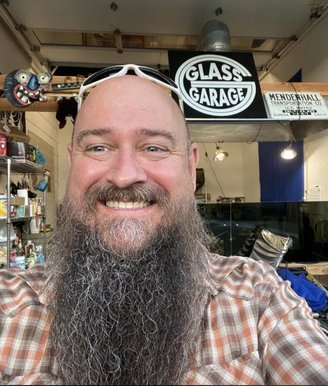
Topher Reynolds, local National Geographic-featured marble maker
“I’m incredibly proud to be part of the Humboldt County marble scene,” Reynolds told the Outpost today when asked about the love his community received in the NatGeo article. “There are few things better in life than watching a passion grow and take on a life of its own. We are all incredibly lucky to live in a community that actively supports the arts.”
Since Humboldt Marble Weekend is historically held in February, Reynolds confirmed that the current COVID reality means there will not be a 2022 edition of the event, but he said he “hope[s] to do the big show again in 2023.”
Lose your marbles, Humboldt! Then go find them! If you’d like to learn more about Humboldt’s ascension to marble destination of note, go here to read the NatGeo article, or click here to listen to Topher share his passion for marbles during his appearance on LoCO’s Humboldt Holding Up.
Above: That time LoCO stopped by Humboldt Marble Weekend


