

ECONEWS REPORT: Let’s Talk About Broadway
The EcoNews Report / Saturday, Nov. 21, 2020 @ 10 a.m. / Environment

###
Highway 101 through Eureka is one of California’s most dangerous stretches of road. Structurally, the road is bad for non-vehicular users: it is wide, fast, and crosswalks are too spaced too far apart, to name a few problems. Local agencies and advocates are looking for ways to make Broadway safer for people walking and biking.
What do wetlands, contaminated soil and traffic congestion have to do with it? Listen to find out.
“The EcoNews Report,” Nov. 21, 2020.
REQUIRED READING:
BOOKED
Yesterday: 14 felonies, 6 misdemeanors, 0 infractions
JUDGED
Humboldt County Superior Court Calendar: Today
CHP REPORTS
1656 Union St (HM office): Missing Indigenous
ELSEWHERE
Mad River Union: Sunny Brae Porchfest 2026
Mad River Union: Miranda case outcry brings county response
Mad River Union: McK Ace adds greenhouses, lumber, parking, wetlands
Mad River Union: Candidates talk at Blue Lake forum
Third COVID Case Confirmed on the Yurok Reservation, Says Tribe
LoCO Staff / Saturday, Nov. 21, 2020 @ 9:53 a.m. / COVID-19 and Humboldt , Tribes
Press release from the Yurok Tribe:
The Yurok Office of Emergency Services has received confirmation of the third COVID-19 case on the Yurok Reservation.
The case involved a resident on the Klamath side of the reservation. The individual is experiencing mild symptoms and will quarantine at home for the next 14 days. Yurok OES and Del Norte County health representatives are conducting a comprehensive contact tracing investigation to minimize the potential for additional transmissions. The tribal and county team has already begun reaching out to the small number of people who spent time in close proximity to the community member during the past two weeks. The Tribe is offering resources to these individuals to help them complete the required, two-week quarantine. To preserve the confidentiality of personal health records, the Yurok Tribe will not disclose any further details at this time.
“We are performing a thorough contact tracing investigation to prevent the spread of the illness,” said Serene Hayden, the Yurok Tribe’s Incident Commander. “With the recent increase in cases in Humboldt and Del Norte Counties, all residents are strongly encouraged to remain consistent in employing all of the personal safety measures, such as wearing a mask and practicing physical distancing while in public. Also, it is extremely important for everyone in this region to stay home and refrain from attending large gatherings during the upcoming holidays. If you feel unwell, please get tested. We are providing free COVID-19 tests multiple times per week in Weitchpec and Klamath.”
During the month of November, the rate of COVID-19 infections spiked significantly in Humboldt and in Del Norte Counties. Humboldt saw its highest number of cases since the beginning of the pandemic. Both counties are at Tier 2 on the community risk level chart and are trending toward Tier 1, which is the most restrictive stage. There has been a total of three COVID-19 cases on the Yurok Reservation. Reservation residents are asked to continue practicing all of the recommended personal safety strategies, such as wearing a mask when outside of the home and only travelling for essential purposes. A disproportionate quantity of elders and individuals with preexisting medical conditions reside on tribal lands. These safety measures offer the most effective means of keeping them and the whole community safe.
Reservation residents can find testing information on the Tribe’s Facebook page (https://www.facebook.com/TheYurokTribe) and at Yurokoes.org. The test is free and open to all. For information about testing in Humboldt County, please visit https://humboldtgov.org/2788/Eureka. If you live in Del Norte County and would like to get tested, please visited the following webpage: https://www.covid19.dnco.org/testing
The Yurok Office of Emergency Services advises residents to follow all personal safety recommendations:
- Maintain a minimum of 6-feet of personal space from individuals outside of the household
- Always wear a face covering outside of the home (Wash reusable mask frequently, only use single-use masks once)
- Do not attend gatherings large or small, including visiting extended family and friends
- Avoid all contact with anyone exhibiting COVID-19 symptoms
- Disinfect common touch points in the home
- Practice cough and sneeze etiquette (cover your sneezes and coughs with your arm. Wash hands immediately after cough or sneeze for additional protection)
- Perform frequent handwashing – Wash hands every two hours for 20-30 seconds with water and soap)
- If you feel ill, please get tested and self-isolate
- Reminder: If you feel slightly unwell and have one or more of the common symptoms of COVID-19, it is advised to stay home from work
Yurok citizens in need of assistance are encouraged to call the Yurok Tribe’s COVID-19 hotline at 1-888-225-8952.
Dungeness Crab Season Delayed Until Mid-December Due to Low Weight in Meat Quality Tests
LoCO Staff / Saturday, Nov. 21, 2020 @ 9:22 a.m. / Business , Environment

Dungeness Crab. | CDFW photo by C. Juhasz
###
Press release from the California Department of Fish & Wildlife:
In a memo released [Friday], California Department of Fish and Wildlife (CDFW) Director Charlton H. Bonham, delayed the northern California commercial Dungeness crab season due to meat quality test results. The delayed area includes Mendocino, Humboldt and Del Norte counties (Fish and Game Districts 6, 7, 8 and 9).
Samplings conducted on Oct. 27 and Nov. 12 did not yield valid results because the total poundage collected did not meet the minimum criteria established by the Tri-State Dungeness Crab Committee. Another round of testing is scheduled to occur on or around Dec. 1.
Pursuant to Fish and Game Code 8276.2 (c), the northern Dungeness crab fishery is delayed 15 days until 12:01 a.m. on Wednesday, Dec.16, 2020. Assuming there is no additional delay, the fishery will be preceded by a 64-hour gear setting period that would begin no earlier than 8:01 a.m. on Sunday, Dec. 13, 2020.
“This industry-supported quality test determines if Dungeness crab have filled out in time following their molting period,” said CDFW Environmental Scientist Christy Juhasz. “The crab we tested achieved the minimum quality standard required by the Tri-State testing protocol but did not meet the minimum pounds to yield a valid sample, indicating that this may be a low production year of crab.”
Under a meat quality delay, no vessel may take or land crab in the closed area (i.e., Fish and Game districts 6, 7, 8 and 9). In addition, any vessel that takes, possesses onboard, or lands crab from ocean waters outside of a delayed area is prohibited from participating in the crab fishery once the delayed area opens for an additional 30 days. This applies to any delayed areas in Oregon, Washington and California.
The central California commercial Dungeness crab season which was scheduled to open on Nov 15, 2020 was delayed due to elevated risk of marine life entanglement. CDFW is working with the California Dungeness Crab Fishing Gear Working Group to evaluate if the risk of entanglement has subsided or if an additional delay is needed to protect marine life. CDFW expects to announce the results of the latest risk assessment for the central California fishery early next week.
For more information, please see CDFW’s Frequently Asked Questions regarding the 2020-2021 Dungeness crab commercial season.
For more information on Dungeness crab, please visit:
www.wildlife.ca.gov/crab
OBITUARY: John Weber, 1941-2020
LoCO Staff / Saturday, Nov. 21, 2020 @ 6:56 a.m. / Obits

John
Weber, 79, passed away on November 5, 2020 surrounded by family. John
was born in Los Angeles on June 4, 1941 to Nick and Kathryn Weber and
graduated from South Fork High School in 1959. In 1961, he married
Shelba Jennings, and they were married for 58 years. They lived in
Scotia where they raised their daughter and son with great memories
and great friends, before retiring to Fortuna.
John is survived by his wife, Shelba, and daughter, Derry Golding, and son, Mike Weber (Ginger), grandchildren, Ashley (21), Kira (19), Hayden (16) and Gracie (16), brother, Allen Weber (Betty) of Las Vegas, sister, Jean Hartman (Jim) of Redding and nieces and nephews. He was preceded in death by his son-in-law, Glenn Golding.
John worked for The Pacific Lumber Company for 41 years and could often be seen cruising around town in his ‘67 Bronco. He had a sense of humor like no other and loved joking around with friends, family and even strangers, too! He loved spending time with his family and some of his fondest memories were teaching his children his passion for the outdoors. One of his favorite trips was elk hunting in Wyoming with his son on horseback. John was so proud of his son’s success in hunting a bull elk on that trip. He also loved to hunt pheasants with both his daughter and son and their labs, and local deer hunting trips. John also loved to drift the Eel River with his son, fishing for salmon and steelhead.
Once he became a Papa, his grandchildren stole his heart and he was their biggest fan in all their various activities. During his weekend’s John enjoyed golfing with Shelba and friends and was a part of the daily afternoon McDonald’s club where he and his close friends would get together for an ice tea. He was an avid Seattle Seahawks fan and enjoyed rooting for the Seahawks regardless of the color of their uniform that week. If he was home on a weekday at 10 am, you could find him enjoying his favorite game show, The Price is Right. He was a loving husband, father and Papa.
A celebration of life will be held at a later time.
###
The obituary above was submitted on behalf of John Weber’s loved ones. The Lost Coast Outpost runs obituaries of Humboldt County residents at no charge. See guidelines here.
BREAKING: Michelle Bushnell Takes Commanding 356-Vote Lead Over Incumbent County Supervisor Estelle Fennell
Ryan Burns / Friday, Nov. 20, 2020 @ 4:41 p.m. / Elections
UPDATE, 5:15 p.m.:
Bushnell’s 356-vote lead looks very likely to be enough, judging by the relatively small number of ballots that haven’t yet been counted.
According to Kelly Sanders, Humboldt County’s clerk-recorder/registrar of voters, there are “maybe” 100 vote-by-mail ballots countywide that haven’t been tallied, plus another 350 or so where the signatures didn’t match what’s on file or the person forgot to sign the envelope. Again, that’s countywide.
There are also about 2,500 provisional ballots, which are used when there’s an unresolved question about the voter’s eligibility, but Sanders said only 284 of those were submitted at precincts in the Second District.
Of course, some of those might be from voters who live outside the Second District. And, by the same token, some provisional ballots turned in elsewhere might belong to Second District voters.
Nonetheless, the number of remaining valid uncounted ballots in this race is probably in the vicinity of 500 or so, tops. And with Bushnell’s lead only growing since Election Night, well, it’s looking like she can safely be called “supervisor-elect.”
###
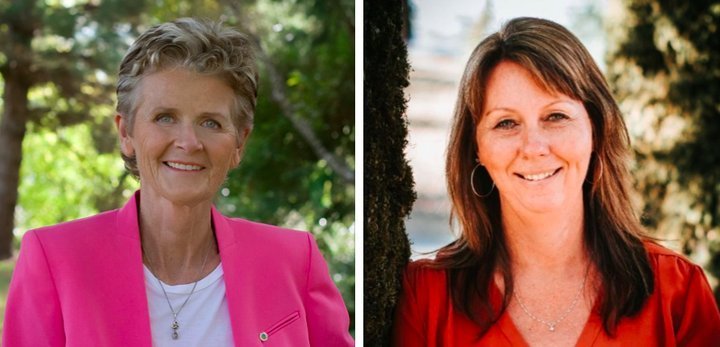
Fennell (left) and Bushnell. | Campaign photos.
###
A week after pulling ahead by a razor-thin 34-vote margin, Michelle Bushnell has expanded her lead over incumbent Second District Supervisor Estelle Fennell to 356.
In the third post-election report issued by the Humboldt County Elections Office, Bushnell has 6,049 votes (51.52 percent) to Fennell’s 5,693 votes (48.48 percent).
| SUPERVISOR, DISTRICT TWO | ||
|---|---|---|
| ESTELLE FENNELL | 5,693 |
48.48% |
| MICHELLE BUSHNELL | 6,049 |
51.52% |
Bushnell has added 1,024 votes since the previous tally, released last Friday, while Fennell added just 702 votes. This continues the trend toward Bushnell that we’ve seen since the initial votes on Election Day.
We have a call in to Kelly Sanders, the county’s registrar of voters, to find out how many ballots remain uncounted. We’ll update this post when we find out, but with the current margin and the way things have trended, Fennell’s re-election is looking like a very long shot at this point.
See the rest of the updated results here.
###
PREVIOUSLY:
- THE BIG ELECTION DAY LIVEBLOG! LoCO Will Be at Our Stations and Out on the Streets Right Here in This Thread All Day and Night
- ELECTION NIGHT FINAL REPORT: With Tens of Thousands of Votes Likely Left to Count, We Know Some Things — But Not Much
- First Post-Election Report Issued; 4,673 More Votes Counted, About 17,500 to Go; Bushnell Theoretically Within Striking Distance of Incumbent Estelle Fennell
- Michelle Bushnell Leads Incumbent Supervisor Estelle Fennell in Latest Vote Tally
In Media Availability, Public Health Officer Issues Grave Warning About Gathering During the Holidays, and During the Case Spike
LoCO Staff / Friday, Nov. 20, 2020 @ 4:22 p.m. / COVID-19 and Humboldt
Video of today’s media availability with Dr. Teresa Frankovich, Humboldt County’s health officer, above. Rough transcript below.
###
Good afternoon, thank you for being with us. Thank you. Would you like to start by addressing the community?
Yes, I do want to mention a couple of things at the outset here before we begin answering other questions.
A couple really important issues. One is if people in the community are concerned about what they’re seeing in terms of rising case counts per day, I want to make it clear I am also very concerned and the trend that we’re seeing is alarming and it is very likely to land us in the purple tier in short order. And I think that when we look at our local case counts we’ve more than tripled those in very recently and acceleration at this pace is exactly the thing we’ve been trying to avoid throughout. We’ve been luckier than most for a very long time, but again, I think we’re seeing the drivers of moving indoors in colder weather and the fact that we are seeing gathering and travel and those drivers are getting us in trouble. There’s just no doubt about it, and it’s important for people understand that our contact tracing has been a big part of helping us to contain, and we can do that robustly when we are getting a scattering of cases.
When we start to see very large numbers of cases coming in, as many other counties are experiencing, the type of contact tracing you do has to decrease, you cannot do as deep and expansive an investigation and that means cases will be unidentified in the community, increasing spread further. So it’s a partnership with the community and the response team to try and keep the transmission rate down, and I’m asking everyone to really join on board and stop the gathering. We have to stop the gathering or we are not going to see this slow, and in addition the travel, and the two of those mixed are particularly challenging.
The second point I want to make is that we know that when we reach out to positive cases sometimes people have been doing things that they know we have not been advising, and I think there’s some sometimes some hesitation on people’s part to give the full details of what they’ve been doing. I just want to emphasize that particularly as our case counts rise we don’t have the time to wait three or four days or five days to be able to get a full picture of what exposures might be. It means that there is spread in that interval and we can’t afford that right now.
So I again would like to ask our community members, if we reach out to you and we’re talking about with you about your case, please be forthright right at the beginning. Let us know what really happened and we’ll work with you to try and contain infection in your friends family and those others who may have been exposed.
The Times-Standard asks, “There have been reports nationwide of spikes in demand for COVID-19 testing as the holidays approach. What advice would you give people who think that testing negative on a single day in advance of a holiday gathering ensures the safety of themselves and their families?”
It’s a good question. What I would say is there really is not a safe way to have a gathering around a table eating with masks off indoors — there isn’t. There just isn’t.
And so I think people need to take that into consideration when they’re dealing with friends and family members, because again we are seeing this where a single gathering around a table leads to multiple infections in that group. You’re just very vulnerable. So I think if people are going to have even the three households gather, ideally that should be outdoors. I get it that that’s challenging here right now but it should be outdoors ideally. If you can’t be outdoors, you should be distanced, if you have to unmask you should clearly be distanced. For eating that means not all being around one table, it means people who are sick stay home, people who have been exposed potentially stay home, and again I just, and make the room as well ventilated as possible, so that we can decrease transmission. But the safest thing is simply not gathering.
In terms of testing a day before gathering, that’s great, you know you’re negative that day, it means nothing about what you are the next day. And so it does not ensure safety of those you’re gathering with.
The Times-Standard asks, “What are Humboldt County’s contingency plans to deal with the possibility of post-holiday COVID-19 surge?”
Well, we are looking at planning. We’ve been planning essentially around the possibility of a full surge, meaning where we’re seeing a lot of impact on healthcare capacity and all that we’ve been planning for that for a long time. In terms of a marked increase in cases afterwards, we will be again kind of robustly staffing as much as possible through the holiday and after the holiday.
We’ll also in our, for contact tracing, will also be trying to maximize testing availability and we’re asking the community of course to really follow the guidance that we really cannot be traveling and gathering. It just can’t happen right now. In the event that we do see an impact in our health care system, that we are getting overburdened with, you know, filling beds, that type of thing. We have been again planning with our Alternate Care Site and our partners around that and we would be talking about activating that site if it becomes necessary in order to serve as sort of a valve on the hospital to protect inside-the-wall capacity at the hospitals for the people who most acutely need it.
So I would say that kind of is the the thrust of what we do around planning as we go forward in this. The best case scenario is that we never need the Alternate Care Site.
The Times-Standard asks, “What are the most important lessons we’ve learned this year about the spread of the virus in Humboldt County?”
Well, I think there are some really good lessons learned. One is the effectiveness of facial coverings, something we did not know or have an appreciation for at the beginning of this pandemic, but we do now. It works. It is not a controversial issue at this point. From a scientific standpoint, people need to wear them.
Distancing: we know that closer is clearly more dangerous and one of the biggest things is, the indoor/outdoor distinction. You know there really has been very little linked to outdoor events in terms of large outbreaks. That’s not all, but when we look at even our in our cases locally, the things that have occurred outdoors have been less likely to spark an outbreak in cases than things that happen indoors, so that importance of being outdoors if you’re going to be with others is critically important.
The Times-Standard asks, “What long-term health effects of this pandemic will Humboldt County residents be dealing with in the months and years to come?”
It’s a really good question, again, and we don’t know, we simply don’t know. You know I’ve compared before, the fact that when you get influenza, if you recover from influenza typically you’re done. You know, we don’t tend to see long-term impact of influenza per se.
With COVID we really don’t know. We certainly know that there are people who are experiencing more long-term and chronic effects of this, we know there can be cardiac effects of this, so again it’s a reason why even people who are younger and healthier individuals we want to avoid infection because we don’t know how many of those individuals may have some sustained effects.
The North Coast Journal asks, “While the state has changed its time frames under its reopening blueprint to be more responsive to immediate conditions, does that change the requirement that a county meet the criteria for a lower risk tier for three consecutive weeks before being moved into that tier?”
Well, the short answer is we don’t know yet. Again, in recent discussions with the state there isn’t a significant expectation that anyone’s going to be moving into a less restrictive tier in the near future. That would be quite surprising.
I think it is very possible that intervals may be changed because of this going forward, but I don’t know yet.
The North Coast Journal asks, “Given COVID-19’s incubation period, do you expect local case numbers to increase, remain consistent or decline over the coming two weeks?”
I expect them to increase, I would be surprised if locally we saw a decrease. I think we are still in a position where we could contain this and help to stabilize, particularly, again, if people’s activities over the holidays don’t push this forward, but my expectation is we’re going to see an increase in activity.
The North Coast Journal asks, “You mentioned during Tuesday’s supervisors meeting that you believe part of the reason young demographics locally represent a large percentage of new cases is because they are more likely to be frontline workers. Does the county have any data regarding what percentage of community transmission cases or known contact cases are employed in front line positions?”
You know, we really don’t track the data that way, so I’m really not able to give specific percentages on this. What I can tell you is some of the examples of this have been, for instance, in agricultural settings, where we have a relatively young workforce and working in close contact often, and we are seeing you know infections in that setting.
You know, it’s more anecdotal from our standpoint as we look at sort of the histories on the cases that are coming in, and I think nationally data suggests that as well — that not only are younger people more part of that essential frontline workforce, but a lot of vulnerable communities and communities of color are part of that frontline essential workforce, and it is part of the reason that we’re seeing a disproportionate impact in those communities.
The Redwood News asks, “Earlier this week you were asked about any cases tied to gatherings specifically on Halloween or voting in person/gatherings for Election Day. With more cases and time to trace our existing cases are you able to give more of an update on whether any cases are tied to these two types of gatherings? Why do you think there may be more cases tied to one than the other?”
I think that for the voting — for instance, on Election Day — what we know about significant contact is it’s usually again unmasked within six feet for 15 minutes or more, so by nature I think the voting on-site is going to be far less of an exposure than activities such as gathering, which are typically — we’re seeing at least now — indoors, often unmasked and not distanced.
The Redwood News asks, “You mentioned that the demand for testing has increased recently. At this point in the pandemic, can you talk about how limited accessibility to testing would impact our case count, amount of virus circulating in the community? Is anything being done to increase testing and make sure those community members that are wanting to get tested can do so safely and in a timely manner?”
Absolutely right. Testing is an underpinning of response in this and so we’ve been working for a very long time at trying to continually bolster our capacity locally. We’re doing that a number of ways. Our internal lab is testing at a higher rate than they have ever done, and there are days I believe where we’re testing as many as 250, 260 samples. When you consider that when the pandemic started the lab was doing 30 samples — actually at the very beginning there wasn’t local testing available, we had to send it out to the CDC — but we started it kind of that 30 specimens a day. So it’s been a dramatic increase in what we’ve done internally.
We’re also working with Optum. The state has now guaranteed Optum through the end of April, which is great. Optum is now feeding specimens to the state lab at Valencia instead of to a commercial lab. They’re just getting ramped up. Their expectation, as they’ve said publicly, is to get 150,000 or so tests per day run, but they’re not there yet, and there’s you know obviously some stumbles and issues when you first get a system up and running. But the expectation is that we’ll be able to have very reasonable turnaround times with that. We’ve also asked for some additional expansion of Optum locally and so I think we’ll be talking about that next week, about what that’ll look like and that increased capacity will be hugely helpful.
And then, again, we’re really working on our regional lab asset as well, that we’ve referenced before, and we’ll talk more about that as well when we have a go live date. So again I agree completely with the question, it’s incredibly important and we’re building it quickly. Again it’s helpful if we can sort of calm this acceleration so that we get all these pieces up and in place so that we can address the increasing need.
The Lost Coast Outpost asks, “You mentioned that the state’s CalREDIE system assigns or attributes cases to an infected person’s legal place of residency regardless of where that person contracted the virus. What happens when an infected person is from out of state or from out of the country?”
What happens is that when we have, for instance, someone visiting our area who is from another state, another county, we may test them here, they may become part of a case investigation while they’re here, but that case is reported in their county of residence. So I can certainly tell you that we are following cases here that are really not reported out as local cases, so they don’t count in our tally for Humboldt County cases.
And by the same token if we have our county residents traveling elsewhere, getting tested and are positive, they get reported back into our system, it’s just the way the system is set up for consistency.
The Lost Coast Outpost asks, “Given that the state assigns cases in this way, is the county obliged for its own purposes to keep a separate ledger of cases acquired here or cases that the local medical system is handling in order to have some idea of the spread of the virus and the local population? Are the discrepancies significant?”
I would say that in this instance it’s probably not a significant difference. We do keep a log of cases and we either put them in our case count or don’t put them in, depending on the county of residence. It’s a relatively small proportion, actually a quite small proportion of our total cases, so it doesn’t have a big impact on our numbers, but of course this movement between counties or states is a driver of infection.
So we do have that data, we do follow those cases, but you know, again, we do not count them in our daily numbers as they’re non-residents.
Students and Staff at Ridgewood Elementary Under Quarantine After Positive COVID-19 Case
Ryan Burns / Friday, Nov. 20, 2020 @ 4 p.m. / COVID-19 and Humboldt
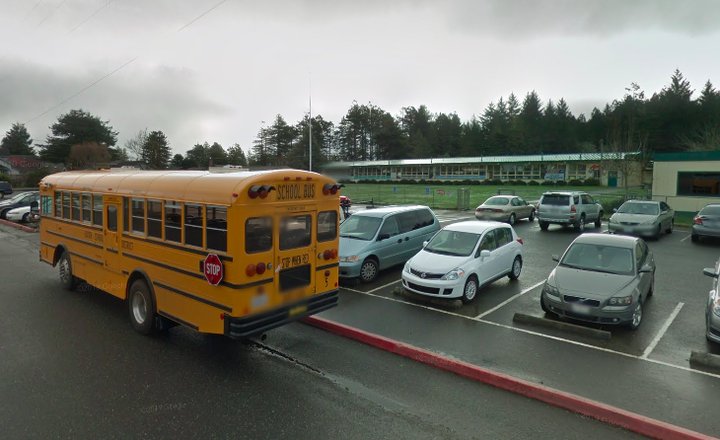
Ridgewood Elementary. | Google Street View
###
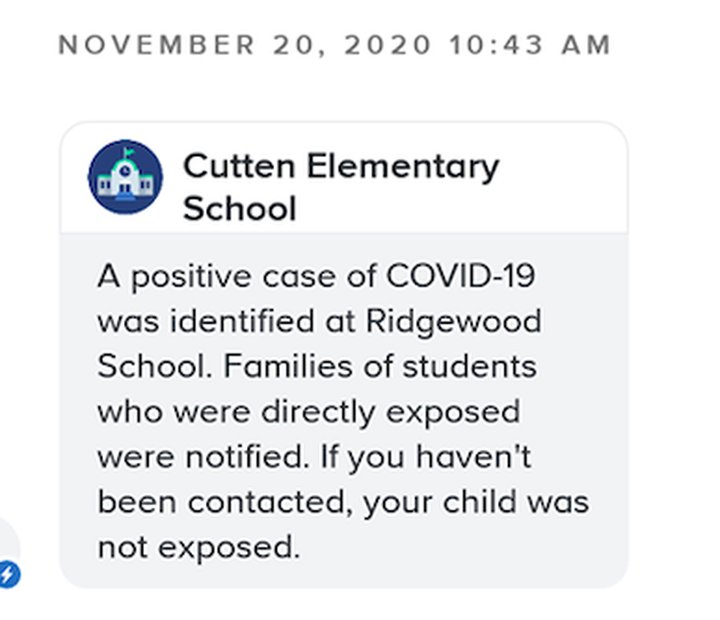
Two staff members and between nine and 14 students have been asked to quarantine after possible exposure to COVID-19 at Ridgewood Elementary, a kindergarten-through-second grade school just south of Eureka.
Parents and staff members were identified via text late Friday morning:
###
Sue Ivey, who serves as principal of Ridgewood School principal as well as superintendent of Cutten School District, told the Outpost via email that she couldn’t reveal the exact number of students who’ve been asked to quarantine because doing so might lead to a breach in confidentiality by allowing people to identify which cohort of students is affected.
“The students who are attending school on campus are in one of two cohorts,” Ivey said. One attends classes on campus in the mornings and the other in the afternoons. Students are on campus Monday through Thursday, and on Fridays the whole student body attends school via the distance-learning model, she added.
“There is a one-hour gap between cohorts, at which time the classrooms are thoroughly cleaned and disinfected,” Ivey said in her email.
Public schools throughout Eureka and Cutten have adopted a “hybrid” instructional model, mixing in-person and remote learning, as have a number of other schools scattered across the county.
Just a week ago, two students at Fortuna High School tested positive for the novel coronavirus, leading administrators to implement quarantine measures. Fortuna is one of more than a dozen public schools in the county that have fully returned to in-person instruction.
Countywide, 19 new cases were reported on Friday, bringing the total number of active cases to an all-time high of 94.
According to the Centers for Disease Control and Prevention, most children who contract COVID-19 have mild symptoms, if they have any at all. “However, some children can get severely ill from COVID-19,” the agency says on its website. “They might require hospitalization, intensive care, or a ventilator to help them breathe. In rare cases, they might die.”
They can also spread the virus to others who may be more susceptible to risk. To date, seven percent of the 730 COVID-19 cases confirmed in Humboldt County have been in children age 9 or younger.
###


