

High Speed Chase From Broadway to Tompkins Hill and Back Again at Four in the Morning Ends With Spike Strip, Foot Chase, Arrest, Sheriff’s Office Says
LoCO Staff / Thursday, Jan. 27, 2022 @ 9:16 a.m. / Crime
Press release from the Humboldt County Sheriff’s Office:
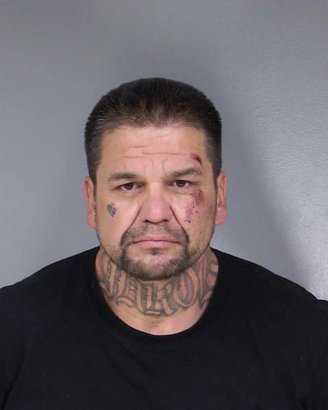
On Jan. 27, 2022, at about 3:42 a.m., a Humboldt County Sheriff’s deputy on patrol in the Eureka area attempted a traffic stop for a vehicle code violation near Broadway and Truesdale Streets. The vehicle failed to yield and fled from the deputy at a high rate of speed.
Deputies pursued the vehicle for approximately 13 miles to the Tompkins Hill area and back to Eureka. The Eureka Police Department (EPD) was requested to assist. In the area of Broadway and W Hawthorne Streets, EPD officers successfully deployed a spike strip, causing the vehicle to become disabled near W Wabash Avenue.
The driver of the vehicle, later identified as 47-year-old Michael Wayne Brissette, fled the vehicle. Following a short foot pursuit, law enforcement officers successfully took Brissette into custody.
Brissette was booked into the Humboldt County Correctional Facility on charges of evading a peace officer (VC 2800.2), resisting arrest (PC 148(a)(1)) and violation of probation (PC 1203.2(a)(2)).
The Humboldt County Sheriff’s Office would like to thank the Eureka Police Department for their assistance in the successful apprehension of Brissette.
Anyone with information about this case or related criminal activity is encouraged to call the Humboldt County Sheriff’s Office at (707) 445-7251 or the Sheriff’s Office Crime Tip line at (707) 268-2539.
BOOKED
Today: 12 felonies, 16 misdemeanors, 0 infractions
JUDGED
Humboldt County Superior Court Calendar: Friday, Sept. 4
CHP REPORTS
Sr299 / Sr3 (RD office): Trfc Collision-No Inj
ELSEWHERE
RHBB: CDPH Issues Immunization Recommendations for 2026-27 Respiratory Virus Season
RHBB: Redway Transfer Station to Close an Extra Day for Construction
RHBB: Dows Prairie Road to Close for Two Months for Culvert Repair
RODRIGUEZ TRIAL: Detective Describe How They Tracked Down Double Murder Suspect and a Witness
Rhonda Parker / Thursday, Jan. 27, 2022 @ 8:02 a.m. / Courts
Law enforcement tracked double-murder suspect Ulisses Rodriguez to his home in Chico after confidential prosecution witness “John Doe” provided them with Rodriguez’s cellphone number, an investigator testified on the third day of trial.
Martin Morris, an investigator for the District Attorney’s Office, said he and sheriff’s Detective Scott Hicks drove from Eureka to Chico after Hicks obtained a warrant “to target the physical location of a cellphone.” They also notified the Chico Police Department of Rodriguez’s location and asked for surveillance at the residence on Esplanade Drive.
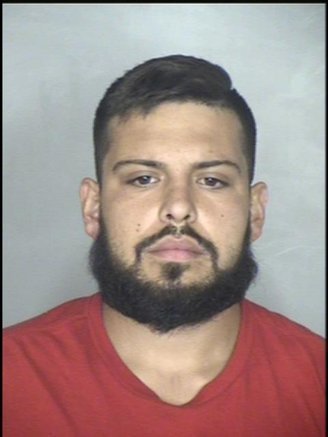
Rodriguez.
When Chico officers saw a dark blue Lexus SUV leave the residence, they pulled Rodriguez over at a nearby gas station and took him into custody. That occurred on Aug. 20, 2018, six days after Rodriguez allegedly shot a Southern Humboldt couple to death and burned their bodies.
Morris, under questioning by Deputy District Attorney Luke Bernthal, said he and Hicks searched the Lexus and also the home where Rodriguez, then 24, lived with his parents. In the Lexus they found .357-caliber ammunition, believed to be the type of ammunition used to kill Jeremy Kuemmel and Tiffany Ellebrecht.
In Rodriguez’s bedroom there was plenty of documentation he was selling marijuana and marijuana-related products. No guns were discovered in the residence.
Morris also testified about how he found an associate of Rodriguez’s who was on the grow site in Southern Humboldt when the couple was killed. The only information he had (from John Doe) was that the man had recently arrived from Hawaii and had an unusual appearance (a cleft palate). But with some impressive detective work Morris found David Kane in Las Vegas.
“I found him on the side of the street waiting for a ride,’ Morris said. At first Kane appeared willing to talk, but then he changed his mind. Morris did seize his cellphone, and the information on the phone was downloaded. The contents of the phone were not mentioned Wednesday, but Kane’s name is on the trial witness list in the courtroom.
Contrary to what this reporter wrongly stated in a previous article, Doe did discuss the man from Hawaii during Rodriguez’s preliminary hearing.
As for John Doe, and what he testified to at trial as opposed to what he initially told investigators: During trial Doe said Rodriguez told him he was going to “kill and burn” Kuemmel and Ellebrecht if they returned to the grow site after he kicked them off. Defense attorney Andrea Sullivan said trial was the first time Doe ever mentioned “kill and burn.”
Sheriff’s investigator Hicks, who also testified Wednesday, was the first officer to interview Doe after he went to law enforcement and turned Rodriguez in. This was just a few days after the killings.
“Ulisses told him that Jeremy had stolen from him and he had given him a chance to leave but if they came back he was going to kill them,” Hicks said.
Sullivan, cross-examining Hicks, asked if Doe ever said he was going to kill the couple and burn their bodies.
“I don’t recall that.”
As to whether Rodriguez held a gun to Doe’s head and ordered him to help with the bodies, Hicks said Doe just mentioned there was a gun.
What remained of the couple’s bodies was found in the back of Kuemmel’s Ford Expedition, which had been set on fire and destroyed. Family members were in the courtroom as jurors were shown nearly 200 photos of the incinerated SUV and its contents.
Rodriguez’s mother is also in court. His father, who is on the trial witness list, waits all day on a bench in the courthouse hallway.
Testimony was expected to continue this morning before Judge Gregory Elvine-Kreis.
###
PREVIOUSLY:
- Chico Man Arrested in Connection to Two Bodies Found Inside Burning Vehicle Near Ettersburg Junction
- Chico Man Pleads Not Guilty to SoHum Double Homicide
- Preliminary Hearing Set for Chico Man Charged With SoHum Double Murder
- Chico Man Held to Answer for Murder of SoHum Couple in Dispute Over Stolen Weed
- COURT ROUNDUP: Trial for Suspect in Gruesome SoHum Double Murder Set for Christmas Eve; Godoy-Standley Judged Mentally Competent; Fortuna Murderer Gets Two Years’ Credit
- HUMBOLDT COURT ROUNDUP: Updates on Two Murder Cases, Two Attempted Murder Cases
- COURT ROUNDUP: Mck Woman to Plead Guilty to Manslaughter; Hoopa Man’s Murder Trial Set to Begin; More Updates
- TODAY in COURT: Bear River Triple-Murderer’s Sentencing Delayed; Double-Murder Trial Over SoHum Couple’s 2018 Deaths Scheduled to Start Next Week
- TODAY in COURT: Two Local Murder Cases Moving Forward
- RODRIGUEZ TRIAL: First Testimony in SoHum Double Murder Trial Describes How the Burning Vehicle and Bodies Inside Were Found
- RODRIGUEZ TRIAL: Terrified Witness Describes Being Forced to Handle Bodies at Gunpoint
On the Street: Omicron Surge Strains California Police Agencies
Byrhonda Lyons / Thursday, Jan. 27, 2022 @ 7:48 a.m. / Sacramento
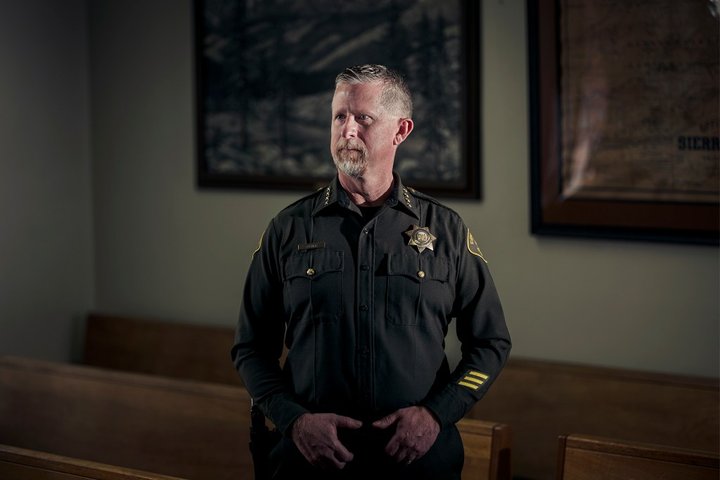
Sierra County Sheriff Mike Fisher at the Downieville Sheriff’s Department office. The department has experienced labor shortage due to the COVID-19 pandemic. Jan. 25, 2022. Andri Tambunan for CalMatters.
###
The call-ins were steady. Deputies were out sick. So were dispatchers. Even the sheriff was forced to stay home for five days.
In a month’s time, the small Sierra County Sheriff’s Office became a revolving door of isolating and returning staff.
When Sheriff-Coroner Mike Fisher was elected in 2018 in this county of 3,200, community policing and recruiting talented officers were high on his priority list. But on a recent Tuesday afternoon, he had to settle for a less ambitious role: driving a jail inmate to a doctor’s appointment, about 90 miles away in suburban Sacramento.
Up and down California, the contagious omicron variant of the coronavirus has shaken the state’s labor market. Hospitals are understaffed. Schools are low on teachers and substitutes. And law enforcement officers and first responders — who are increasingly exposed to risky, one-on-one contacts and super-spreader events — are having to make do with fewer people.
“Our people are tired.”
— Lt. Ray Kelly, Alameda County Sheriff’s Office
Since the surge began in December, law enforcement agencies have been forced to increase overtime, reduce services and reroute non-emergency calls to online portals, according to a CalMatters survey of more than 30 agencies statewide.
“Our people are tired,” said Lt. Ray Kelly, the Alameda County Sheriff’s Office spokesperson. “They are working extra hours; they’re working extra shifts…picking up the slack where they have to.”
Most of the agencies contacted by CalMatters are largely funded by local governments. While state lawmakers have agreed to extend paid sick leave for workers and support for small businesses, among other things, no statewide effort has been made to help city and county law enforcement agencies deal with the variant’s fallout.
State agencies also are feeling the strain.
The California Highway Patrol, the largest statewide police department, would not detail how many officers have been out to COVID but “we have not been immune,” said spokesperson Fran Clader. Even so, she said, the “COVID-related absences have not impacted the Department’s mission.”
Recently, news stories have reflected some of the unique COVID-related challenges and job reassignments the highway patrol has faced. After high-profile retail thefts in Northern and Southern California, Gov. Gavin Newsom enlisted the agency in November to increase patrols near retail areas over the holidays, as the omicron virus took off.
“California is substantially increasing CHP’s presence, especially near retail areas, and will be investing even more to aggressively curb retail crime,” Newsom said in a press release. “As a small business owner myself, I am resolved to holding these criminals accountable and protecting our local businesses.”
Earlier this month, as COVID cases rose, Newsom also activated the California National Guard to work with communities to add more testing sites. The governor has called on the Guard several times since the pandemic began to secure the Capitol from potential armed protesters and to distribute goods at food banks, among other things.
“I pulled duty shifts; dispatchers were working seven days in a row. It pretty much took out my overtime budget for the year.”
— Robert Gibson, Mount Shasta police chief
As state-level law enforcement agencies say they are experiencing outbreaks within their ranks, so are local law departments – often with fewer resources.
In Yuba County for instance, which has the state’s highest rate of COVID hospitalizations, the small sheriff’s department has recently called in part-time reserve officers as the virus spread through its ranks.
“Some are retired, others are not full-time law enforcement officers and can be different ‘levels’ of qualifications,” spokesperson Leslie Williams wrote in an email.
In Mount Shasta, after roughly half of its 13-person policing staff was out for COVID, the chief stepped in.
“I pulled duty shifts; dispatchers were working seven days in a row,” said police chief Robert Gibson. “It pretty much took out my overtime budget for the year.”
While smaller agencies struggled, one of the largest police forces in the country said it was able to maintain business as usual after nearly 900 Los Angeles Police Department officers were out last week. A department spokesperson said the agency has maintained its staffing for patrols.
Facing outbreaks and labor shortages, some agencies doubled down on longer shifts and the power of technology.
“I got to dust off some uniform stuff and head out into the real world.”
— Mike Fisher, Sierra County sheriff-coroner
Imperial County on the Mexican border has seen it all during this pandemic. The first wave of infections in 2020 hit its communities hard. Then, the county boasted one of the best-in-the-state for vaccinations by August 2021. Then came the omicron variant, which has significantly increased hospitalizations there.
By that time, the Imperial Police Department said it was somewhat prepared. The department already had started steering people with non-emergencies to its website to report crimes and neighborhood problems.
“Before the pandemic, we were responding to people’s houses for any call for service,” said Max Sheffield, Imperial Police spokesman. “It’s really changed policing for us.”
The Kern County Sheriff’s Office also was asking the public during this month’s omicron surge to use the agency’s online system to report crimes that were in progress, or other non-emergencies,” according to a report from KABK-KBFX.
While some duties can be shifted to an online portal, day-to-day policing cannot.
Last Tuesday morning, 400 miles north of Kern County, Sierra County Sheriff Mike Fisher pulled out a familiar wardrobe and hit the road.
Shuttling incarcerated people is not the typical fare for the duly elected sheriff and coroner. But with his transport deputy under quarantine after being exposed to COVID-19, Fisher did what everyone has had to do.
He adapted.
“I got to dust off some uniform stuff and head out into the real world,” he said.
For now, though, things are looking up. This week marked the first time the Sierra County Sheriff’s Office has had a full staff in more than two weeks.
“I’m knocking on wood because that’s subject to change tomorrow,” he said.
###
CALmatters.org is a nonprofit, nonpartisan media venture explaining California policies and politics.
The Battle Over Vaccine Rules for Kids Reignites in California
Joe Hong and Elizabeth Aguilera / Thursday, Jan. 27, 2022 @ 7:43 a.m. / Sacramento

Ariel Garcia, 5, receives a COVID-19 vaccination at the La Clinica de la Raza community vaccination site in Oakland on Jan. 4, 2022. Martin do Nascimento/CalMatters
California legislators are reigniting an ugly fight over child vaccination requirements with bills that would mandate COVID-19 vaccinations, eliminate the personal belief exemption for COVID-19 vaccines and allow some minors to get vaccinated without parental consent.
These bills together constitute one of the most aggressive campaigns in the country to vaccinate more children.
It’s possibly the most intense, emotional and potentially explosive issue the Legislature will take up this year. In previous years, lawmakers have been threatened and assaulted over their attempts to pass stricter vaccine rules. In 2019, a voting session for a vaccination bill was disrupted when an anti-vaccine protester threw what appeared to be a menstrual cup full of blood onto the Senate floor.
With an ever-changing pandemic, a new vaccine that isn’t completely preventing transmissions and parental reluctance, the stakes are even higher.
Democratic authors of the new bills and local school district leaders expect the rhetoric and violence to only escalate in this next stage of the fight over vaccine requirements. Their response will likely be more of the same: statewide information campaigns paired with small-scale community outreach.
Here’s how this year’s battle’s shaping up:
The lawmakers
State Sen. Richard Pan of Sacramento, a pediatrician and chair of the Senate Health Committee, is leading the offensive. If signed into law, his bill would require all children attending schools or enrolled in child care in person to be vaccinated for COVID-19 by Jan. 1, 2023. Most importantly, the bill would eliminate the personal belief exemption allowed by Gov. Gavin Newsom’s student vaccine mandate issued in October.
“There’s lots of evidence that vaccine mandates work,” said Pan, citing an increase in vaccination rates after his 2015 bill eliminated the personal belief exemption for the 10 other immunizations required for students.
The bill also goes a step further by no longer requiring personal belief exemptions for any future vaccine mandates coming from the governor or the California Department of Public Health. Under the current plan, parents can request exemptions by saying, for example, that they have religious or political objections to vaccines.
The intent, Pan and other supportive legislators said, is twofold. In the short-term, it would give public health experts the flexibility to respond to future COVID-19 surges and variants. In the long-term, it would give state experts more authority to make public health decisions without the loophole of personal belief exemptions.
If Pan’s legislation passes, parents who still wish to keep their children unvaccinated would be unable to have those children attend school or child care and would have to seek independent study if they wanted to keep their children enrolled in public school.
“I think what this bill does allows for a little more flexibility,” said Assemblymember Akilah Weber, who co-authored the bill. “Having to go through the Legislature for every vaccine is not necessarily ideal.”
So far, state public health officials have highly recommended but not required the vaccine for children. A handful of school districts like Los Angeles Unified and San Diego Unified tried to mandate it but faced challenges. Vaccines for children rolled out last year, first for teenagers and later for 5- to 11-year-olds on an emergency use authorization.
In California, as of Jan. 19, 35% of children 5 to 11 have received the first dose of the vaccine. Among those 12 to 17 the number is much higher, with 82% having had their first shot, according to the Centers for Disease Control and Prevention.
A related bill by Democratic Sen. Scott Wiener of San Francisco would allow those 12 years and older to get vaccinated without parental consent.
Pan says he’s open to thoughtful policy debates, but he also expects the same threats and vitriol he’s received in past years.
“When people are making outlandish claims, relying on personal attacks and death threats, that’s not good policy,” Pan said. “That speaks to the poverty of their proposals.”
The opposition
Some say the number of breakthrough cases among vaccinated people and the relatively low number of serious illnesses among children makes the vaccine mandate both ineffective and unnecessary.
“This should be something that families should be able to make their own personal decisions about,” said Sharon McKeeman, founder of Let Them Breathe, a COVID-era parent coalition opposing mask and vaccine mandates. It was a lead plaintiff in a successful lawsuit to overturn San Diego Unified School District’s COVID vaccine mandate — the district is appealing — and McKeeman said her organization would sue the state if Pan’s bill becomes law.
Children 0 to 17 account for 1.2 million COVID-19 infections in California, or 17% of all cases, since the pandemic began. Of those minors, 47 have died and 790 kids have been diagnosed with a rare complication known as multi-system inflammatory syndrome in children, or MIS-C.
Christina Hildebrand, head of the opposition group A Voice for Choice Advocacy that has fought to keep exemptions to vaccine mandates since 2015, said she’s been gearing up for this battle for months. “This is premature,” Hildebrand said about the proposed mandate. “We don’t know where COVID is going to go, it changes week by week.”
When people are making outlandish claims, relying on personal attacks and death threats, that’s not good policy.
— Sen. Richard Pan, Democrat, Sacramento
She would prefer to see the Newsom administration’s mandate stand because it’s flexible, allows parents to use personal belief exemptions and can be changed by the state Department of Public Health. If Pan’s bill advances, her organization will push for an amendment to allow a religious exemption for students, to mirror exemptions being given to school staff and other workers.
Nationally, three in 10 parents of 5- to 17-year-olds say they will “definitely not” get their child vaccinated for COVID-19, according to a Kaiser Family Foundation survey of parents published in early December.
Hesitant or opposed parents are most concerned about safety and potential side effects, the survey found. About a third of responding parents of 5- to 11-year-olds want to wait and see how the vaccine is working.
Some experts also question the effectiveness of such a mandate because the vaccine is so new and the infection still evolving.
A mandate could harden those who are vaccine hesitant against the vaccine because they feel forced, said Neeraj Sood, director of the COVID Initiative at the USC Schaeffer Center for Health Policy & Economics.
“Overall, the risk for kids is very low so it does not require the government to come in and mandate,” Sood said. “It’s not like a measles vaccine, where you take it and it offers lifetime protection.”
Pan’s legislation to close personal exemption loopholes for the measles vaccine in 2015 was driven by an outbreak at Disneyland. Roughly 1 in 1000 children infected with measles die, according to the CDC. Nobody died as a result of the Disneyland outbreak.
Outreach efforts
Despite the showdown looming at the state Capitol, vaccine proponents are pushing ahead elsewhere.
San Diego Unified, the state’s second-largest school district, is relying on one-on-one communication with parents to combat vaccine misinformation — while hoping its appeal reverses a local court and allows its mandate to proceed. The district has also partnered with community organizations like Alliance San Diego and the Chicano Federation in a door-knocking campaign.
“It’s going to require direct outreach,” said school board president Richard Barrera. “Our school staff is calling, texting and emailing parents every day.”
Already the district has gone from 70% of students vaccinated against COVID before its mandate to 82% of students vaccinated now, according to Barrera. It
Vaccines have been so politicized that our kids are nervous about them
— Dorit Reiss, professor, UC Hastings
Catherine Martin, the executive director of the California Immunization Coalition, said her organization is hosting webinars to train pediatricians and health care providers on the best strategies for reassuring parents about the vaccine. She said parents are more likely to listen to someone they trust, like a family doctor.
“We work mostly with physician groups to get the word out,” Martin said. “I think we need to encourage people to ask questions.”
The governor’s next move
It remains unclear how enthusiastic Gov. Gavin Newsom is about Pan’s bill. A spokesperson for the governor said his office is still analyzing it.
Barrett Snider, a lobbyist for school districts, said the risks for the governor are a question. While it is an election year, the fallout from a vaccine mandate without personal belief exemptions might anger just a vocal minority.
“I feel like these issues of schools and COVID-19 were largely litigated in the recall election,” Snider said. “And there’s no apparent contender for him in the upcoming election.”
Given the anxiousness many Californians feel, leaders should tread carefully, said Dorit Reiss, professor of law who focuses on legal and policy issues related to vaccines at UC Hastings College of the Law in San Francisco.
“Vaccines have been so politicized that our kids are nervous about them,” she said. “Moving forward with the mandate could exacerbate and push parents who are not anti-vaccine into the arms of the anti-vaccine crowd.”
The division could lead to more pressure on the Legislature, Reiss said.
“Everybody is nervous, stressed or tired and everyone is vulnerable,” she said. “And they are going online. It’s a moment of opportunity for people who want to scare other people.”
###
CALmatters.org is a nonprofit, nonpartisan media venture explaining California policies and politics.
OBITUARY: Nicole Marie Nada, 1970-2022
LoCO Staff / Thursday, Jan. 27, 2022 @ 6:56 a.m. / Obits
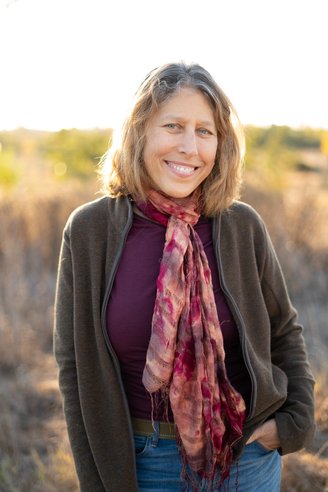
Nicole Marie Nada
September 4, 1970 - January 22, 2022
Nicole Marie Nada was loved by all. Generosity, kindness, humor and compassion were just a few of the characteristics that made her the kind of person that everyone loved to be around. She was a sage with advice, and an exceptionally great friend to many.
Always an adventurer, Nicole was blessed to explore Hawaii, the glaciers of Alaska in a kayak, Baja California, Belize, Mexico, Guatemala, the Galapagos Islands, Ecuador and Holland, as well as innumerable epic backpacking adventures, river rafting trips, grand bike and car trips throughout the US, including summer vacations with family in the East Coast. Equally, she cherished adventures to Humboldt’s Dry Lagoon, beach days at Moonstone and hikes to Strawberry Rock or Arcata Marsh. With stage IV cancer, 4 months before her death, Nicole rafted down the Colorado River in the Grand Canyon for 16 days and then took her children on an incredible fun-filled journey through California.
Over the years, Nicole climbed mountain peaks with her friends, the Mountain Mammas, read hundreds of books with her dedicated book club, was part of a women’s business circle and a knitting group. Nicole adored all animals, sharing her home and yard with rabbits, guinea pigs, cats, dogs, chickens and bees over the years. She was continuously attending to her spiritual growth, gleaning wisdom from many teachers of various traditions, always looking for inspiration to be the best person she could be. She cherished, above all else, being a mother to Taylor and Asher, who are testaments to the conscious and loving mother that she was.
Nicole was born in Los Angeles, and moved to Marin where she lived most of her childhood, roaming in the Marin hills, with a particular fondness for the Yolanda Trail in the Mount Tam watershed. As a young adult, Nicole was a river guide and cross country ski guide for Environmental Traveling Companions. She worked as an environmental educator at Point Bonita YMCA. Moving to Humboldt for college, she studied plant biology at College of the Redwoods and Humboldt State. In her early days in Humboldt County, she was a well known friendly face at the Arcata Co-op and Northtown Books, working later as a plant biologist for Simpson Lumber and then as a planner for Redwood Community Action Agency where, among other tasks, she created and implemented plans for the North Coast Stormwater Coalition. Nicole was co-founder and co-owner of the Arcata Scoop, and specifically loved designing the interior with unique and beautiful handcrafted furniture and art. She studied and received a nutritionist certificate from Bauman College and became passionate about assisting people to improve their health through her business, Shifting Gears Nutrition. Most recently, she worked for Salmonid Restoration Federation at their annual conference and Six Rivers Montessori. Nicole was recently inspired to get her certificate as a life coach in order to incorporate these skills into her business when she was diagnosed with a second bout of cancer.
Nicole shared her time and resources generously, getting involved with as many community events as possible and caring for community members every chance she got. One inspirational endeavor was her bike ride from Arcata to Marin for her first chemo treatment in 2011, where she raised money for cancer research and blogged about her experience, inspiring and educating many along the way. Her last great teaching before she passed was how to die; Many lives have been transformed through the experience of Nicole’s preparation for, and thoughts about her death, which she considered a rebirth.
Nicole will be remembered for so many of her gifts, including her humor and her great stories. Amazing things always happened to Nicole, and she had just the right way to have you in stitches when she told you about it. She is survived by her two beloved children, Taylor and Asher, their father Garret Nada, numerous family members and a wide community of friends. A small burial service was held at the Trinidad Cemetery and a grand celebration of her life will be planned and held in Humboldt County in the near future. Updates can be found by searching Nicole Nada at Caringbridge.com.
###
The obituary above was submitted on behalf of Nicole Nada’s loved ones. The Lost Coast Outpost runs obituaries of Humboldt County residents at no charge. See guidelines here.
OBITUARY: Caroline Mathews, 1940-2021
LoCO Staff / Thursday, Jan. 27, 2022 @ 6:56 a.m. / Obits
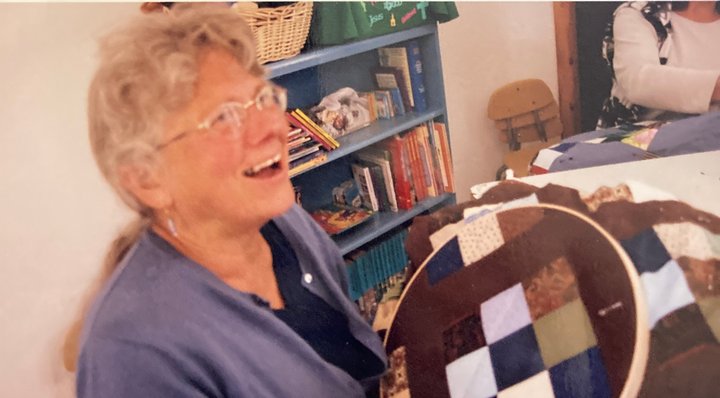
Caroline Mathews
November 1940 - December 2021
Our dear friend and community member Caroline Mathews passed away on December 22, 2021. She was 81 years old. She was born in Los Angeles in 1940. Throughout her childhood she lived in various locations including Yreka, California and Demming, Iowa. During High School, her family returned to California. Caroline received her Masters degree from Humboldt State University in 1976 while raising her two daughters. She taught business and history for over 30 years at Fortuna Union High School.
As a young adult, Caroline was an avid runner. She racked up the miles running on the Arcata bottoms. She enjoyed backpacking and hiking all over Northern California and beyond. Caroline loved the Trinity Alps. She often went backpacking with friends or her daughter. Her last trip was in 2019 with her daughter and her grandson.
Caroline spent her life dedicated to serving God and was an active member in the church of the Nazarene in Arcata. Caroline’s heart was as big as her smile, always was she willing to lend a hand to help those in need. She volunteered wherever there was a need in her community. One of her favorite volunteer jobs was making baby blankets and hats and donating them to Mad River Community Hospital for any mother in need.
Caroline was a member of the Wae Yu Nae Gong dojo in Arcata and earned her blackbelt in 2012. She was an active participant and volunteer in Relay for Life. She quilted and had many friends in her quilting group. In her 70s she began learning to play the piano. She spent her life learning the things that interested her.
Her life was filled with her garden, working on her home, enjoying her friends and her grandchildren. Caroline lived life to its fullest and gave so much of herself to others. She is survived by her two daughters Jodie and Lisa and their families which include her two grandchildren Sophie and Cian, her sister Jeanette and her nieces Pamela, Deborah, Melinda and Hawley. Thank you Caroline for the love you gave. May you feel the love from all of those who love you as well.
A celebration of life will take place at the Arcata church of the Nazarene on April 24th, 2022. Any inquiries can be sent to arcatanazarenepastor@gmail.com. Please donate to the Nazarene Church in Arcata in lieu of flowers.
###
The obituary above was submitted on behalf of Caroline Mathews’ loved ones. The Lost Coast Outpost runs obituaries of Humboldt County residents at no charge. See guidelines here.
CUDDLE FRENZY! Fourth-Grade Students Donate Hundreds in Change to Humboldt County Animal Shelter and Meet Sapphire, a Kind Pit Bull Rescue
Jacquelyn Opalach / Wednesday, Jan. 26, 2022 @ 3:36 p.m. / :)
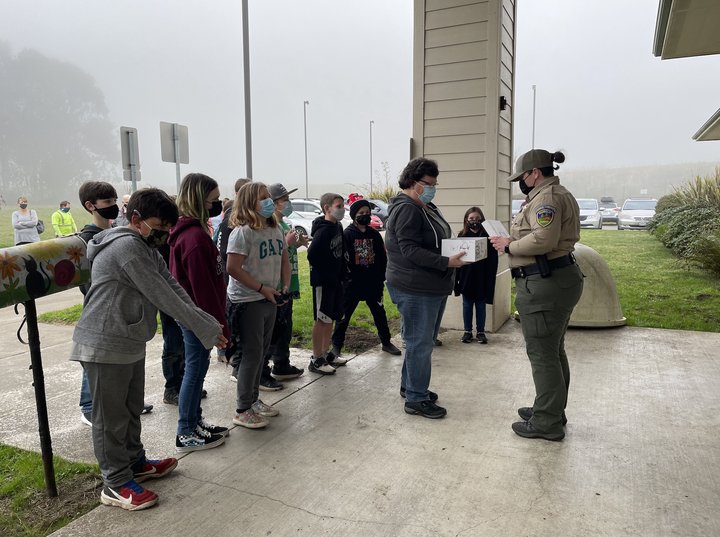
Heidi Conzelmann and her class hand off their donation to the Humboldt County Animal Shelter. | Jacquelyn Opalach
###
Fuzzy-warm energy overpowered the mild January chill on Tuesday afternoon in McKinleyville as a fourth-grade class from Morris Elementary School donated $425 in change to the Humboldt County Animal Shelter.
“We all kind of love animals, huh? Yeah, we’re kind of fond of animals,” said teacher Heidi Conzelmann, surrounded by her students, who nodded enthusiastically in agreement. “You guys are pretty impressive, doing all of this fundraising. We’re pretty darn proud of you kids,” Conzelmann told her students.

Students collected coins and bills for three weeks as participants of the Betty White Challenge, a fundraising effort to benefit animal shelters across the country in honor of the late actress and animal welfare advocate, who would have celebrated her 100th birthday this year. Some students emptied their piggy banks for the cause, a few told the Outpost, and others dipped into their wallets.
One went for a more unusual – but certainly reliable – collection route. “I just found change all over the floor in my dad’s room!” he said.
After raking in all that change, students rolled the coins and tucked the money safely in a decorated donation box, which weighed in at 23 pounds. One student proudly said the class found a penny from the 1930s, which was pretty neat, it sounds like.
After handing off the money, the fourth graders learned some facts about the shelter, which is a safe haven for all types of animals, including dogs and cats, but also snakes and fish, said animal control officer Taylor Pedersen.
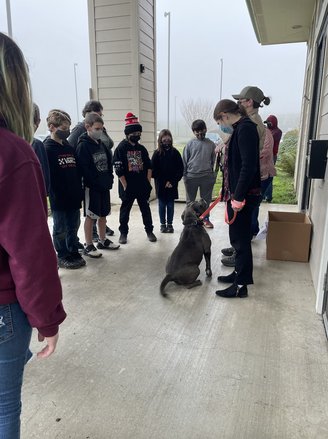
Sapphire, post cuddles
“We help all sorts of animals – no matter cold blooded, warm blooded, we help ‘em!” said Pedersen.
But the real fun began when Sapphire, a sweet pit bull, came out to meet the students, who quickly swarmed the dog in a cuddle frenzy that was so wonderfully chaotic the encounter was impossible to properly photograph.
The money will go toward the shelter’s emergency medical fund.
“We do a fundraiser every year, but continual donations like this are really great for making sure that all of the animals that come in that need a little bit more expensive care, get that expensive care,” Pedersen said. “Because of donations like this, we don’t really turn animals away for these kinds of things. So – broken hips, broken legs – we’ve done a lot of expensive surgeries with these kinds of donations and so it’s really really appreciated.”


