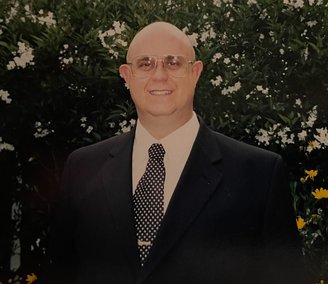
Marty Modine, age
56 of Eureka, passed away on January 6, 2022, after a heroic battle
with cancer. He was born in Garberville and spent most of his life in
Humboldt County. He graduated from Eureka High School in 1983 and
then joined the Marine Corps as an engineer that built bridges. After
leaving the Marines, he worked for Brinks in the San Jose area. He
moved back to Humboldt County and worked for Bank of America, Blue
Lake Casino and other local companies in security.
He loved fishing
and was an avid collector of Star Wars, Kiss and Viking memorabilia.
He was involved in the 501st Star Wars Legion and enjoyed
participating in their activities and charity functions.
He loved his cats
and his last cat, Freya, had been with him for nine years.
He is preceded in
death by his mother Jody and is survived by his father LeRoy,
stepmother Ina and many family members and friends. He will be
greatly missed by all.
As a proud Marine
Corps Veteran, he will be buried in the Northern California Veterans
Cemetery in Igo, California. There will be a private celebration of
life at another time when it is safer for family and friends to
gather.
“God saw him
getting tired and a cure was not to be, so He put His arms around him
and whispered, ‘Come to me.’ With tearful eyes we watched him
suffer and saw him slowly fade away. Although we loved him dearly, we
could not make him stay. A golden heart stopped beating, hardworking
hands put to rest, God broke our hearts to prove to us He only takes
the best.”
— by Frances and Kathleen Coelho
We know we will
see him in his mansion in Heaven when we join him.
###
The obituary above was submitted on behalf of Marty Modine’s loved ones. The Lost Coast Outpost runs obituaries of Humboldt County residents at no charge. See guidelines here.
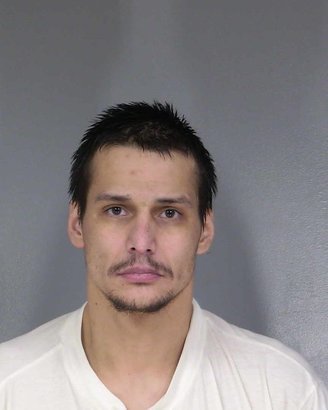
A prison parolee who was shot as he allegedly tried to run down police officers pleaded not guilty today to two counts of attempted murder and one count of assault with a deadly weapon.
Little Eagle Moon, 29, of Hoopa appeared in Judge Christopher Wilson’s courtroom with his left forearm and right hand bandaged. He was struck twice on the afternoon of Dec. 30 when Eureka Police Detective Joseph Couch fired six rifle shots at his vehicle.
According to EPD, Moon was first ramming police vehicles with his car, then driving toward officers. The criminal complaint names the victims as Deputy S. Stallworth and Agent M. Tomlin.
Officers were there to arrest Moon, who has a long criminal history, on a slew of outstanding warrants.
Wilson appointed the Conflict Counsel’s Office to represent Moon, and Deputy Conflict Counsel Meagan O’Connell entered not guilty pleas on his behalf.
“Is that your plea, not guilty?” the judge asked. “Yes, Sir.”
After speaking privately with O’Connell, Moon agreed to enter a general time waiver, meaning he gave up his right to a preliminary hearing within 10 days and a parole hearing within 15 days.
The state has filed a petition to revoke his parole. Moon’s next court date will be Feb. 24, when a date for the preliminary hearing may be set.
Police said after Moon was shot he drove away from the scene at Third and T streets in Eureka, causing a traffic collision at Fifth and V streets. He reportedly then fled on foot but was found hiding in some brush.
Moon was hospitalized for his wounds for several days before being booked into Humboldt County Correctional Facility. Two passengers in Moon’s car were not injured.
Moon is on a parole hold with no bail. Wilson set bail in the attempted murder case at $1.5 million, and bail for his other cases ranged from $50,000 to $110,000.
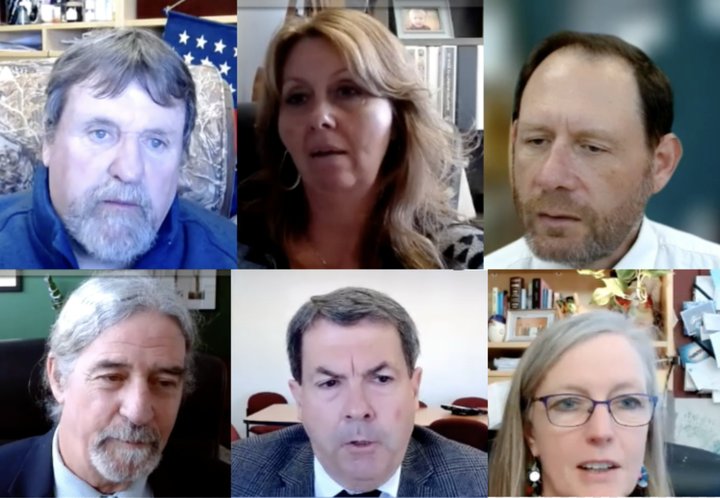
Screenshots from Tuesday’s Board of Supervisors meeting (clockwise from top left): Humboldt County Supervisor Rex Bohn, Supervisor Michelle Bushnell, Supervisor Mike Wilson, Supervisor Virginia Bass, Planning and Building Director John Ford and Supervisor Steve Madrone.
###
More than half a decade after California voters legalized recreational cannabis, the seven members of the Humboldt County Planning Commission felt like maybe it was time to tinker with the rules of the experiment.
“That’s what this is,” Planning Commission Chair Alan Bongio said in a phone interview Thursday — an experiment in taxing and regulating the plant that made Humboldt County famous and filled its hills with clandestine crops. “We were the first county to come up with an ordinance.”
That would be the Commercial Medical Marijuana Land Use Ordinance (CMMLUO), passed in September 2016, shortly before the statewide legalization vote. It’s now commonly referred to as “Ordinance 1.0,” and county staff estimates that there are somewhere around 1,500 or 1,600 applicants countywide who’ve been approved under these rules or, in many cases, are still trying to obtain their permits.
After many public hearings, a lawsuit and much deliberation, the Humboldt County Board of Supervisors passed a new set of rules — the Commercial Cannabis Land Use Ordinance, aka Ordinance 2.0 — in May of 2018. But for the hundreds of people who were already in the application process, Ordinance 1.0 continues to serve as the rulebook.
That fact has become increasingly controversial — at least from the perspective of the Planning Commission, which acted on close to 150 cannabis permits last year. With the state in a serious drought, many local residents have questioned the commission’s frequent permitting of new wells, worried about the cumulative impact on local creeks and rivers.
People have also voiced concerns about the use of generators — their greenhouse gas emissions, the noise, the potential for spills and the added traffic of fuel deliveries. Others complain about the impact to local roads and a county policy that allows applicants to self-attest as to whether the road to their project site meets the county’s Category 4 standards.
“I just felt that we were getting a lot of pushback, meeting after meeting after meeting,” Bongio said. “And we were having the same conversation meeting after meeting after meeting.”
And so last month, Bongio submitted a letter to the Board of Supervisors on behalf of the Planning Commission, asking for guidance in addressing those three main areas of concern — generators, water and roads.
On Tuesday, the board discussed the letter, and while the conversation lasted more than three hours, it was apparent from early on that the board was divided.
Third District Supervisor Mike Wilson expressed a willingness to consider some new guidelines that might address the issues at hand. Fifth District Supervisor Steve Madrone advocated personal responsibility and growing cannabis outdoors, rather than under generator-powered lighting. Like Wilson, he said he was open to adjusting the rules, if only to cut down on the number of projects getting appealed to the Board of Supervisors after a ruling from the Planning Commission.
But the rest of the board argued that it would be unfair — especially in light of the dramatic recent declines in the industry — to “move the goalposts” or change the rules “midstream.”
Second District Supervisor Michelle Bushnell was the most adamant in her opposition giving the Planning Commission new guidelines.
“To change that process for somebody who’s been following the rules that were set forth by this county, it’s hard,” she said during the meeting. “And these are people’s lives. They’ve been struggling for four years, five years now to come into compliance under [Ordinance] 1.0.”
Generators
Following the advice of Planning and Building Director John Ford, the board tackled the three issues one at a time, starting with generators. Wilson said he’s long been opposed to generators except for emergencies. Using them consistently shows that whatever system you’re operating, it’s not sustainable in terms of the environment and safety, he argued.
“I would be — and I may be in the minority — in favor of new ordinance language about transitioning away from that,” Wilson said. “It’s just not a good direction for us as a county.”
Bushnell noted that Ordinance 2.0 placed restrictions on generator use (whereas the version 1.0 only set limits on the noise they produce), so the issue has been addressed. And she complained that many of the appeals the board has heard were over conditions that the Planning Commission added to the project — conditions that go beyond the rules laid down in the ordinances.
“Right now, with not much money in that industry, to change the goalposts … I don’t think it is fair to them,” she said, “unless we’re going to pay for them to upgrade.”
Virginia Bass, the board chair and Fourth District supervisor, agreed, saying that changing the rules midstream causes her heartburn.
Madrone said that the Planning Commission has been adding conditions as a response to community feedback, though he acknowledged that appeals on such projects have started to become routine. But he pushed back on Bushnell’s call to leave the rules alone.
“The fact is that things change,” he said. “We learn and we have to adapt.” Madrone said he would “absolutely support” a policy that regulates generator use for any project that’s not already permitted.
Rex Bohn, the First District supervisor, sided with Bushnell.
“I can’t be in favor of changing rules that are already in place,” he said.
Roads
Without reaching a consensus, the board moved on to the topic of road conditions. Bob Bronkall, deputy director at the Department of Public Works, explained that staff came up the idea of self-attestation for road conditions in response to complaints from applicants that projects and improvements were too costly. The county decided to let applicants measure the width of their access roads, “and if it’s meeting the criteria of a category 4 road, they’re good to go,” Bronkall said.
Madrone said he’s seen a lot of problems with that system. “I don’t think the self-attestation process is working,” he said, and then he made another plug for sun-grown weed, saying an outdoor crop requires fewer vehicle trips.
Bushnell asked Ford to confirm that virtually every applicant has been required to make some kind of road improvements. (He did.) And she compared the road regulations under the county’s cannabis policies to the more lenient requirements of timber harvest plans.
Wilson said this issue wasn’t as big of a deal to him as the other two. Madrone, meanwhile, said roads have been a big part of his career and he believes many of the access roads for cannabis projects lack sufficient engineering. Sediment from road runoff is killing salmon in our streams, he said.
Water
Ford noted that well usage has become “extremely controversial” at Planning Commission hearings.
“It was initially thought that wells were a great source of water rather than forbearance or diversions,” he said. “A lot of people did invest in wells. But with the drought, certain members of the public began to express concerns. … So the Planning Commission began to question whether it is appropriate to add storage and require forbearance” as conditions to project approval, even with a well as the water source.
In response to these concerns, staff has already begun developing criteria — both short-term and long-term — for a well-approval process that takes greater measures to protect the groundwater.
“If we’re finding that it’s declining, forbearance or storage may be required … ,” Ford said. “But we are not there yet.”
Wilson observed that this endeavor — already underway — appears to be an adaptation, a change to the rules set forth in Ordinance 1.0, his implication being that his colleagues’ objections to “moving the goalposts” are already moot. He again argued that making such changes in light of new information or shifted priorities is entirely appropriate.
“We are finding that our landscapes are remote and hard to manage with regard to these resources that are becoming more scarce and more impactful,” he said. The county permitting process, whether it’s before the Planning Commission or the Board of Supervisors, “is where we make a determination as to whether or not there’s significance to the health and wellbeing of our community and the environment on an individual project basis — because we have discretion to do so,” Wilson said.
Public comment
Nearly everyone who spoke during the public comment period was either a cultivator or a consultant, and they were almost universally opposed to the prospect of new rules or guidelines.
Thomas Mulder, a planning commissioner who insisted he doesn’t have a conflict of interest because he doesn’t take his allotted stipend, said that thousands of hours went into creating ordinances 1.0 and 2.0, and they should be left alone. He called efforts to tweak the rules an “emotional attack at a dwindling population of legacy cultivators,” suggesting, “maybe the plan is to make them go extinct.”
Natalynne DeLapp, executive director of the cannabis industry group Humboldt County Growers Alliance (HCGA), spoke on behalf of the organization’s 275 licensed and permitted members. She said that at Planning Commission hearings, the rules governing roads, generators and water are applied inconsistently. Costly and often hard-to-book services are getting tacked on as conditions of approval at Planning Commission hearings. She said she was encouraged by the board majority’s talk of not moving the goalposts.
Selena Rowan, owner of Midnight Gardens in Benbow, said she lives and works on her small outdoor farm and is afraid of making any alterations lest the rules be changed under her feet.
The lone voice on the other side of the argument came from longtime SoHum resident Bonnie Blackberry, who said she’s one of the people who’s been regularly voicing concerns at Planning Commission hearings, and she knows plenty of others who feel the same way but are intimidated by the prospect of speaking publicly.
As for moving the goalposts, Blackberry said, “Well, climate change and this drought [are] moving the goalposts.” It would be irresponsible not keep doing business as usual, she argued, adding, “Do you really want [Humboldt County] to be the generator-grown brand?”
When the matter came back to the board, Bohn said that with just 472 acres of permitted marijuana being grown countywide it’s silly to blame the industry for all the world’s environmental woes. He also argued that further restrictions could dissuade people from becoming compliant.
“If you guys want to restrict the hell out of ‘em, think about what we’re doing,” he said. “We’re gonna drive ‘em back underground in a heartbeat.”
Wilson acknowledged that the testimony the board heard from industry insiders was “sobering,” though he said the cumulative impacts of the industry are serious, too.
“We’re all trying to move to a better place in terms of how we manage not just cannabis but everything we do,” he said, and he went on to advocate for establishing some thresholds that might apply to all land use decisions, though by this point in the discussion Wilson clearly knew he was in the minority.
Ultimately, the board agreed to have staff draft a letter back to the Planning Commission that will instruct that body to list specific findings whenever it adds conditions of approval to a project. That way, the Board of Supervisors knows the commission’s reasons for requiring something that might be beyond the scope of Ordinance 1.0 or 2.0.
The letter will come back to the board at a future meeting — likely on the consent calendar — for approval.
Bongio said that letter won’t tell the commission anything it doesn’t already know. “They said that if we can give the justification we can make additional requirements. We’ve always known that, and we’ve done that if something doesn’t seem right,” he said.
And so the commission’s request for more guidance probably won’t amount to much. “I don’t think much is going to change,” Bongio said, “but at least they had the opportunity to have the discussion.”
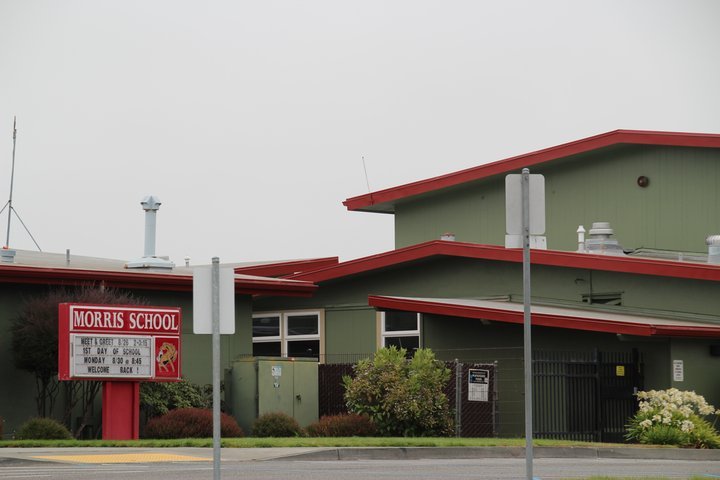
Morris Elementary School in McKinleyville is closed this week due to staffing shortages. | Outpost file photo
###
On trend with climbing case numbers, Humboldt’s schools are facing the biggest boom in COVID-positive staff and students since the onset of the pandemic.
After closing and reopening one of its schools last week due to staffing shortages, McKinleyville Union School District closed McKinleyville Middle School for three days this week and Morris Elementary for the entire week. The Klamath-Trinity Joint Unified School District board voted to close the district’s seven schools from Jan. 12 through Jan. 18, citing “the number of CoVid cases in our communities.” On Tuesday, Loleta Elementary School announced on Facebook that grades 7 and 8 will be distance learning until next week. Other classrooms might be closed too, but not all schools publicly announce their closures.
The situation is weighing heavily on some parents. One mom told the Outpost that if she and her son get COVID, isolating will be extremely financially straining. “If I get sick my work won’t pay for Covid pay. Many people are in that boat,” she said. Her son goes to Morris Elementary. She’s worried about sending him back once the school opens up again, but doesn’t see any alternatives because there is no help for parents in this situation.
Meanwhile, schools able to remain open are navigating higher case counts than ever. The Northern Humboldt Union High School District – a rare district that releases student and staff case counts – recorded more than half (70) the district’s total positive cases (126) last week. There will be more positives to record at the end of this week, and, on top of those, some families are keeping students home to avoid getting sick. Attendance is way down.
“It’s just all COVID all day – from early in the morning, through the day, into the evening,” said NoHum Superintendent Roger Macdonald. Administrators are busy communicating changes and developments to staff, who are busy picking up extra COVID-related duties, like contact tracing, calling families and logging cases into databases for the county.
“The impact on our schools is that we’re thin everywhere – we’re not able to fully take care of everyone like we want to.” NoHum is facing its own staffing shortages, but Macdonald doesn’t think closing a school will be necessary. The district hires substitutes every day, and even if last-minute help isn’t needed in a classroom, there’s always COVID-related work elsewhere, Macdonald said.
“We’ve been fortunate so far that we have not gotten to a place where we need to consider closing.” Macdonald guessed that the surge is hitting high schools the hardest because teens are more social than younger kids.
Following the winter break, HCOE and Humboldt’s school districts anticipated there might be an uptick in cases. According to a press release, HCOE was able to provide enough rapid tests for every K-12 student in Humboldt, and districts began distributing the tests at the end of December. But HCOE doesn’t have the results from all those tests; parents were instructed to report positives to Public Health and their child’s school.
And so it is hard to say just how many students and staff are out sick. That said, a parent-run Facebook group aiming to track in-school COVID cases is exploding with posts describing half-empty classrooms and student case counts in the hundreds. Some parents post to the group when notified of a positive case by their child’s school, and others post their own observations or information provided by their kids. The thousand-member group was created at the beginning of this school year by parents concerned that student case numbers are not made public, even though the data exists. (It should be noted that there is no way to verify many of the posts.)
“I dropped my son off at AHS this morning at around 8:20. Usually there is a long line of cars – parents waiting to get to the curb and teens finding a spot, but this morning hardly any cars in the parking lot or the line. It was noticeable,” one parent wrote last week.
“Washington elementary. My kid told me 12 were absent in his class on Friday. His best friend said 5 in his class. Both tested positive this weekend. They were testing kids all day long and my K-aged child told me they pulled kids from class during the school day, as I assume they were testing kids all day. It’s all over the place there. They are doing a good job of calling and such. I don’t know what else they could do?” another said this week.
Some parents believe all schools should close and wait out the surge, but moving back to distance learning isn’t an option under California law.
“Philosophically, we don’t want to [close] because we all know at school that our students need to be at school,” Macdonald said. “We believe that it’s probably safer to be at school – masked, distanced, amongst a population that’s tested regularly – that’s probably safer than just being out in the community anyway.”
And so – with a successful few months of very little in-school transmission in the rearview – school districts, the county office of education and public health are prioritizing keeping schools open. Those that are shifting to independent study during the surge are doing it due to staffing shortages, not to prevent in-school transmission.
“Staffing shortages are a very real and concerning reality. In school districts across the state, it’s a case of ‘all hands on deck’ with administrators and itinerant teachers being pulled-in to teach classes when substitute teachers are not available,” said Superintendent of Schools Michael Davies-Hughes in last week’s press release. “I continue to be very proud of our educational community in doing ‘whatever it takes’ to ensure that students can safely attend school for in-person instruction.”
To help with the staffing shortages, HCOE is hosting an informational meeting for people interested in becoming substitute teachers on Friday via Zoom.
In the midst of the surge, HCOE, in partnership with Humboldt County Public Health, updated its COVID response guidelines for schools last week. The biggest change is that quarantine – in the case of a positive – has been reduced from ten days to five, in most circumstances. This change mirrors updated isolation guidelines from the Centers for Disease Control and Prevention.
Many schools are offering on-campus testing to students and staff. Johnny Kell, a nurse at NoHum, said that scratchy throat, mild headaches and mild nasal symptoms are the most common COVID-related symptoms he’s seen recently. NoHum is offering on-site rapid and PCR tests, and is providing and encouraging higher-performing masks, like 3-ply surgical masks or KN95 respirators, as opposed to cloth masks.
“I am proud of how many students are testing for peace of mind and how many students and parents are communicating well about feeling ill and staying home,” Kell said. “We are doing all that we can to keep students and staff safe and I appreciate the collaboration and everyone doing their part.”
Ishan Vernallis, a local parent who created the Facebook group tracking in-school COVID cases, said that, to this point, he feels COVID prevention measures in schools have worked well.
“That was actually really reassuring – just to see that the masking and the social distancing and everything that the schools were doing for Delta worked really well,” Vernallis said. But he wonders if mitigating in-school transmission is as possible with the omicron variant, which is far more contagious. “It seems to me that it’s spreading in the schools at this point – mostly because of how many staff are going out,” he said. “But I can’t say that for sure.”
At Vernallis’ kids’ school, there have only been a few exposures. “The Facebook page is at least allowing me to see what’s going on in the surrounding areas and make informed decisions,” he said. “If we start seeing the cases rising in the school, we’re gonna pull our kids out.”
When Vernallis started the Facebook group, he and many other parents were concerned about sending their kids to school because children under 12 weren’t yet vaccine-eligible (now children older than 5 can be vaccinated). This surge is different.
“People are definitely expressing a lot of concern and worry, but I don’t feel it’s the same – where people are afraid their kids are going to end up in the hospital – it’s not that drastic. It doesn’t seem like it’s as much of a life-and-death situation as it felt during delta.” Vernallis added that although omicron looks to be less severe than delta, his awareness and concern that the long term effects of COVID are still being discovered continues.
School leaders are asking the community to help our strained schools by being patient and responsible.
“[We] ask our community to be patient with us. We’re doing the very best we can to communicate with them. We’re doing our very best that we can to provide a safe place for our students to learn. And we appreciate our community’s support,” Macdonald said.
“Particularly we appreciate our community that’s doing their part too – masking and making healthy choices, safe choices.”
California’s hospital system is in danger of collapse as skyrocketing COVID-19 cases, severely ill patients and sick staff push hospitals past their capabilities, the California Hospital Association warned today.
Hospitals are expecting COVID-19-positive patients to triple by the end of the month, with admissions peaking in the next four to six weeks. The surge in infections and hospitalizations is expected to last until the end of February.
“We find ourselves on the precipice of the most challenging time to date for California’s healthcare system,” Coyle said. “Our capabilities may soon be eclipsed.”
The state health department’s projections indicate the surge in California will peak at 40% more COVID-19 hospitalizations than last winter, bringing the daily total number of hospitalized patients to well over 70,000 by the end of January, association CEO Carmela Coyle said. Last year, 54,000 people were hospitalized in California during the peak, about 40% of which had COVID.
State projections also indicate 7,000 patients will require ICU hospitalization, nearly twice as many as last year.
While major cities like New York, Boston and Chicago are beginning to see infection numbers stabilize, California’s infection and hospitalization numbers are still climbing.
The strain on the system is compounded by staffing shortages. National estimates indicate 20% of the health workforce have left during the pandemic, and omicron has resulted in hundreds of workers calling out sick.
One hospital in the state told the association that more than half of its staff was out sick due to COVID-19 illness or exposure.
“We have far more people that are in need of care and fewer people to provide that care,” Coyle said.
This week, the California Department of Public Health quietly put out guidance allowing asymptomatic COVID-positive staff to return to work without isolation or additional testing. The guidance, although voluntary, sparked outrage among labor groups like the California Nurses Association.
Some hospitals have already begun canceling elective procedures to alleviate the strain, and the state health department is considering an order to hospitals that would postpone many procedures, according to one top-ranking state official who spoke to county health officers at a public meeting last week.
More than a third of hospitals in California have reported “critical staffing shortages” this week, a number that continues to grow.
###
CALmatters.org is a nonprofit, nonpartisan media venture explaining California policies and politics.
Press release from the Humboldt County Public Health Division:
Updated quarantine and isolation guidance for individuals testing positive for COVID-19, regardless of vaccination status, is now available. The new Centers for Disease Control and Prevention (CDC) guidance allows for shortened isolation.
Individuals who test positive for COVID-19 should contact their primary care provider. If severely ill with COVID-19, isolate for at least 10 days.
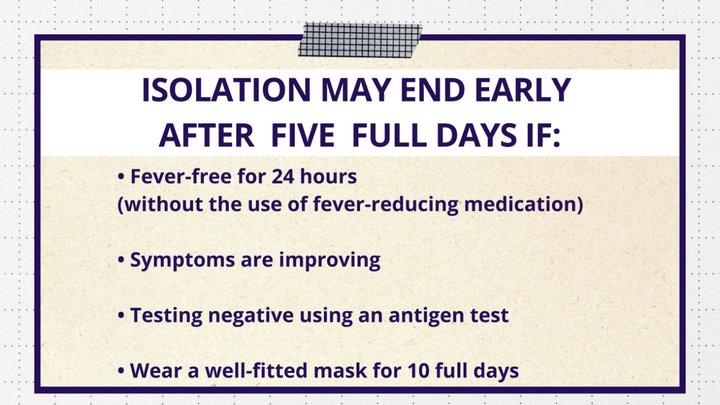
If experiencing mild or no symptoms, it is recommended to stay home for at least five days and isolate from others. Isolation may end early after five full days if an individual:
Is fever-free for 24 hours (without the use of fever-reducing medication)
Has symptoms that are improving
Tests negative using an antigen test.
If ending isolation early, the CDC recommends taking the following extra precautions until day 10:
Wear a well-fitting mask for 10 full days when around others at home or in public. Do not visit places if unable to wear a mask
Avoiding travel
Avoiding being around people who are high risk.
To isolate at home, one should:
Seek medical care immediately if experiencing the following symptoms –trouble breathing, chest pain or pressure, confusion or inability to stay awake
Inform contacts and primary care provider of positive test results
Stay in a separate room from other household members
Use a separate bathroom, if possible – sanitize and ventilate bathroom between uses
Improve ventilation at home – use forced-air heating and fans, open windows and use air cleaners
Avoid contact with other household members and pets
Don’t share personal household items, like cups, towels and utensils
Wear a well-fitting mask when around other people.
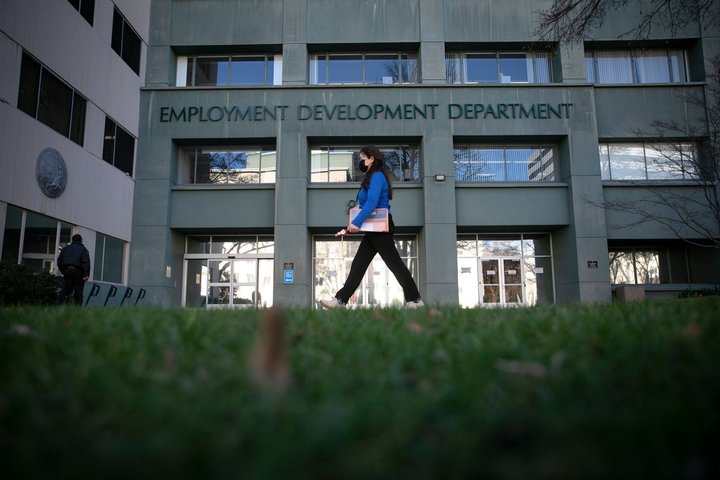
The offices of the Employment Development Department in Sacramento on Jan. 10, 2022. Photo by Miguel Gutierrez Jr., CalMatters
A musician who lost all her unemployment documents when her home burned in a wildfire. An arborist who filed for unemployment assistance a year before the pandemic began. A tattoo artist who can’t prove he was working because he ran a cash operation.
These are just a few Californians caught in a state dragnet to recover money from fraudulent unemployment claims.
Late last year, California’s Employment Development Department launched a clawback program, requiring some 1.4 million people who received federal pandemic unemployment assistance to retroactively prove they were working or seeking work. That program, which ended in September, was aimed at helping people who don’t usually qualify for unemployment benefits because they are freelancers or small-business owners.
As of Jan. 4, one out of five recipients who received the notice have responded. The state says a majority have been deemed eligible and won’t have to repay, but some are unable to providedocumentation, leaving them on the hook to repay benefits that could add up to tens of thousands of dollars. If they can’t pay, the state could collect the money in a variety of ways, such as wage garnishments or taking them to court.
“They are going to want money back from me that I don’t have,” said Donna Casey, a musician who could owe EDD more than $30,000 after losing her home in the August Complex fire in 2020. “What are they going to do to me, put me in jail? At least I’ll have a place to live.”
Policy experts had warned against the clawback program, noting it would hurt poor Californians who were already disproportionately sidelined from the job market by the pandemic. Even former federal prosecutor McGregor Scott, hired by the state to lead a separate investigation into large-scale unemployment fraud, expressed skepticism that the effort would recoup much of some $20 billion lost to fraudulent claims, including millions of dollars of state-approved payments to prison inmates. Advocates suggested letting claimants like Casey keep the money regardless of proof, but the state is holding firm.
That’s left many Californians in a bind.
Some who were contacted by EDD said they are terrified of losing their homes. Many are furious that the responsibility fell on them after they already received the money. And others simply don’t know where to turn for help.
Casey had lost gigs and stopped selling homemade jewelry at festivals when the lockdown began. Then she lost all her documentation when her house in Trinity County burned in a wildfire, just after her daughter died of a lung infection.
Unemployment was a lifesaver as Casey searched for work throughout the pandemic, includingapplying to an Amazon warehouse. But, at 67 years old, she couldn’t lift enough to qualify for the job.
Casey, however, never thought she might have to pay back her benefits.
The state’s unemployment agency has noted that the repayment policy is a federal requirement, passed by Congress in the Continued Assistance for Unemployment Workers Act in 2020. The agency pledged to offer waivers if overpayment of benefits was not the recipient’s fault and repayment would cause extraordinary hardship, defined as any single-person household making under $1,351 a month or just over $16,000 a year.
None of the people CalMatters spoke with, however, were aware of such an option or how to apply for a waiver. They said it wasn’t in any of the agency’s communications to them.
Now living in Berkeley with one of her daughters, Casey has some photos of her old business cards that she’ll send to the agency. She also hopes EDD will speak with the music groups she played with – but she worries that won’t cut it.
“They are going to want money back from me that I don’t have. What are they going to do to me, put me in jail? At least I’ll have a place to live.” — Donna Casey, musician who lost her home in the August Complex fire in 2020
Similarly, at the start of the pandemic, Sasha Emery was livingin an RV partly paid for by federal emergency funds after her Paradise home burned down. After finally getting into affordable housing during the pandemic, she signed up for unemployment when the few available jobs didn’t pan out.
When the notice arrived asking for proof or repayment, shock turned into tears. All Emery has to offer are records of her dire situation: food stamps, Medi-Cal documentation and potentially the federal assistance she received after the fire.
If a recipient can’t offer the necessary proof, and cannot repay the funds at once or in installments that could include 3% interest, EDD may seek the money in a number of ways. The agency could put a lien on property, take up to 25% of a recipient’s wages, withhold state and federal tax refunds or lottery winnings, deduct benefits from future unemployment or state disability insurance benefits, or file a lawsuit.
Prasad Krishnamurthy, a debt collection expert and professor of law at UC Berkeley, said the state isn’t bound by the same rules that constrain private collection agencies in pursuing debtors. That makes the government, said Krishnamurthy, “a very powerful and aggressive creditor.”
“It just kinda feels like I was set up.” — Sam, arborist who filed for unemployment
The debt could push Californians further into poverty, Krishnamurthy said.
Sam, an arborist who asked not to use his full name for fear of retaliation from the state, filed for unemployment at the end of 2018 after losing his San Francisco business. He receivedbenefits for the next seven months. Then in August 2020, the EDD contacted him, telling him that he qualified for a federal extension. “It has been automatically filed for you,” the agency wrote.
At the time, Sam was grateful for the support, which allowed him to care for hismother, who suffered a heart attack at the beginning of the pandemic and has cancer.
In fact, he said, the agency held a virtual hearing to approve his eligibility. After that, he received $4,000 installment payments for benefits going as far back as January 2020. Now, with two ailing parents and no documentation to prove that he lost pay due to the pandemic, Sam may owe close to $30,000 in accrued benefits.
“It just kinda feels like I was set up,” he said.
For others who ran small cashbusinesses, there was never a paper trail.
After Martin Davalos’s tattoo work dried up, Davalos turned to unemployment, which kept him off the streets, he said. Now, however, he has no proof to show EDD. He spent the money on bills, gas, food and rent.
“Sure I would give it back,” Davalos said, “but it’s gone.”\
###
This article is part of the California Divide, a collaboration among newsrooms examining income inequality and economic survival in California.CALmatters.org is a nonprofit, nonpartisan media venture explaining California policies and politics.