Would you like to “spread joy and holiday cheer” to your fellow Eureka citizens while simultaneously competing for the newly created-but-coveted “Mayor’s Holiday Award”? Well, please continue scrolling to find a City of Eureka press release announcing the First Annual Home for the Holidays Decorating Contest! Ho ho ho!
The City of Eureka presents the Mayor’s First Annual Home for the Holidays Decorating Contest, designed to
spread joy and holiday cheer throughout the city.
Mayor Seaman is encouraging Eureka residents to decorate their homes with their best holiday décor. With
COVID-19 keeping us home for the holidays, grabbing some hot chocolate and driving around the city to view
your neighbors’ decorations is the perfect holiday outing for you and your family.
Individuals who have decorated their homes in an exceptional and creative manner will be recognized for their
hard work.
The decorator with the most votes will receive the Mayor’s Holiday Award and be recognized for their contribution
to bringing holiday cheer to our community.
Rules & Regulations
There is no cost required to participate
All of Eureka & the greater Eureka area are eligible to participate
One entry per household
Addresses of all entered homes will be included on the Home for the
Holidays contest map (viewable to
the public)
Registration starts December 2nd and all entries are due by December 13th at 5PM
Voting will begin on December 14th and end on December 22nd
Mayor Seaman will announce the winner on December 23rd
Decorations must be visible from the street
Photos of the homes will be displayed on the City’s social media sites
How to Participate
Complete the entry form between December 2nd through December 14th
Your home’s photo will be published for the public to vote on your display
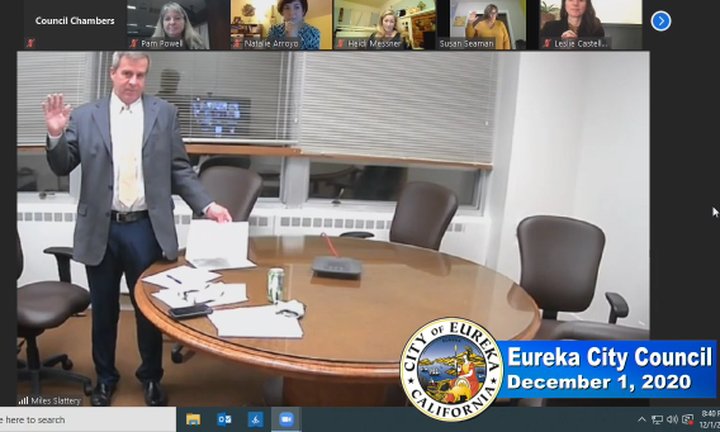
Slattery gets sworn in via Zoom | Screenshot fromt the Dec. 1 Eureka City Council meeting
###
It’s official, Eureka. Miles Slattery is now your city manager.
During last night’s meeting the Eureka City Council unanimously voted to execute an employment agreement with Slattery — who has served as Eureka’s interim city manager for over five months — and he was sworn into the permanent position by Mayor Susan Seaman.
The council’s decision followed a surprisingly lengthy discussion on the matter, after the resolution authorizing Slattery’s employment agreement was pulled from the consent calendar — meaning it was originally slated to be passed in one motion without discussion.
Several of the council members said that they had heard concerns from their constituents about the plan to offer Slattery the position and that some people felt there was not a lot of transparency from the city or effort to involve the public. “I think there was a bit of frustration that during COVID we would be [making] a lot of changes,” Councilmember Heidi Messner said.
There were also concerns about the timing. Initially the council was going to start the process in February, when the new council members would be able to weigh in on the decision. This was the last meeting for councilmembers Messner and Austin Allison and the newly elected councilmembers Kati Moulton and Scott Bauer will be sworn in on Dec. 15.
The suggestion to offer Slattery the full-time position was made by the outgoing councilmember Allison, who brought up the subject at the end of the council’s Nov. 3 meeting. The council then discussed the matter further in a closed session — as is usual for personnel matters — on Nov. 17.
Allison explained during last night’s meeting that he made the suggestion because he believes Slattery is the best person for the job, adding that he believes the council should hire someone from within the city, rather than spend more time and money on another nation-wide search. (The city conducted an extensive search and interview process to find previous city manager Dean Lotter, who left the job after barely four months.)
“That’s why I want to do this one last thing, because I think it would be a good thing for the city,” Allison said.
The other council members agreed that Slattery has proven himself to be the right pick for the position. He has, after all, already been doing the job for months amid the pandemic. Slattery has worked for the city of Eureka for years as Parks and Recreation director and, most recently, Community Services director. Several council members also pointed out that Slattery did already go through a rigorous public interview process, as he was one of the top contenders for the position before Lotter was selected.
Slattery’s employment contract includes an annual salary of $162,000 and there is no end date for the position.
During the meeting Slattery expressed his thanks for the job and encouraged any community members with questions or concerns to reach him on his cell at 707-599-2053.
“If there’s any interest in talking to me about my vision for Eureka or how I plan to lead the city of Eureka going forward, I’m more than willing to have those conversations,” Slattery said.
###
In other business, the council voted down a settlement agreement proposal pertaining to the syringe exchange program operated by the Humboldt Area Center for Harm Reduction (HACHR). The vote was 2-3, with councilmembers Leslie Castellano and Natalie Arroyo voting in favor of the proposal and councilmembers Austin Allison, Heidi Messner and Kim Bergel dissenting.
Council then voted unanimously to hold a continued meeting Thursday at 7:30 p.m. to allow for a reconsideration of the vote.
A cargo vessel similar to the MSC ROMANE, which accidentally dumped six shipping containers overboard off the Humboldt County coast last week. | Image source.
###
Last Wednesday, shortly after 1 p.m., the Portuguese cargo vessel MSC ROMANE was chugging northbound through a shipping lane 30 miles off the Humboldt County coast when half a dozen 40-foot shipping containers tumbled overboard, splashing into the sea below.
On Tuesday, six days after the containers took their unsanctioned dive, Humboldt Harbor Safety Committee Chair Leroy Zerlang received an email from the supervisor at the U.S. Coast Guard’s Sector Marine Safety Detachment Humboldt Bay alerting him to the situation and giving the location of the spill.
“The containers are presumed to be still floating,” Chief Warrant Officer Adam Shilts told Zerlang in the email.
Reached by phone on Wednesday, Zerlang said this was a first for him. “You hear about it happening all the time, but this is the first time I’ve heard about it happening in this area,” he said.
The MSC ROMANE is a massive vessel — nearly 160 feet wide and 1,000 feet long with a carrying capacity of almost 5,000 of those 40-foot shipping containers. So losing just six represents a relatively small spill, but Zerlang said they could cause big problems.
“We have lots of concerns,” he said. “We don’t want anybody to run into ‘em. And if [the containers] do sink, we don’t want them to interfere with anybody fishing out there, where their gear gets caught on it. … They don’t want to lose their $100,000 net.”
The floating metal boxes could also impact wildlife. Coast Guard Lt. Stephanie Cardenas told the Outpost that one of the agency’s units is still working to determine the contents of the containers, though she said the Coast Guard has confirmed that they weren’t carrying any hazardous materials or pollutants.
The last update came on Saturday. “The Coast Guard did a flyover and found some debris in the area,” Cardenas said. But no sign of the containers.
“Last I heard was that they were still floating,” Zerlang said, “but none of the boats I’m in contact with have seen ‘em.”
The email he received on Tuesday said the containers may be on the move. “Weather and current analysis shows the most likely drift would be to the south,” the message read, adding a parenthetical: “(this is only assumed not verified).”
Keep your eyes peeled, seafarers.
###
Approximate location of the dropped shipping containers.
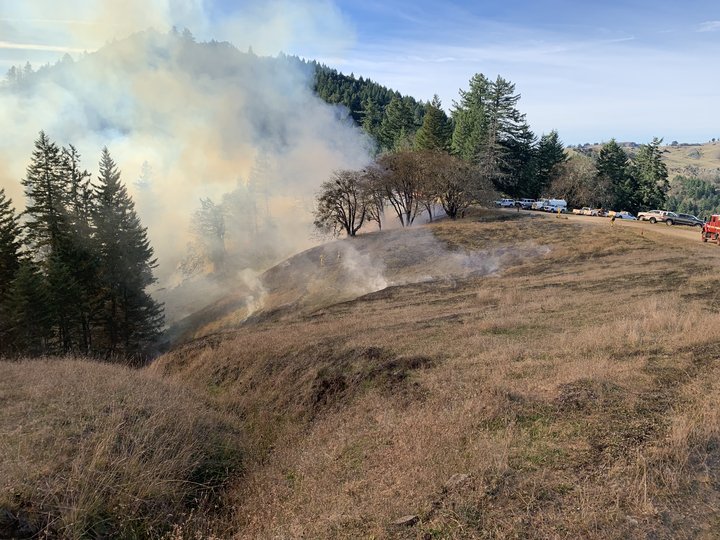
Lone Star Junction prescribed burns from years past. Photo: Calfire.
###
From release from Calfire HUU:
CAL FIRE Humboldt – Del Norte Unit is planning to assist private landowners by conducting a prescribed burn in the area of Lone Star Junction, south of Kneeland.
This prescribed burn is conducted under the department’s Vegetation Management Program (VMP). VMP is a cost-sharing program that focuses on the use of prescribed fire, and some mechanical means, for addressing wildland fire fuel hazards and other resource management issues on State Responsibility Area (SRA) lands.
The use of prescribed fire mimics natural processes, restores fire to its historic role in wildland ecosystems, and provides significant fire hazard reduction benefits that enhance public and firefighter safety. CAL FIRE will work cooperatively with landowners to provide the resources needed to conduct the burn safely. The Lone Star prescribed burn is expected to provide many benefits, such as: fuel reduction, control of non-native species, and habitat improvement.
This project is expected to take place over the next several days as conditions allow.
The HCSO’s documented response to a shots fired call on Thanksgiving.
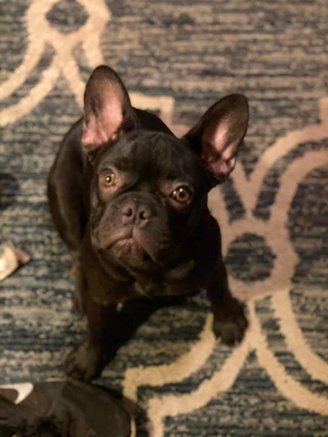
A Fortuna family is mourning after an off-duty California Department of Fish and Wildlife game warden reportedly shot their puppy “JuJu” to death on Thanksgiving in front of their 10-year-old.
“JuJu.” | Photoso provided by the Farfan family.
The Humboldt County Sheriff’s Office confirmed that deputies responded to a shots fired call that day on Loop Road in Fortuna at 8:23 a.m.
“Investigating deputies learned that the dog’s owners had let their two dogs out of their home earlier that morning,” HCSO spokesperson Samantha Karges told the Outpost. “The dogs left the yard and went onto a neighbor’s property. One of the dogs then reportedly began attacking the neighbor’s chicken, at which time the neighbor shot and killed the dog. Deputies found that the neighbor’s actions were in compliance with Food and Agriculture Code Section 31102.”
Lifelong Fortuna resident Becky Farfan said she’s concerned that her neighbor, who the Outpost confirmed to be CDFW game warden and former U.S. Coast GuardJoshua Zulliger, shot the dog without taking time to notice her grandson standing 30 to 40 feet away.
“My grandson was calling both pups; the female came back to him,” Farfan said. “He proceeded over a little hill where he saw [Zulliger’s] wife throw the dog off of the chicken. Then, Boom! A gun went off and my grandson saw his little dog yelp and fall over dead.”
The Outpost contacted Zulliger about the incident. H said that he would not have killed the dog if he knew it was his neighbor’s pet, adding that he made the decision to protect his chickens, which he sees as both livestock and pets.
“Imagine drinking coffee with your family in the morning and then two dogs come flying down into your backyard and start terrorizing your chickens,” Zulliger said. “I grabbed my rifle and went outside in my bare feet. The dog was shaking the chicken in its mouth violently trying to kill it. I had a very safe shot with a very safe background and I made a decision. It might not have been the best decision but I made a decision.”
One of the biggest disagreements between the Farfans and Zulliger, which has fueled tension between the families in the last few days, is whether or not the chicken was in the dog’s mouth at the time of the shooting. Based on the child’s eye-witness account, the dog had a mouth full of feathers, but the family had safely recovered the wounded chicken. Zulliger says the chicken was in the dog’s mouth when he took the shot.
“I am a dog lover,” Zulliger said. “I absolutely adore dogs. This was a horrible situation that I was put in due to a lack of control of other people’s dogs. I had never seen that dog before. Had I known whose dog it was, it would have changed things.”
The incident fueled heated internet comments from local community members when the Farfans shared their side of the story on social media. Zulliger said that he didn’t want to get involved with the internet comments, and said he had a neighborly relationship with the Farfans before the shooting.
“Who’s the victim?” he said. “Maybe it’s the guy sitting in his backyard, drinking coffee, when his livestock is attacked?”
While the HCSO determined that Zulliger was within his rights to shoot the 6-month old French bulldog, the family says it has serious concerns about Zulliger’s lack of remorse and his quick decision to shoot the puppy with their 10-year-old looking on 30 to 40 feet away.
“My son keeps saying he’s having flashbacks,” mother of the 10-year-old and owner of the slain $4,000 puppy Angela Farfan said. “I can understand that, when I blink my eyes I see my dead dog in the driveway.”
Angela Farfan added that she’s in the process of filing a complaint with the CDFW about the shooting. The Outpost reached out to the CDFW and was informed that the agency is aware of the incident.
“We are looking into this matter currently and have no public statement at this time,” CDFW spokesperson Kirsten Macintyre said.
While the family said it doesn’t condone their puppy chasing one of Zulliger’s chickens, Becky Farfan said that she was infuriated by Zulliger’s reaction after she confronted him about the shooting.
“He came to the door smiling,” she said. “I asked why he didn’t just scare it off. ‘Why didn’t you shoot the gun in the air? Why did you have to kill little JuJu?’ He said it was his right; the dog was on his property.”
Zulliger, who expressed concern with how people may interpret the story, said he only acted to save the lives of his chickens.
“Feathers and blood were flying,” Zulliger said. “They’re livestock and loving pets. It’s my right to protect my livestock. I’m upset that somebody allows their dog to roam free and kill other people’s livestock. What’s the difference between cattle and pet chickens that eat blueberries out of your hand?”
One of Zulliger’s neighbors, who chose to remain nameless, also contacted the Outpost to express their concerns about the puppy’s death, saying that Zulliger also threatened to shoot their dog after it killed one of his chickens in 2018.
“His dogs are on my property often, by the way,” the unnamed neighbor said.
In an effort to comfort the Farfans, the same neighbor provided them with Chinese lanterns that they released into the sky Monday night as a final sendoff for “JuJu.”
Still coping with their sadness, Becky Farfan said that her family has found solace in the kind words that were sent to them by local community members on social media.
“Our family is resilient; we will get through it,” she said. “I just think this guy needs to know what the neighborhood and community thinks of it.”
The Farfan’s release a lantern in honor of their lost dog.
Diane
Brocco Clark, my wife of 40 years, passed away Saturday, Nov. 28 at
2:38 a.m.
Love you,
Diane!
Diane
was born Diane Louise Brocco in Vallejo on January 25, 1950. She was
preceded in death by her parents, Mami and Charles Brocco. She is
survived by her husband, Craig Clark, and sons Ryan and Mishakal, her
sisters Linda and Karen, and brother Michael and step-sisters Grace
and Susan, and numerous cousins, nieces and nephews.
Diane
graduated from San Jose State in 1972, and began teaching grades
Kindergarten through 4th
grade in the two-room Mattole Union School in Petrolia the following
September. Since that time she has touched the lives of so many
students in the Mattole Valley and beyond. She will be remembered for
her friendly, kind, caring ways, and especially for her positive
outlook on life. She always was able to see the good in others. Diane
loved sharing her love of books with children and led many to the
adventures of reading while working as the Mattole School librarian
and teachers
aide.
One parent said, “You
were one of the first people we met when we moved to Petrolia in
1974. I came into your class to parent-help. You honestly looked like
a good fairy with your long blonde hair and big blue eyes. The
children clearly adored you.”
Diane
and Craig were married in 1980, moving to Blocksburg to build what
was said to be “the first hippie shack on the ranch.” While there
she taught at Weott Elementary, the Casterlin School, and later at
the Moore Avenue Children’s Center before returning to the Mattole
Valley, with Craig and her two sons. Diane worked as a waitress at
the Hideaway in Petrolia, making all who stopped in feel welcome.
Diane
loved bringing vegetable starts and produce to the Petrolia Farmers
Market and singing with the newly formed Mattole Community Choir
The
family would like to thank the many doctors and nurses at UC Davis
Medical Center in Sacramento, and St. Josephs Cancer Center for their
care.
Due
to the Covid pandemic the family will have a private interment at the
Table Cemetery in Petrolia. A memorial and celebration of life will
be held at a later time.
###
The obituary above was submitted on behalf of Diane Clark’s loved ones. The Lost Coast Outpost runs obituaries of Humboldt County residents at no charge. See guidelines here.
Today was Dr. Teresa Frankovich’s last day as Humboldt County’s health officer. Frankovich was hired to the nominally part-time position shortly before the pandemic began and resigned — technically — at the beginning of September. Events turned the job into something she had not signed up for.
Deputy Health Officer Dr. Josh Ennis will fill the position until next week, when the Board of Supervisors is expected to name a permanent new successor. Frankovich will be sticking around; in the future, she’ll serve the county as a deputy health officer, on the part-time basis she was originally hired for.
Today she took questions from local media outlets, and she has been doing since nearly the beginning of the pandemic, and she said farewell to the county with a very moving exhortation to her fellow citizens to keep the faith for just a little while longer. It looks very likely that the end is in sight.
Video above; rough transcript below.
###
Hello. As some of you may be aware, today is my last official day as the Health Officer for
Humboldt County. Next Tuesday, Dec. 8, the Board of Supervisors will have approval of
the new health officer on their agenda. Until then, Dr. Ennis, deputy health officer, will
provide coverage. On Dec. 14, I will be moving into my new, part-time supporting deputy health
officer role. We will be doing media on Friday to provide information about the transition,
and the incoming health officer. Before I respond to today’s questions, I just want to say again how
grateful I am for having had the opportunity to serve as the health officer for Humboldt County.
I have found out the hard way that the fastest way to learn what is at the core of your new community
is to face a pandemic together. I don’t recommend this approach. But the gift has been seeing the
incredible heart of this place, the way most of us have recognized this as the moment to practice
what we teach our children about kindness and the responsibility we all have to one another.
And as hard and exhausting as this has been, I would do it all again,
because it has been a privilege to be able to do important work, and to do it alongside and
on behalf of people I deeply respect and admire. Every day I am literally surrounded by my personal
heroes at Public Health and the EOC who have given their all to this effort for 10 months now,
and still show up every day to do it again. This includes every person supporting this effort,
and all of those holding down the fort on everything else that still needs to get done.
For a very long time, longer than every other large county, we held COVID-19 at bay.
Finally, as most of the country and the state surged in cases, we began to see the impossibility
of keeping COVID forever outside our gate. But the time gained has made us far better prepared
than we would have been last spring. As of next week, we will have tripled our Optum capacity,
including a mobile unit that will test five days a week in locations across the county.
This asset, together with our outstanding internal lab, will bring testing capacity to well over
3,000 specimens per week, more than 100 times what we could do at the start of the pandemic.
In addition, our new regional testing partnership with UIHS and Del Norte County,
is finalizing its preparations and is expected to begin adding to our capacity sometime
this month. Our stellar contact investigation team has been expanded and refined over time.
Together, we have made the move to a state contact tracing platform, bringing increased efficiencies
to our process, new tools and additional staffing to meet the growing response need.
Our alternate care site preparations are nearly complete through the dedication of our EOC team
and our partner in this effort, St. Joseph Hospital. I see this as an incredible safety
net for our community as we watch what is playing out across the country and in parts of California.
We still hope to never need it, but it will be there if we do.
Our Joint Information Center team continues to do what it has done in extraordinary fashion
from the start, helping to ensure everyone in the community has the information
they need to navigate through this pandemic. Those in the community who have called for information
are met with warmth and civility and answers to their questions in real time.
Finally, to all of you, the journalists in our community, who have worked so hard to inform
the public throughout the pandemic, I extend my deepest thanks. We’ve all been talking about COVID
and living with COVID for a long time and it would be tempting to move on and drift away in coverage,
but you have steadfastly hung in there, following the science and bringing it to Humboldt residents,
and for that I am forever grateful. Your dedication has helped to keep our friends and
relatives safer.
We’re entering a challenging period in this pandemic, with surging cases
and threatened hospital capacity statewide. It’s going to take concerted effort by all of us,
and continued sacrifice, to move through this wave with fewer severely ill individuals,
and fewer lives lost. But the vaccine is coming, data suggests it will be safe and effective and
is likely to be the thing that propels us forward out of this pandemic and the enormous toll it has
taken on all parts of our community, children, families, businesses, schools, and the most
vulnerable across the county. But I am hopeful we will celebrate its end soon, and we’ll celebrate
it together, all of us, healthy and together. It will be a most amazing day.
The North Coast Journal asks, “On your last day as Humboldt County’s full-time health officer,
what advice would you offer your successor?”
Wow. Well, um, I think the biggest thing is really
listening and asking questions. I think we have developed an incredible amount of expertise here,
within our Public Health department, within our EOC, and with our state experts. And I
think forging relationships, asking questions, and being willing at the end to take all the
information and make a decision that may not be the popular one, but is the right one to do,
I think is probably most important. That and reading everything you can read is essential.
The North Coast Journal asks, “What have been the most rewarding and challenging aspects of
the job for you personally?”
Well I think the most rewarding has clearly been the people I’ve
been working with and the community, there’s no doubt. Obviously there have been some people who
are not supportive about what we’ve been doing, but it is, I believe, a minority of people.
The vast majority of our community has been extremely supportive and helpful in moving us
forward, and that has been incredibly rewarding. I think the single most challenging issue has been
the lack of national policy on COVID-19 response, and the political divisiveness that arose
out of that and I think it has made this more complicated than it had to be, and
I think it’ll be a lesson learned going forward.
The North Coast Journal asks, “Reflecting on the past eight months, what do you consider
to be the county’s biggest successes and shortcomings in responding to COVID-19?”
Well, you know the successes I think are pretty evident. I think the infrastructure
we’ve been able to build, in a cooperative way across the community, speaks for itself.
I think it’s really been an amazing, amazing team effort to accomplish that. The shortcomings,
I think when we go back and look at all the response, I’m sure we’re going to find things
we could have done quicker or better, it’s inevitable, and we’ll learn lessons from that.
Hopefully we will not need them for a long time, but we’ll learn from it.
But overall I’ve been tremendously impressed by what Humboldt’s been able to do.
The North Coast Journal asks, “What do you envision your role in Humboldt County’s
pandemic response will be moving forward?”
Well I will be here as long as I’m needed,
I will be working in a support role, part time, which will allow some of the flexibility I needed,
so I look forward to contributing, and to being here when it’s done.
The North Coast Journal asks, “The governor warned yesterday that need in Northern California
hospitals is projected to eclipse capacity by Dec. 24 if current infection rates continue.
Do local models and projections show a similar trend? If infection rates continue, when do you
anticipate local hospitals will run out of beds or the healthcare workers needed to staff them?”
I think that if we continue at the current pace, we may have issues prior to the 24th
on a statewide basis, but locally we don’t actually construct models, our numbers are
small enough that it makes it somewhat challenging to have something that’s predictive, but we do
watch what’s happening across the state with our local data. I certainly have concerns about the
impact on health care capacity locally with the case rate increase that we’re seeing right now.
I think our hospitals have built an incredible amount of increased capacity,
I think they have brought on increased equipment, including things like ventilators,
as in many other places, we will need to staff all of that to provide adequate care.
But my hope is that with some of the measures we have taken preventatively,
with sort of ratcheting down our activity locally, that we may be able to prevent
moving that far. But we have to prepare as if that may happen some time in December.
The North Coast Journal asks, “Some California hospitals are already in danger of exceeding
available capacity. To your knowledge have there been any discussions about transferring patients
into the county from other areas?”
Well certainly through our hospital-wide system,
there are requests made through our Emergency Response, and for beds,
if a facility is having difficulty, so we see those all the time. For the most part,
those are in areas that are quite far from us and logistically not appropriate for transfer. So
we haven’t really looked at transfers to our facility at this time.
The North Coast Journal asks, “You and Dr. Ennis have spoken repeatedly about available healthcare
workforce being a likely limiting factor in efforts to increase local hospital capacity to
meet a surge. Can you speak to current efforts to expand workforce capacity and where they stand?”
We continue efforts with our partners, discussions about how we will pull workforce into this. One
thing I do want to point out is that again, we’ve designed the alternate care site to be very low
acuity, really meant to be a valve, a pressure valve for the hospital, to take people who are
nearly ready to go home, and provide a little bit of care for a day or two until they are ready
to do so. So our staffing levels will not need to be very high to be able to accomplish that,
and that will make staffing overall much easier. We’re counting on all of our health care
friends in the county to step in and help when we need that,
and we also have our disaster service volunteers that we will be looking at as well. In addition,
the state potentially has assets, depending on what’s happening,
and the state of course is able to ask the federal government as well. So, it’s a work in progress.
The Times-Standard asks, “Has Humboldt County seen any impact of the surge on local testing
capabilities? If so, how? And is this being addressed?”
Well we’ve certainly
seen an increase in testing volume and the need for that, and so we are very fortunate
to have that Optum expansion to help meet that need. We’ve been ramping up internally
hugely as well, I think our lab had over 1,200 specimens last week that they received.
And we continue to work on our regional testing partnership to increase testing further.
Finally we are receiving some rapid tests that we can help to distribute to acute care settings,
so that they will have some ability to test symptomatic people in front of them,
with a rapid point of care test, and these tests perform very well, actually for symptomatic
individuals. So that should improve capacity as well. But we’re definitely feeling the strain.
The Times-Standard asks, “Where is Humboldt County at, as far
as acquiring freezers to hold COVID-19 vaccine?”
We’re very fortunate because our partner, Providence St. Joseph Healthcare,
procured ultra-low temperature so that we’re able to use those for storage of vaccines and the
capacity there should actually serve the community well. It’s a great benefit for our community and
we really appreciate that. So, we’re working collaboratively with them. These first doses
will be targeted for healthcare workers and we hope to see these actually very soon in December.
The Times-Standard asks, “Can Dr. Frankovich address what changes
the county might be seeing with a new stay-at-home order this week?”
I really don’t know. I was in a discussion with health officers and public health directors
across the state this morning providing feedback of what that could look like.
The governor’s office is obviously planning with the state public health leadership as well.
I don’t know what the final plan is going to look like, all I know is they are looking for
basically some concrete time limited interventions that are likely to be effective,
highly effective. We want to use lessons learned from our previous shelter-in-place to inform this.
The Lost Coast Outpost asks… “What’s the most important thing you’ve learned during the
county’s management of the pandemic? What advice will you have for your successor?”
I think as I alluded to earlier, I think a big part of this is relationships.
I was new coming into this position, so I needed to forge those relationships. We’ve
had a relatively long period to do that and the nice thing is that we really have solidified
those with our partners across the county. And that means in a time like this, we are better
positioned to respond because we are all very connected. Those relationships are a resource
that rural communities really have in spades. And that really helps us out in a time of crisis. So
that is really a good lesson learned from this. The other thing i would simply say,
is that I know our business community has taken a huge hit through this COVID pandemic. The length
of it and the restrictions are just daunting and so i do think we need to do increasing work with
outreach to and in support of our business communities to help them through this. Thank you.
The Lost Coast Outpost asks… “Yesterday, Gov. Gavin Newsom hinted that California may be
prepared to introduce new emergency measures to slow the rapid spread of the virus. What sorts
of additional measures available to the state would be most effective in accomplishing that?”
Again, we really don’t know what this is going to look like. It really, I would imagine,
will be looking at sector by sector. What type of restrictions make sense. What would have the
most sort of bang for the buck, in terms of what we’re doing. And asking of people. And again,
learning lessons from previous interventions that we’ve used to see what might be most helpful.
I expect we’ll hear something this week.
The North Coast News asks… “With the CDPH recommending this week that all hospitals
have staff tested for COVID-19 weekly, have protocols changed at hospitals here in Humboldt
County? Have COVID-19 infections among health care workers impacted hospital staffing negatively?”
So far we’ve actually been very lucky and had very little impact on our hospital setting in terms of
healthcare worker infections. And I credit them with the precautions they’re taking and the
prevention pieces they’ve put in place. But we’ve also benefited from the fact that we have had
a relatively low prevalence of illness. So, those prevention measures are all going to be
increasingly important. In terms of the hospital testing, this is a new recommendation from the
state and there is a timeline for hospitals to begin implementing this. We are in discussions
with the hospitals about what strategies we can use to meet this. It’s a big lift to test all
healthcare hospital staff, or all hospital staff in our community.
The Redheaded Blackbelt asks… “How
many supplemental hospital staff are, as of this moment, enlisted to work the overflow site
in the event that our local ICU is at capacity in the immediate future?”
Well we don’t have a roster of people that are signed up to do this. We will
at that time - we have to make certain planning assumptions which are that
certain healthcare operations are not going to be functioning as normal.
If we are in a surge situation, those folks become available to help serve in this effort.
And we are again constantly updating and reviewing our volunteer network that we have as well. So,
it’s again an ongoing conversation across the healthcare community about how we’ll do this,
but we’re counting on our partners to really step forward when we need it.
The Redheaded Blackbelt asks… “We’re trying to understand the ICU occupancy information.
How many patients are currently in the ICU in the entire county?”
Yesterday, according to the state site, we had zero ICU beds available
(though we believe the county has a total of 18 overall but “only” 5 COVID hospitalizations.
It is really challenging to read this online. The problem is that most of the numbers that
are presented are related to staffed beds. And our hospitals staff according to census.
So if there are more patients, they bring on more staff, which increases bed capacity.
What I would say is that we really are seeing - we do have some COVID hospitalizations. We
really have not seen that as a primary driver of our hospital occupancy at this point,
but hospitals obviously have a lot of other patients who need care and that is one thing
we’ve been talking about is that we not only have to be able to house COVID patients,
but everyone else who may need care. People who have heart attacks, strokes, people who have
other urgent situations that need care. So we are monitoring this constantly as are the hospitals.
The Redheaded Blackbelt asks… “Have the average wait times for COVID test results
jumped? For instance, one woman was tested on the 17th and has not yet received her results.”
Well I know that the Optum site now is sending all of its specimens to the state lab in Valencia.
That lab is contractually committed to really good turnaround times of about 48 hours, but we have to
add in our transit. I’ve been actually seeing some really good turnaround times from that.
So I’m surprised by this particular test result, but I do know as they first ramped up,
there were some growing pains there. So it’s not impossible. I would just say that overall
I’m actually really encouraged by what we’re seeing right now, in terms of turnaround.
Thank you Dr. Frankovich, and thank you for your service.