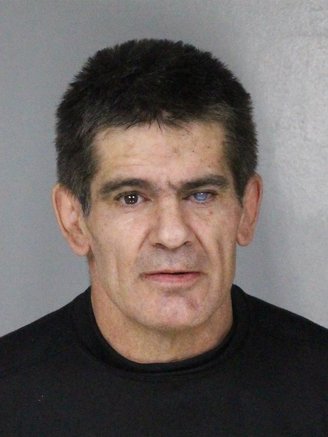
The ex-girlfriend of hit-and-run suspect Jeffry Tsarnas says Tsarnas knew the car he was driving hit a person on Fernbridge on Nov. 27, 2018, and he also admitted that when the collision occurred, he spilled the milk and brandy cocktail that he was drinking while driving.
Tsarnas.
Barbara Craft, the main prosecution witness in the felony case against Tsarnas, has provided plenty of incriminating evidence against her former live-in boyfriend. But she may have lost some credibility today with jurors when she admitted that she once tried to get out of coming to court by telling law enforcement she had been “telling fibs” about what she knew.
Under questioning by Deputy District Attorney Roger Rees, Craft insisted she lied about lying. And she said she was telling the truth today.
Tsarnas, 47, was charged with felony hit-and-run after he allegedly ran over a woman pedestrian about 5:30 p.m. on Fernbridge, breaking her left foot and ankle. Tsarnas continued on his way to the nearby casino and didn’t arrive home in Myers Flat until about midnight. When he pulled in Craft was furious because he had taken her car without permission as she lay sick in bed.
She walked out to meet Tsarnas when he drove in, Craft said, and saw her car was damaged.
“My mirror was missing off my car and I wanted to know why,” Craft testified. She asked “What the fuck did you do my car?”
As Craft yelled for about 15 minutes, Tsarnas tried to explain he had hit something on Fernbridge.
“He thought a dog might have fallen out of someone’s truck,” Craft recalled.
She went back to bed and Tsarnas went to the living room, she said, when she heard him say “I hope I didn’t hit a person.”
Under cross-examination by defense attorney April Van Dyke, Craft acknowledged that today was the first time she’d ever told anyone that Tsarnas made that statement.
The next morning, Craft said, she saw a Lost Coast Outpost report about a hit-and-run on Fernbridge. The article included a photo of what she recognized as the mirror missing from her car.
She started yelling at Tsarnas about hitting a person, and he replied “Oh shit.”
She told Tsarnas he needed to go to the police.
Rees asked Craft how Tsarnas reacted.
“Of course he was scared. He wanted to go get another mirror and wait a few days.”
“Did he say why he wanted to wait?”
“He wanted to make sure he was clean for drugs, in case he was tested.”
Craft said both she and Tsarnas were daily methamphetamine users at the time.
But Tsarnas did call the Sheriff’s Office and was referred to the California Highway Patrol. Craft and Tsarnas drove to the CHP Office in Arcata and were interviewed. When they were allowed to leave without the car being impounded, Tsarnas was reportedly relieved because the spilled liquor on the floor would have been discovered.
Defense attorney Van Dyke questioned Craft about the new revelation that Tsarnas brought up hitting a person the night of the incident. Van Dyke asked whether she’d mentioned that to the CHP the day after the wreck.
“No.”
Van Dyke than began questioning Craft about a possible reason for Tsarnas to be more alert than the average person about hit-and-run. But the jury never heard why: because Tsarnas’s 14-year-old daughter, Faith Lorraine Tsarnas, was killed in July 2016 by hit-and-run driver Marci Kitchen. Attorneys argued over that issue with the jury out of the courtroom.
Rees objected to Van Dyke bringing up the subject, suggesting Van Dyke was attempting to elicit sympathy from the jury. But if she did want to pursue that line of questioning, Rees said, he wanted to point out during closing arguments that Tsarnas, of all people, should be keenly aware of the consequences of drinking, hitting someone and speeding away.
“Which is exactly what Marci Kitchen did,” Rees said.
When the jury returned, Van Dyke did not ask more questions along that line.
Another witness, CHP Sgt. Matthew Harvey, testified about a phone conversation with Craft a couple of days after the collision. Craft told him that after they left the CHP station, she accused Tsarnas of knowing he’d hit a person.
He reportedly responded “Well, duh yes, but I’m not going to tell them that.”
Testimony was expected to continue tomorrow morning before Judge Timothy Canning.
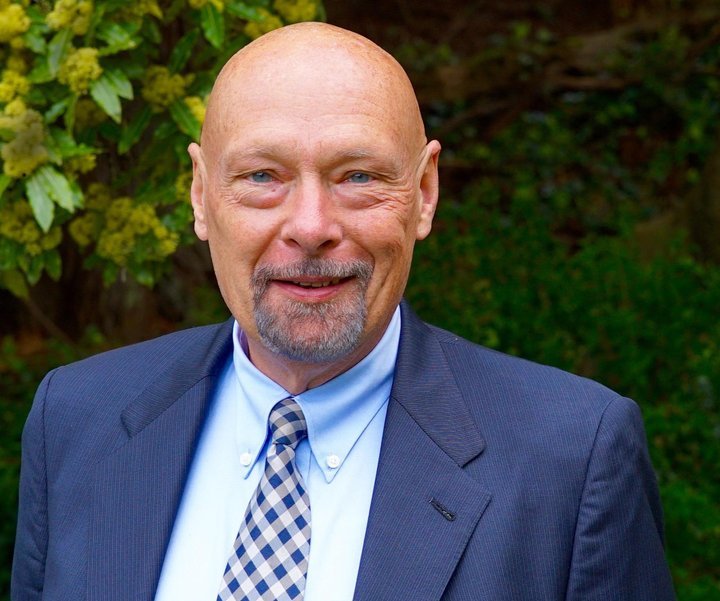
Former KHSU station manager Peter Fretwell. File photo.
These days, KHSU-FM — the once-vibrant public radio station operated by Humboldt State — may offer nothing more than canned programming from outside the area.
But even if the station itself no longer makes content, the slow, spectacular meltdown that culminated in its total evisceration in April 2019 still provides.
The latest chapter in the saga: Former station manager Peter Fretwell, a personage loathed by the station’s longtime staff and volunteers, has filed a federal lawsuit against the California State University Board of Trustees in which he claims, among other things, that he was the target of religious persecution by a mob comprised of his underlings and other KHSU hangers-on, and that HSU administration failed to “protect” him from that mob.
From his complaint:
[Fretwell] was
publicly attacked for being an “old” “Christian” “man” who must surely have fired [former program director Katie] Whiteside, host of a
popular pagan music show, on account of religious animus. He was also falsely and publicly decried as
a right-wing Christian fundamentalist.
Instead of protecting him from the mob and investigating his complaints, the University
retaliated against him, signaling its decision that he should leave. Eventually, the University made the
decision to terminate local control of the radio station, ostensibly because it had sacrificed not only
Fretwell himself, but local support of the station, and University control.
The University succeeded, not only in wrongfully terminating Fretwell, but in destroying his
career and his future.
One of Fretwell’s attorneys of record works for the Church State Council, which bills itself as “a religious liberty ministry of the Pacific Union Conference of Seventh-day Adventists.”
The story from the point of view of “the mob” is pretty well known by now — Fretwell, brought in as station manager in 2017, soon set about taking actions that upended the longstanding culture of the station. In May 2018, Whiteside — who had been at the station for decades — was fired, and Fretwell was blamed. A struggle for control of the station very publicly ensued, with demonstrations and letter-writing campaigns and threats of workplace sabotage. Fretwell suddenly disappeared. A couple of months later, everyone was fired and the station went on autopilot.
But in the lawsuit we get, maybe for the first time, Fretwell’s full story of his experience, which was apparently shot through with anti-Christian bigotry and a lack of concern from his employers. In his telling, Fretwell was hired on to modernize and professionalize KHSU, and after he did that, when the backlash hit, the university fed him to the mob — to such a degree, he says, that he had to flee the state for his own safety:
Although he was permitted to remain on salary until his formal termination, Fretwell had been
forced to flee not merely the campus, but the community, even the State of California — in an effort
to restore some measure of mental and physical health.
###
How did such a frightening state of affairs come to pass?
Fretwell says his job was to move KHSU away from being a “community radio” station, with its ragtag band of volunteers’ music shows and community calendars and the like. Instead, the administration was looking for a “public radio” model, with “important local and state news, in-depth public affairs, vigorous civic dialogue, professional journalists, etc.”
However, he was quickly shown where true power at the station lay. First he tried to get people to dial back on volunteers’ use or abuse of the station’s internal email listserv. A few people were just sending way too many emails, and they were clogging up inboxes all over campus! People would just start deleting them without reading them. So he instituted email reform.
But some people didn’t like that. From the complaint:
That was his first brush with KHSU’s inverted culture, where a
few volunteers had developed a culture where they bullied others into “going along to get along.”
The volunteer culture often managed the station successfully by force of sheer numbers and group
intimidation.
This became more serious when Fretwell discovered that paid staff members were also performing volunteer work at the station — a violation, he claims, of federal labor law. He took his concerns to the university’s human resources department, and together they ordered that this practice must end. However, he claims, his deputy — Whiteside — continued to allow staff members to volunteer their time, and when she sought to find ways around it they concluded, in Fretwell’s words, that she “consciously challenged and violated the Fair Labor Standards Act.” After meetings between himself, HSU administration, the human resources department and the university-affiliated Sponsored Programs Foundation, all four parties agreed to fire her in May 2018.
This is when the mob formed in earnest, Fretwell says, and he became its sole target. HSU declined to accept any of the responsibility for Whiteside’s termination, he says in the complaint, and so outrage focused on his own person — his age, his sex and his Christian faith.
He received a voicemail from a community member, which is transcribed in the complaint ..
So my recommendation for you is to
eat a little crow, apologize, put Katie back in… or we’re coming after your job! And it’s just that, if
you’re trying for retirement in a few years of time, but you will not go down well in history. And
your children - If you have them - or your friends may wonder what you’re doing, because
you’re gonna be shamed!
… that he promptly forwarded to the University Police Department. The police department’s response was unsatisfactory, he says.
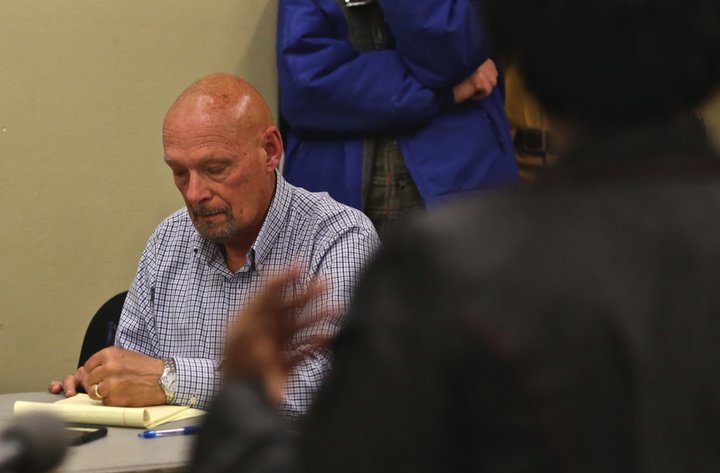
Fretwell at the May 30, 2018 meeting of the KHSU Community Advisory Board. Photo: Andrew Goff.
Fretwell says he was on the receiving end of much more abuse of that kind in the weeks that followed, particularly at meetings of the station’s Community Advisory Board, where he was “subjected to discriminatory intimidation, public ridicule, and numerous insults based on his age, religion and gender.”
He again asked Humboldt State to step up and take responsibility for firing Whiteside, he says, and he says that again the University took no action.
After a couple of months spent trying to disallow the Community Advisory Board from meeting again on campus, Fretwell in late July met with the University’s Discrimination, Harassment, and Retaliation Prevention Administrator and filed a formal complaint. According to Fretwell, the subsequent investigation was slipshod and its conclusions were not acted upon. In the meanwhile, he says, another staff member filed a discrimination complaint against him, and he was suddenly stripped of his ability to discipline KHSU staffers. At which point things only got worse, he says, and he eventually was “forced” to flee town.
###
Fretwell claims that the administration violated his civil rights through harassment and discrimination based on his age, gender and religious beliefs, and also that the university retaliated against him after he blew the whistle on illegal activity at KHSU. He asks the court for an unspecified but presumably large amount of money — to compensate for lost wages, for “non-economic” damages” he suffered, for attorney’s fees; and also additional money in order to punish the university for its alleged misdeeds. He asks the court to enjoin the CSU system from ever allowing such unjust behavior again.
The CSU Board of Trustees, meanwhile, has filed a preliminary response to Fretwell’s complaint. It offers a broad and pro forma denial to most of the factual allegations he puts forth. Further, it charges that he’s late in bringing these claims forward, that the university had “good and legal” reasons for taking the actions it did throughout the whole affair, and that Fretwell himself has “unclean hands” in the matter.
On Tuesday, March 23, 2021 at approximately 6:30 P.M., Fortuna Police arrested 26 year old, Alejandro Mendoza-Alcazar following an investigation into multiple counts of felony sexual assault perpetrated against a minor. These events occurred recently and were first reported to the Fortuna Police Department during the
third week of March 2021. Mendoza-Alcazar was interviewed by investigators from the Fortuna Police Department and as a result, Mendoza-Alcazar provided a confession to the reported allegations.
As a result of the available evidence and Mendoza-Alcazar’s statements to police, investigators obtained an arrest warrant which was issued by the Humboldt County Superior Court for the arrest of Mendoza-Alcazar. Mendoza-Alcazar was booked on the following charges:
California Penal Code Sections: 287(c) – Oral Copulation of a Minor Under 14 Years of Age with Force or Fear, 288 – Lewd and Lascivious Acts with a Minor, 288.2 – Harmful Matter Sent to a Minor, 288.3 – Contact of a Minor with Intent to Commit a Sexual Offense, 289(i) – Any Person 21 Years of Age or Older Participating in an Act of Sexual Penetration with a Person Under the Age of 16, 289(a)(1)(A) – Penetration with a Foreign Object, and 647.6(a)(1) – Annoying or Molesting a Minor Child.
Fortuna Police will be filing additional felony charges with the Humboldt County District Attorney’s Office. As a result of the arrest, Mendoza-Alcazar was booked at the Humboldt County Correctional Facility. Bail was set at $1,250,000.00.
The Fortuna Police Department remains committed to public safety. Any questions regarding this incident can be directed to Casey Day, Chief of Police at (707)725-7550.
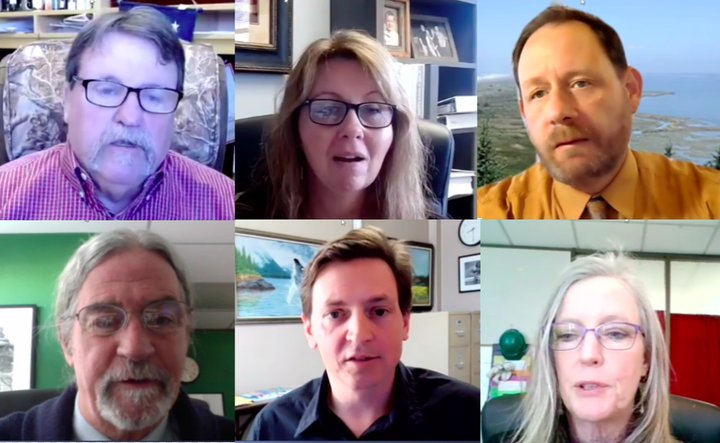
Screenshots from Tuesday’s meeting (clockwise from top left): First District Supervisor Rex Bohn, Second District Supervisor Michelle Bushnell, Third District Supervisor Mike Wilson, Fourth District Supervisor Virginia Bass, Health Officer Dr. Ian Hoffman and Fifth District Supervisor Steve Madrone.
###
If people stand in line too long, they can get antsy.
At Tuesday’s Board of Supervisors meeting, Humboldt County Health Officer Dr. Ian Hoffman attempted to hold the line, so to speak, on COVID vaccinations, telling the supes that it’s important to continue focusing on getting shots to people in the qualifying phases of the state’s vaccine rollout even though plenty of non-qualifying residents are finding ways to get vaccinated.
Second District Supervisor Michelle Bushnell said Jerold Phelps Community Hospital in Garberville recently had a large batch of vaccine doses that were made available to residents of all ages, and she encouraged residents to check social media for vaccination opportunities.
“Even if you’re 20 years old and want it, it’s out there in abundance at certain clinics,” Bushnell said. “I think it’s important we say that.”
Fourth District Supervisor Virginia Bass said she was able to get vaccinated thanks to a local clinic that had “a huge number of no-shows,” and she was amazed by how many young people she saw there, getting vaccinated.
Like Bushnell, she encouraged people to call up clinics and get on whatever list they’re able. “It’s worth a shot,” she said. “It’s better to try. I’ve been recommending that to people.”
Hoffman agreed, up to a point. “If you’re interested, get on whatever list you can get on,” he said. But he also pointed out that there are still 65-year-olds in the community who’ve been waiting for months to get vaccinated and have yet to succeed. While the community is “about to turn the corner” into easier availability thanks to increased supplies and new vaccines coming online, Hoffman said it’s important to prioritize the most vulnerable residents.
The rollout is still officially open only to people in Phase 1A (healthcare workers and long-term care facility residents) and Phase 1B (people age 65 and up, and those working in food and agriculture, education and child care or emergency services), plus younger people who are at high risk due to certain health or lifestyle factors.
Humboldt County’s case rate has leveled off at around six to seven cases per 100,000 residents per day, Hoffman said, which keeps us firmly in the red tier.
“With continued focus on a slow reopening, we should be on track to reach the orange tier sometime in April as long as we remain cautious,” he added.
There has been a slight increase in the number of vaccines coming into the county. Hoffman said we’re averaging about 5,000 per week, and he expects that figure to keep growing into April and May with more doses of Johnson & Johnson’s one-shot vaccine becoming available.
It’s possible that by May, every American who wants a vaccine will be able to get one without having to wait in line, he said. For now, the county is still encouraging residents to fill out the interest form available through the county website.
Statewide, there’s an ongoing effort to reach people living in zip codes that fall into the bottom 25 percent of California’s Healthy Places Index, which assesses communities based on housing, education, economic and social factors. Hoffman said the state has reached its initial goal of vaccinating 2 million people in those zip codes, and when we reach the next goal of 4 million, the cutoff for counties to qualify for the orange tier will move from a case rate of four per 100,000 residents to six per 100,000. That would allow Humboldt to reach the looser orange tier restrictions sooner.
Hoffman also reminded people that both the CDC and the California Department of Public Health (CDPH) have offered no recommendations to change your behavior after getting a vaccine. You should continue masking and social distancing and avoid mixing with other households.
As for youth sports, Hoffman said we’ve been on a “rollercoaster” of rapidly changing guidance from the state. In mid-February CDPH said there should be no spectators at youth sporting events, but in the absence of more specific recommendations, many counties, including Humboldt and Del Norte, developed their own rules. Humboldt health officials decided two parents per kid would be fine. CDPH also announced a ban on youth cheerleading along the sidelines only to rescind the ban days later.
The state is still recommending against all non-essential travel, asking that people stay within 120 miles of their homes. Changes to that policy are expected to come next month, Hoffman said.
He stressed the importance of remaining cautious as society starts to open up again. “We’re working hard to balance [the needs of] those who are most vulnerable and those who need to get back to normal,” he said.
Ancient depiction of the wave that we should imagine engulfing Humboldt between 11 a.m. and noon today, even though it will not.
###
Today is tsunami test day! You might remember what that used to mean in pre-COVID times — the National Weather Service, the local Office of Emergency Service and various partner agencies and businesses are going to make sure our tsunami warning infrastructure is up to snuff.
That means that sometime between 11 a.m. and noon today, radio listeners and TV watchers should hear those automatic beep-beeps break into programming with the message that THIS IS ONLY A TEST. If you live near the coast, you can expect to hear the tsunami sirens blare out.
Remember: It’s only a test!
###
From the National Weather Service:
WHEN: Wednesday, March 24, 2021, between 11:00 a.m. & 12:00 Noon
WHERE: Del Norte,
Humboldt, and Mendocino counties.
HOW: Interruptions
of TV* and Radio Stations, and activation of NOAA Weather Radios and
Outdoor Sirens. (*Not all Cable and
Satellite TV Stations may be able to participate)
WHY: To test the
Tsunami Warning System to ensure it works properly during a real
tsunami emergency.
HOW THIS TEST WILL
AFFECT YOU:
If you are watching
television between 11:00 a.m. and 12:00 Noon on Wednesday morning, expect to see a
crawler at the bottom of the screen indicating that a tsunami warning
has been issued, and hear a
voice indicating that it is only a test. If you don’t hear the TV
audio, please remember that this
is only a test. If you are listening to the radio, you will hear
alerting tones followed by a voice
announcing that the test is occurring. If you have a NOAA weather
radio with the Public
Alert feature, the radio will automatically turn on and you will hear
the same message as broadcast
on radios. In some areas, you may also hear the sounding of a tsunami siren, an
airplane testing its public address system, or receive other communication tests
in some local jurisdictions.
The Wireless Emergency Alert (WEA) system that comes
across smart phones will NOT be activated for this test.
Please help us by
providing any feedback regarding this test by emailing:
ryan.aylward@noaa.gov
When you hear or see
the warning test on March 24 between 11:00 a.m. & 12:00 Noon:
The test is
conducted by the National Weather Service, the California Office of
Emergency Services, the Offices of Emergency Services for Del Norte,
Humboldt, and Mendocino Counties, and Tribal Governments. For more
information, contact: National Weather Service (707) 443-6484.
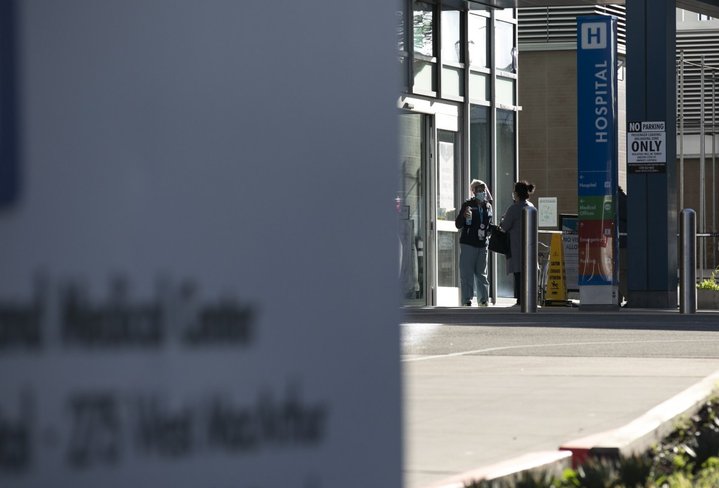
Patients and hospital staff wore masks outside of Kaiser Permanente Oakland Medical Center on Feb. 12, 2021. Many California hospitals are opening up to more visitors. Photo by Anne Wernikoff, CalMatters
###
One patient recovering from COVID-19 finally started eating after a family member was allowed to bring home-cooked meals to a hospital in Fresno. Another patient’s racing heart calmed at a hospital in Monterey when a relative was allowed inside.
After a year of strict rules that forced many people to abandon their family members at a hospital entrance, many California hospitals are now beginning to crack open their doors to regular visits for non-COVID-19 patients.
Most counties moved this month to less restrictive tiers and the state last week issued new, looser guidelines for hospitals. Now hospitals in 50 counties — home to more than 93% of the population — are eligible to open up to two visitors per patient, with some caveats.
“I’m so happy and so excited, like a little kid in a candy store,” said Adolphe Edward, chief executive officer of El Centro Regional Medical Center in Imperial County. “Returning some of those visits back is going to be very helpful for our mental health.”
Some hospitals, however, are cautiously weighing whether to allow more people inside. Dignity Health, Kaiser Permanente and SutterHealth hospital systems, for example, said that they will continue to reevaluate their visitor policies and could update them soon.
Cracking the doors open
Until two weeks ago, most of California remained in the strictest purple tier, where state health officials advised hospitals to limit visitors to only special cases, such as children and women giving birth. Now only eight counties, with less than 7% of the state’s population, remain in the purple tier.
In addition, the new state guidance increases the number of visitors recommended in non-purple counties to two at a time per patient, provided they’re from the same household and “social distancing can be accomplished.” For all tiers, the number of visitors recommended for children, women giving birth and patients who are dying, undergoing surgery, or have disabilities increased to two.
The guidance doesn’t have the force of law, but a spokesperson for the California Department of Public Health said “hospitals are licensed by CDPH and should comply.” Counties may implement stricter standards if the local public health officer orders them.
“It’s about the families coming back to the hospital. The policies (are) finally following the human needs.” — Adolphe Edward, cEO of El Centro Regional Medical Center in Imperial County
Imperial County left the most restrictive purple tier in early March. So starting this week, El Centro Regional Medical Center hospital now allows some visitors for patients in the medical-surgical and intensive care units, except for patients in isolation for COVID-19 or other diseases. One visitor per patient is allowed in the emergency room, and the hospital will now permit two parents to visit hospitalized children, one at a time.
Previously, the hospital largely barred visitors except for children, people giving birth, or people with disabilities that make it difficult for them to communicate or stand without assistance. Visitors were also allowed for patients who were dying as long as the patient was not in isolation.
The hospital was obligated to follow the state’s guidance, Edward said, but the restrictions were difficult to implement. “You’re hearing them cry, and you’re hearing the pain of the loss that’s about to happen,” he said.
Now Edward is thrilled to be allowing more people to be with their loved ones. “It’s about the families coming back to the hospital,” he said. “The policies (are) finally following the human needs.”
Alone in the ER
While the guidance doesn’t explicitly mention emergency rooms, a state health department spokesperson said it “applies to visitation for various levels of patient care, including those in emergency room care.”
Charis Hill, a 34-year-old disabled activist whose immune system is weakened by treatment for an inflammatory disease, came down with a 102-degree fever in August. A friend rushed Hill to the emergency room at Mercy General Hospital in Sacramento, but they were separated at triage.
Hill spent hours alone in limbo — sweating, shivering and waiting for care. Unable to sit up, a security guard threatened to call the police on Hill for lying down across the chairs in the waiting room, Hill said.
“I felt helpless. I was alone,” Hill said. “I needed someone to advocate for me, to explain my disease that I live with.”
“I felt helpless. I was alone. I needed someone to advocate for me, to explain my disease that I live with.” — Charis Hill, disabled activist and former patient at mercy general hospital
Hill’s friend, who asked not to be named because she works for the state, sat for hours in her car, wearing a respirator because she didn’t know whether Hill was infected with the coronavirus.
“You’re just wondering what the hell is happening. You know, you’re just kind of stuck in the lurch just thinking is it good, with no information? Is it bad? Like what’s going on?” she said.
When she heard about the security guard’s threats to call the police, she raced into the emergency room to join Hill. “I was going in, come hell or high water,” she said. “COVID be damned. I was going in.”
William Hodges, a spokesperson for Dignity Health’s hospitals, which include Mercy General, couldn’t comment specifically on Hill’s experience. “We have no record of a complaint or incident report filed by this patient, and therefore, do not have necessary details to determine what may have transpired during the visit,” he said.
He said the health system is constantly re-evaluating its visitor policies, which at the time allowed one support person in the emergency department.
“As conditions continue to improve, we hope to ease these restrictions soon,” Hodges said.
Letting loved ones in
Doctors across the state are seeing the benefits of letting family members into hospital rooms and emergency departments.
“When I truly see the need of the patient’s family at bedside, I advocate for that,” said Dr. Jorge Martinez-Cuellar, an internist and medical director of hospital medicine at Saint Agnes Medical Center in Fresno.
Counties such as Fresno that remain in the purple tier must still largely restrict hospital visitors to the few exceptions defined by the state.
But Martinez-Cuellar tries to make exceptions when the benefits outweigh the risks.
One coronavirus patient with severe lung disease had been in the hospital for several weeks and was experiencing a language barrier and anxiety. The patient had been refusing to eat, and wasn’t improving enough to be discharged.
“At some point we said, ‘You know what, we’re not going to lose anything, let’s let the family bring their own food,’” Martinez-Cuellar said. “And what a difference, believe me.”
The patient began improving enough to eventually be sent home.
Martinez-Cuellar is hopeful that with increased vaccination, the hospital will soon be allowed to let more families visit their loved ones’ bedsides.
“As long as we vaccinate people massively, we’ll get soon to that level of normality that we need to facilitate the family members of bedside,” he said. “Because definitely that makes a huge difference in patient care.”
Close was treating a Korean-speaking patient through an interpretation service and saw his vital signs improve instantly when a relative arrived who supported the patient and helped interpret the conversation.
“He would start becoming visibly more anxious talking about something, or trying to understand, the heart rate would go up,” Close said. “And as he was more calm and more comfortable and feeling more supported, the heart rate definitely came down. It was quite impressive.”
The hospital plans to update its policies to reflect the state’s new guidance, a spokesperson said.
But Close doesn’t expect to see visitors flooding through their doors.
“People are still really scared,” she said. “They’ve been out for so long. I think many people have started to view the emergency department or healthcare in general as this scary place. And so trying to allay those fears, while caring for their family member, is very, very challenging.”
Weighing the risks and benefits
Hospitals in counties with high-infection rates worry that in places with widespread infections, people may unknowingly walk into the hospital and bring the coronavirus with them — or contract the virus there and walk back out with it.
“I’m super torn and have very strong feelings on both sides — to increase the number of visitors to help with the patients, and then to not let anyone in ever because I just don’t want this to spread again,” said one emergency medicine doctor in a purple-tier county who asked not to be named because their hospital has not cleared them to speak with the press. “I don’t know what the right answer is.”
“People are still really scared. They’ve been out for so long. I think many people have started to view the emergency department or healthcare in general as this scary place.” — Dr. Reb Close, emergency medicine physician at the Community Hospital of the Monterey Peninsula
Rais Vohra, an emergency medicine physician and interim health officer in hard-hit Fresno County, agreed, but said it is tougher to quickly piece together the medical history of patients who can’t speak for themselves.
“Having a relative speak on behalf of the patient was something that I really didn’t appreciate was so important to the work of emergency medicine, until that was taken away from us,” he said.
The benefits of visitors are especially clear for older adults with cognitive impairments, who are at risk for delirium in hospital settings.
“I think it’s really vital and important that hospitals see that family caregivers are as integral to the patient outcomes for older patients as they are for children and pregnant women,” said Terri Harvath, a professor and director of the Family Caregiving Institute at UC Davis Health.
“There’s actually strong data that support that older patients, particularly older patients with cognitive impairment, or communication challenges, do better when they have a family caregiver there to support and advocate for them.”
While the state’s policies make allowances for people with physical and cognitive impairments of all ages, there is no exception specifically for older adults, a public health department spokesperson said.
Harvath has personal experience with the importance of these policies. Last year, her partner was hospitalized in Canada, and Harvath had to fight to be by her side. “She would have died had I not been there because she had several episodes where her (tracheostomy) got occluded, and she was too confused to put on her call light,” Harvath said.
In the absence of visitors, Tammy Hshieh, an associate physician at Brigham and Women’s Hospital and the Dana-Farber Cancer Institute who has studied delirium, recommends that people keep calling their loved ones.
“It can’t replace human touch, and human presence,” she said. But “that love that you have with each other, those emotions of love and caring or even sadness, patients realize that… these emotions don’t go away.”
###
CALmatters.org is a nonprofit, nonpartisan media venture explaining California policies and politics.
Illustration by Anne Wernikoff, CalMatters; iStock
###
It’s a good kind of problem to have.
During the last cataclysmic recession, California’s state government was forced to cleave billions from its budget to close an historic deficit. This year, thanks to a very unequal economic downturn and a tax code that relies on the wealthy, the state is swimming in cash, even during the pandemic. The waterline inched up even more earlier this week when the California Department of Finance announced that tax revenue is coming in $14.3 billion over an earlier forecast. And now that President Joe Biden has signed the biggest economic relief bill in U.S. history, another wave of moneyis on its way.
The only challenge left for state lawmakers is to figure out how to spend it all.
Before they do, they will have to answer some thorny questions: In a year of unprecedented need, whose pleas for help will be prioritized? Between the governor, who has wielded unprecedented emergency spending power since the beginning of the pandemic, and an increasingly frustrated Legislature, who will ultimately make those decisions and who will oversee the spending? And once the windfall from Uncle Sam arrives, what terms and conditions apply?
“This has not been like any other budget season that we’ve had,” said Assemblymember Vince Fong of Bakersfield, lead Republican on the Assembly Budget Committee. Earlier this year, state lawmakers passed a series of emergency spending bills — on cash assistance, a school reopening plan, rental assistance — breaking from the typical budget-writing schedule.
“In addition to that, you have the state windfall and then you have the federal resources coming as well,” said Fong. “We’ve got so many moving parts. I don’t know if there’s a playbook for that.”
Few strings attached
Roughly $150 billion is on its way to California from Washington, D.C., from the $1.9 trillion American Rescue Plan. The bulk of that cash either circumvents the state government — including $40 billion in checks to households and $16 billion in direct relief to cities and counties — or has to be spent on specific programs such as vaccinations, child care or preparing schools for reopening.
But $26 billion will go directly into a state budget already brimming with cash. Those funds come with very few strings attached; in a memo issued Tuesday, the nonpartisan Legislative Analyst’s Office called it “flexible funding.”
Under the broad conditions set by the federal legislation, this latest round of relief money to the state has to be spent addressing some aspect of the “public health emergency” or its “negative economic impacts,” on pay for essential workers, on making up for lost tax revenue or on making “necessary investments in water, sewer, or broadband infrastructure.”
In other words, it can be spent on a whole lot. The state has until the end of 2024 to spend the $26 billion.
There are a few other restrictions. The federal relief bill also prohibits states from using the funds to either prop up their pension systems, something Republicans in Washington were loath to subsidize, or to cut taxes.
The prohibition on tax cuts could prevent California from passing COVID-related relief that enjoys bipartisan support in Sacramento. Those blocked proposals include one that would keep small businesses that received federal loans last year from having to pay taxes on the rescue money, along with tax credits for poorer Californians and housing developers. Last week, Keely Bosler, director of California’s Department of Finance, wrote a letter to Treasury Secretary Janet Yellen seeking some extra flexibility around those rules.
But even with those conditions, the federal bill gives state lawmakers plenty of leeway over how to divvy up the cash. And even in a state the size of California, $26 billion is a significant chunk of change.
In January, Gov. Gavin Newsom put forward his preliminary budget for the current year, proposing a record-breaking $165 billion in discretionary spending. The federal relief money expands that pot of cash by another 16%.
Hands out
Phil Ting, the Democratic chairpersonof the Assembly Budget Committee, contrasts this year’s financial picture with the one California lawmakers faced in 2009. Amid the collapse of the national housing market and substantially less federal relief, legislators cut nearly $16 billion in spending and raised taxes by another $4 billion that year.
“As we learned last time…going too small extends the recession,” said Ting, who represents San Francisco.
And though the incoming federal money and the cushion of extra state tax revenue constitutes an unprecedented budget windfall, Ting said the need is also unprecedented. “It doesn’t feel like that much money given the amount that was lost in the economy.”
Among the expensive problems the pandemic has foisted on state government: Closed schools, a backlogged and chronically dysfunctional unemployment claims system, spiking utility debts and the need to vaccinate every adult in California. Homelessness, wildfire prevention, patchy Internet access and poverty are perennial challenges that haven’t gone anywhere.
The requests from activists and lobbyists are already pouring into the state Capitol.
Last week, a coalition of county governments, hospitals and nonprofits asked the governor to set aside $8 billion for broadband internet.
That came a week after the California Cable & Telecommunications Association sent in its own request that $1 billion go to a high-speed internet development program — and that the state temporarily nix the cable bill surcharge that pays for it.
The California Chamber of Commerce is likewise hoping lawmakers will use some of the extra cash to pay down the state’s unemployment insurance debt, which is set to be paid for with a payroll tax.
Anthony York, a spokesperson for the California Medical Association, which advocates for the state’s doctors in Sacramento, has another idea: “There’s a strong case to be made that much of that money should go to health care and expanding health coverage and fortifying our health care infrastructure.”
He’d like the state to support small physician practices that have struggled as patients have delayed non-essential visits, and to boost the rates that doctors receive from Medi-Cal, the public health insurance system for low-income Californians.
Homelessness, wildfire prevention, patchy Internet access and poverty are perennial challenges that haven’t gone anywhere.
Advocates for low-income Californians say they hope funds are prioritized for those most harmed by the pandemic and economic downturn, even if that demographic employs fewer lobbyists.
“There’s a frenzy I’m sure to come up with good ideas” for how to use the money, said Jennifer Fearing, who lobbies for the state’s association of nonprofits, including Meals on Wheels. “I would surmise that not all of them are tied to our values or to some of the pressing disparities that were really made clear during the pandemic. I would hope we can prioritize those.”
Chris Hoene, executive director of the California Budget & Policy Center, said he welcomes that political debate.
“There’ll be political contention about what should be prioritized and what should receive more funding,” he said. “But that’s certainly a better situation to be in than having to have political fights over who gets cut and who doesn’t get cut, which is what we experienced last time around.”
Who decides spending?
Another source of political tension: The contention between the Newsom administration and the Legislature over which branch of government has the ultimate say over where this money goes.
It’s a fundamental separation-of-powers debate that’s been brewing in Sacramento for more than a year now. California law gives governors expansive authority to spend money as they see fit during emergencies. Newsom has made ample use of that power since the beginning of the pandemic.
That’s rankled some legislators, including Democrats, who have been complaining since last summer of being snubbed or left out of the loop. Calls for additional oversight have become louder following media reports on no-bid contracts awarded by the Newsom administration to businesses that were either poorly vetted or to political donors or favored businesses.
Because the federal money will arrive in the middle of the budget-writing process, it ought to be subject to the same checks, balances and transparency requirements as any other kind of spending, said Ting.
But the governor’s most recent budget proposal includes a provision that would allow the administration to make use of incoming federal funds for COVID relief however it chooses without notifying the Legislature.
Calls for additional oversight have become louder following media reports on no-bid contracts awarded by the Newsom administration to businesses that were either poorly vetted or to political donors or favored businesses.
In an Assembly hearing last week, Department of Finance analyst Stephen Benson said the administration would use the power only “in the specific situations where immediate response is necessary.”
Asked whether that provision would allow the governor to spend federal money without approval from the Legislature, Ting said there was legal ambiguity.
“Ask ten lawyers and you’ll probably get 20 different opinions,” he said. But, he noted, “the Legislature’s main authority is to appropriate money.”
###
CALmatters.org is a nonprofit, nonpartisan media venture explaining California policies and politics.