

GROWING OLD UNGRACEFULLY: The Seven-Year Switch
Barry Evans / Sunday, Dec. 27, 2020 @ 7 a.m. / Growing Old Ungracefully
Another quixotic attempt — following last week’s
musing about a 16th century book burning — to write
about a topic that doesn’t automatically engender a Trump/anti-Trump
flame war.
###
Conventional wisdom has it that our bodies renew themselves every seven years. Just imagine, a brand new you, like a butterfly emerging from its chrysalis, ready to face the world afresh on a regular cycle! By this reckoning, my 78-year-old body should now be in the process of reverting to that spry, energetic, virile, breathtakingly handsome 22-year old I must — mustn’t I?—have been eight epochs back. Who is that bleary old geezer, then, who scowls at me every morning in the mirror? What went wrong? Why am I — why are you — getting old?
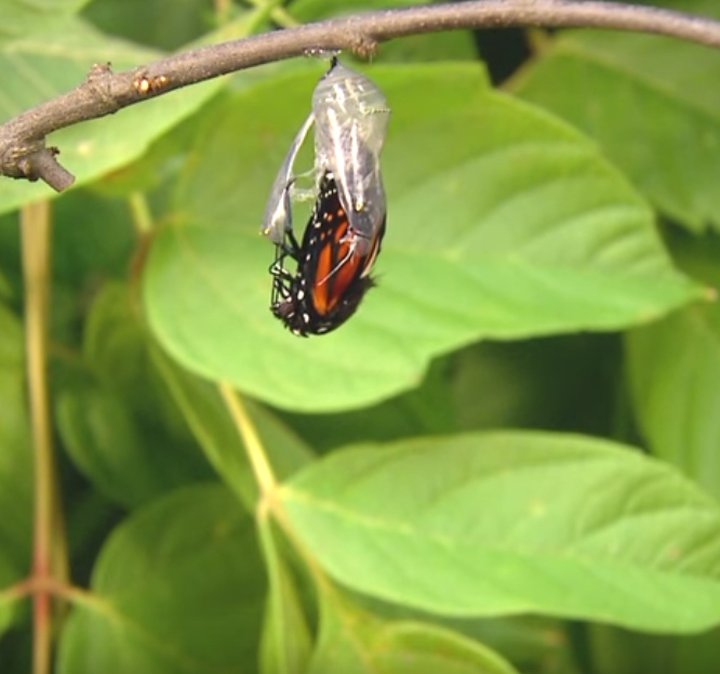
Monarch butterfly emerging from chrysalis (U.S. Fish & Wildlife Service)
I liken it to having a series of keys cut. That new lock you bought for your door (perhaps learning from Gloria Gaynor, “I should’ve changed that stupid lock, I should have made you leave your key…”?) came with a couple of shiny new keys. At some point you get a duplicate cut. Then another, using the first dupe as the template. And again and again — until, by the time you get to the seventh or eighth iteration, the key doesn’t fit anymore. Same with our cells (kind of): every time our cells duplicate themselves, the daughter cells aren’t quite as perfect as the originals. In a word, they’re mutations.
More to the point, is there any truth to the seven-year replacement cycle? Turns out, yes, but it’s only recently that researchers have been able to prove this. Jonas Frisen is a Swedish molecular biologist who figured out how to estimate the age of a new cell by its Carbon14 content. Until the 1963 aboveground test ban treaty, for 18 years the great powers regularly dumped radioactive C-14 into the atmosphere. Since then, the concentration of C-14 in the air has been going down, so its concentration in a cell is a kind of time stamp by which you can date when that cell was created.
Frisen came to the conclusion that bodies do, indeed, renew themselves every seven to ten years, although there’s quite a range when you look at specific organs. For instance, epidermal skin (the outer layer) is replaced on average every three weeks, while the cells that make up the cerebral cortex (the brain’s outer layer) are never replaced. So if you think your memory and attention span aren’t what they used to be, you’re probably right. (Fortunately other brain tissue, including the hippocampus “learning center,” does rejuvenate.) Bones are constantly renewing themselves over about a 10-year span, but the process slows down as we age—hence osteoporosis. The linings of our stomachs and intestines have a hard acidic life, god knows — they replace themselves on a five-day cycle. Liver? Anywhere from five months to two years. Red blood cells? Four months. Hair? About three years for men, six years for women. (Anyone know why the difference? I couldn’t find any information on this.)
###
In any case, however efficiently your body renews itself, those mutations will catch up with you sooner or later. How soon, how late? Mammals get about a billion heartbeats per lifetime, pretty much across the board. Larger mammals have slow heartbeats and long lives; vice versa for small mammals. For instance, in order of size:
Pygmy shrew: 1.02 billion total heartbeats (1300 beats per minute, 1.5 year average lifespan) Mouse: 1.31 billion heartbeats (500 bpm, 5 years) Cat: 1.18 billion heartbeats (150 bpm, 15 years) Human: 2.24 billion heartbeats (60 bpm, 71 years) Horse: 0.93 billion heartbeats (44 bpm, 40 years) Elephant: 1.03 billion heartbeats (28 bpm, 70 years)

From H.J. Levine, Rest Heart Rate and Life Expectancy. Journal of the American College of Cardiology, 1997
Wait a bit — why do humans get so many more heartbeats? That one billion rule should have had us pushing up the daisies at age 32. As I discussed it in my book Everyday Wonders, it’s probably due to our very long periods of adolescence compared with other creatures. The late paleontologist Stephen Jay Gould attributed to our “neotenic” evolution, whereby as adults we have retained the juvenile features of our ancestors. With much longer gestation and childhood periods than comparably sized mammals, we have longer lives overall. (Contrary to popular myth, the maximum lifespan of humans hasn’t increased that much over the centuries — used to be, plenty of people lived to age 70 if they managed to avoid disease and violence.)
Having read this far, you just used up another 300-odd heartbeats. Don’t squander any more!
BOOKED
Today: 4 felonies, 7 misdemeanors, 0 infractions
JUDGED
Humboldt County Superior Court Calendar: Today
CHP REPORTS
No current incidents
ELSEWHERE
RHBB: New Fire Near French Gulch Grows Rapidly in First 45 Minutes
KINS’s Talk Shop: Talkshop October 5th, 2026 – Brian Stephens
RHBB: Redcrest’s Hayle Gibson-Stillwell Rides into the NFR as the One to Beat
Governor’s Office: California’s economy continues to dominate — topping $4.5 T in economic output, and remains the world’s fourth largest economy
LETTER FROM ISTANBUL: The Making of an American
James Tressler / Sunday, Dec. 27, 2020 @ 7 a.m. / Letter From Istanbul
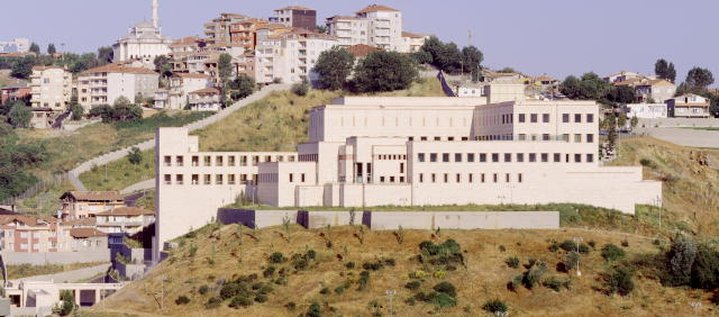
The American Embassy in Istanbul. Photo: Wikimedia.
###
The
American embassy in Istanbul resembles a fortress, at least when
viewed from a distance. It’s located some distance from the city
center, at the top of a hill in a residential neighborhood called
Sariyer. Up close, it looks like a military compound. The ground
floor entrance is blocked by gates and fortified with the presence of
security per sonnel and armed vehicles.
We were there to get our son Leo’s American passport. Getting an appointment at the embassy had taken months. Because of the pandemic, the embassy had drastically reduced its services. So when we finally managed to secure a coveted slot, we jumped at it.
When we arrived that morning with Leo, bundled and wrapped against the early morning December chill, it was still dark outside and except for the security, virtually lifeless.
“Well, at least we won’t have to stand in a queue,” I mused aloud, trying to keep the mood cheerful. We’d got up at six, disrupting Leo’s morning routine, struggled him into his winter clothes and managed to get out the door to the waiting taxi, documents in hand.
The half hour journey from our home in Uskudar to the embassy was quick. The vast city was still mostly asleep at that hour, dark except the glow of lights around the great mosques and the twinkling skyscrapers.
At 7:30 the taxi dropped us off in front of the embassy. A burly but not unpleasant security guard told us to wait until 8, when we could go inside to wait for our appointment.
“What are we going to do for thirty minutes?” my wife Özge asked, holding Leo in the kangaroo pack. Leo was sleepy but curious. The street was silent, dark. A coffee shop directly across the street was closed. The pandemic, my wife reminded me.
Özge found a sort of alcove in the entrance of a nearby apartment building and she ducked inside to keep Leo at least out of the cool damp mist.
Nervously, I stood on the pavement, smoking a cigarette to pass the time, keeping an anxious eye on the embassy. After so many months of waiting, I think I was paranoid of some last-minute snafu, or a whole busload of people would suddenly emerge from the pre-dawn shadows and descend on the gates. But the only people who came were embassy employees, who drove slowly in through the entrance to the small parking lot to start their day.
The consulate offices themselves are located in a tower-like building that sprouts up from the top of the hill overlooking the security entrance. As an American, you can’t help but feel a sense of proprietorship, even outrage, at being told to stand outside and wait, especially when they give you the routine once-over. Hey, you want to say, I’m not some refugee or asylum seeker. I’m an American, that’s my embassy.
I reminded myself for the -nth time to be patient. We’d done everything we could do to be ready. The rest was in God’s hands, or at least the blessed bureaucrats. I checked on my wife and Leo, barely discerning their figures in the sleeping shadows of the alcove.
“Is it a dodgy neighborhood?” she asked rhetorically.
I knew how she felt. At that hour, the buildings all looked wet and dark and shabby. The embassy alone stood tall and safe-looking, almost proud in the dawn.
At 8 o’clock, I heard a voice calling from a distance. It was the same security guard from when we arrived. “Gel! Gel!” he said, waving at us to come.
At the entrance, two other security guards asked to see our appointment, which I had saved on my phone. We handed over our passports, mine American and my wife’s Turkish.
“Only you can come,” the guard said, in Turkish, indicating that I alone had the appointment. Protocols are strict, even more so nowadays.
I politely protested, since the procedure requires that in order to apply for a passport for Leo, both he and my wife must be present in person. My wife also explained this to the guard. After a moment of confusion, a call was made upstairs and, the matter cleared up, the guard nodded and waved Özge and Leo to come forward.
“Spread your arms,” the guard ordered. But then he stepped back, turning his head brusquely. “Mask!” he barked.
I’d forgotten to put my mask back on when we entered, so I apologized and quickly donned it. The guard patted me down for weapons, then let me through and turned his attention to my wife and son. She had brought along a baby bag, with milk, snacks, diapers. This bag was run through the X-ray machine, opened and inspected.
Finally, we were allowed to proceed to the entrance. Elated, we walked along the brightly lit passageway and into the building. There, we went through an airport-like full X-ray scan, and handed over our mobile phones. Then we were directed to the elevator. The consulate offices were on the second floor.
“Why do they take our phones?” my wife asked.
“I guess they can be used for bombs,” I said.
Inside the office, it was deserted. In normal times, all of the seats would be full of nervously hopeful Turkish visa applicants. American Citizen Services is in a separate office, much smaller. A lone guard directed us to wash our hands in lotion, and have a seat.
At 8:30 we went into the American Citizen Services office and a Turkish employee, very pleasant and easy going, looked over Leo’s application forms. “So you’re here for a passport and a CRBA,” he said, pronouncing the latter as “kerba,” fancy bureaucratese I gathered. He checked to make sure we had submitted all the proper documents. As part of the procedure, I had to submit proof that I had actually lived in the United States for at least five years, so I handed him my university transcripts,which had been mailed all the way from California, a not-easy maneuver in these trying times.
Our documents in order, we were sent to another window, where an American woman conducted a short interview. She was young, efficient, to the point. The interview took about five minutes.
Evidently satisfied, she told us the passport would arrive in a couple of weeks, followed by the birth abroad certificate. It was done.
We wished the American woman happy new year and headed back to the elevator. She smiled again, and seemed happy for us, and for Leo. Perhaps that is a good part of her job, seeing such moments, the making of an American.
In the taxi, we crossed the bridge again, looking out at the ships in the Bosphorus, and all the now-awake city in the distance. All this time, Leo had behaved beautifully. He’s already a seasoned traveler. He picked a hell of year to be born, we say.
Well, we Americans have always been an uprooted, ever-migrating people. It’s in his blood.
The taxi dropped us off. We were home. Which home? Our home here in Istanbul. But now Leo had a home in America, too.
“I want him to have options,” my wife said. I agreed. After all, isn’t that something parents can do for their children? Not just give them love, but also options in life?
###
James Tressler, a former Lost Coast resident, is a writer and teacher living in Istanbul.
Ready to Get Rid of Your Christmas Tree? Here’s a List of Places Where You Can Drop it Off, And Some That Will Pick It Up
LoCO Staff / Saturday, Dec. 26, 2020 @ 10:31 a.m. / Helpful Information
Press release from the Humboldt Waste Management Authority:
With the holidays coming to a close, residents may dispose of their Christmas trees at several community locations at no-charge or may arrange for pick-up by their trash hauler. Residents are encouraged to recycle their Christmas trees so they may be processed into useful mulch or compost. To prepare Christmas trees for recycling, residents must remove all decorations, including ornaments, hooks, garland, tinsel and lights. Flocked trees may not be recycled.
Drop-Off Locations:
Arcata
Wes Green Landscaping, 6360 West End Road
Dec. 28th – Jan. 16th
822-8035
Blue Lake
Clemance Field/Perigot Park, 312 S. Railroad
Jan. 2nd — Jan. 14th
668-5932
Eureka
HWMA’s Hawthorne Street Transfer Station, 1059 West Hawthorne Street, Eureka
Dec. 26th -Jan. 10th
268-8680
Ferndale
Ferndale’s Fireman Park, 100 Berding Street
Ferndale Fairgrounds, 1250 5th Street
Dec. 31st - Jan 4th
786-4224
McKinleyville
Humboldt Sanitation Transfer Station, 2585 Central Avenue
Dec. 26 — Jan. 24th
839-3285
Fortuna
Recology Eel River’s Fortuna Transfer Station, 965 Riverwalk
Fortuna Fairgrounds, 1 Park Street
Dec. 26th — Jan. 14th
725-5156
Rio Dell
Rio Dell City Hall, 675 Wildwood Ave (back parking lot)
Dec. 26th – Jan. 4th
764-3532
###
Curbside Collection (Collection fee may apply, please contact)
Humboldt Sanitation
839-3285
Recology
May collect curbside trees in Arcata, Eureka and some unincorporated areas of Humboldt County.
442-5711
Arcata High School Track Team
Arcata residents only. Curbside pick up of tree for $15 with funds benefiting the Arcata High track team.
822-8325
THE ECONEWS REPORT: 2020 Humboldt County Environmental Roundup
The EcoNews Report / Saturday, Dec. 26, 2020 @ 10 a.m. / Environment

Our panelists take a look back at local environmental work in 2020 and take a look forward to big issues in 2021.
Discussed: Mercury levels in Humboldt Bay fish, the Potter Valley dams on the Eel River, Caltrans’ Richardson Grove project, management of the region’s National Forests in the shadow of catastrophic wildfire, and more.
AUDIO:
ETTERSBURG MURDER CASE: Judge Rules That Ryan Tanner Must Stand Trial For Murder
Rhonda Parker / Thursday, Dec. 24, 2020 @ 8:36 a.m. / Courts
Ryan
Anthony Tanner must stand trial for murder, kidnapping, arson and a
slew of other charges, Judge John Feeney ruled Wednesday.
Feeney, who presided over Tanner’s 13-day preliminary hearing, ruled enough evidence was presented to provide “probable cause” that Tanner murdered 26-year-old Jason Todd Garrett on Feb. 12 in a cabin near Ettersburg.
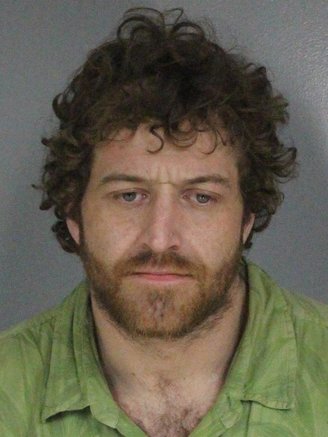
Tanner.
It’s also suspected that Tanner, 33, burned down the cabin and set several brush fires in the area in an effort to conceal his crime.
Before the judge made his ruling, defense attorney Russ Clanton argued there was no solid evidence that Tanner killed Garrett. Clanton said law enforcement trusted the initial statement from eyewitness Christopher Champagne, and from then on the investigation focused only on Tanner. Investigators’ goal was to make the evidence conform to what Champagne claimed, Clanton said.
“Ryan was an easy target,” he said, because of his past history of violence. Tanner allegedly physically abused his girlfriend and others. During the hearing, numerous witnesses said Tanner had threatened them with death.
As for Champagne, who said he saw Tanner kidnap Garrett and then shoot him in the head with an assault rifle, “it would be diplomatic to call Christopher Champagne’s testimony bizarre.”
Although Champagne provided law enforcement with details that were later confirmed, he also made some astonishing claims. One was that he witnessed Tanner in a shoot-out with law enforcement, killing a half-dozen officers and burning their bodies.
Clanton argued “there is nothing that points to Mr. Tanner committing this homicide other than some collateral contact with other people (witnesses who encountered Tanner around the time of the killing).”
He criticized the law enforcement investigation as “full of gaping holes” and called the testimony of prosecution witnesses “a classic example of self-serving statements.”
Deputy District Attorney Whitney Timm, who is prosecuting the case along with Deputy District Attorney Jessica Acosta, said it was clear some of Champagne’s testimony was “hallucinatory.”
But the cornerstones of Champagne’s account were corroborated by other witnesses, Timm argued. There is no dispute, she said, that Garrett and his friend Natalie Pierce were on Crooked Prairie Road in the Ettersburg area, and Pierce was having problems with her vehicle. Champagne said Tanner set fire to the back of Pierce’s truck and forced him to light the front on fire.
“That makes sense when considering the conclusions of the arson investigators, “ she said. Calfire investigators said most of the damage to the truck was on the passenger side, but there was also major damage to the right front tire. Also, arson investigators confirmed Champagne’s statement that the truck’s battery was removed before the fire was set. Timm pointed out that Champagne said he wrapped Garrett’s neck with duct tape after Tanner slashed him with a knife. Witness Robert Norris saw tape around Garrett’s neck, and there were tape strips found on his neck when his body was exhumed on Tanner’s property.
It’s alleged Tanner shot Garrett with an assault rifle. A shell casing from an assault rifle was found about 10 feet from the bathtub that Garrett was allegedly forced into before he was shot. Also, identical shell casings were found strewn around Tanner’s property and in his house.
Champagne told investigators that at some point, a bloody T-shirt was thrown into the cab of Tanner’s Toyota 4-Runner. A few months after the killing, sheriff’s investigators took trained cadaver dogs to Tanner’s property. The dogs “hit on that 4-Runner,” Timm noted.
Garrett reportedly was in the bed of that 4-Runner both when he was kidnapped and after he was shot. When law enforcement examined the truck, the bed had been doused with bleach. During the investigation, many witnesses came forward to tell law enforcement what they knew. Tanner eluded police for several days and was finally arrested at a friend’s house in Briceland.
Tanner
is expected to be arraigned on Jan. 6.
Timm told the judge she expects Clanton to file a motion to dismiss.
###
PREVIOUSLY:
- HOMICIDE IN ETTERSBURG: Sheriff’s Office Arrests One After SWAT Operation Yesterday
- Investigators Locate Ettersburg Suspected Homicide Victim’s Remains
- Ettersburg Murder Suspect Enters Not Guilty Plea; Also Charged With Assaulting Two Other Men With AK-47
- Suspect in Homicide Near Ettersburg is Sane Enough to Face Charges, Judge Rules
- Witness Describes Execution-Style Murder of a Man and Dog in a Bathtub During Ryan Tanner Prelim Hearing
- Main Prosecution Witness Garbles Testimony
- Witness Provides Gruesome, Hallucinatory Testimony in Ettersburg Murder Trial
- Girlfriend of the Accused Testifies That He Abused Her and Threatened Her With Death
- Another Neighbor Testifies That the Accused Had Been on a Paranoid, Violent Rampage for Weeks Before the Killing
- Police Investigators Testify to the Discovery of the Body and Possible Murder Weapons
- Defense Attorney Grills Lead Detective, Attempts to Cast Doubt on Witnesses, Evidence, Investigation
OBITUARY: Mary Jane Holly, 1930-2020
LoCO Staff / Thursday, Dec. 24, 2020 @ 6:56 a.m. / Obits
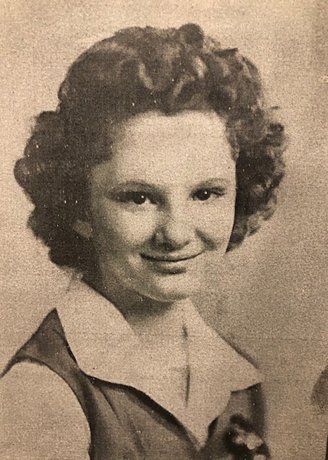
Mary
Jane Holly, a long time resident of Rio Dell, passed away December 2,
2020. She had lived in Briceland since 1969. Briceland had been the
home of Glen and Amy Strawn, long-time residents and some of the
original old-timers. Glen had at one time been married to Mary’s
mother, Julia. Glen was, in fact, the father of Mary’s two oldest
sisters Betty and Doris (both predeceased). Mary and her husband
Melvin Holly eventually settled in Rio Dell.
Mary was born August 26, 1930 in Stonyford, California. She was the youngest of four sisters. Her mother, our Grandmother Julia, married Bob Grieves after her marriage to Glen was dissolved. Grieves is a well known Scottish surname. And it was so wonderful to have bag pipe music at the memorial service in which Mary’s family celebrated her life.
Bob and Julia had two daughters. They named the first one Roberta (predeceased), then Mary was born. When our mother was four years old, Bob and Julia divorced and Mary and Roberta went to live with Bob. Roberta and Mary were both placed in a Catholic Convent shortly afterwards, and they lived there for about two years. Mom and Roberta both had tales to tell about the stern Convent Sisters.
Mom was 13 and living near the naval base in Bremerton, Washington in 1943 – just when the Pacific theater of WW II was in full swing. Service men of all branches of the military were heroes at that time, and the sailors at Bremerton were no exception. A story that she reluctantly told from time to time was when she wanted to go to the base and see sailors. She really wanted to be around the sailors. Her older sister Betty wisely forbade her to go. Mary, as strong-willed as she has always been, insisted on going and would not take no for an answer. Betty, to keep her from leaving the house and going to the base, tied her up in a chair and would not untie her or let her go. Up until just a few years ago, when she could still tell a story, her sons would coax her to talk about this. She would tell the story as though it had happened yesterday, and had fire in her eyes and smoke spewing from her ears when she told it and still held it against her sister Betty even after all those years.
By 1946, at age 16, shortly after the war she was married to Dave Erckenbrack. Dave had been a sailor so she finally got her wish. Lonnie, her oldest son was born in 1947, Carol was born in 1949, and Steve was born in 1952. The marriage between Mary and David didn’t last, so by 1955 Mary had married Melvin Holly (who had also been a sailor!). They were living in Hanford California at the time, and later moved to Fresno. And when they lived in Fresno, Leonard was born in 1960 and Vernon was born in 1962. Lonnie enlisted in the USAF in 1967, and Carol flew from the nest in 1968. By 1970 Mary and Melvin had moved to Briceland.
Another story involves her youngest son, Vernon, when they lived in Briceland. Vernon has always loved to hunt. As a young boy, he used to hunt squirrels. And the rule in the family was that if you shoot it or catch it, you have to eat it. Vernon had skinned and cleaned the squirrels, and eventually amassed quite a few of them in the freezer. Mom told him to stop shooting squirrels but he kept at it. But Mom had her own way of solving the problem. Vernon woke up to a nice breakfast of fried squirrel. For lunch he had squirrel. That night —yep, squirrel. For breakfast the next day, another mess of fried squirrel. By now Vernon was begging for something different. After two or three days of this Vernon had learned his lesson.
Mom and Dad and Steve Leonard and Vernon formed lifelong friendships in Briceland. For a short time they moved to Pacifica to be closer to work, and then when they moved back to Humboldt County they moved to Rio Dell and stayed here from that time on.
There is a story told, that one time when Mary had been called in for jury duty, she called her daughter (after a few beers) and told her all about it. She also mentioned the judge’s admonition to not discuss the case outside of the court room. Her daughter Carol then ran with it. One thing this family enjoys is a well executed practical joke. So in cahoots with her brother Lonnie and Carol’s husband Jim, Carol put her plan action. Mary got a call from Carol’s husband posing as “the officer of the court,” reminding her of the judge’s admonition. Mary and her husband Melvin were astounded. They were convinced that line men working in the area had tapped their phone. Her son Lonnie was supposed to call the next day and let her know that it was a joke but he forgot to call. Mary’s daughter then called, three days later, and told her mother. Mary was silent for a few long seconds, obviously processing this. As the realization dawned on her and she finally understood that it was a joke, she began laughing. She laughed for a long time. She enjoyed the joke as much as her kids did!
She was a stay-at-home mother.She always aspired to be a writer and had written several short stories. Mary was an aspiring and an inspiring woman. She had an unquenchable thirst for knowledge. She had enrolled in English classes for years and had always wanted to be a writer. She always saw the good in people. Between she and her husband Melvin (predeceased), they always had something to fill the outstretched hand. Nobody left their home hungry. She always defended her children, and was deeply loved by her grandchildren.
Mary has five children, 19 grandchildren, and 35 great-grandchildren. Mom had always been a very important part of her children’s lives, and an active part in the lives of her grandchildren. They meant everything to her. She always saw the good in her children, and her grandchildren. She didn’t ignore the bad parts, but she always had love for us. She always supported her children. And that’s how she lived out the rest of her life. Being a part of her children’s lives, and doing everything she could for them and the grandchildren.
She was a guardian angel to many, friend and family alike. To know her was to love her. She is sorely missed. No one who came to their home left hungry. You could always count on taking home with you some berries or a milk carton of frozen fish or something from the garden. Usually all of the above. Mom was always willing to share with us her recipes. She was a good cook even though we did eat at 8 o’clock at night sometimes. I think she was angry when she spent all day cooking and then finally we sit down to eat and within 15 minutes dinner was devoured.
###
The obituary above was submitted on behalf of Mary Holly’s loved ones. The Lost Coast Outpost runs obituaries of Humboldt County residents at no charge. See guidelines here.
Christmas Shoppers Are Lining Up to Support Local Business This Year Despite COVID, Retailers Say
Stephanie McGeary / Wednesday, Dec. 23, 2020 @ 5:23 p.m. / Business
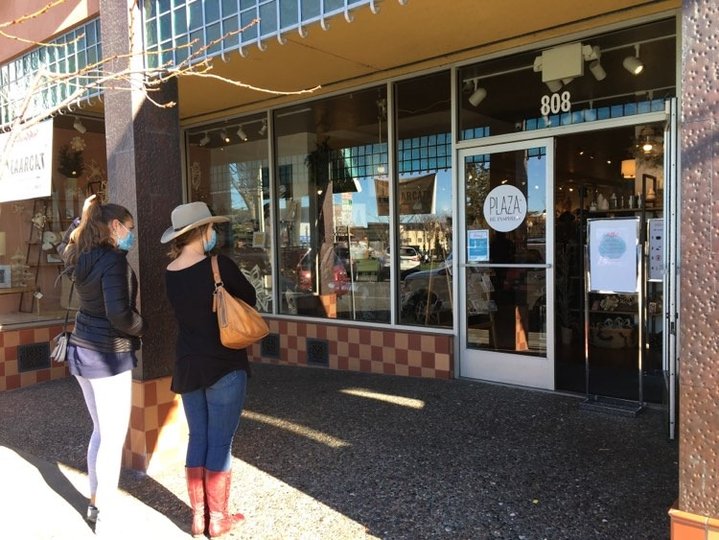
Shoppers wait outside of Plaza in Arcata on Dec. 23
Though the pandemic has been tough on our local economy, with many small businesses taking a hit, some retailers report that the Christmas season has been as good as ever this year, with masked shoppers lining up to spend their dough despite the pandemic.
While calling around to Eureka and Arcata shops, many were too busy to even take LoCO’s questions. But a few folks were able to squeeze in some time between customers to fill us in on how sales have been, how they’re approaching customer service during COVID and what the general mood has been during the busiest shopping days of the year.
“People have overall been really pleasant,” Natalie Walston, owner of Plaza in Arcata told the Outpost over the phone today, adding that customers have been waiting in line outside at times when the store is at capacity. “Our customers have been great about it. They have been patient and understanding that we have to adhere to guidelines.”
Humboldt remains in the state’s “purple tier” for COVID guidelines, which allow retailers to remain open, but restrict them to operating at 25 percent capacity and with all the usual masking and sanitizing requirements in place.
For Plaza that means 12 shoppers are allowed into the store at a time, Walston said, which makes it impossible to complete as many sales as the store has in past years. Also, when the store is at capacity, some people may decide not to shop there and go elsewhere instead. But even though the store has seen a lower volume of sales this year, Walston said, the numbers have still been good because customers are tending to spend more money.
Walston said that it has been heartening to see so many people supporting their local businesses this year. “People are letting us know that they are shopping local intentionally,” she said.
Over in Old Town Eureka, Little Shop of Hers has also been having a successful Christmas shopping season and owner Courtney Jackson says that in some ways this year has actually been a bit easier.
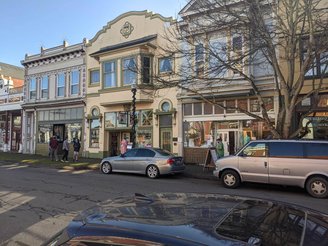
Littel Shop of Hers and other Old Town stores | Photo: Hank Sims
“I think having limits on the number of people who come in has been a good thing,” Jackson told the Outpost over the phone this afternoon, occasionally breaking from the conversation to help a customer. “People are so aware of their space. They’ve been so considerate.”
Jackson said she has also seen a reduction in theft this year, something that has been a problem for her during past Christmas seasons. Usually manning her store by herself, Jackson is not always able to watch all the customers when the store is very full.
Like Walston, Jackson reports that although the store has seen fewer customers because of COVID, sales have overall been very good, with fewer people coming in to just look around. “When people come in, they come in with a purpose,” she said. “When people come in, they’re buying.”
For local cannabis dispensary the Humboldt Patient Resource Center (HPRC) the sales trend seems to be the same — though the volume of sales has declined this year, the average amount of each sale has increased.
“We seem to see that people spend a little more, but shop less frequently,” HPRC geneal manager Bryan Willkomm told the Outpost. Of course, this trend makes sense, Willkomm said, because people are trying to be conscious of the amount of shopping trips they take during COVID.
It’s hard to say yet how much overall sales have been impacted this year, Willkomm said. But the dispensaries have definitely seen fewer new customers this Christmas season than in past years. Usually there is an uptick in tourism-based shopping during the holiday season, Willkomm said, with a lot of people coming to visit their friends or families in the area.
Willkomm agrees that a lot of community members have been motivated to support their local businesses this year. “We’re grateful to all those business groups and chambers who have been supportive of ‘shop local’ campaigns,” he said. “Especially as a cannabis business, it’s been great to feel like we’re being supported by the community.”


