ETTERSBURG MURDER CASE: Another Witness Testifies That All Was Fine Between the Accused Murderer and the Victim on the Night of His Death
Rhonda Parker / Friday, Dec. 18, 2020 @ 7:55 a.m. / Courts
According to Robert Norris, all was fine and dandy the night Jason Todd Garrett had his throat cut and then got shot in the head by an AK-47 assault rifle.
Norris, an obviously reluctant witness for the prosecution, testified Thursday during the preliminary hearing for murder suspect Ryan Anthony Tanner. He was at Tanner’s house for several hours with Tanner, Garrett and Christopher Champagne. This was after Tanner allegedly slit Garrett’s throat and Champagne wrapped the wound with cloth and duct tape.
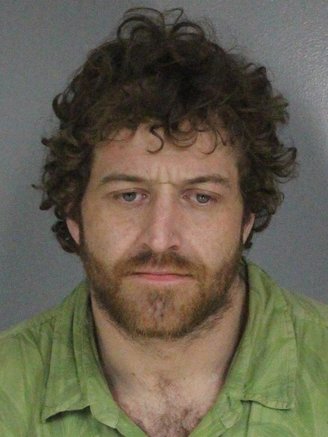
Tanner.
Norris, under questioning by Deputy District Attorney Jessica Acosta, said he saw no wound and saw no blood. Champagne had testified earlier in the hearing that the cut was so deep he could see Garrett’s Adam’s apple hanging out.
Norris insisted everyone was behaving normally, and the only thing Garrett was upset about was some kind of trouble with his friend Natalie Pierce. He and Pierce had been hanging out together in her van. The vehicle has been variously described as a van, a truck, a bread truck and an ice cream truck.
“He was griping about the girl in the truck,” Norris said. “He was upset about the lady not helping him with the truck.”
According to Champagne, Pierce and Garrett were stranded in the back woods because the truck’s tires were flat. Champagne said Tanner set the vehicle on fire and kidnapped Garrett. Pierce had run away. Norris had been living and working at Tanner’s place for about three weeks. He denied he’d been hired as a marijuana trimmer, saying he was just there to clean up around the house so Tanner “wouldn’t get an abatement letter.”
About 40 minutes after Tanner, Champagne and Garrett arrived that night, Norris said, Champagne and Tanner left for a couple of hours. Norris said Tanner told him “Keep an eye on that guy,” referring to Garrett.
“I didn’t take him seriously,” Norris said. “We were in the middle of nowhere in the middle of the night. Where would (Garrett) go?”
He and Garrett ate some oatmeal and watched a movie, Norris testified. He lay down on the living room couch, and Garrett was on a mattress in the corner.
About midnight Tanner and Champagne returned, with Tanner announcing they were going to take Garrett to “the end of the road,” meaning where the dirt road ended and pavement began.
“(Garrett) said ‘Great! Right on!’ Norris recalled. “That’s where he wanted to go.” All this time Garrett was accompanied by his dog, Leonard.
Prosecutor Acosta asked whether Garrett had also said he didn’t want to be there. Norris said no.
According to Champagne, Garrett was driven to another residence, where Tanner forced him into a bathtub and shot him, killing both Garrett and the dog. Champagne said Garrett and Leonard were buried under a water tank on Tanner’s property.
But Norris said that the following morning, he saw Leonard “pop up” from the bed of Tanner’s truck. Norris left the property when he realized Tanner and Champagne were gone and he was locked out of the house.
“I figured I wasn’t going to get paid so I walked out,” Norris said.
With Leonard following him, Norris walked and hitch-hiked to Redway. He stayed for a few days with a friend, Angie. Eventually someone who wanted a dog came and got Leonard. Norris denied a series of statements he allegedly made to law enforcement and to people in Redway. One example: Garrett had an ice pick sticking out of his neck.
“I never said that.”
He also denied telling anyone that when Tanner left with Garrett, he turned to drive up the hill, not down to the end of the road.
And he said it wasn’t true that he heard Garrett mumbling under his breath to the dog, saying “Someone will come and everything will be all right.”
At one point, Acosta asked “Mr. Norris, are you afraid of Ryan Tanner?”
“No.”
Both Acosta and co-prosecutor Whitney Timm asked it be noted for the court record that Norris nodded to Tanner while entering the courtroom.
Testimony was expected to continue this morning before Judge John Feeney, who will eventually rule on whether enough evidence has been presented to order a jury trial for Tanner.
###
PREVIOUSLY:
- HOMICIDE IN ETTERSBURG: Sheriff’s Office Arrests One After SWAT Operation Yesterday
- Investigators Locate Ettersburg Suspected Homicide Victim’s Remains
- Ettersburg Murder Suspect Enters Not Guilty Plea; Also Charged With Assaulting Two Other Men With AK-47
- Suspect in Homicide Near Ettersburg is Sane Enough to Face Charges, Judge Rules
- Witness Describes Execution-Style Murder of a Man and Dog in a Bathtub During Ryan Tanner Prelim Hearing
- Main Prosecution Witness Garbles Testimony
- Witness Provides Gruesome, Hallucinatory Testimony in Ettersburg Murder Trial
- Girlfriend of the Accused Testifies That He Abused Her and Threatened Her With Death
- Another Neighbor Testifies That the Accused Had Been on a Paranoid, Violent Rampage for Weeks Before the Killing
BOOKED
Today: 4 felonies, 7 misdemeanors, 0 infractions
JUDGED
Humboldt County Superior Court Calendar: Today
CHP REPORTS
No current incidents
ELSEWHERE
Governor’s Office: Governor Newsom announces new disaster intelligence satellites, opens modernized State Operations Center as Trump erodes national disaster readiness
RHBB: Controversy But Fortuna Area Cannabis Farm Allowed to Expand With Manufacturing, Distribution
RHBB: Humboldt Events Launches a ‘Central Place to Discover Local Events’
RHBB: Temporary closure on Forest Road 16N21 in the Upper Lake Ranger District
OBITUARY: Edna Juanita ‘Nita’ Guglielmina-Monson, 1935-2020
LoCO Staff / Friday, Dec. 18, 2020 @ 6:56 a.m. / Obits
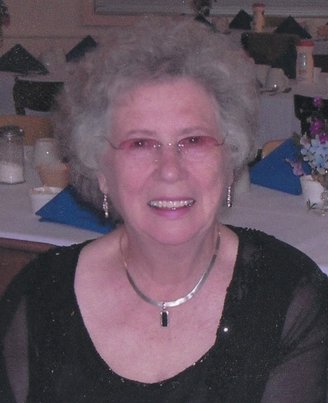
Edna
Juanita ‘Nita’ Guglielmina-Monson
December
22, 1935 – December 12, 2020
Nita was born on Dec. 22, 1935 to Robert and Alice Hancock in Lincoln, Arkansas. In 1939 Nita and her family moved from Arkansas to California. They resided in various places in the Watsonville/Lodi area until Nita finished high school. After high school Nita moved to Humboldt County, where she met Norman Cushing. Nita and Norman were married for 16 years.
During this time she went back to school and received her LVN license, then worked as a surgical prep nurse at St Joseph’s Hospital in Eureka. In 1971, Nita married Elmer Guglielmina and the two moved to Loleta where they remained for 29 years. After Elmer’s passing in 2000, she moved to Eureka, where she met Alfred Monson. Nita and Al were married in 2006, and they spent the next 14 years traveling and cruising everywhere their hearts desired.
Nita passed away in her home in Eureka on Dec. 12, 2020 at the age of 84, with her husband, Al, and fur-baby Sophie, at her side.
Nita is survived by her husband Al Monson of Eureka, sister Bobbie Parker of McKinleyville, son Edward Cushing (Melissa) of Hydesville, daughter Emily McCall (Kenneth) of Eureka, granddaughter Kathleen McCall of California, and numerous other aunts, uncles, nieces, nephews and cousins.
Per Nita’s request, there will be no services or viewing. In lieu of flowers, donations can be made in her name to Hospice of Humboldt.
###
The obituary above was submitted on behalf of Nita Monson’s loved ones. The Lost Coast Outpost runs obituaries of Humboldt County residents at no charge. See guidelines here.
Eureka Police Investigating Hate Crime After Gay Couple’s Christmas Decorations Were Vandalized
Ryan Burns / Thursday, Dec. 17, 2020 @ 4:44 p.m. / Crime

Photos courtesy Brian Kleinmeyer.
###
On Wednesday morning, Brian Kleinmeyer walked out to the front yard of the Myrtle Avenue home he shares with his boyfriend, Daniel Kain, and noticed that the gingerbread men in their elaborate Christmas yard display had been pulled from the ground and placed beneath their nearby pride flag. Closer inspection revealed that the handmade decorations had been smeared with feces.
“They literally ripped them out of the ground, and wiped their asses with them, and carefully laid them at the base of our Pride Flag,” Kleinmeyer wrote in a Facebook post. “I thought things might get stolen, but never in a million years did I think this would happen. I’m completely in shock.”
The Eureka Police Department is now investigating the incident as a hate crime.
###
Speaking with the Outpost Thursday afternoon, Eureka Police Chief Steve Watson said an officer was dispatched to the scene for investigative purposes after Kleinmeyer reported the incident, and once the evidence was gathered, the suspect’s (or suspects’) intentions were unmistakable.
“It’s very clear in my mind this was a deliberate act based on the suspect’s perception of [the victims’] sexual orientation,” he said.
Describing the crime as an “absolutely horrendous and appalling thing,” Watson said the investigating officer will follow up with a criminal report for a hate crime under California Penal Code 442.6(b). Under state law, a hate crime is defined as a criminal act committed, in whole or in part, because of the victim’s disability, gender, nationality, race/ethnicity, religion or sexual orientation.
If convicted of this crime, the suspect would face up to a year in jail, a fine of up to $5,000 or both.
In a message to the Outpost, Kleinmeyer said this is actually the second time in the past two weeks that his and Kain’s Christmas decorations have been vandalized. “The first time they broke a Santa sleigh in half and tangled up a bunch of my Christmas lights,” he said. Regarding the latest crime, he added, “Something about two Gingerbread Men holding hands just pushed them over the edge, I guess.”
While the incident took him by surprise, Kleinmeyer said he felt compelled to speak up about it. “I just want to make sure that this doesn’t happen to anyone else or, if it already has, that they feel empowered enough to speak up about it,” he said.
Watson said he called Kleinmeyer and Kain personally Thursday morning.
“I just wanted to reassure them that the city manager and I, the council — that EPD and the city has their back,” he said. “This kind of hate is not going to be tolerated. We’ll throw every resource we have into identifying, pursuing and arresting whoever’s responsible, as well as working with the District Attorney to make sure they’re prosecuted to fullest extent of the law.”
Watson believes that hate crimes, such as the “white youth” recruitment flyers posted in Eureka last year, go underreported locally, much like domestic violence, because people are sometimes afraid to come forward.
“I still want to believe that … the overwhelming majority of Humboldt County residents are welcoming, accepting people,” he said. “But we can’t stick our head in the sand, because we know there are many people who live in fear of racism and hate.”
He mentioned this past summer’s Black Lives Matter protests as evidence of those experiences.
The Eureka Police Department is asking for the public’s help in identifying anyone who might be responsible for this or any other hate crime, Watson said.
This afternoon, as the Outpost was messaging back-and-forth with Kleinmeyer about this experience, there was a new development.
“Daniel just came home and says he ran into Chief Watson today,” Kleinmeyer wrote, adding, “He gave us these amazing cookies.”

###
His next message read, “I’m not going to lie, I didn’t cry over our decorations being vandalized, but I did from the kindness we have been shown since it happened. I’m completely blown away  “
“
Below is nighttime footage of the Kleinmeyer-Kain Christmas decorations, pre-vandalism.
Two Suspected Burglars Arrested Last Night After Brief Standoff at Spring Street Apartment, EPD Says
LoCO Staff / Thursday, Dec. 17, 2020 @ 4:33 p.m. / Crime

Lemmons (left) and Cookman.
###
From the Eureka Police Department:
On December 16, 2020, at about 8:42 p.m., officers with the Eureka Police Department (EPD) responded to the 2100 block of Spring Street for the report of two unknown male subjects seen inside a neighbor’s apartment.
Once on scene, officers confirmed entry had been forced to the apartment and movement could be seen inside. Dispatchers contacted the resident who stated that nobody was home and no one had permission to be inside. Officers set up a perimeter and began giving commands to exit. During this time, an officer saw one male with a long gun through a window.
As a K9 announcement was being made, two male subjects fled out of the apartment in different directions. They were met by officers at the perimeter. 18-year-old Thomas Cookman was taken into custody and found to be in possession of a loaded handgun. 21-year-old Tyler Lemmons was taken into custody after a taser deployment. A handgun presumed to have been in Lemmons’ possession was later found near where he was taken into custody.
Once in custody, statements were made that additional subjects were inside. Based on the totality of the situation, the Humboldt County SWAT team was requested. A reverse 911 Shelter in Place notification was made to nearby residents for their safety. SWAT responded and took over the perimeter and commands for exit. A distraction device was used to assist in the tactical entry into the apartment. After a thorough search, it was determined that there were no additional suspects inside.
Cookman and Lemmons were transported to the Humboldt County Correctional Facility and both booked for conspiracy, burglary, felon in possession of a firearm, and obstructing an officer. Based on their probation status, they are not eligible for bail.
How Many Granada Residents Will Die? Deputy Health Officer Dr. Josh Ennis Takes Media Questions on the Pandemic
LoCO Staff / Thursday, Dec. 17, 2020 @ 4:06 p.m. / COVID-19 and Humboldt
Is the county keeping track of workplace outbreaks? How many Granada residents will die? Are medical staff being tested often enough? Is the trigger for the state’s new stay-at-home order — less than 15 percent of ICU capacity — actually too lax? Are there enough people to staff all our ICU beds?
Dr. Josh Ennis, deputy health officer, answered these media questions and more in today’s media availability on the county’s COVID response. Video above, rough transcript below.
###
The North Coast News asks, “Are county health officials keeping track of the number of workplace outbreaks, defined as three or more cases within 14 days, and can you share this number with us? Are you able to share a list of which workplaces specifically have had outbreaks?”
For every single positive case that we get we reach out to the individual, we get information regarding potential exposure, define the infectious period, investigate places of employment as well, because there are some new mandated reporting requirements surrounding exposures in the workplace.
We don’t keep track of outbreaks in the way that this question is worded, but we do keep track of where exposure events occur and many times that is in the workplace setting. Suffice it to say it is truly in a large number of settings and in the highest-risk settings such as nursing facilities, assisted living, as well as health care settings. We have more than five across some of those settings ongoing right now. Just to give you an example of what we’re up against right now.
In many of those settings we’ve been very successful at containment, but not successful in every single one of those cases, so this is what we’re battling against and it’s challenging to respond to every single one of these situations and test hundreds of people on a once or twice weekly basis. That is how widespread the disease is right now.
The North Coast News asks, “When a county resident is tested are they asked for their place of employment and is this documented? If not, why?”
So I spoke to this already in the first question but we typically get this information at the time a positive test comes in, so we don’t ask for it up front, we’re testing thousands of people in any given week, and so it’s when we have a positive that we reach out to individual, ask about places of employment, to determine if there’s any exposure potentially within that workplace setting, and then it goes out from there through the tracing. So we ask for it after the positive comes in and not up front at the time of testing because it’d simply be too much information to manage when we’re testing thousands of people every week.
The North Coast News asks, “With community transmission at an all-time high do you believe focusing on stopping spread of COVID-19 in the workplace is still as effective in mitigating spread in the population as it was earlier on in the pandemic? Has stopping workplace spread become more or less of a priority for Public Health?”
I think we are more effective in mitigating transmission in the workplace setting but given the volume it’s become increasingly challenging to always contain it 100 percent of the time because our resources are spread thinner and thinner.
There’s no explicit statement that we’re placing more priority on the workplace setting, although we’ve seen lots of the regulatory environment around this get tightened up at the state level, but I will tell you because of the shift we made some time back in our investigations and tracing to having certain priority groups that are higher risk individuals or higher risk for widespread spread of disease, it is inherent in the priority groups that we put together that we do focus on some workplace scenarios where there is a lot of potential for widespread transmission of disease.
And again I’ve said this about the nursing facility setting, but anytime there’s a workplace setting and there’s a big outbreak within it, it’s not isolated to that facility because people are coming in and out all the time of that system, so there’s a huge potential for it to reflect back out in the community and while I wouldn’t call it necessarily a super spreader event, it’s working in much the same way, spread out, drawn out over a period of days to weeks, so it’s a big concern anytime we have a large outbreak in any of these settings and the workplace is no exception.
The North Coast News asks, “Do you agree with the new requirements for employers laid out in Cal/OSHA’s emergency temporary standard?”
Early on in the pandemic we set up the business approval process through our county EOC and Joint Information Center, and so many employers already have kind of the framework of what’s being asked for here, and we’ve seen that there is a lot of potential for spread to occur in the workplace setting on account of concerns about retaliation in the workplace setting, a potential loss of short-term income and ultimately potential loss of long-term employment if that person’s potentially easily replaceable in the workplace setting.
So I think the idea here is to make it easier for people to come forward have a plan in place to deal with it quickly and try and limit the spread of COVID-19 in the workplace and the reality is we’ve been doing this all along this is just formalizing kind of the regulatory environment around it.
The North Coast News asks, “What is the realistic expectation for loss of life at Granada considering many residents have opted to not have extreme life-saving measures taken? Can they change their minds on the DNR paperwork considering many signed it pre-pandemic?”
So when a patient comes to a nursing facility their code status or end-of-life wishes need to be evaluated and they need to be known upfront and that’s reevaluated on an ongoing basis.
When we look at who actually is in a nursing facility, they tend to be people who are older and who have comorbidities that make them more dependent upon 24-hour nursing care, and that’s the definition of a skilled nursing facility.
So these are the two things that we know place those individuals at the highest risk for severe disease, as well as death, and so we know that when there’s an outbreak in the nursing facility that there is going to be a lot of loss of life, and it’s where approximately 40 percent of all deaths were occurring early on in the pandemic.
None of them are forced into any end of life decisions last minute. They can have a discussion surrounding any changes they would like to make, so it’s not something that’s written in stone, it can be reevaluated at any point.
The Redheaded Blackbelt asks, “Since the state issued the mandate for weekly testing of all hospital staff, which includes support staff and delivery personnel, as well as staff that are in direct contact with patients, has St. Joseph Hospital in Eureka implemented this process, and if not what are the hurdles to getting this done? Alternatively, if you are aware that they have been doing this on a weekly basis, how many tests are required to test the entire hospital staff?”
First I’d like to point out that this is not actually a mandate, it is a recommendation at this time.
Secondly, this was a timeline that tried to put this all together in a matter of two weeks and we’re talking about thousands of tests a week across the entire county. Seeing how the testing landscape has been, where it’s where it’s been throughout the entirety of the pandemic, making another 2,000 tests available, 3,000 tests available in the matter of two weeks, is simply impractical.
We’ve been working 10 months to get where we’re at now of being able to do somewhere around four or 5,000 in a week, so the hospitals are making their best effort and a good faith to meet this recommendation, but it’s simply impractical to make it happen in a matter of two weeks, so we’ve been trying to make it much more targeted but support the hospitals in trying to meet this recommendation.
The Redheaded Blackbelt asks, “Due to the need for COVID-19 positive patients to be coordinated together and isolated apart from other non-COVID hospitalized patients, how many ICU beds are designated to the COVID unit currently in light of our recent increase in hospitalizations?”
So I want to clarify one item here because this question’s asking about the COVID unit, so I’m guessing they’re speaking to the COVID unit that’s been established, or the respiratory care unit that’s been established at St. Joe’s Hospital in Eureka.
They do have dedicated space for those patients but that does not overlap, is my understanding, with the actual ICU.
What’s really important in caring for COVID-19 patients is that to minimize risk of exposure to those staff caring for the individual, they need to have negative airflow and so there’s a certain air volume that needs to be exchanged in a certain period of time and those rooms exist elsewhere in the hospital, they’re not exclusive to just the COVID unit, so they have Med Surg rooms, they have ICU rooms that have those air flow capabilities, and so the patients can be cared for outside of this respiratory unit, it’s just the unit itself tries to bring together all of it in a more centralized fashion to make caring for these patients easier and safer on the whole for the entire staff.
The North Coast Journal asks, “In other parts of the state, doctors and hospital administrators have raised alarm bells about whether the state’s ICU capacity metrics used to trigger the governor’s stay-at-home order fully take into account staffing and other limitations. Do you feel like the state’s regional ICU capacity database accurately reflects hospitals capacity to provide intensive care?”
The regional ICU capacity metric across Northern California doesn’t reflect how patients move throughout the health care system.
As an example, Humboldt as well as counties to our south typically send patients south to the Bay Area or east over into the Sacramento Valley, Del Norte sends into Southern Oregon, the north eastern corner of our region sends into Reno, so patients move throughout the health care system and it’s not captured fully by this regional metric.
Secondly, the regional metric has maybe a little more than 100 beds, but if you compare to that to receiving hospitals such as Bay Area and Sacramento, we’re only a tenth of what the Bay Area has and we’re only about a fifth of what the Sacramento Valley has, so we have a very small sliver of the overall ICU beds that our patients may end up occupying. So while our percentage looks good locally, it looks good across the region, it may not take into account the context of where the patients move outside of our region.
The North Coast Journal asks, “As of this morning the county’s dashboard shows Humboldt County hospitals have 50 percent available ICU capacity. Can you explain what metrics are used to determine this percentage? Is it simply licensed beds that are currently available? Does it take into account hospitals’ emergency plans to create more surge capacity? Does it account for available staffing under current conditions with traveling nurses largely unavailable?”
So there has been no shortage of confusion about this because the way it’s been looked at has changed several times throughout the pandemic. It is not using licensed beds. Licensed beds across the state typically include neonatal ICU beds, they include pediatric ICU beds in our county, and I believe there are five neonatal ICU beds that are included in that number, so it’s kind of misleading, you can’t put a 60-year-old in that neonatal ICU bed.
So what they’re looking at are the adult ICU beds that are part of what they term as non-surge operations, meaning they can bring the staff and the equipment in as part of their regular resources.
So they basically look at the empty adult ICU beds and put that on top of how many non-surge adult ICU beds are look and calculate that percentage of available ICU capacity. Again our numbers are very small in our county and our region compared to many of the receiving regions that may have our patients getting sub-specialty care that they can’t otherwise get in our county.
The North Coast Journal asks, “In a county like Humboldt with comparatively fewer ICU beds per capita than more urban areas and understanding hospitalizations generally trail two weeks or so behind new confirmed cases, is the 15 percent threshold an early enough trigger to effectively implement new restrictions that would prevent the local hospital system from becoming overwhelmed?”
It really depends upon what’s happening around us whether that 15 percent threshold or trigger is appropriate. I can tell you that as I’ve already talked about some of our other regions that may receive some of our patients — The Bay Area has more than 1,300 ICU beds, the greater Sacramento region has more than 500 and the Nor Cal region, just to put in perspective, has somewhere between 120, 125 ICU beds across our region. So we hold a very small sliver of the entire pie of ICU beds that may care for Humboldt County residents.
So if they’re impacted dramatically all around us, it may not make sense to wait until we reach this trigger because we’re talking about a very small number of beds and as we’ve seen with small numbers, they can fluctuate a lot and so it may not make sense if what’s going on around us is dramatically impact and full already.
The North Coast Journal asks, “There has been a lot of talk about securing additional ventilators and building ICU surge capacity in local hospitals, but a ventilator in a hallway isn’t really an ICU bed and a ventilator alone won’t save lives if there isn’t a trained professional ready to staff it. How many patients would you estimate Humboldt County’s health care system can provide with intensive care at one time before the hospital becomes taxed and the quality of care decreases?”
So there has been a lot of focus on this because it is our most limited resource and no one wants to be forced into position similar to wartime medicine where you’re having to choose who gets the vent, who gets the ICU bed.
This question is correct though that if we’re reaching a point where there aren’t enough people to care for all these, the quality care is going to suffer.
So we’ve focused on these limited resources, we’ve increased them substantially, both ICU beds and vents to a point where other issues are probably going to come into play, such as the health care workforce, before we actually reach the hard cap of these finite, limited critical care resources.
So I’d be hard-pressed to give a number at this time because it changes depending upon the demand for this healthcare workforce elsewhere.
In Humboldt County we do have a need for traveling health care professionals and if they’re in demand across the entire country at the same time we’re going to have a much more challenging time bringing them in to deal with the surge.
So the actual number can fluctuate depending on what’s happening around us and right now they’re in peak demand across the state, across the entire country.
Six Rivers Charter Students Put Together 2021 Wall Calendar for the Local History Lover in Your Life
Jacquelyn Opalach / Thursday, Dec. 17, 2020 @ 11:28 a.m. / History
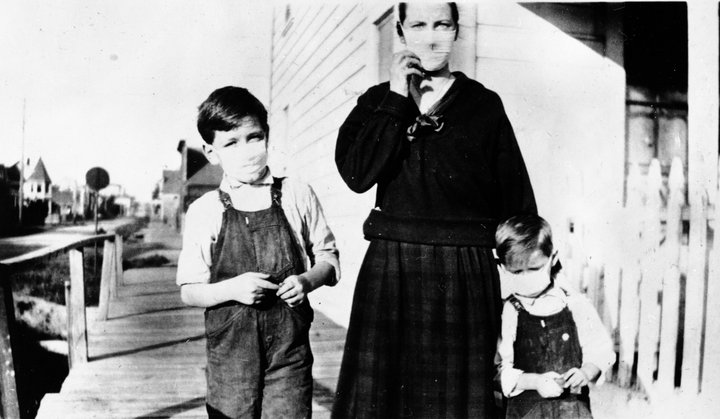
An adult and two children in flu masks — among the images used in Six Rivers’ “Then & Now” 2021 wall calendar. Photo: HSU special collections.
###
If you’re a fan of local history and you still haven’t got yourself a 2021 wall calendar, don’t worry! Six Rivers Charter High School has gotcha covered.
Students there recently completed their historical calendar project, which features old-time photos of local landmarks side-by-side with current snapshots of the same location, plus facts about the site’s history. Despite unusual virus-y circumstances, seniors and project directors Emma Scott and Isaac Wilson managed to pull it together, marking the fourth year in a row that Six Rivers has produced a calendar.

The two started the project in September, choosing local photos from the Humboldt State Special Collections, researching the photos’ histories courtesy of local museum websites, and often personally capturing a modern image of the landmarks they chose to feature. Wilson, who likes history, handled the research, while Scott took on the photography.
One page in particular highlights the very historical time we are living indeed. It’s an image of a 1918 Flu pandemic-era family, masked and standing on an Arcata street corner. Scott and Wilson posed for the re-creation image themselves, also masked and standing on the very same corner.
Scott’s favorite page is of Humboldt’s Coast Guard station, and Wilson likes the month about Trinidad’s 1920s-era whaling station ‘cause the history is interesting. (Despite promises that the station would be sanitary, it turned out to be a putrid disaster and had to be shut down not long after it opened.)
Six Rivers Principal Ron Perry said in a press release that he’s proud of the students and their creation. “The calendar is an example of the sense of interdependence Six Rivers hopes to foster in our students,” he said, stressing that a lot of support for the project came from local businesses and community members.
It was difficult to complete the project virtually, Scott told the Outpost, but ultimately, “it was really cool to learn about these things that I had no idea happened.”
And you, too, could learn such things. The calendars, which cost five dollars, have been distributed to local businesses, including A&L Feed, Coast Central branches, Pierson’s, Sunnybrae ACE, Wildberries and the Grind Cafe. All proceeds go toward Six Rivers student activities. You can also snag one from the Six Rivers site itself, by calling 707-825-2428.
FEAST YOUR EYES on the Expansive Network of Multi-Use Trails in the County’s Final McKay Community Forest Trail Plan
LoCO Staff / Wednesday, Dec. 16, 2020 @ 5:24 p.m. / Local Government
Press release from the Humboldt County Administrative Office:

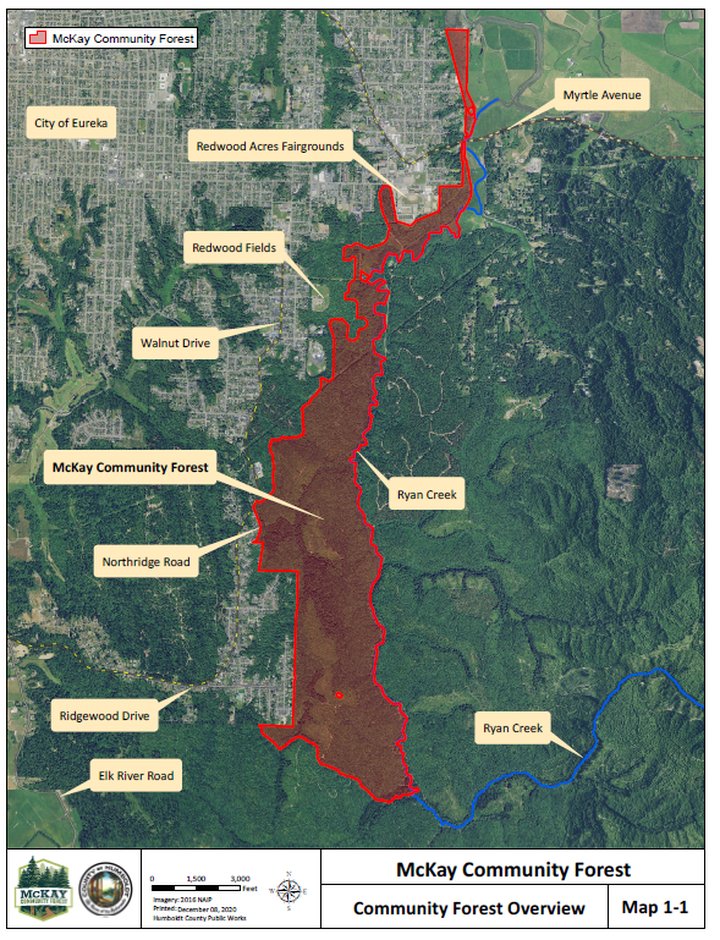
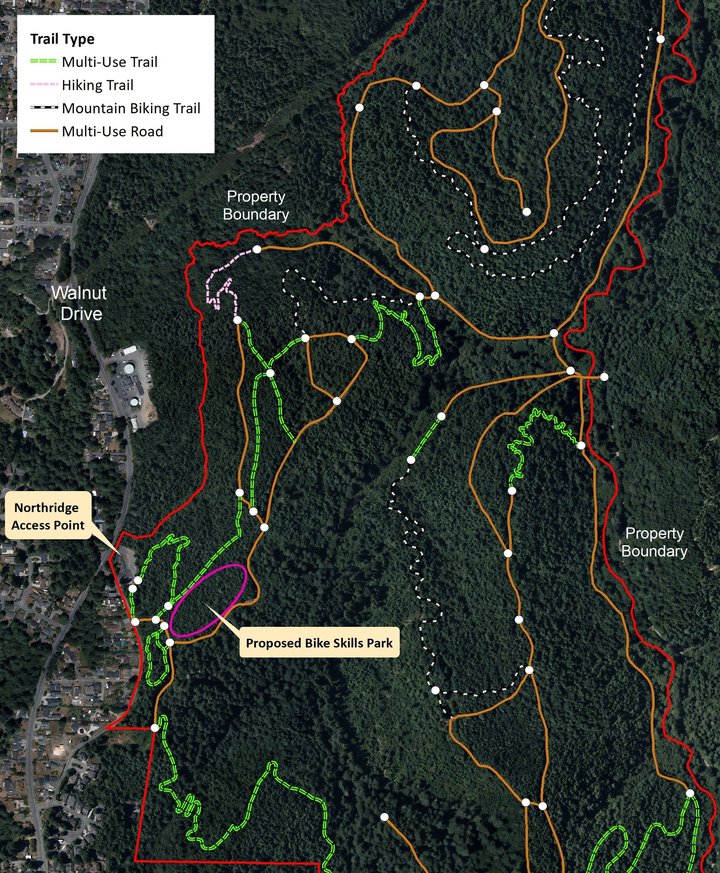
Humboldt County residents are one step closer to potentially having new forest trails to enjoy on the North Coast. The County of Humboldt today released the final McKay Community Forest Trail Plan along with the associated environmental report, both of which are available for review and comment on the county’s website. The trail plan proposes a trail network with 31 miles of multi-use roads, multi-use trails, hiking trails, and mountain bike trails.
The trail plan describes the overall goals, objectives, guiding principles, design standards, and construction practices for building sustainable trails to support outstanding outdoor experiences for a diversity of trail users. The plan contains detailed maps showing the proposed access points and trail locations. The final plan was revised based on 85 comment letters received from the public on the draft plan.
The environmental report identifies a set of mitigation measures to ensure that implementation of the trail plan does not have significant effects on water quality and biological resources. The public review period for the environmental report extends from Dec. 17, 2020, through Jan. 19, 2021. The Board of Supervisors will consider adopting the report in February or March, 2021. Trail construction within the McKay Community Forest can begin once the environmental report is adopted and public health guidance allows groups to gather for trail building.
The trail plan was prepared with an emphasis on accommodating users with accessibility needs. The proposed trail network includes 1.5 miles of trails that fully meet the technical standards for accessible trails, and 0.7 miles of trails that meet most, but not all, the technical standards due to topographic constraints. The trail plan includes 5 miles of trails with features designed specifically for mountain bike riders, to be constructed in conjunction with the Redwood Coast Mountain Bike Association. Mountain bikers often prefer narrow, curvy trails with features that are technically challenging and provide an experience of play and discovery.
“The release of the trail plan and environmental report for the McKay Community Forest is a huge milestone and gives us something really exciting to look forward to in 2021,” said Rex Bohn, Humboldt County First District Supervisor. “Trails and open spaces help make Humboldt County a great place to live in and visit, and trails have been especially important for people this year during the COVID-19 pandemic. Once groups can gather once again, hopefully next spring, we’ll be able to work with volunteers to start the trail building and make the McKay Community Forest a tremendous asset for our community.”
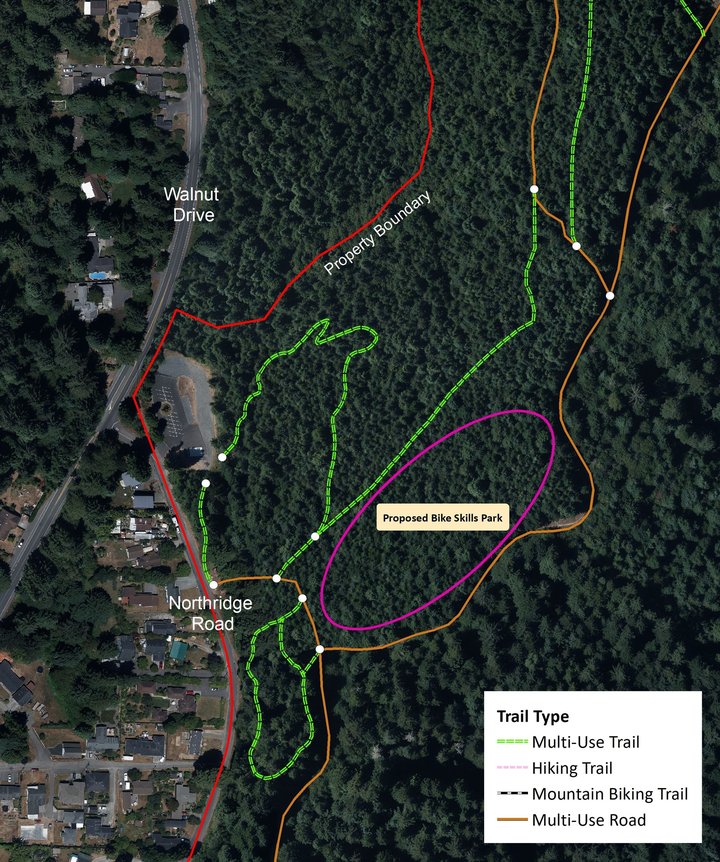
The McKay Community Forest was established in August, 2014, in partnership with Green Diamond Resource Company and The Trust for Public Land, and then expanded in June 2020 to its current size of 1,194 acres. Funding for developing and managing the Community Forest will be achieved through timber harvest revenues, grants, and donations. A parking area was constructed in Cutten along Northridge Road in 2018 to provide dedicated access to the community forest. Additional access points will be located along Harris Street and within Redwood Acres. More entrances are expected to be developed near Redwood Fields, Manzanita Avenue, and Walnut Drive within 2 to 5 years as large parcels are permitted for subdivision.
Trails will be developed incrementally in a logical sequence over the course of several years. The first trails to be built and opened to the public will be located near Northridge Road, Harris Street, and Redwood Acres. Trail construction will depend heavily on the California Conservation Corps, Volunteer Trail Stewards, and Redwood Coast Mountain Bike Association. A total of 12 bridges will be required.
The trail plan includes a proposed Bike Skills Park near the Northridge parking area that would be developed and maintained in collaboration with the Redwood Coast Mountain Bike Association. Facilities would include a pump track, skills area, kids zone, and three sets of flow trails. The pump track would provide a continuous loop with features that allow riders to gain momentum without pedaling by “pumping” the bike with up and down movements. The skills area would provide features developed with dirt or wood to help riders practice bike handling, balancing, and jumping.
The kids zone would provide small-scale features with a focus on safety and skill development. The flow trails would have a concentration of technical features with a range of difficulty levels. These facilities would provide opportunities for riders, especially youth, to learn and practice skills and then apply those skills on the trails within the Community Forest.