Since
the legalization of recreational cannabis in 2016, growing herb here
in the Golden State has become increasingly complicated. Compliance
costs and competition have increased significantly, while prices for
bulk flower have cratered. The relatively idyllic, romanticized
lifestyle that family farms enjoyed for decades is being upended
quickly. Multibillion-dollar deals are now commonplace in the
industry, with major Pharma, tobacco, and beverage players entering
the space and staking their claim.
Humboldt
County, long recognized as the powerhouse in global cultivation, is
now a takeover target. Reports of “distressed outdoor assets” are
now being discussed in corporate boardrooms as are strategies to move
in, purchase farms on the cheap, and greenwash the Humboldt brand.
Our story, which took decades to unfold is at risk of being upended
in just a few short years.
To
survive and thrive in a new corporate paradigm, family farms need to
up their business and cultivation skills. As someone who has engaged
dozens of commercial cannabis farmers through my financial consulting
platform, it’s become clear that many smaller operations could
benefit from professionalizing and formalizing their operations.
Doing so can help farmers stay in the game and capitalize on the
world’s most rapidly growing industry.
For
decades farming cannabis profitably in California was simpler.
Because of this, operators never had to bother with many of the
business planning functions so common to other industries. Things
like business plans, mission and vision statements, target markets,
and product diversification weren’t really on the minds of folks
operating in the space. One could buy rural land on the cheap, grow
tons of decent weed, sell it for high prices, and earn a marvelous
living. There was lots of work involved and the risk of incarceration
and theft was real, but it didn’t take a rocket scientist to be a
successful cultivator. Humboldt, like neighboring communities, minted
many millionaires from the mid-nineties onward.
Corporations
and investors took notice. Now that billions of dollars are flooding
into the industry, competition is fierce and farmers must become
astute businesspeople if they want to survive. They must formalize
and professionalize their operations to find lasting success. The
first step in this process is creating a written business plan to
help guide the operation forth with clarity. The second is creating
an operations plan that guides day-to-day workflow to control
quality, improve outcomes and generate the consistency necessary to
build a successful brand.
A
business plan doesn’t have to be intimidating. It can be a real
joy to create, especially for those who truly love farming cannabis
and competing in a growth industry. It’s your chance to be creative
and identify how you want to operate and where you want your business
to go.
When
creating your business plan, you must first describe
your company in detail. Things like your vision,
mission, and value proposition are included here. What problems are
you trying to solve? What market needs are you attempting to meet and
why/how can you meet them better than others? What do you hope to
achieve with your business, in other words, what is its meaning and
purpose?
Your
plan should also include market
analysis.Many use a SWOT analysis that outlines your
specific strengths and weaknesses as well as opportunities and
threats facing your company. In the case of cannabis, market analysis
should talk about increasing social normalization and competition,
changing consumer needs and preferences, product proliferation, price
action, and a developing national and global marketplace among other
things.
The
business plan should also detail your company’s organizational
structure. What type of entity are you, a corporation, an LLC?
How about the structure in terms of employees, management, and
outsourcing of critical business functions like accounting and human
resources?
Product
focus and marketing/salesare often the bread and
butter of the business plan. Are you competing for shelf space with
high-end flower, seeking celebrity endorsements, or growing biomass
for extractors and other value-added participants in the supply
chain? Are you focused on cannabis as a medicinal, lifestyle, or
recreational product? How will you get your product to market? What
distribution platforms will you use and will they provide acceptable
sales velocity and revenue? How does your operation help distributors
fulfill the needs of their customers and do you fulfill them better
than others?
A
natural offshoot from this section of the business plan is
financials.Using
reasonable figures for production, prices garnered for a product, and
a detailed breakdown of costs, how do things pencil out? At what
point during the year will you break even? How much must you set
aside post-harvest to fund the following season’s operation? How
profitable is your business? What changes can be made to improve
financial performance?
When
complete, you will be proud of the plan created. It will guide your
organization forward and can always be adjusted as needed. Once
commercial lending finds the cannabis space and as mergers and
acquisitions continue in the coming years, having a sound plan and a
proven track record of success will show your professionalism and
help you stand out from the crowd.
An
operations plan is also critical to your ongoing success. This
plan should outline your farming process in exceptional detail.
Everything you do to create a product, from start to finish, must be
written down. This not only helps improve consistency and
predictability but also allows you to transfer your knowledge
efficiently to workers or potential suitors.
I
build a master plan in January of each year that outlines planting
and harvest dates, clone dates, farm purchases, and other pertinent
information. From that basic blueprint, I create a weekly calendar
each Sunday with the necessary action items to keep me on track for
the week and the season. I enjoy the process as it clears my head and
allows me to farm more confidently than I otherwise would. It is
enormously beneficial in terms of dictating workflow, improving
efficiency, and creating accountability. Was the work done or not? If
not, why not? Calendaring helps avoid distraction and helps prevent
overlooking important details. Many farmers are paranoid about
documenting their “trade secrets” and workflow, but failing to do
so will inhibit your ability to scale or grow your operation.
Transferability of your winning systems will help drive enterprise
value and will become increasingly valuable in a marketplace
dominated by consolidation and M&A.
While
somewhat time-consuming, professionalizing and formalizing your
operation is a must. Failing to do so will only hasten one’s demise
and facilitate the transfer of wealth from your pocket to corporate
coffers. As margins continue to compress and as excess profits or
economic “rents” are priced out of the cannabis supply chain
through increased efficiencies and increased competition, your
cultivation business must run like a well-oiled machine. Sound
planning, creative marketing, and a laser-like focus on quality and
cost control can help your business survive the challenging times
ahead. Everyday execution of your plan coupled with love, faith,
unwavering commitment, and authenticity will help you win the hearts
of consumers and allow you to continue operating in the industry you
helped create.
###
Jesse Duncan is a lifelong Humboldt County resident, a father of six, a retired financial advisor, and a full-time commercial cannabis grower. He is also the creator of NorCal Financial and Cannabis Consulting, a no-cost platform that helps small farmers improve their cultivation, business, and financial skills. Please check out his blog at, his Instagram at jesse_duncann, and connect with him on Linkedin.
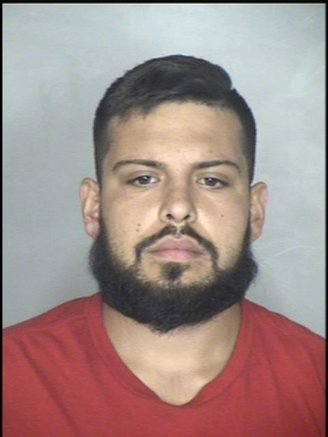
In the days before he allegedly murdered a Southern Humboldt couple, Ulisses Rodriguez may have been planning to rob his own marijuana grow in the China Creek area, a prosecution witness testified today.
Martin Morris, a district attorney’s investigator who is very familiar with the contents of Rodriguez’s cellphone, said he came to that conclusion by reading a “What’s App” conversation between Rodriguez and a person who called himself “D.”
In the chat, the two mentioned that their own plants (not at the China Creek site) weren’t ready to sell, and Rodriguez said he had a couple of people lined up, “like Jose.”
Jose Sanchez also was growing marijuana at the same site, on property owned by a man named David Wilks and managed by Wilks’s sister.
Morris said he believes Rodriguez and D were gathering firearms and possibly other people to commit the robbery. It has been established Rodriguez owned a .357 revolver and a pistol. There are plenty of selfies on his phone showing him with the revolver.
The weapon holds seven rounds, which Morris said “is unusual.” Seven shell casings were found in a burn barrel near the spot where the shooting occurred.
Morris also established Rodriguez was mailing packaged marijuana to a person in Hawaii, and the customer was wiring him payment through Western Union. A few days before the killings, Rodriguez texted “the dude from Hawaii” had arrived.
According to eyewitness “John Doe,” a man from Hawaii was standing right there when Rodriguez allegedly shot Jeremy Kuemmel and Tiffany Ellebrecht. Doe said Rodriguez told the Hawaiian man to get in his car while he ordered Doe to wrap the bodies in chains.
Rodriguez reportedly hooked the chain to his Lexus SUV, which was a equipped with a “Z ring” for towing, and dragged the bodies to Kuemmel’s Ford Expedition.
On the day of the shootings, according to cellphone records, Rodriguez got a text from the property owner’s sister. She told him “the stress is killing me” and she planned to turn the operation over to her brother. She had done everything she could to save the property, she said, but “I’m done.”
Rodriguez responded with “Wut are you talking about? You don’t answer my calls. Wut are you trying to do? Threaten me?”
“Not a threat,” she replied. “Not a threat.”
The sister also told Rodriguez “Jose lied to me. He told me he only had three greenhouses.”
It’s unknown whether Rodriguez and the sister had that exchange before or after he allegedly shot Kuemmel and Ellebrecht. Their incinerated bodies were found later that day in Kuemmel’s Expedition, which had been parked in a turnout on Briceland Road and set on fire.
Deputy District Attorneys Trent Timm and Luke Bernthal are the trial prosecutors, with attorney Andrea Sullivan representing the 27-year-old Rodriguez.
Testimony is expected to continue Monday before Judge Gregory Elvine-Kreis, with Sullivan cross-examining Morris.
Jose Sanchez is on the trial witness list, as are two Sanchez cousins. The man from Hawaii, David Kane, is also on the list.
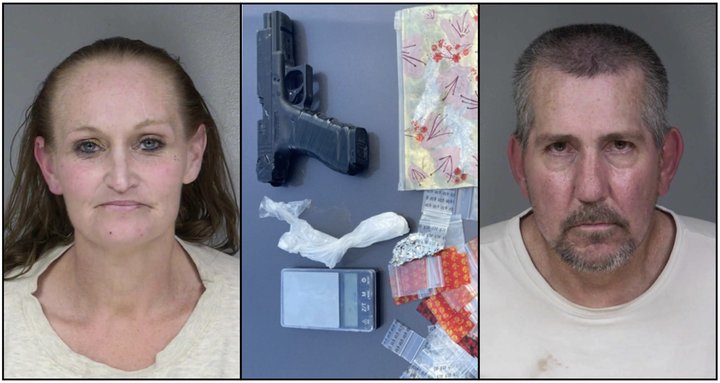
Since early January 2022 the Humboldt County Drug Task Force (HCDTF) had been investigating
Suntalena Downs (41 years old from Eureka) for transporting fentanyl into Humboldt County. As a
result of their investigation agents received a search warrant for Suntalena Downs and any vehicle
related to her.
On January 26th, 2022, HCDTF agents conducted surveillance on Downs and her boyfriend, James Davis
(53 years old from Eureka) as they left Humboldt County driving a rental car. Agents observed Downs
and Davis drive to San Francisco, Sacramento, and then Redding. During the early morning hours of
January 28th, 2022, HCDTF Agents stopped Downs and Davis as they entered Humboldt County on
Highway 299 in Willow Creek. Both subjects were detained without incident.
Agents conducted a search and located approx. one ounce of fentanyl, packaging, a digital scale, and a BB
gun made to look like a real firearm. Downs and Davis are both on probation in Humboldt County. Both
suspects were arrested and transported to the Humboldt County Jail where they were booked for the
following charges:
H&S 11351 Possession of fentanyl for sale
H&S 11352(a) Transportation of fentanyl
H&S 11352(b) Transportation of fentanyl across non-contiguous counties
PC 182 Conspiracy
PC 1203.2 Probation violation
Anyone with information related to this investigation or other narcotics related crimes are encouraged to
call the Humboldt County Drug Task Force at 707-267-9976.
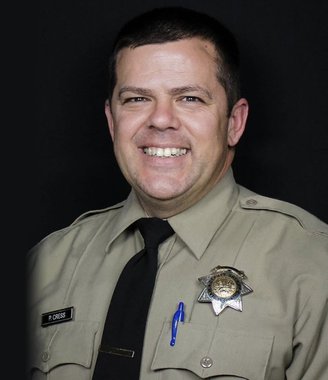
Today is Chief Anthony Morgan’s last day at Cal Poly Humboldt. Cal Poly Humboldt is initiating the search process for a replacement Chief of Police. Peter Cress has been appointed interim Chief of Police for the University Police Department. This appointment shall continue until a permanent replacement is selected.
In this capacity, interim Chief Cress shall be responsible for University Police, Security, and Parking.
Peter has 24 years of experience in law enforcement and public safety. After beginning his career locally, including two years as an officer at Cal Poly Humboldt Police Department, his interests took him to law school and then service at the Sacramento County Sheriff’s Department as their in-house counsel. Upon return to Humboldt County, he served as a lieutenant for the Humboldt County Sheriff’s Office before coming to UPD.
Peter was born and raised on the North Coast. He earned his undergraduate degree from Cal Poly Humboldt in 2003 and his law degree from the University of the Pacific, McGeorge School of Law, in 2006. He is set to begin the dissertation phase of a Ph.D. in Criminal Justice this fall. He has taught courses at Sacramento State University, Humboldt State, and College of the Redwoods.
Cress has shown he is a creative and thoughtful leader on campus and in UPD. He has shown commitment to the continuation of UPD’s cultural growth.
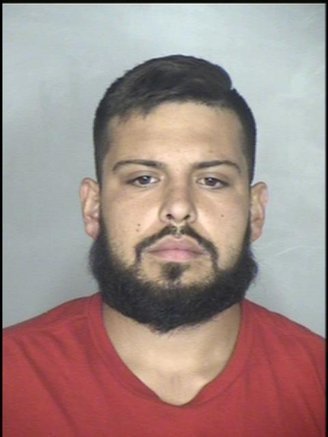
In the week between his alleged murder of two people in Southern Humboldt and his arrest in Chico, Ulisses Rodriguez had a special interest in two topics: shopping for a car and reading news articles about the killings.
On Thursday, the fourth day of Rodriguez’s jury trial, David Kahl, a Sonoma County District Attorney’s investigator and an expert in extracting data from electronic devices, testified about the information extracted from Rodriguez’s cellphone. The phone was seized when he was arrested Aug. 20, 2018.
Rodriguez.
Kahl testified that beginning on Aug. 15, the day after Tiffany Ellebrecht and Jeremy Kuemmel were shot dead, Rodriguez began reading news reports about the killings. A few times he read a story about the autopsies being scheduled.
And several times he clicked on “Humboldt Cars and Trucks” and “Chico Cars and Trucks,” possibly hoping to replace his Lexus SUV with another vehicle.
Under questioning by Deputy District Attorney Trent Timm, Kahl said that before Aug. 15, Rodriguez had never used the phone to search a news site.
Defense attorney Andrea Sullivan, cross-examining Kahl, asked about the typical Internet searches by homicide suspects.
“Reading news articles about the crime,” Kahl said.
“Wouldn’t they being doing research about how to dispose of bodies, or GPS’s or how to cover their tracks?”
Kahl said that’s possible.
Sullivan pointed out Rodriguez had also clicked on stories about the effort to relocate a sex offender to Humboldt County, a teen being shot in Chico, a teen missing in Chico and suspects being arrested in Chico. He even visited an article about salmon and the Klamath River.
Later Timm asked whether crime suspects, in an effort to evade law enforcement, “attempt to purchase another vehicle.”
“Yes,” Kahl said.
Also testifying Thursday was Humboldt County District Attorney’s investigator Martin Morris, who went through a text conversation between Rodriquez and “D.” The exchange was on the “What’s App” application, and Rodriguez’s user name was Gallo, or Spanish for rooster.
Gallo and D appeared to be planning something that would involve using a Taser and possibly a rifle.
Morris was expected to continue testifying this morning. Judge Gregory Elvine-Kreis is presiding over the trial.
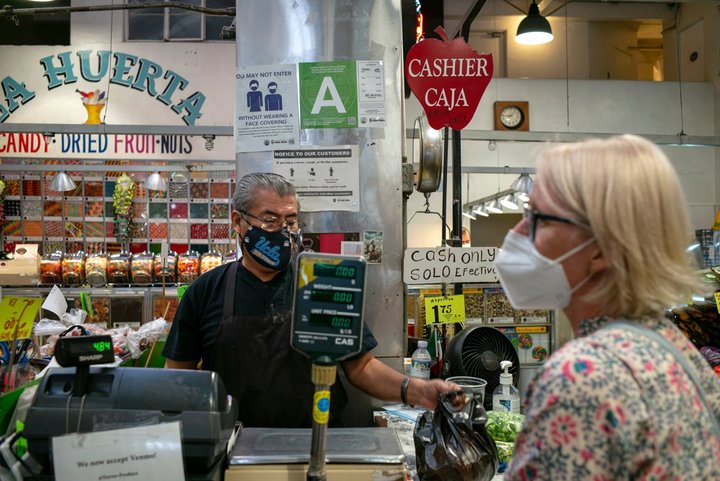
Adan Hernandez, a fruit vendor inside the Grand Central Market in Los Angeles, completes a transaction on Jan. 19, 2022. According to Hernandez, he has worked here since 1983. “Throughout all of my years here, I have not seen anything like this,” Hernandez said. Photo by Pablo Unzueta for CalMatters.
Other countries met this variant with freshlockdowns. Other states authorized state bureaucrats to moonlight as teachers. In New York City and Washington D.C., businesses are now required to check the vaccine status of their customers.
Would any of that have kept California workers safe, curtailed the worst of the spread and avoided cascading labor shortages? And what can lawmakers do now to prepare for the future of COVID — be it the next deadly variant or the low-level simmer of a pathogen gone endemic?
Five waves and nearly two years into the COVID-19 pandemic, this virus still doesn’t brook any easy solutions.
Did it have to be this way?
If public opinion were no object, tighter mask mandates and increased vaccinations after the delta wave in the late summer would have blunted some of omicron’s impact, said Dr. John Swartzberg, a clinical professor emeritus of infectious diseases and vaccinology at UC Berkeley. But the variant’s transmissibility is so formidable that even with those measures, omicron still would have been a problem, he said.
“Frankly, I think that California did a reasonable job trying to balance protecting people from the virus and allowing people’s lives to function in a more normal fashion,” Swartzberg said.
Broad shutdowns, he said, probably would not have made a manifest difference in how many people got sick, a sentiment shared by other public health experts contacted for this story.
“I think that California did a reasonable job trying to balance protecting people from the virus and allowing people’s lives to function in a more normal fashion.” — John Swartzberg, professor emeritus of infectious diseases and vaccinology at UC Berkeley
While other states and countries responded differently to omicron’s spread, case counts suggest that policy differences didn’t make a drastic impact on the course of this surge, said Jeffrey Clemens, a health economist and associate professor at UC San Diego.
“There probably weren’t many steps that governments could have taken in real time in an effort to significantly blunt the wave,” said Clemens.
It may take a couple months, to know whether local or state policies made a difference in how many people got severly ill or died from this surge.
If the state deserves criticism for its strategy leading up to the current crisis, it was for focusing too narrowly on vaccine promotion, said Peter Chin-Hong, an infectious disease physician at UC San Francisco.
“Putting all the eggs in the vaccine basket” meant there was less focus on stockpiling masks, tests and new treatments like monoclonal antibodies that have rendered COVID much less of a threat for the vast majority of vaccinated patients, he said. “I think we could have been more proactive as a state. We have the resources, we have the brainpower, we have the wherewithal.”
“There probably weren’t many steps that governments could have taken in real time in an effort to significantly blunt the wave.” — Jeffrey Clemens, health economist and associate professor at UC San Diego
Another cohort of Bay Area-based medical professionals and researchers say that if there’s a lesson to be learned from the most recent COVID surge, it’s that state public health officials have been too slow to recognize the actual, much-diminished threat that the virus poses to most people in 2022.
Last week four doctors associated with UC San Francisco wrote a controversial letter drawing a very different lesson from the state’s experience weathering omicron: California needs to eliminate masking and testing requirements at schools as soon as the current surge has subsided.
Whether the state could have done more to limit the spread of omicron is the wrong question to ask, said emergency medicine professor Jeanne Noble, who co-authored the letter. Instead public health policy should strive to “get that very small sliver of our population maximally protected and not in this more clunky way of restricting the lives and social norms of the population at large.”
No lockdowns in sight
Even as many Californians were still learning how to pronounce “omicron” in early December, Newsom had already ruled out the possibility of another lockdown. With so many state residents vaccinated, such drastic social distancing measures were no longer demanded by the science, he said at the time. Nor, presumably, would they have been tolerated by much of the COVID-weary public.
California’s Democratic governor wasn’t the only governor to make that calculation. Even as hospitals ran out of beds, schools ran out of unexposed teachers and graphs ran out of vertical space to accommodate the stratospheric case numbers, not a single state imposed new lockdown measures.
That was a sharp contrast from two years prior. Back then, blue state governors in particular were quick to shutter businesses and schools. This time the prevailing focus has been to keep things up and running. In Michigan, Oklahoma, and North Carolina, governors handed down emergency orders deploying state workers and school district administrative staff into classrooms in order to keep schools open. New Mexico’s governor, Lujan Grisham, went a step further and became a substitute herself.
Other states have tried to address omicron-induced worker shortages with financial incentives. Lawmakers in Kentucky are considering whether to offer loan forgiveness to nurses and social workers.
Earlier this month, U.S. Health and Human Services Secretary Xavier Becerra said that the department would be spending $103 million on programs that address health care worker “burnout,” $8.7 million of which will go to three hospitals and one nonprofit in California.
Newsom’s omicron response
Since omicron arrived in California, the Newsom administration has tried some version of all of these approaches. Earlier this month, the governor issued an executive order making it easier for schools to hire substitute teachers. In the budget proposal the governor submitted to the Legislature earlier this month, he requested that the state continue to waive credentialing fees for new teachers and that $3 million be set aside to “research health care shortages.”
In November, prior to the arrival of omicron, the administration finalized a request to Legislature to set aside an extra $1.4 billion in emergency COVID spending above and beyond the state budget passed last year. Of that total ask, $478 million would be used to to hire more nurses and clinicians to relieve short-staffed hospitals. This week they bumped up that total request to $2.3 billion, with another $8 million set aside for “surge” staffing.
For all that extra spending, the administration appears optimistic that the wave will soon recede and that a new one isn’t likely to follow. Tucked into his budget proposal is the assumption that Californians will be back to work at “pre-pandemic labor force levels” by the late summer or early fall of 2022.
On Tuesday, Newsom and legislative leaders announced what is certainly the most dramatic response to workplace disruptions since the beginning of the current wave: an agreement to revive a paid COVID sick leave policy for employees at medium and large-sized companies.
Under the terms of the deal, which isn’t likely to become law for at least a week, workers could get up to two weeks of paid time off to recuperate or help a family member recover from COVID. Businesses would be compensated in part with additional tax credits. Workers would be able to apply for compensation retroactively for any work missed after January 1.
The new agreement was heralded by labor unions and anti-poverty groups, while getting a tepid response from the state’s business lobby.
“Some of the workforce shortages that we’re seeing right now are being caused primarily because folks don’t have the ability to isolate, and to do so with some economic security,” said Eduardo Martinez, legislative director for California Labor Federation.
What comes next?
The coronavirus has been difficult to predict, said Swartzberg, the infectious disease expert at UC Berkeley. If another variant comes along that completely evades the protections recent infection and vaccinations offer, he said, “we’re going to be still riding the roller coaster.”
But that’s unlikely, he thinks. With so many Californians vaccinated or recently infected — or both — we could be headed for a world in early March where case levels remain relatively constant and people can essentially live their normal lives, with sound judgment and a mask in their back pocket, said Swartzberg.
Ensuring that employers and workers have easy access to testing would give business owners a degree of certainty going forward, said Mark Herbert, chief strategy officer for Small Business Majority, a policy advocacy organization. He pointed to California’s effort to distribute tests to child care providers in late January as one step in that direction. The Newsom’s administration’s request this week for additional funds to respond to omicron also included $386 million for testing.
Shoring up the child care system — which is facing its own acute staffing problems, layered on top of a longer-term shortage of providers — could help address the worker shortages elsewhere by giving parents more reliable access to child care. Measures put in place earlier in the pandemic, including fee waivers for low-income families, and paying providers who offer state-subsidized care based on enrollment rather than attendance, are set to expire this summer, said Kristin Schumacher, a senior policy analyst at the California Budget and Policy Center.
The Newsom administration is thinking about the next phase of the pandemic, too. At a testing site in Paramount earlier this month, the governor acknowledged that his administration is now preparing for a new “endemic phase of this reality and how we live with future variants,” and said there would be more details in the coming weeks. Entering an “endemic” phase would mean the virus’s presence is relatively constant, and not causing unpredictable disruptions.
If there’s a period of quiet after omicron, public health experts warn that we can’t squander it.
“We need to, of course, be using COVID as preparation,” said Chin-Hong. “Not just for the next variant, but for the next pandemic.”
###
CALmatters.org is a nonprofit, nonpartisan media venture explaining California policies and politics.
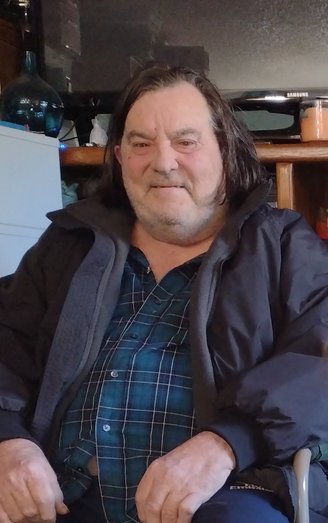
David Wayne Hill
January 20, 1954 - January 20, 2022
David Wayne Hill went to be with his family on his 68th birthday. He was surrounded by his love ones. David was born in Arcata on January 20, 1954 at the old Trinity Hospital, to his parents Amil and Myrtle Hill. David was raised in Arcata with his sister Ellen, his brother Lee and cousins on Buttermilk Lane. David attended Jacoby Creek School and Arcata High School.
He was known as the “Mayor of Buttermilk Lane” and also “Dave on Tour,” when he would ride his lawn mower to Murphy’s Market in Sunnybrae.
David loved to go fishing and have coffee with his freinds at Uniontown Coffee Shop, where he meet his wife, Sherry. He also loved going to the race track to watch the races. David was a hard worker, always ready to help anyone or to play with his grandson Harvey.
David worked on fishing boats, and had a postal contract to drive mail to the Willow Creek and Burnt Ranch area, where he met alot of friends along the way.
David is survived by his wife of almost 30 years, Sherry Hill, his daughter Michaela Hill, and his grandson Harvey Ray Olson, his cousins Tom and Vonnie O’niell, Gary and Lois O’niell, and Allen O’niell, and Darlene Fredrickson Shearer, and family, Dwayne Fredrickson and family, and Jimmy Fredrickson and family, Ronnie O’Niell and family, Kevin Meyers and family, Lynne Hillegeist and family, Kelly Ramirez and family, His brother and sister-in-law Keven and Tammy Lewis, and his sister and brother-in-law Michelle and Jon Shaddix, his mother-in-law Elaine Lewis, his niece Alexandria Elliott, nephews Max Elliott and Fred Elliott, great-niece Kendra Shaddix and great-nephews Gunner Elliott and Wyatt Elliott, and many friends that he made throughout the years, and special friends Jerry Nolan, Chuck Krull, Ben and Lee Towers.
David is preceded in death by his parents, Amil and Myrtle Hill, his grandparents, Ernest and Bessie Raab, his aunt Eunice O’niell and uncle John O’Niell. and uncle and aunt Erwin and June Fredrickson, his brother, Lee Hill, his sister and her husband Ellen and Pat Magnotte, his father-in-law Ray Lewis, and nephew Dale O Elliott and many more.
David was always coming up with sayings: “If you can’t wear it, if you can’t eat it or you can’t use it, you don’t need it.” or “Time is money” or “I can sleep when I am dead.”
David will be miss by everyone that knew and loved him.
David’s family would like to thank everyone who has reached out to us, and the staff at Open Door Clinic in McKinleyville, the staff at St Joseph Hospital, and Hospice for all of your great care for David.
We will have a celebration of life for David at a later date.
As I sit in heaven
And watch you everyday
I try to let you know with signs
I never went away
I hear you when you’re laughing
And watch you as you sleep
I even place my arms around you
To calm you as you weep
I see you wish the days away
Begging to have me home
So I try to send you signs
So you know you are not alone
Don’t feel guilty that you have
Life that was denied me
Heaven is truly beautiful
Just you wait and see
So live your life, laugh again
Enjoy yourself. be free
Then I know with every breath you take
You’ll be taking one for me…….
###
The obituary above was submitted on behalf of David Hill’s loved ones. The Lost Coast Outpost runs obituaries of Humboldt County residents at no charge. See guidelines here.