The Humboldt County Sheriff’s Office reports that the suspect has been identified and that deputies have contacted them regarding the vandalism.
“Thank you to the community for your help!” the HCSO stated on social media.
###
Humboldt County Sheriff’s Office:
Do you recognize this suspect?
The Humboldt County Sheriff’s Office is seeking information about the woman pictured in this photo who was captured on surveillance footage vandalizing a Garberville bank and the Garberville Town Square on May 18, 2021.
If you can identify this suspect or provide location information, please contact: HCSO Deputy Ross at 707-445-7251, reference HCSO Case # 202102615.
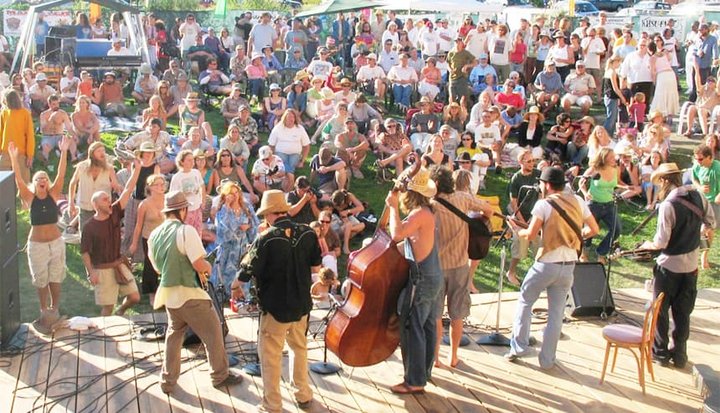
Don’t expect crowds like this one at a previous Folklife Festival, part of the Mad River Festival | Photos provided by Dell’Arte International
###
After a year without live theater or festivals, Humboldt folks can now look forward to the return of a beloved community tradition that celebrates both. Dell’Arte recently announced that the Mad River Festival will be back this summer, but with a new identity.
“Dell’Arte International is producing the five-day-and-night outdoor Baduwa’t Festival this summer, featuring live theatre acts, music and speakers,” Dell’Arte announced in a press release last week. “Formerly known as the Mad River Festival, Dell’Arte is partnering with the Wiyot Tribe, Circus Nonsense and other community partners and artists to reimagine and remember what a gathering of the people can be.”
The decision to rename the festival to Baduwa’t — the Wiyot word for the Mad River — is something that Dell’Arte has been thinking about for several years, Elisabeth Colón Nelson, a member of Dell’Arte’s Collective Leadership Council, told the Outpost in a recent phone interview. When the leadership council began seriously discussing bringing back the festival this year, the members thought it was the appropriate time to re-emerge with the Wiyot name.
“When we were talking about bringing the festival back, our production team was asking questions like, ‘If we can do that, what’s our intention?’” Nelson said. “As we’re coming back and acknowledging the deep change we’ve all gone through this last year, our intention is to celebrate the community and this beautiful place. And this place is Wiyot land.”
The decision to give the festival the Baduwa’t name was approved by the Wiyot Tribe and is the latest collaboration in a years-long partnership between the tribe and Dell’Arte, which has included collaborations on youth theater programs and on the Bartow Project — a project investigating the life and work of Wiyot artist Rick Bartow.
Wiyot Tribal Chair Ted Hernandez told the Outpost that he is happy about the name change, which is helping to promote the tribe’s efforts to promote more usage of the Wiyot language, Soulatluk. “We are all sitting on Wiyot land, so it is important to know the Wiyot words for the places here,” Hernandez said.
Hernandez also said that there will likely be much more involvement from the tribe in the Baduwa’t festival, but what that will look like will be greatly dependent on the state of the pandemic. Hernandez added that, although renaming places and events can sometimes be an empty gesture, he does not feel that this is the case with Dell’Arte and that the organization has made a great effort to work with the Wiyot tribe and to serve the tribal community.
“Dell’Arte and the Wiyot Tribe have a true partnership,” Hernandez said. “It’s not something that they’re just going to pat themselves on the back over.”
The new name is not the only way the festival will change this year. Due to COVID, the event will be held entirely outdoors, with limited capacity and reserved tickets will be required for all events. Attendees and participants will also be required to provide either proof of being fully vaccinated or a negative COVID-19 test for admission.
The Baduwa’t Festival will also be quite a bit shorter than previous years, taking place over five days (July 14-18), instead of the months of scattered events that usually take over the town of Blue Lake throughout the summer.
“We’re trying to ease back into live performance,” Maricela Aceves Wexler, also of Dell’Arte’s Collective Leadership Council, told the Outpost, adding that Dell’Arte hopes to build the festival back up in the coming years. “It’s a little prototype for the renewal.”
Not everything will be different about the festival, however, with some familiar favorites returning this summer, including performers from the Red Light Cabaret and music from the Dell’Arte House Band. This year’s lineup also includes Circus Nonsense and the youth ambassadors from Two Feathers Native American Family Services.
Marla Joy of the Dell’Arte House Band, during a past festival
Wexler and Nelson said that a more detailed lineup will be released soon, adding that things are moving a little bit more slowly than usual because of COVID. In addition to working more closely with the Wiyot Tribe, they said, Dell’Arte is also reaching out to other local organizations and community members to try to be more inclusive and include more Black, Indigenous and people of color’s voices.
Nelson acknowledged that Dell’Arte has been especially focused on promoting racial equity and inclusion since a group of previous and current staff members called out the organization on social media for its treatment of people of color.
“Dell’Arte as an organization continues to be grateful to those nine folks who came out and said ‘we see this,’” Nelson said. “It’s our responsibility as leaders here and an arts organization to step forward and make a more racially equitable place.”
The Baduwa’t Festival will take place in Dadiqhoughuk (the Wiyot name for Blue Lake) on July 14-18. More information will soon be available on Dell’Arte’s website.
One of two men who invaded and robbed a Southern Humboldt home, terrorizing a father and his daughter, was sentenced this morning to nine years in state prison. Franklin Antonio Molina received the sentence as part of a negotiated deal, with Judge Kaleb Cockrum imposing six years for robbery and three years for a special weapons allegation. Molina also was sentenced for false imprisonment, assault with a firearm and making criminal threats, but those terms will run concurrently with the nine years.
In December 2018 shortly before Christmas, Molina and another man showed up at Adam Owen’s rural residence about an hour’s drive from Garberville. They wore ski masks, brandished guns and demanded money.
Before the terrifying episode was over for Owen and his 23-year-old daughter, Owen had been robbed of numerous guns and $30,000 in cash. He had been tied up, hit repeatedly on the head with a gun, pushed down a flight of stairs and locked in a closet with his daughter.
Molina’s alleged accomplice then took off in the vehicle they came in, and Molina stole Owen’s GMC Denali truck and fled. He was arrested during a standoff with law enforcement in Mendocino County.
The other man escaped with the stolen property and was never caught.
Molina, a 23-year-old native of El Salvador, waived all custody credits up to April 16, meaning a total of 846 days. He received credit for 42 actual days and six days “good-time” days served since April 16. He also waived his right to appeal.
Deputy Public Defender Casey Russo represented Molina, with Deputy District Attorney Trent Timm in court for the prosecution.
Spanish interpreter Ariana Rayburn interpreted the hearing today for Molina.
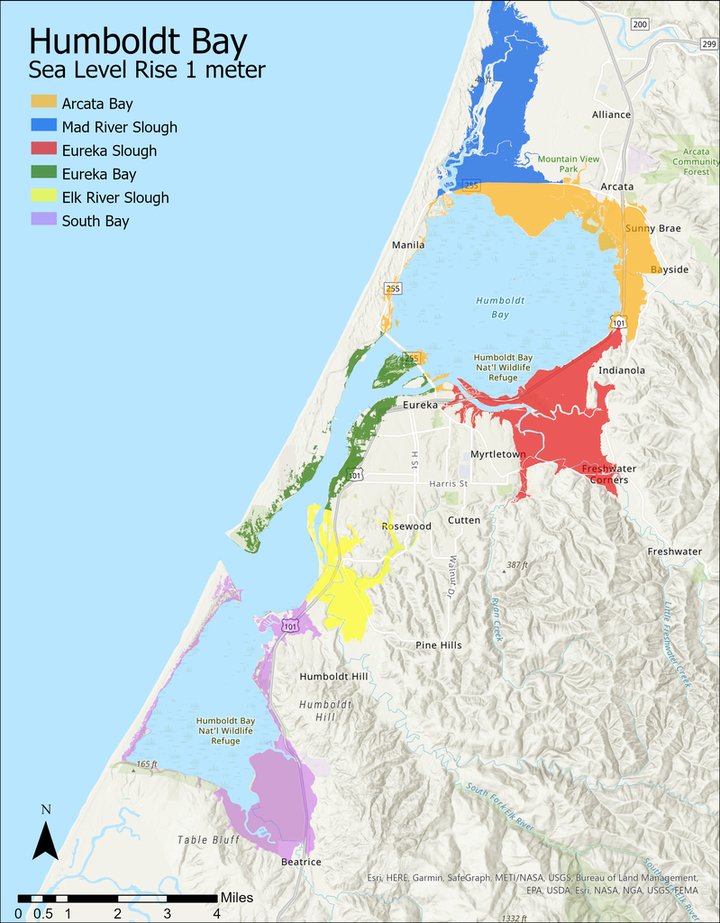
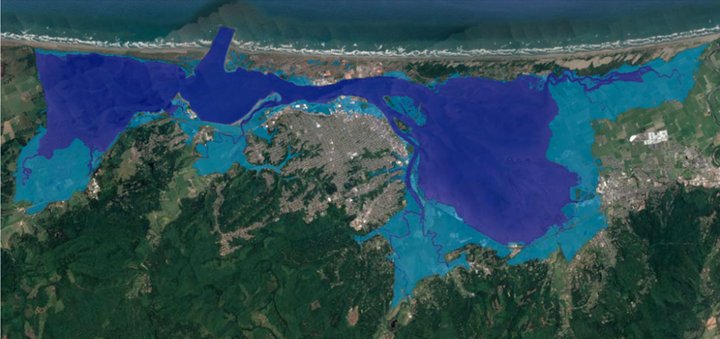
Areas around Humboldt Bay that could be flooded with 3 feet of ocean water. | County of Humboldt
The Humboldt County Planning and Building Department announced today that it is conducting an anonymous survey to better understand the community’s awareness, concerns and preferences regarding sea level rise planning around Humboldt Bay.
“Sea Level Rise affects all of us who live and work along the coast,” the County stated in a press release this morning. “Humboldt County is trying to determine if regional coordination is the best way to address the impacts of sea level rise locally.”
This public survey will be incorporated into the Humboldt Bay Sea Level Rise Regional Planning Feasibility Study — a grant-funded project created to help the County adapt to the impending sea level rise caused by rising global temperatures.
The California Ocean Protection Council reports that Humboldt Bay could see as much as a 3-foot rise in sea level by 2060.
Projected Sea Level Rise Inundation Zone (Stillwater) on Humboldt Bay for Mean Monthly Maximum Tide with 3.3 feet (1.0 meter) of Sea Level Rise. | County of Humboldt
“This survey will help the County identify and understand the roles, responsibilities, needs and concerns of those that could be involved in sea level rise planning efforts within the Humboldt Bay region,” the County stated. “The County hopes to identify ways collaborative adaptation efforts could be advanced.”
A physical copy of the survey has been mailed to those who own property near the Humboldt Bay shoreline. However, the digital version is available to the general public.
Press release from the Environmental Protection Information Center:
In response to news from Nordic Aquafarms and Humboldt County that the
county will pursue a full environmental impact report for the proposed fish farm, a coalition of
North Coast environmental organizations thank the company and county for listening to
community concern and their commitment to rigorous environmental review.
“Our organizations called for the preparation of an environmental impact report because we
believed that this project—which is unlike anything seen before in Humboldt County or even the
state of California — could benefit from more thorough environmental impact review and public
participation,” said Jennifer Kalt, director of Humboldt Baykeeper.
“Process matters. Thorough environmental impact review does two things: it allows the public to
better engage with a project, helping to better shape and mold the project to reduce impacts and
it allows the public to see and trust that this is safe for Humboldt Bay,” said Tom Wheeler,
executive director of EPIC. “We are happy that the county and Nordic are moving forward in the
right way.”
Among the impacts that the coalition anticipate will be better studied and ultimately mitigated
are greenhouse gas emissions and impacts to coastal communities and coastal access.
“While this project would require a significant amount of energy, raising the risk of considerable
greenhouse gas emissions, there are easy ‘fixes,’” said Dan Chandler of 350 Humboldt. “We
expect that Nordic will commit to using 100% renewable energy throughout the project and will
increase the amount of solar produced at the project site.”
“Addressing transportation needs for a somewhat remote and rural area can be challenging but
we have provided Nordic with ways to both reduce emissions from cars and trucks and improve
worker morale, such as employee vanpools, improved bike and pedestrian facilities, and a
commitment to use zero-emission vehicles,” said Colin Fiske, executive director of the Coalition
for Responsible Transportation Priorities.
“The Samoa Peninsula is a popular place for surfing, fishing and beach-going, so potential
effects to water quality and coastal access as a result of this project are naturally a concern and
need to be thoroughly analyzed for impacts and mitigation needs,” said Delia Bense-Kang
Surfrider Foundation’s Northern and Central California Regional Coordinator.
The willingness of the company and county to conduct this review stands in contrast to the
well-publicized failure to do so for other large and potentially impactful projects, such as the
Rolling Meadow cannabis project.
“Too many projects slip through without a meaningful attempt to consider all the environmental
impacts,” said Larry Glass, executive director of the Northcoast Environmental Center (NEC). “If
the county routinely scrimps on environmental impact review and tries to be quick and cheap,
we have to take a stand to preserve our environmental laws.”
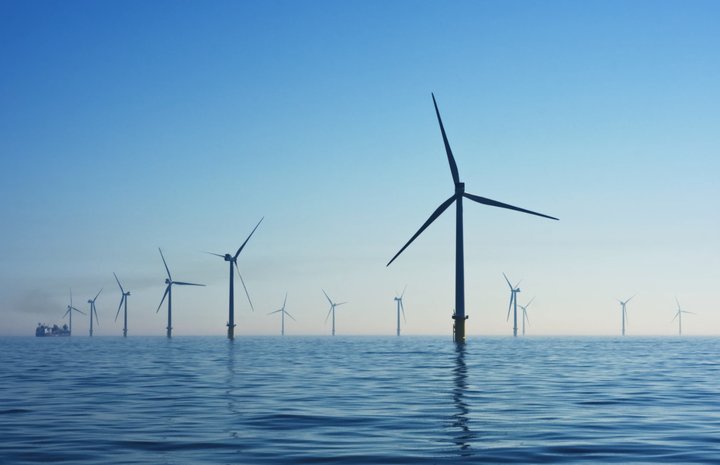
In another move that could signal big things to come for Humboldt, both the Biden administration and Governor Gavin Newsom announced plans Tuesday to open up sections of California’s coastline for future offshore wind development.
Humboldt is one of two areas, along with Morro Bay, being considered for wind turbines that officials say could produce up to 4.6 gigawatts of energy, with hopes that the Humboldt project would produce 1.6 gigawatts of that total.
“This historic announcement, which could provide clean power for up to 1.6 million homes over the next decade, represents the innovative approach we need for a clean energy economy that protects the coasts, fisheries, marine life and Tribal and cultural resources we value so much as Californians,” Gov. Newsom said.
More details in the U.S. Department of the Interior release below:
Secretary of the Interior Deb Haaland, National Climate Advisor Gina McCarthy, Under Secretary of Defense for Policy Dr. Colin Kahl, and California Governor Gavin Newsom today announced an agreement to advance areas for offshore wind off the northern and central coasts of California. This significant milestone is part of the Biden-Harris administration’s goal to create thousands of jobs through the deployment of 30 gigawatts (GW) of offshore wind by 2030.
These initial areas for offshore wind development could bring up to 4.6 GW of clean energy to the grid, enough to power 1.6 million homes.
The Department of the Interior, in cooperation with the Department of Defense and the State of California, has identified an area (“the Morro Bay 399 Area“) that will support 3 gigawatts of offshore wind on roughly 399 square miles off California’s central coast region, northwest of Morro Bay. The Department of the Interior is also advancing the Humboldt Call Area as a potential Wind Energy Area (WEA), located off northern California. These identified areas will enable the build out of a significant new domestic clean energy resource over the next decade or more.
“I believe that a clean energy future is within our grasp in the United States, but it will take all of us and the best-available science to make it happen. Today’s announcement reflects months of active engagement and dedication between partners who are committed to advancing a clean energy future,” said Secretary of the Interior Deb Haaland. “The offshore wind industry has the potential to create tens of thousands of good-paying union jobs across the nation, while combating the negative effects of climate change. Interior is proud to be part of an all-of-government approach toward the Biden-Harris administration’s ambitious renewable energy goals.”
Today’s announcement comes after years of collaboration between the Departments of the Interior and Defense to find areas offshore the central coast of California that are compatible with the Department of Defense’s training and testing operations. The Bureau of Ocean Energy Management (BOEM) issued a Call for Information and Nominations for offshore wind on October 19, 2018, for three areas off the central and northern coasts, including Humboldt and Morro Bay.
The Department of Defense engages in significant testing, training and operations off the coast of California that are essential to national security. The Department of the Interior acknowledges the critical nature of current and future military testing, training and operations and acknowledges that ensuring the operational integrity thereof is a national security imperative. Interior’s Bureau of Ocean Energy Management will work with the Department of Defense to ensure long-term protection of military testing, training and operations, while pursuing new domestic clean energy resources.
“Tacking the climate crisis is a national security imperative and the Defense Department is proud to have played a role in this important effort,” said Dr. Colin Kahl, Under Secretary of Defense for Policy. “The Defense Department is committed to working across the U.S. government to find solutions that support renewable energy in a manner compatible with essential military operations. Throughout this effort, the Defense Department has worked tirelessly with the White House, the Department of the Interior, and the State of California to find solutions that enable offshore wind development while ensuring long-term protection for testing, training, and operations critical to our military readiness. The Defense Department applauds this step and looks forward to continued coordination to address the climate crisis.”
In addition to contributing to the goals of the Biden-Harris administration, the development of offshore wind can help California reach its goal of carbon free energy by 2045, create good-paying, union jobs, and foster investments in coastal communities. Offshore wind resources are typically stronger and more consistent than land-based wind and is especially strong in the evening hours when solar production drops off, ensuring that it can make an important contribution to California’s electric grid.
“Developing offshore wind to produce clean, renewable energy could be a game changer to achieving California’s clean energy goals and addressing climate change – all while bolstering the economy and creating new jobs,” Governor Gavin Newsom said. “This historic announcement, which could provide clean power for up to 1.6 million homes over the next decade, represents the innovative approach we need for a clean energy economy that protects the coasts, fisheries, marine life, and Tribal and cultural resources we value so much as Californians.”
BOEM, in partnership with California, will hold an Intergovernmental Renewable Energy Task Force meeting on June 24 to discuss the identified areas off the north and central coasts as potential WEAs.
Following the task force meeting, the WEAs can be finalized and will undergo environmental analysis; BOEM will also undertake government-to-government tribal consultation. The processes for the northern and central coasts will then be merged in a Proposed Sale Notice (PSN) for one lease sale auction, targeted for mid-2022.
More information on offshore wind development is available on the Clean Energy Future page.
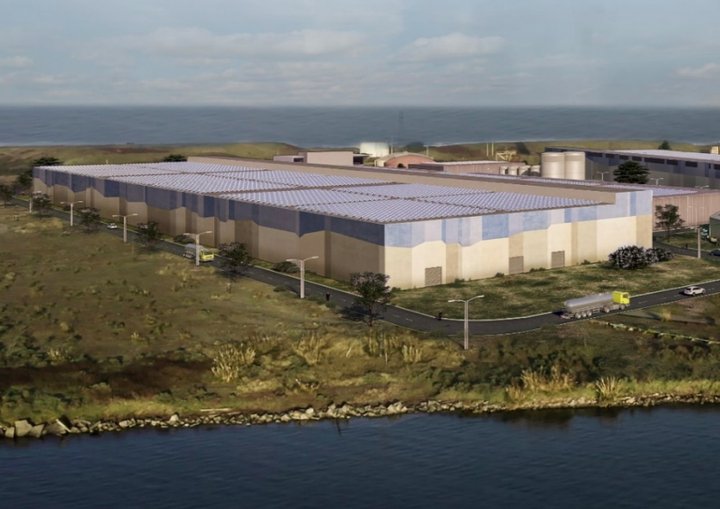
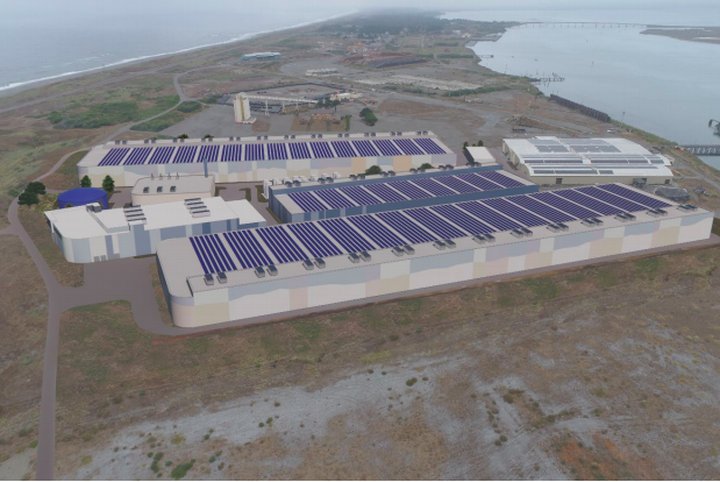
Computer-generated photo illustration showing how Nordic Aquafarms’ proposed recirculating aquaculture system (RAS) facility would look on the Samoa Peninsula. | Image via County of Humboldt.
###
In terms of sheer size, Nordic Aquafarms’ land-based aquaculture facility, slated for construction on the Samoa Peninsula, would be the largest development project Humboldt County has seen for decades, maybe since the heyday of the timber industry.
The facility’s five buildings — including two massive production modules where Atlantic salmon would be raised inside fully-contained recirculating tanks — would total 766,530 square feet, nearly an acre larger than the footprint of the Bayshore Mall.
It’s been more than two years since the Norwegian company announced its ambitious plans, and the environmental review period was scheduled to wrap up this week. The county, as lead agency, released its initial study last month: hundreds of pages of analysis capped by a conclusion that with mitigation measures the fish farm would have no significant adverse environmental effects. A 30-day period for the public to review the study and submit comments concluded Monday.
But in a surprise twist, Nordic executives this week announced that they will subject the project to yet more review, going above and beyond the requirements of the California Environmental Quality Act. Why? Well, in an interview conducted via Zoom last week, Marianne Naess, the company’s executive vice president of commercial operations, said it’s because people asked for it.
“We have been listening to the community and listening to the feedback … and in order to be a good partner we are going to transfer the MND into an EIR,” she said.
For anyone unfamiliar with environmental law acronyms, “MND” means mitigated negative declaration, a report like the county’s for this project, in which the lead agency says the environment won’t be significantly harmed. If the lead agency comes to the opposite conclusion — that there will be negative environmental impacts from the project — then a more extensive review called an environmental impact report (EIR) is required.
Naess is right: People have been asking Nordic to conduct a full EIR. Environmental advocates have made the request publicly, and a coalition comprised of Humboldt Baykeeper, the Surfrider Foundation, EPIC, the Northcoast Environmental Center, the Coalition for Responsible Transportation Priorities and 350 Humboldt issued a collective action alert last week urging local residents to demand an EIR from the county, along with more mitigation measures from Nordic.
Naess described the completed MND as “a fairly robust document” and said expanding it into an EIR won’t require a lot of extra work.
“We feel it’s much better for the community,” she said. “We want to be a good partner. … [And] we don’t want to leave the impression that we are trying to take a shortcut.”
Naess said she expects the EIR to be released sometime in July, after which the public will have a second chance — 45 more days — to review and critique the project.
Below, we’ll give an overview of the project and examine some of the community concerns raised thus far, including the project’s eyebrow-raising electricity and water demands; potential impacts to wildlife habitat both offshore and in Humboldt Bay; the range of chemicals being used in production; the amount of extra traffic expected on the peninsula and more.
###
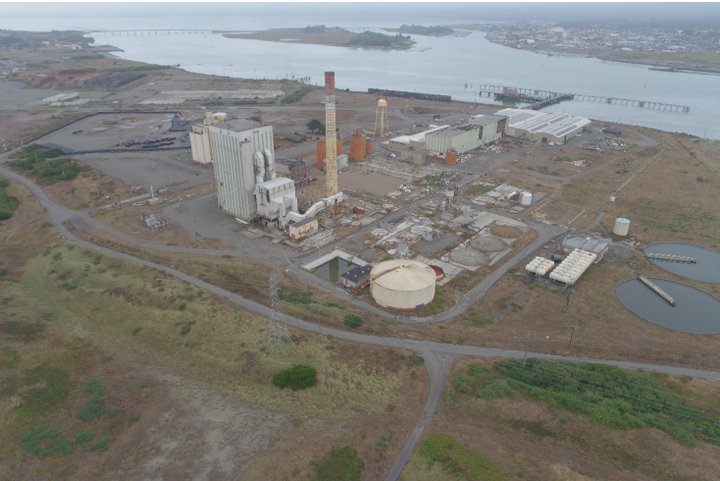
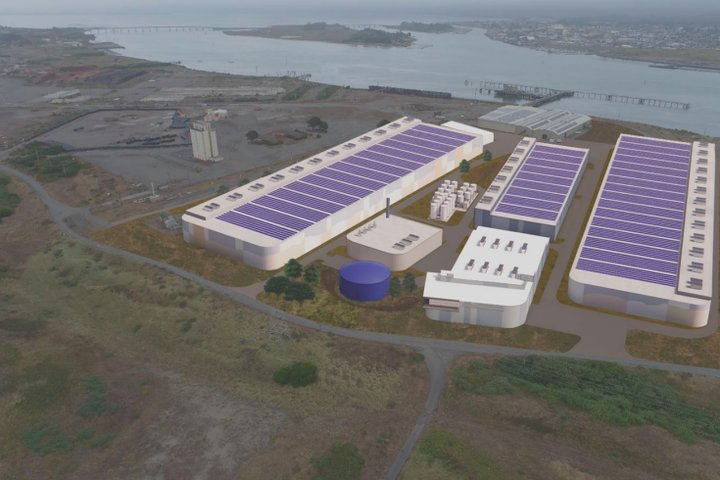
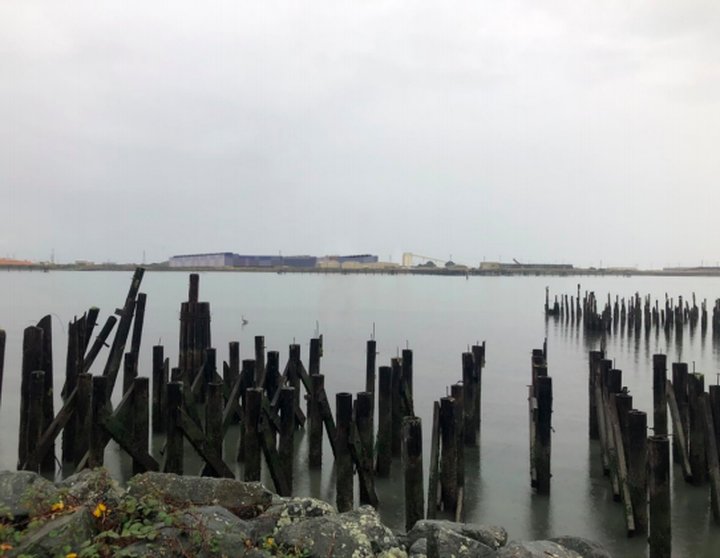
TOP: Aerial view of the former Samoa pulp mill site, now known as Redwood Marine Terminal II. BOTTOM: A simulation of the proposed Nordic facilities, with solar panels on building rooftops. | Images via County of Humboldt.
###
The facility is slated to be constructed in phases on the site of the decommissioned Samoa Pulp Mill property. Most recently operated by the Freshwater Tissue Company, the mill shut down more than a decade ago, and the property is now owned by the Humboldt Bay Harbor, Recreation and Conservation District.
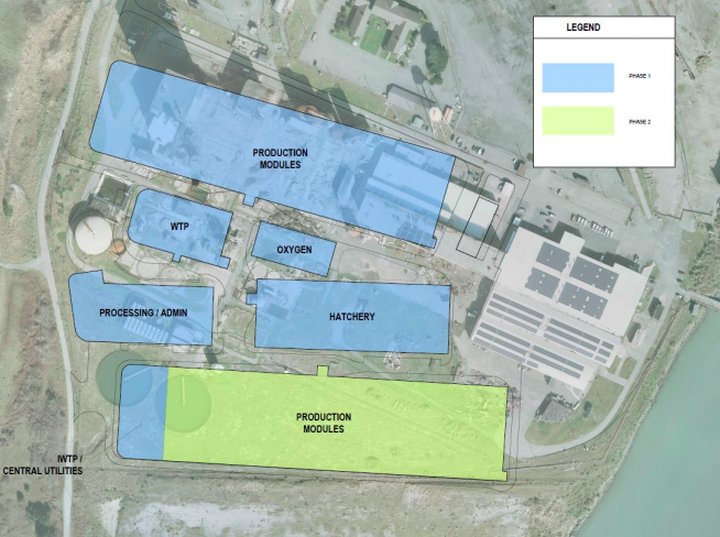
In their place, Nordic will construct five new buildings, including a hatchery, where fish will be raised from eggs to juveniles, then transported via underground pipes to “grow-out modules” where they’ll be raised to market size in recirculating aquaculture systems (RAS). Water treatment plants will subject all inlet and wastewater to fine filtration, biological treatment and ultraviolet sterilization.
Construction could begin as soon as this fall and will likely extend through 2024, though the company says it can start cultivating and growing the fish before the campus is fully built. Once completed, Nordic’s facility would employ up to 150 people and have an annual production capacity of 25,000-27,000 metric tons of fish, enough to supply West Coast markets from Seattle to Los Angeles and beyond.
Critics and skeptics
A few people have come out against the development. Other have a long list of concerns, but they’re not necessarily opposed.
Jake McMaster, a local fisherman and executive board member of the Humboldt Fishermen’s Marketing Association, believes the Nordic project should not be approved. His reasons include the project’s freshwater consumption (up to 2 million gallons per day of untreated surface water from the Mad River, plus half a million gallons of potable water), its electricity demands, the possibility — however remote — of fish escape, the chemicals and cleaners slated for use and the potential impacts of wastewater, which would be sent into the ocean via an existing mile-and-a-half-long outfall pipe.
“I brought up a bunch of those [concerns] to them,” McMaster told the Outpost in a recent phone interview. “It doesn’t add up.”
Regina Chichizola, policy director of Save California Salmon, also opposes the project, largely due to concerns over potential impacts to local wild salmon, though she told the Outpost that her organization’s main objection is the lack of a full environmental impact report. We spoke before Nordic announced its intention to conduct one.
Other environmental leaders have expressed more nuanced opinions. In a recent episode of the EcoNews Report, for example, Humboldt Baykeeper Executive Director Jennifer Kalt said that while she has serious concerns about Nordic’s plans, she also believes that development of the property is likely the only way to get it cleaned up.
“What we have right now is a huge mess left in 2008 by the last operator of the pulp mill, [who] just went bankrupt and left us with a pile of toxic waste,” she said. “A lot of it has been cleaned up on the taxpayers’ dime, but there is a lot of old, contaminated debris and buildings getting rained on, and that all runs off into the bay.”
She also said Nordic’s fish farm is certainly preferable to some of the “horrendous, horribly objectionable projects” that were previously proposed for the site, including a liquid natural gas import facility and an ore processing plant.
Tom Wheeler, executive director of EPIC (the Environmental Protection Information Center), expressed similar feelings in a recent intervew.
“There will be environmental impacts … but this is also a potentially appropriate and good use of this land,” he said. “This is a former pulp mill with contaminated soil that needs to be cleaned up, and because of [Nordic’s proposed] water intake [from Humboldt Bay], they will likely become a good advocate for clean water on the bay.”
Still, Wheeler, Kalt and others have a list of concerns. Let’s take a closer look at some of them.
Overhead layout of the site plans, with buildings slated for Phase 1 construction in blue.
###
Water Use
Nordic’s recirculating aquaculture systems (RAS) will require roughly 10 million gallons of seawater per day. This water would be sucked up from Humboldt Bay via existing intake infrastructure designed in 1966 for the Georgia-Pacific paper mill.
Larry Glass, executive director of the Northcoast Environmental Center, was among the guests on that recent episode of the EcoNews Report, and he noted that a proposal to upgrade the intake infrastructure is being considered separately from Nordic’s environmental review process. He and others say that’s an inappropriate bifurcation in the analysis.
But Naess pointed out that this infrastructure belongs to the Harbor District, which is the agency applying for a coastal development permit from the California Coastal Commission. Once the upgrades are completed, the intake system, which has a design capacity of 30 million gallons per day — more than double what Nordic requires — would serve other aquaculture businesses on the peninsula as well.
Larry Oetker, the Harbor District’s executive director, told the Outpost via email: “The intake systems are public infrastructure designed for multiple users, similar to the ocean outfall and industrial water system on Harbor District properties. Approximately 10.1 million gallons per day would be for the Nordic Aquafarms project and 1.8 million gallon per day are intended for other users of our system.”
McMaster and others say they’re worried about wildlife from the bay being affected by this intake system.
“The bay is a giant estuary,” McMaster said.”Juvenile fish and Dungeness crab could be sucked into this intake pipe.”
The Harbor District consulted with the State Water Board and Coastal Commission, and the agencies concluded that the potential entrainment — or sucking up — of fish and fish larvae was indeed a potentially significant issue.
Oetker said the upgraded intake system has been designed with filtration systems to prevent significant impacts on fish. The final impact assessment is complete and has been sent to the county’s planning department for use in analyzing the Nordic project. “The Harbor District intends to complete and circulate our CEQA Document for public and agency review and comment in June,” Oetker said.
Nordic’s systems will also require up to 2 million gallons per day of fresh water, which the Humboldt Bay Municipal Water District (HBMWD) has agreed to provide.
“That sounds like a lot of water during a drought,” McMaster said. He identified this water usage as his No. 1 concern, saying he worries about the impacts to fish in the Mad River, which is where HBMWD draws water from. Chichizola, from Save California Salmon, agreed. In a letter submitted to the county she said, “This level of withdrawal during an extreme drought is likely to result in death and injury to juvenile Chinook salmon and steelhead in a manner that has not been properly analyzed, addressed, or considered.”
However, strange as it may seem, the county’s major population centers actually have access to way more water than we can possibly use. John Friedenbach, general manager of HBMWD, said his agency has rights to divert up to 75 million gallons of water per day into the industrial water system, more than 20 times the amount that Nordic requires. And if locals don’t figure out a way to use those 75 million gallons, the district could lose its water rights when the current permits expire in 2029.
“Our district obviously wants to increase local water sales up to what’s allowed in our water rights,” Friedenbach told the Outpost, “and we promote local jobs through doing that.”
The district’s water supply comes from Ruth Reservoir, which reached 100 percent capacity this year, as it almost always does.
“There’s only been one year in the 60-year history of Ruth Reservoir that it didn’t fill, Friedenbach said. As such, wholesale customers of the district’s water, including the cities of Eureka, Arcata and Blue Lake, plus McKinleyville and surrounding communities, are not expected to see any impacts from the drought, and Friedenbach said there shouldn’t be any impacts to the Mad River from Nordic’s water usage. In fact, he said, the two pulp mills that once operated on the peninsula used more than 30 times the amount of freshwater being requested by Nordic.
Wastewater discharge
As noted above, Nordic intends to discharge treated effluent into the Pacific Ocean via an existing 1.55-mile-long outfall pipe. The 12.5 million gallons per day of anticipated effluent is projected to contain a maximum of 673 kilograms of nitrogen, 185 kilograms of suspended solids and trace amounts of ammonium nitrogen and phosphorus.
Nordic’s planned wastewater treatment facility will remove 90 percent of the nitrogen and 99 of the phosphorus prior to discharge, according to the company’s published plans.
In their collective action alert, local environmental groups say that, “given the newness of the technology and the complexity of predicting impacts from new nutrient discharge, we believe that this project would be improved by monitoring and disclosure of actual effluent discharge,” along with adaptive management if the effluent proves more harmful than anticipated.
Naess noted that the North Coast Regional Water Quality Control Board has already issued a draft permit for the discharge, with both the water board and the EPA classifying it as “minor.” She also said the draft permit requires monitoring and analysis from third-party labs.
“This is a highly efficient wastewater treatment plant with known technology,” Naess said. “And what we are discharging, in addition to taking out the nutrients, is actually the water that the fish swim in.” Anything that would harm ocean wildlife would also harm the fish in the RAS tanks, so in that sense, quality control is built in, she reasoned.
“And also keep in mind that a discharge permit needs to be renewed every five years,” Naess added. “I can assure you, you’re going to have trouble renewing that unless you’re compliant.”
Fish feed
What will Nordic’s farmed Atlantic salmon eat? That’s been another major source of concern among environmental advocates.
Jennifer Savage, California policy director for the Surfrider Foundation (and a friend of mine, for the sake of disclosure), told the Outpost via email, “Commercial fish feed contains fish meal and oil from small fish like herring. Known as ‘forage fish,’ they are a critical food source for wild fish and marine mammals.” And harvesting these fish is often done in unsustainable ways, she added.
Kalt said that if you feed fish with a lot of protein from other fish, you wind up using a lot of resources per pound of finished product. She and others say feed source issues are not adequately addressed in the MND.
Chichizola, meanwhile, voiced concerns about poultry byproducts being used in the fish feed, saying, “Antibiotic resistance in poultry farming is a well-established environmental concern, and there is a high risk of antibiotic-resistant bacteria reaching the marine environment.”
Naess insisted that’s not the case. Nordic has committed to avoiding all GMOs and antibiotics in its feed. Last month, Nordic published a three-page document that outlines its “guidance” on sourcing fish feed. Modern feed includes ingredients from terrestrial crops such as wheat, corn, soy and canola along with land animal byproducts (i.e., poultry meal/oil, bone and blood meals) and ingredients derived from the marine fisheries (fishmeal and oil).
“You need to keep in mind that salmon are carnivores — and it’s important to have the right balance between omega three and six — so there needs to be some kind of animal protein in it,” Naess said. Nordic’s “guidance” document doesn’t identify the specific formula that the company will use for its feed, but Naess said that’s because the formula can’t be static. It must remain subject to change in case, say, the fish don’t like certain ingredients, or the feed clogs the filters or any manner of other variables.
But she said certain principles will guide the company’s choices. “We all agreed we don’t want to use a lot of forage-caught fish,” Naess said. “A lot is trimmings from wild-caught fish.” The amount of marine-derived ingredients included in fish feed has declined over the past 10-15 years from 60-70 percent down to about 15 percent, which is what Nordic expects in its feed, Naess said. The company’s fact sheet says this represents “best in class” with regard to sustainable feed formulation for salmon farming.
A visual simulation of how the Nordic facility would look from the Eureka Waterfront Trail, facing west.
Energy consumption and greenhouse gas emissions
This project will use a lot of electricity; there’s no way around that. Its estimated normal electricity usage, according to the study from the county, will be 21.4 megawatts. To put that in perspective, the peak countywide demand on a typical day is in the neighborhood of 150 megawatts, meaning the Nordic facilities will increase the county’s electrical draw by close to 15 percent.
A portion of that — between three and five megawatts — would be offset by the rooftop solar installation, which would be installed across approximately 690,000
square feet of facility rooftops. Meanwhile, modernization and upgrade of the existing PG&E substation onsite could expand the total capacity of the switchyard to 35 megawatts.
This energy usage, combined with increased vehicle traffic from delivery vehicles and company employees traveling to and from work, is another cause of serious concern for local environmental advocates. Colin Fiske, executive director of the Coalition for Responsible Transportation Priorities, questioned how the county could conclude in its MND that the resulting greenhouse gas emissions aren’t a significant environmental impact.
“I think it’s fairly clear that it is a significant impact,” he said in last week’s EcoNews Report. “The [MND] document, as far as I can tell, does not commit them to using renewable energy.”
Wheeler told the Outpost that Nordic officials had expressed a commitment to use 100 percent renewable energy, but Naess disputed that, saying that’s just not possible at this point.
“Our goal is to use as much renewable [energy] as possible, but of course you have to use the electricity that’s available in Humboldt,” she said. Both PG&E and the Redwood Coast Energy Authority, a local Joint Powers Authority that serves as the region’s community choice aggregation agency, have said they aim to transition to 100 percent renewable energy.
But as Naess pointed out, with community choice aggregation, the energy you purchase isn’t necessarily the energy you use. RCEA purchases electricity on the open market on behalf of local consumers, and its current “transactional” power mix is at least 40 percent renewable. But in reality, the vast majority of electricity used in Humboldt County still comes from PG&E’s Humboldt Bay Generating Station. which runs on fossil fuels.
Naess noted that PG&E is moving toward using more renewable energy, just like RCEA.
“I think, by the time we need a substantial amount of electricity, those portfolios will be clean,” she said optimistically. “And if they don’t reach their goals there are always ways you can purchase credits.”
The electricity usage is a trade-off, she said” “We’ve invested a lot in water treatment systems. If you want more treatment, it’s going to cost you a little bit more electricity, which we think is worth it.”
She also encourages people to compare Nordic’s planned operations to the current market sources. United States residents consume more than four times the amount of salmon we harvest, importing the vast majority of it from Europe and Latin America. The origins, growing conditions and harvesting methods are typically hidden to U.S. consumers, and international shipping creates a huge carbon footprint.
Market impacts
Chichizola and McMaster worry that Nordic’s operations could have negative impacts on local fisheries and fishermen.
“[S]aturating the market with cheaper farmed salmon will have consequences for California’s Pacific salmon fisheries,” Chichizola said in an emailed statement. “The fact that fishing practitioners and Indigenous fishers currently cannot fish to feed or support their families, while the same waters would be used to grow millions of Atlantic salmon, is a severe misplacement of priorities.”
Naess again pointed to the current market conditions, saying Nordic isn’t aiming to displace sales of local, wild-caught salmon but rather the vast volumes of fish that’s frozen and imported from overseas. “There’s room for both,” she said.
Lynette Mullen, an independent project manager who’s been serving as Nordic’s community liaison to Humboldt County, added that the environmental degradation and depleted fish stocks in local waters can hardly be laid at the feet of Nordic, since the company’s operations don’t even exist here yet.
One more simulated view of the proposed Nordic facilities, on the peninsula facing north.
But McMaster isn’t convinced. “I realize they’ve said till they’re blue in the face that fish can’t escape,” he said. “Well, they’re not taking into account human error.”
He cited a recent study that analyzed eight years of data on escape of Atlantic salmon and rainbow trout from Norwegian fish farms. It found that seven percent of escapees came from land-based facilities, including one incident in which 203,000 fish
escaped from a land-based smolt production site.
“The Chinook salmon has enough out there without having to worry about Atlantic salmon,” McMaster said.
But Naess said that just being “land-based” doesn’t mean a facility is remotely comparable to what Nordic plans to build. Most land-based farms are old, rudimentary facilities serving net-pen operations, she said. They’re built right on the ocean, and most accidents occur while pumping the fish to a well boat for release into the ocean. “We don’t have that.”
Instead, Nordic’s grow-out facilities, treatment systems and floor drains will have between five and seven physical barriers to prevent escape, including a filtration system that blocks anything bigger than 0.04-microns. (A strand of human hair is between 50-70 microns thick.)
“There’s no way a fish would be able to go through that, the way it’s designed,” Naess said. “It would have to pass through a full wastewater treatment system. … And keep in mind that the facility itself is several hundred feet from any body of water.”
Even if these farmed Atlantic salmon somehow managed to escape, Naess said, they would pose no risk to ocean wildlife. For one thing, she said, they’re not at all like coastal California chinook.
“They’re both called salmon in the English language, [but] if you look in Latin or in other other languages, they’re not. They’re a completely different species,” incapable of interbreeding, Naess said. The company chose Atlantic salmon because the species has been domesticated, sort of like cows, rendering them incapable of fending for themselves in the wild. Pluss, Naess said, the egg stocks will be entirely female, and any hypothetical escapees would be free of pathogens and viruses, because Nordic wouldn’t be producing a marketable product otherwise.
“Some people don’t believe us no matter what you say,” Naess said. “We’re putting tens of millions [of dollars] into the design, for our own sake, to ensure that this facility is escape-proof and earthquake-proof, to the extent possible, and we feel confident that we can claim that it’s 100 percent escape-proof.”
Traffic
Nordic has projected that at full production its operations will generate 95 new truck trips per week, including 40 outgoing product delivery trucks per week, hauling fish to markets up and down the West Coast, plus 32 outgoing trucks per week carrying waste streams to various secondary-use processing sites within 150 miles and 20 delivery trucks per week carrying fish feed from central Oregon.
There will also be employees commuting to and from work. The facility will operate around the clock, with employees operating in two shifts, one starting early-morning and the other late-afternoon.
Savage said bicyclists are concerned about the increased traffic, as are surfers who park on the shoulder of New Navy Base Road to change in out out of their wetsuits. The extra traffic “changes the vibe from a rural beachfront community to a little bit more of a highway feel,” she said recently.
Some have called on Nordic to build a bike path on the peninsula, but Naess said that since the company doesn’t own the property or the roads to and from it, Nordic doesn’t have any authority to provide a bike path.
That said, traffic-reducing measures are a requirement of CEQA, and Nordic has agreed to prepare a Transportation Management Plan and receive approval from the county’s Planning and Building
Department as part of the Coastal Development permit.
Initiatives include van pools to transportation hubs in Eureka, facilities onsite for employees to change and shower and onsite charging stations for electric vehicles.
Tribal consultation
Mullen said Nordic executives have been consulting with local tribal governments since the beginning. They hired an archeologist who worked independently with the Tribal Historic Preservation Officers (THPOs) to figure out what sites might be sensitive. That archeologist wrote up a cultural resources report and sent it to THPOs with the Wiyot Tribe, Bear River Band of Rohnberville Rancheria and the Blue Lake Rancheria, who provided input. The report was then updated and sent to the county, Mullen said.
With Nordic now planning to conduct a full EIR, more tribal consultation may well be conducted, and many of the environmental issues discussed above be be reexamined.
“I appreciate that people are concerned about their community, and we want to be a good part of the Humboldt community,” Naess said. “So we are willing to discuss with people and take input.” Mullen said that anybody who wants to ask questions or meet with Nordic representatives can email her at lynette.mullen@gmail.com.
Naess said some of the people who’ve come out against the project have refused to meet up. She said their objections “might be more ideology than actual science.”