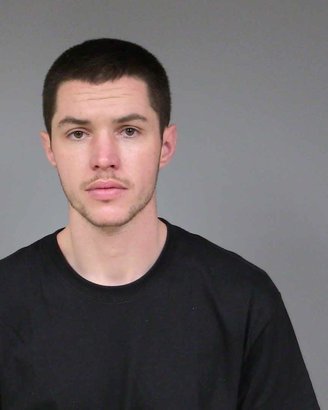
A Eureka man suspected of a recent shooting on West Del Norte Street pleaded not guilty today to attempted murder and a variety of drug and weapons charges.
Deputy Public Defender Casey Russo entered the pleas on behalf of Braylan Jay Lanier, suspected of attempting to kill a 37-year-old man who was shot several times and left lying in the street the night of Jan. 14.
Judge Timothy Canning ordered Lanier, 26, to be held without bail because he was out of jail on supervised release when he allegedly shot the other man. Bail on the attempted murder charge was set at $750,000.
Eureka police officers and Humboldt County Drug Task Force agents arrested Lanier on Jan. 21 after he entered a market on K Street. Police said he was carrying a loaded firearm, along with the drug Fentanyl and 13 grams of heroin packaged for sale.
He is charged with being armed with a firearm during the commission of a felony, possession of narcotics for sale, being a felon in possession of a firearm and ammunition, and violating the terms of Community Supervised Release.
In other court news, defense attorney Michael Acosta is still hoping for a plea bargain in the case of convicted sex trafficker David Bernard Anderson II, accused of sexually assaulting a Eureka teen.
The 49-year-old Anderson is scheduled for jury trial next month, although he is on a waiting list. Humboldt County is allowed to conduct only one jury trial at a time because of the Covid 19 pandemic, and the trial now underway has been halted because one of the witnesses is ill .
Today Judge Christopher Wilson told Acosta he needed to submit his questions for prospective jurors by the end of the day today. Deputy District Attorney Stacey Eads, the prosecutor, has already turned in her questions.
Acosta said he would, then added “I am also developing a new counter-proposal to present to Ms. Eads.”
For now, Anderson’s jury trial is set to begin Feb. 8. He has already been convicted once of sex-trafficking, and reportedly told his latest alleged victim that “I could make a lot of money off you.”
Anderson has been in Humboldt County Correctional Facility since December 2018. Acosta has already tried and failed to have a judge, rather than a jury, try Anderson. The District Attorney’s Office held out for a jury trial.
The much-delayed preliminary hearing of murder suspect Daniella Patricia Moore has been postponed again, this time because a doctor appointed to evaluate Moore has not turned in his report.
Moore, 41, has pleaded not guilty by reason of insanity to the alleged murder and torture of 19-year-old Eureka resident Hannah Hayhurst. Her body was found July 4, 2019, in a parking lot. Moore was arrested the same day.
Two doctors were appointed to conduct evaluations on Moore, and so far only one has submitted a report.
Judge Kaleb Cockrum set the next court date for Feb. 23, when a new date may be chosen for the preliminary hearing.
Moore is represented by Deputy Public Defender Casey Russo. Deputy District Attorney Stacey Eads is prosecuting the case.
Humboldt County Auditor-Controller Karen Paz Dominguez. | Screenshot.
Months after launching an investigation into delayed financial transactions, the county has abruptly called off the inquiry without a resolution, and without interviewing Auditor-Controller Karen Paz Dominguez, who has been at the center of public discussion on the matter.
“I wish I had more information myself,” Paz Dominguez told the Outpost on Friday.
The investigation, which was prompted by complaints of delays in payments, transfers and reconciliations of accounts, according to the County Administrative Office, first came to the public’s attention in November during a long and contentious special meeting of the Humboldt County Board of Supervisors.
Supervisors Rex Bohn and Virginia Bass, who make up the board’s ad hoc budget committee, called the meeting to address these delays, which they said could wind up costing the county millions in state and federal reimbursement.
At the meeting, Paz Dominguez defended her accounting practices while reiterating a longstanding complaint that her office has been chronically understaffed. She also said other departments and agencies were regularly failing to meet her office’s deadlines, and she called on the county counsel’s office to “stop interfering … and forcing us to participate in unwarranted investigations.”
In the intervening months, the conflict got hung up on Paz Dominguez’s request to be appointed an outside attorney of her choosing — namely, former Eureka city attorney Cyndy Day-Wilson — to represent her in the investigation. Earlier this month, at another combative meeting, the board agreed to appoint an outside attorney but not Day-Wilson, about whom several supervisors expressed reservations.
On Friday, Paz Dominguez told the Outpost she’d gotten word the previous Saturday that the county was closing the investigation due to the passage of time.
“I tried really hard to understand,” she said.
In response to an Outpost inquiry, Deputy County Administrative Officer Sean Quincey sent the following statement late Friday afternoon:
The County treats all complaints and/or allegations very seriously. The County received complaints concerning delays in payments, transfers, and reconciliations of accounts. To mitigate potential liability for the County, immediate steps were taken to address these serious allegations. However, due to the passage of time, the County was unable to proceed with the investigation. The matter has now been closed without further proceedings.
Asked to elaborate, Quincey said he could only refer us back to the statement.
Reached by phone on Monday, Bass suggested that the matter didn’t need to develop into such a pitched battle.
“To me, the investigation was not [necessarily] to see what went wrong in [the Auditor-Controller’s Office] but to see where communication broke down somewhere along the way,” she said, adding that “investigation” was perhaps a stronger and more pointed term than necessary for the inquiry.
Third District Supervisor Mike Wilson said he couldn’t really discuss the details of the matter.
“It’s important that the county maintain confidentiality to protect all parties,” he said by phone on Friday. “Anyone can speculate on the details of the investigation, but that’s all it is, speculation.”
Paz Dominguez said she had yet to be interviewed or even appointed an attorney. “It just kind of closed before it started,” she said.
However, the county’s internal inquiry may have been launched as early as August of last year. That’s according to Paz Dominguez herself.
As for its unceremonious end, the auditor-controller said, “I’m not gonna complain about it. … It’s one less thing. It means I can focus more on my work and my team can have more time to do their work.”
From the Humboldt County Joint Information Center:
All Humboldt County residents who want to receive the COVID-19 vaccine can now submit their contact information through an online interest form to be notified when doses are available for their tier.
The form takes about two minutes to complete and asks for basic information like name, email, zip code and willingness or ability to travel to a clinic in another part of the county. Nearly 3,000 residents have filled out the form since the soft launch on Friday.
Currently in Humboldt County, vaccine is available by appointment only due to limited supply, and priority is given to frontline health care workers and people age 75 and over as part of Phase 1A. Vaccination appointments, while still limited, will be expanded to some in Phase 1B Tier 1 in the coming days and weeks.
Appointments will be made by priority group, as laid out by the California Department of Public Health. Completing the interest form will allow Humboldt County Public Health to contact residents directly when a clinic is scheduled for their priority group. Filling out the form does not place a resident ahead of someone in a higher priority group.
The State of California is developing a similar system, myturn.ca.gov, but it is currently not operational in much of the state. More information about that system will be released as it becomes available.
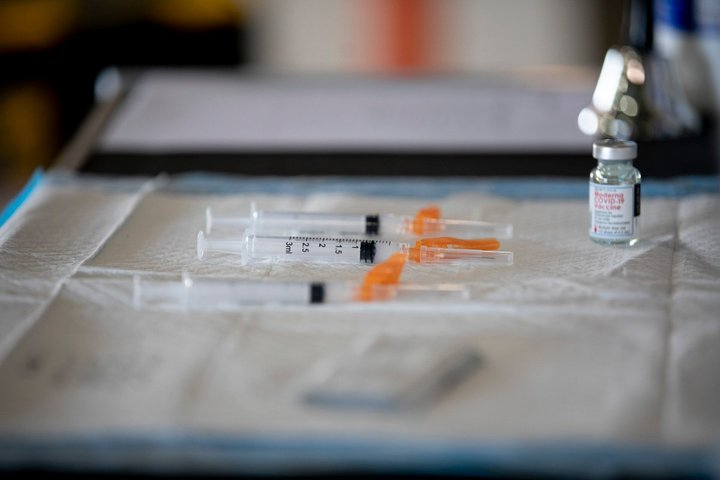
A vial of the Modern COVID-19 vaccine and syringes on a table at a drive through distribution site at Cal Expo in Sacramento on Jan. 21, 2021, Photo by Anne Wernikoff, CalMatters
###
Melinda McKee is anxious to get her COVID-19 vaccine. The medication she takes for a rare form of arthritis makes her immunocompromised and at high risk of falling severely ill from infections. But she’s only 33, and at the current vaccination rate, it may be months before she can get her shots.
After filling out a questionnaire from her provider, McKee learned she likely would fall in Phase 1C of the state’s vaccination plan, alongside millions of other Californians with underlying medical conditions. It’s not certain, though, because the state has yet to define which conditions would be included in this phase. It would put her ahead of the healthy general population, but behind seniors, millions of essential workers, the homeless, and incarcerated people.
“It’s unfortunate that immunocompromised people have to wait this long. I think we’re just as vulnerable, if not more, than a healthy 65-year-old,” McKee, of Los Angeles, said.
With more than 35,000 deaths from COVID-19, pressure has been building for the state to vaccinate people more quickly, especially those most vulnerable to a severe form of the disease. But ongoing limits on the supply of doses are instead forcing the state’s top public health officials to make tradeoffs and tough calls. They say the overarching question behind their decisions is this: How can they save the most lives? As the virus evolves and vaccine supply fluctuates, the only thing for certain is that their plans have to be flexible.
“It’s heartbreaking for all of us every day. And the challenge we have is that we don’t have enough vaccines.” — Dr. Nadine Burke Harris, state surgeon general
“We’re between a rock and a hard place,” Dr. Nadine Burke Harris, the state’s surgeon general, said during last week’s vaccine advisory committee meeting, where health, senior, and disability advocates, union representatives, and community groups had sometimes heated and impassioned discussions about the state’s proposals and slow progress.
“It’s heartbreaking for all of us every day. And the challenge we have is that we don’t have enough vaccines,” Burke Harris said.
About 12 million people are eligible for a vaccine now, under the state’s current guidelines. The state has received nearly 5 million doses and administered about 45% of them as of today. Each person requires two doses. There are close to 30 million adults in the state, and some experts have estimated at least 70% of the population needs to be immunized for widespread protection.
The vaccine advisory committee doesn’t make the call about who goes next but members are able to advocate for their own constituencies. Some want to keep it simple and distribute vaccines by age. Others argue that wouldn’t be fair for farmworkers and grocery store employees, essential workers who generally are younger but highly exposed. Some members said last week they were concerned about fast vaccine availability in zip codes that are virus hot spots. Others asked about people under age 65 with disabilities and preexisting conditions.
Earlier this month, following federal guidance, the state announced people aged 65 and over would be eligible to receive a vaccine — although how soon seniors could actually make an appointment varies by county. California’s public health officials said vaccinating that age group will help reduce deaths and take the pressure off strained hospitals. Those seniors make up about 11% of cases, but almost three quarters of deaths in the state.
While the federal guidance also encouraged states to start vaccinating people under age 65 with certain documented medical conditions, California’s public health officials decided supply was too limited to include them. It would take potentially tens of millions of additional doses to vaccinate that group.
For example, expanding eligibility to people with diabetes would add millions to California’s immediate rollout; about 3 million adults are diabetic in California, including those over age 65. Diabetics have a higher risk of becoming severely ill from COVID-19, according to the U.S. Centers for Disease Control and Prevention. Other conditions that make people high risk include cancers, heart conditions, chronic obstructive pulmonary disease, obesity, and sickle cell disease.
Yet decisions on eligibility could be modified at any time, depending on the state’s supply of the vaccine. Public health officials heed advice about the phased rollout from a panel of medical experts that includes Dr. Mike Witte, chief medical officer of the California Primary Care Association. “Epidemiologists know how many people are in each of those tiers… so they can cross that with how many vaccines are being allocated,” Witte said.
The state is receiving anywhere between 300,000 to 500,000 vaccine doses a week. To date, it is unclear whether President Joe Biden’s goal to vaccinate 100 million people in 100 days would boost California’s supply. But at its current rate, the state wouldn’t finish immunizing those aged 65 and over until June, Dr. Erica Pan, the state’s top epidemiologist, said during last week’s vaccine advisory meeting.
In addition to supply issues, some experts have also blamed California’s inefficient system, in which rules vary by county and health system, for the slow vaccination rollout. With it comes confusion about who is eligible to be vaccinated, and when.
About 12 million people are eligible for a vaccine now, under the state’s current guidelines. The state has received nearly 5 million doses and administered about 45% of them as of today.
Anthony Wright, director of Health Access and a member of the vaccine advisory committee, said an effective vaccine plan needs to be easy to understand. “I find age compelling because of the simplicity and clarity in being able to communicate that to the public; it’s very simple to know when you’re eligible based on your age,” he said.
While it’s worth considering faster immunizations for people with certain medical conditions, Wright said that would require the state to define the comorbidities and be able to verify them. If California took that route, it likely would need to create more subsections in its vaccine tiers, further complicating an already complex system, he said.
“You could imagine a formula that took health conditions, age, your work, your level of exposure, and other factors as well, in creating some sort of score,” Wright said, explaining the difficulty. “We’re hoping this moment of scarcity won’t be for very long.”
State health officials hope other manufacturers will soon hop in line and increase supply — especially with potential vaccines that only require one dose like the Johnson & Johnson vaccine that is nearing the end of its trial.
In the meantime, counties fear running out of doses, noting they have no choice but to take it week by week, making planning extremely difficult.
“We were honestly afraid we were going to run out this week, and then the state came through with an extra 5,100 doses… which we think will allow us to continue until our next allocation next week,” Dr. Rais Vohra, Fresno County’s health officer said last week. The county has built a system to vaccinate many more people if only the doses were available, he said.
Amid the slow rollout, Dr. Otto Yang, an infectious disease expert at UCLA Medical Center, said he is concerned many high-risk individuals might have to wait several more months to be vaccinated because they don’t meet a certain age requirement.
“A healthy 65-year-old and 60-year-old with a list of comorbidities are not the same in terms of risk,” Yang said. “It seems a little arbitrary, but I understand you need a cutoff.”
###
CalMatters COVID-19 coverage, translation and distribution is supported by generous grants from the Blue Shield of California Foundation, the California Wellness Foundation and the California Health Care Foundation.
CALmatters.org is a nonprofit, nonpartisan media venture explaining California policies and politics.
Press release from the Humboldt County Sheriff’s Office:
On Jan. 23, 2021, at about 3:15 a.m., Humboldt County Sheriff’s deputies on patrol in the area of Shoemaker Road and Telescope Peak Road, near Hoopa, conducted a traffic stop for a vehicle code violation.
While contacting the driver, 29-year-old Kayce Marie Salas of Eureka, deputies observed a firearm in plain view inside the vehicle. Deputies recovered the firearm and found it to be loaded. Upon further investigation, Salas was found to be on active probation. During a search of Salas, deputies located approximately 0.65 grams of methamphetamine.
Salas was taken into custody and booked into the Humboldt County Correctional Facility on charges of unlawfully possessing a firearm (PC 25850(C)(4)), carrying a loaded firearm without being the registered owner (PC 25850(C)(6)), carrying a loaded firearm in a public place (PC 25850(A)), possession of a controlled substance (HS 11377(A)) and violation of probation (PC 1203.2(A)(2)).
Two other occupants of the vehicle were released at the scene.
Anyone with information about this case or related criminal activity is encouraged to call the Humboldt County Sheriff’s Office at (707) 445-7251 or the Sheriff’s Office Crime Tip line at (707) 268-2539.
Press release from the Humboldt County Sheriff’s Office:
On Jan. 23, 2021, at about 11:12 p.m., Humboldt County Sheriff’s deputies on patrol in the area of the 700 block of Redwood Drive conducted a traffic stop on a van for a vehicle code violation.
The driver, 30-year-old Tyler Dylan Maupin of Redway, was found to be driving on an expired license and was on active probation with a search clause. During a search of Maupin, deputies located just under one gram of methamphetamine. During a search of Maupin’s vehicle, deputies located over 50 grams of heroin, over one pound of cannabis and items related to the sale of illegal substances. Additionally, deputies located and seized over $22,000 pursuant to asset forfeiture proceedings.
Maupin was arrested and booked into the Humboldt County Correctional Facility on charges of possession of a controlled substance for sale (HS 11351), transportation/sale of a controlled substance (HS 11352(A)), possession of over 28.5 grams of cannabis (HS 11357(C)), possession of a controlled substance (HS 11377(A)), driving without a license (VC 12500(A)) and violation of probation (PC 1203.2(A)(2)).
A passenger in the vehicle was released on scene.
Anyone with information about this case or related criminal activity is encouraged to call the Humboldt County Sheriff’s Office at (707) 445-7251 or the Sheriff’s Office Crime Tip line at (707) 268-2539.
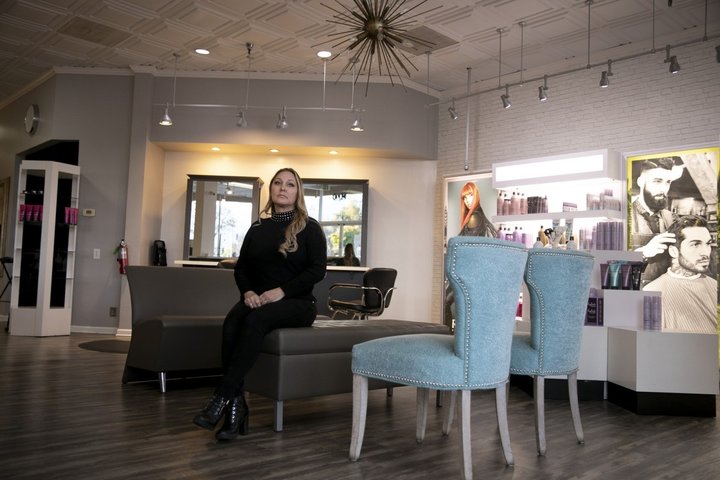
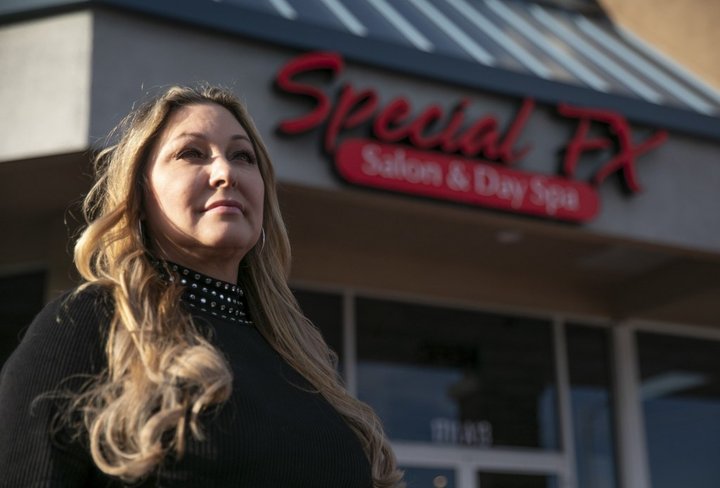
Denise Russell, owner of Special FX Salon & Day Spa in San Jose, photographed in the waiting area of her salon on Jan. 15, 2020. Russell, who has been in business for more than 30 years, says she misses her clients and stylists. Photo by Anne Wernikoff, Calmatters.
###
Since the coronavirus swept into Silicon Valley last spring, Denise Russell’s race to save her San Jose salon has stretched into a marathon. It started with a $103,020 Paycheck Protection Program loan. Then came a federal small business Economic Injury Disaster Loan for $159,000. Now, she’s applying for a $15,000 state grant and another PPP loan — all while fighting the state for delayed unemployment payments.
“They make it so complicated,” said Russell, whose Special FX Salon & Day Spa was closed for seven months in 2020. “They’re constantly changing the rules. I mean, it’s a nightmare.”
Russell spent thousands on medical-grade sanitizer and a parking lot salon, but she only brought in around $350,000 of the more than $1 million in revenue she expected last year. Across the state, business owners staring down similarly daunting numbers warn of an “extinction event” that could claim a third or more of small businesses, with service sector employers and those owned by women and people of color at highest risk.
Denise Russell, owner of Special FX Salon & Day Spa in San Jose, is photographed outside of her salon on Jan. 15, 2020. Russell says she has had to close the salon for more than 7 months this year. Photo by Anne Wernikoff, CalMatters
Amid winter closures triggered by record virus cases, California kicked off an unprecedented small business rescue plan. Federal loan programs have already injected more than $83 billion into California businesses, and the state is rolling out its own grants, loans and tax relief. Still, business owners warn that it’s not enough, especially after widespread technical glitches and confusion about eligibility, programs that have at times favored bigger companies and nagging questions about interest or funding restrictions.
“These are unheard-of numbers when it comes to cash for small businesses,” said Mark Herbert, vice president of California operations for national advocacy group Small Business Majority. “But it’s also important to understand the scale of the need. ”
A $4.5 billion relief plan
Beyond high-profile clashes over pandemic reopening rules is a fundamental question that has vexed state and federal officials: whether to inject more direct aid now, hopefully staving off mass commercial evictions and bankruptcies, or focus on longer-term economic stimulus.
With his $4.5 billion Equitable Recovery for California’s Businesses and Jobs budget plan, Gov. Gavin Newsom aims to do both. Among the proposals: $575 million in cash grants, $630 million in tax relief and $135 million in low-interest loans. The administration included $1.5 billion for zero-emission vehicles and $500 million for housing development, contending those funds would spur clean-energy and construction jobs
“Small businesses are the backbone of our economy,” Newsom said during a Jan. 5 virtual address. “I recognize the headwinds. I recognize the stress. I recognize all that you have been put through over the course of the last year.”
California’s approach has national implications. Janet Yellen, a member of Newsom’s economic recovery task force, is President Joe Biden’s nominee for treasury secretary. Isabel Guzman, director of California’s Office of the Small Business Advocate, is Biden’s nominee to lead the U.S. Small Business Administration.
Back in Sacramento, economic recovery efforts will be helmed by Newsom’s new senior business adviser and Clinton administration alum Dee Dee Myers. State lawmakers are also fighting for additional small business aid. Sen. Anna Caballero, a Democrat from Salinas, has championed a larger $2.6 billion small business grant program with SB 74.
“I’m a big supporter of community aid right now,” Caballero said. “Part of that is we need to get people back to work.”
Mind the gaps
One challenge 10 months into the pandemic is that no one knows for sure how much damage has already been done.
From February to April, 3.3 million small businesses nationwide vaporized, according to a Stanford Institute for Economic Policy Research analysis — a 22% overall drop, but a 41% drop for Black-owned businesses, 32% for Latinos, 26% for Asians and 25% for women. In California, 30% of small businesses remained closed in November, and “thousands” shut down permanently, according to a report by state oversight agency the Little Hoover Commission.
Last spring, millions of businesses scrambled to get a piece of the $669 billion federal Paycheck Protection Program, which doled out 617,216 loans totaling $68.3 billion in California, Small Business Administration records show. It was a frenzy that strained the state’s hundreds of local small business groups and highlighted existing racial disparities in access to capital, as well as costly tools like online sales software to stay safe and competitive in a pandemic.
“We had an influx of people reach out that needed just the fundamentals,” said Dene’ Starks, education director of Elk Grove’s four-person Black Small Business Association of California. As big banks fast-tracked applications for the Los Angeles Lakers and billion-dollar tech startups, her group helped small businesses get federal tax numbers and open bank accounts.
Brian Rauso (right) co-owns Orange County’s Green Cheek Brewing Co. with brewer Evan Price. Photo courtesy of Green Cheek Brewing Co.
Brian Rauso managed to cut through the red tape for a PPP loan worth $82,250 for his Green Cheek Brewing Co. in Orange County. The company was still forced to lay off dozens of its 49 employees after opening a second location in January. A $1,000 grant from Orange County helped build an outdoor patio this summer, and he’s got a $150,000 emergency loan in reserve.
With the businesses closed again as the virus rages in Southern California, Rauso worries government aid is “too little, too late.” The bigger issue, he said, is when he can reopen, and whether the business will still be bound by highly specific state rules that require breweries to serve full meals to operate. For now, Green Cheek has indefinitely shelved plans for a third location, and Rauso has watched three former employees move out of state for lower costs of living.
“COVID, unfortunately, it’s like turning the lights on in the middle of the night and seeing what’s really going on,” Rauso said. “It’s exaggerated all the problems that have been there.”
New loans
As small business owners try to keep their heads above water, policymakers, philanthropists, attorneys, banks and academics have come together behind the scenes to try to fill gaps in patchwork aid programs. It’s a tall order, especially to reach the state’s smallest businesses. But if it works, those involved say it could change the way small business lending is done in California and kickstart new jobs as the state economy recovers.
The public-private California Rebuilding Fund launched late last year is small by the scale of recent federal loan program, but it’s 4.25% interest loans are designed to be paid out by local Community Development Financial Institutions that can reach more small businesses. A separate $35 million Dream Fund in Newsom’s proposed budget would offer additional capital to entrepreneurs from underrepresented groups to start new businesses.
“We need to try to stem the bleeding. But we also wanted to start planning and thinking about, ‘How do we identify long-term strategic priorities?’” said Herbert of Small Business Majority, who helped develop the Rebuilding Fund. “That’s a piece of infrastructure that’s not just built for the emergency, but has tremendous implications in the future.”
Unemployment numbers and new business starts in the coming months will test which programs are making a dent for small businesses. For now, with her San Jose salon still closed, Russell is among those branching out. She’s already raised money from two private investors to start the wine company she always imagined at her home in Morgan Hill.
“I’m a workaholic. I had to figure out how to divert my negative energy,” she said. “That would have never happened had the status quo continued.”
###
CALmatters.org is a nonprofit, nonpartisan media venture explaining California policies and politics.