

MONDAYS WITH MICHAELE: If You Want Blood…
LoCO Staff / Monday, Jan. 25, 2021 @ 6:50 a.m. / Mondays With Michaele
As your President of Positivity always says, “Good morning and good health!” And if you’d like to contribute to your community’s good health, consider making this the week that you pay a visit to the Northern California Community Blood Bank’s Blood Mobile to drop off a pint.
Due to past COVID restrictions, NCCBB is very much in need of the red stuff and would greatly appreciate your contribution! For more info on the Blood Mobile’s upcoming locations and how you can donate, head on over to NCCBB’s website.
# # #
Perhaps You’d Like to Explore Previous Mondays With Michaele For Some Reason!
BOOKED
Yesterday: 9 felonies, 11 misdemeanors, 0 infractions
JUDGED
Humboldt County Superior Court Calendar: Today
CHP REPORTS
No current incidents
ELSEWHERE
RHBB: Five Victims and the One Survivor of Fatal 299 Crash Identified
RHBB: Free Health Care Clinic Responds to Humboldt’s ‘Startling’ Needs
RHBB: PG&E Helicopters to Hover Over Humboldt for About a Month
RHBB: State Disaster Declared Months After 2.9 Million-Gallon Sewage Spill in Clearlake
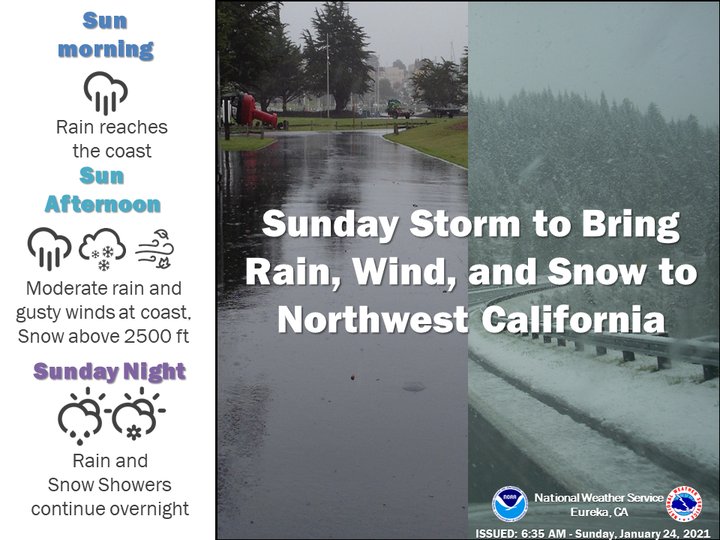
Major Winter Storm: Two Feet of Snow Forecast to Fall in Areas as Low as Berry Summit
John Ross Ferrara / Sunday, Jan. 24, 2021 @ 10:30 a.m. / How ‘Bout That Weather
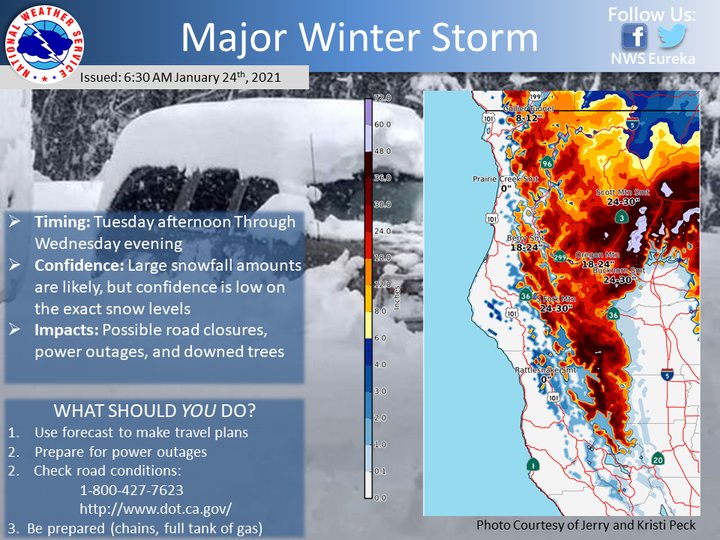
Weather graphics provided by the NWS.
A major winter storm will hit Northwest California between Tuesday afternoon and Wednesday evening, dropping 18 to 30 inches of snow along local highways at elevations as low as 2,500 feet.
Eureka’s National Weather Service office reports that 18 to 24 inches of snow is expected along Highway 299 at Berry Summit, and 24 to 30 inches of snow is expected along Highway 36 near the Humboldt-Trinity border.
“Large snowfall amounts are likely but confidence is low on the exact snow levels,” the NWS stated. “Consider changing travel plans or taking an alternate route. Major impacts are possible with this storm due to utility outages, downed trees, and road closures.”
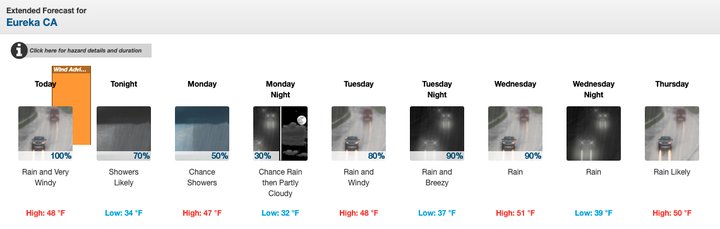
Rain and 23-mph winds will be possible in coastal areas of Humboldt County between Monday and Thursday.
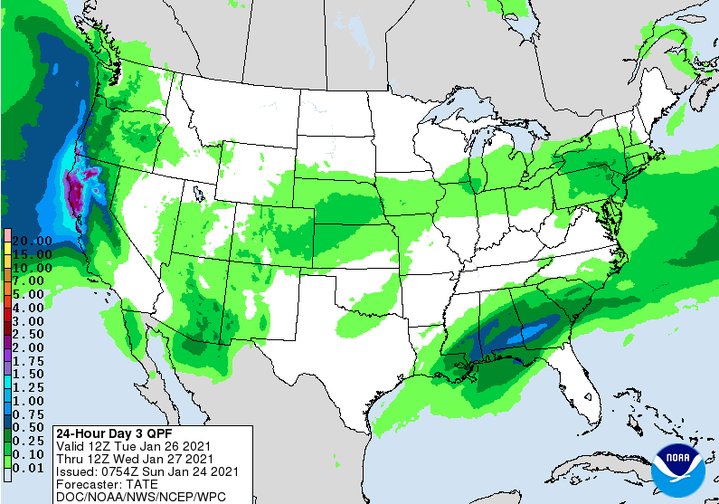
Forecasted rainfall for Tuesday and Wednesday.
A wind advisory has been issued for the North Coast today. Gusts between 27 and 46 mph are forecast to impact the area starting this afternoon. A smattering of rain and snow is also in today’s forecast.
“Most areas will see around a quarter to half an inch of rain, while elevations above 2500 feet in the mountains of Del Norte and Humboldt Counties see 1 to 3 inches of snow,” the NWS stated. “Gusty north winds ranging from 25 to 35 mph are expected for the coastal plains, with occasional gusts as high as 45 mph early Sunday afternoon.”
Light hail and thunderstorms are also possible in the greater Humboldt Bay area tonight.
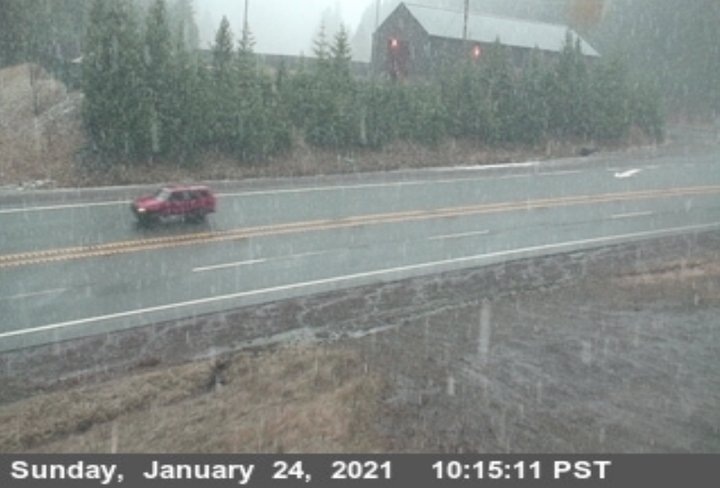
A look at Berry Summit this morning. | Caltrans highway camera
GROWING OLD UNGRACEFULLY: Big History
Barry Evans / Sunday, Jan. 24, 2021 @ 7 a.m. / Growing Old Ungracefully
For better or for worse, we’re in a period of history when technology, innovation and industry are roaring ahead as if there’s no tomorrow. It’s easy for me to forget how different the world in which I now live is, compared to the one in which I was born. 1942: Stalingrad, El Alamein, Midway; computers and the digital age were in the future; the turbojet plane was three years old; the first mobile phone four years away; the Manhattan atomic bomb project was just getting underway; and for every living person then, three are alive now. In the 78 years since—barely a lifetime—the rate of invention has been one headlong rush. It hasn’t always been so. History tells us of times when scientific inquiry and technological ingenuity pretty much came to a halt. Here are three of those times.
Bronze Age Collapse
The most celebrated of these occasions is probably the “Bronze Age Collapse,” around 1200 BC (or exactly 1177 BC, “the year civilization collapsed,” according to historian Eric Cline, when the so-called “sea-peoples” invaded Egypt). Prior to this time, the world of the Bronze Age had been thriving and growing in the eastern Mediterranean and Middle East. And then, in the space of a couple of decades, Old World civilizations went belly-up. Virtually all the great Bronze Age cities of the Minoans, Mycenaeans, Trojans, Hittites and Babylonians were destroyed, most by fire—archeologists point to blackened layers of debris. Trade essentially stopped. Writing mostly disappeared (to be revived much later, around 750 BC, allowing the lliad and Odyssey epics to be recorded for posterity after four centuries of oral transmission).
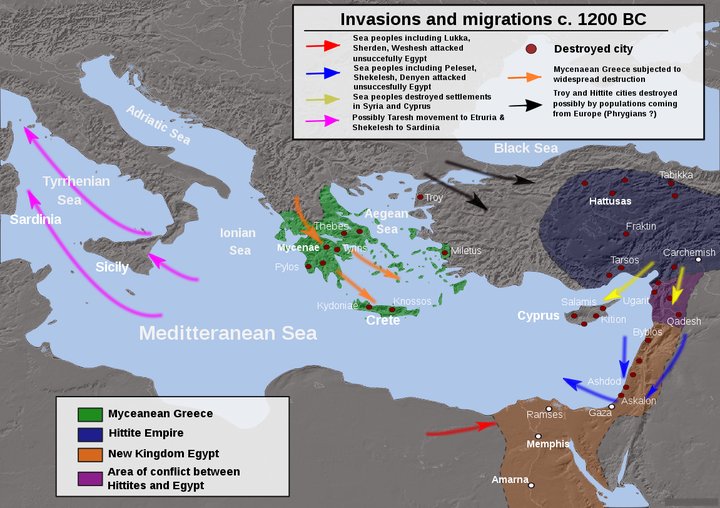
Graphic by “Alexikou.” Creative Commons License. Via Wikipedia.
What caused this comparatively sudden, widespread collapse? Probably a perfect storm of events—drought, climate change, overpopulation, disease—historians have been arguing about it for decades. For what it’s worth, my vote for the proximate cause: the tin trade routes were cut by brigands. Without tin, no bronze (tin + copper), no new weapons, leading to a crisis economy. (Copper was abundant in Cyprus, hence the name, while the source of tin is still debated.)
Dark Ages
Much later, the western world went through another hiccup, the Dark Ages, aka Early Middle Ages, following the fall of the Roman Empire. Learning only survived by “the skin of our teeth,” in the words of the late historian Kenneth Clark, whose 1969 BBC Civilization series presaged Ken Burns and all other TV historical documentaries; it’s still well worth watching. By Clark’s reckoning, remote Irish monasteries in the sixth and seventh centuries kept the flame of civilization burning. (His is now a minority view. Most historians give more credit to Arabic scholars centered on Baghdad during the Golden Age of Islam. Their efforts ensured survival of the works of Greek and Roman philosophers and inventors, via the 700-year-long Umayyad occupation of the Iberian Peninsula. Very little to do with Christian monks in Ireland.)
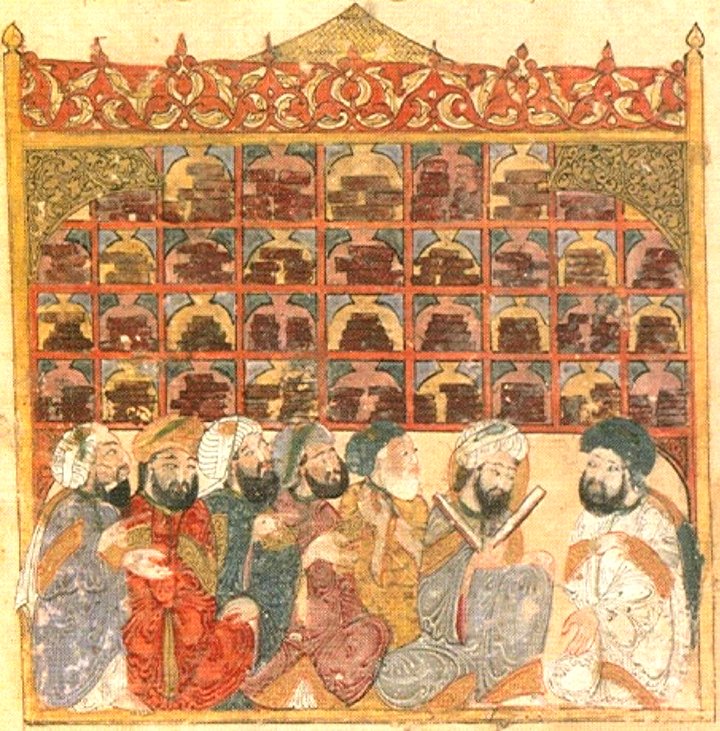
13th century depiction of Abbasid caliphate scholars, Yahya ibn Vaseti, (“Zeresh.” Public domain. Via Wikipedia)
12th Century Reversal
Then there was a curiously synchronous 40-year period when, far apart, several disconnected cultures turned their backs on scientific curiosity and inquiry. Consider three unrelated events that took place between 1100 and 1150 AD: (1) In medieval Kaifeng, China, the most sophisticated mechanical device up until that time, Su Song’s astronomical clock, was destroyed; (2) In France, freethinker Peter Abelard of the University of Paris was attacked by St Bernard of Clairvaux, the guy who preached the disastrous Second Crusade; (3) In Baghdad, philosopher-mystic Al-Ghazali’s attack on learning was (arguably) responsible for the beginning of the end of Islam’s “Golden Age” of scientific inquiry.
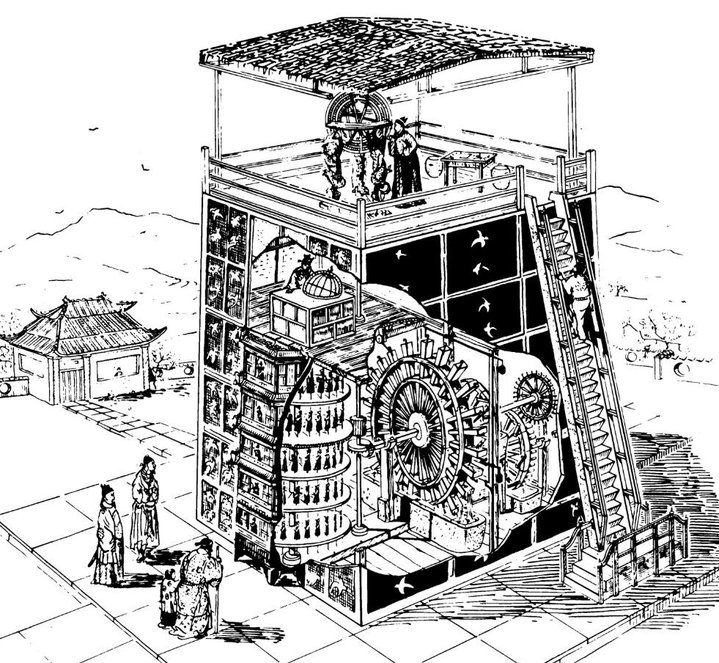
Su Song’s astronomical clock, drawn in 1877 per contemporaneous descriptions, via John Christiansen. (Public domain. Via Wikipedia.)
Despite all these setbacks, the human capacity for novelty and invention survived and flourished, bringing one revolution after another: printing, industrial, mechanical, electrical, digital and—just around the corner—AI and cybernetics.
I wonder if the anti-scientism of our time will prompt the next collapse?
LETTER FROM ISTANBUL: Never Say ‘Nevermore’
James Tressler / Sunday, Jan. 24, 2021 @ 7 a.m. / Letter From Istanbul
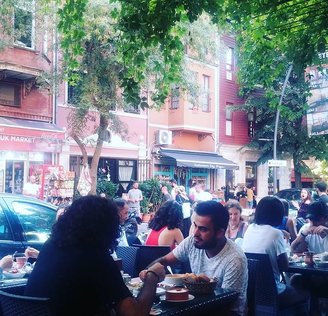
Kuzguncuk. Photo: James Tressler.
Kuzguncuk is a pleasant, tree-lined neighborhood that brushes along the shores of the city’s Asian side, the Martyrs’ Bridge in the backdrop as you approach on the coastal sidewalk.
In years’ past, my wife Ozge and I always liked Kuzguncuk, first because it’s easy to walk there from our neighborhood, and also because its bohème (or nearly bohème , if only it had a few more bars) aesthetic is always appealing. The narrow streets are cobbled, always shaded and cool even on the hottest summer day, and the sidewalks are filled with people sitting outside at small tables, sipping tea or coffee, having Turkish kavahlti at the many cafes, or kebab at Metet, or one of the many rich desserts served at the well-known places like Dilim. Browsing the pictures in the small galleries or the bookshops. Retro-chic hideaway from all the urban clamor.
Nowadays, that all has changed. The specter of the pandemic has crept here, as it has everywhere. With the restrictions, a good portion of the visible charms of the neighborhood have vanished. The sidewalks are empty, no tables. The trees, stripped of their leaves, present a stark beauty, the thin lines of the branches as noticeable as the absence of the colorful crowds. Many of the shops are closed, and a few shuttered, with “For Sale” or “Rent” signs in the windows. Kuzgun means “raven” in Turkish, and we can surmise that if the area’s namesake were observing from some tree nearby, it may well be echoing Poe’s famous forlorn decree: Nevermore. Fittingly, outside one of the closed cafes hangs a poster of the French New Wave classic, “Breathless,” showing the famous actors, only someone has thoughtfully taped Covid masks to their faces.
Not all is lost. The bakeries we like are still open, serving fresh pide bread and the baguettes we like to take home for sandwiches; Dilim’s is still open, with its colorful array of cakes and puddings on display. The small markets, with the winter sunlight presenting a bright still life of the vegetables and fruits on offer, still have the look of bustle. The butcher we like can be seen inside packaging minced meat or chopping a lamb leg with his mighty cleaver. The galleries are open.
The past week it snowed a few days, which we badly needed (the country faces drought conditions this year). But on Friday, it felt like a false spring, which is why we walked to Kuzguncuk. With our son Leo in the stroller, looking curiously at the passing cars and buses, and at the happenings along the sidewalk, we felt good to be out of the house.
One of the coffee shops was open, so we stopped and grabbed an Americano and tea for my wife. People were out, masked and still bundled up for winter, and they were mostly families, like us. At the park, lots of children were out playing in the green grass, the snow all melted in the becoming sunlight. A boy and girl, most likely siblings, were engaged in mortal combat with a pair of swords, while other children had fashioned more primitive swords out of the branches of nearby trees. Watching them reminded me of my brother and friends.
“We used to play war in the woods,” I mused to Ozge. “God, we’d play for hours.”
Ozge was busy with Leo. She took him out of the stroller and, holding his hands, let him practice walking. Four or five dogs, including one splendid looking golden retriever, were prancing and playing with each other nearby, and Leo regarded them with a mixture of fear and puzzlement. He looked at the other children with the same feelings. They were all a bit older, except for one or two in tow of their mothers who looked almost the same age. It occurred to me that Leo spends all his time with us, and perhaps he thought it strange that there were other “little people” besides himself.
“I wonder if he’ll be shy when he gets older,” I said. “I mean, because of the pandemic he’s never able to be around other kids.”
My wife didn’t say anything, but she was listening. She walked with Leo to the far end of the park, letting him look around at the other kids. Two older girls were batting a volleyball back and forth, and it looked odd with them wearing their masks, but they seemed to be having fun. As I sipped my coffee, I sat on the bench, while other parents also sat and talked while their children played. I overheard two women gossiping about the current US political situation in Turkish, but I didn’t catch much of what they were saying, other than the words “Trump” and “Midterms.”
It has been nearly a year since the pandemic entered our lives. None of us ever imagined things being this way. I thought of a restaurant we like in the neighborhood. It’s a simple, unpretentious local place that serves good, cheap (well, it used to be anyway) Turkish food and there is a wonderful rooftop terrace where you can drink your beer or wine after dinner and look out at the other rooftops in the neighborhood and even out at the Bosphorus and the boats passing, on their way up to the Black Sea or south to the Sea of Marmara. We used to go there regularly in the summertime, and I hoped that if things get better by summer we can go there again, if it is still open. We could even have dinner with Omer and Fatma, or our other friends, who we haven’t seen in nearly a year.
Later, we walked back through the neighborhood, and we stopped at a corner grocery store that has a really good deli, and where you can find things like Jif peanut butter and quality imported beers. Leo was behaving beautifully, just sitting peacefully in the stroller and taking in the scene casually beneath his wool tossel cap. Ozge was pointing out passing buses and shouting “Toot! Toot!” to keep him awake and interested, so that he would not waste his afternoon nap in the stroller, but rather have it at home so we could enjoy an hour or so to ourselves.
I thought about dinner as we walked back along the coastal road. The Bosphorus was a deep blue in the sunlight, and across the way the skyscrapers looked very sharp and clear, the Galata Tower looking like the tip of a fountain pen.
“Hey, it’s Friday,” I said. “Maybe for dinner we could order from the Kuzuncuk Steak House.” They do delivery.
“Maybe,” my wife said. She was busy singing “Wheels on the Bus” in Turkish to Leo, and Leo was still awake and not nearly sleepy. It felt really good to be outside. I thought about Kuzguncuk as we continued walking. In many cultures, the raven is a symbol of death or ill omens, and in other cultures the raven is said to foretell the future. I prefer this raven to the former, and later I thought about how nothing lasts forever, not even the pandemic. Never say, “Nevermore.” At some point Kuzguncuk will return to how it was, and all the people will be out sitting at the tables, and everywhere will be full of life again. At home, we ended up ordering Iskender kebab from Metet’s, and settled in for another quiet Friday evening together.
###
James Tressler, a former Lost Coast resident, is a writer and teacher.
(AUDIO) HUMBOLDT HOLDING UP: Mayor Susan Seaman on Eureka’s 2021 Challenges, the Inauguration, Traffic Safety and More
LoCO Staff / Sunday, Jan. 24, 2021 @ 7 a.m. / Humboldt Holding Up
(AUDIO) Mayor Susan is Holding Up
Subscribe to Humboldt Holding Up on iTunes!
Look out, y’all. The Mayor is here.
On this week’s edition of Humboldt Holding Up, the Lost Coast Outpost’s Good Enough Podcast™, we Zoom it up with Eureka Mayor Susan Seaman about what this particular weird new year may have in store for Eureka, Humboldt and the ol’ U.S. of A as a whole. In addition to the requisite COVID-19 check in, topics discussed include:
- President Joe Biden’s inauguration and the tone of our politics
- Eureka’s housing issues and their contributing factors
- The City’s marketing arrangement with Eddy Alexander
- The never-ending HACHR saga
- Traffic safety in Eureka
- The Mayor’s desire to personally participate in more drag racing
- More!
Click the audio player above to tune into Mayor Seaman’s chat with LoCO’s Stephanie McGeary and Andrew Goff and/or scroll through previous episodes of Humboldt Holding Up below:
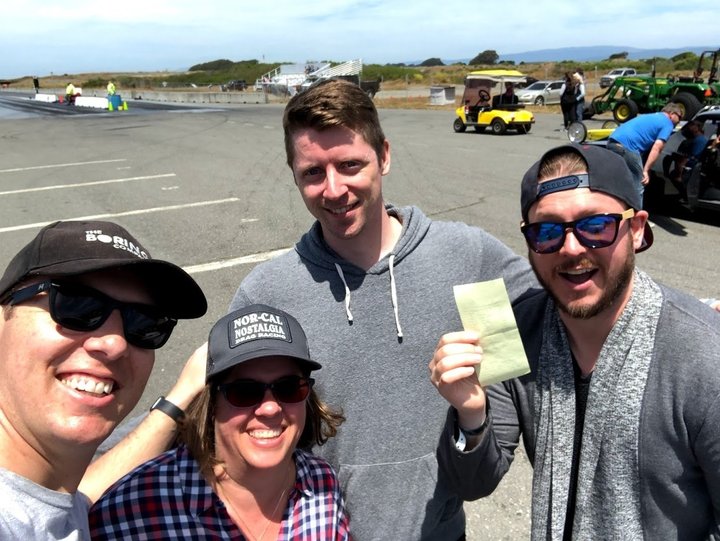
Mayor Seaman during a pre-COVID trip to the Samoa Drag Strip, a place, we discover, she has quite the fondness for
PREVIOUS GUESTS:
- Eagle House Owner Jennifer Metz
- Absynth Quartet Drummer Mike “Tofu” Schwartz
- HACHR Executive Director Lasara Firefox Allen
- Alchemy Distiller Owner Amy Bohner
- Eureka City Councilmember Kati Moulton
- Eureka City Councilmember Scott Bauer
- Ungraceful Ager Barry Evans
- Arcata City Councilmember Sofia Pereira
- HumBrews Music Booker Laurel Weston
- Eureka City Councilmember Kim Bergel
- Film Commission’s Cassandra Hesseltine and Nate Adams
- Marble Maker Topher Reynolds
- Arcata Playhouse Director Jacqueline Dandeneau
- Humboldt Political Junkie Eric Kirk
- Rio Dell Mayor Debra Garnes
- Second District Supervisor Estelle Fennell
- Arcata Food Aficionado Jada Calypso Brotman
- Body Piercer Jackie Silva
- Dick Taylor Chocolate’s Adam Dick
- FUHS Teachers Mark Thom and Inma Thompson
- Eureka City Manager Miles Slattery
- Savage Henry Co-Founder Chris Durant
- Eureka Street Art Festival Organizer Jenna Catsos
- SCRAP Humboldt Founder Tibora Bea
- Gym Owner Tyler Parr
- Six Rivers Brewery Co-Owner Meredith Maier
- Multicultural Skincare Therapist Levia Love
- Annie’s Cambodian Server and Social Worker Joshua Coppock
- Eureka City Councilmember Austin Allison
- HSU Professor Deidre Pike
- Pastor Bethany Cseh
- Singer/Songwriter Chris Parreira
- Eureka City Councilmember Leslie Castellano
- Arcata City Councilmember Paul Pitino
Want to Help Beautify Eureka? HACHR Invites You to A Community Cleanup Event
Stephanie McGeary / Saturday, Jan. 23, 2021 @ 4:49 p.m. / Community
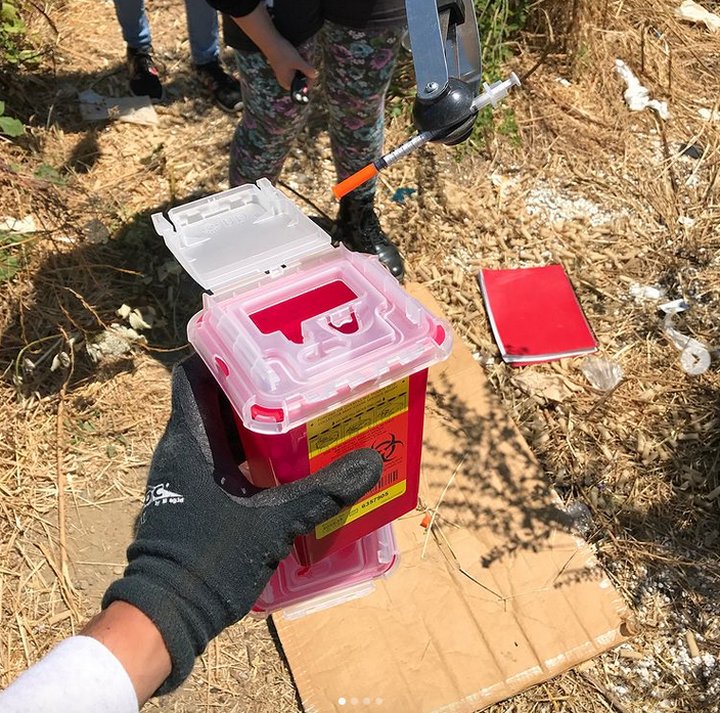
HACHR Employees picking up syringes at a cleanup in 2017 | Image from HACHR
If you like Eureka and want to help it look a little nicer, the Humboldt Area Center for Harm Reduction (HACHR) invites you to grab a trash bag, put on some gloves and join the staff for a community cleanup event on Saturday, Jan. 30.
Volunteers will meet at 11 a.m. in the HACHR parking lot — 1522 Third Street, Eureka — and break into groups to spread out and focus on different parts of the neighborhood. HACHR Executive Director Lasara Firefox Allen told the Outpost that the cleanup will cover the area roughly between the Humboldt County Library, Target, the Northbound 101 and the Waterfront.
Hot drinks and snacks will be provided to volunteers, as well as trash grabbers, sharps containers (for syringes) and garbage bags, Allen said. Volunteers are asked to provide their own work gloves and masks and to please follow all COVID safety protocols, including remaining masked and staying at least six feet away from anyone not in your “pod.” Allen added that the event will take place rain or shine, so be sure to dress accordingly.
HACHR’s syringe exchange program — which is not currently operating in Eureka — has been the focus of many recent Eureka City Council meetings and on Tuesday the council approved the nonprofit’s plan for a mobile syringe exchange. Allen said that HACHR is working with the city on some of the particulars, but they are hopeful that the mobile outreach vehicle will be operational in a couple of weeks or so. In the meantime, HACHR continues to offer syringe services outside of Eureka, and its many other harm reduction services — including free food, clothing, overdose prevention supplies and guidance to medicated treatment — at its Third Street location.
HACHR also has a designated “community cleanup liaison,” Allen added, who will respond to calls for syringe cleanup. If you find any syringes, you can call HACHR during business hours and they will come get them and dispose of them safely. HACHR can also provide you with a sharps container to keep on hand.
As for Saturday’s cleanup, volunteers will focus on picking up all garbage, not just syringes. And Allen hopes the event will also serve as an opportunity for participants to connect with other community members and HACHR employees.
“We’re definitely excited to see folks there and to have an opportunity to build some sense of community,” Allen told the Outpost. “It should create a starting point for better relationships.”
THE ECONEWS REPORT: What Can the August Complex Tell Us About the Fires of the Future?
The EcoNews Report / Saturday, Jan. 23, 2021 @ 10 a.m. / Environment
The August Complex fire near Forest Glen. Photo: Mike McMillan, U.S. Forest Service. Via Inciweb.
###
The 2020 August Complex was the largest fire in recent history, burning over one million acres. Scientists warn that large fires like these will likely become more common in the future, as climate change produces longer fire seasons and more extreme weather.
If large fires are the new future, what can we learn from the August Complex? One lesson that might be surprising to some is that the fire had large beneficial effects on the fire-adapted landscape.
Ryan Henson from the California Wilderness Coalition joins Gang Green to talk about wildfires, the environmental costs of fire suppression, and how we should (and should not) approach post-fire management.
AUDIO:
“The EcoNews Report,” Jan. 23, 2021.
LINKS:
- “Post-Wildfire Logging Hinders Regeneration and Increases Fire Risk,” Science, Jan. 20, 2006.
- “Salvage Logging, Ecosystem Processes, and Biodiversity Conservation,” Conservation Biology, June 20, 2006.
- “The forgotten stage of forest succession: early‐successional ecosystems on forest sites,” Frontiers in Ecology and the Environment, March 2, 2010.
- “Stop the Salvage Logging of Post-Fire Forests,” EPIC, Sept. 21, 2020.


_(20481431946).jpg)