

MONDAYS WITH MICHAELE: Leon and On and On
LoCO Staff / Monday, Nov. 16, 2020 @ 7 a.m. / Mondays With Michaele
60 years! Humboldt’s President of Positivity begins her week with a visit to Leon’s Car Care Center in Eureka to boogie down with the Warmuth clan as they celebrate six decades of servicing North Coast vehicles.
Shop local, says Michaele! Vroom vroom!
# # #
Perhaps You’d Like to Explore Previous Mondays With Michaele For Some Reason!
BOOKED
Today: 13 felonies, 12 misdemeanors, 0 infractions
JUDGED
Humboldt County Superior Court Calendar: Today
CHP REPORTS
Sr255 (HM office): Traffic Hazard
ELSEWHERE
SENIOR NEWS: The Horrible Toenail Incident
RHBB: As AI Ascends, Humboldt Seeks Control of Data Centers
RHBB: Expect Lines on Election Day, Humboldt’s Registrar Says. Here Is How to Skip Them
Humboldt Bay Fire Extinguishes Water Heater Fire on Q Street
LoCO Staff / Sunday, Nov. 15, 2020 @ 9:15 a.m. / Fire
Humboldt Bay Fire press release:
On 11/15/2020 at 1:26 A.M. Humboldt Bay Fire was dispatched to a reported structure fire on the 3200 Block of Q Street.
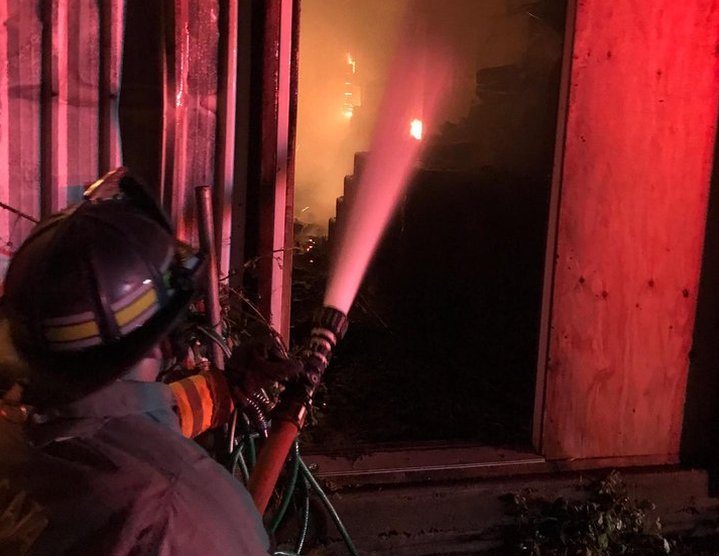
The first arriving engine company found moderate smoke coming from the front and rear of the a single family residence. Fire personnel entered the structure and located fire in a water heater utility room.
Additional personnel searched the structure and surrounding area and found that the occupant had self-evacuated with her pet prior to the fire department’s arrival. Humboldt Bay Fire personnel had the fire controlled within 15 minutes. The damage was limited to the water heater utility room and the laundry room that the fire had burned into.
The investigation determined that the fire was accidental and originated in the water heater utility room. Fire officials could not determine if the water heater malfunctioned, had been installed improperly, or if combustibles had been stored too close to the water heater.
Damage was estimated at $5,000. There were no injuries to civilians, fire personnel, or animals. Humboldt Bay Fire wants to remind everyone to maintain adequate clearance around heating appliances and electrical service rooms.
(AUDIO) HUMBOLDT HOLDING UP: Writer Barry Evans On the ‘Resilience’ of Old Town During COVID and Recovering from His Recent Bike Crash
LoCO Staff / Sunday, Nov. 15, 2020 @ 7:05 a.m. / Humboldt Holding Up
Subscribe to Humboldt Holding Up on iTunes!
When life knocks you off your bike, you just got to get back up and keep riding, even if you’re 78 years old. At least, that’s been the attitude of local columnist Barry Evans, who is already back to cycling after his recent recovery from a pretty serious spill.
Evans tells us all about it in this week’s episode of Humboldt Holding Up. The longtime Old Town resident also discusses his love for the Old Town neighborhood and how he’s watched it adapt to the pandemic, his background as a civil engineer, his world travels and how he landed in Eureka.
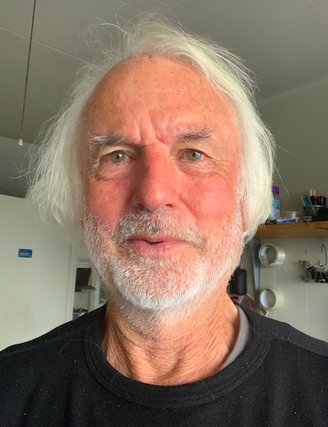
Evans, Growing Old in Old Town
Oh, and Evans also talks a bit about the latest installment of his column “Growing Old Ungracefully” and why he thinks Vice President-elect Kamala Harris will make a great leader amid the pandemic.
Click the audio player above to hear Evans’ chat with LoCO’s Andrew Goff and Stephanie McGeary and/or scroll the the list of previous guests below.
PREVIOUSLY ON HUMBOLDT HOLDING UP:
- Arcata City Councilmember Sofia Pereira
- HumBrews Music Booker Laurel Weston
- Eureka City Councilmember Kim Bergel
- Film Commission’s Cassandra Hesseltine and Nate Adams
- Marble Maker Topher Reynolds
- Arcata Playhouse Director Jacqueline Dandeneau
- Humboldt Political Junkie Eric Kirk
- Rio Dell Mayor Debra Garnes
- Second District Supervisor Estelle Fennell
- Arcata Food Aficionado Jada Calypso Brotman
- Body Piercer Jackie Silva
- Dick Taylor Chocolate’s Adam Dick
- FUHS Teachers Mark Thom and Inma Thompson
- Eureka City Manager Miles Slattery
- Savage Henry Co-Founder Chris Durant
- Eureka Street Art Festival Organizer Jenna Catsos
- SCRAP Humboldt Founder Tibora Bea
- Gym Owner Tyler Parr
- Six Rivers Brewery Co-Owner Meredith Maier
- Multicultural Skincare Therapist Levia Love
- Annie’s Cambodian Server and Social Worker Joshua Coppock
- Eureka City Councilmember Austin Allison
- HSU Professor Deidre Pike
- Pastor Bethany Cseh
- Singer/Songwriter Chris Parreira
- Eureka City Councilmember Leslie Castellano
- Arcata City Councilmember Paul Pitino
Subscribe to Humboldt Holding Up on iTunes!
GROWING OLD UNGRACEFULLY: Kamala and Covid
Barry Evans / Sunday, Nov. 15, 2020 @ 7 a.m. / Growing Old Ungracefully
Kamala Harris was asked on 60 Minutes whether her perspective was socialist or progressive? “It is the perspective of a woman who grew up a Black child in America, who was also a prosecutor, who also has a mother who arrived here at the age of 19 from India. Who also, you know, likes hip-hop.”
###
I call it the Taraneh Effect, after my doctor when we lived in the Bay Area years ago. Taraneh was female and Iranian, which gave me great confidence in her. I reasoned that anyone with those identity markers must have gone through many more rigors than her male-white-American counterparts. My confidence was duly rewarded: she was wonderful.
So it must be for the Vice-President Elect of the United States, Kamala Harris. What extra hurdles has she had to face, which her male (mostly white) colleagues have probably never even thought about? Dressing just right (skirt neither too short nor too long). Appropriate make-up (regularly checked throughout the day). Not being caught short when her period started early, and having something in her purse to deal with cramps. (And having to carry a damn purse in the first place!) Her hair—oh God, worthy of an essay in itself. And yes, those shoes (Converse sneakers)—smart choice. So yeah, she’ll probably be—time will tell—a better federal leader than a similarly-qualified white male VP might have been, based on the Taraneh Effect.
But that’s only half the story. We’ve got enough female heads of state to check out actual performance. For instance, researchers from the Universities of Liverpool and Reading published a paper titled “Leading the Fight Against the Pandemic: Does Gender ‘Really’ Matter?” found that, yes it did. “Using a constructed dataset for 194 countries…[we] show that COVID-outcomes are systematically better in countries led by women and, to some extent, this may be explained by the proactive and coordinated policy responses adopted by them.”
That was last June, so I tried to get a bit more up-to-date. Here are the worldwide average daily cases per 100,000 for the previous seven days (as of last Thursday). Sadly, the promise of those initial Covid months has slipped since that paper. But it still looks pretty good for most of the female-led countries.
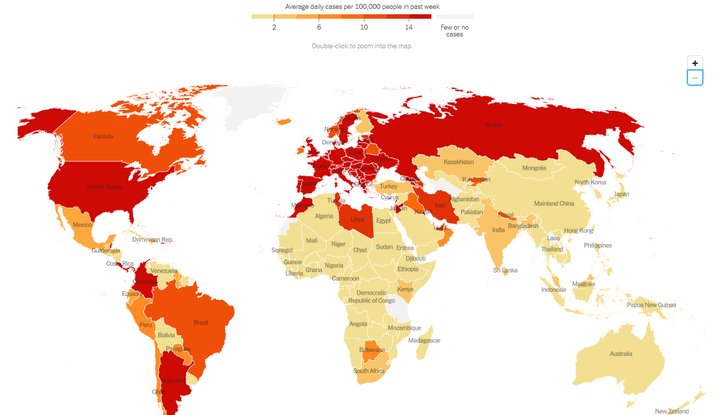
(New York Times)
If you open the link, you can hover over each country for a graphic look at how they’re coping with the pandemic (it’s fascinating!).
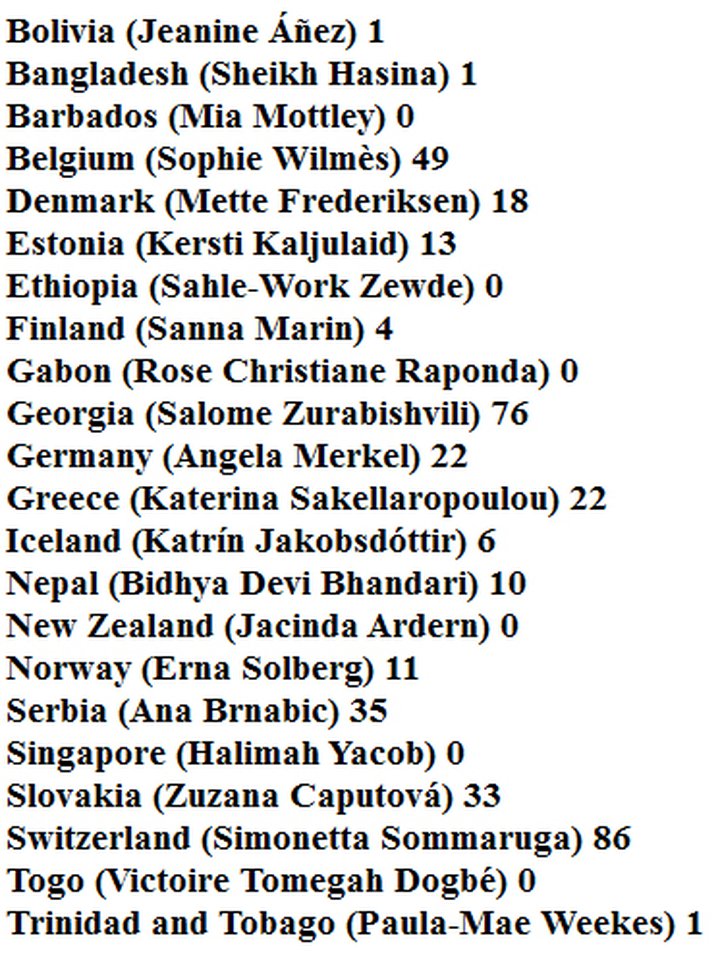
Here are the 22 countries (of 193 UN members) that currently have female leaders, with their daily cases per 100,000, as above. For comparison, the US is currently (last Thursday) at 39, Canada 11 and Mexico 5. Note that only three of these female-led countries have Covid rates higher than ours.
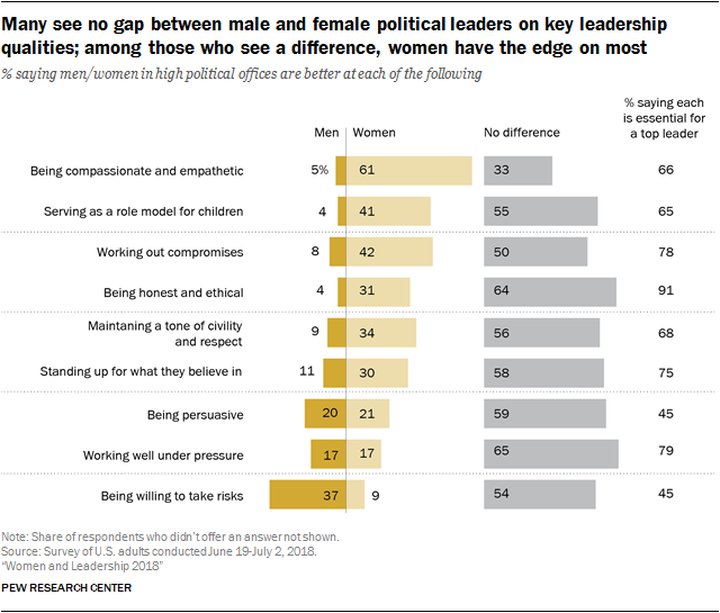
Perhaps more to the point is how men and women are perceived as leaders—our perception usually leading to actual outcomes. Here’s the result of a Pew survey from a couple of years ago:
For now (ask me in four years) I’ll stick to the Taraneh Effect in my hopes for the new Vice-President Elect. One thing I’m sure of: we’ll be hearing a lot more about her than the lackey, if I could just remember his name, who has been occupying that VP position for the last four years.
THE ECONEWS REPORT: Election Post-Mortem
The EcoNews Report / Saturday, Nov. 14, 2020 @ 10 a.m. / Environment

On this week’s episode of the EcoNews Report, Gang Green talks about the 2020 general election and what it means for local and federal environmental issues. Locally, Gang Green is excited about environmental scientist Scott Bauer making it to the Eureka City Council and the passage of Arcata’s Measure A, which will fund parks, greenspace protection and wetland restoration.
On the federal side, President-elect Joe Biden and the Democrats may have a surprisingly easy road to undo damage wrought by Trump on federal environmental laws, although a (likely) divided government will make a positive legislative agenda more difficult.
AUDIO
With Measure F Passing, Arcata Fire District Says Reopening Third Station Will Take a While
Stephanie McGeary / Saturday, Nov. 14, 2020 @ 9:37 a.m. / Elections
Arcata Fire District battles a barn fire in Arcata | File photo
The latest Humboldt County election report is in and it looks like Measure F — a special tax proposal to fund the Arcata Fire District — has passed with over 75 percent of the vote.
After the special tax proposal by way of Measure R failed in the last election, the district was forced to close one of its three stations and freeze eight firefighter positions. The district said that with the passage of Measure F, it would again fill those firefighter positions and reopen its third station.
So, when can we expect to see these changes? According to Arcata Fire District Chief Justin McDonald, reopening the third station “will not be as easy or as swift as we would all hope.”
Chief McDonald sent out a press release on Friday, explaining why this process will take some time and what residents can expect to see in the months and years moving forward:
I would like to say thank you to all those that promoted and voted for Measure F. I am excited to see such great support from the community. I would also like to take this opportunity to explain what the passage of Measure F will look like, post-election. The District Board is waiting on the official notification from the County Elections Office for the final election results. The Board will then implement Ordinance 20-20, which calls for the Measure F special tax to be collected. However, the big topic that everyone wants to know is, “When will the third fire station open?” Unfortunately, re-opening the third station will not be as easy or as swift as we would all hope and the following are a few of the reasons.
First, and most importantly, the District will not receive the funding from Measure F until January 2022. Although the new tax was approved during 2020, the current fiscal year tax bills have already been processed and sent out to the property owners in our District. This means that it could not be included this fiscal year and the District will have to endure one more budget cycle of tight revenues. As reflected in the current budget, the Board has made cuts to operations and staffing to balance the budget.
A second reason reopening the third station cannot be a quick process is related to staffing. Operationally, the District is currently short-staffed, and without enough firefighters to safely, or contractually, staff more engines, we cannot open the third station. Presently, there is not enough money in the District reserve account to begin hiring new employees immediately. As such, the process of hiring new employees is expected to begin around July 2021, at the beginning of our new fiscal year. It is not as simple as hiring an entry-level firefighter, we have vacancies in all ranks/positions of the organization that will also need to be filled. We will likely be conducting promotional exams concurrently with the recruitment of new firefighters. In addition to the time it takes to advertise and interview potential candidates, all new employees must go through a background check, health exam, and a new hire academy. This process can easily take six months to accomplish.
During last week’s Board meeting, a follow up question was posed about using overtime to cover the needed positions to reopen the station, as we work through the new employee hiring process. Unfortunately, as mentioned above, we do not have enough current employees or reserve funds to accomplish this undertaking as a long-term solution. However, the District’s Finance Committee will be reviewing the feasibility of utilizing overtime to open the station on an infrequent basis, depending on daily staffing levels.
Finally, The District Board will be developing the Measure F “Citizens Review Committee.” Once the parameters of the committee and selection process are settled, we will be looking for community members to participate on this oversight group.
Regular updates will be provided as new information becomes available. Please check our website and social media for these updates regarding our hiring process and any other information related to Measure F funding.
Arcata Fire District has been proudly serving the communities of McKinleyville, Manila, Bayside, Jacoby Creek and the City of Arcata for over 70 years and we look forward to many more. We sincerely appreciate the community support and request continued patience and understanding as we work through this process.
Preparing for the Surge: Humboldt’s Deputy Public Health Officer Takes Questions on Rising COVID Cases and the County’s Response
LoCO Staff / Saturday, Nov. 14, 2020 @ 9:06 a.m. / COVID-19 and Humboldt
Yesterday, Dr. Josh Ennis, Humboldt County’s deputy health officer, took loads of media questions on the state of the pandemic — and particularly on the recent surge of cases in Humboldt County and nationwide.
Video above, rough transcript below.
###
Good afternoon, thank you for being with us today, would you like to start by addressing the community?
Yeah, I’d like to take this opportunity to talk a little bit about where we’re at and how the tier framework might be able to adapt to certain situations.
So right now across the state as well as our own county we’re seeing unprecedented growth the volume is of concern but even more than that is the acceleration, so how quickly that volume has taken off. Just two weeks ago we had far fewer cases, on the order of very low single digits per day, and now we have days where we’re consistently in the double digits.
The tier system looks at a couple different things, but one of them that many people can understand, is the case rate, so how many new cases per 100,000 people we see every day. The state looks at that every Tuesday and they’re looking at data that’s 17 to 10 days old, okay so there is a substantial lag in the period of time that they’re looking at, and on top of that, they are looking at that data and looking for increases spanning two consecutive weeks.
So really, movement within the state’s tier framework is two-and-a-half, three weeks later, so naturally you can see if we’ve sped up dramatically during that lag period time, intervention is coming really way too late. So to bring it back home to our own county, the acceleration has been quite dramatic, this prior week we saw that we stayed within the yellow tier by the skin of our teeth and come next week that could look very different when the state looks at our metrics.
I’d also like to mention that within all this framework, within all the guidances, the state has allowed the county the opportunity to exercise some amount of local control, to be more restrictive than the state, and that is something that many folks outside of our own county, in local health jurisdictions, as well as folks even within the state, are discussing given the very concerning trends with acceleration of the cases as well as the volume and what we’re seeing happen across the entire nation that is beginning to threaten some of the health care systems in in many of these other states.
The Redheaded Blackbelt asks, “Reader-submitted question: Because of the discomfort with the swab test, why is the county not using the spit tube process used by major league baseball and other sports? does this have something to do with the cost of the test?”
First, I’ll just I’ll clarify that there are two different type of nasal tests that are commonly used in our county. One is the nasopharyngeal swab or NP swab for short, and this is the very deep nasal swab. There are some sites such as the Optumserve site that is a state-contracted entity that has their own decision making and so we cannot determine what type of swap they use.
The county, on the other hand, where we can exercise more control or make recommendations to local organizations, has adopted the position of recommending that an anterior nare swab can be used, this is the very front of the nose, it is far more comfortable than that very deep nasal swab. And that is the one that we have generally supported, it’s the one that we accept and compliance with it is far more acceptable than the deep nasal swab.
Now for the spit test, the jury was still out very early on, it seems that it is proving to be reliable enough that you can probably use it. Now, the FDA issues emergency use authorization for these different testing platforms with very specific restrictions to what what type of specimen collection it can be, and I can say that amongst all the testing platforms we have in the county none of them have FDA emergency use authorization for use with saliva, so from a very practical standpoint we can’t use those specimens quite yet, that could change in the future but we do we don’t have permission at this time from the FDA.
The Redheaded Blackbelt asks, “As the holiday season ramps up large gatherings are normal. Can you describe the process that happens if someone calls into the COVID Joint Information Center at 707-441-5000 with a concern about a large gathering they know is being planned?”
So, our JIC is still receiving concerns and complaints about this and I’ll remind folks that this is forwarded on to the appropriate jurisdiction for which they’re received. Ultimately I’m gonna again ask that we maintain some amount of social responsibility here, that people in light of what’s happening across the country, in our county, really question if they need to bring multiple households together, especially across state lines, in a time when we’re seeing unprecedented rates of growth of disease that is truly stretching health care systems.
So again this is about social responsibility to some degree and so I’m asking folks, now is the time to really question if you should be bringing people together and whether the travel that that you’re pursuing in the future, is really worth taking the risk of overwhelming our own local health care capacity.
KMUD News asks, “What are the chances Humboldt will be required to phase back down into greater restrictions again? Can you predict if and when that could happen?”
I cannot predict it, because throughout the coarse of tracing as well as a case investigation we learn more and more information and it changes something we call the episode date. So cases may fall into one reporting week and then they may get moved into another reporting week and so for that reason, we can only produce best estimates of the data that the state is going to be producing and looking at come each Tuesday.
That being said, with what we’re seeing across the state, is that many counties are being moved into more restrictive tiers. Just last week many of the Northern California counties were in the yellow. This week almost all of them are at least in the orange and some in even more restrictive tiers. I think that it is very likely that we as a county will be moved into more restrictive tier.
Again I’ll note though, that the lag is very significant between what the state framework requires and what we’re actually seeing on the ground. If we had our original alert level system we likely would move well in advance of the state requiring that movement because three weeks late, it is really too late to be intervening. Thank you.
KMUD News asks, “What symptoms are common in patients who more recently tested positive? Has the colder weather altered how COVID-19 affects people?”
The symptoms of COVID-19 span a huge spectrum, asymptomatic at one end, fever, cough, headache, body aches at the at the other end requiring oxygen, ICU level care. I’d encourage you to go on our website and you can actually see what percentage of symptoms folks within Humboldt County have had.
Now I will point out that there is one symptom in particular that seems to be fairly specific to this and that’s loss of sense of smell and taste. Now I’ll use this question as an opportunity to ask people if you are symptomatic, if you have new symptoms that are abnormal that are on that list, you need to act on that, please seek out a test and stay at home until you get those test results. We are seeing far too many people who seek a test at least a week in the symptoms, it takes a few days to get results, and now we’ve lost our opportunity to break that chain of transmission.
So please, if you’re having new symptoms, believe that they’re symptoms, stay at home, get a test and help us to break the chain of transmission.
The Senior News asks, “Public health officials in the Bay Area are recommending two-week quarantines for people who travel outside their home county once they return. Is that also the recommendation for Humboldt? And what about people traveling into Humboldt from places with higher infection rates, whether another California county or out of state? Should those people self quarantine when they get here?”
So, we are actively revising our own travel guidance and we have yet to release the new travel guidance but I’ll go ahead and say it here. If people travel out of county, if they travel out of state, if they’re bringing people from out of state, we recommend the safest option as a 14-day quarantine. I said this up front, but I’ll say it again. Half of all our new cases are being driven by travel and in most cases it’s travel out of the state. If we look at community transmission as well, that is starting to tick up as well, and so it’s really folks who don’t know that they’re actually infected or don’t know that they’ve been exposed, they’re picking it up in places that we’re not capable of following through contact tracing, and that is the biggest concern to me.
So really ask yourself if you should bring households together, ask yourself if you really need to travel right now. We’re seeing unprecedented levels of disease across the entire country.
The Times-Standard asks, “How many contact tracers does the county currently employ? What is the maximum number of cases the entire tracing team could track in a single day? What daily challenges face the tracing team? How would you describe the public’s willingness to cooperate with tracers?”
Giving an exact number to our contact tracers is difficult because we have a number of folks who volunteer for the position, they come in and out of availability, and so I think I could generalize and say that it’s on the order of low to mid teens at any given time. Above these tracers though you should keep in mind that we have investigators, these are all public health nurses and they typically have a couple tracers underneath them, above them we have what we call task force leaders, they’re capable of doing any amount of investigation and tracing as well, and so we have a fairly large operation at this point.
It’s hard to pinpoint the maximum number of cases that we could track at any one given time and it’s because 50, if they’re all related to community transmission and they’re all individual cases that aren’t related to one another, is very different than 50 that are entirely related to a single cluster. And so it’s really difficult to give a number. I will tell you though that the current volume is a challenge at this time. We are staying on top of it but if case growth continues at the pace it is we may have to consider dramatically reorganizing how we do things.
And we are not alone in this, other counties have done this in a very different way and they have pulled back months ago, but make no question of it — the reason we’ve done so well is because we’ve been supporting intensive investigation and tracing up until this point.
The Times-Standard asks, “Would you recommend Georgia Tech’s COVID risk assessment tool to the public? Do you think the website offers help for people looking to determine risk factors and holding gatherings with the holiday season approaching?”
This risk assessment tool is I think a fantastic resource.
I think what you need to know though is that it, just like our own state’s tier framework, has a significant lag. It’s pulling data that’s made available publicly which tends to have quite a bit of a lag to it. I think when we’re talking about the idea of gatherings during the holidays, people need to know that almost the entire nation has significant burden of disease, we are seeing it tick up faster than it ever has before, and this is now our third wave and this is far more concerning than the prior two when it comes to looking at Humboldt County alone.
So I’d really encourage you to think about whether you should bring those folks from out of the county, from out of state, and whether it is worth taking that risk right now. It is very likely at this point that people coming from elsewhere by virtue of where they live or the convenience of travel may have been exposed to COVID-19 and they may not know it when they first show up.
The North Coast News asks, “With a huge increase in COVID-19 cases this week, how close are we to falling back into the orange tier?”
I think I spoke to this earlier somewhat, the case rate is certainly very concerning and I think it’s very likely that our numbers will fall well within that range, but again because episode dates move, I don’t know that we can say for certain at this time. Thank you.
The North Coast News asks, “If we were to have a large influx in cases what is the emergency room capacity locally how many cases could the county handle at once before our system would become overwhelmed?”
Looking at emergency room capacity is is probably not where we should be looking for talking about health care capacity, but the essence of this question is talking about the health care system.
Our health care system is somewhat of an island here. We have four hospitals across the county and the next nearest are quite a ways away. We’ve looked at how many beds we have across the four facilities, we’ve looked at the ICU beds, the ventilator capacity, and we know that because we’re an island, we have to work hard to make sure we can take care of our own, because when we see a surge in hospitalized cases, it’s very likely that the normal receiving hospitals around us are going to be in similar scenarios. So we really need to work hard to make sure we can manage whatever happens here locally. We’re paying very close attention to this right now.
I would say that our hospital system is well prepared because we’ve had many months to prepare for this and what we are seeing as one of the biggest risks here is our health care workforce capacity. We have enough disease within the community that they are, cases are starting to intersect with some of our health care workers and that is going to impact our ability to be able to grow the number of beds, ICU beds and vented patients that we can take care of at any one time.
The North Coast News asks, “Do you think the announcement of the vaccine this week led to a decreased caution around preventative safety measures because people were feeling more hopeful?”
I’m not really sure that the vaccine contributed in large part to the decreased caution. I think people are very tired of the pandemic. I think that this has been ongoing with changes in behavior for weeks, and so I would speculate that it had little to do with it.
I’ll remind everyone that the vaccine does not have an expected launch date, it’s going to be in extremely short supply for weeks if not months, so I think that it had very little to do with this.
The North Coast News asks, “What do you have to say to the community about the holiday season with this new increase in cases we are seeing?”
I’ve spoken about this in several other questions, I spoke about it up front, again ask yourself if you should really be bringing together several different households from different areas. We’re seeing that as contributing to driving increases and right now the most concerning features how quickly the growth is occurring. So I know we’re asking for a lot but really ask yourself if now is the time to be doing that.
The North Coast Journal asks, “It seems the virus is currently moving faster in Humboldt County than the tier system engineered by the state to slow its spread. Do you expect Humboldt County to be moved into the orange tier by the state Tuesday and is there a chance it could skip orange and be moved into red due to what seems to be markedly increased virus activity?”
I’ve spoken about the tier system and how there is some uncertainty going into the date that they make the tier level assessment. For that reason i can’t say that we are definitely going to be in one tier versus the other. I’ve already said that i do expect that in the near future we will land more restrictive tiers. In regards to particular colors again it really relies upon the case rates, I only have estimates at this time so I would not be able to give more detail than that.
The North Coast Journal asks, “Based on what you are seeing regarding virus activity locally do you think there are any arguments to be made that mitigating factors support keeping Humboldt County in the yellow tier moving forward?”
I’ve mentioned that we barely eked by, staying in the yellow tier this past week, clearly there’s been a dramatic uptick in the number of cases. Because it’s so different this time around, because like I said, more than half the cases are due to travel or community transmission, each one of those represents a new case that has no relation to any of the ongoing investigations. That to me is much more concerning than anything we’ve seen in the past, and so any argument to potentially stay in the yellow at this point, I think does not have legs to stand upon.
The North Coast Journal asks, “Because of the lag between on the ground conditions and the state triggers for tighter restrictions, are there circumstances you think should prompt counties to proactively implement restrictions beyond what’s under the state’s framework?”
So I think I’ve answered this to some degree, there’s a significant lag to this state’s tiered framework. It’s unable to adapt quite as quickly. Our own county alert level assessment tool prior to adopting the states probably would have seen movement prior then, so yes I think there are circumstances which warrant consideration of moving in advance of the state requiring it.
The North Coast Journal asks, “Currently what’s the state of hospital capacity locally? The state database shows two local COVID-19 hospitalizations with another two suspected. But taking into account all non-COVID-19 hospitalizations as well, is Humboldt County prepared for a potential spike in hospitalizations should one follow this recent increase in cases?”
I’m unsure when the COVID-19 hospitalization data was accessed or pulled, but we have seen at least two more hospitalizations that we reported out yesterday and I’d like to remind folks that we will not see hospitalizations increase for at least two weeks prior to the spike in case counts. And so there’s going to be a lag there. As I’ve mentioned already the hospital system is healthy at this point but we do not have the capacity across the county to absorb a huge increase. We would be reliant upon house hospitals around us to some degree if we had a dramatic increase in cases. I
don’t want to alarm anyone. We have looked at the supplies that are required for caring for the sickest of the sick, that includes ICU vents, sorry ICU beds as well as vents, and we are well within the ability to continue to care for the sick, but if the current trend continues on the order of weeks, just looking at the percentages of people who end up getting sick, who end up in the hospital, that could start to threaten the health care system capacity at some point in the future.
The North Coast Journal asks, “You mentioned Tuesday that our current increase in cases is unlike what we saw in August because that spike was largely attributable to a handful of large case clusters linked to gatherings or travel, while current conditions are seeing many small clusters of cases. How many unlinked chains of transmission or unlinked virus clusters has Humboldt County identified over the past 14 days?”
So to give you a better idea of this I can go back to that number that I’ve already mentioned, the the number of either travel or travel related or community transmission cases, is around 55 percent. To put that in context, if we look back several months, we have not had a number anywhere near that great for at least since very early on in the pandemic. Now keep in mind that very early on in pandemic our numbers were very low, they’re nothing like the volume now. Now that might give you a sense that this is truly different this time, it is spread out across many different sectors, many different settings, we have no one large cluster that’s driving these numbers, it is very different this time.
The North Coast Journal asks, “While test results from the Humboldt County public health laboratory seem to be reported at a consistent flow, it seems there is great variation in how results are reported from corporate laboratories. Can you discuss generally how the county is notified of these results? Do they come in large batches or a steady stream? What is the current lag time between a sample being taken and a result returned? How much variation are you seeing in that lag time?”
When a test is performed in a commercial lab there are a few different ways that we at Public Health can be notified. For Optum Serve we’ve worked a parallel reporting system that’s more direct to us but its fallback is CalREDIE and then for most of these other labs such as say CVS or PALCO pharmacy, we generally receive results through CalREDIE, so that’s kind of the backstop reporting system. Sometimes we’ll notice that there are true data dumps within that system. We may get a flurry of new positives that aren’t really commensurate with the pace of testing, meaning that they’re all concentrated in a short period of time, but they may span you know several days over which those specimens were collected. Currently there’s there’s a big range, it’s between two days and seven days after collection the specimen that we’re receiving the results. In general it’s been about three days and as of yesterday you know many of the specimens were right at that mark, about 72 hours later that we find out about it.


