

MONDAYS WITH MICHAELE: The Boys and Girls Club Makes Today Awesome
LoCO Staff / Monday, Feb. 1, 2021 @ 7:05 a.m. / Mondays With Michaele
And another happy Humboldt Monday to you all. This week, your President of Positivity drops by the Boys and Girls Club of the Redwoods to see how they’re fairing with everything that’s going on in the world. Spoiler: They’re managing to still have fun.
# # #
Perhaps You’d Like to Explore Previous Mondays With Michaele For Some Reason!
BOOKED
Yesterday: 7 felonies, 9 misdemeanors, 0 infractions
JUDGED
Humboldt County Superior Court Calendar: Today
CHP REPORTS
No current incidents
ELSEWHERE
RHBB: Mendocino County Encourages Winter Weather Preparedness
RHBB: EPIC Blasts Newsom’s Veto of Bill to Shift State Forests Beyond Timber Production
RHBB: Humboldt County Road Construction Notice: Road Closure for Meridian Road Beginning Monday
RHBB: Multiple Blazes Reported Near Boonville; At Least One Structure Threatened
DTF Raids Eureka Hotel, Arrests Two From San Francisco for Alleged Possession of Drugs, Unregistered Firearms, Clothes ‘Covered in Blood Splatter’
John Ross Ferrara / Sunday, Jan. 31, 2021 @ 3:30 p.m. / Crime

Evidence seized from the scene of the crime. | Photos provided by the Humboldt County Drug Task Force.
Humboldt County Drug Task Force press release:
In early January of 2021 special agents with the Humboldt County Drug Task Force (HCDTF) initiated an investigation into the fentanyl distribution operation of Joseff Gene Greek (34 years old from San Francisco). Greek is currently on Federal probation for firearms violations. Agents had developed probable cause to believe Greek was transporting large quantities of fentanyl from San Francisco to Humboldt County on a regular basis.
Joseff Gene Greek.
During the final weekend of January 2021 agents conducted surveillance on Greek as he travelled from San Francisco to Sacramento, then to Mendocino County, and eventually on Sunday morning January 31st , 2021 Greek entered Humboldt County and checked into a hotel room in the area of 4th St. and B St. in Eureka. HCDTF agents obtained a search warrant for Greek and his hotel room.
At approximately 10:15 a.m. agents performed knock and notice on the door of Greek’s hotel room. A second male that was in the room with Greek, Dale Michael Melvin (24 years old from San Francisco), jumped out the back window of the second story hotel room in an attempt to flee. Humboldt County Sheriff Deputies were waiting in the alley way behind the hotel and detained Melvin. HCDTF agents breached the hotel room and detained Greek without incident.
Inside the hotel room agents located equipment for manufacturing assault weapons, pistols, and unregistered firearms. Agents also located an assault rifle, multiple handguns, a zip gun, silencers, several high capacity magazines, and large amounts of ammunition. Agents located documents detailing the manufacturing of firearms and price lists for the firearms distribution operation.
Agents also located approximately 3 ounces of fentanyl, 6 ounces of methamphetamine, cutting agents, scales, and packaging. Inside the room agents located two bags full of clothes covered in blood splatter. It is unknown how these clothes became in this condition. The clothes were seized as potential evidence in other crimes.
Dale Michael Melvin.
Greek and Melvin were transported to the Humboldt County Jail where they were booked for the following charges:
- H&S 11370.1 Possession of controlled substance while armed
- H&S 11352(b) Transportation of controlled substances across noncontiguous counties
- H&S 11351 Possession of controlled substances for sale HUMBOLDT COUNTY DRUG TASK FORCE Post Office Box 5338 Eureka, California 95502 (707) 267-9976 • Fax (707) 445 - 2611
- H&S 11379(b) Transportation of methamphetamine across noncontiguous counties
- H&S 11378 Possession of methamphetamine for sale
- H&S 11366.5 Maintaining rented room for distributing controlled substances
- PC 29800(a)(1) Felon in possession of a firearm
- PC 33410 Possession of a silencer
- PC 31500 Possession of an unconventional pistol (zip gun)
- PC 30605(a) Possession of an assault weapon
- PC 30600(a) Manufacturing assault weapons
- PC 148(a)(1) Resisting or obstructing a police officer


Anyone with information related to this investigation or other narcotics related crimes are encouraged to call the Humboldt County Drug Task Force at 707-267-9976.
(VIDEO) Humboldt Redwoods State Park Naturalist ‘Griff’ Discusses Dinosaur Hickeys, Saving the Pacific Lamprey
John Ross Ferrara / Sunday, Jan. 31, 2021 @ 10 a.m. / Animals
Humboldt Redwoods State Park Naturalist John “Griff” Griffith is back to riff about a “world champion hickey giver”: the Pacific Lamprey.
“They’ve been on the planet for 450 million years and they’re parasitic so they suck onto the sides of fish,” Griff says in the video. “But if you’ve been here for 450 million years … they might have been sucking on the sides of dinosaurs. They might have been giving dinosaurs hickeys!”
Griff also uses this opportunity to teach us what “anadromous” means and to talk about declining lamprey numbers and ways you can help.
Watch Griff’s fun and informative lesson in the video embedded above.
GROWING OLD UNGRACEFULLY: Woke
Barry Evans / Sunday, Jan. 31, 2021 @ 7 a.m. / Growing Old Ungracefully
When white people
aspire to get points for consciousness, they walk right into the
cross hairs between allyship and appropriation…Wokeness has
currency, but it’s all too easy to spend it.
— Amanda Hess, NYT Sunday Magazine, 4/24/16
###
I was introduced to the idea of “woke,” if not the word, in 1962. As an engineering student at the University of London, I loved our weekly Student Union meeting, at which topics affecting us all were debated. The issue in question was whether to extend an invitation to Max Mosley to speak to us. Max is the son of the leader of the British Fascist leader Oswald Mosley, whose “Blackshirts” had rampaged through the East End of London on anti-Semitic race riots, smashing Jewish shop windows and terrorizing black immigrants. At the time, Max supported his dad’s views (he later quit politics to become a racing driver), and the question before our Union was, Should we give someone of his ilk a platform?
This scenario has played out countless times in colleges across the US, where students clash over whether, for instance, the well-known racist-misogynist Milo Yiannopoulos should be permitted to address students at Berkeley. He eventually did, after bitter debates, but was drowned out by protesters. As I understand it, wokeness won the day.
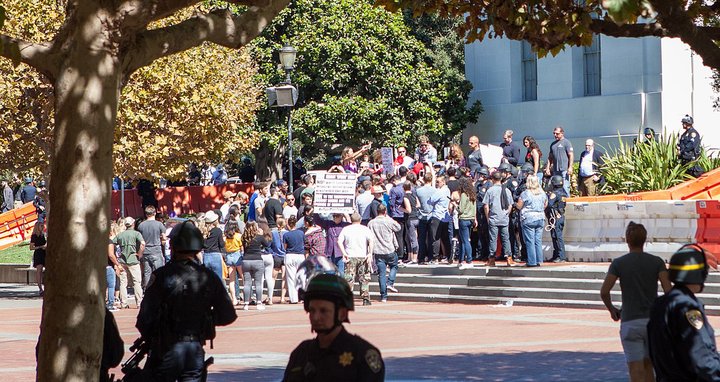
Milo Yiannopoulos greeting supporters on the steps of Sproul Hall, UC Berkeley, 24 September 2017. (Pax Ahimsa Gethen, Creative Commons License via Wikimedia Commons)
So, “woke.” The word seems to have come to public attention with the BLM protests about seven years ago, although it’s been around for a lot longer – probably the controversial Jamaican activist Marcus Garvey was the first to popularize it. While the word seems to have started off with the best of intentions – “Alert to injustice in society, especially racism” (Oxford Languages), it seems to have morphed into a term of derision – too much wokeness and you’re virtue signaling. That’s if you’re white – I hope non-whites will respond in the comments. The problem is summed up by what been happening at the venerable New York Times, starting in August 2016. You can read about it here, but briefly:
In August 2016, during the penultimate presidential election, NYT “writer-at-large,” Jim Rutenberg, changed the rules in a front-page story. “If you view a Trump presidency as something that is potentially dangerous, then your reporting is going to reflect that.” News media analyst Martin Gurri, commenting on this, wrote, “Once objectivity was sacrificed, an immense field of subjective possibilities presented themselves. A vision of the journalist as arbiter of racial justice would soon divide the generations inside the New York Times newsroom.” Thus, according to Gurri’s storyline, began the paper’s slide into what he calls “post-journalism,” from journalism-as-fact to journalism-as-opinion; the opinion, in this case, being the one that supports the liberal struggle against injustice.
This change of focus came to a head with the Times’ publication, on June 3, 2020, of an ultra-right op-ed by Arkansas Senator Tom Cotton, “Send in the Troops,” in which he recommended harsh measures against BLM protesters. The backlash by many of the Times staff has apparently, resulted in a change of editorial policy, from facts to woke, not to mention the resignation of its editorial page director, James Bennet. (Why not bring back the Fairness Doctrine, in which opinion pieces that promote extreme POV’s are balanced with op-eds from the “other side, I wonder?)
The Times has, of course, always had a liberal tilt, but until a few years ago, it was a moderate bias compared to, say, HuffPost on the left and Breitbart on the right. (Although its months-long vendetta against Hillary Clinton and her private emails seemed to align with Trumpist propaganda at the time.) What I used to appreciate about it was, in essence, the Times’ willingness to trust its readers by publishing the facts, letting us decide what to make of them. Seems to me, no longer: now we’re protected against illiberal commentary because, I guess, we’re too vulnerable to think for ourselves. The Times is now woke.
Which pisses me off, just as denying Yiannopoulos a platform to express his offensive views infantilizes students: being offended by what someone says isn’t a valid reason to deny their right to say it. (As Stephen Fry succinctly put it, “You’re offended by what I’m saying? So fucking what?”) If students are going to be protected against weird and hateful opinions at university, how the hell are they going to manage out in the real world? IMHO, they should be welcoming any opportunities to hear, debate and agree or disagree with any points of view, no matter how outlandish or offensive. This is how we learn to discriminate, to separate the wheat from the chaff, to think skeptically, and to understand the dangers of confirmation bias. In short, to be adults.
In 1962, I voted against inviting Max Mosley to speak to us, because, I suppose, I thought that was the “woke” thing to do, had I known the word then. Today I would vote the other way: denying free speech is the enemy of democracy, and only encourages those whose views I object to. And yes, I am a card-carrying member of the ACLU.
PASTOR BETHANY: The Messy Middle
Bethany Cseh / Sunday, Jan. 31, 2021 @ 7 a.m. / Faith-y
I’ve been sitting with an image these last few days where I’m standing on the middle of some kind of platform with people on my left and right. It feels good, like we all have enough in common to be near. But then both sides start moving further away from the middle, so far I can barely see them anymore. And as they move further away, the middle where I stand begins to rumble, tremor, and split like ice breaking off in Antartica. I’m desperately holding onto both sides, my muscles aching, afraid of falling through and losing myself into a widening chasm of separation where families and friends have lost sight of what really matters.
I try to shake off this image, this horrifying vision, but it won’t leave me alone.
In my conservative Christian high school government/economics class, like, a hundred years ago, we all took a quiz to find out if we leaned more Democrat or Republican. As we “graded” our own quizzes with our teacher’s instructions, I was deeply dismayed and disturbed with each answer that leaned more left than right. Agitation spread through me as I realized that I might agree with Democrats on some moral and ethical ideals! I began to question my loyalties to Christianity and Jesus, wondering if I belonged anywhere anymore. Hoping no one would see my shame, I quickly tucked the quiz into my binder where it would stay hidden—I could stay hidden—desperate that no one would find out.
For years since that moment, I registered Republican and blindly voted with the “Christian” party, rarely delving into the policy or personhood of each vote. But the more I began to grasp my own convictions and the more I began to pay attention to those outside of me and mine, the more I recognized the messy middle was where I felt most at home. I belong in the middle, finding myself pulled left and right at different times and in different ways. I’ve found space to stretch and expand in the middle, never quite landing on one side fully but often having to navigate the complicated, unstructured messiness the middle offers. Instead of a wasteland of lonely wandering, I’ve found a people there in the middle with friends and family on each side—some further to the left or right, but others closer to the middle with me.
Lately, though, this disturbing image where the Left and Right walk further away from each other—so far they can’t seem to see the other any longer—seems to be a reality. Each side points fingers at the other saying it’s their fault. Instead of seeking the middle, the Left has rooted itself in prideful arrogance where belonging is found in how “woke” they are in what they say, regardless of what they do. And the Right has traveled so far down a rabbit trail called Q, they’re not sure if they ever want to come back, if they could even find their way. Not all are arrogant bastards or conspiracy quacks, friends. But certainly enough on both sides that the middle tremors and my muscles ache. Enough that my family and friends look differently than they did a year ago.
Enough that I’m concerned.
When I look at the messy middle example of Jesus and his disciples, his closest friends had political leanings that were extremely opposite and violently contradictory. Their ideals for government structure and their personal moral compasses didn’t align perfectly. Perhaps this is why Jesus spoke of God’s kindom so often? Maybe Jesus knew that the first words he spoke out when starting his ministry needed to be the most important and often repeated because human beings are forgetful people who need countless reminders. “Turn your attention away from the systems and structures of this world because God’s kindom, God’s intention of harmony is here.”
I was reminded by my friend on Sunday that Shalom/Harmony isn’t something we can do on our own. We need each other to harmonize. We need to meet in the middle and join our voices together, in the midst of our severe disagreements and deep differences, to lay down our defenses and all the ways we’re right and they’re wrong. Maybe if we decided to humbly press through the discomfort, like the disciples chose to do, we could begin to make music together and find enough healing and grace for today and tomorrow.
The middle might be messy, but it’s where I belong. I hope you can scoot a little closer.
With (love), Bethany
# # #
Bethany Cseh is a pastor at Arcata United Methodist Church and Catalyst Church. She blogs frequently on her website, With Bethany.
LETTER FROM ISTANBUL: What Falls From The Sky
James Tressler / Sunday, Jan. 31, 2021 @ 7 a.m. / Letter From Istanbul
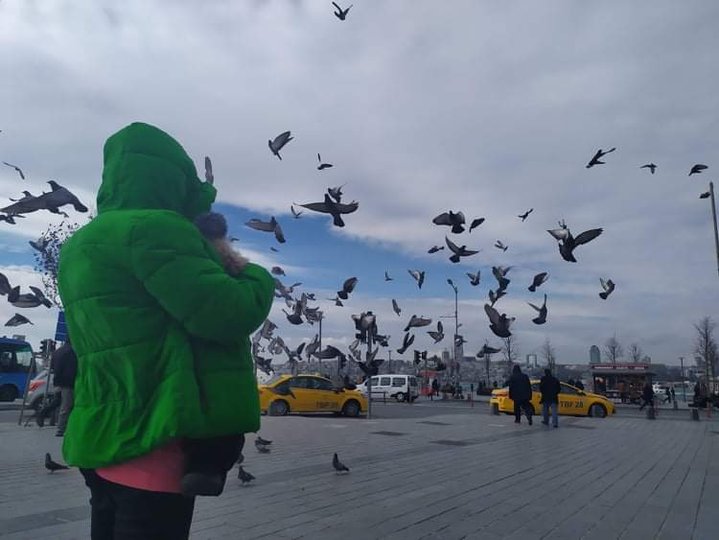
Photos: James Tressler.
###
We were annoyed. I know I was. You see, we’d planned to walk to Kuzguncuk, but the weather was not cooperating. It was sunny but icy gusts hit us as soon as we started down the hill to the coastal road. Our boy Leo began crying because the gusts were hitting him in the face. He was cold in the stroller. And it was the one day I’d decided we didn’t need the kangaroo pack since Leo usually loves the stroller and the forecast had said it would be warmer.
“Shall we go home? Or can you take the stroller back and get the kangaroo?” My wife was holding Leo, the hood and mask obscuring her face except her lovely expressive brown eyes, which were tired and anxious at the moment.
“I’ll get the kangaroo,” I muttered, turning with the stroller and trudging back up the hill, cursing under my breath. It was Friday, near the end of the term, and I’d felt good because I got up early that morning and finished marking all the students’ papers and updating their grades in the system. And we’d been looking forward to the walk to Kuzguncuk under sunny skies.
As I returned with the kangaroo pack and loaded Leo into it, we noticed that a delivery truck had pulled up.
“Maybe Leo’s mattress has arrived,” Ozge said. We’d been expecting it. She flagged down the driver and made inquiries. He nodded, got out of the truck and lifted a mattress from the back seat.
“Can you take it downstairs?” my wife asked. I took the mattress, it was very light and covered in plastic, back to the apartment, sprayed the plastic with liquid bleach and put it out on the balcony. Some Friday, I thought, with the visceral anger we often feel nowadays. The feeling that you’re not living the life that you should be living. Images – distant and fragrant – of having drinks with friends in Kadikoy, of doing something fun – “Why does everything have to be ‘have to?’ I muttered aloud. Well, at least we wouldn’t have to wait for the package anymore, and Leo really did need a new mattress for his crib.
Back on the street, Ozge was waiting at the corner with Leo. He had calmed down and as we began walking through the neighborhood, he put on his customary “outside” face: a curious silence, looking around at everything with the eyes that are like his mother’s, wide, brown and wistful. At home, he’s a very chatty, funny boy, but on the street he is different.
Nevertheless, we were tired. Ozge was feeling the same as I was.
We didn’t really have a destination, except the vague purpose of getting Leo out. The weekend lockdowns meant he wouldn’t see the outside world until Monday (except for a few minutes here and there, when we sneak him out for a walk on our street). We stopped at our neighborhood bakery and bought some of the fresh, thin pide bread that is really excellent, especially when toasted.
“Well, I guess we can’t blame the weather and we can’t blame Leo,” I mused. “What can we do about it?”
“Let’s go to the market,” my wife said, agreeing. “I want Leo to at least see some human beings other than us before being inside all weekend.”
At the bottom of the hill, we passed a local mosque. Friday prayers had just ended, and a fair number of people, mostly middle-aged and elderly, were coming out onto the quiet street. At the entrance of the mosque, an old covered woman was selling packets of tissue, or trying to. She entreated us in a scratchy, tiny voice but we shook our heads and continued on. I felt kind of bad. Normally, we buy a packet of tissue now and then, but nowadays it just didn’t sound like a good idea, and we’d have to spray it down anyway.
The wind was still gusting strongly. Dry leaves whisked past, scraping along the pavement, making thin scratching sounds. We took a shortcut in a passageway that leads through an old Ottoman cemetery, the stones very ornate and opaque-looking. An old man, dressed in a suit and wearing a hat, was in front of us, walking in a stooped way with a cane. I thought about how the pandemic has hit the elderly especially hard.
“There are a lot of old people out today,” I said aloud. “Do they still have restrictions?”
“Yes,” Ozge said. “They can go out between 10 and 2, I think. But on Fridays there are exceptions because of the prayers. And young people can go out in the afternoons.”
I knew that because of my students. We have our lessons in the mornings so that they can utilize the time in the afternoons to go out if they wish. Of course, by the end of the term, only about half the class was showing up to the Zoom lessons, most presumably preferring to just sleep in rather than maximize the possibilities of online education (probably another reason for the persistent feeling of annoyance that has been dogging me of late).
We reached the main thoroughfare. It was buzzing as always. Mostly empty city buses groaned by, yellow taxis, cars. We waited for a gap in the traffic and crossed with Leo in the kangaroo. From there it was just a five-minute walk to the bazaar.
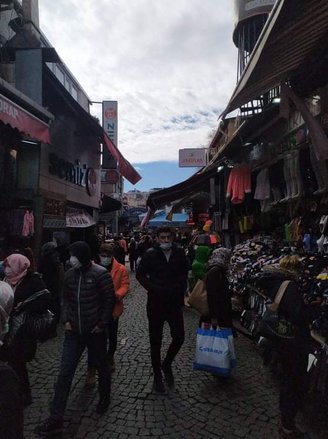
“Of course now the weather is perfect,” my wife observed. It was true. Here the wind had been chased off by the clamor of the shops, cut off by the buildings. We entered the cobbled street where the markets bloomed with goods and all variety of nuts and fruits, candies, dried peppers hanging from windows. The shiny skins of the fresh fish over at the fish markets, the whole chickens basted and golden brown as they rotated on spits, the pide bread on offer at the bakeries. Indeed, all the world’s offerings on display (except alcohol, this is Uskudar, after all). I felt revitalized, remembering that the teeming markets, with all their bustle, was one of the things I’d always loved about this city. Even with the pandemic, and the sellers and customers alike wearing masks, the markets hurtled on, full of color and life, as they always did in the best and worst of times.
We took Leo through the markets and let him look around, and then we went out to a plaza where all the pigeons gather because he likes to watch the birds flock and poke around and dart and fly off with his ever-roaming eyes. After they’d gone, disappearing in the sudden return of the cold gusts of wind, we decided to head home.
“What shall we have for dinner?” Ozge asked.
“Shall I stop and get some chicken?”
“No, don’t buy anything. We have enough at home. I want to make a salad.”
“Do we have mercimek (lentils)? I asked.
My wife nodded.
“We can have soup and salad and the fresh bread we bought,” I said. I thought about the bottle of cabernet chilling on the balcony at the apartment, and how we could have that with dinner.
We were feeling much better after the walk, and the evening began to take a pleasant shape. The Bosphorus was grey and choppy as we walked along the coastal road and back up the hill to our neighborhood.
“What was the name of that nightclub where the terrorist attack was (a few years ago)?” my wife asked, scanning the opposite side of the Bosphorus. “Wasn’t it over there?”
“It was further up, past the Ortakoy mosque,” I said, remembering.
“Reina!” Ozge said. “That was the name. God, there were only a few proper nightclubs in Istanbul, like posh ones, and now they’re all gone.”
“I was just thinking that,” I said. “I mean, when I arrived here in 2009, Istanbul was really a vibrant city. Really cosmopolitan. Taksim especially. And then we had the Gezi Park protests, then the coup attempt, and now coronavirus …”
We talked like this for a little bit as we reached our street, about how things had changed, things that we seldom discuss because we’re so preoccupied with things like changing diapers and washing dishes, the domestic realities made all the more persistent and engulfing because of the pandemic. Always that feeling that you can never really break away, go to some place where you could really feel free and unpossessed. In the old days, you could always say, “Maybe I’ll go to China, or Vietnam or Chile,” or some place like that, but nowadays there is no such place in the world, nowhere to run. The thing to do is just try to make the best with where you are and with what you have. And Istanbul has so much of everything.
Leo, meanwhile, was still quiet, just looking around with his outside face as he had been for the past hour or so.
“Hey son,” I said. “Are you ready to get home to be warm and play with your toys?”
He didn’t answer, still in his street mode, lost in his observations. Yes, he’s a good little boy. It was nice to be heading home, where he would be his funny, talkative self again. But his outside face is nice too, seeing the world as this big, mysterious open place, which it is.
And I thought about what I’d said earlier, about how you couldn’t blame anyone or anything for the way things were. I remembered an old Turkish expression, or part of it anyway. It was something like: “Don’t blame what falls from the sky, for what falls from the sky must be a blessing.” I’m probably embellishing that a little, but why not? What can we do about it anyway except try to get through these days the best we can.
###
James Tressler, a former Lost Coast resident, is a writer and teacher.
(AUDIO) HUMBOLDT HOLDING UP: Performance Artist Noël August on Adapting Club Triangle, Her Alter Ego Tucker Noir, Pandemic Momming and Working on That Jason Segel Movie
LoCO Staff / Sunday, Jan. 31, 2021 @ 7 a.m. / Humboldt Holding Up
Subscribe to Humboldt Holding Up on iTunes!
Since COVID canceled all our in-person fun last year, possibly no one has maintained the “show must go on” attitude like the organizers of Humboldt’s LGBTQ+ party and drag show Club Triangle. Almost immediately after canceling the in-person event, the first online Club Triangle was born and has continued in some form every week since March, 2020.
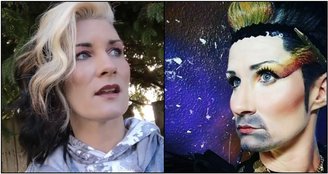
Noël August/ Tucker Noir
On this week’s episode of Humboldt Holding Up, Noël August — better known by locals as drag king Tucker Noir — discusses the importance of keeping the event going, adapting to the pandemic and plans for Club Triangle moving forward.
August also discusses the many other things that have been keeping her occupied during the last year, including working on that Jason Segel movie that recently filmed in Humboldt, teaching online dance classes, serving on the Community Advisory Board for the College of the Redwoods Police Academy, and somehow balancing all of that with raising children.
Click the audio player above to hear August’s chat with Andrew Goff and Stephanie McGeary and scroll through past guests below!
Club Triangle’s Streaming Saturdays is all day every Saturday on Instagram and (coming soon) on Twitch.
PREVIOUS GUESTS:
- Eureka Mayor Susan Seaman
- Eagle House Owner Jennifer Metz
- Absynth Quartet Drummer Mike “Tofu” Schwartz
- HACHR Executive Director Lasara Firefox Allen
- Alchemy Distiller Owner Amy Bohner
- Eureka City Councilmember Kati Moulton
- Eureka City Councilmember Scott Bauer
- Ungraceful Ager Barry Evans
- Arcata City Councilmember Sofia Pereira
- HumBrews Music Booker Laurel Weston
- Eureka City Councilmember Kim Bergel
- Film Commission’s Cassandra Hesseltine and Nate Adams
- Marble Maker Topher Reynolds
- Arcata Playhouse Director Jacqueline Dandeneau
- Humboldt Political Junkie Eric Kirk
- Rio Dell Mayor Debra Garnes
- Second District Supervisor Estelle Fennell
- Arcata Food Aficionado Jada Calypso Brotman
- Body Piercer Jackie Silva
- Dick Taylor Chocolate’s Adam Dick
- FUHS Teachers Mark Thom and Inma Thompson
- Eureka City Manager Miles Slattery
- Savage Henry Co-Founder Chris Durant
- Eureka Street Art Festival Organizer Jenna Catsos
- SCRAP Humboldt Founder Tibora Bea
- Gym Owner Tyler Parr
- Six Rivers Brewery Co-Owner Meredith Maier
- Multicultural Skincare Therapist Levia Love
- Annie’s Cambodian Server and Social Worker Joshua Coppock
- Eureka City Councilmember Austin Allison
- HSU Professor Deidre Pike
- Pastor Bethany Cseh
- Singer/Songwriter Chris Parreira
- Eureka City Councilmember Leslie Castellano
- Arcata City Councilmember Paul Pitino


