
MONDAYS WITH MICHAELE: We’re Still Runnin’ Out Here!
LoCO Staff / Monday, March 8, 2021 @ 7 a.m. / Mondays With Michaele
Another week, another burst of unexplainable energy from Humboldt’s President of Positivity! This time she’s visiting with Eureka High School’s cross country runners and their coach Matt Messner, who’ve managed to keep their legs moving despite the many roadblocks this pandemic has thrown in front of them. May their example help you get out the door to start this week. Ciao Bella!
# # #
Perhaps You’d Like to Explore Previous Mondays With Michaele For Some Reason!
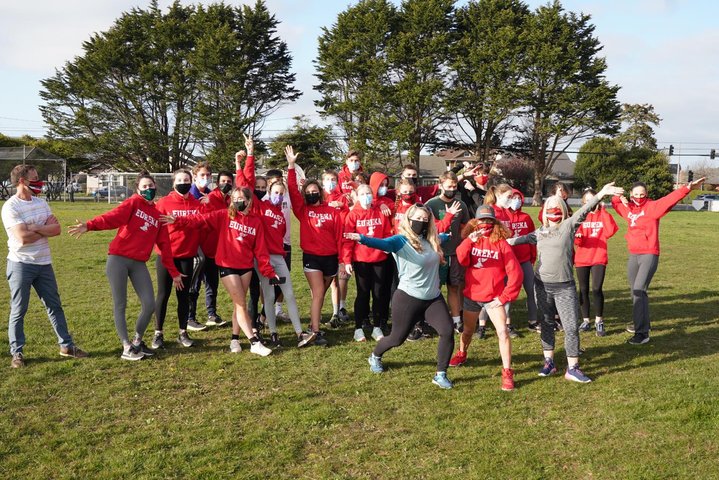
Photo: Patrick Rutherford
BOOKED
Today: 11 felonies, 7 misdemeanors, 0 infractions
JUDGED
Humboldt County Superior Court Calendar: Today
CHP REPORTS
Us101 / Hilfiker Ln (HM office): Assist with Construction
ELSEWHERE
RHBB: [Update] Two-Vehicle Crash Near Singley Lane This Evening Results in at Least One Injury
County of Humboldt Meetings: Human Rights Commission Agenda- Hybrid Meeting
Governor’s Office: Governor Newsom proclaims Latino Heritage Month
How California’s Recall Rules Could Spell Trouble for Gavin Newsom
Ben Christopher / Monday, March 8, 2021 @ 7 a.m. / Sacramento
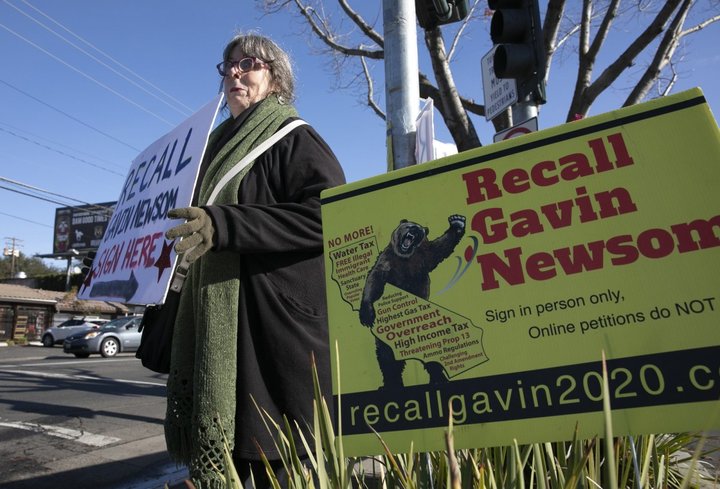
Recall Newsom volunteer Kerin Kay holds up a sign during a petition signing event at a Save Mart in Sacramento on Jan. 5, 2021. Photo by Anne Wernikoff, CalMatters
###
If recalls followed the rules of a normal California election — the person who wins a majority of the votes wins — then Gov. Gavin Newsom, an incumbent Democrat in a thoroughly Democratic state, would have nothing to worry about.
But unfortunately for him, a California recall is not like an ordinary California election.
“It really is its own animal,” said Ken Miller, a Claremont McKenna political science professor. One part standard-issue candidate race, one part free-spending ballot measure campaign, with a generous dash of political circus, California recalls adhere to a unique — and some critics say, less than fully democratic — procedure that makes for a much more unpredictable outcome.
“Newsom would beat any Republican head-to-head pretty easily,” said Miller. But “because of the way the game is structured, it could be more problematic for him.”
It could also be potentially problematic — or at the very least, puzzling — for the majority of voters. Under the recall rules, Gavin Newsom could conceivably get more support than the top vote-getter in the recall — and still lose his job.
“Newsom would beat any Republican head-to-head pretty easily. Because of the way the game is structured, it could be more problematic for him.”
— Ken Miller, Claremont McKenna political science professor
At last count, the Republican Party bigwigs, small business groups and irate parents campaigning to oust Newsom from office a year before the end of his first term are just 400,000 valid signatures shy of the nearly 1.5 million total needed to put his political career on the ballot. That was as of early February and they have until March 17 to make up that difference. (Before a recall rally at the state Capitol on Sunday, organizers said they have collected 1.95 million signatures and believe enough will be valid.) Even allies of the governor are now conceding that a recall election is likely late this year.
The odds are still probably in Newsom’s favor. Despite a recent drop in the polls, he remains fairly popular — especially when compared to Gov. Gray Davis, the only California governor to have been successfully ejected from office by recall. And though Californians across the board give Newsom low marks for his handling of the pandemic, voters won’t have the chance to vote in a recall election until the fall, at which point the state’s economic and epidemiological woes may have subsided substantially.
Unpredictable, but also anti-democratic?
But recall elections can be unpredictable.
A run-of-the-mill election for state office in California follows a predictable two-step. First, every candidate crowds onto a single ballot and voters cast their ballots for whomever they like — regardless of party. Next, the top two winners from the first round go head-to-head in a second and final contest.
That “top-two” set-up ensures that the candidate who wins will have received more than 50% of the vote. The will of the majority rules, guaranteed.
Recall elections offer no such guarantee. Voters are first asked whether they would like to give the incumbent the boot. Then, in a second question, they are asked who ought to be the replacement. Under California law, incumbents can’t run to replace themselves.
If more than 50% of voters opt for a “yes” on the recall question, whoever comes first on the replacement list is immediately hired as the state’s next chief executive. That’s where things can get weird. In a crowded field with no clear frontrunner, coming first could mean getting far less than 50% of the vote.
It might even mean getting far less support than the incumbent being ousted.
That didn’t happen in 2003, the only time a California governor has been successfully recalled. Despite the 135 candidates in the running to replace Gov. Gray Davis, the well-known moderate movie star Arnold Schwarzenegger won 49% of the vote, compared to the less than 45% who wanted to keep Davis. But Schwarzenegger’s star power and bipartisan appeal may make him a political unicorn.
A more recent example shows just how odd California recall math can be.
In 2016, Democratic state Sen. Josh Newman won a seat in a longtime GOP stronghold in north Orange County. In the summer of 2018, Republicans and anti-tax advocates mounted a recall campaign over Newman’s support for an increase in the state gas tax. A fired-up conservative bloc of voters turned out en masse, Democratic voters did not, and Newman was replaced by Republican Ling Ling Chang.
In that race, 66,197 voters, or 42%, opposed the recall and backed Newman. Chang, running against five other candidates, received fewer votes, 50,215, but still won the seat with 34%. In the next regularly scheduled election in 2020, Newman reclaimed the seat.
A sufficiently crowded and disorganized field could produce similar results in a 2021 recall race.
“If the outcome is that Newsom ends up with 49% opposing a recall — so thus supporting him — and whoever wins in question two gets, say, 35%, then Newsom, in theory, had more support,” said Miller.
But in that scenario, Newsom would lose anyway. That’s “a little tricky from a democratic theory perspective,” he added.
From the perspective of Republicans hoping to win a statewide election in California, however, it holds real political promise.
In 2018, Newsom beat his GOP opponent, John Cox, by 24 percentage points, with 62% of the vote. In the last two presidential elections, the Democratic candidates — Hillary Clinton and Joe Biden — raked in nearly two votes for every one earned by Donald Trump. A Republican hasn’t won a statewide election here since 2006.
So far, two prominent Republicans — Cox and former San Diego mayor Kevin Faulconer — have challenged the governor. Richard Grenell, a Trump ally and former U.S. ambassador to Germany, is publicly flirting with the idea of jumping in too. At the California Republican Party’s virtual convention last month, support for the recall was one of the few unifying principles.
“No governor in California’s history is more deserving of a recall, and we’re going to give it to him,” party chairperson Jessica Patterson said in a speech to the GOP delegates.
Though the recall is clearly written into the state constitution, some Democrats see the current effort as, at best, a sign of desperation and at worst, a circumvention of popular will.
Earlier this year, California Democratic Party chairperson Rusty Hicks likened the recall effort to a “coup” — a statement he later walked back after widespread criticism.
“The fact is that, all things being equal, (Republicans) can’t win a Democrat-versus-Republican statewide race, because they haven’t done so in 15 years,” said Garry South, who managed the unsuccessful Davis campaign to avoid a recall. “What route is left to them? Recalls.”
Democrats tried a version of that argument in 2003.
“They couldn’t beat him fair and square, so now they’re trying another trick to remove him from office,” read the governor’s official response listed in the recall petition. “We should not waste scarce taxpayers’ dollars on sour grapes.”
The argument didn’t work then. “Sour grapes” won.
More recalls reflect the political moment
Though recalls for state office are relatively rare, this particular election procedure has been having a moment in recent years. According to data collected by the National Conference of State Legislatures, of the 42 recall campaigns against state officeholders that qualified for the ballot, 18 of them, or 46%, popped up since 2010.
That trend could be due to the advent of social media, which makes it easier to publicize these efforts, the national wave of anti-incumbent feeling epitomized by the Tea Party and Occupy Wall Street movements, or mere political faddism.
But Seth Masket, director of the Center on American Politics at the University of Denver, said the rising tide of recalls is yet another product of our highly polarized political environment.
“Almost all of the states are basically one-party government…The minority party in those states just sees fewer opportunities to influence the legislature or influence politics,” he said. “The recall is an outlet in that situation.”
For the GOP in California, the recall is “probably the only way” to the governor’s mansion, he added.
California is one of 19 states that give voters the ability to fire their elected officials in snap elections. But in 17 of them, the incumbent being ousted is either allowed to run to keep the seat or is simply replaced by another state official. The California model is only shared by Colorado.
That raises a new set of strategic headaches for California’s Democratic Party. Should the party focus its money and sloganeering on opposing the recall? Or should it run a Democrat on the replacement list — an insurance policy in case the recall succeeds — at the risk of muddying its message backing Newsom?
In 2003, then-Lt. Gov. Cruz Bustamante opted for option two, announcing at the last minute that he would run to replace his ostensible political ally Davis. The campaign slogan was muddy indeed: “No on Recall; Yes on Bustamante.”
Asked about the party’s strategy earlier this year, party chairperson Hicks declined to offer specifics, simply saying that “anything and everything is on the table.” Newsom, himself, has also had little to say on the subject.

Recall Newsom volunteer Pat Miller makes a sign during a petition signing event at a Save Mart in Sacramento on Jan. 5, 2021. Photo by Anne Wernikoff, CalMatters
State Sen. Ben Allen, a Democrat from Santa Monica, is hoping to update the state’s recall law. Inspired by the ouster of Newman in Orange County, for two years now he has introduced a proposal that would allow an incumbent subject to a recall to run among the list of potential replacements.
“We should have a system where, at the very least, on the day of the recall, the candidate who gets the most votes actually gets the seat,” he told CalMatters earlier this year. “The current system is undemocratic.”
But as an amendment to the state constitution, Allen’s proposed change would first have to receive support from a supermajority of both the state Assembly and Senate. Then it would go before the voters at the next regularly scheduled election in 2022.
And that would be too late to help Newsom.
###
CALmatters.org is a nonprofit, nonpartisan media venture explaining California policies and politics.
OBITUARY: William Andy Beck, 1949-2021
LoCO Staff / Monday, March 8, 2021 @ 6:56 a.m. / Obits
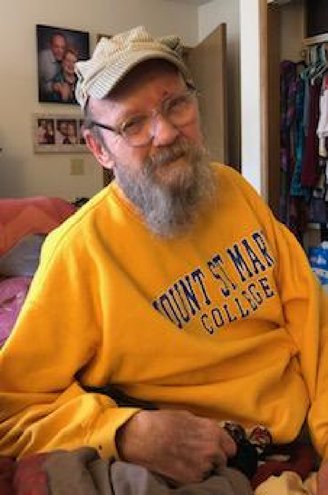
William
Andy Beck
July
31, 1949 - March 2, 2021
William Andy Beck was born in Perryton, Texas as the third child of Homer and Ruth Beck. He was welcomed him into the young family with great joy. He was a happy, easy going baby and always hungry. Mashed pototoes were quickly added into his diet. Even in his last days, he could be found in the kitchen, no lights except the glow of the open refrigerator as he searched for the milk carton.
As a young adult, Bill worked as a Nursing Assistant in the local Wichita, Kansas hospital. He was valued for being reliable and sensitive to the needs of patients. He was well known for his ability to apply CPR in emergency situations. One day as he was walking by a neighborhood barber shop, he saw a customer inside clutch his chest and fall to the floor. Bill ran inside, started CPR and kept him alive until paramedics arrived. When Bill saw someone in distress, he didn’t look the other way. He called upon God and tried his best to help.
Bill drove heavy construction equipment for over 20 years. He drilled in Western Kansas oil fields. He delivered wet concrete to Kansas highways, freeways, bridges, overpasses and developing construction sites within Wichita. He was valued for his skills and his ability to deliver in tight places. He was respected by fellow workers.
His humor was legendary. People were both astounded by and enjoyed his historical knowledge, his love of music, old cars and family.
Bill walked personally with God throughout his life. He studied the Scriptures at the Wichita Nazarene Bible College. However, his personal focus was on the Person of Jesus Christ, His coming as prophesied in the Old Testament, His birth, life and death and salvation for all who accepted Him. Bill’s life was filled with testimony of known and unknown people who experienced God’s Grace, Mercy and Salvation because Bill humbly lived it, using words when necessary.
He was the main caregiver of his parents in their declining years. He daily kept them clean and loved . He shared his humor to lighten the load and his comforting hand to hold. Professional nursing caretakers were also present, but Bill’s big hand was the one they wanted near.
He leaves behind Judy, his God given wife of six years married 12-13-14. William breathed praise to God:
“Jesus, thank you for this beautiful, strong woman. What did I ever do to deserve her committed love? Nothing . Only You, our Lord, could have intervened to bring me into the arms of this woman I love.”
Bill also leaves behind his older brother, Floyd (Laura) Beck, who taught him how to repair cars and how to tell a great story without actually fibbing; his older sister, Carol (Jim) Martin, “The One Who Must be Obeyed”; his devoted niece, Elizabeth (Scott) Winterbourne and son, Daniel, in San Diego; his loving daughter, Jen Rice and S/O Travis Kenyon, of 17 years in Phoenix; his son, Aaron (Jenny) Beck and two cherished grandchildren, Harrison and Norah in Wichita.
He is survived by his wife’s children and their families who he considered to be his own; Kevin (Ana) Ontiveros and children, Kevin, Megan, Emily and Andrew; Brian (Brenda) Ontiveros and children, Brianna, Benjamin, Bryce (Nicole){ their daughter Robin} and Brayden; Kristina (Sage) Burtis and son Sage; Melissa ( John) Whitehead and children Josh and Gabby.
The Beck family is deeply grateful to Judy.
As Bill laid in Saint Joseph’s COVID-19 Isolation Unit, our constant prayer was that he would return home to be with “Jesus and Judy”. In His mercy, God gave them extended time together within the comforts of home. They talked, laughed, prayed together, read the scriptures as they had for many years. Bill knew God’s voice well. When Jesus passed by in His Glory on March 2, Bill took His hand, joined Him in the radiant Light of Heaven. Bill is at peace.
Go rest high on the mountain, William. Your work on Earth is done. It mattered.
We miss you terribly here on Earth, but we also know we will be together again praising God.
###
The obituary above was submitted on behalf of Bill Beck’s loved ones. The Lost Coast Outpost runs obituaries of Humboldt County residents at no charge. See guidelines here.
Local MMA Fighter Cass Bell Announces Next Pro Fight
John Ross Ferrara / Sunday, March 7, 2021 @ 1:20 p.m. / LoCO Sports!
A look at Bell’s next opponent.
Humboldt mixed martial artist Cass Bell announced today that he will return to the ring for the first time since suffering his first pro loss in July.
Bell (5-1) will face the undefeated Jornel Lugo (5-0) at Bellator 256 on April 9 at the Mohegan Sun Arena in Uncasville, Connecticut.
“I’m so excited to get back in to the cage,” Bell shared on social media.
Bell said he’s also looking for a few more sponsors before the fight, if any local companies want to support Arcata’s homegrown fighter.

Cass Bell celebrates a victory. | Photo provided by Cass Bell
GROWING OLD UNGRACEFULLY: Camel Man
Barry Evans / Sunday, March 7, 2021 @ 7 a.m. / Growing Old Ungracefully
One day in 2000, walking around the “back” of the world’s first
true pyramid, Djoser’s step pyramid at Saquarra, Egypt, a
djellaba-robed guy sitting on a nearby dune hailed me. A camel stood
next to him.
“Yes, welcome! Come see pyramids. Which country you?” “California,” I told him, feeling slightly ornery to be asked yet again “Where you from?” Sometimes I’d say, “Wales,” just to confuse, not that it fazed in the slightest, since they unfailingly proffer the rote reply, “California! (Wales!) Very good.” I wondered what would happen if I said, “Mars.” (“Mars! Very good!)
We squatted side by side on the dune to the accompaniment of his camel doing her loud regurgitating thing. First a deep swallow. A ten-second pause. Then this ghastly vomiting sound (there’s no way to convey it in words), accompanied by upwardly-moving ripples of her neck muscles as she brings up a gob of semi-masticated food from stomach to mouth. Followed by a couple of minutes of side-to-side chewing before swallowing and starting the whole disgusting process all over again.

Pharaoh Djoser’s tomb, the earliest massive stone structure in Egypt, c. 2700 BC. Djoser reigned either 19 or 38 years, archeologists aren’t sure. The pyramid was originally sheathed in polished limestone. (Barry Evans)
Humiyed was fifty. He wrote “50” in the sand, so I wrote “OV” which he liked, that I’d bothered to learn Arabic numerals. “Fifty-seven,” he mused, looking into my face. “Good.” He wanted, of course, for me to take a ride on his camel.
I was never the same after two camel-days in Rajastan, just happy that I’d already sired children. “La, shukran,” I said, no thanks. “Why not?” “Because camels are very uncomfortable to ride.” “Five minutes,” he insisted, “then good.” “Not true,” I replied. “I spent two days riding a camel and nearly died from the experience. Very painful!” “Where?” “India,” I said. He thought a moment, then gave me a knowing look. “Ah, India,” he mused. “Bad camels India. Here Egypt, good camels.” I wasn’t convinced.
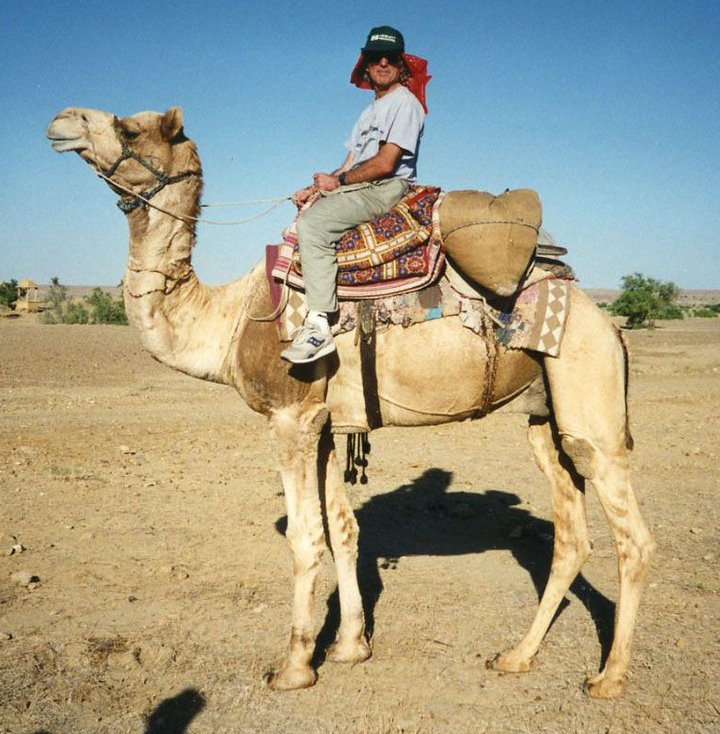
Trying to look cool in Rajastan despite having lost all feeling below my waist. (Otto Schuler)
“How many camels do you have?” I asked. “One.” “How many wives?” “Two.” “How many children?” “Five. How many you?” “Two,” I answered. He looked amazed.
“Two only? Why not more?” Sidestepping this challenge to my manhood, I asked him about his kids. He had four boys, one girl, all at school or college (this on his meager income!).
“Better have one girl only,” he said. “Why?” I asked. “Two wives, one daughter. Too many women already.”
I didn’t argue.
LETTER FROM ISTANBUL: A Cup of Coffee
James Tressler / Sunday, March 7, 2021 @ 7 a.m. / Letter From Istanbul
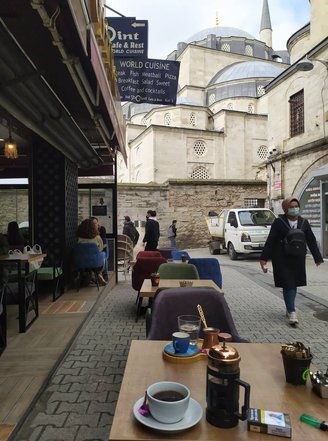
Photo: James Tressler.
We
took Leo out for his usual afternoon walk. The skies looked ominous
but they got on our side as we ventured down the hill of the
neighborhood, and by the time we landed on the busy streets at the
bottom the sun was shining.
The government announced a partial lift of the lockdowns that have been in effect all winter. For months, you’d walk past the cafes and restaurants and they were all closed, the sidewalks empty where the tables filled with customers usually sat looking out at the street.
We were curious to see which places were open. With Leo in his stroller, staring out in a curious trance, we walked past the busy supermarket to a slender side street where we always used to go for coffee. The traditional Ottoman restaurant was open, and we saw there were people inside having lunch. Here and there, some men sat beneath the awnings of shops having tea – they were workers and looked rugged but cheerful – and then at the end of the street we arrived at Bal 12, the place we like.
“It’s open,” I announced, noticing that some tables were back, with their ashtrays and sugar packets placed atop the illustrated tablecloths.
“We can stay for a coffee if you want,” my wife said.
“It’s up to you,” I said.
Ozge guided the stroller to a place beside one of the tables. There were only a few customers: a young couple, the girl very pretty and flashing dark and sitting cozy with her beau, and near us sat a man smoking a cigarette. The other tables were empty, and in the street people passed by still wearing their masks.
The waitress, a soft-spoken covered girl, recognized us and immediately came over.
“Hos geldiniz!” she cheerfully exclaimed. “Nasil siniz?” She made a small polite fuss over Leo, how much he had grown since she had seen him last. Indeed, he had.
“He wasn’t walking last time,” I said, in my rudimentary Turkish.
“He’s walking – whoa!” the girl said.
She knew what we always ordered – a French press sade for me, Turk kahvesi with milk for Ozge.
While the waitress went to get our order, Ozge took Leo out of the stroller and let him waddle gingerly on the brick pavements. He stared with wonder at a motorcycle that had just pulled up. It was one of the delivery guys who probably had just returned from dropping off somebody’s lunch. Seeing Leo looking up at him, the man just smiled and said, “Merhaba!”
Leo wandered up and down the slender side street, with his mother following closely, looking at the three street cats posted idly nearby, the people passing to and fro, the great Mihrimah Sultan mosque in the background and the sea birds flickering in the now-sunny sky.
The girl brought the coffee. I poured some of the French press into the cup, took a sip and watched Ozge and Leo for awhile. It felt good to be in the café, to be in a social atmosphere, to see that our coffee shop had made it through the lockdown. It felt good to see that the waitress was still working there. I was tempted to shoot the breeze, to ask how things had gone during the lockdown, but the girl was busy tending to the handful of customers and I really didn’t feel like talking much anyway. It was better to just sit back, drink coffee and watch the goings on in the street.
Ozge came back and handed me Leo. I put him in my lap and let him look out at the street while Ozge had some of her Turkish coffee. It is served in the classic style, with the heavy dark coffee in a small brass pot that you pour into a tiny cup, and a piece of chocolate on the side.
After awhile, I got up, handed Leo to Ozge and went in to pay the bill. One of the male proprietors, who also knew us, said the total was 13 lira. As I handed him a 20, I noticed on the screen that the total was actually 24 lira. He’d looked at the wrong table.
The man tried to cover his mistake by waving me off.
“Tamam, tamam,” he said. “It’s OK, OK.”
I insisted, but he wouldn’t hear it. We were old, loyal customers. He liked our son. Twenty lira was enough.
I reached in my wallet, found a 5-lira note and pushed it past him onto the counter.
The man relented, and thanked me.
“For the economy,” I said, shrugging.
Understanding, he nodded and laughed.
I was glad I did that. Normally, I would have accepted his gesture. But they had managed to survive a long, cold winter, as had many. They had remembered us, so it was only fair to pay what was owed, mistake or not.
“What shall we do?” Ozge asked. She had put Leo back in the stroller, his face nearly invisible beneath his woolen cap.
“Let’s go to the iskele,” I said. “We haven’t been there for awhile. Leo can look at the boats and the sea birds.”
So we did. Along the waterfront, it was windy, and despite the sun it was still cold. Lots of people were out though, many of them sitting or standing looking out at the Bosphorus. A giant red tanker ship was passing, nearly swallowing up the view, and over at the ferry boat stations many people were getting on and off, still wearing masks and bundled up in winter coats, hats and scarves.
Leo practiced walking – he’s getting much better at it – and his face lit up as he circled and circled on the wide concrete shoreline plaza, blinking in the sunlight, and waddling over to where a large flock of pigeons were pecking at a mound of breadcrumbs. Later we took him over to a nearby park where there’s a playground and let him try out climbing the steps to the slide, and touch all the brightly colored things. A few other children were there, slightly older, and they climbed the jungle gyms while their mothers watched.
It felt good to be outside, and to take Leo to other places besides the same streets in the neighborhood, streets that have bored us for months, and to have a decent cup of coffee for a change – outside, the way it’s supposed to be. I looked forward to the spring, and the good warm weather, when we can take Leo to Kadikoy and we can sit outside at Nazim Hikmet or Bahane, and have ice cold beer, maybe even with friends. Leo should be walking like a pro by then. It felt good to have things to look forward to – the old life, and the new life too.
###
The next day, Thursday, I finished the online lessons and was done for the week. Outside it was sunny so we decided to head to Kuzguncuk.
In Kuzcuncuk, people were out enjoying the fine weather. They looked pale owing to the long winter and the lockdowns, but nevertheless you could tell they felt fine. The tables outside the cafes and bakeries and restaurants were nearly full. Outside Metet, the popular kebab restaurant, the lines had even returned. A lot of things had returned.
We walked up the street to the park, after I first stopped and grabbed two Americanos. It was pleasant to walk, the bright sunlight falling through the still-bare trees and splashing onto the tables and onto the faces of the people, the good and kind and attractive people who always come to Kuzguncuk, the ones we had missed. Above all the shops and cafes the apartments are charmingly retro, painted in pale golds, turquoise, light red and brown – the kind of places you wished you lived in when you walked by and looked up at them from the street.
We took Leo to the park and let him walk around for an hour or so, keeping him away from the dogs lounging in the sun, even though they seemed to be friendly. The other children were all mostly a bit older, running and zig-zagging around in their intrigues and games, while Leo tried to waddle after them and we had to keep him from falling in the places where there are stones or mud. The other parents sat chatting together, keeping an eye on each others’ kids and they smiled and made a polite fuss over Leo whenever he approached them, holding out a blade of grass he had picked as a kind of offering.
Later, we stopped at the grocer and picked up some fresh spinach that my wife likes, and headed back to the main street. The golden lunch hour was over, and many of the tables were empty again, but there were still people out, walking, masked but feeling good about themselves and the sunny afternoon.
“Look, it’s still closed,” Ozge said, pointing out Corvino’s, the Italian restaurant that stood on one of the corners. “I wonder if they are bankrupt,” she added.
I thought about how the few times we had gone there, the place had seemed overpriced, the product underwhelming at best.
“Well, maybe that’s not such a bad thing,” I ventured. “After all, there are plenty of restaurants in Istanbul.”
Even in the best of times, restaurants were always opening and shutting down, new ones springing up in their place over night. The same with the shops, the cafes, the bars, and all the other places. After all, it is a remarkably resilient city, I thought. It’s had thousands of years of practice – survived empires, conquests, World Wars and the usual lot. I thought about how people in general are resilient, and how the bad times come and go and the good times return, and the good and the bad get mixed up so often, but life always seems, in one shape or another, to return, inshallah.
###
James Tressler, a former Lost Coast resident, is a writer and teacher in Istanbul.
(AUDIO) HUMBOLDT HOLDING UP: Teacher and Rapper Zach ‘Zigzilla’ Lehner Talks Reopening Schools, Teaching Over Zoom; Freestyles An Educational Rap
LoCO Staff / Sunday, March 7, 2021 @ 7 a.m. / Humboldt Holding Up

Zach “Zigzilla” Lehner records a rap with his daughter
Subscribe to Humboldt Holding Up on iTunes!
Zach “Zigzilla” Lehner is Holding Up
Local rapper and Pacific Union teacher Zach Lehner — aka “Zigzilla” —has spent many years sharing his passion for hip-hop both on the stage and in the classroom. You might know Zigzilla as one half of hip-hop duo Area Sound, who rapped about dad life in the music video for “Glamorous Lifestyle,” or perhaps you are familiar with the educational rap videos Lehner created during the pandemic.
On this week’s episode of Humboldt Holding Up — the Outpost’s good enough podcast — Lehner talks more about those projects, Pacific Union’s plans for bringing kids back to in-person learning, how distance learning has impacted his six grade students and some of the ways he’s gotten creative with his teaching during the pandemic.
Lehner also chats with LoCO about how he and his other half Liam “Steamer” Nelson formed Area Sound, recording their latest album Squeeze the Elephant, and how he’s balanced it all with the “glamorous lifestyle” of being a dad.
Of course, Zigzilla also spits a freestyle educational rap. A Humboldt Holding Up first!
Click on the audio player above or subscribe to HHU on iTunes to hear Lehner/ Zigzilla’s chat with LoCO’s Andrew Goff and Stephanie McGeary. And you just might find another name that interests you in the list of past guests below.
PREVIOUS HUMBOLDT HOLDING UP GUESTS:
- Madaket Captain “Zippo” Libby Tonning
- Event Planner Alegria Sita
- Food For People Executive Director Anne Holcomb
- AHHA President Nezzie Wade
- Performance Artist Noël August/Tucker Noir
- Eureka Mayor Susan Seaman
- Eagle House Owner Jennifer Metz
- Absynth Quartet Drummer Mike “Tofu” Schwartz
- HACHR Executive Director Lasara Firefox Allen
- Alchemy Distiller Owner Amy Bohner
- Eureka City Councilmember Kati Moulton
- Eureka City Councilmember Scott Bauer
- Ungraceful Ager Barry Evans
- Arcata City Councilmember Sofia Pereira
- HumBrews Music Booker Laurel Weston
- Eureka City Councilmember Kim Bergel
- Film Commission’s Cassandra Hesseltine and Nate Adams
- Marble Maker Topher Reynolds
- Arcata Playhouse Director Jacqueline Dandeneau
- Humboldt Political Junkie Eric Kirk
- Rio Dell Mayor Debra Garnes
- Second District Supervisor Estelle Fennell
- Arcata Food Aficionado Jada Calypso Brotman
- Body Piercer Jackie Silva
- Dick Taylor Chocolate’s Adam Dick
- FUHS Teachers Mark Thom and Inma Thompson
- Eureka City Manager Miles Slattery
- Savage Henry Co-Founder Chris Durant
- Eureka Street Art Festival Organizer Jenna Catsos
- SCRAP Humboldt Founder Tibora Bea
- Gym Owner Tyler Parr
- Six Rivers Brewery Co-Owner Meredith Maier
- Multicultural Skincare Therapist Levia Love
- Annie’s Cambodian Server and Social Worker Joshua Coppock
- Eureka City Councilmember Austin Allison
- HSU Professor Deidre Pike
- Pastor Bethany Cseh
- Singer/Songwriter Chris Parreira
- Eureka City Councilmember Leslie Castellano
- Arcata City Councilmember Paul Pitino


