

Arcata Police Name Man Killed in Weekend Stabbing; Two Others Remain Hospitalized in Stable Condition
LoCO Staff / Monday, April 19, 2021 @ 12:25 p.m. / Crime
###
PREVIOUSLY:
###
From the Arcata Police Department:
On Sunday April 18, 2021, at approximately 1:20 am, The Arcata Police Department responded to a fatal stabbing in the 1000 block of G Street.
The decedent has been identified as 29-year-old Eureka resident, Luis Enrique Pinel Zelaya.
A 27-year-old male and a 23-year-old male remain hospitalized in stable condition. Both males are Humboldt County residents and received critical injuries during the incident.
This is an active, on-going investigation and no additional details will be released at this time. Anyone with information is encouraged to contact the Arcata Police Department’s Investigations Division.
BOOKED
Yesterday: 7 felonies, 9 misdemeanors, 0 infractions
JUDGED
Humboldt County Superior Court Calendar: Today
CHP REPORTS
5345 Walnut Dr (HM office): Trfc Collision-1141 Enrt
ELSEWHERE
Mad River Union: Flight Path
Mad River Union: McK not-a-tree cell tower project bumped
Mad River Union: Arcata council decides this, decides that
Mad River Union: Porchfest 3 evolves with new prep, participation
MONDAYS WITH MICHAELE: Sprung on Spring
LoCO Staff / Monday, April 19, 2021 @ 8 a.m. / Mondays With Michaele
Humboldt is full of new growth! This week, your President of Positivity tours Laurel Tree Charter School in Valley West with her bud Ken Hamik. It’s an exciting time for Laurel Tree. They’ve just extended their campus to McKinleyville to a 4-acre plot just west of Highway 101 on Murray Road. And on May 1 they will be holding a Makers’ Fair where students will present their plans for a permaculture garden and a forest to be developed there.
Very cool! More details can be found here. Have a great week!
# # #
Perhaps You’d Like to Explore Previous Mondays With Michaele For Some Reason!
Late Night Knife Fight in Downtown Arcata Leaves One Dead, Two Hospitalized, APD Says
LoCO Staff / Sunday, April 18, 2021 @ 10:33 a.m. / Crime
From the Arcata Police Department:
On 4/18/21 at about 0121 hours, officers with the Arcata Police Department responded to the 1000 block of G Street for the report of a male that had been stabbed. Upon arrival, officers located three subjects with injuries consistent with being inflicted by a knife or stabbing/slicing weapon.
During the subsequent investigation, the Arcata Police Department was able to identify the involved subjects and determine that the three involved subjects knew each other prior to this assault. This fight between the three subjects left two of them hospitalized and one deceased.
This appears to be an isolated event and there is no information that there is any threat to the public at this time. Further information will be released as the investigation progresses.
The Arcata Police Department is requesting anyone with information on this investigation please contact Detective Sergeant Ortega at 707-822-2424.
GROWING OLD UNGRACEFULLY: Sex Versus Gender
Barry Evans / Sunday, April 18, 2021 @ 7 a.m. / Growing Old Ungracefully
About a billion years ago, evolution hit on a brilliant way to fast track the number of variations that could try their hand at adapting to their environment: sex. Instead of each species giving birth to a clone of itself (meiosis), with a dash of mutation thrown into the mix for variety, two of a species could combine their genomes. (Your genome is your complete set of chromosomes.)
In one fell swoop, Nature had created her own experiment kit, where she could play with every possible permutation and combination. So that’s what evolution had to work with: two similar but not identical creatures making a third creature sharing the traits of both its parents. One parent is the male of the species whose gametes — sperm — are the mobile members of the team; the other parent, the female, keeps her gametes — eggs — closer to home. Which is how most species, fauna and flora, reproduce. Birds do it, bees do it, even educated fleas do it. And all this time — a billion years! — Nature has used two and only two versions of a species, male and female, to do her magic. Not three or four, not some fluid middle ground, just a simple binary division. Sexually, you’re male or you’re female. Period.
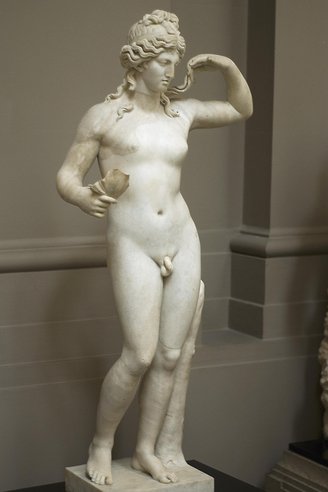
Okay, okay. A very few species exist as hermaphrodites, having both male and female gametes, thus are able to fertilize themselves. For true hermaphrodites in humans, you have to turn to mythology, as here: the god Hermaphroditus was the son/daughter of Hermes and Aphrodite, hence the name. (Unknown photographer, public domain. Via Wikimedia.)
What could be clearer?
Your sex is defined by your gamete type — sperm or egg — which puts
you in either the mom or dad role. Which has absolutely nothing to do
with how you think of yourself. Straight? Gay? Trans? Bi?
Intersexual? Asexual? Born with ambiguous genitalia and you’re not
sure how you want to self-describe? That’s something completely
different. You might have male gametes but you feel you’re female,
you dress as a female, you call yourself a woman: then, as far as
society is concerned, you are a woman. You may even have an
operation to create a vagina where formerly there was a penis and
testicles, and you may make love as a woman. But — big but — you’re
never going to be able to give birth as a woman. Your gametes define
your role in reproduction, and nothing you can say or do will change
that.
Having said that, whatever social role you choose to adopt should obviously (obvious to me, at any rate) be respected; it certainly shouldn’t be subject to the politics of the day. Which is why I find the current rash of anti-transgender laws so abhorrent. Currently 28 states are considering anti-trans bills outlawing gender-affirming health care to young people. Three states, Tennessee, Mississippi and Arkansas, have already passed such laws, using the bogeyman of keeping a level playing field in sports as the reason, trans girls presumably having an unfair edge on non-trans girls.
(Which, by the way, is a huge can of worms for female athletes. World Athletics, the governing body for international track and field competitions, bars women with over five nanomoles of testosterone per liter of blood from competing as females in races between 400 meters and one mile. Which, IMHO, makes as much sense as barring any players over six feet in height from the NBA. The February 2021 issue of Scientific American has the story.)
These bills all refer to the sex the kid was assigned at birth — which is sometimes a gray area, i.e. the intersex situation. Not all infants who will later produce sperm have obvious penises, and vice versa. According to this, “The most thorough existing research finds intersex people to constitute an estimated 1.7% of the population.” That is, up to 1 in 60 kids are in that ill-defined area. It’s not just ambiguous genitalia that make for intersex babies, but a bunch of other defining characteristics, including sex chromosome composition, gonadal structure, hormone levels, and the structure of the internal genital duct systems.
Bottom line: your ability to make either eggs or sperm defines your biological sex, for which humans have just two options. Everything else — ambiguous genitalia, the sense you’re in the wrong body, all the rest — define your gender, with all its many variations. We shouldn’t conflate the two, and please keep politics out of it!
LETTER FROM ISTANBUL: The Forbidden City
James Tressler / Sunday, April 18, 2021 @ 7 a.m. / Letter From Istanbul
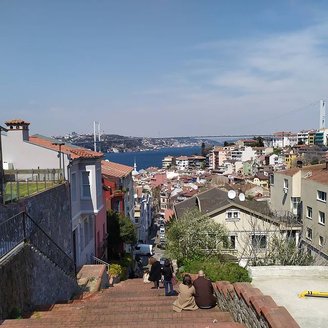
Photo: James Tressler.
The
holy month began. David woke up early and headed out. He was curious
to see what the streets would look like, with the reports that a full
lockdown would be in place in hopes of curbing a recent spike in
Covid cases. His wife and son had left for her parents’ house on
the south coast a few days before since travel was also restricted
during the holy month, so he was all alone in the city.
He walked the long coastal road to the neighborhood of Kuzguncuk. It was a bright, clear morning. A few people were out walking, but there was very little traffic. The air felt warm and pleasant, a sign that spring was perhaps finally on the way. He walked unhurriedly, reminding himself that he was on break from the university – a whole week – and there was nothing that needed to be done except relax, and maybe even get some writing done.
In Kuzguncuk, the sidewalks were deserted, and most of the places closed except for delivery, as reported in the news and social media. He went to one of the few coffee shops that was open, ordered a large take away Americano, and sat at a bench that had a good view of the street. All of the trees along the street were still bare from winter, and you could see clear down to the waterline, where the Bosphorus was calm and also quiet, except for a few ferries making their usual rounds.
He was 35, slenderly built, and still dressed for winter out of habit. After months of winter and lockdowns, he was very pale, as were most people. He’d shaved that morning for the first time in several days, and he was well-rested, not having had to get up to teach or help around the house for a change.
It felt strange being alone, all alone in the city, the first time he had been on his own in what seemed like years. He was determined to write something, anything. His thoughts arranged themselves in neat rows, each idea itemized, assessed and ready to be explored.
David picked up his notebook and scanned the empty page. So, he surmised, we have an American living in Istanbul, his wife and child are out of town for a few weeks. Well, what kind of trouble can we get him into? A noir thriller sprang to mind. He had always wanted to write a proper thriller, especially one set in his adopted city. The problem was finding a fresh approach. He didn’t want to write chase scenes in the Grand Bazaar, with the protagonist eluding the bad guys by knocking over fruit stalls in the crowded markets. He rather liked the idea of a femme fatale, but where does one encounter such a woman during the holy month of Ramazan? He looked up and scanned the street. The only women out were the usual mixture of fashionable housewives and young university students, also enjoying the term break. She could be a Russian tourist, bound for the shores of Antalya, he mused, but then he’d read in the news that Russian tourist flights had been suspended as part of the precautions during Ramazan, so there went that idea.
What else happened in thrillers? There was always the misplaced package, the one containing secret plans, a MacGuffin. Perhaps the plot could involve the American picking up the wrong package that his wife had sent, setting in motion a story of espionage and mistaken identity. But he crossed out that idea after reflecting that, in this day and age, what villain would send secret plans in the post? Wouldn’t he or she just email them? He laughed as he imagined a technophobic mastermind, or the plight of spies being unable to travel during the lockdown, or even coming down with Covid while on their nefarious mission.
“I could call it, ‘The Spy Who Came Down With A Cold,” he said to himself, chuckling.
After a while he put down the notebook. Where was all this noir-ish stuff coming from, he wondered. Too much damned Netflix probably. The night before, he’d watched a documentary on the Night Stalker while nursing a six pack of Tuborg. Serial killers, they always sell. A serial killer stalks the streets of Istanbul during the holy month. The media dubs him, The Sahoor Slaughterer because he shows up in the middle of the night, as the people woke for their pre-dawn meal before starting their fast. Or perhaps he attacks in the evenings during iftar. The Iftar Assassin. Jeez, he thought, dismissing the idea. Not only would the story offend Muslims, it offended him as a storyteller. Either lay off the beer or lay off Netflix.
###
He stared again down the long, quiet street, drinking the coffee. He thought about his wife Lara. She’d called earlier that morning and said the sea on the south coast was not yet warm enough for swimming. Instead she was planning to take the boy Miles in the stroller for a long walk. The boy had adjusted to his new surroundings without any problems. David had spoken to the boy on video chat, and the boy had recognized him and laughed and said, “Da Da!” David smiled as he thought about the call, reflecting that, despite their occasional problems (especially the past year during lockdowns), he loved his wife and son dearly, and already missed them terribly.
With the writing not going anywhere, he now wished he’d gone with them, even though it would have been a pain to go all the way to the south coast only to have to return in a week to begin the next term. He thought about how they went to the south coast the first summer of their marriage, how each evening they walked along the quiet beach under the hot sun, leaning close together, both wearing swimsuits and sandals. Back then it seemed they were the only people in the world, and they found comfort and reassurance in being alone together, the beach deserted and silent except the hushed sounds of the sea. With the boy Miles now, they were never alone, and over the past year, they’d been stuck together every hour of the day in their small, cramped Istanbul apartment. They’d found themselves, to their dismay, growing tired of each other, arguing over small domestic things, over the child’s constant needs, and out of boredom. Oh, the boredom! (He would have said, “ennui,” but wasn’t that word a condition reserved exclusively for characters in Antonioni films, he thought wryly)
Come on, he rallied himself. You stayed behind in Istanbul because you needed a break. All couples do at some point. What was it that old UPI reporter friend of yours once said? “The secret of a successful marriage is to be a little deaf and dumb, and have frequent periods of long absence.” OK, so try to relax and enjoy the freedom you have now. Let Lara have some time with Miles and to be with herself. She always relaxed there. It will be good for her too.
He finished the coffee, paid, sprayed his hands with the lotion, donned his mask and walked up the street. He turned on a side street that led to a steep hill. At the top of the hill was a long, wide staircase that led up to a park. The stairs were similar to the Spanish steps in Rome – he and Lara had gone there the first year of their relationship, a young lovers’ trip. It took several minutes to climb the hill to the steps, and he had to take off his mask to gulp down air and rest a few times. All this sitting at home during the winter had left him a bit out of shape.
Reaching the steps, he stopped and looked around. The neighborhood already looked tiny and far away. On the steps, a young couple sat gazing out at the bright blue sky, the Martyrs’ Bridge in the distance, and the rooftops of all the houses and buildings. A trio of young girls took selfies, one of them stretching out languidly at the top of the steps, posing with black shades and smiling radiantly. Feeling conspicuously older, David walked passed them and continued on up the hill. He turned and looked back, taking in the view of the city, looking across the Bosphorous at the minarets of the famous mosque in Ortakoy over on the European side. The bridge was very busy, with cars speeding along in both directions, and he was high enough now that the bridge was level with his gaze.
The road here was old brick, the bricks faded and broken up here and there by tufts of grass and weeds. Further up there was the entrance to the park that, if he walked through it, would eventually take him back to the neighborhood. He knew that because he and Lara had made the hike a few times together. But he didn’t feel like going back to the apartment. So instead he meandered onto a nearby street, stopping to look at the houses. They were built into the side of the hill, almost like hobbit houses, and he noticed also that part of the ancient city walls, a crumbling section of it, peeked out from beneath shades of undergrowth, the stones jumbled and clinging to life against the side of the hill. He reflected on the irony that once the walls had protected the hills, but now the hills protected the walls.
He snapped a view and sent it to his wife on What’sApp. “Are you in Kuzguncuk?” she asked a few seconds later. “Nice.” Then she sent a photo of Miles, who was playing in the sand. Looking at the photo, David felt a slight pang, missing them all over again. “Remember to buy the cat some dry food,” his wife texted a minute later. He could tell from her messages that she was enjoying herself, being at the beach with Miles, so he resumed his survey of the neighborhood, of the ash-blonde sunlit air.
###
For a while, David regarded the old houses, peered into their enclosed yards and overgrown gardens, some littered with the bric a brac of accumulated years, and wondered about the people who lived there – old residents, retirees most likely. They, and their homes, had dwelled there for so many years, the great city growing and expanding all around them. Here it had remained secluded, almost overlooked, forgotten, like some forbidden city. Probably at some point the developers would get around to it, grab up the properties, demolish the houses to make way for overpriced new high rises, the kind that sprung up in abundance all over the Asian side in the past decade. He remembered it happening in Goztepe, seeing a whole swath of that neighborhood bulldozed, wholly leveled (except for a single mosque) and that area was now home to a superplex of office buildings, apartments and even a new urban university campus.
It happened all the time. The city was forever being conquered, leveled and redefined, only nowadays the conquerors were not Byzantian or Ottoman, but the developers, eager to cash in on the city’s ever-growing population and housing demands.
David knew that those things were an inevitable part of living in a 21st Century city, especially here at the gate way to Asia. The old was constantly giving way to the new, that he was witnessing the rebirth of the Silk Road; new dynasties were on the way. Much had been written about that. And he knew that Istanbul had always been an ambitious city, proud of its imperial past, and those ambitions and pride were part of what had drawn him there. Avarice, greed, opportunism in all its forms too were part of its history as much as adaptation, transformation and rebirth were. All these elements he too could understand and want to be a part of. The city’s identity, like his own, one of turmoil, of flux, of transmigration, the future always encroaching on the past, the present shimmering, indistinct, like the ripples on the surface of the strait far below.
###
David walked back down the hill, back down the steps, his knees buckling a little with the reverse steepness. It was nearly noon. Back in the neighborhood, more people were out and a few more places had opened their doors after all. Most only offered take away. People were out and the café employees were standing in their doorways looking up and down the street.
He overheard some Americans (judging from their accents) asking at a coffee shop if they could sit at one of the tables. The patron, a young woman, apologized through her mask, so they just silently walked on down the sidewalk.
He bought another coffee and sat at a nearby bench.
His meditations were interrupted by a middle-aged man and woman. They were part of the group of Americans he’d seen outside the coffee shop a few minutes earlier.
“Excuse me,” the man said. “Do you know if we can catch the ferry here?”
“There’s a station over there,” I said, pointing. “You can check the schedule and see.”
“Thank you,” he said. He had a Turkish accent. The woman was American, and David supposed they were a couple. “So are you American? Where are you from?”
“California,” David said.
“California?” the woman asked, joining the conversation. “Which part?”
“Eureka.”
“Eureka?” The woman took off her sunglasses and seemed to concentrate. “Eureka … let’s see. Is that where Michael Jackson used to live? I seem to recall something –”
“No,” David answered, smiling. “Michael Jackson did not live in Eureka.”
“Isn’t it near LA?”
“No, Eureka isn’t anywhere near L.A. It’s up north.”
“Oh, Eureka! Right, you’re up near the redwoods. Beautiful country.”
“It is,” David said.
“Encino!” the woman cried, clapping her hands. “That was where Michael Jackson lived. I knew it started with an ‘E.’”
“So how long have you been in Istanbul?” the man asked, interrupting.
“Ten years.”
“Ten years!” he exclaimed. “Why so long?”
David smiled again. “I married it.”
“Oh, your wife is Turkish.”
“Yes, and my son.”
“I see. Well, thanks for helping us.”
David nodded. “I hope you find your ferry.”
The American woman smiled.
“Take care!” she said. “Sorry if we bothered you.”
“Don’t worry about it,” David said. “Kolay gelsen! Take it easy!”
###
He walked to the intersection, crossing at the light over to the waterfront. He sat at a bench beneath some trees and looked out at the Bosphorus. A couple of girls, university students on break, sat catching up gaily, but still wearing their masks. David felt much better, having made the walk up the hill, like he had arrived at something there, a new understanding. After a year of living in suspended animation, where every day had felt much like the same day over and over, something inside him had loosened up. He adjusted his eyes to the bright sunshine over the Bosphorus and thought about his wife and son, and the thought that things were finally changing, and for the better. He knew they would be back soon – the time would pass quickly – and when they returned they would continue on with their usual family routine, their life here in the city in a new decade that was finally beginning to feel like a new decade.
Yes, life would go on, and their love and their work, and the city would continue to grow up around them. Wasn’t it better that way, to have become a part of the city, to have settled down, and changed with it, rather than have just been a selfie-snapping tourist? Or a half-assed character in some spy novel? Wasn’t it better that the city itself change rather than be stuck in the past, entombed like some forbidden city? Wasn’t there a balance to be found somewhere, in cities as well as people and their relationships?
Yes, he was feeling much better. David sat back, enjoying the shade of the trees, the warm spring air, the ferry boats passing, and the birds fluttering in the sky. How long had it been since he had been outdoors this long?
He went back to looking at the sea, enjoying the feeling of change and beginnings that were happening all around.
###
James Tressler, a former Lost Coast resident, is a writer and teacher.
(AUDIO) HUMBOLDT HOLDING UP: Local Musician Lyndsey Battle Is Finding the Silver Lining of a Year Without Live Music
LoCO Staff / Sunday, April 18, 2021 @ 7 a.m. / Humboldt Holding Up

Lyndsey Battle and daughter, Vela bringing their twinning game
For local musician Lyndsey Battle — who you may also know as a radio DJ or square dance caller — the forced hiatus from performing has not only provided an opportunity for her to pursue her other creative interests, but also to learn to be OK with doing a little bit less.
“This sabbatical of sorts has really given me some time to examine how much I affiliate productivity and output with self-worth,” Battle told the Outpost. “I think I’ve gotten to a better place with that and feeling a little bit kinder to myself.”
On this week’s episode of LoCO‘s Zoom-quality podcast Humboldt Holding Up, Battle stops by to discuss how much music she has not been playing during the last year, how she’s feeling about getting back to performing in public and what other things she’s been pursuing during her year-long break from live music. Topics discussed with Battle include:
- What makes each of Humboldt’s live music venues great (we give her a list and make her tell us why people should go there)
- Why Battle does not dig performing over Zoom
- Her latest business venture in making her own mustard
- Square dancing!
- The passing of beloved local musician, recording engineer, composer and sound designer Tim Gray and Gray’s project “Footfall” — a soundscape meant to accompany a walk through Arcata’s Creamery District (you can check it out at this link)
As a bonus, Battle’s 12-year-old daughter, Vela also joins the podcast to talk about entering the sixth grade during the pandemic, what learning over Zoom has been like and how she’s coped with being isolated from her friends.
Listen to Battle’s chat with LoCO’s Andrew Goff and Stephanie McGeary by clicking the audio player above, or listen in in your podcast app. You can also scroll through past guests below.
PREVIOUS HUMBOLDT HOLDING UP GUESTS:
- Mad River Brewing CEO Linda Cooley
- LoCO Editor Hank Sims
- Humboldt Republic’s Jason Brandi
- Table Bluff Farmer Hannah Eisloeffel
- Logger Bar Owner Kate Martin
- Teacher/Rapper Zach “Zigzilla” Lehner
- Madaket Captain “Zippo” Libby Tonning
- Event Planner Alegria Sita
- Food For People’s Anne Holcomb
- AHHA President Nezzie Wade
- Performance Artist Noël August/Tucker Noir
- Eureka Mayor Susan Seaman
- Eagle House Owner Jennifer Metz
- Absynth Quartet Drummer Mike “Tofu” Schwartz
- HACHR Executive Director Lasara Firefox Allen
- Alchemy Distiller Owner Amy Bohner
- Eureka City Councilmember Kati Moulton
- Eureka City Councilmember Scott Bauer
- Ungraceful Ager Barry Evans
- Arcata City Councilmember Sofia Pereira
- HumBrews Music Booker Laurel Weston
- Eureka City Councilmember Kim Bergel
- Film Commission’s Cassandra Hesseltine and Nate Adams
- Marble Maker Topher Reynolds
- Arcata Playhouse Director Jacqueline Dandeneau
- Humboldt Political Junkie Eric Kirk
- Rio Dell Mayor Debra Garnes
- Second District Supervisor Estelle Fennell
- Arcata Food Aficionado Jada Calypso Brotman
- Body Piercer Jackie Silva
- Dick Taylor Chocolate’s Adam Dick
- FUHS Teachers Mark Thom and Inma Thompson
- Eureka City Manager Miles Slattery
- Savage Henry Co-Founder Chris Durant
- Eureka Street Art Festival Organizer Jenna Catsos
- SCRAP Humboldt Founder Tibora Bea
- Gym Owner Tyler Parr
- Six Rivers Brewery Co-Owner Meredith Maier
- Multicultural Skincare Therapist Levia Love
- Annie’s Cambodian Server and Social Worker Joshua Coppock
- Eureka City Councilmember Austin Allison
- HSU Professor Deidre Pike
- Pastor Bethany Cseh
- Singer/Songwriter Chris Parreira
- Eureka City Councilmember Leslie Castellano
- Arcata City Councilmember Paul Pitino
Eureka Planning Commission Chair Jeff Ragan Abruptly Resigns, Citing ‘Grave Concerns’ Over City’s Approval of Housing Projects on Three City-Owned Parking Lots
Stephanie McGeary / Saturday, April 17, 2021 @ 1:26 p.m. / Local Government
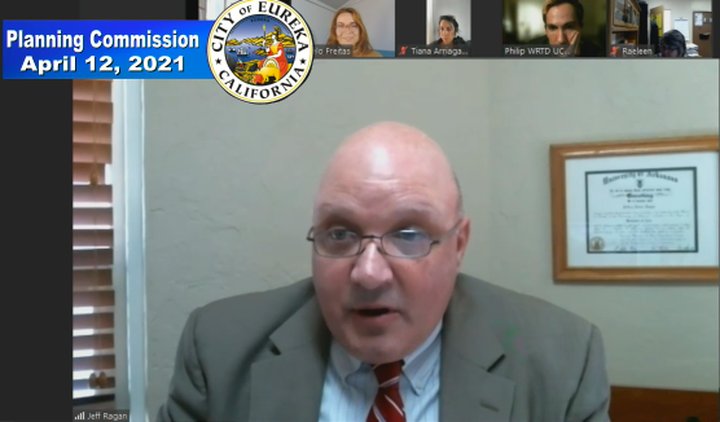
Jeff Ragan announces his resignation during Eureka Planning Commission meeting on Tuesday, Apr. 12 | Screenshot from Zoom meeting
Planning Commission Chair Jeff Ragan — who has served on the commission for 12 years — abruptly resigned during a meeting on Tuesday, citing “huge, grave” concerns over the City Council’s approval of three low-income housing developments to be built on city-owned parking lots.
A proposal for the three developments — one on 8th and G Streets one on 6th and M Streets and the other on Sunny and Myrtle Avenues — was approved by the council in Oct., 2020 and the city has entered into an agreement with developers Linc Housing. Although Ragan was initially in favor of these projects in concept, he said, he felt that the city did not hold a rigorous enough public process before approving them.
“After an RFP [request for proposals] was issued last July and three proposals were reviewed by an in-house group last fall, city council on October 20 — after a 1 hour 18 minute discussion, over zoom, during a pandemic, during a contentious presidential election — decided to commit to the project,” Ragan said just a few minutes into Tuesday’s virtual meeting. “…Frankly I’m just appalled that the council and staff thinks this kind of decision making process is adequate.”
Ragan continued, reading from a prepared statement, to discuss how he felt that there were not enough meetings with the public or the entire city staff to discuss the proposed details of this project. He also said that, after talking to several city council members and city staff about his concerns, that they “affirmed there had been ongoing discussions about these projects for years,” a claim that Ragan felt was “dishonest” and “fraudulent.”
He then went on to say what a pleasure it has been to work with the Planning Commission and other city staff for the past 12 years and how much he has enjoyed working with the private citizens of Eureka — especially those who had the courage to speak up at public meetings.
“I can’t in good conscience participate in a government that claims to represent those people and then sidelines them with minimized processes and minimal efforts and public outreach,” Ragan added. “…So with gratitude and gratefulness for the good work we’ve accomplished before, and with grave concern and disappointment for the project and processes before us now, I resign from the City of Eureka’s Planning Commission, effective immediately.”
Ragan then apologized for unexpectedly passing the gavel to the commission’s vice-chair Tiana Arriaga, who was clearly caught by surprise. “Well, that was a dramatic turn of events that I don’t think any of us were expecting,” Arriaga said, immediately following Ragan’s exit from the meeting.
Delo Freitas — who had just been sworn in as a member of the commission at the beginning of the meeting — added that she remembers working with Ragan when she had worked for the City of Eureka previously, and that she “appreciated his style” and how much he tried to engage the public and make them feel comfortable. However, Freitas did not share Ragan’s concerns.
“That being said, I also really appreciate how staff has seen through the housing projects that he expressed concerns about,” Freitas said during the meeting. “I think that everything they’ve done has been by the books and very transparent and I appreciate the effort they’ve put into this.”
In a follow-up interview with the Outpost on Friday, Ragan explained in further detail some of his issues with the three housing projects, saying that, although he is in favor of low-income housing, he feels that a large-scale projects like these require a great deal of scrutiny to make sure that they’re done right.
“While there’s a tremendous potential for good, there is a tremendous potential for bad,” Ragan told the Outpost. “If they’re designed wrong they’re going to be a magnet for crime and poverty and junk and all kinds of stuff.”
Ragan added that in the last several months he has received calls and emails from community members who were concerned about the magnitude of this project and that he feels that many people in the city are not even aware of these projects at all. When asked what he felt the city could have done to involve the public more in the process, Ragan said that there could have been public workshops — similar to the workshops held prior to the city’s adoption of its General Plan Update. He also felt that there could have been a committee assembled, consisting of various different city staff and experts, to review the submitted project proposals. Ragan said he shared these suggestions with Eureka City Manager Miles Slattery, who was “dismissive” of his ideas.
When asked why he felt these housing developments should be subject to that level of review — something that is not usual for any housing project in the city — Ragan said that because these developments are on city-owned sites, he feels that the process should have been more rigorous.
“Most housing projects are built by private owners on private land,” Ragan said. “They’ve got the right to build what they want. These projects are built on city land. Those parking lots are owned by the citizens of Eureka and there should not be a small cabal of officials that just decide on their own what the rest of us are going to have built on our parking lots.”
Reached by the Outpost, City Manager Slattery said that these projects went through all of the usual processes required to approve housing developments, including going through the Planning Commission. “It went to the Planning Commission for the change in zoning regulations,” Slattery told the Outpost. “[Ragan] approved that. He signed off on that.”
Slattery added that he felt that the city had been “exhaustive as far as the public process for this project” and that the developers Linc Housing had held several public meetings — notifications of which were sent to every resident within a three-mile 300 foot radius — and had even altered its building designs based on the feedback from those meetings.
As far as whether these projects should have been subject to a more scrupulous process because they will be built on city-owned land, Slattery said that the City has built housing on city-owned property several times — including on a site on Myrtle between 6th and 7th Streets.
However, Slattery said that these will be the first low-income housing projects to be built on city property. But they won’t be the last. The city has been working to develop more low-income housing to meet state requirements and has established that building on city-owned properties will be absolutely necessary to meet those requirements. In fact, these sites are three of of 12 city-owned parking lots that the City plans to turn into housing.
“Not only is this [housing] a state requirement, but all of these people we are housing — they will be a part of the fabric of our community,” Slattery said. “It’s unfortunate because [Jeff] was a valued member of our planning commission. I really appreciate Jeff and everything he’s done. It’s unfortunate that this is the hill he chose to die on.”
When asked if his issue with the city’s approach to these housing developments was really the only reason he resigned after 12 years on the Planning Commission, Ragan said “absolutely,” reiterating that his issue is not with the projects themselves, but with the City’s “horrible job of involving the public.” Ragan added that he plans to use some of his freed up time to continue voicing his concerns to the City.
“Now I have to have time to go through these plans and show up at city council meetings and tell them where I think they got it wrong,” Ragan said. “And it seems obvious to me that the City Council really, fundamentally doesn’t care what the Planning Commission thinks anyway. Had they, they would have run this [project] by us.”
You can view the video of Ragan’s dramatic exit from Tuesday’s Eureka Planning Commission meeting below.


